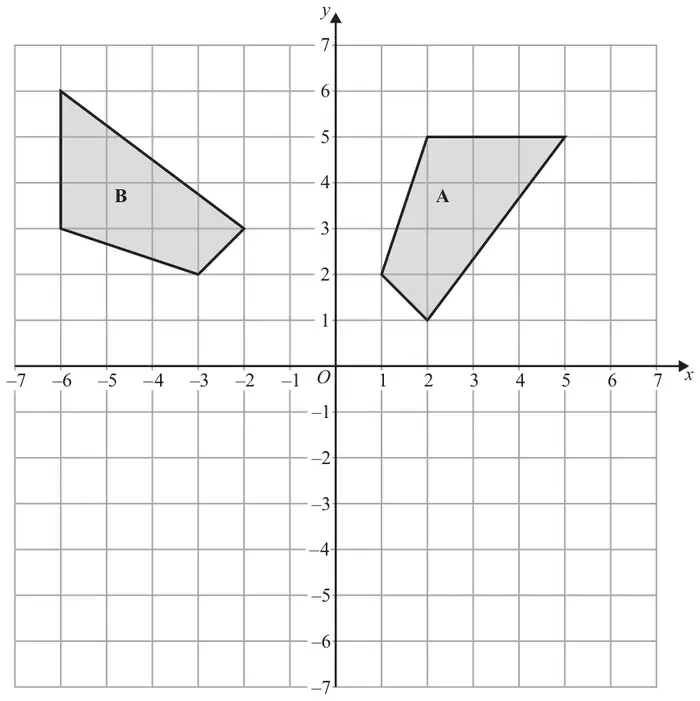
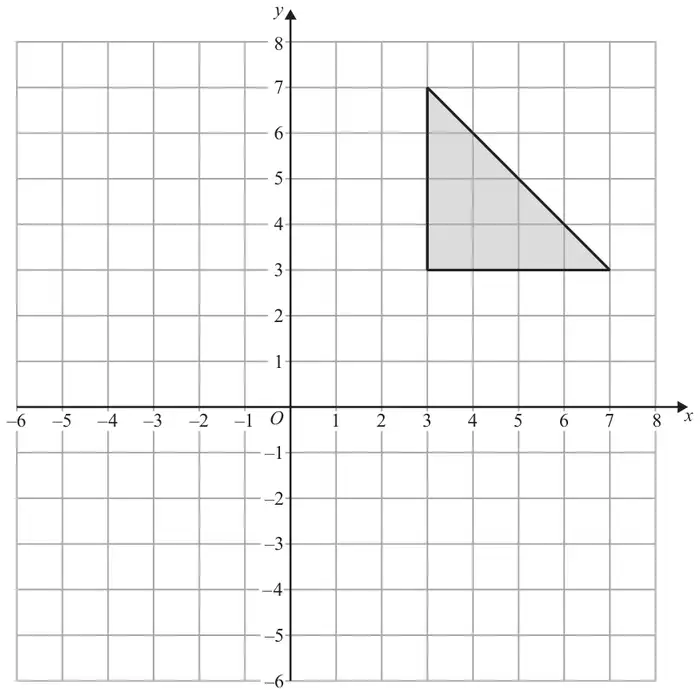
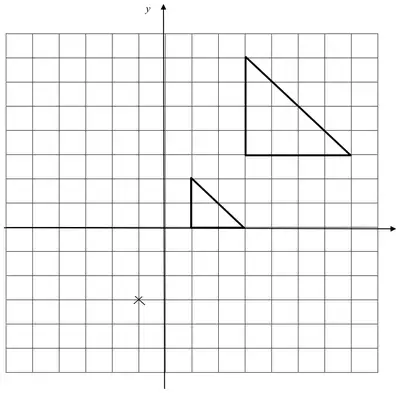
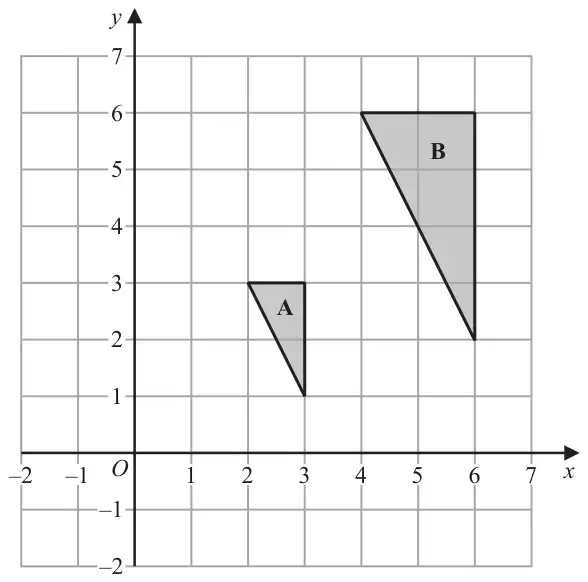
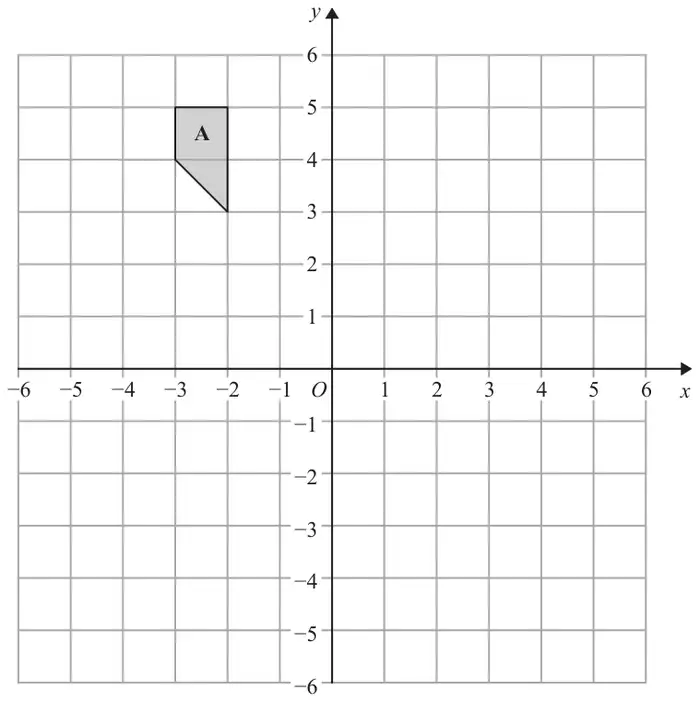
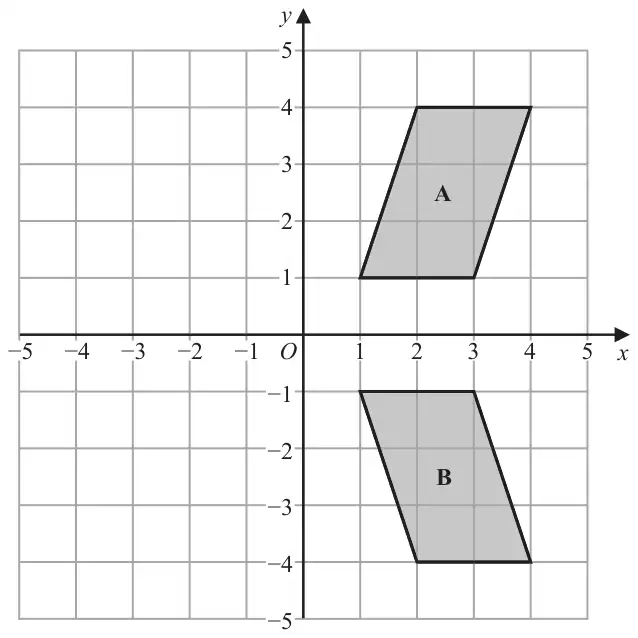
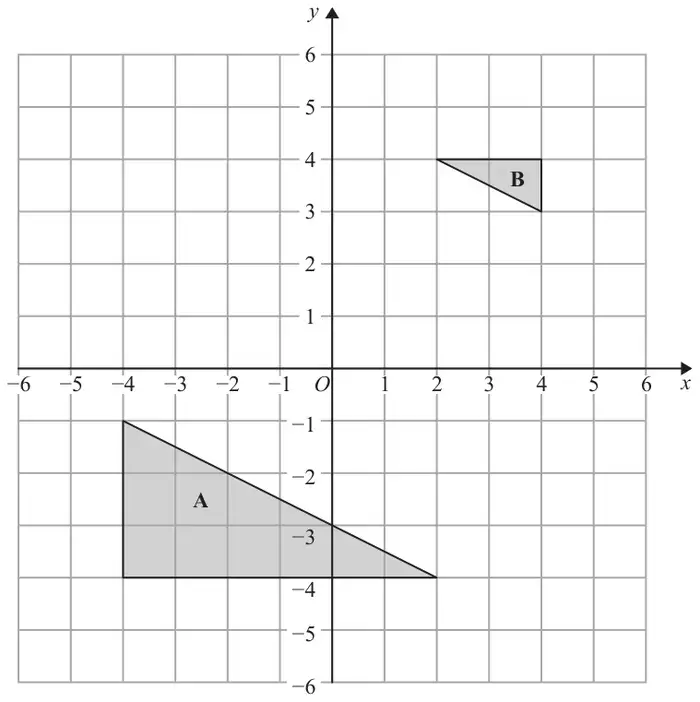
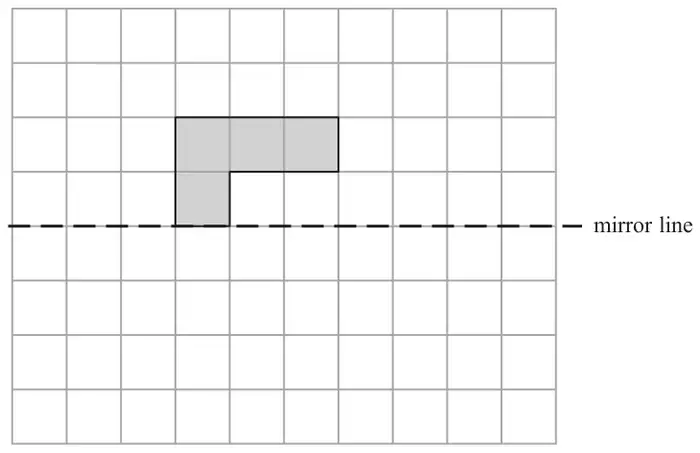
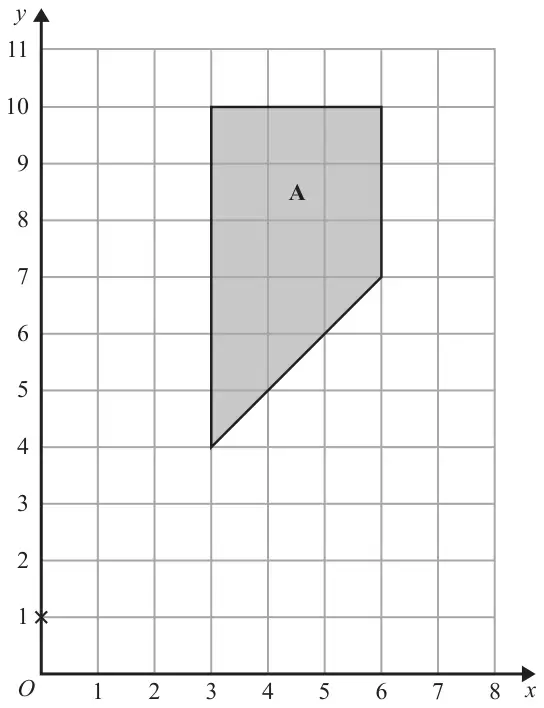
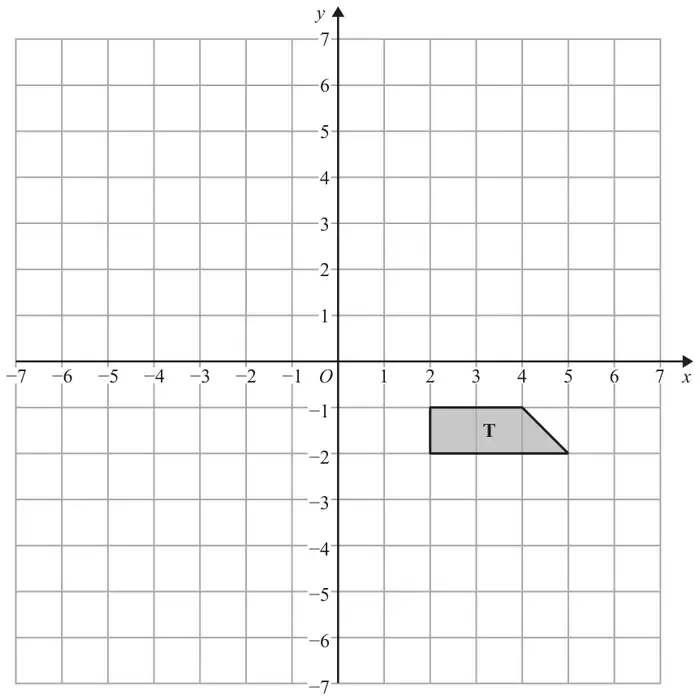
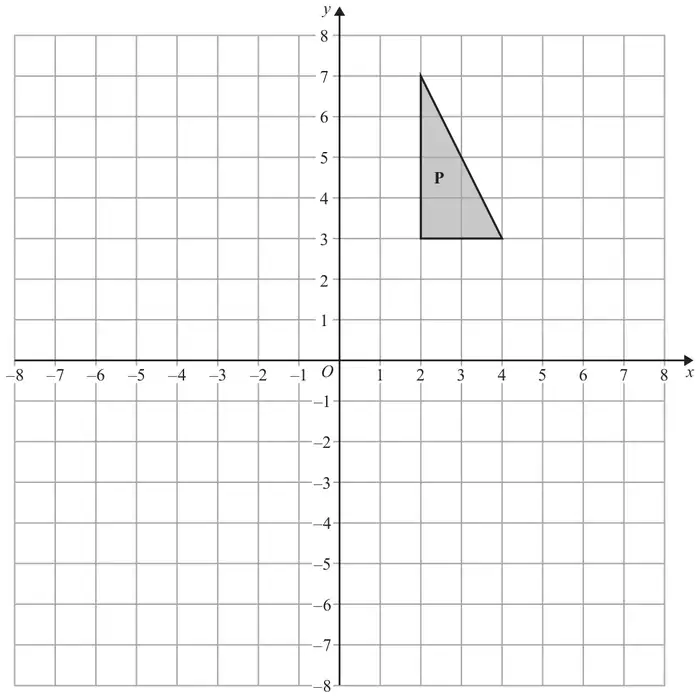
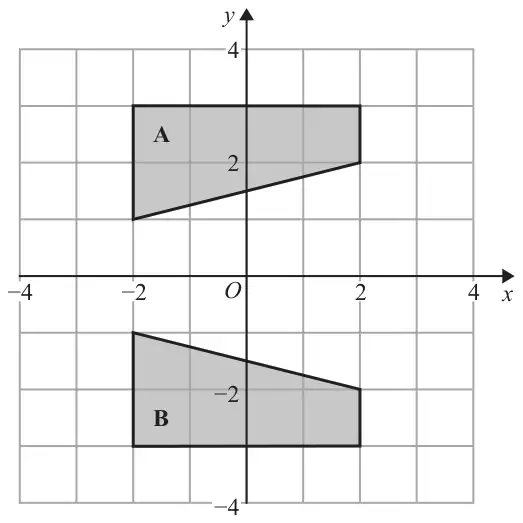
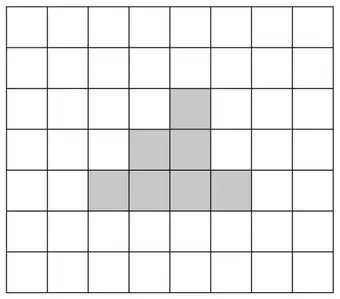
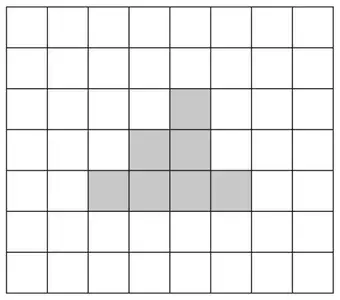
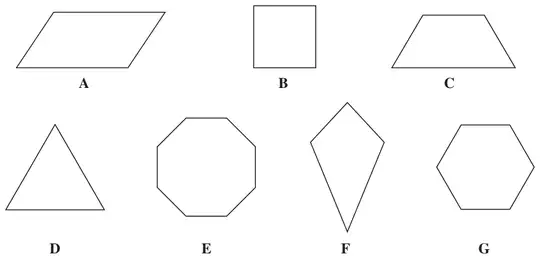
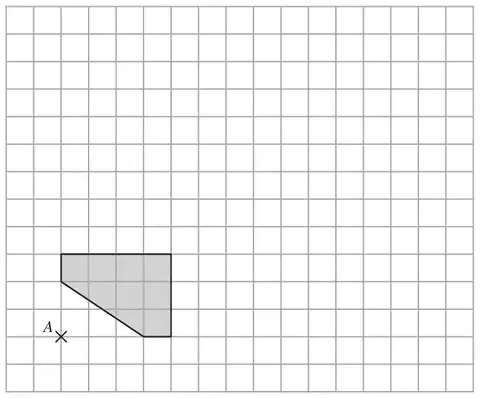
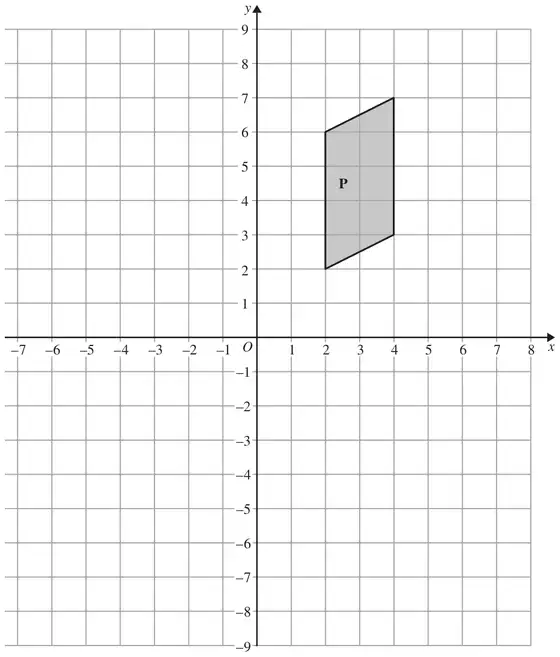
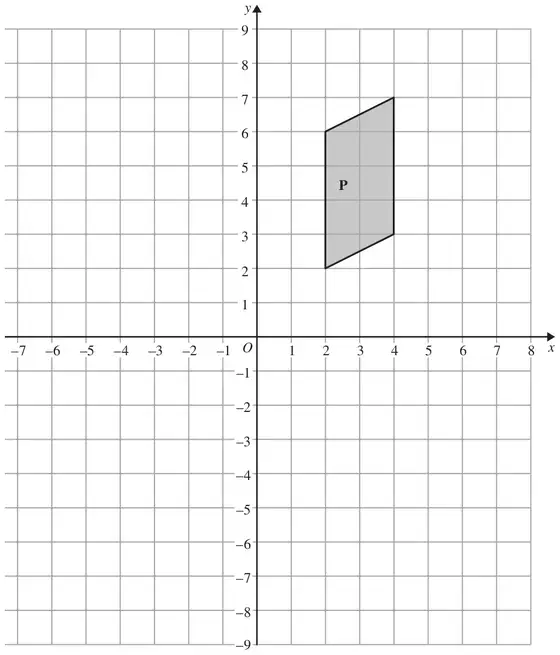
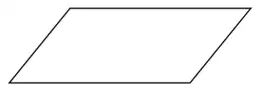
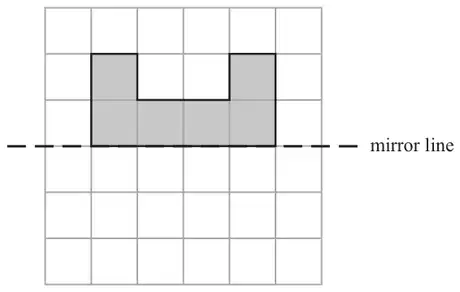
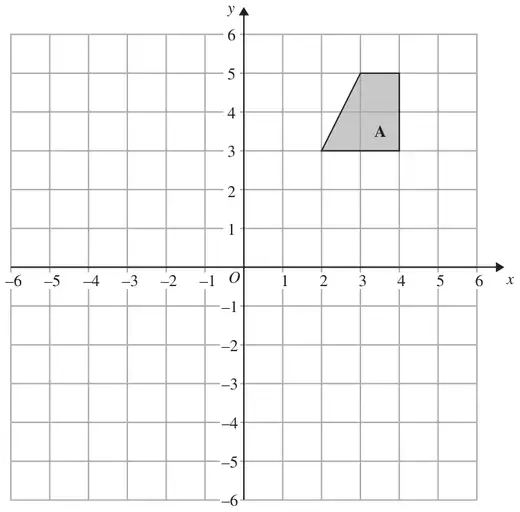
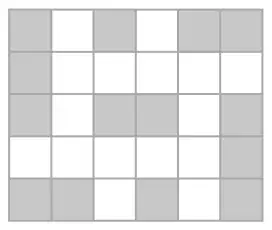
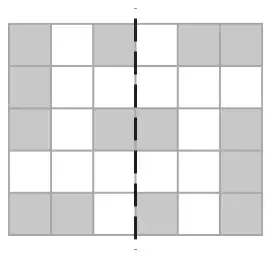
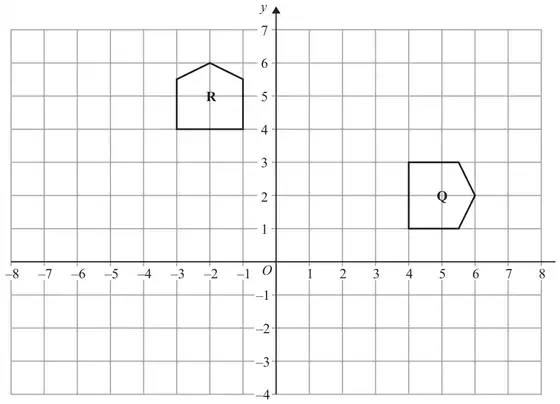
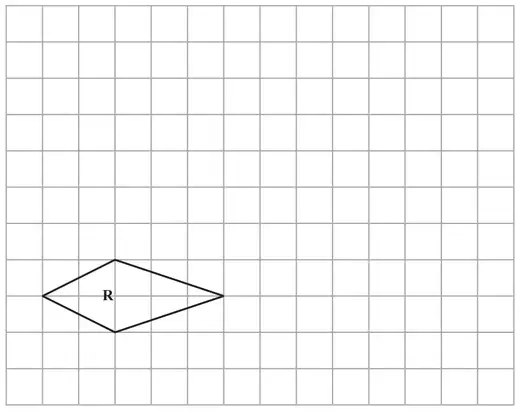
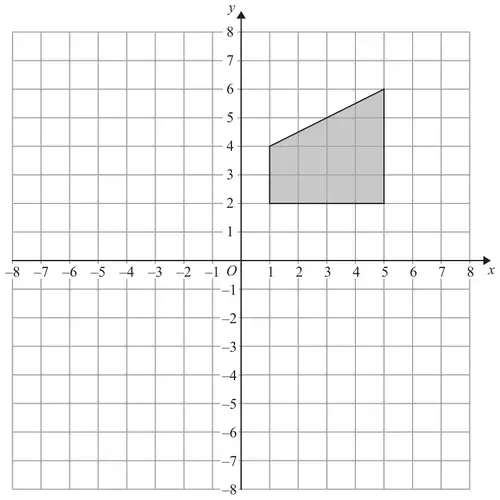
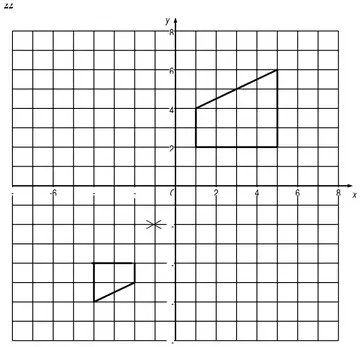
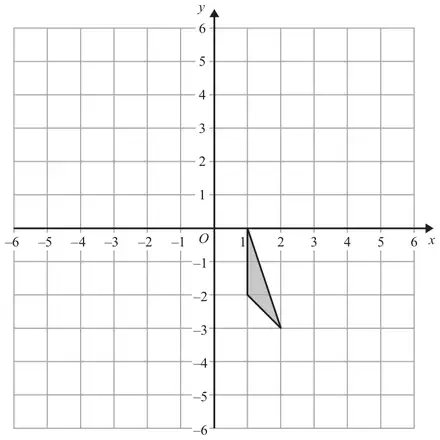
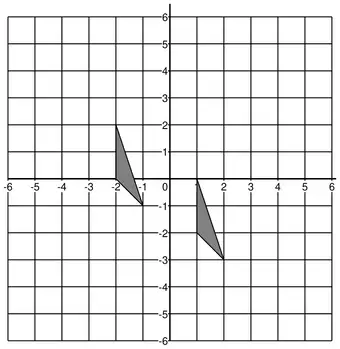
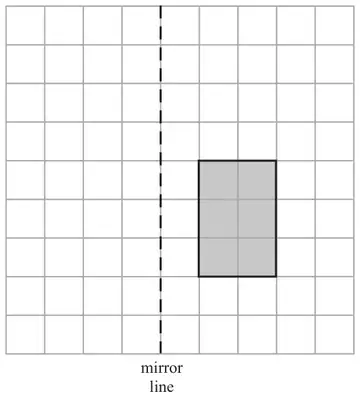
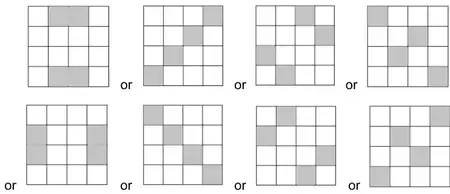
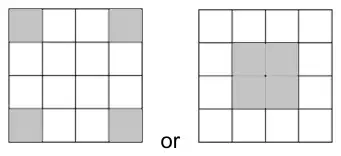
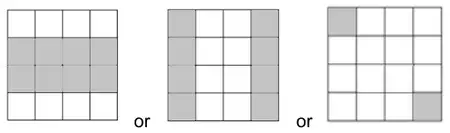
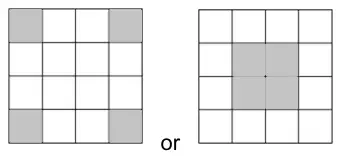
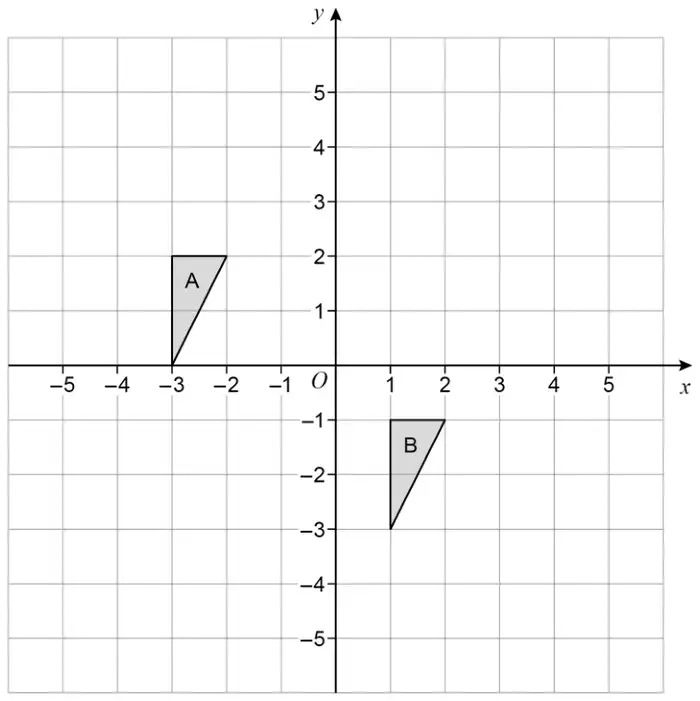
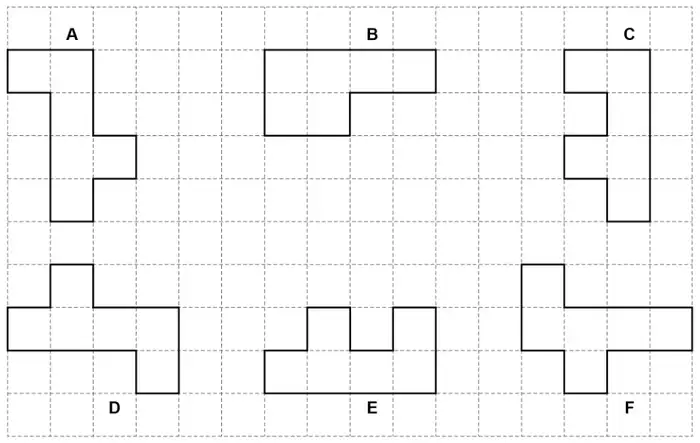
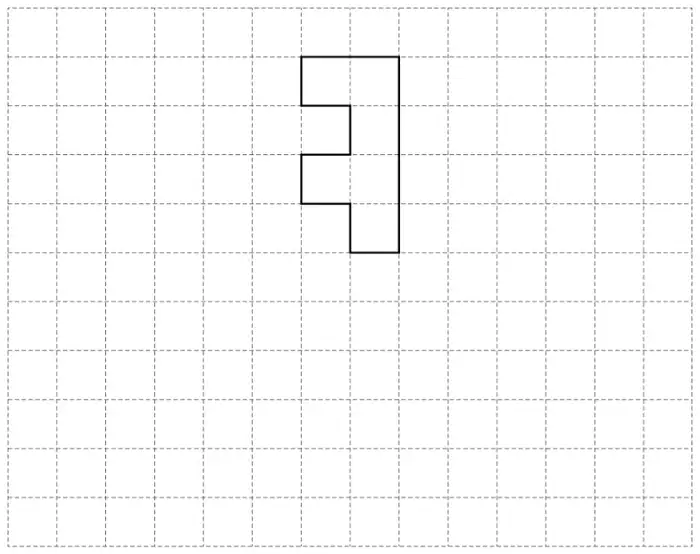
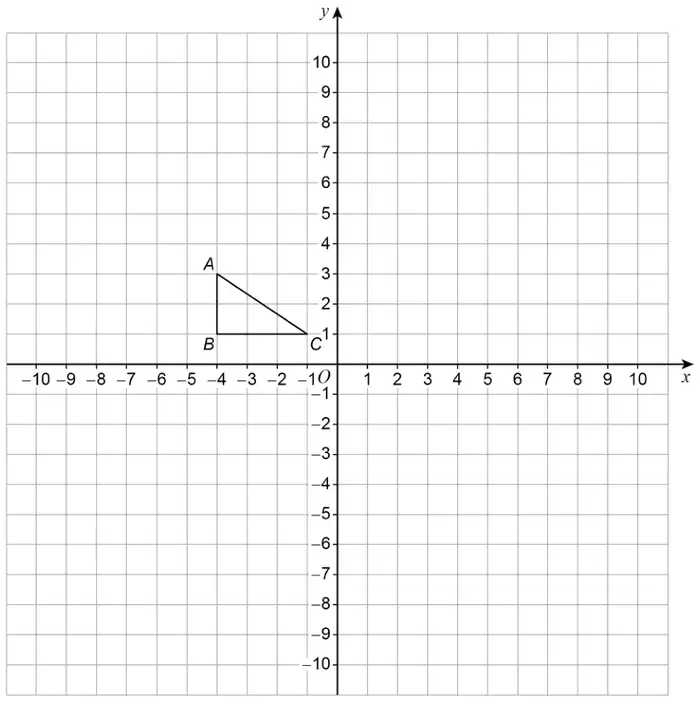
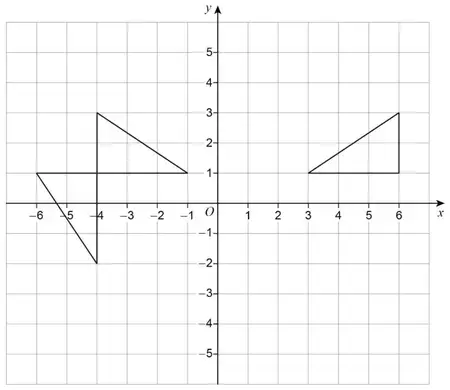
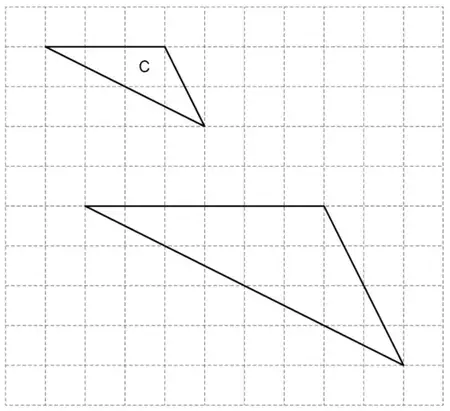
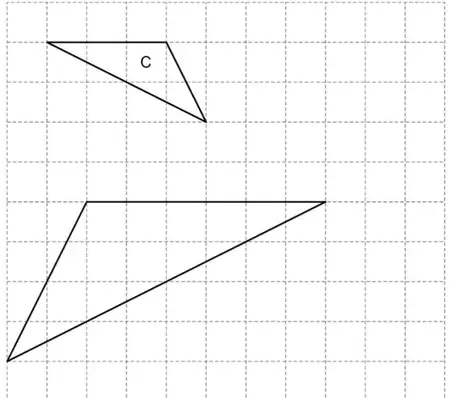
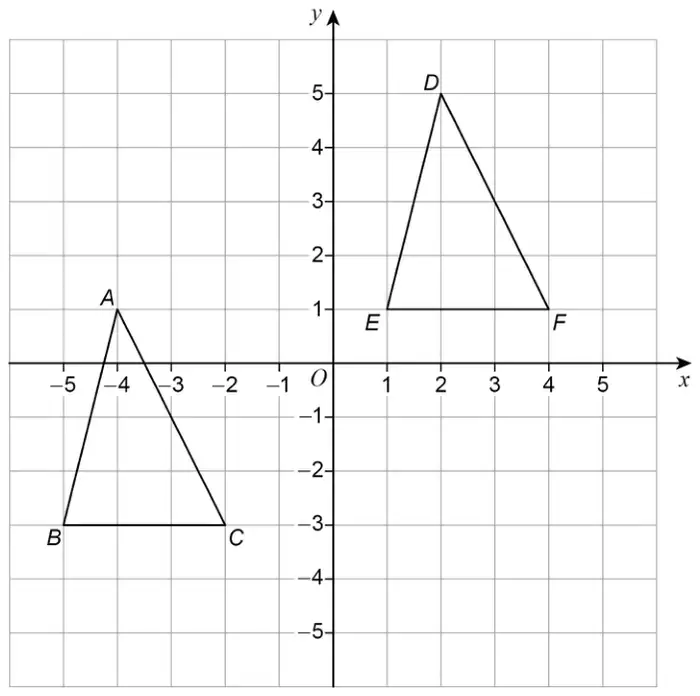
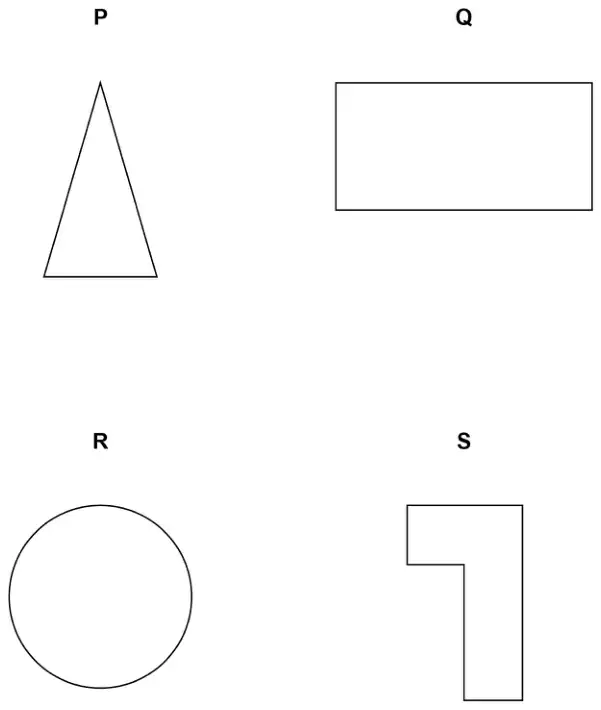
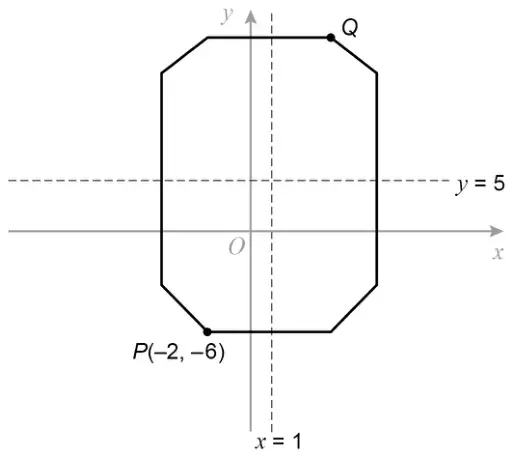
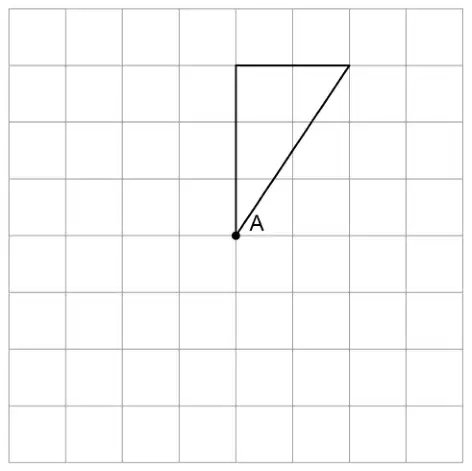
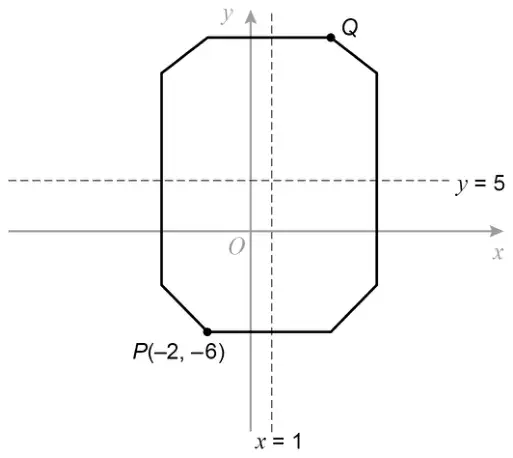
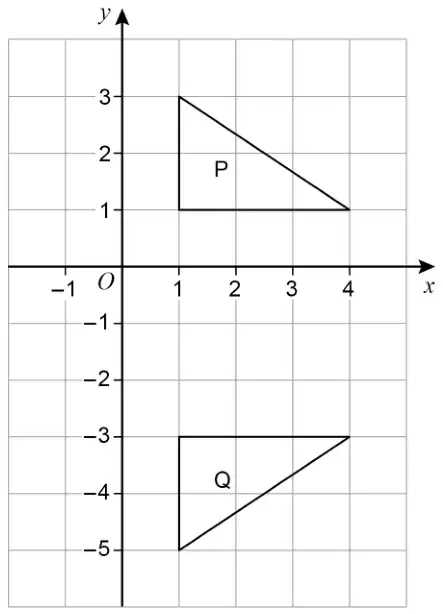
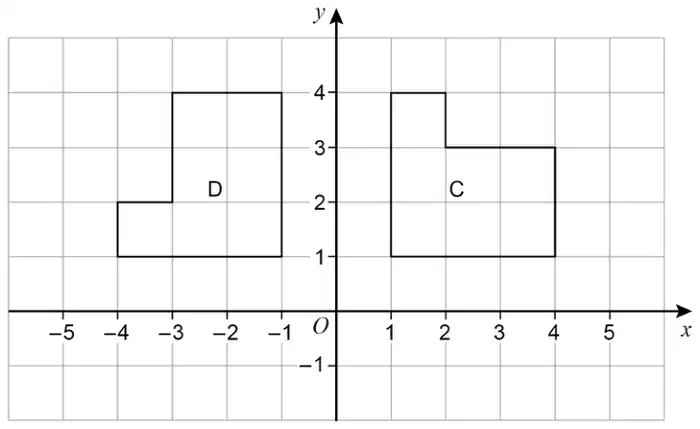
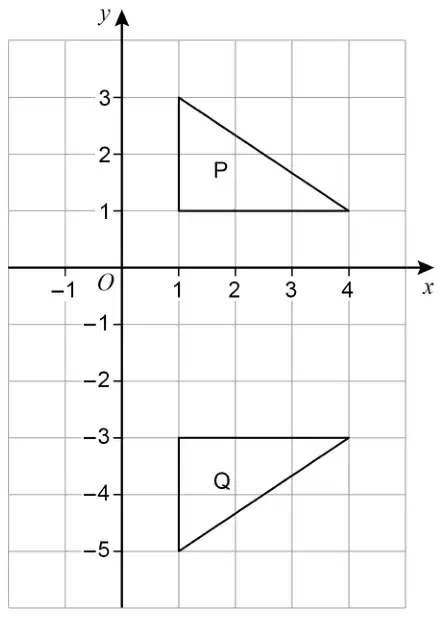
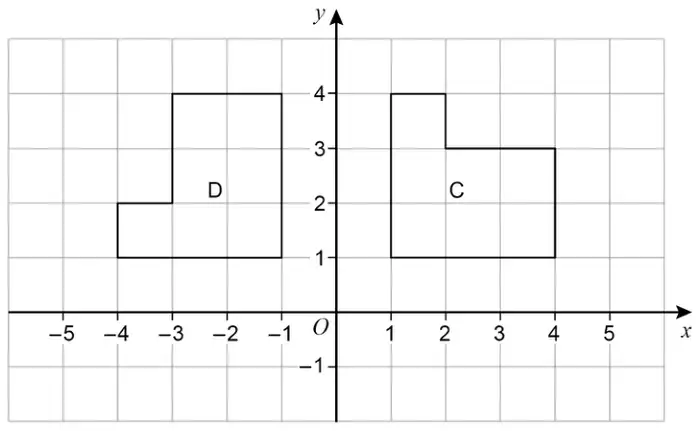
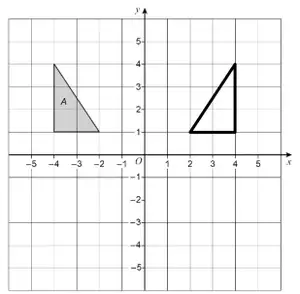
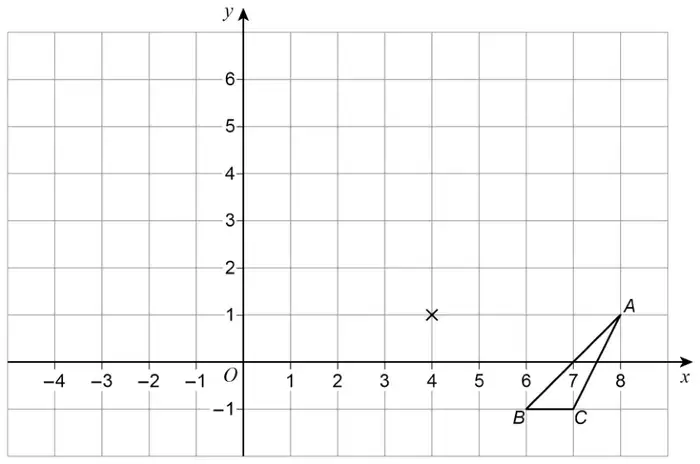
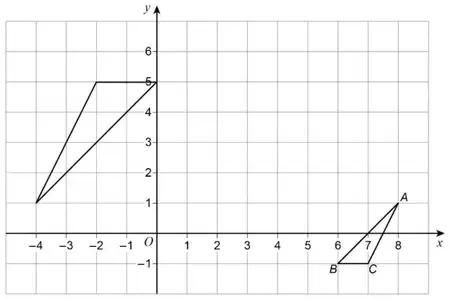
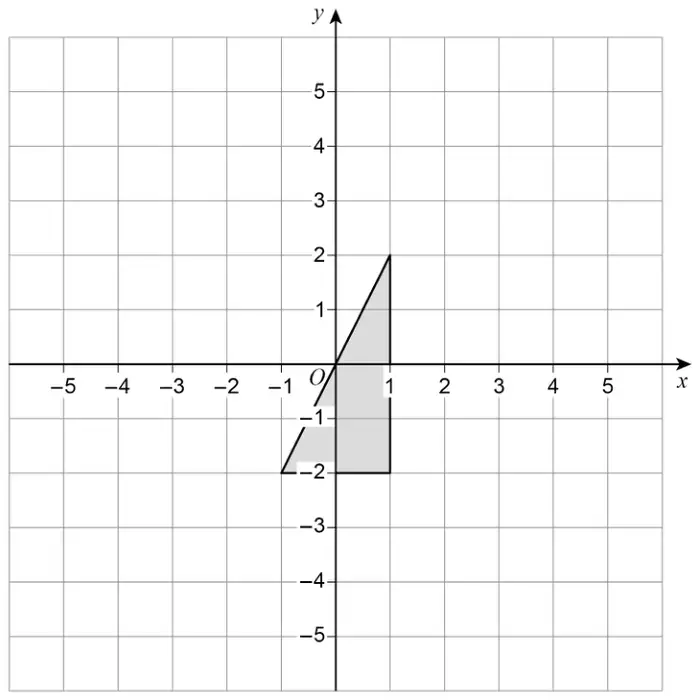
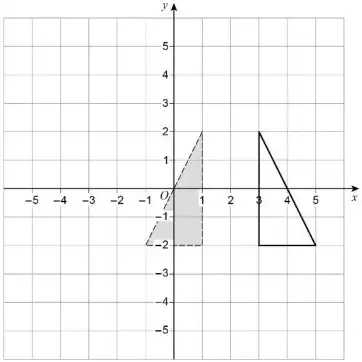
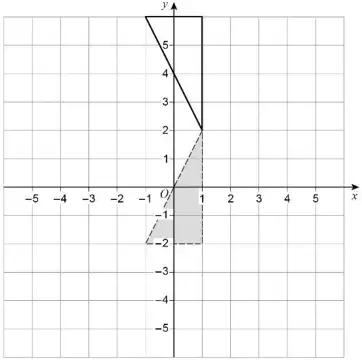
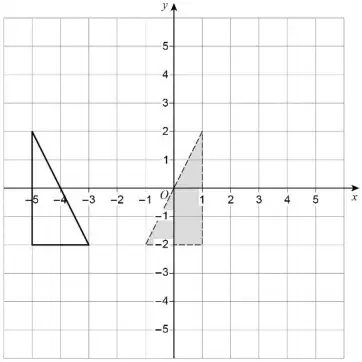
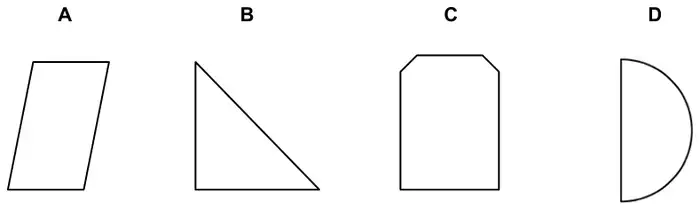
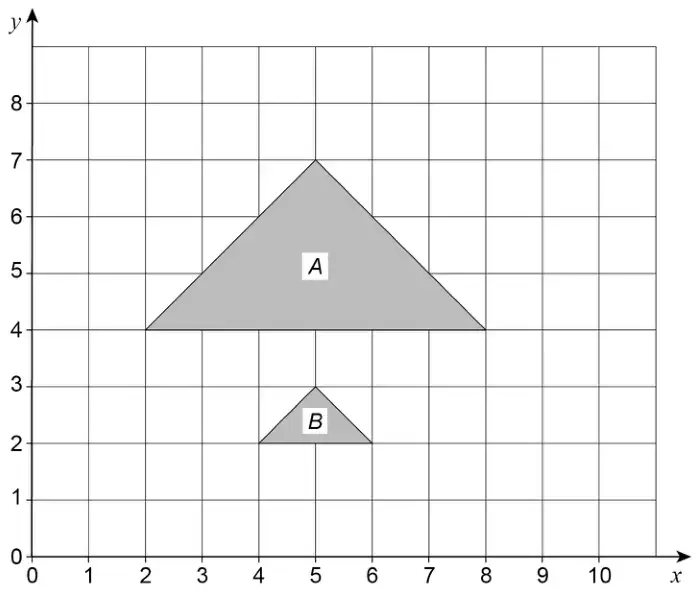
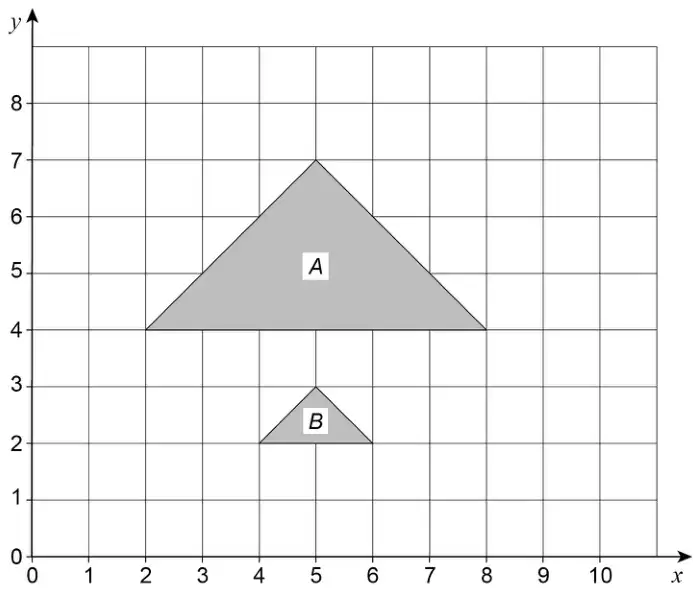
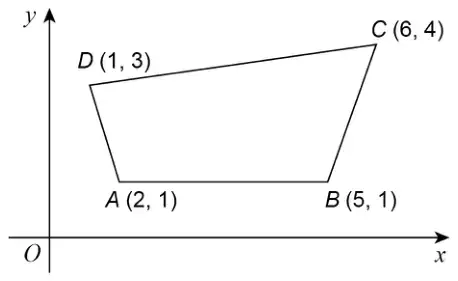
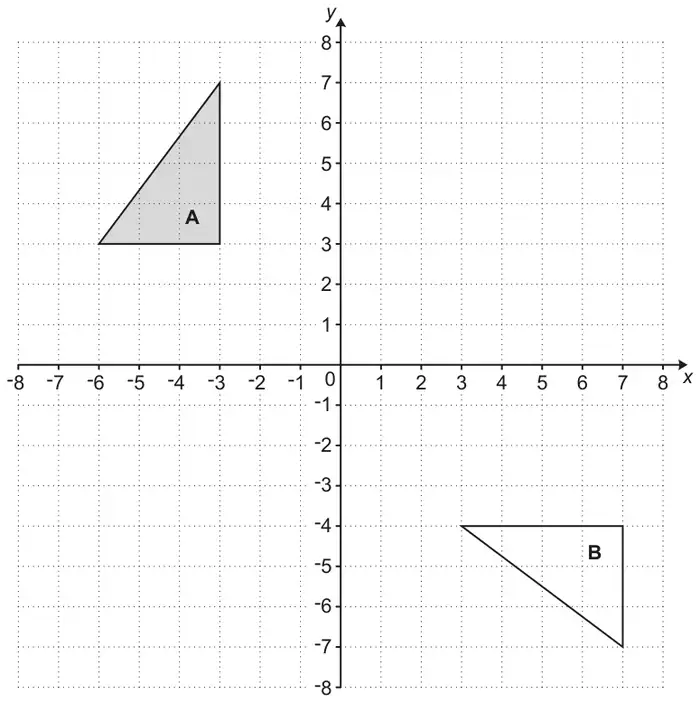
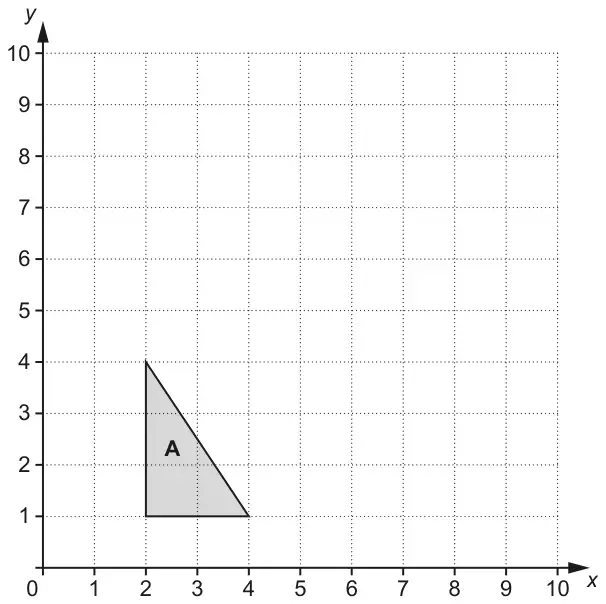
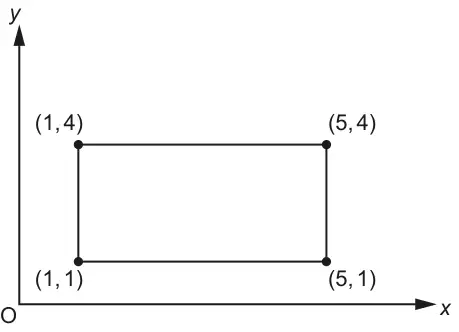
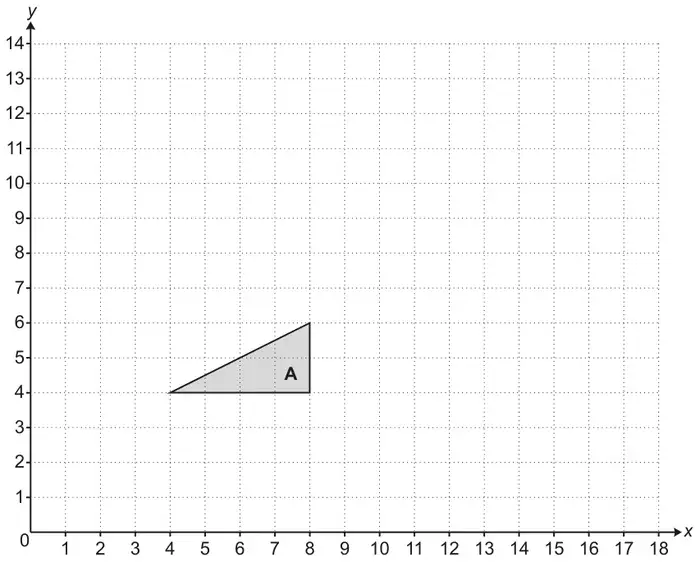
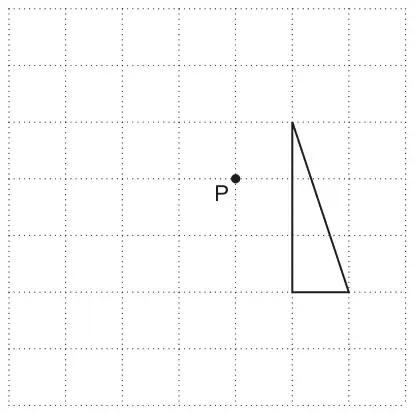
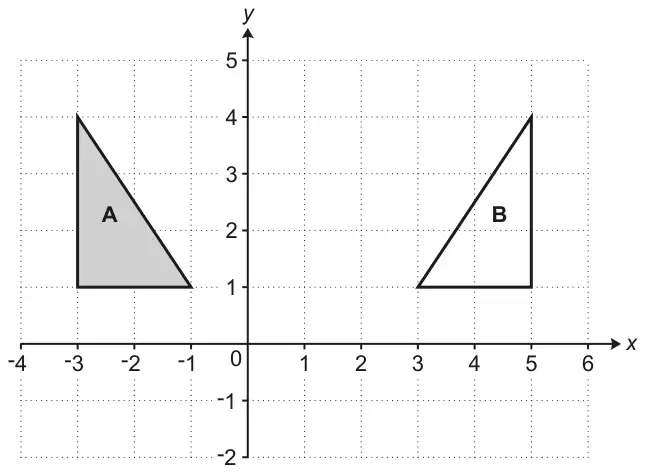
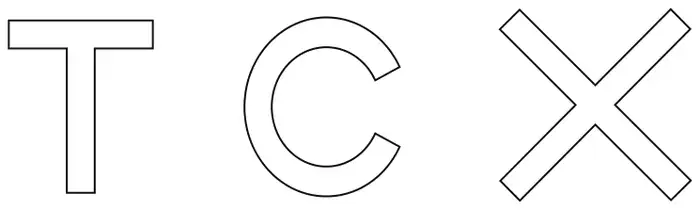
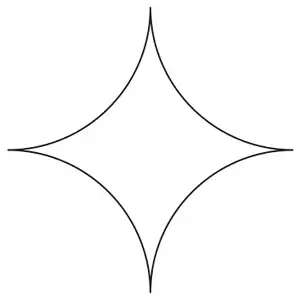
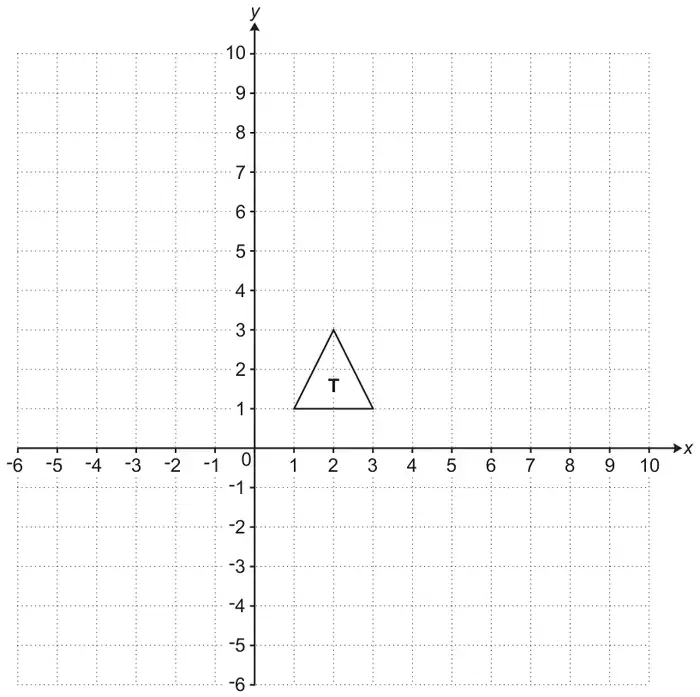
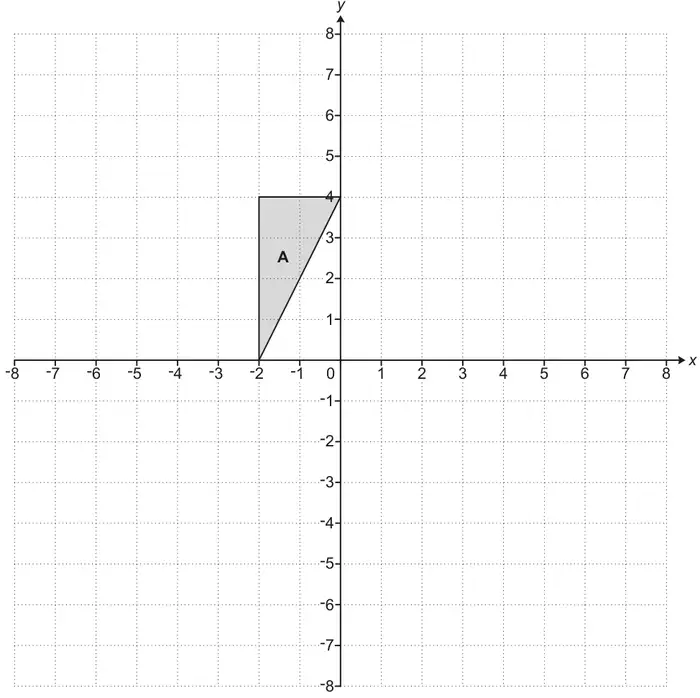
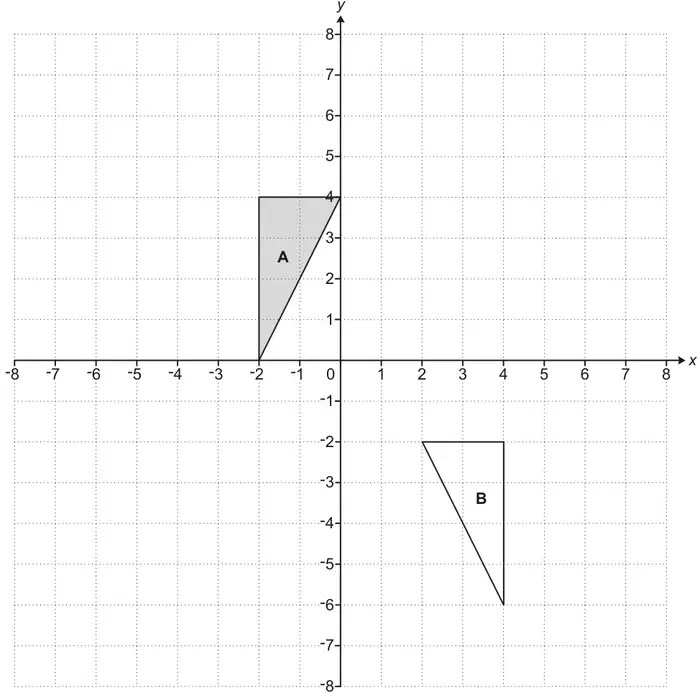
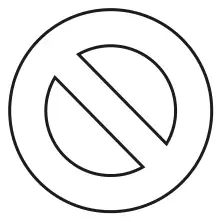
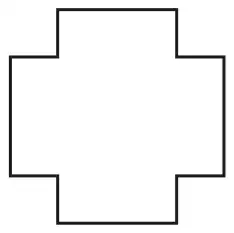
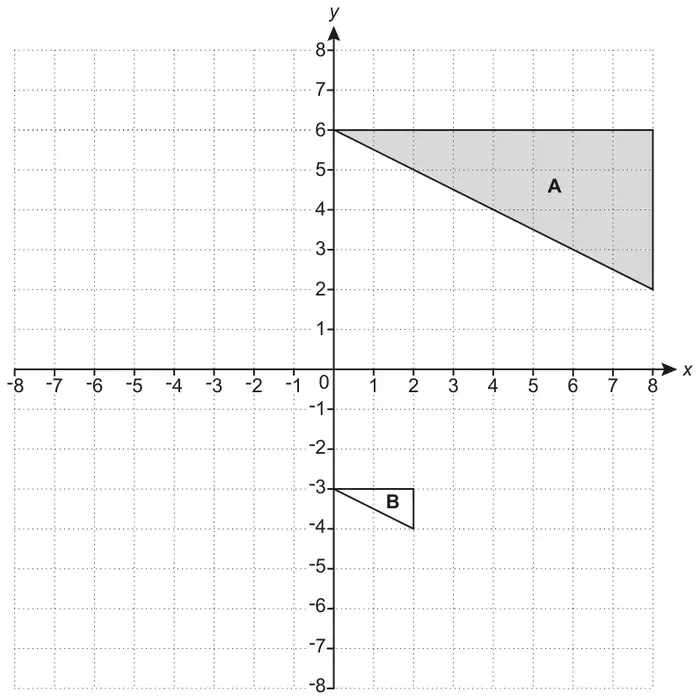
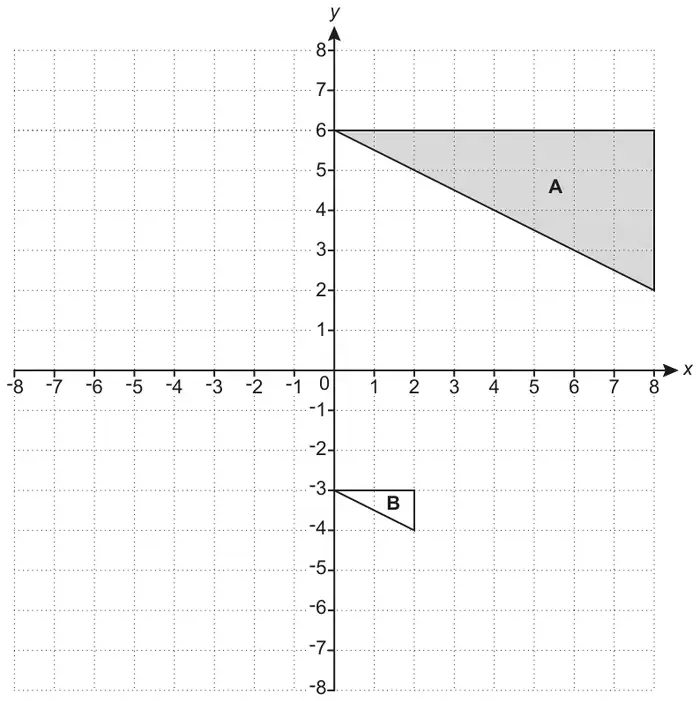
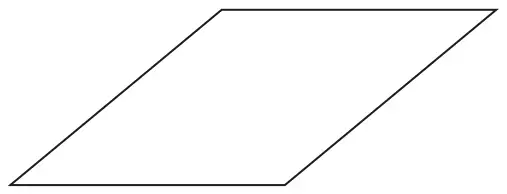
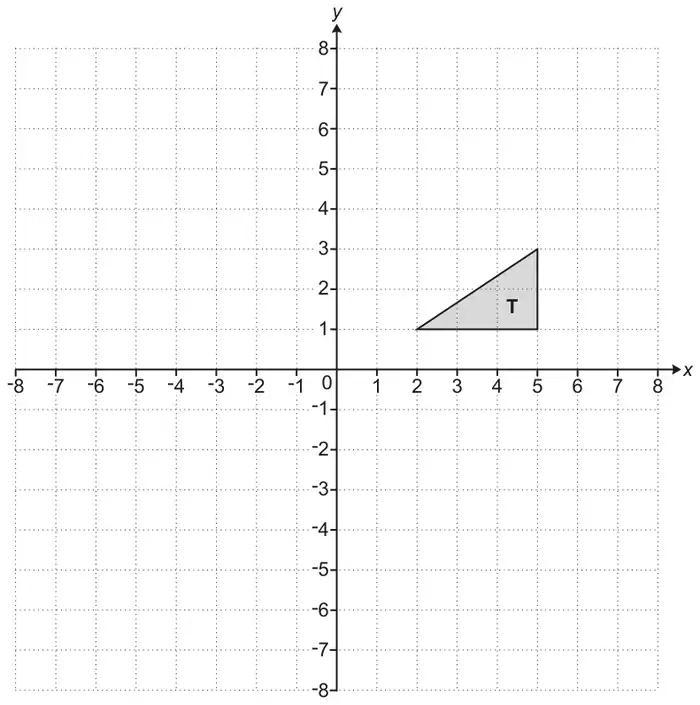
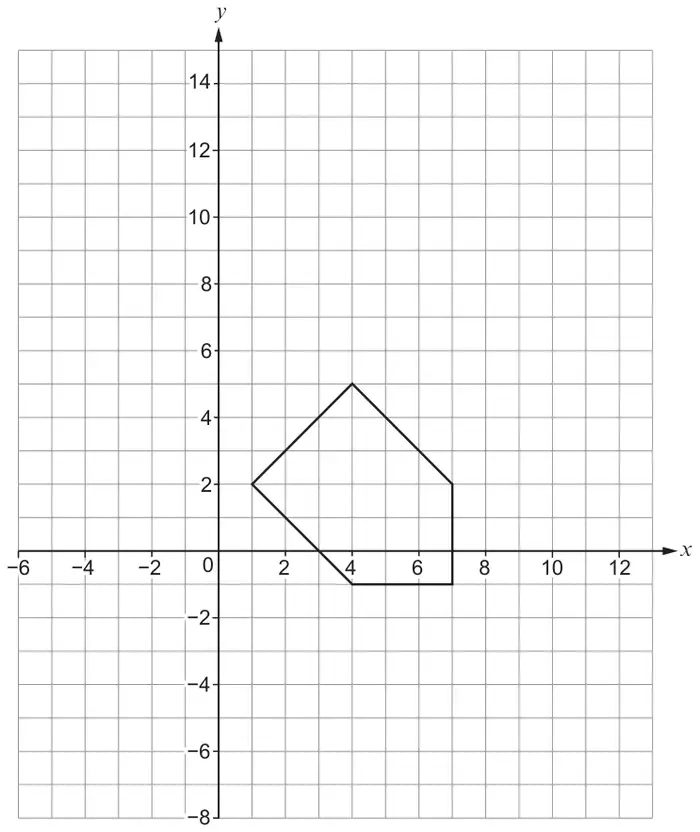
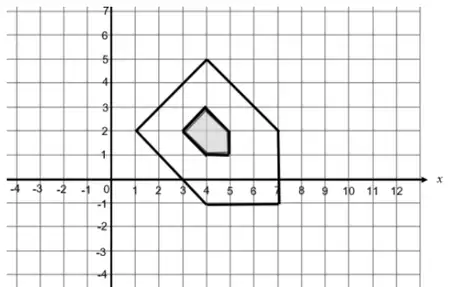
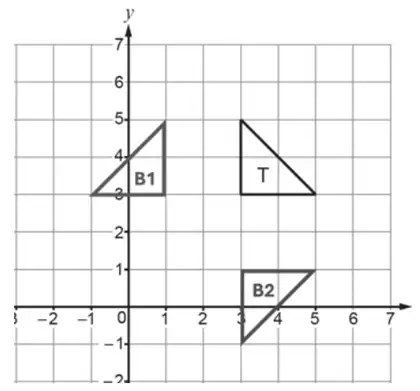
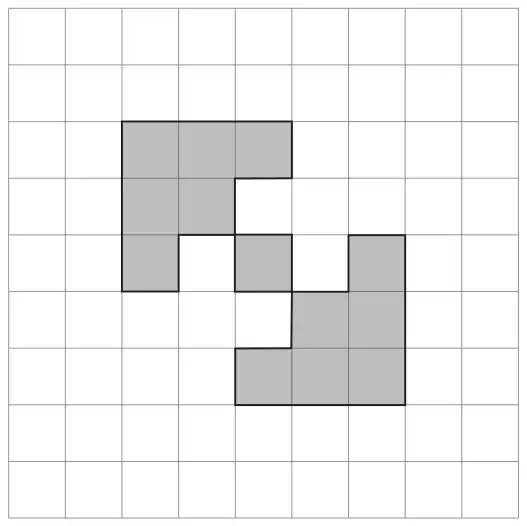
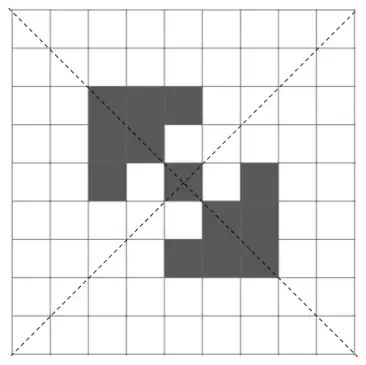
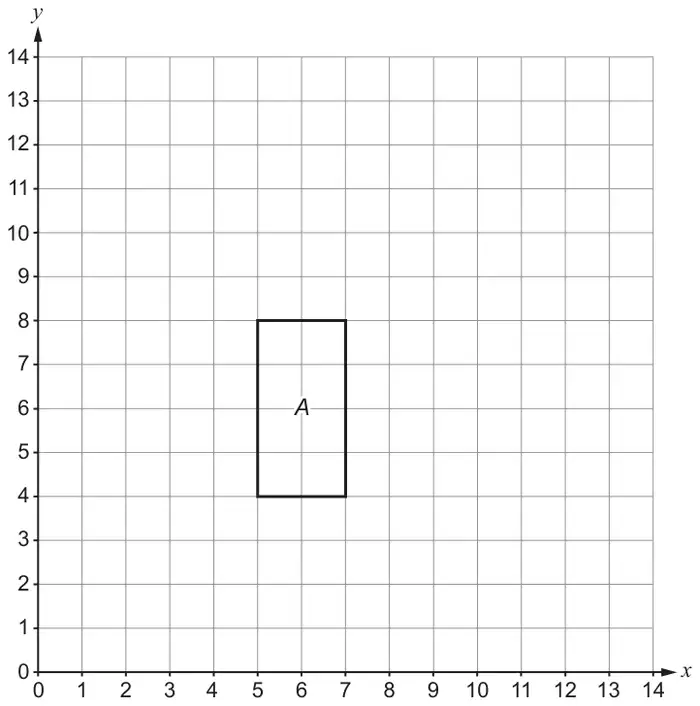
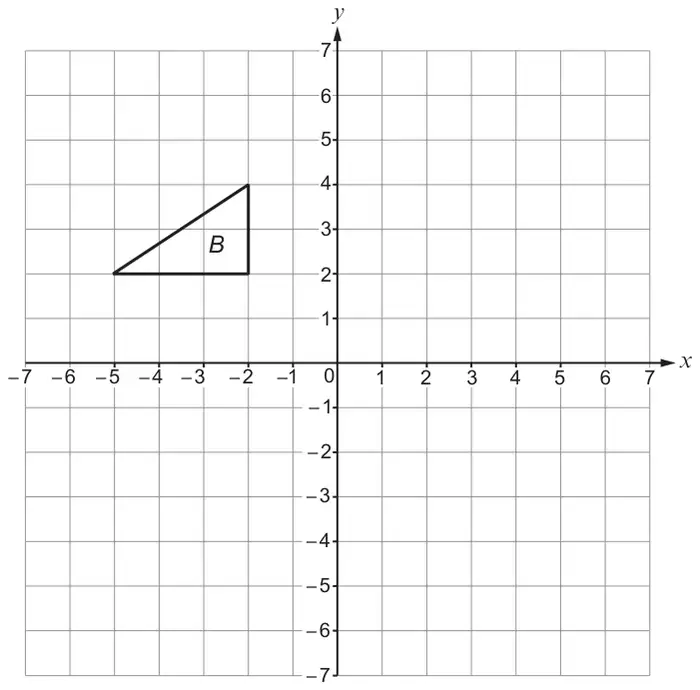
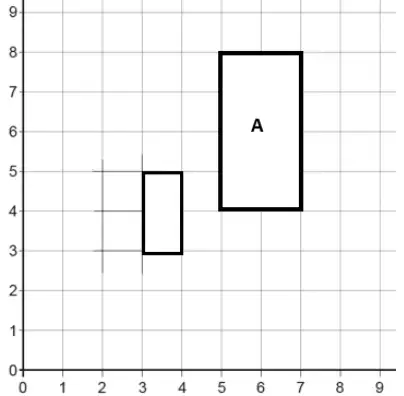
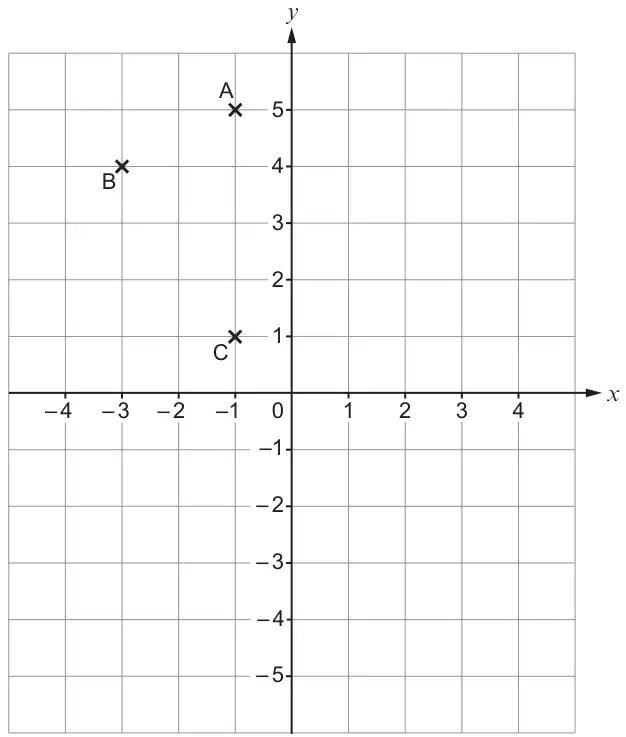
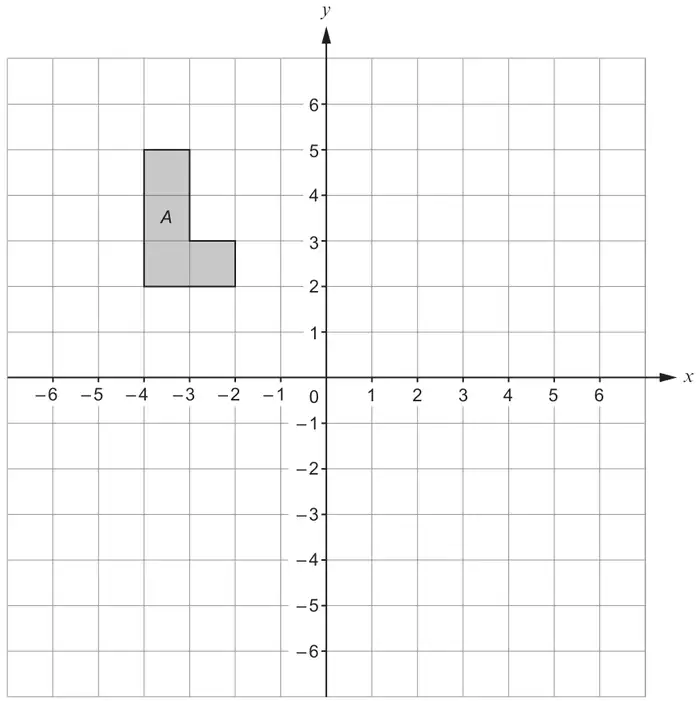
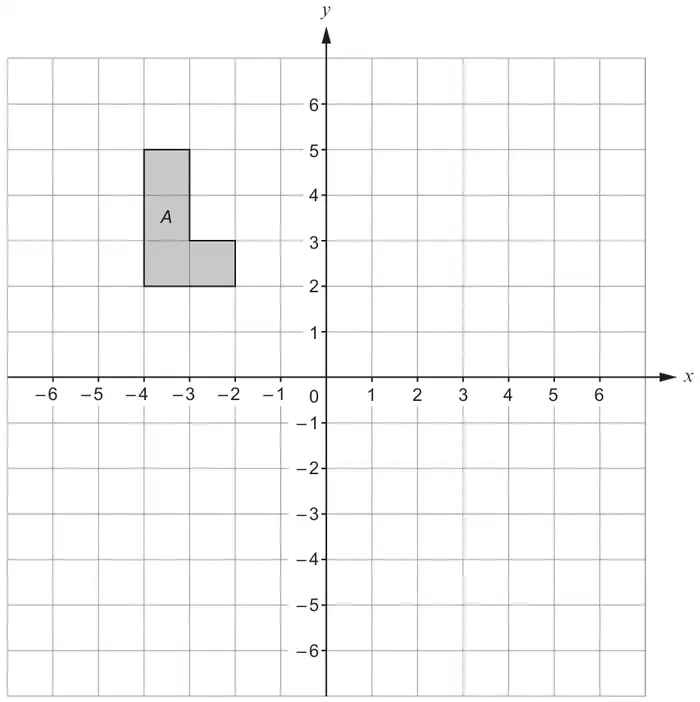
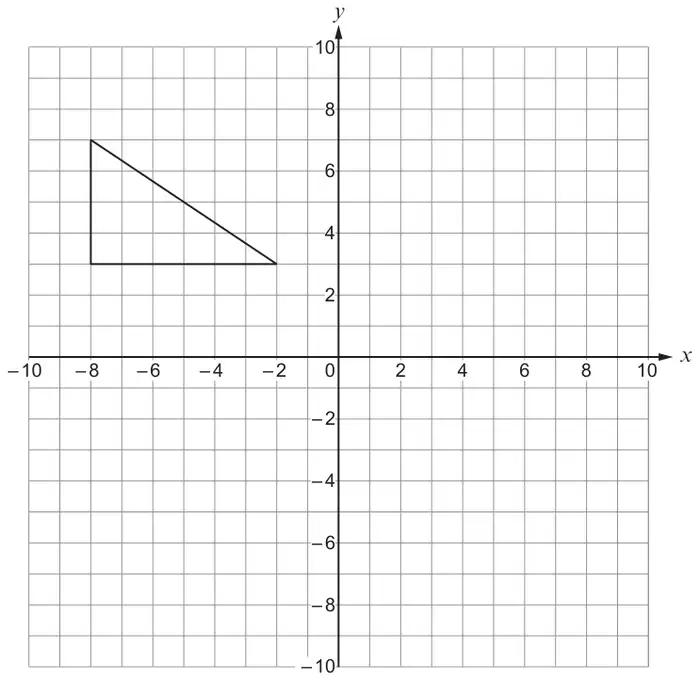
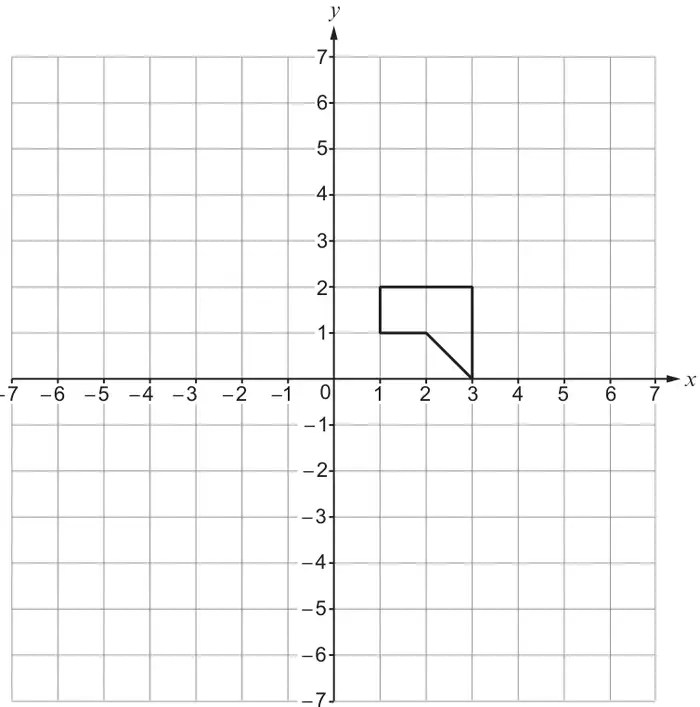
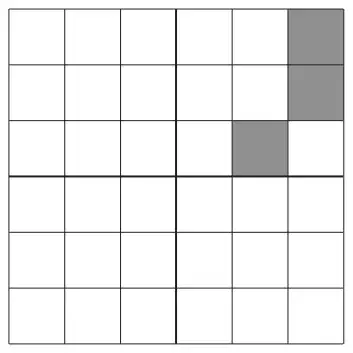
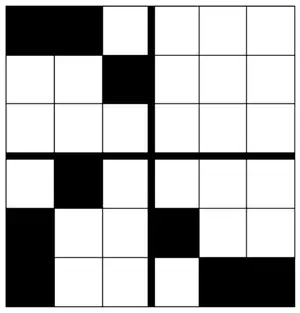
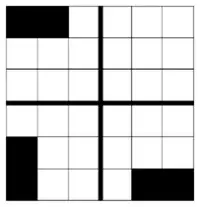
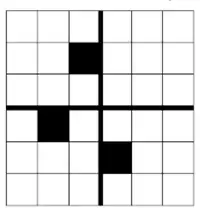
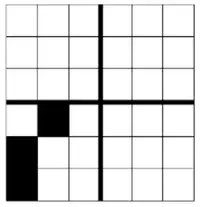
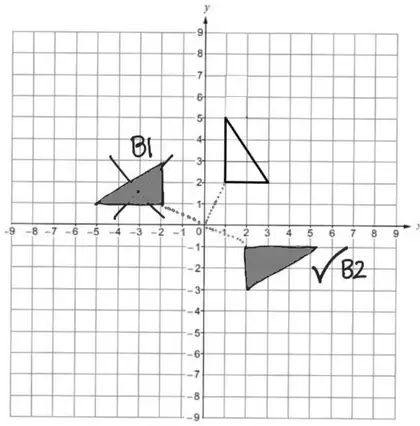
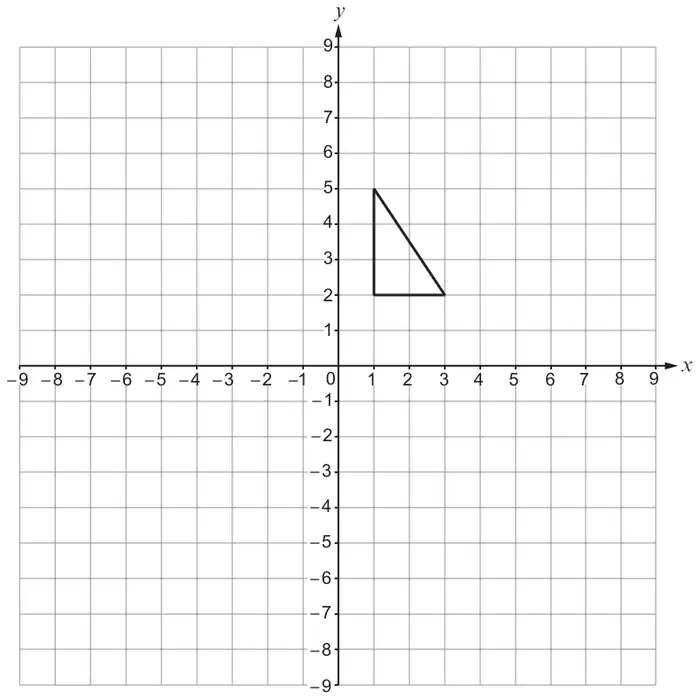
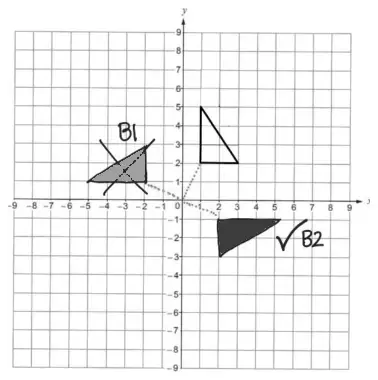
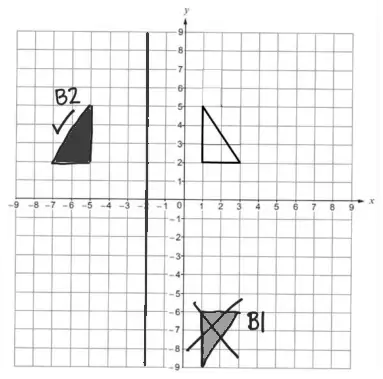
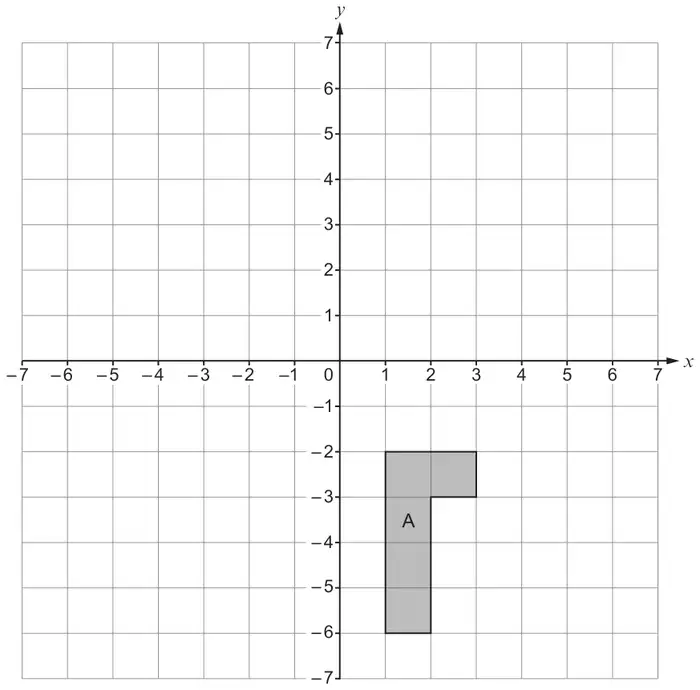
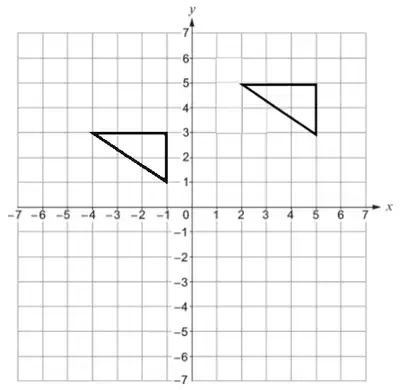
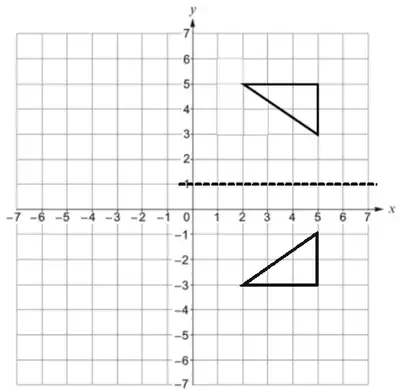
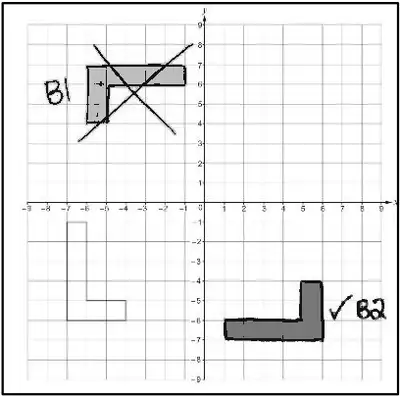
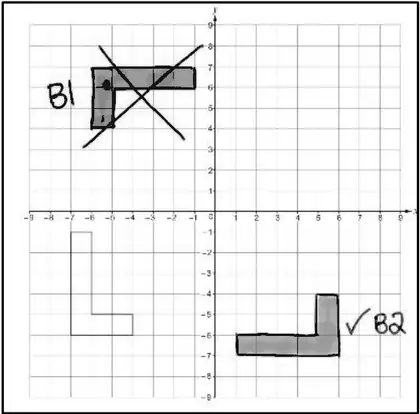
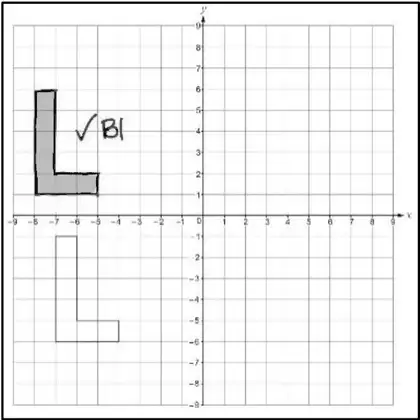
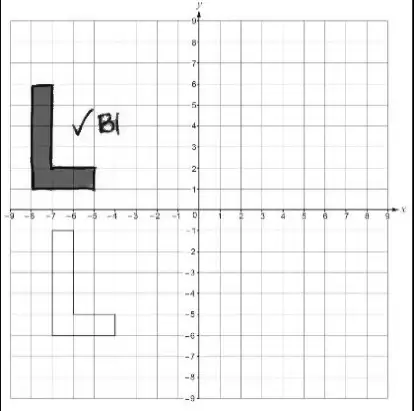
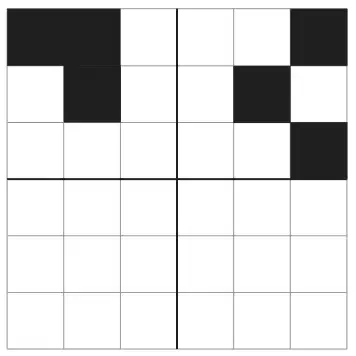
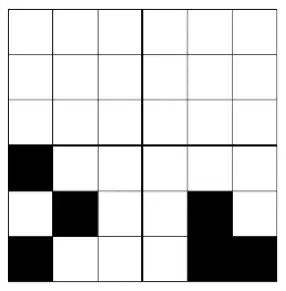
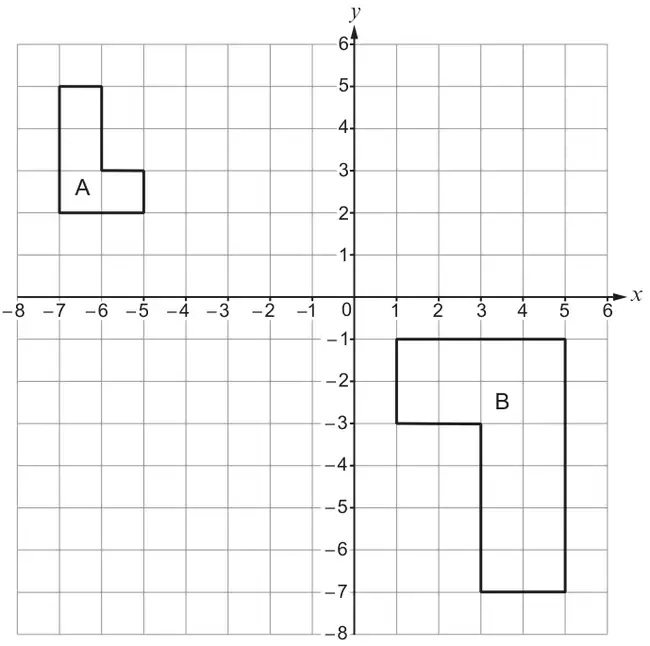
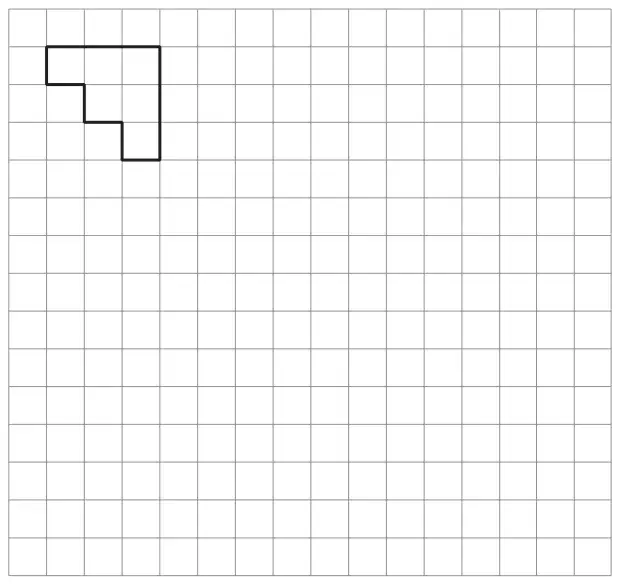
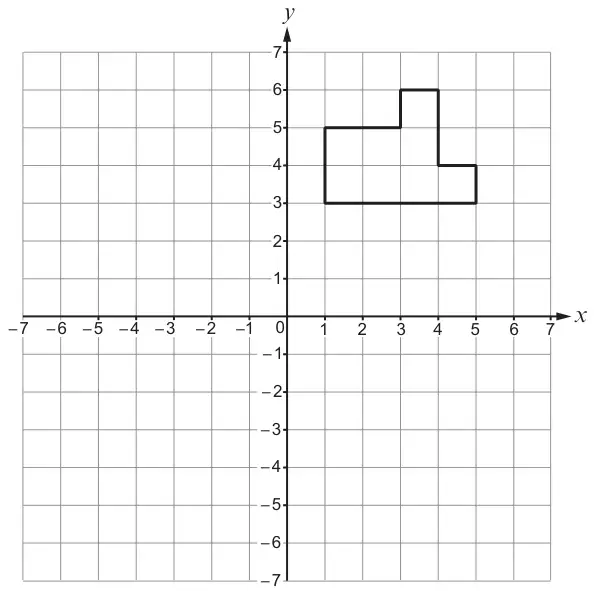
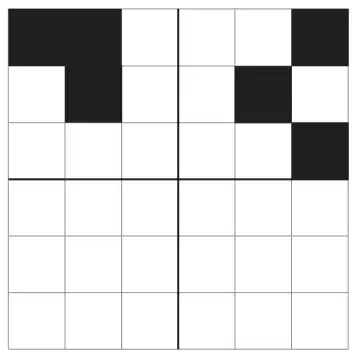
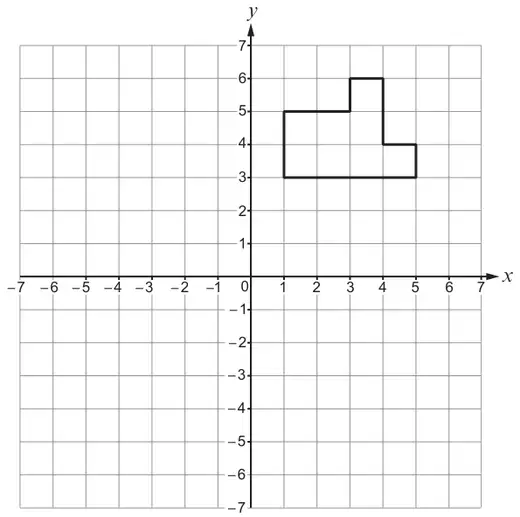
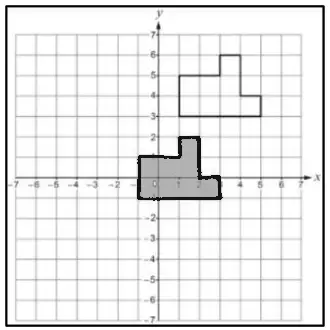
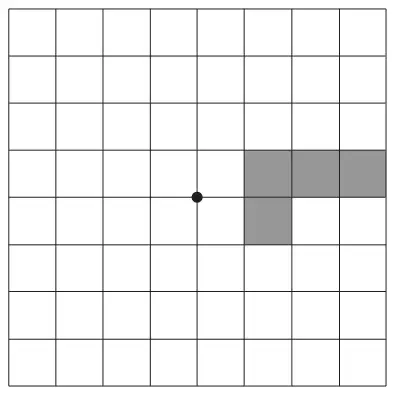
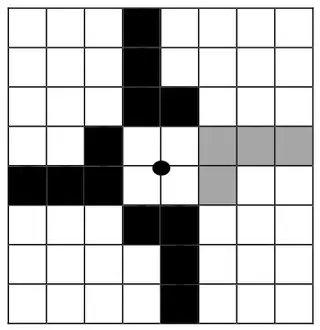
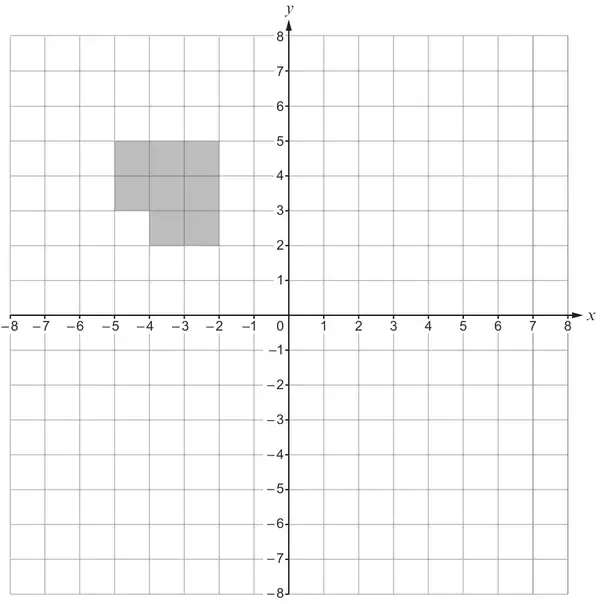
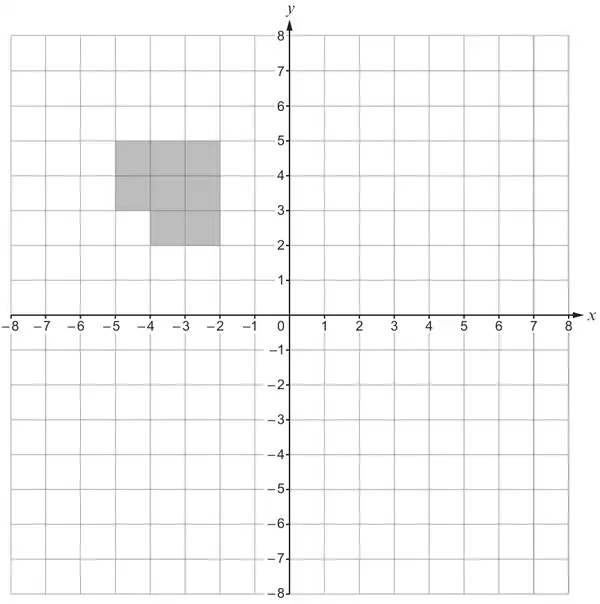
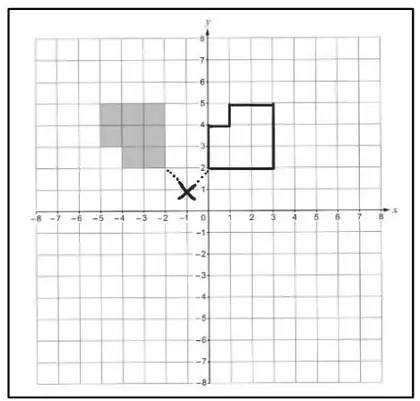
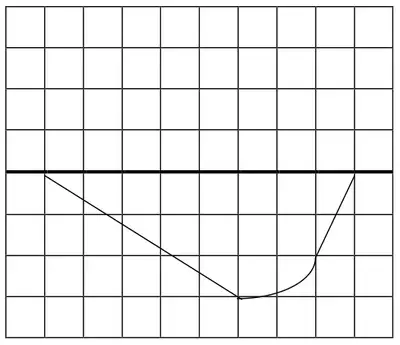
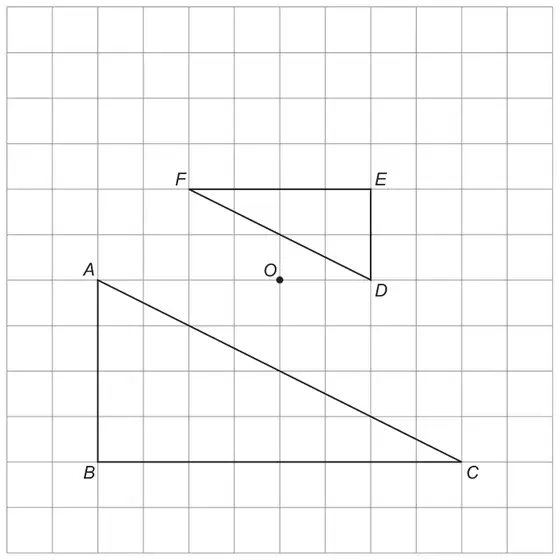
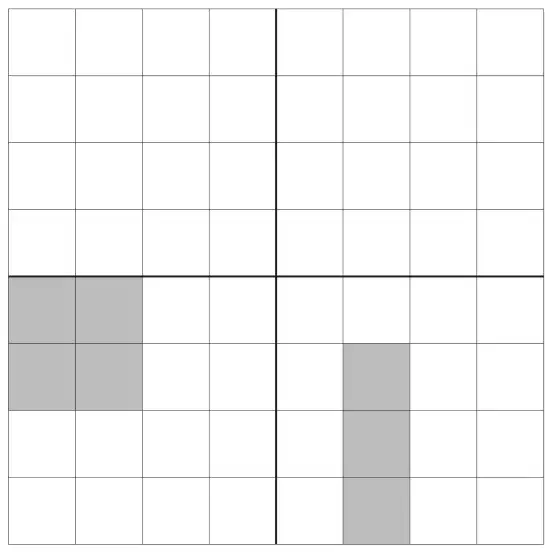
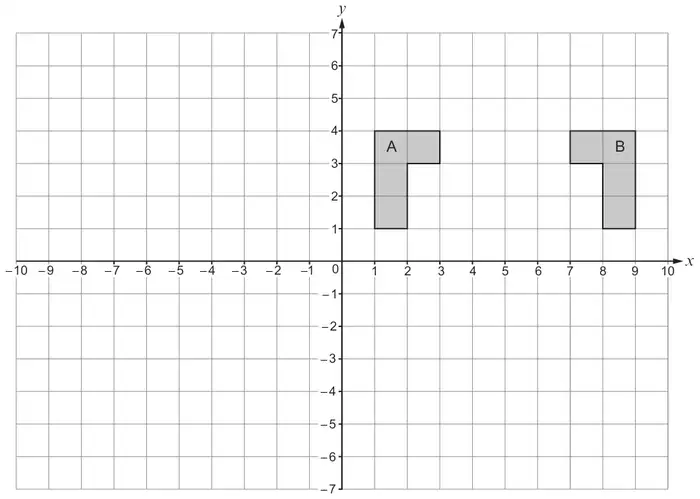
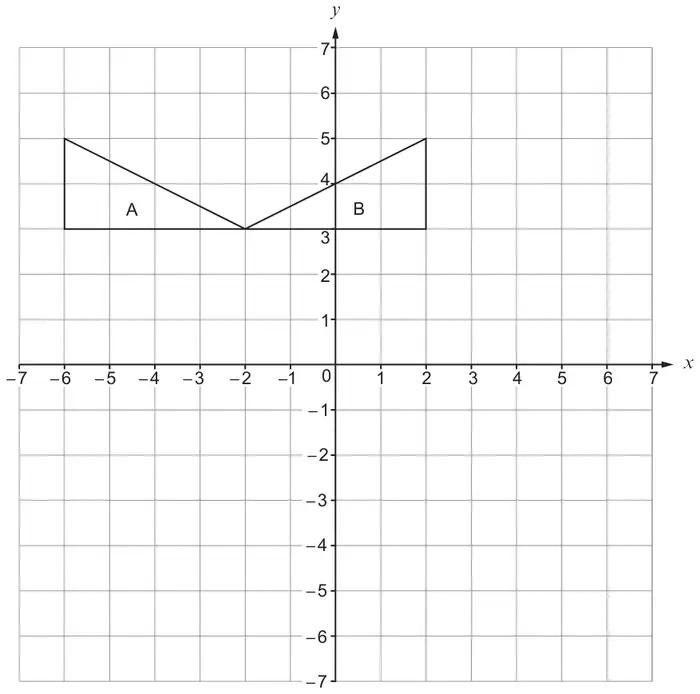
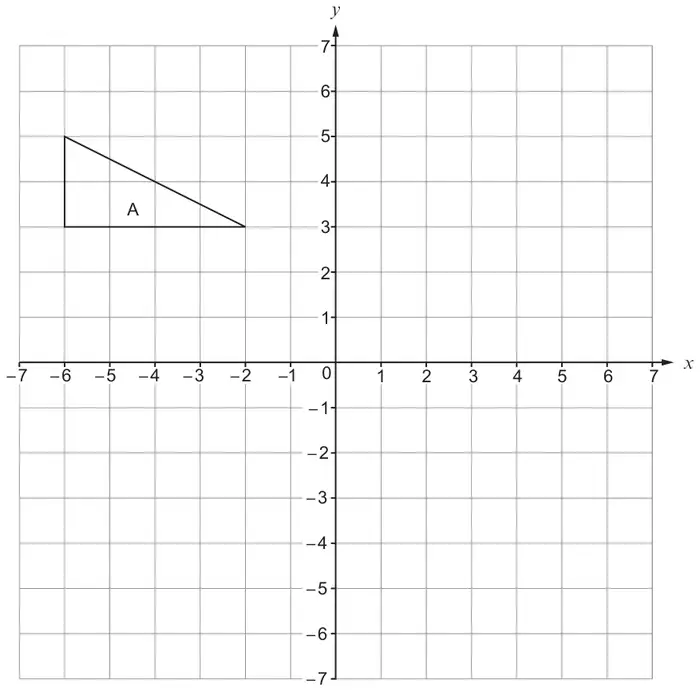
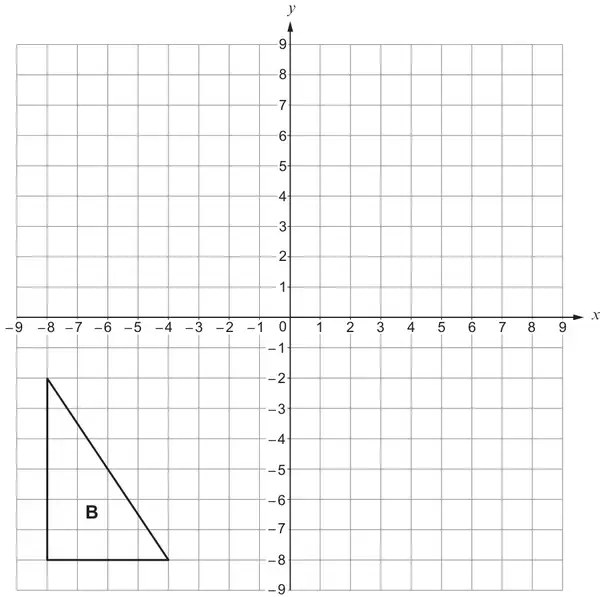
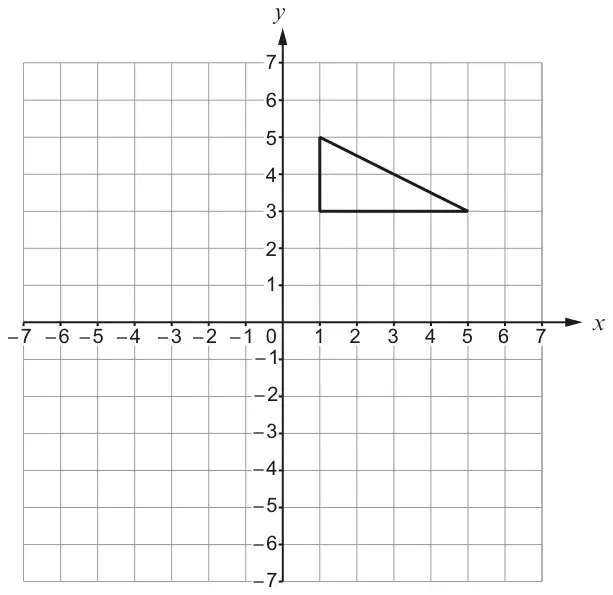
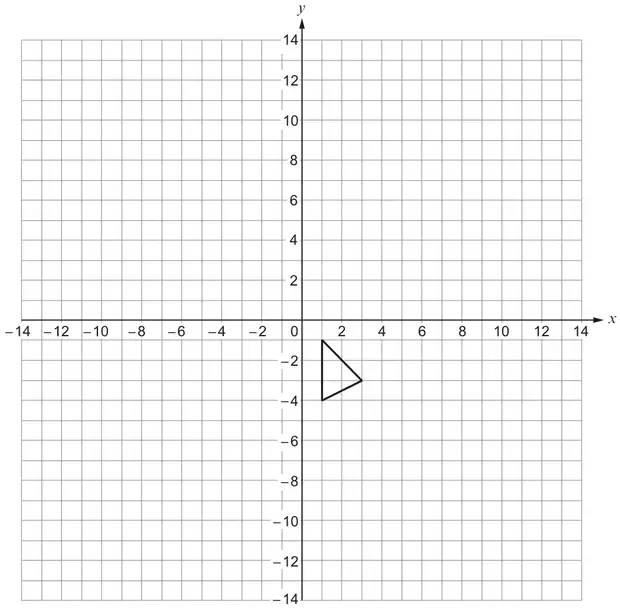
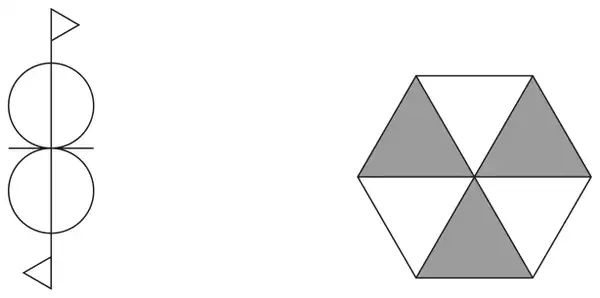
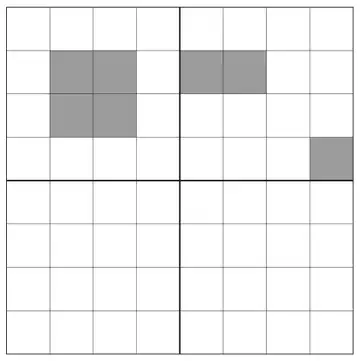
for rotation of the shape by 180° about any centre or for any 3 out of 4 vertices correct)
Mark scheme (b)
Answer
Mark
Mark scheme
Explanation
C1
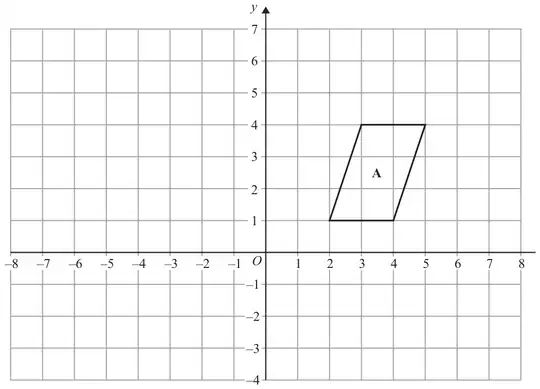
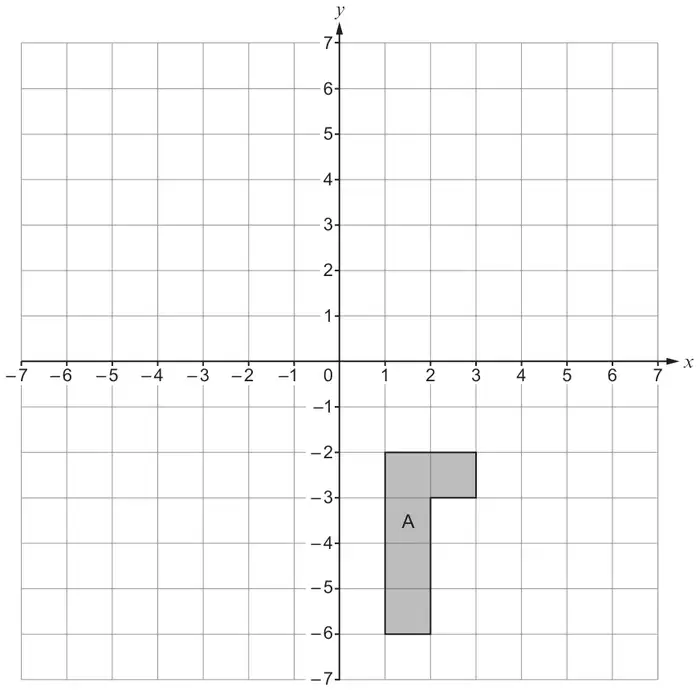
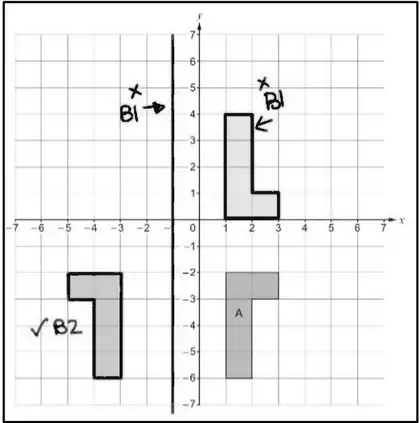
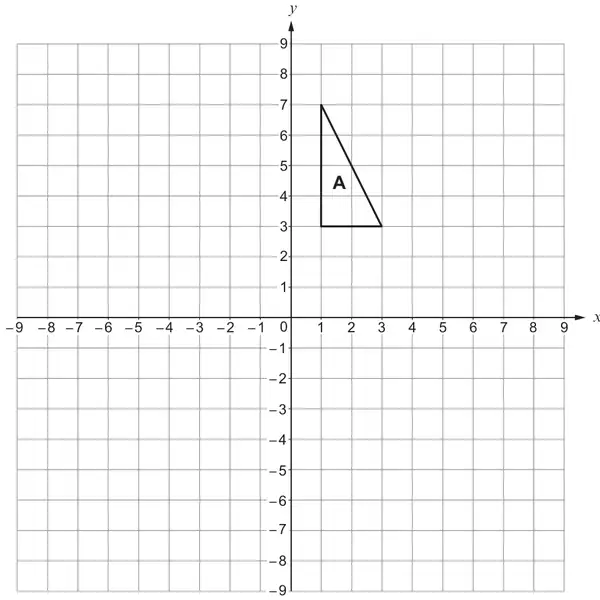
for explanation of why answer is wrong Acceptable examples he has reflected (in the line) \(y = 3\) / he has used \(y = 3\) he reflected shape A with equation \(y = 3\) \(x = 3\) is supposed to be vertical \(x = 3\) means the line of reflection should go through 3 on the \(x\)-axis it should be on the right of A, not beneath it correct reflection in line \(x = 3\) shown on diagram with supporting comment eg it should be here
Not acceptable examples he has not reflected the shape (in the line \(x = 3\)) he has reflected in the wrong line / the reflection line isn’t on \(x = 3\) because the shape is the wrong way he drew it wrong he has used the \(y\)-axis instead of the \(x\)-axis
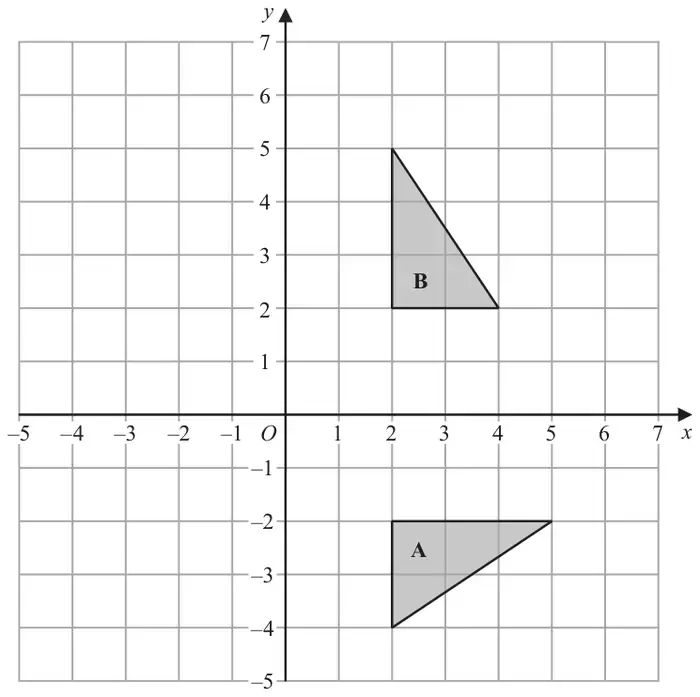
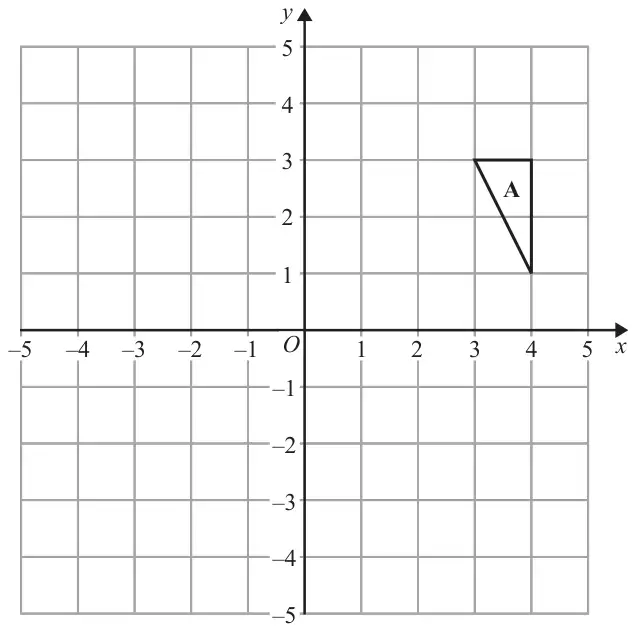
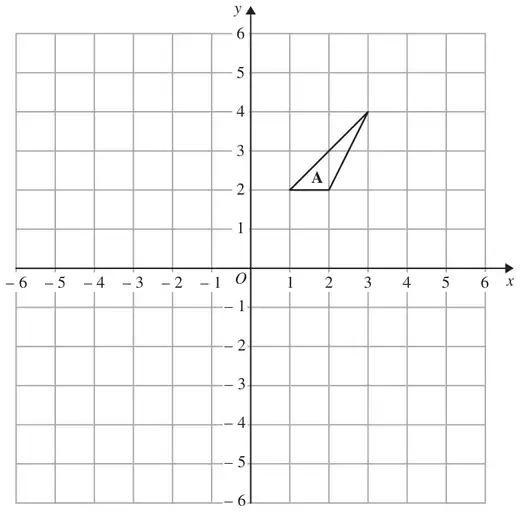
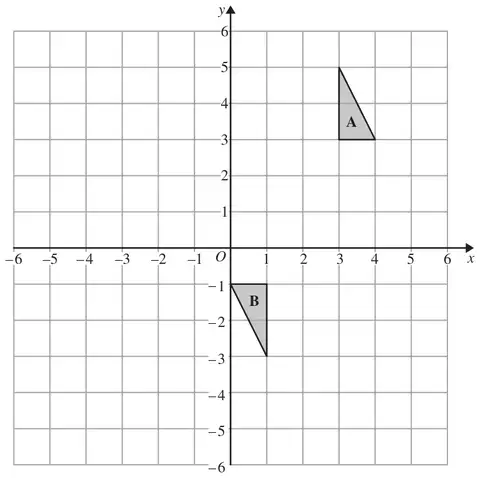
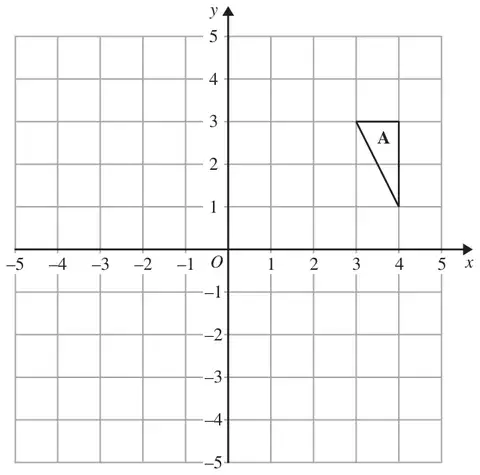
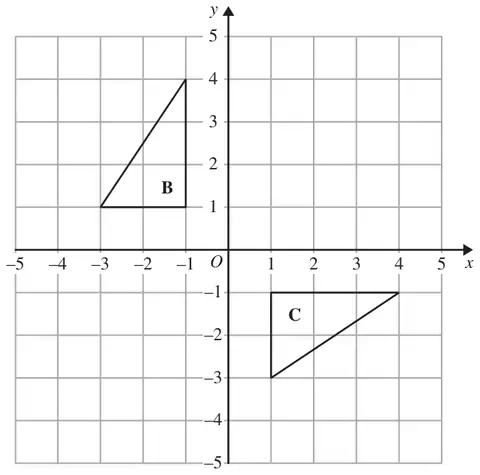
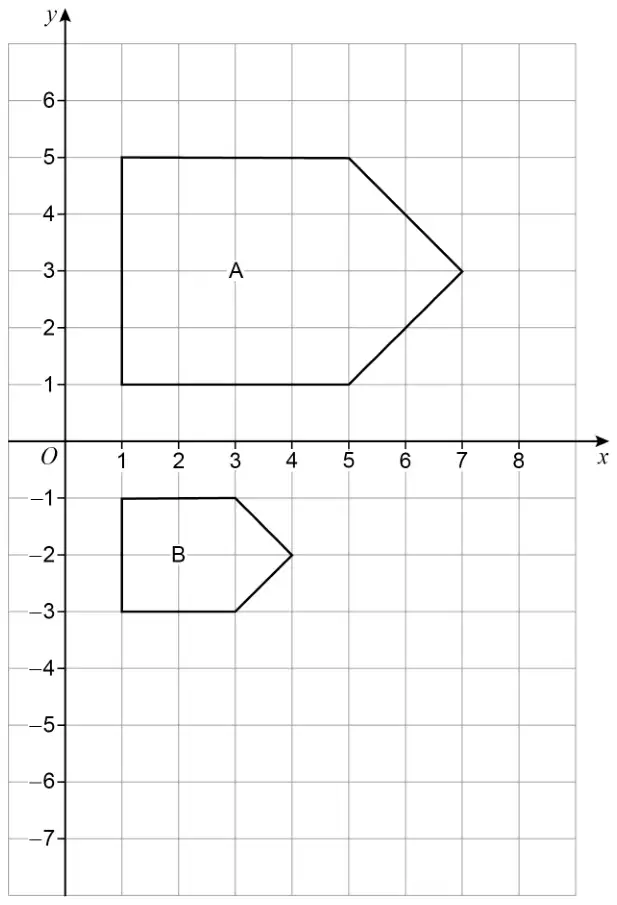
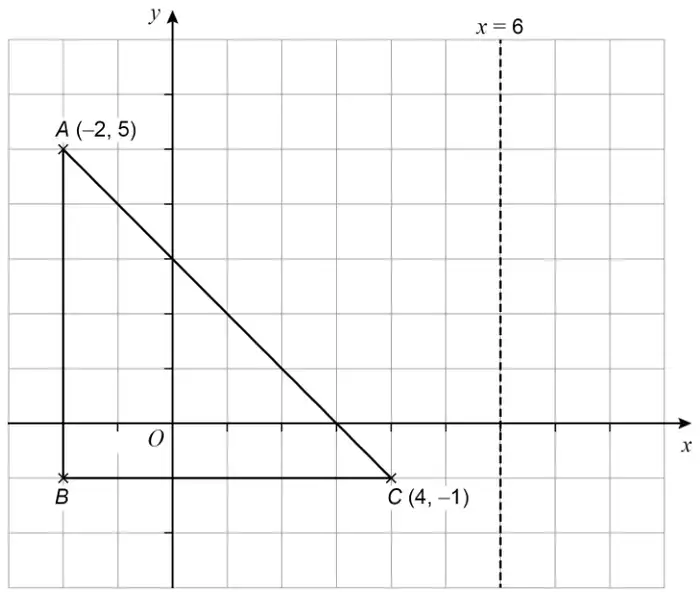
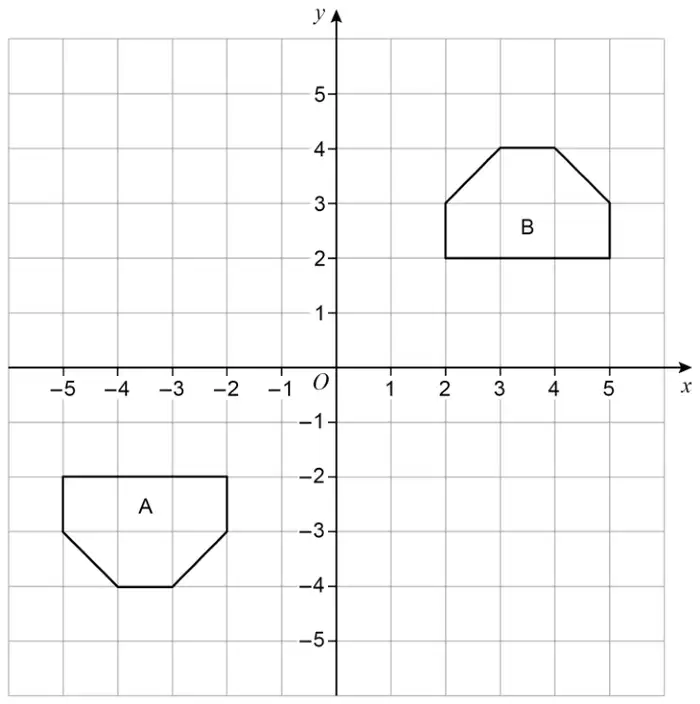
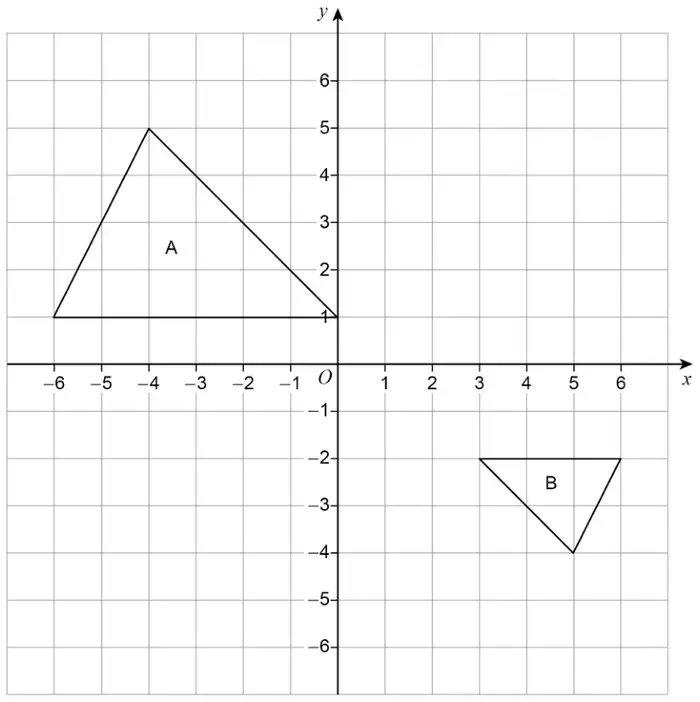
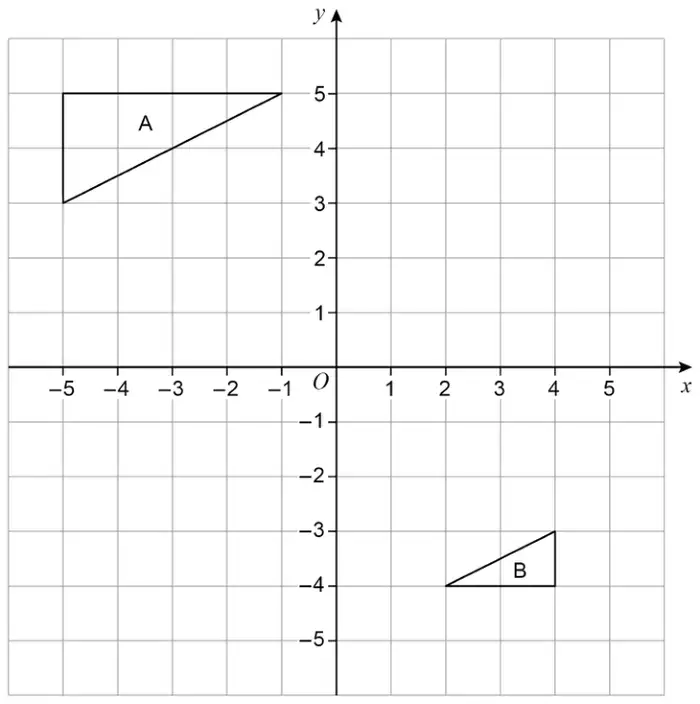
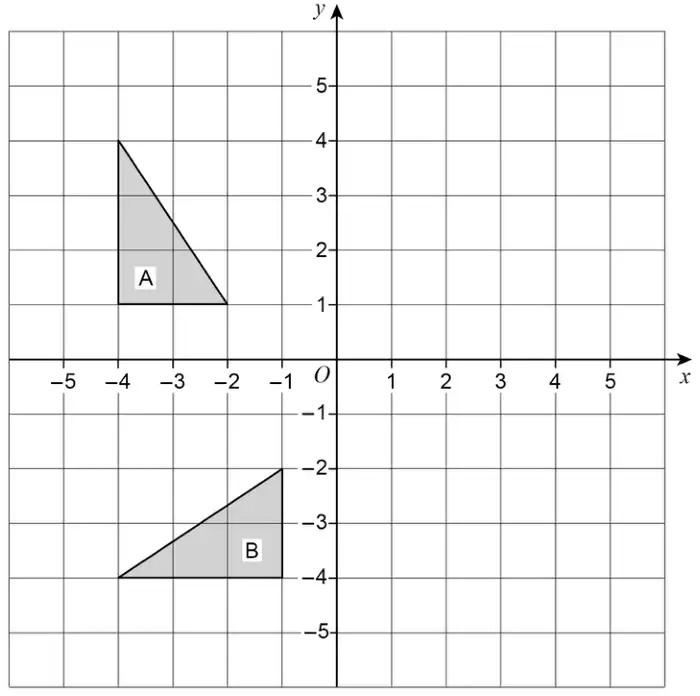
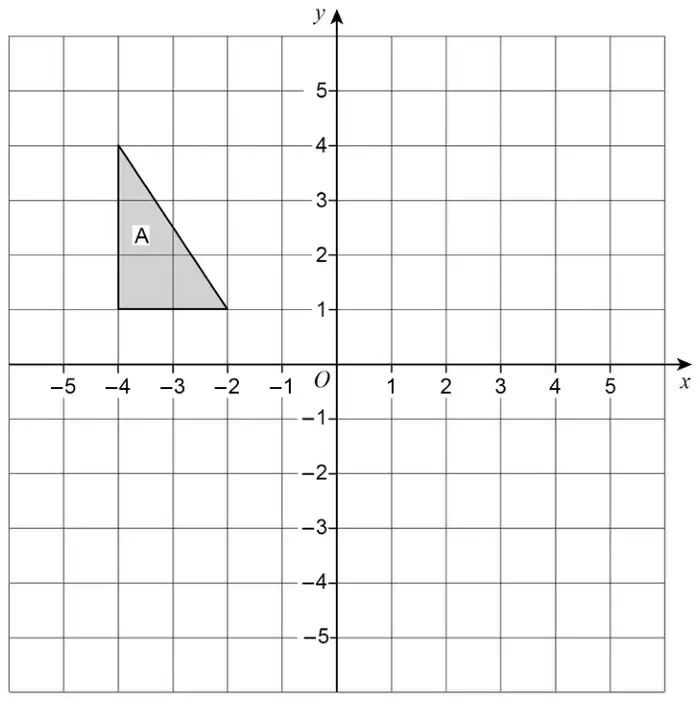
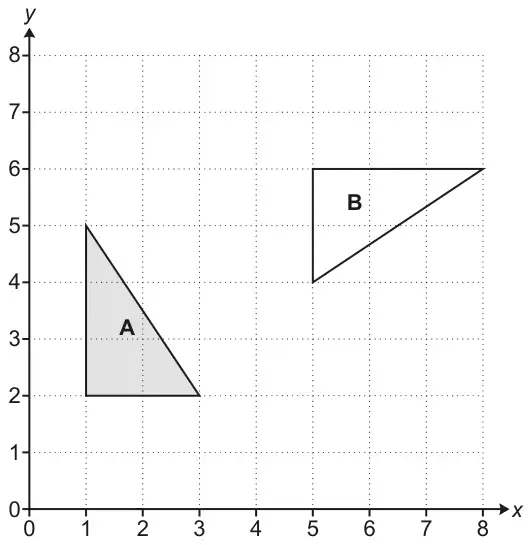
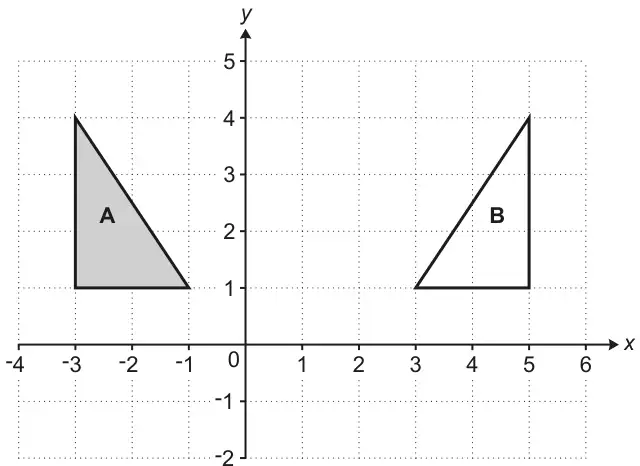
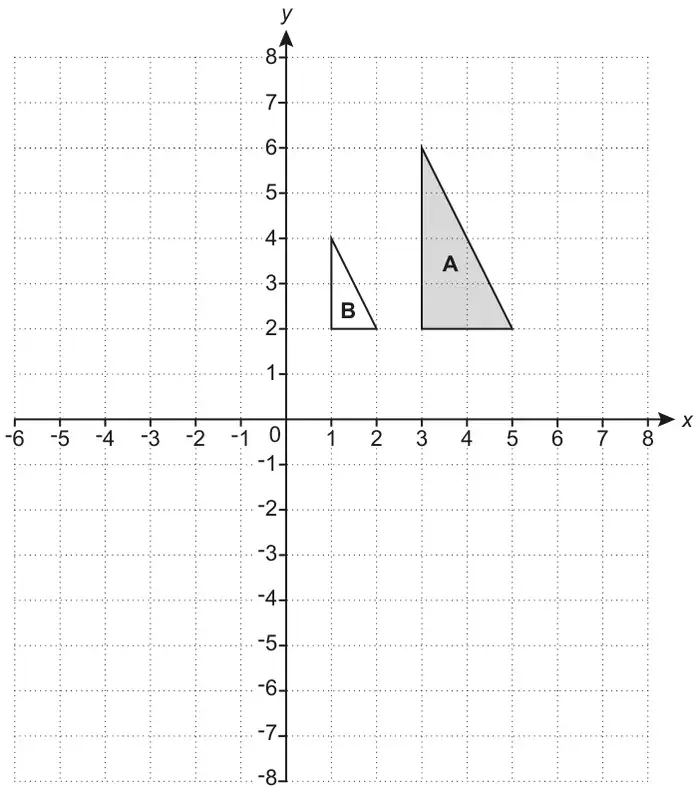
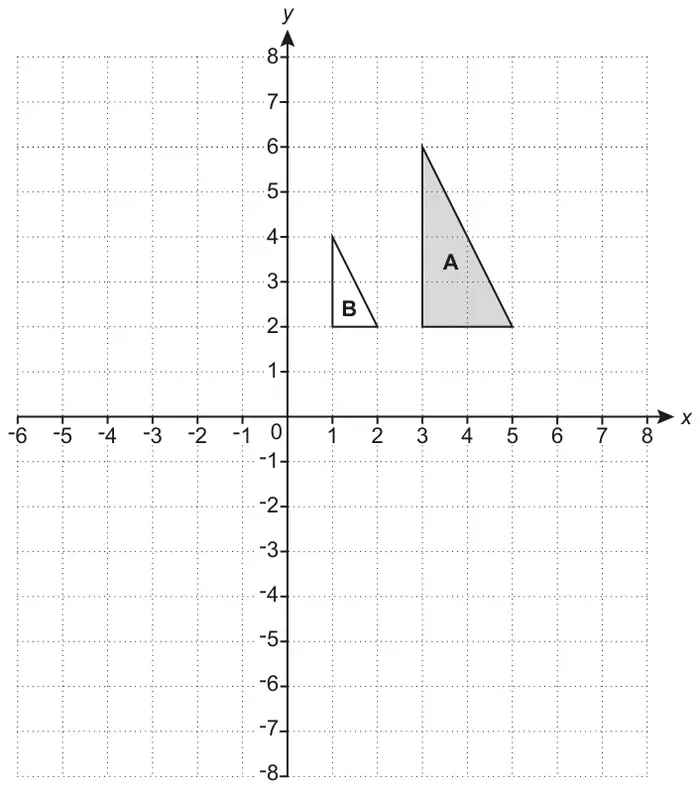
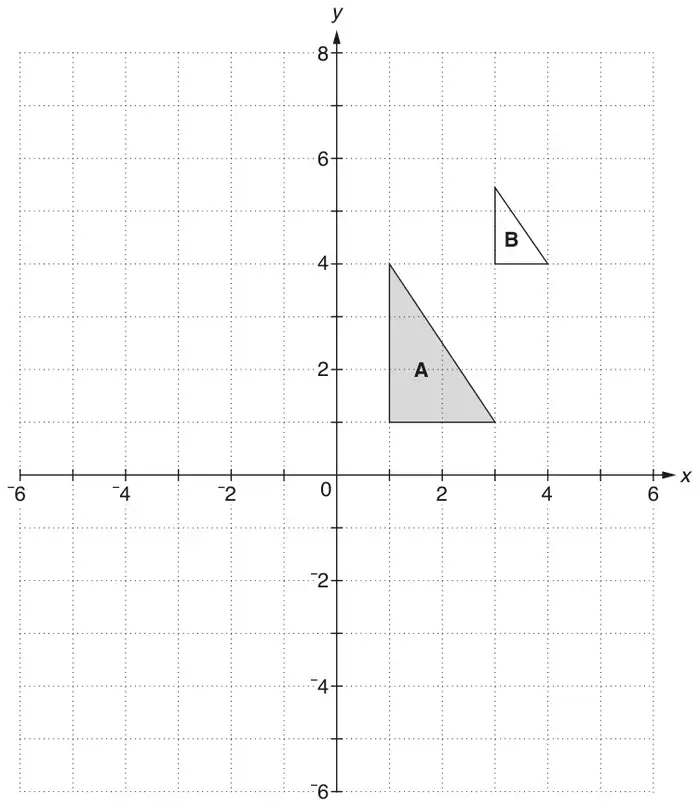
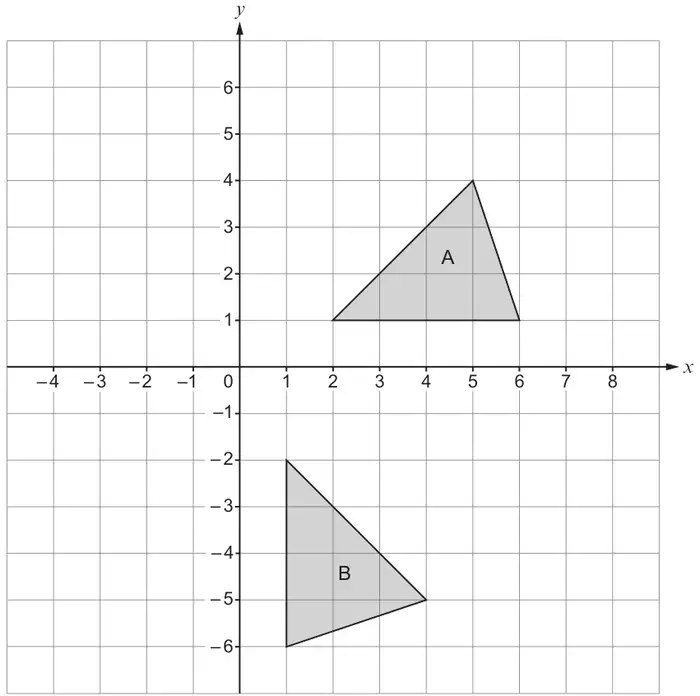
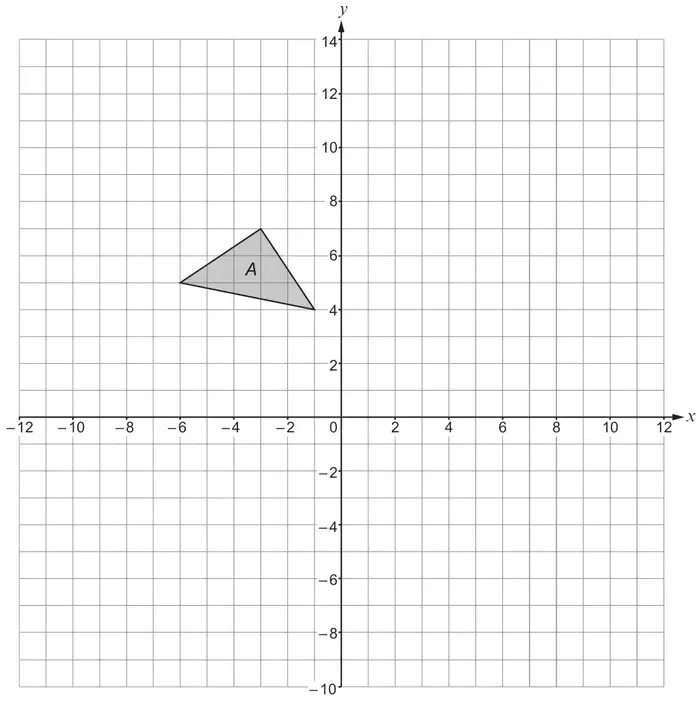
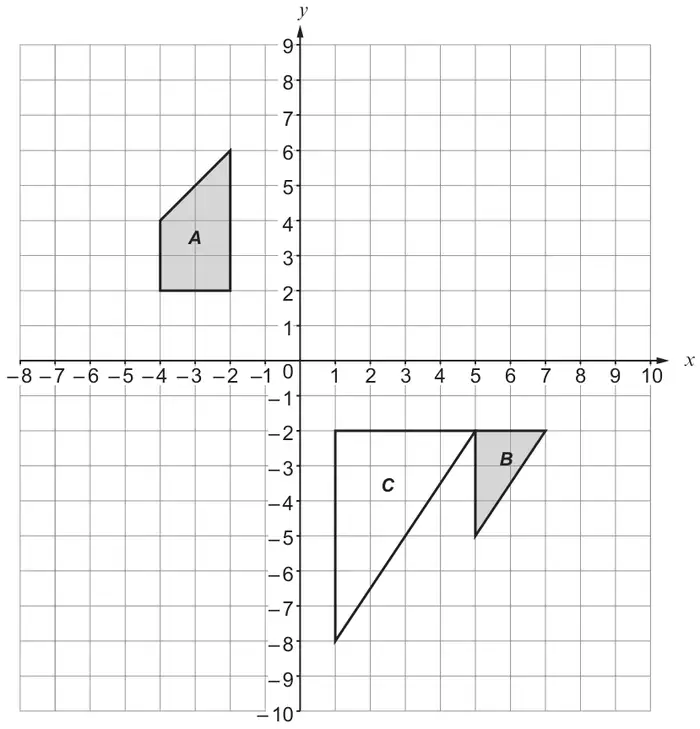
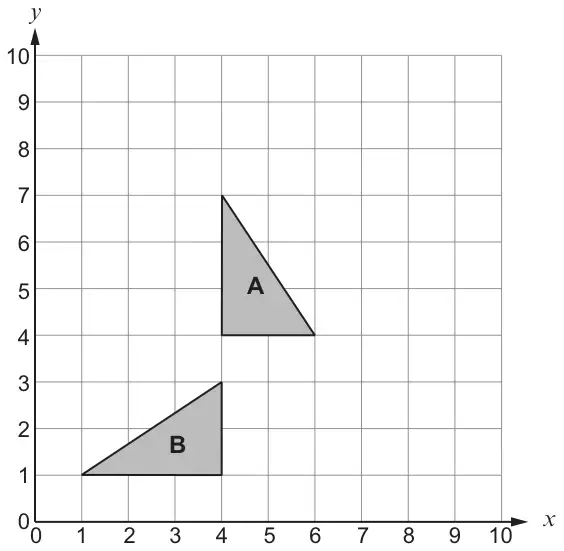
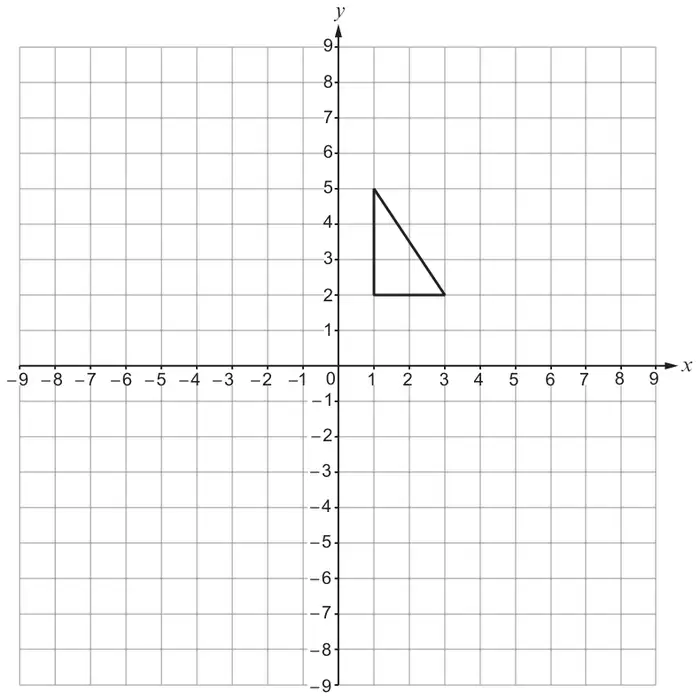
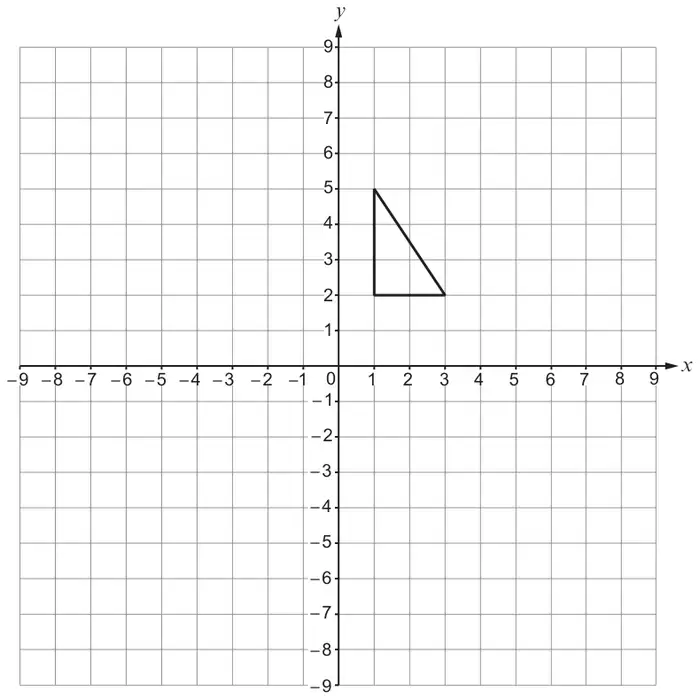
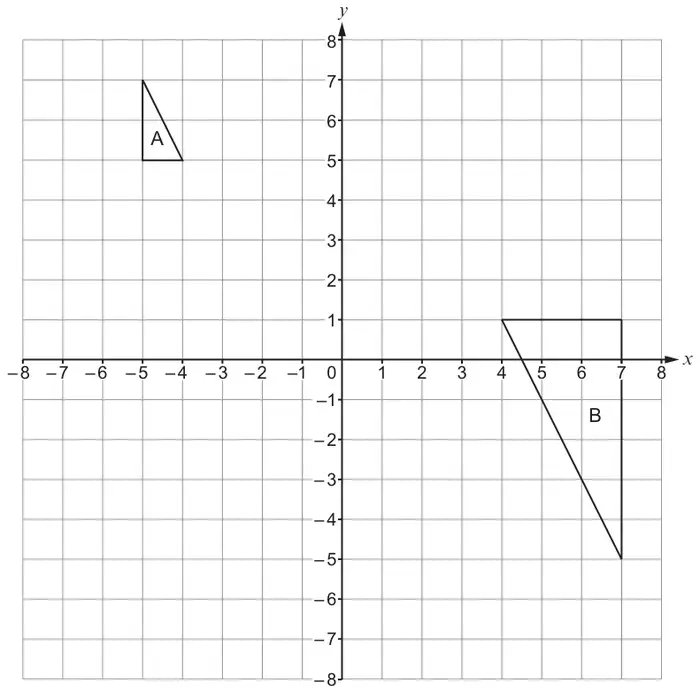
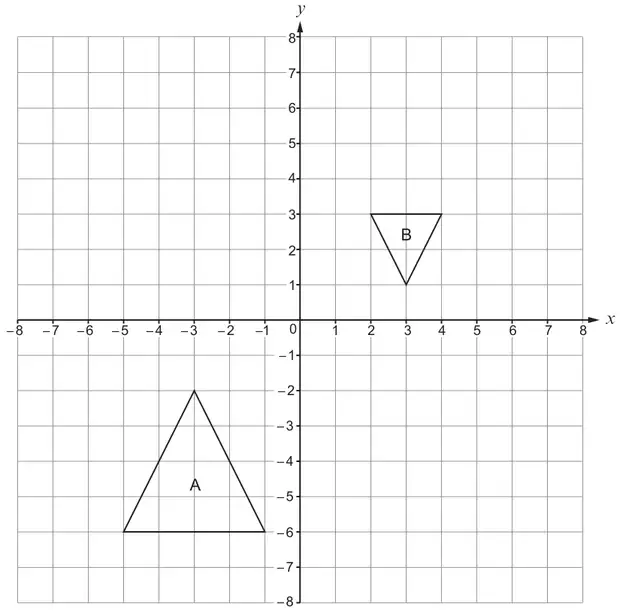
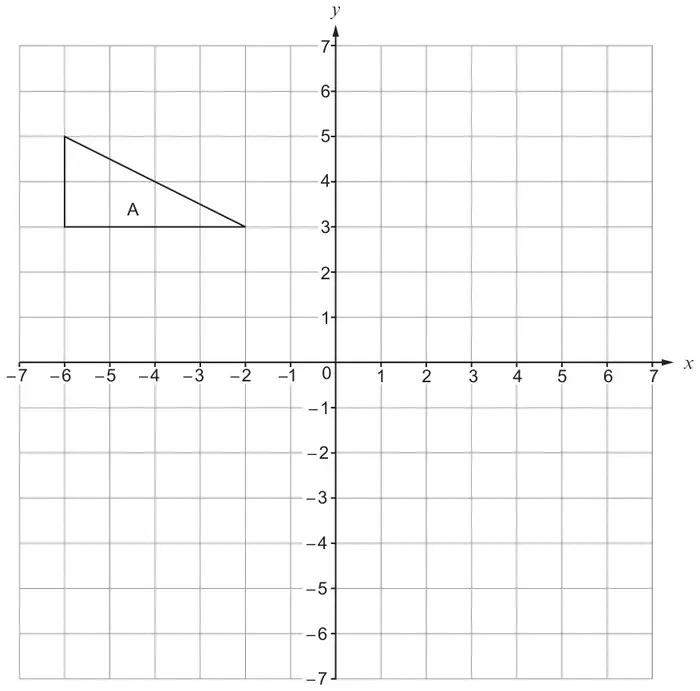
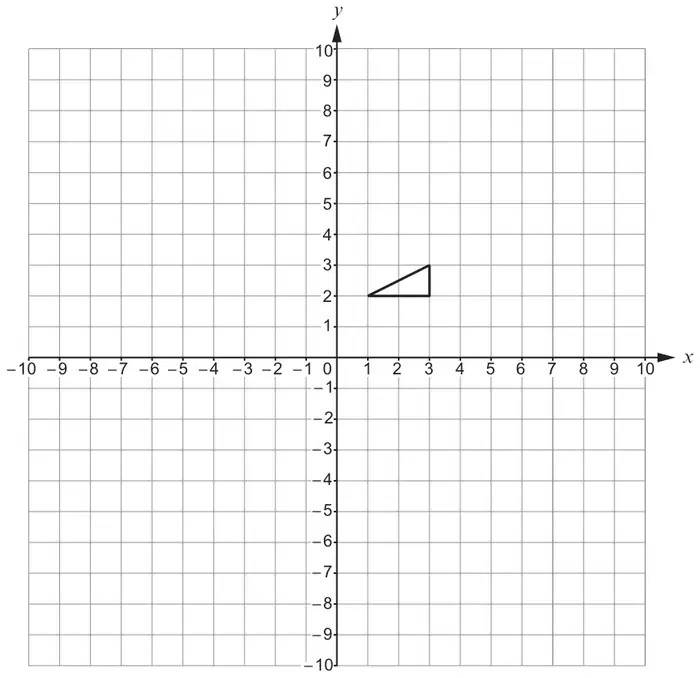
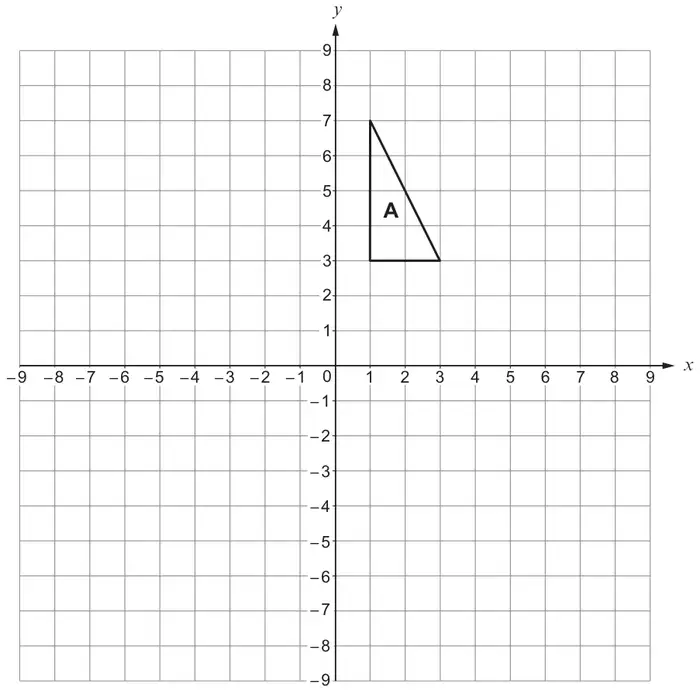
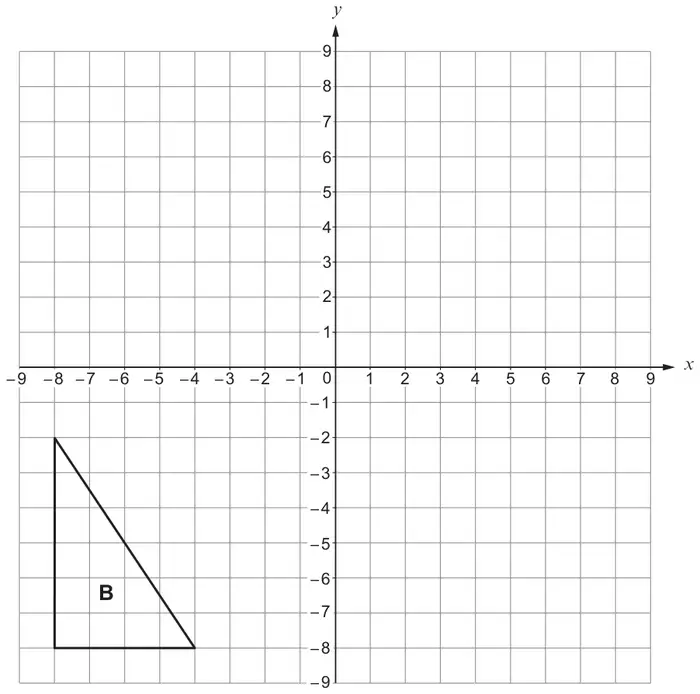
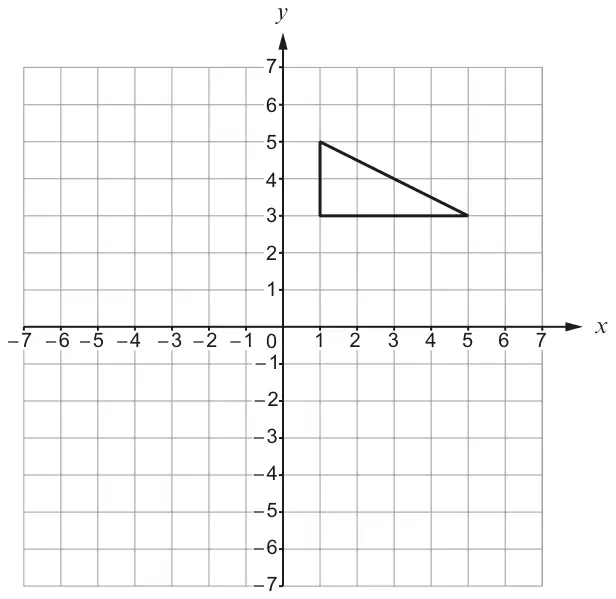
Triangle A is translated by the vector \(\begin{pmatrix} 6 \\ -4 \end{pmatrix}\) to give triangle B.
Triangle B is rotated 90° clockwise about the point (1, 2) to give triangle C.
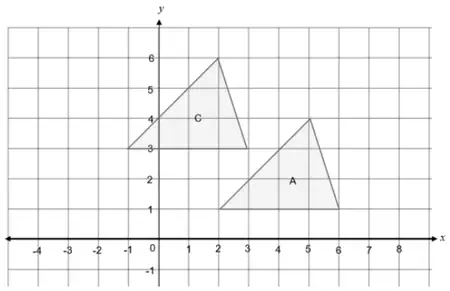
Describe fully the single transformation that maps triangle A onto triangle C. (3)
Mark scheme
Answer
Mark
Mark scheme
Rotation 90° clockwise centre \((-4, 1)\)
M1
for triangle B drawn at \((4, 0), (4, -2), (3, -2)\) or for triangle C drawn at \((-3, 0), (-3, -1), (-1, -1)\) or for rotating their B 90° clockwise about (1, 2)
A2
for rotation 90° clockwise centre \((-4, 1)\)
(A1
for any 2 of the 3 aspects)
Additional guidance
Award for a triangle in the correct position without the label B or C as long as this is the only triangle in the quadrant. Accept just the vertices marked.
Accept 270° (anticlockwise)
Do not award A1 for ‘rotation 90° clockwise’ if triangle C is shown not in the correct orientation
Do not award A marks if there is evidence of other transformations in the description or other ambiguity in the answer given
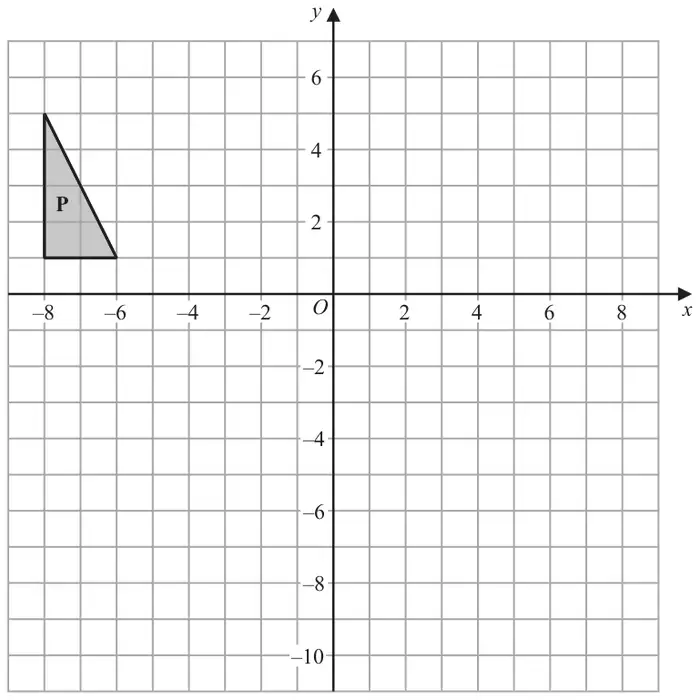
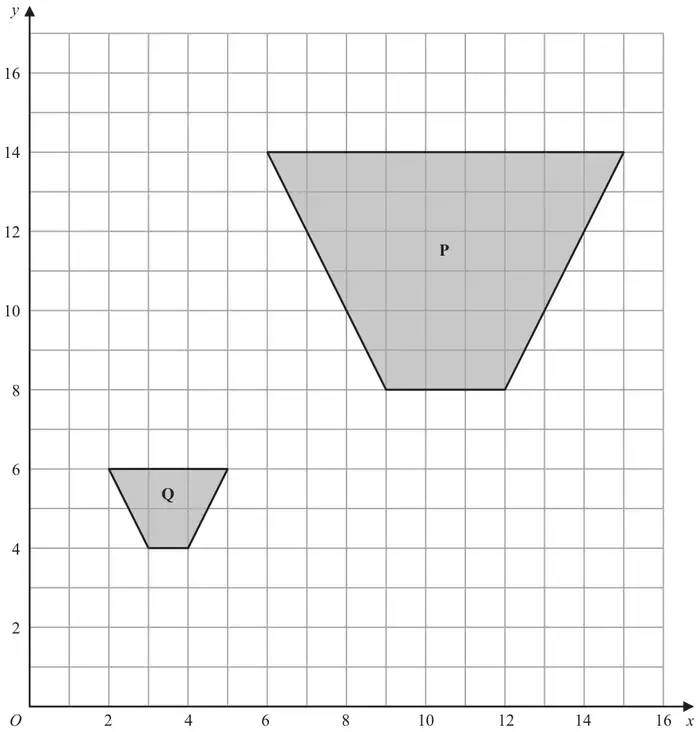
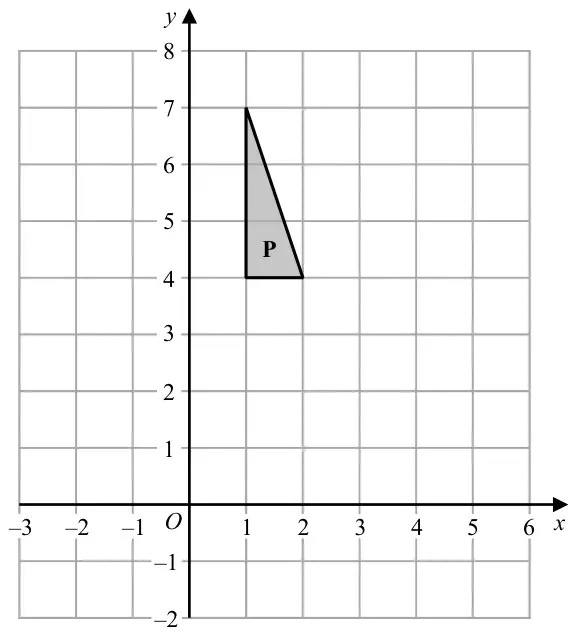
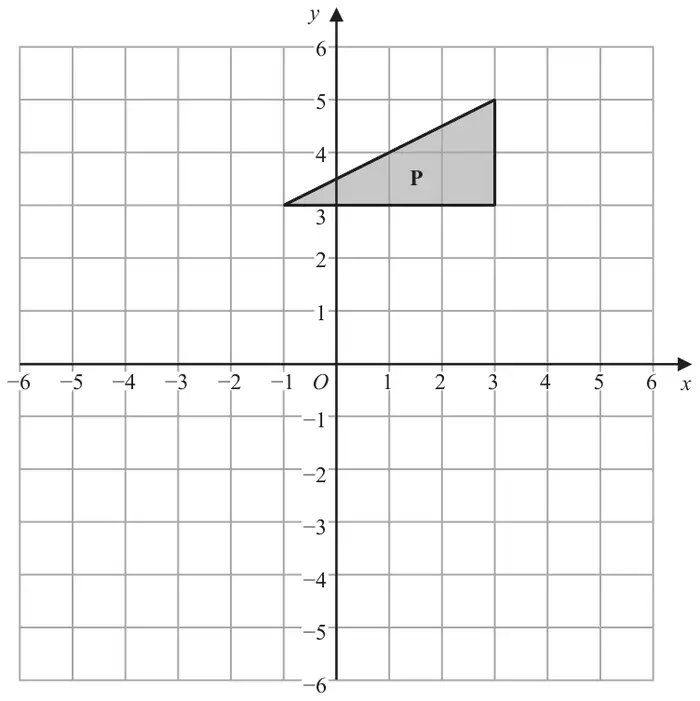
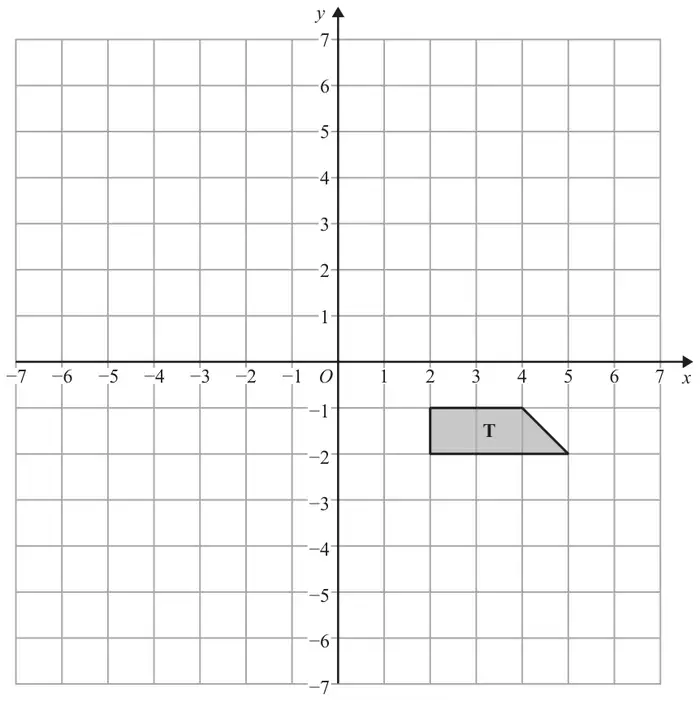
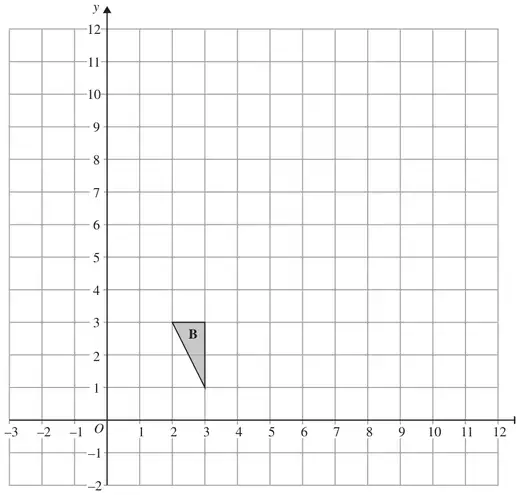
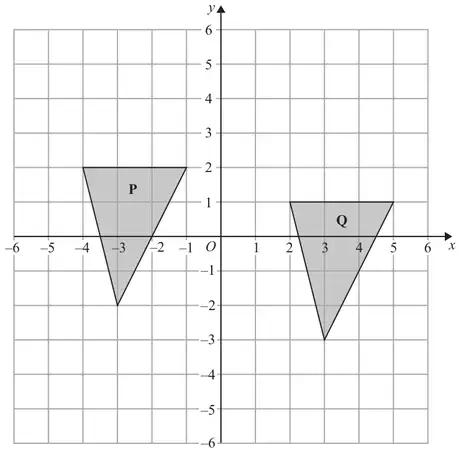
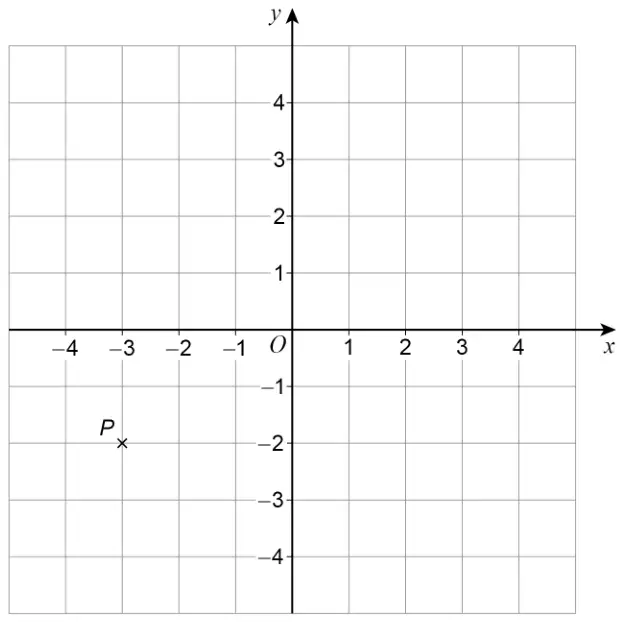
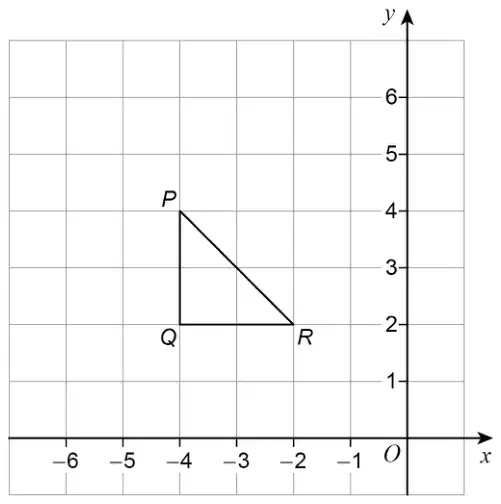
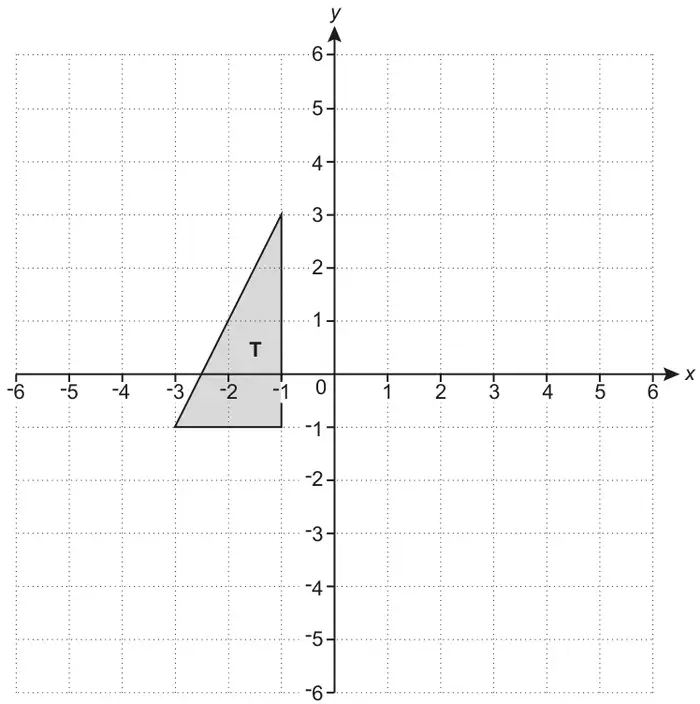
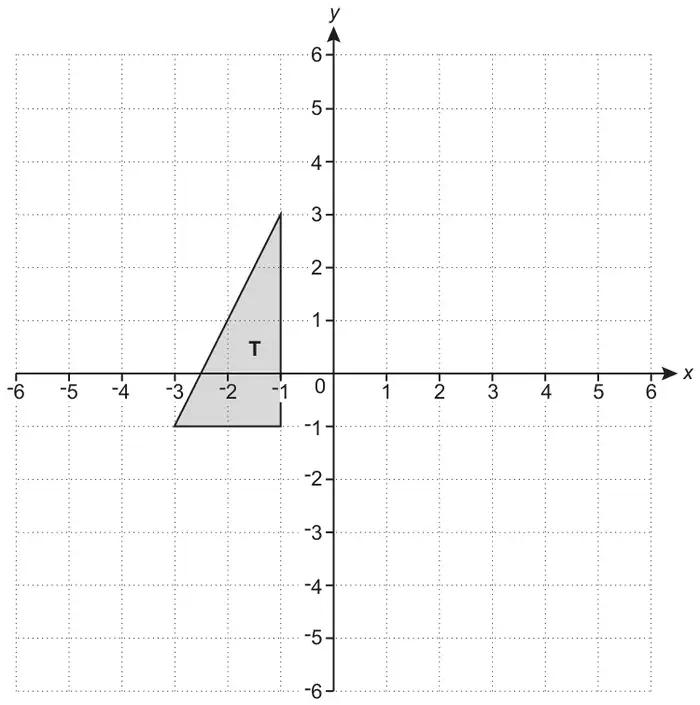
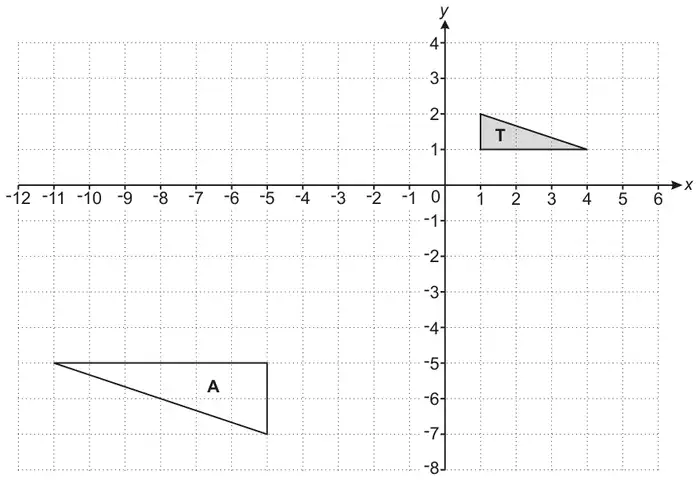
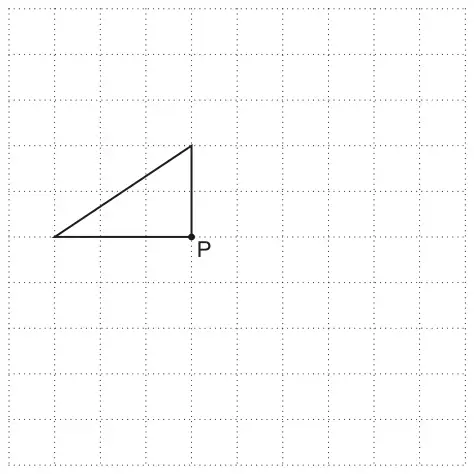
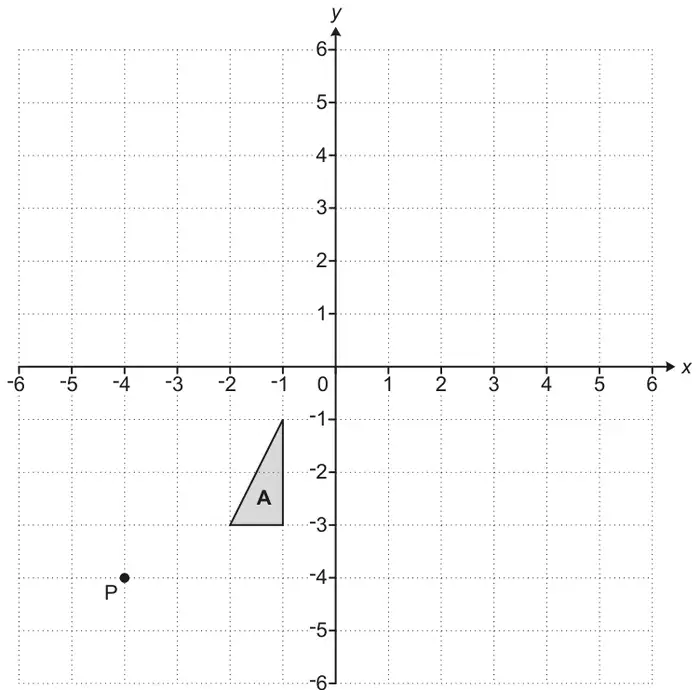
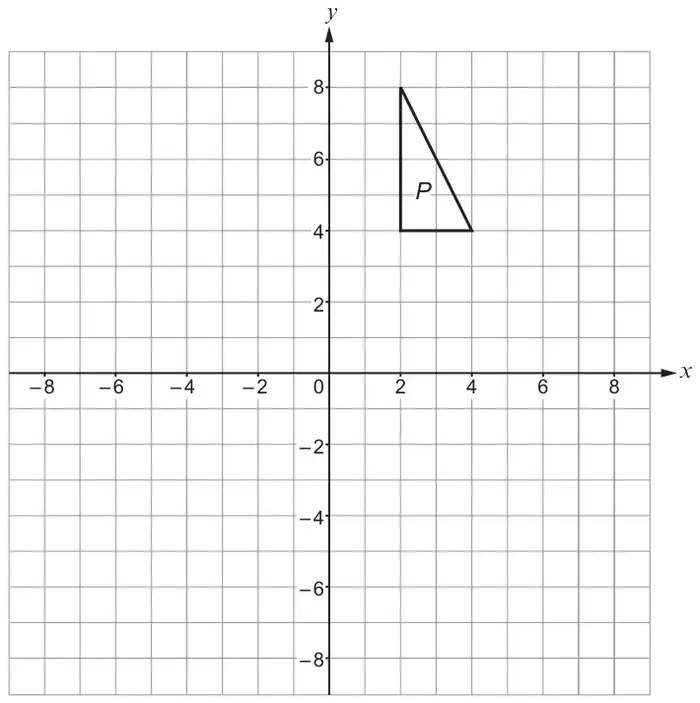
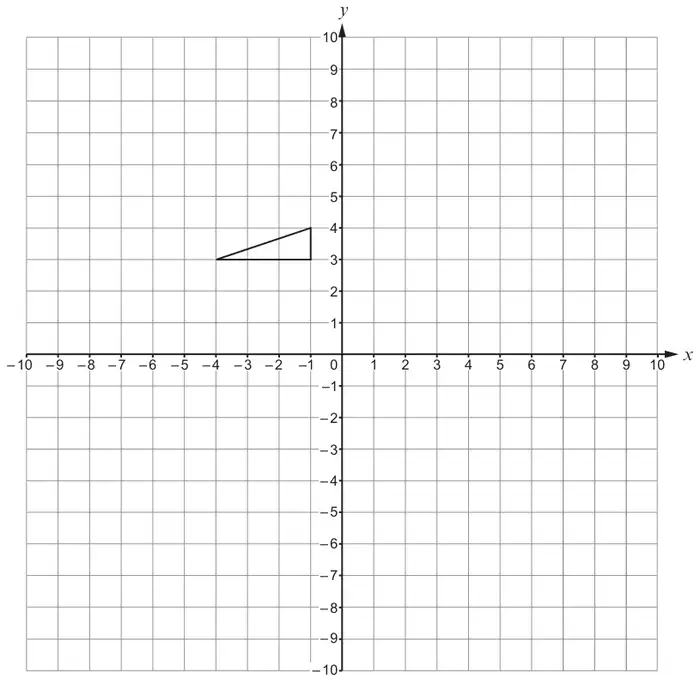
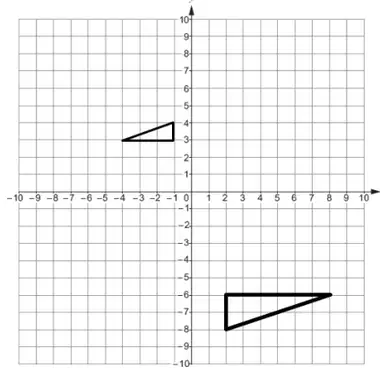
(a) Enlarge triangle P by scale factor \(-1\tfrac{1}{2}\) with centre of enlargement \((-2, -1)\) Label your image Q. (2)
Triangle P is transformed by a combined transformation of a rotation of 90° anticlockwise about the origin followed by a translation to give triangle R.
Exactly one vertex of triangle P is invariant under the combined transformation.
(b) Find one possible column vector for the translation. (1)
Mark scheme (a)
Answer
Mark
Mark scheme
Triangle drawn
B2
for correct enlargement at \((7, -10)\) \((4, -4)\) \((7, -4)\)
(B1
for triangle of correct size and orientation in the wrong position or for 2 vertices correct)
Additional guidance
Label not necessary provided intention is clear
Mark scheme (b)
Answer
Mark
Mark scheme
Correct vector
C1
for \(\begin{pmatrix} -5 \\ 7 \end{pmatrix}\) or \(\begin{pmatrix} -7 \\ 9 \end{pmatrix}\) or \(\begin{pmatrix} -3 \\ 13 \end{pmatrix}\)
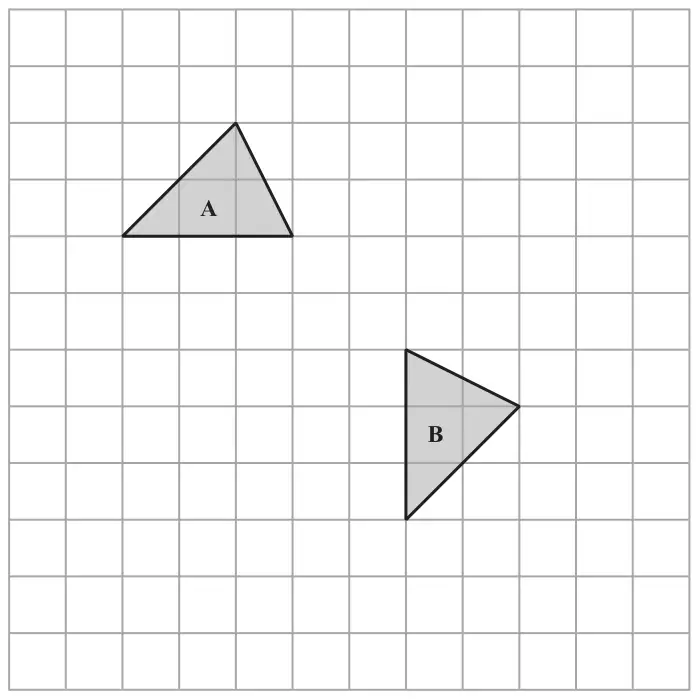
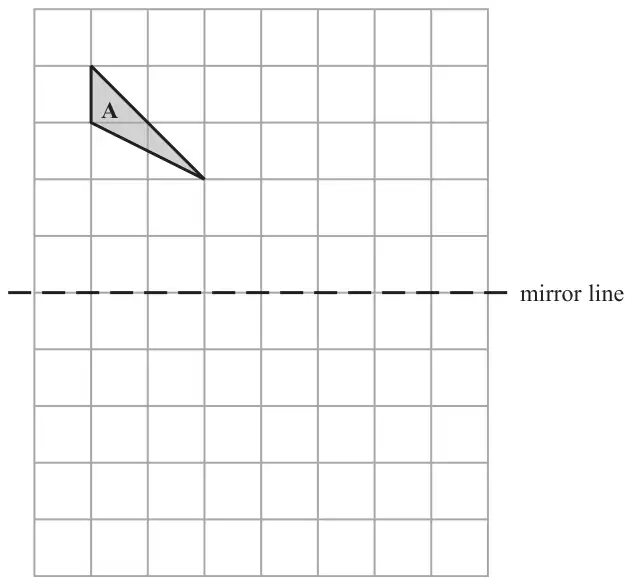
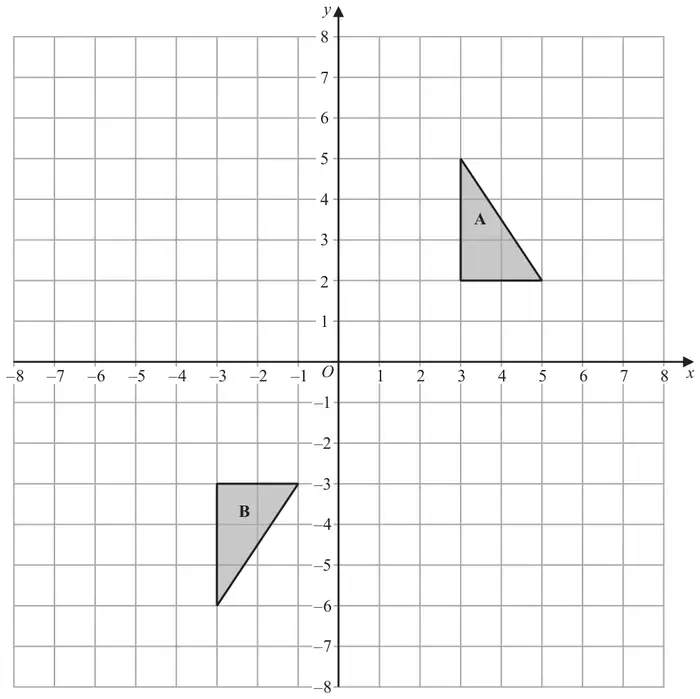
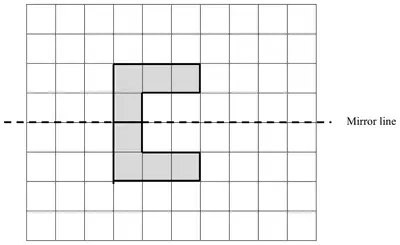
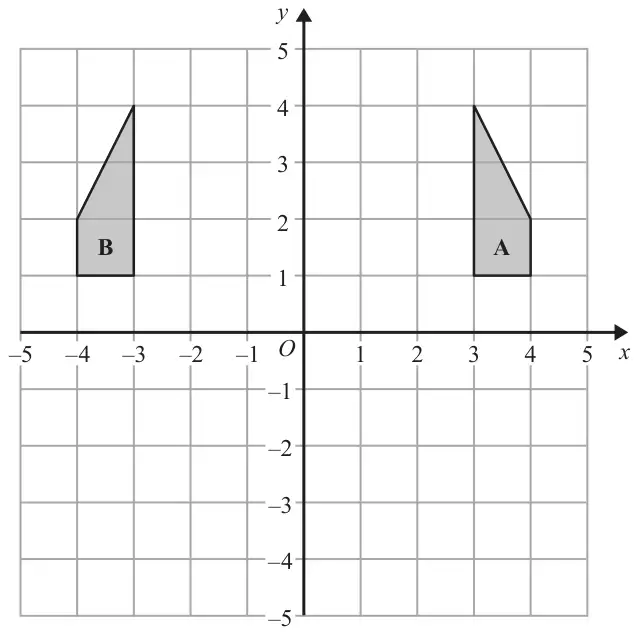
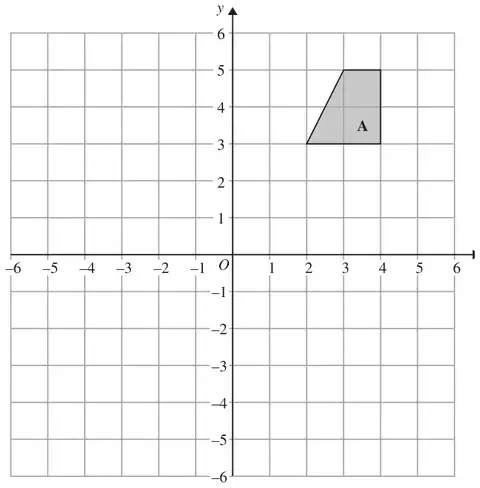
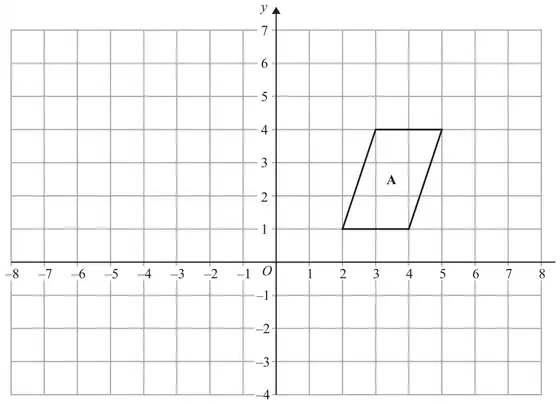
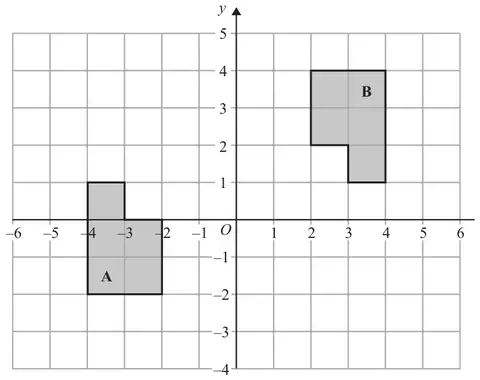
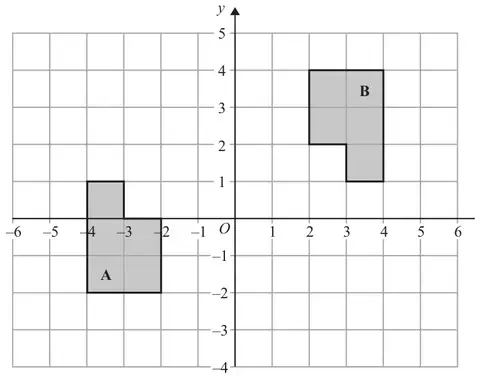
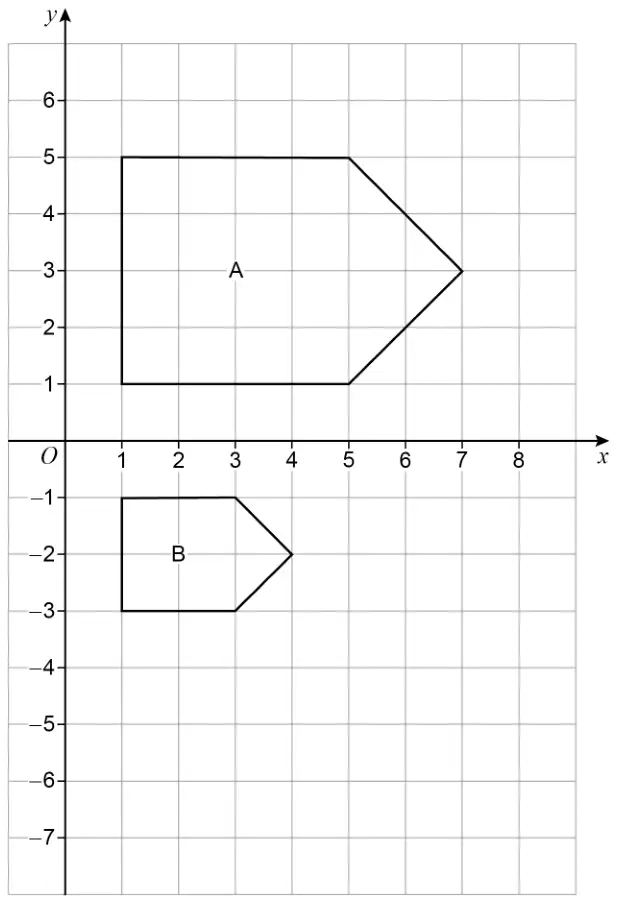
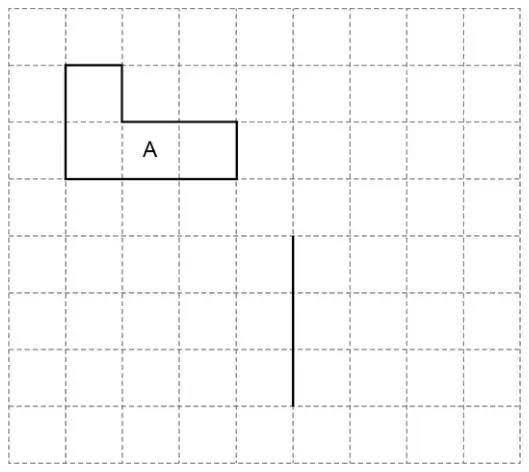
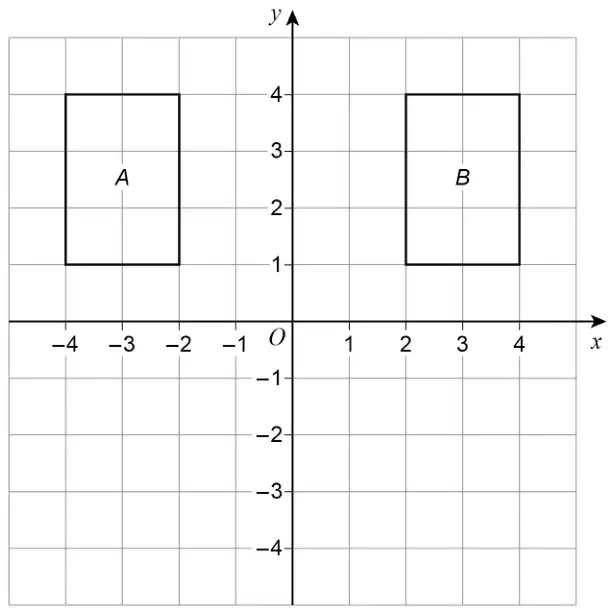
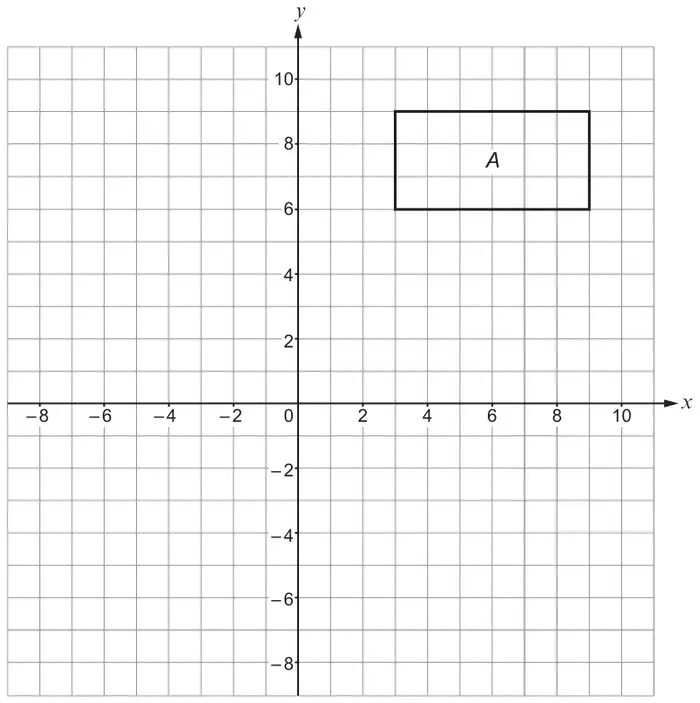
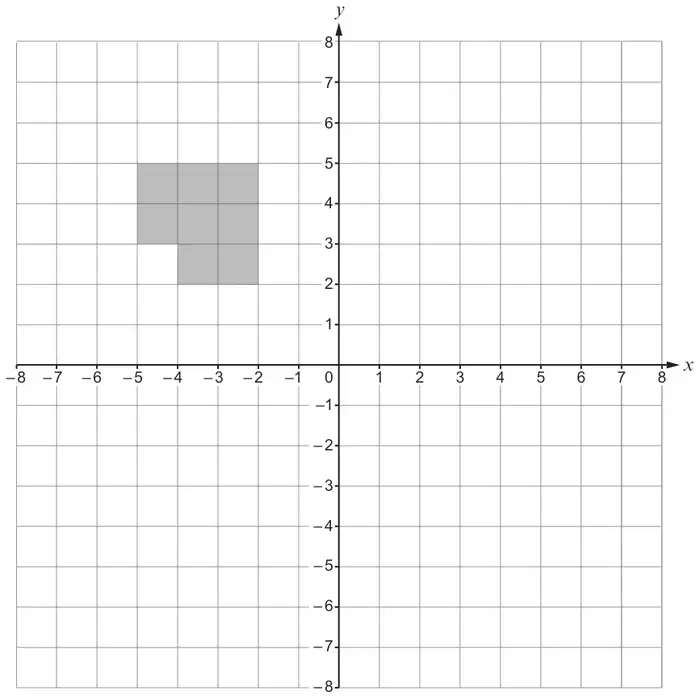
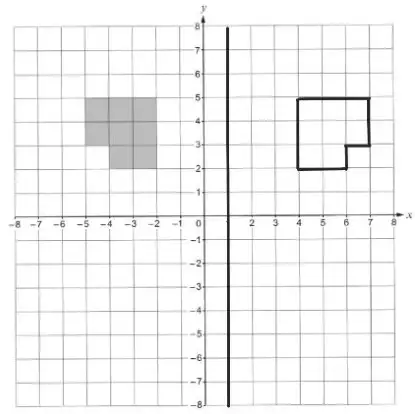
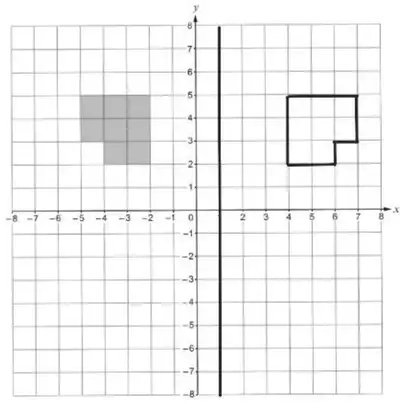
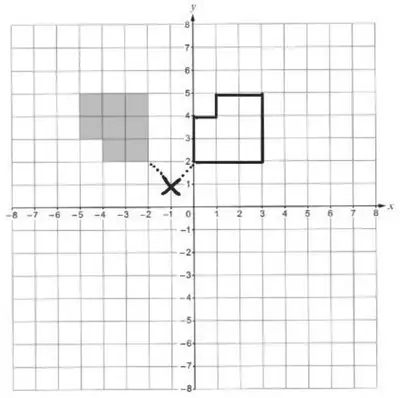
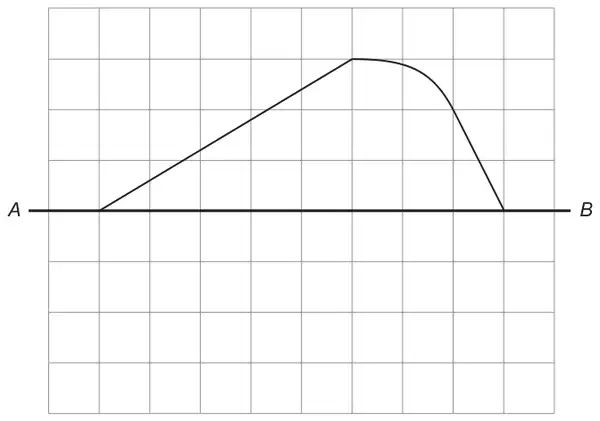
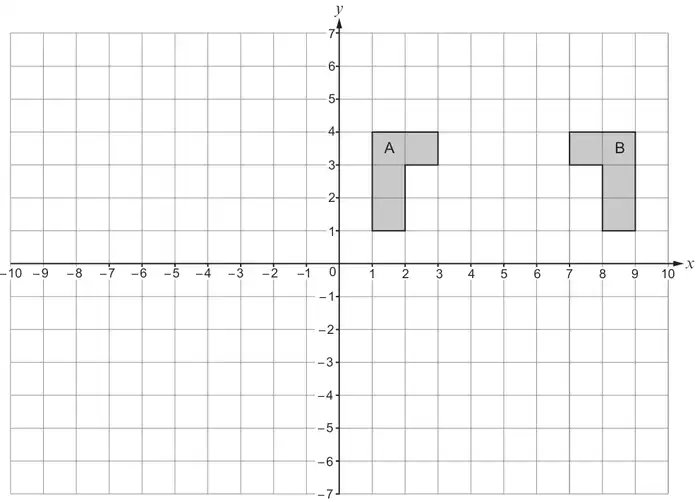
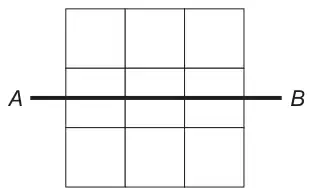
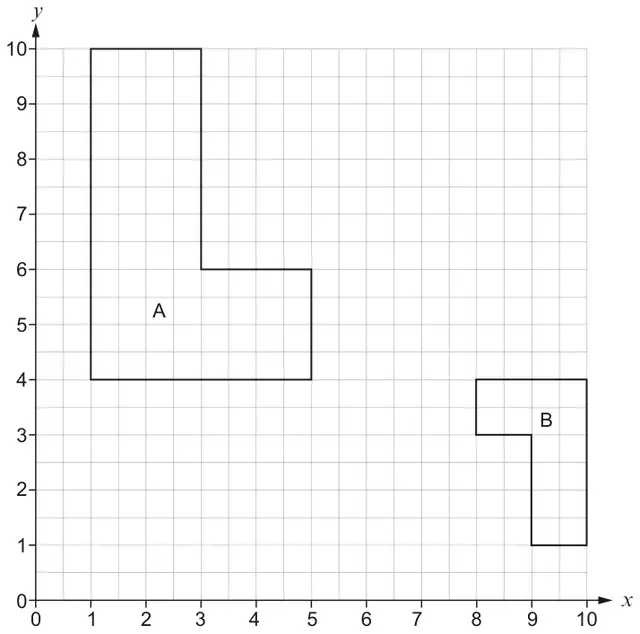
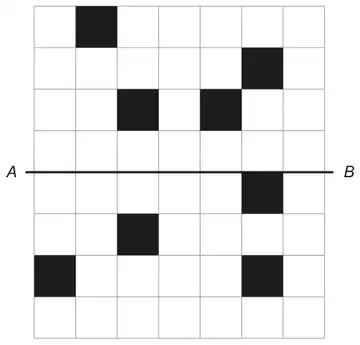
12 Shape A is reflected in a mirror line to give shape B.
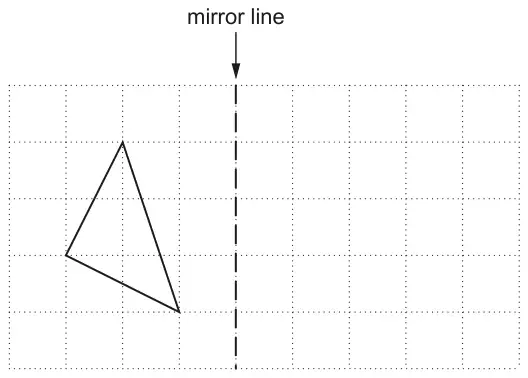
(a) On the grid, draw the mirror line. (1)
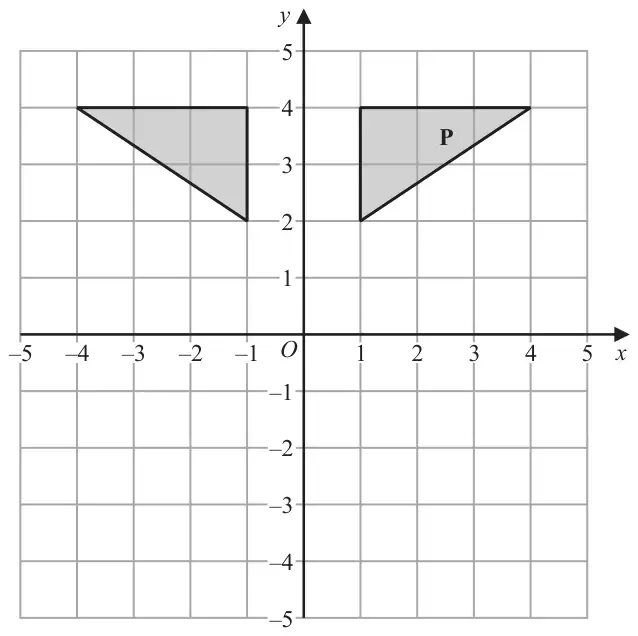
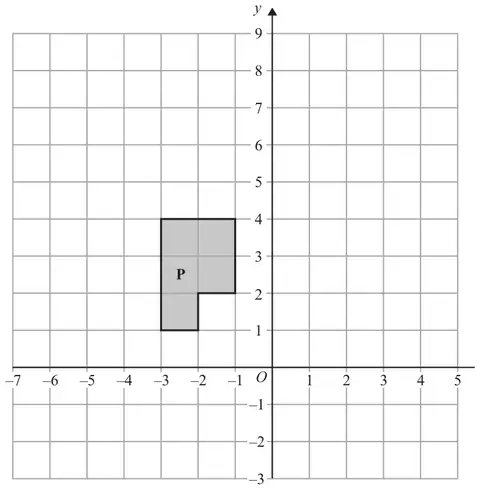
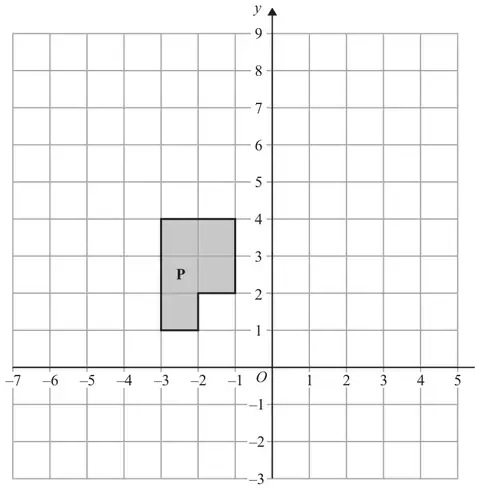
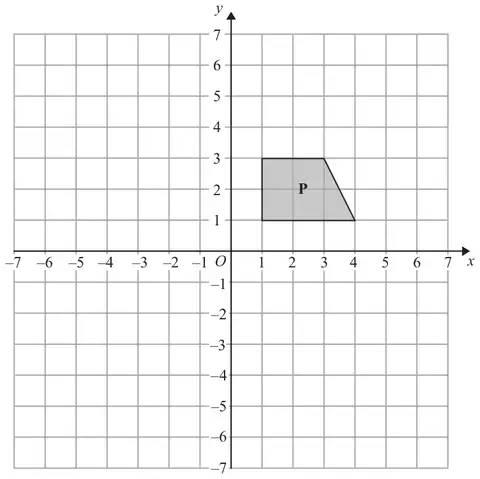
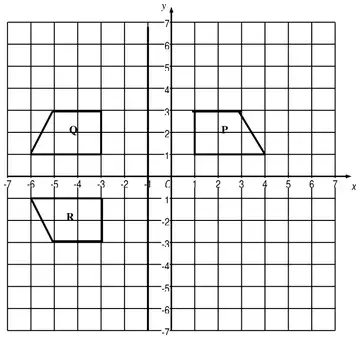
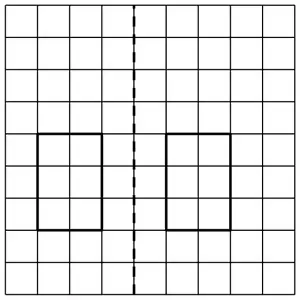
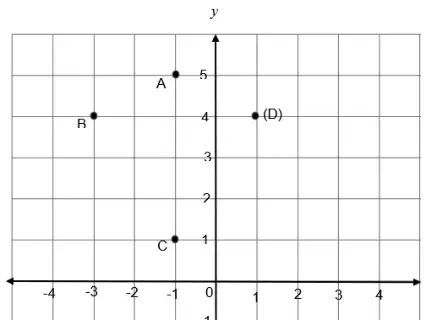
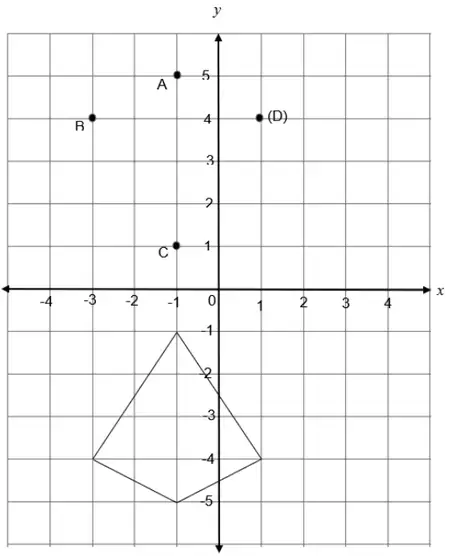
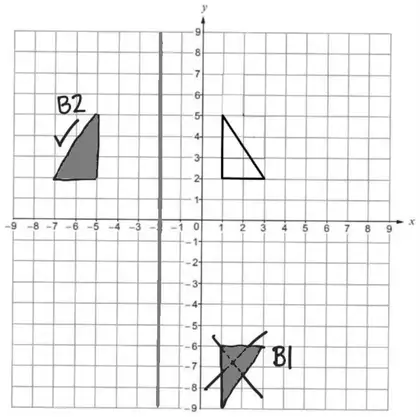
(b) Alex is asked to reflect shape P in the \(x\)-axis. Here is the diagram Alex draws.Explain the mistake Alex has made. (1)
Mark scheme (a)
Answer
Mark
Mark scheme
Line drawn
B1
for correct line shown on diagram, provided unambiguous
Mark scheme (b)
Answer
Mark
Mark scheme
Explanation
C1
for explanation, eg he has reflected in the \(y\)-axis (not the \(x\)-axis)
Acceptable examples Alex didn’t reflect in/on the \(x\)-axis She/he drew it on the \(y\)-axis or he didn’t draw it on the \(x\)-axis It should be in the bottom right box Used a mirror on the \(y\)-axis (not \(x\)-axis) It needs to be reflected down not across Vertical (reflection) instead of horizontal (reflection) Drawn in the correct position on grid and statement “it should be here”
Not acceptable examples the reflection is facing the wrong way It’s in the wrong box or it should be on the bottom She/he has flipped it wrong It needs to go down not across She/he (should have) used a mirror There is no label or label in the wrong place Alex reflected the shape
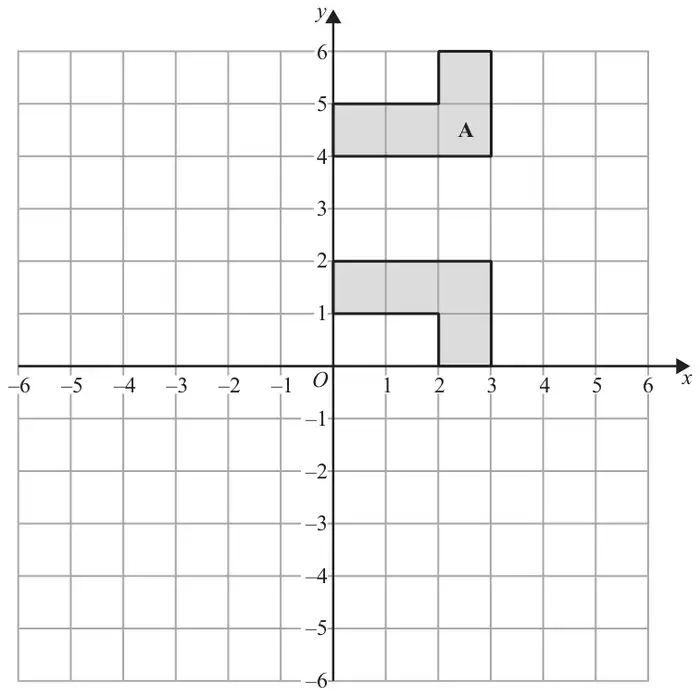
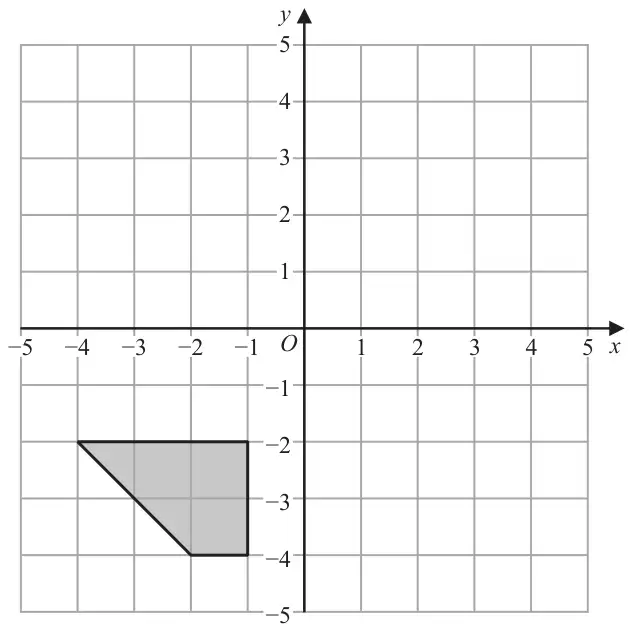
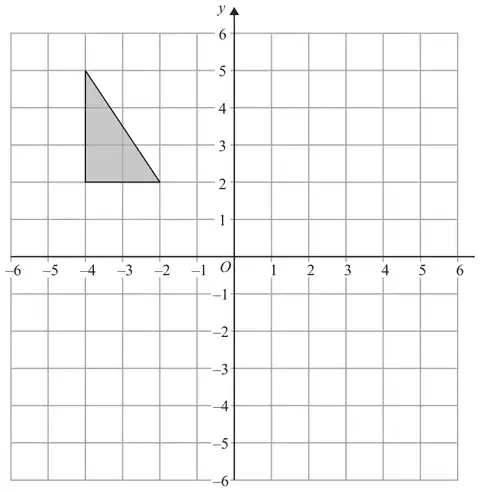
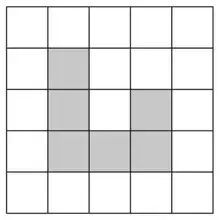
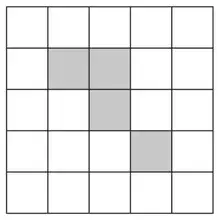
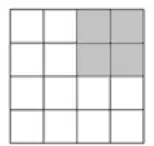
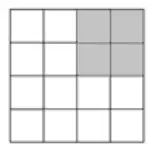
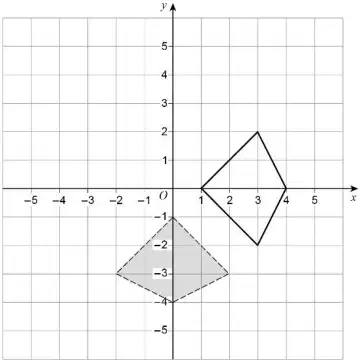
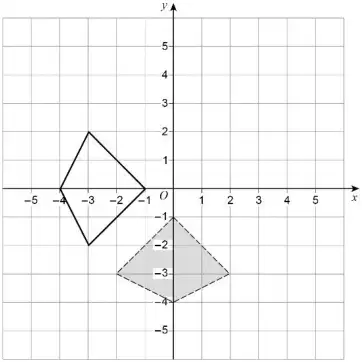
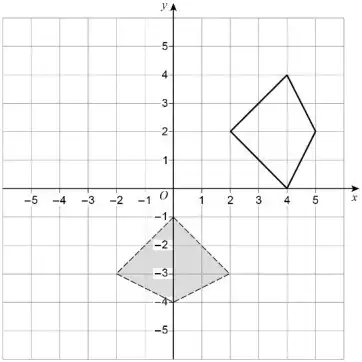
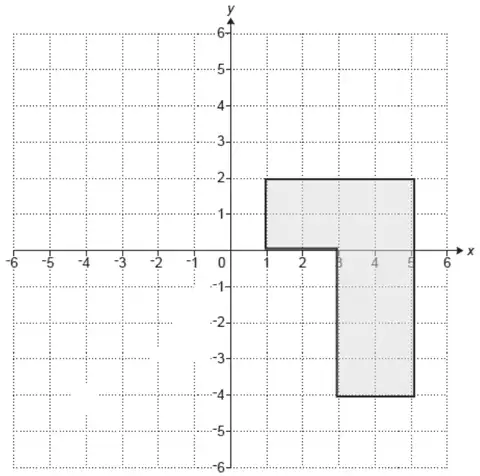
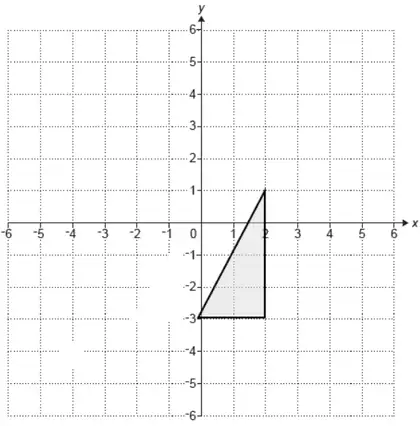
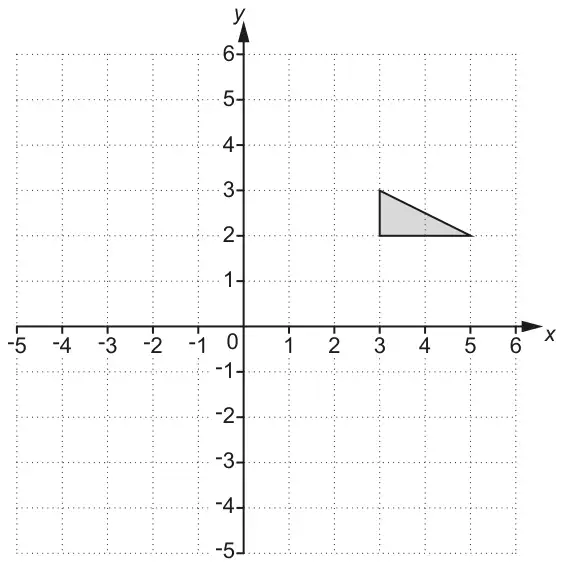
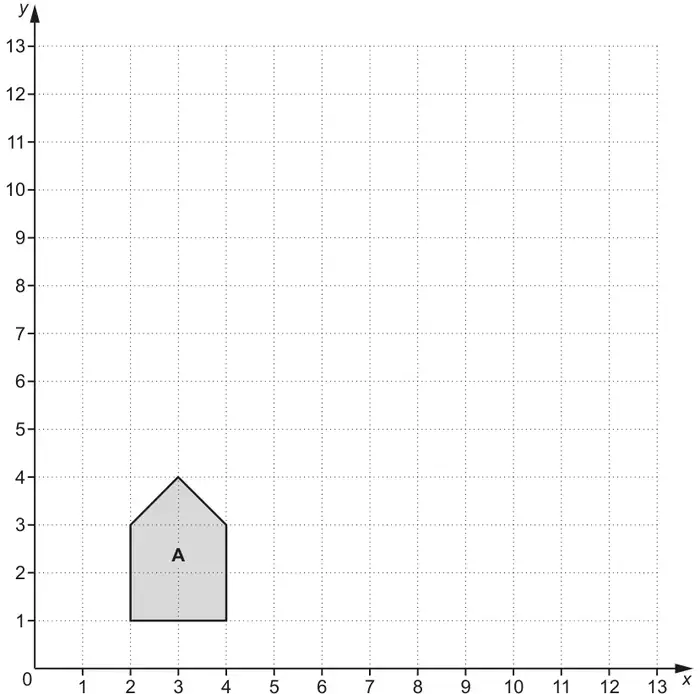
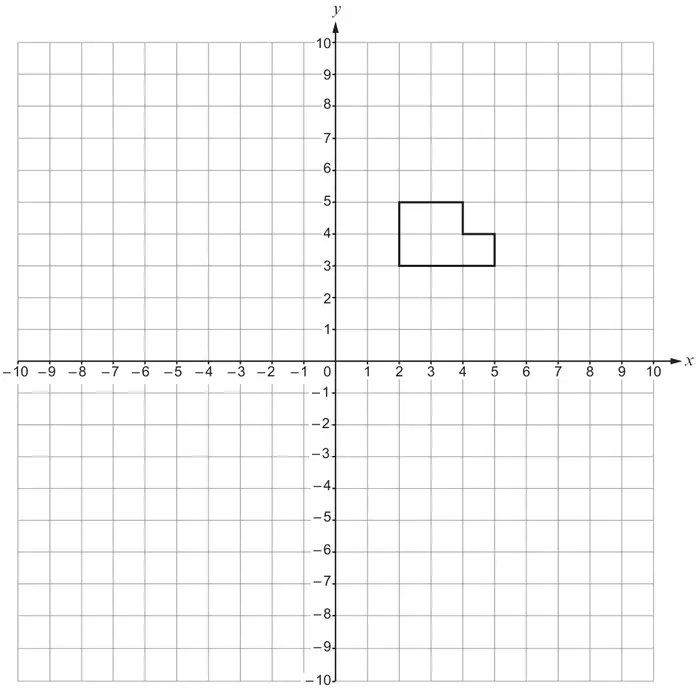
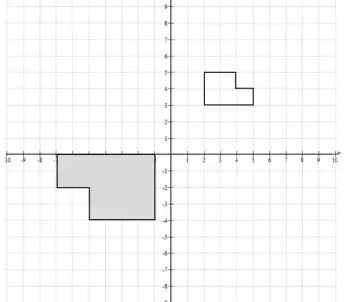
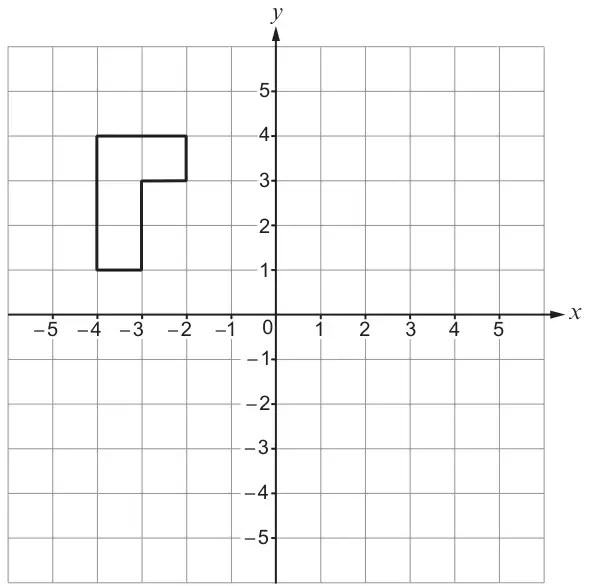
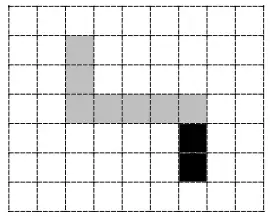
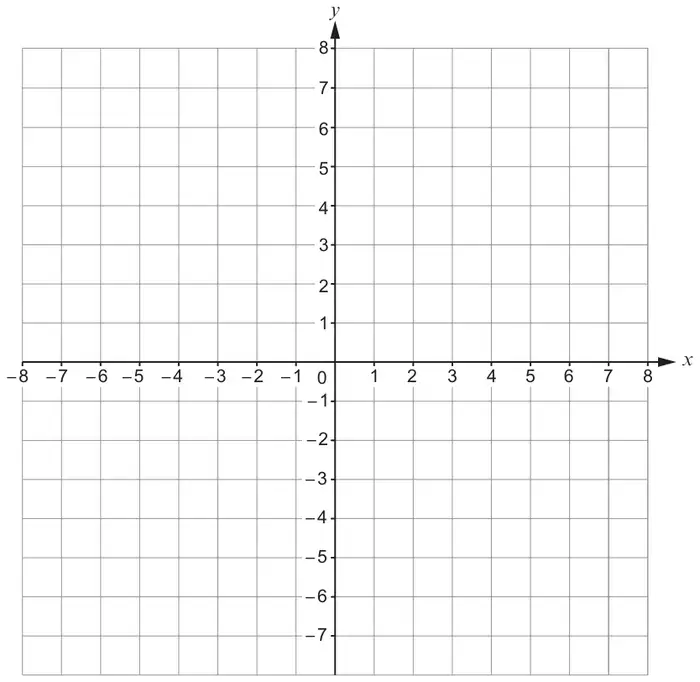
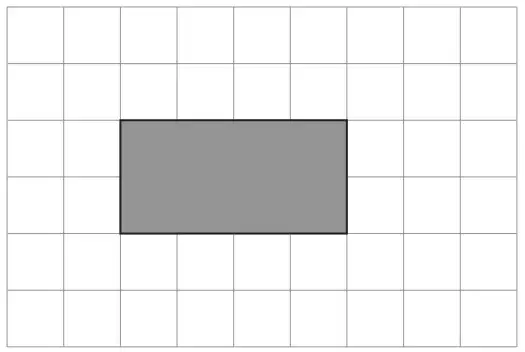
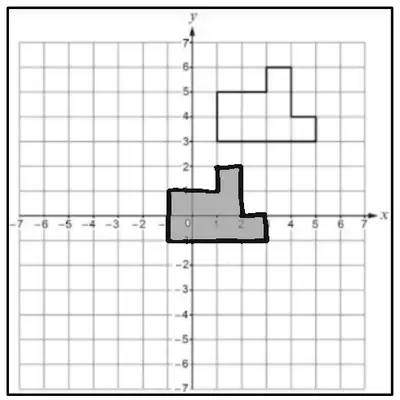
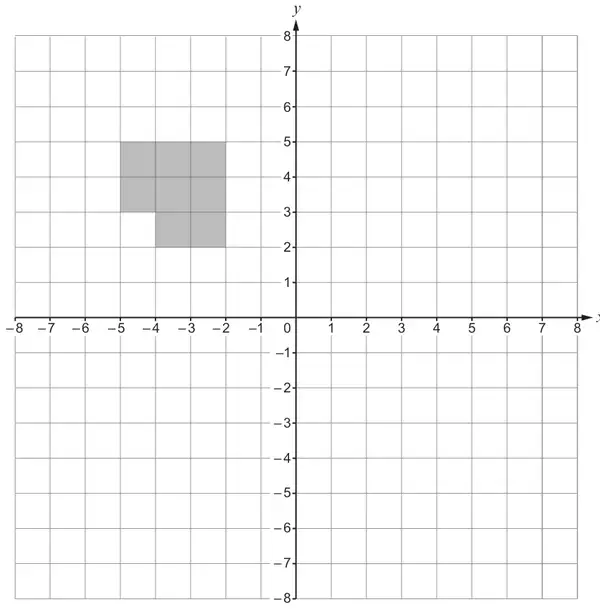
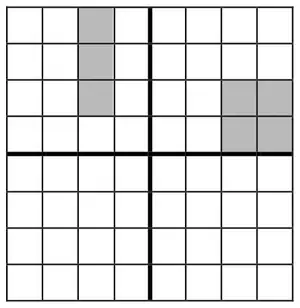
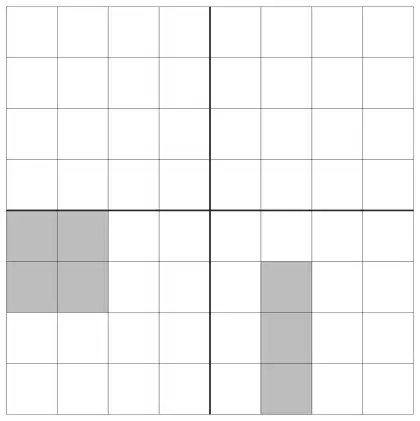
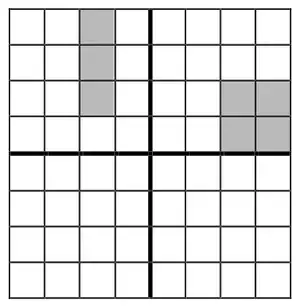
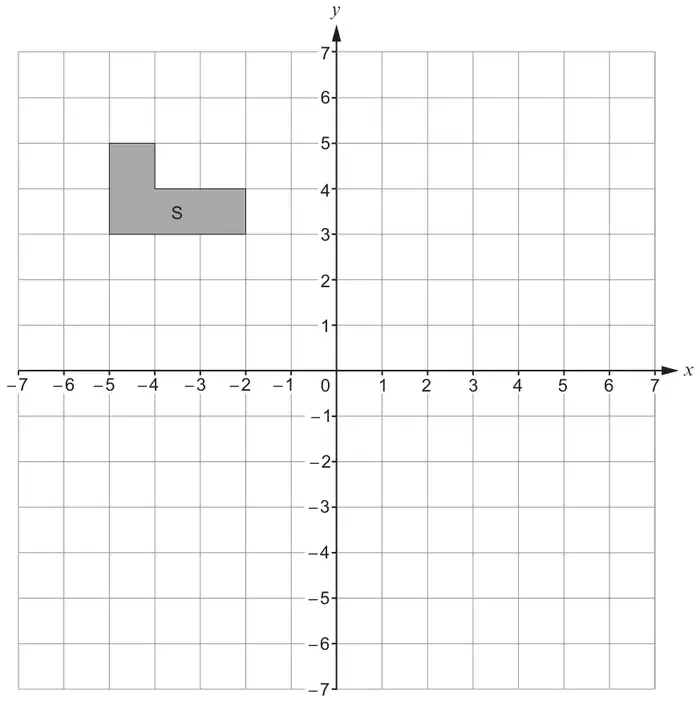
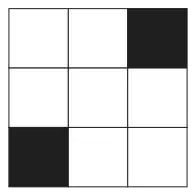
Rotate the shaded shape 90° anticlockwise about (0,0) (2)
Mark scheme
Answer
Mark
Mark scheme
Rotation drawn
B2
correct shape drawn at \((2,-1), (2,-4), (4,-2), (4,-1)\)
(B1
for a correct shape drawn clockwise 90° about (0,0) or a shape drawn in the correct quadrant with the correct orientation or a shape with at least 3 vertices correct)
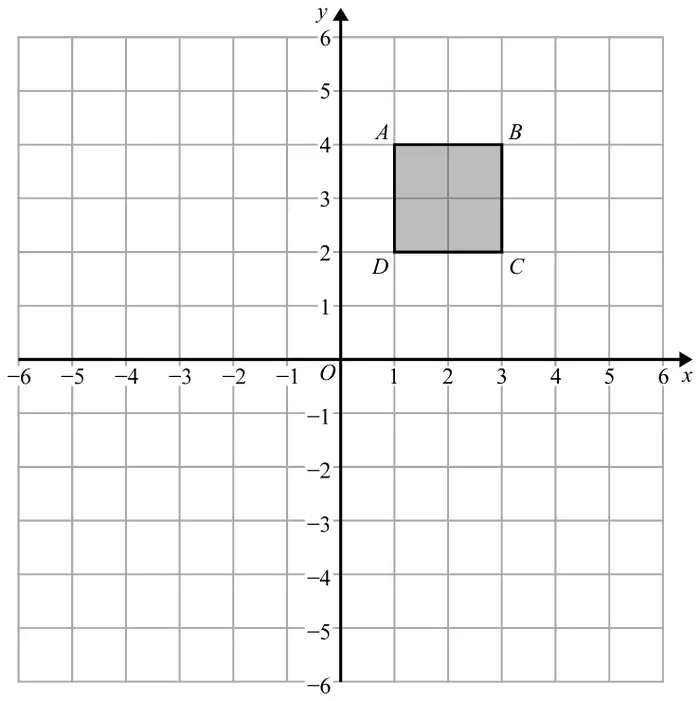
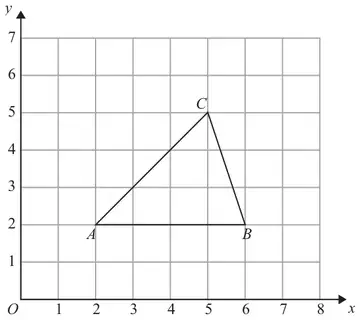
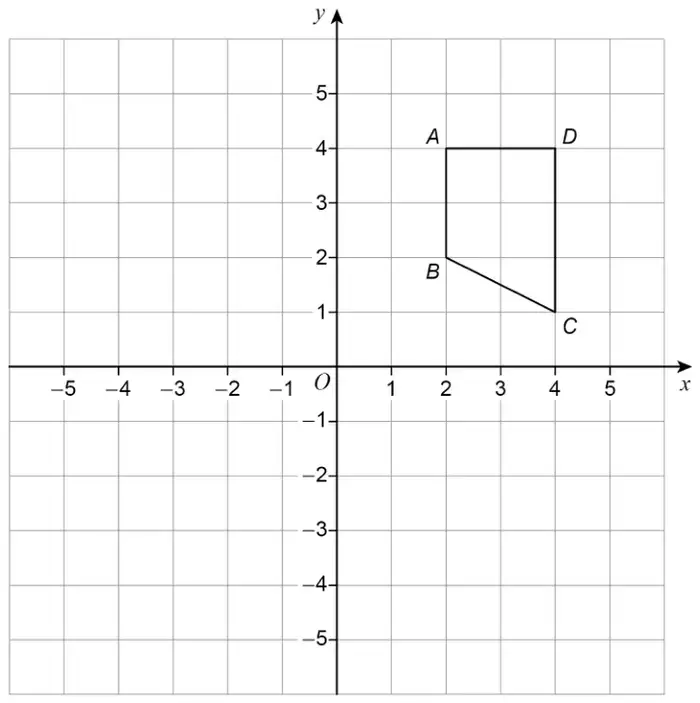
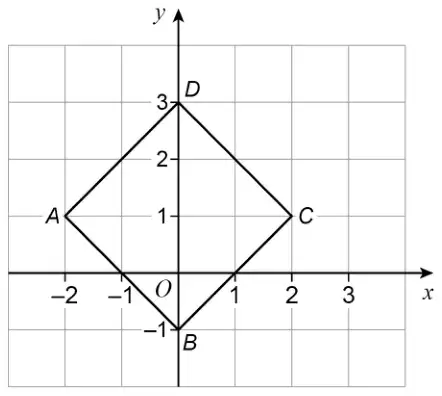
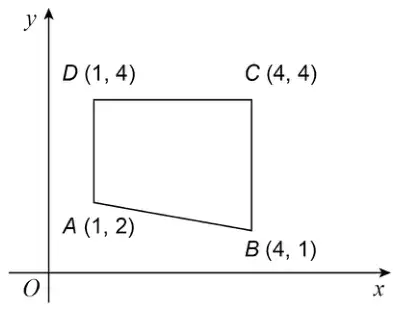
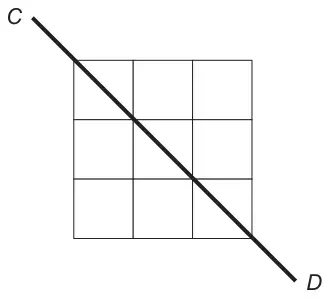
Square \(ABCD\) is transformed by a combined transformation of a reflection in the line \(x = -1\) followed by a rotation.
Under the combined transformation, two vertices of the square \(ABCD\) are invariant.
Describe fully one possible rotation. (2)
Mark scheme
Answer
Mark
Mark scheme
Description
C2
for (rotation) \(90^\circ\) clockwise about \((-1, 0)\) or (rotation) \(90^\circ\) anticlockwise about \((-1, 6)\) or (rotation) \(180^\circ\) about \((-1, 2)\) or (rotation) \(180^\circ\) about \((-1, 4)\)
(C1
for \((-1, 0)\) or \((-1, 6)\) or \((-1, 2)\) or \((-1, 4)\))
Additional guidance
Award 0 marks if there is reference to other transformations eg coordinates given as vectors (which is a translation)
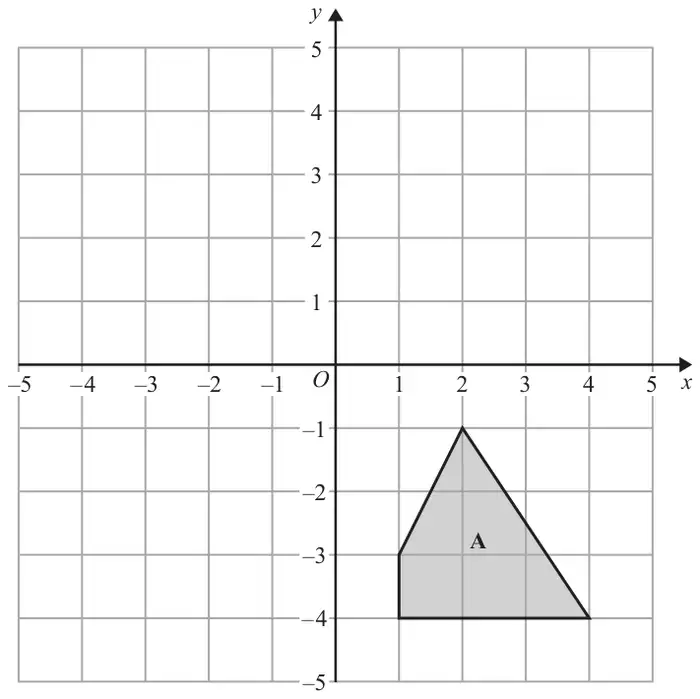
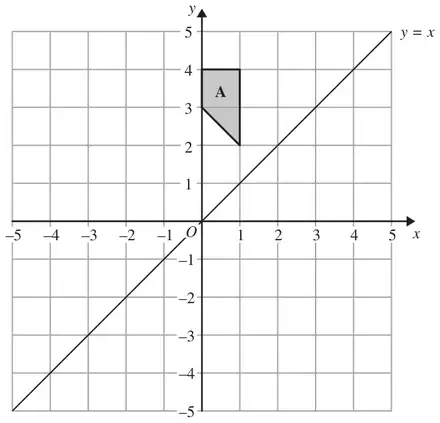
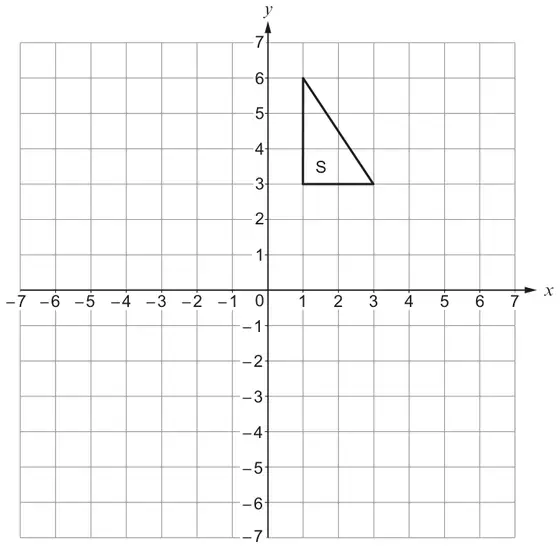
for a correct reflection in the line \(y = a\) or a correct reflection in the line \(x = 3\), or triangle in correct orientation with 2 of 3 vertices correct)
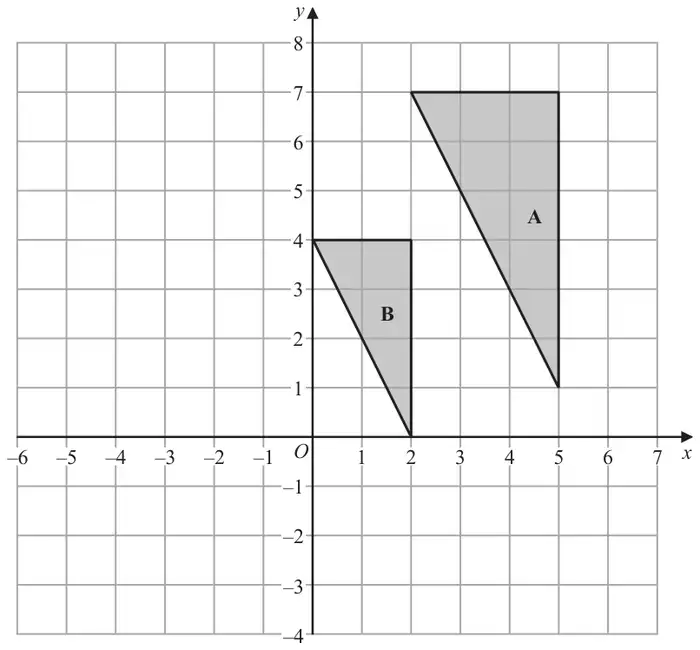
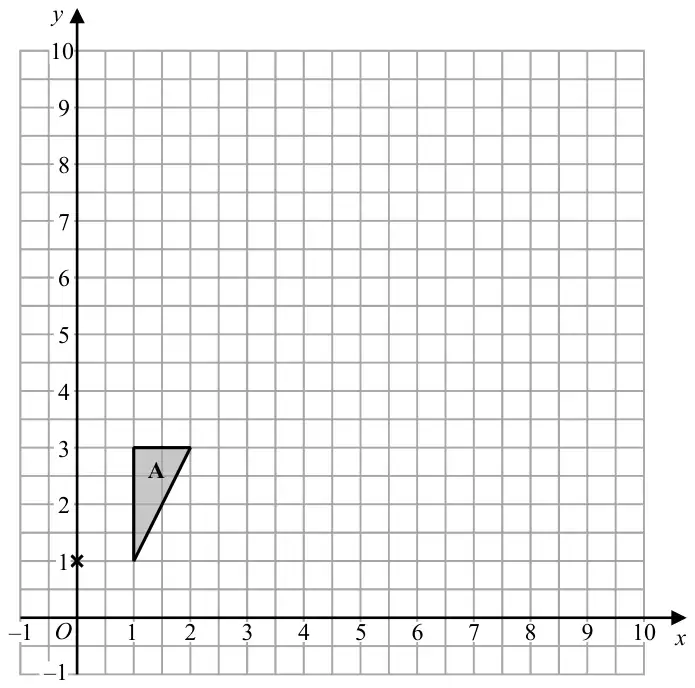
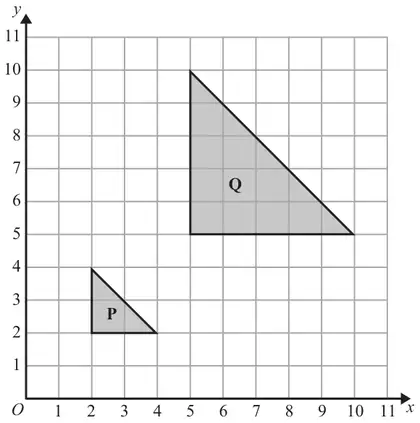
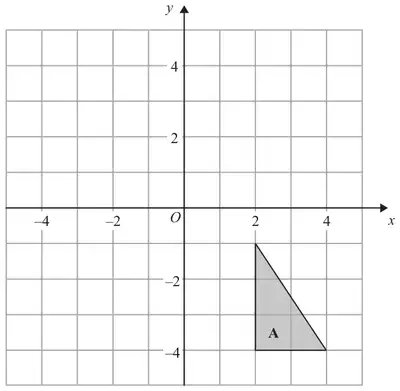
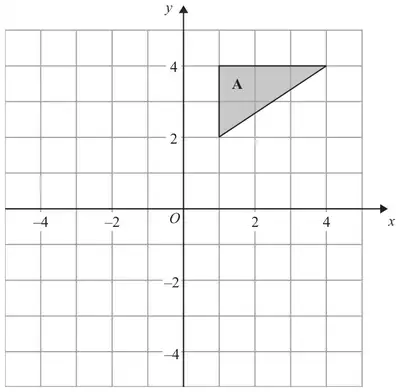
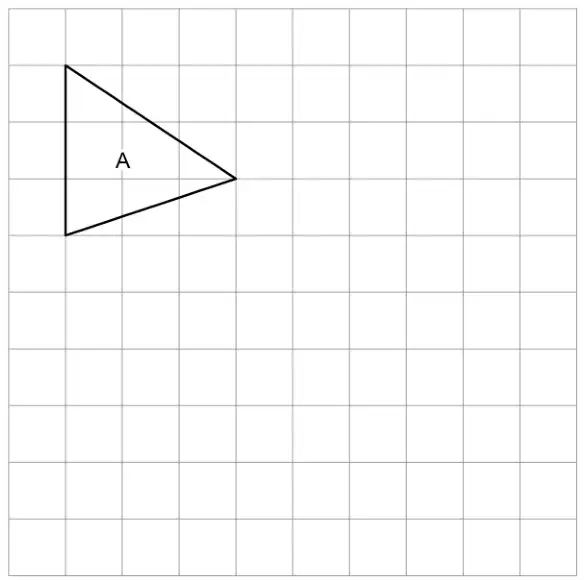
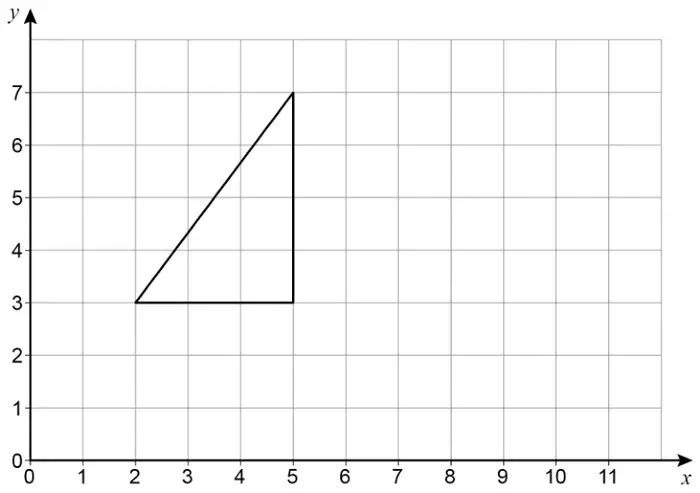
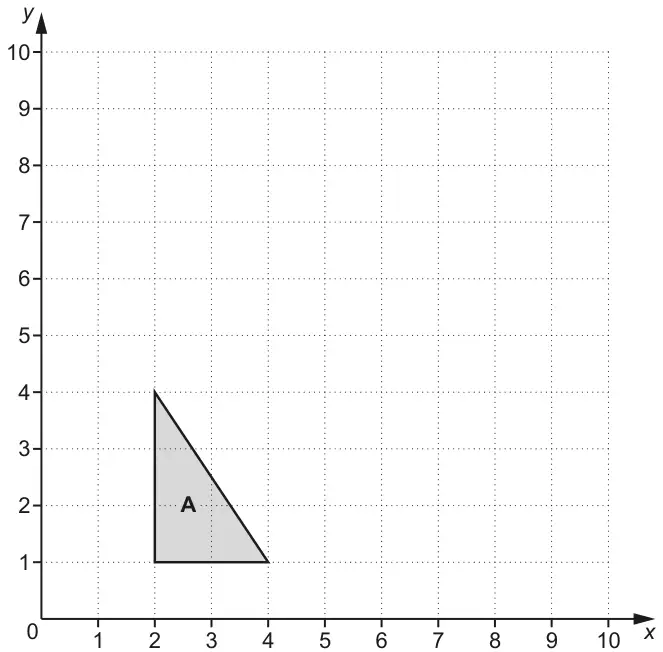
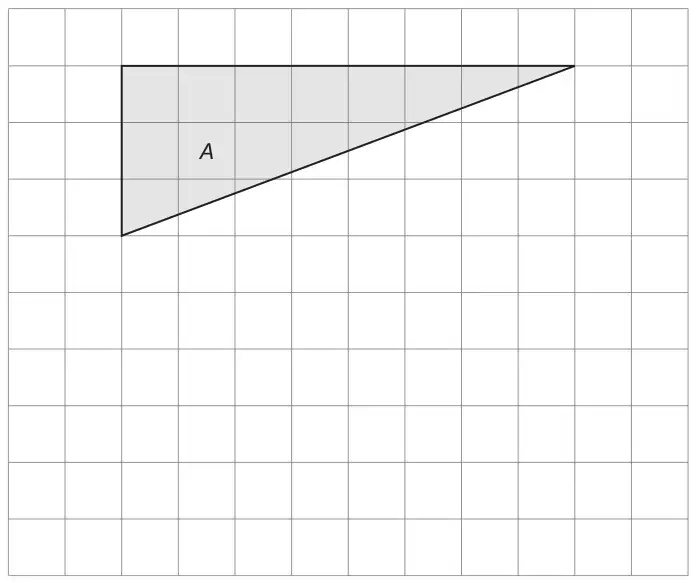
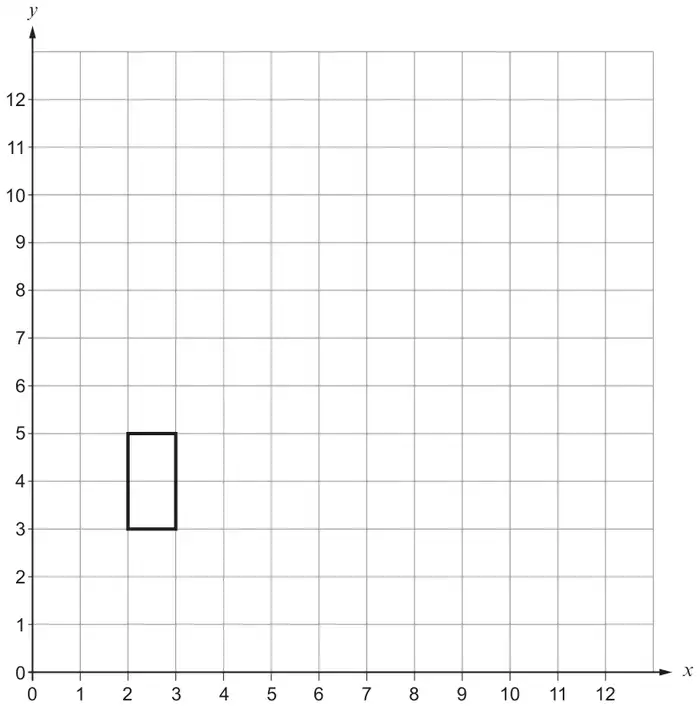
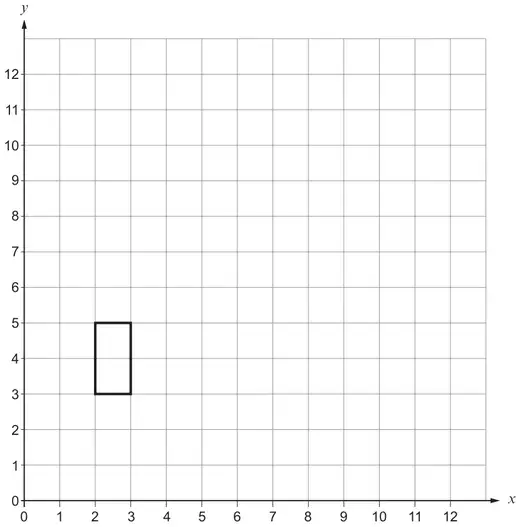
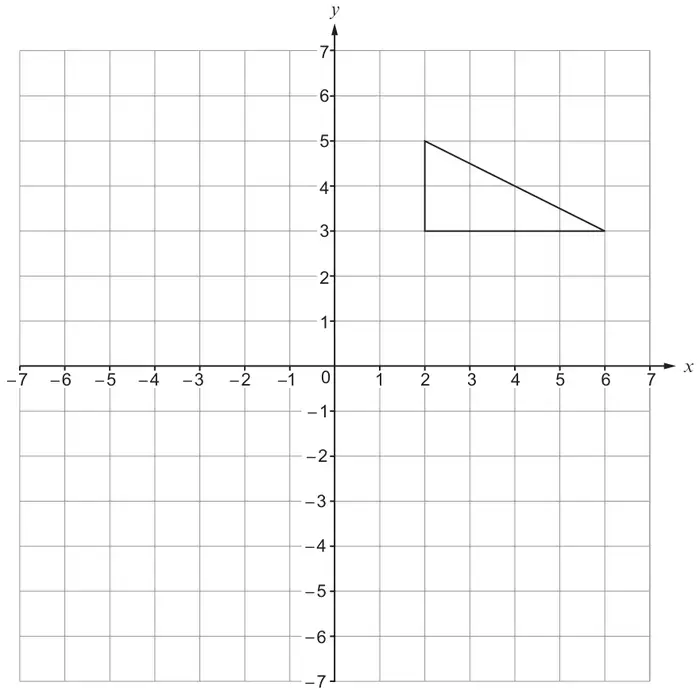
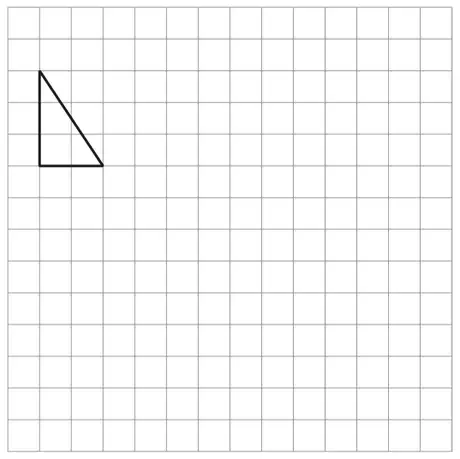
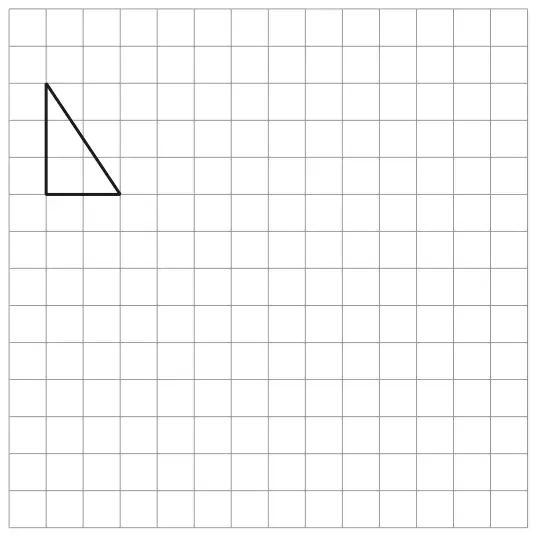
Enlarge triangle A by scale factor 2.5 with centre (0, 1) (2)
Mark scheme
Answer
Mark
Mark scheme
Enlargement
B2
vertices at (2.5, 1) (2.5, 6) (5, 6)
(B1
for triangle of the correct size and orientation in the wrong position or a correct enlargement of a different scale factor centre (0, 1) or correct orientation with 2 of 3 vertices correct)
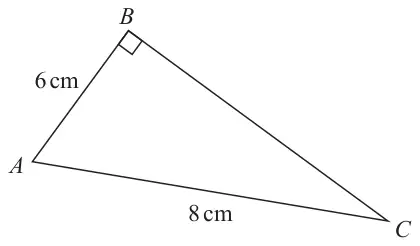
(a) What mistake has Sarah made in her method? (1)
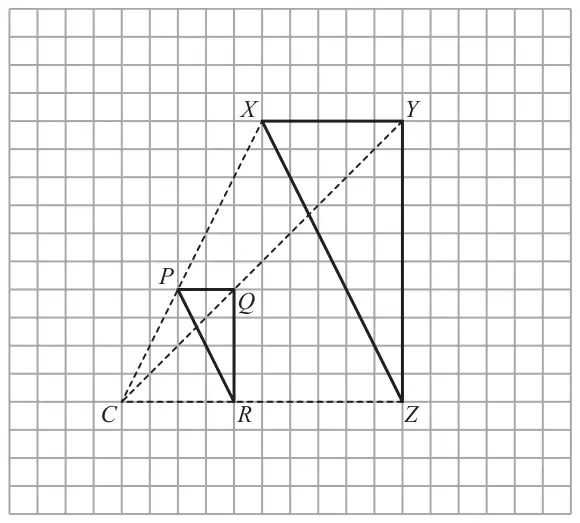
Roy is going to enlarge triangle \(PQR\) with centre \(C\) and scale factor \(1\frac{1}{2}\) He draws triangle \(XYZ\).
(b) Explain why Roy’s diagram is not correct. (1)
Mark scheme (a)
Answer
Mark
Mark scheme
Mistake described
C1
for statement describing a mistake Acceptable eg should be \(AC^2 - AB^2\) she should do \(8^2 - 6^2\) she should be subtracting not adding the numbers she thought that \(BC\) was the hypoteneuse when it was actually \(AC\) should be \(BC^2 + AB^2 = AC^2\) should be \(8^2 = 6^2 + BC^2\) Not acceptable eg she has not used Pythagoras correctly \(6^2 + 8^2\) is 120 the answer should be \(\sqrt{28}\) or 5 or 5.3 or 5.2915 \(BC + AB = AC\)
Mark scheme (b)
Answer
Mark
Mark scheme
Explanation
C1
for explanation Acceptable examples the scale factor used is 2.5 \(5 \div 2\) is not 1.5 \(10 \div 4\) is more than 1.5 the scale factor is not 1.5 he has not used the correct scale factor has enlarged it by too much \(ZY\) should be 6 Not acceptable examples the grid is not large enough he has used the wrong centre
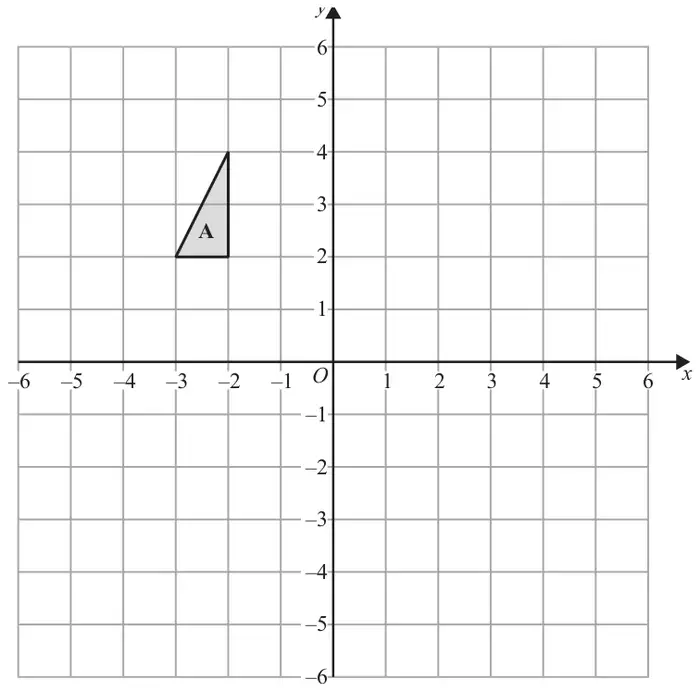
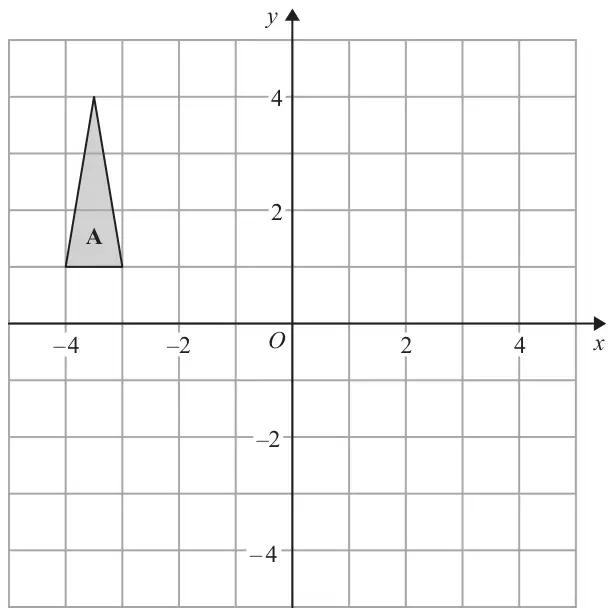
Triangle A is transformed by the combined transformation of a rotation of \(180^\circ\) about the point \((-2, 0)\) followed by a translation with vector \(\begin{pmatrix} -3 \\ 2 \end{pmatrix}\)
One point on triangle A is invariant under the combined transformation.
Find the coordinates of this point. (2)
Mark scheme
Answer
Mark
Mark scheme
\((-3.5, 1)\)
M1
for a complete method to show the transformations
A1
cao
Additional guidance
Image at \((-4, 1)\), \((-3, 1)\) and \((-3.5, -2)\)
Triangle P is reflected in the line \(y = -x\) to give triangle Q. Triangle Q is reflected in the line \(x = -1\) to give triangle R.
Describe fully the single transformation that maps triangle R to triangle P. (3)
Mark scheme
Answer
Mark
Mark scheme
Rotation \(90^\circ\) anticlockwise centre \((-1, 1)\)
M1
stating rotation or for showing R [(1,1), \((1, -3)\), \((3, -3)\)]
A1
for rotation of \(90^\circ\) anticlockwise
A1
for centre \((-1, 1)\) given as a coordinate.
Additional guidance
Award for a triangle in the correct position without the label R as long as this is the only triangle in lower right quadrant.
Accept rotation of \(270^\circ\) clockwise
Can be given as a coordinate alone. Do not award A marks if there is evidence of other transformations in the description, or other ambiguity in the answer given.
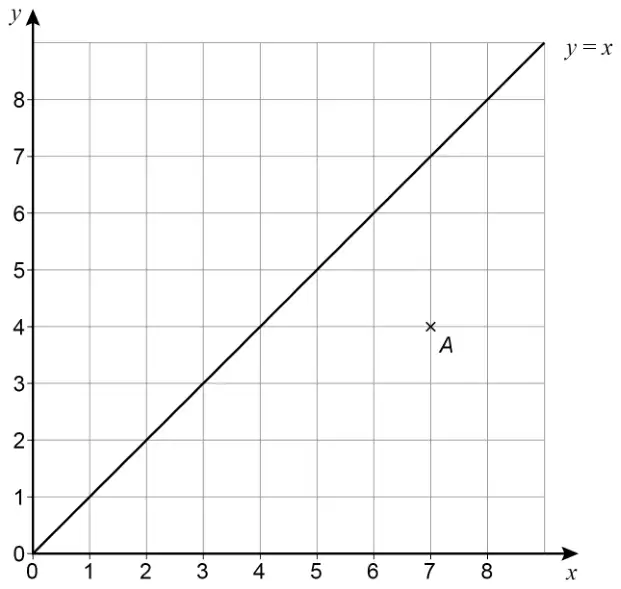
Kyle reflects triangle A in the \(x\)-axis to get triangle B. He then reflects triangle B in the line \(y = x\) to get triangle C.
Amy reflects triangle A in the line \(y = x\) to get triangle D. She is then going to reflect triangle D in the \(x\)-axis to get triangle E.
Amy says that triangle E should be in the same position as triangle C.
Is Amy correct? You must show how you get your answer. (3)
Mark scheme
Answer
Mark
Notes
No (supported)
M2
for the correct position of C or E
[M1
for a correct position of B or D]
C1
for No with correct supporting evidence, eg. showing C and E in the correct positions
OR
M2
for C is a rotation of \(90^\circ\) anticlockwise about \(O\) or E is a rotation of \(90^\circ\) clockwise about \(O\)
C1
for No with supporting evidence, eg. C is a rotation of \(90^\circ\) anticlockwise about \(O\) and E is a rotation of \(90^\circ\) clockwise about \(O\).
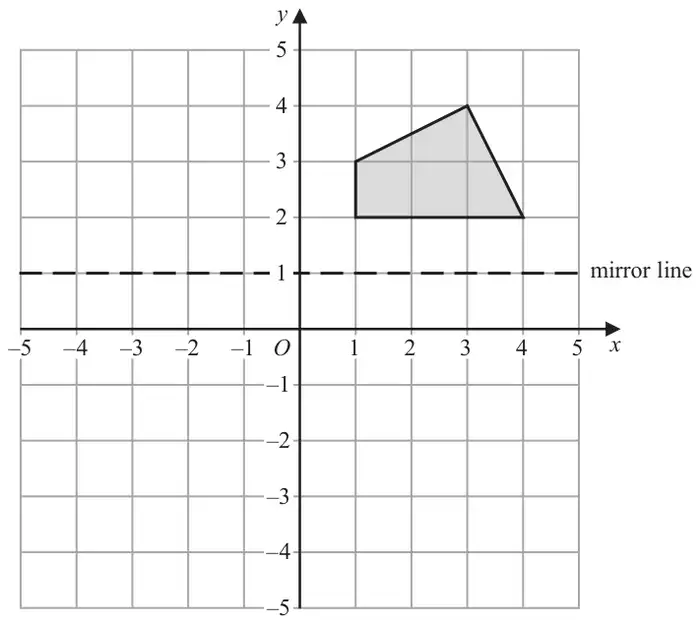
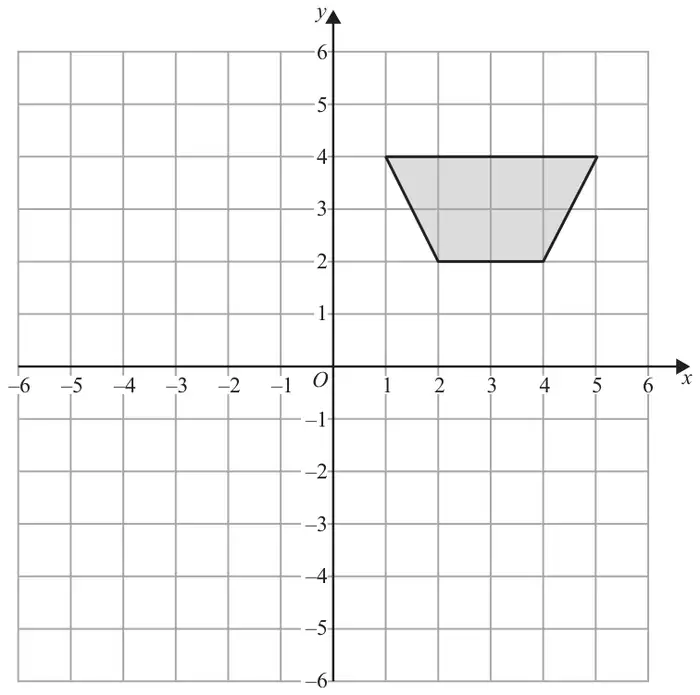
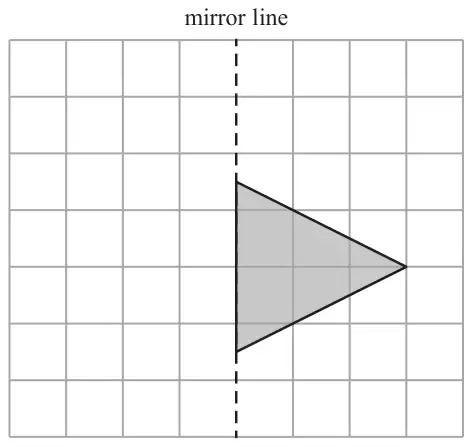
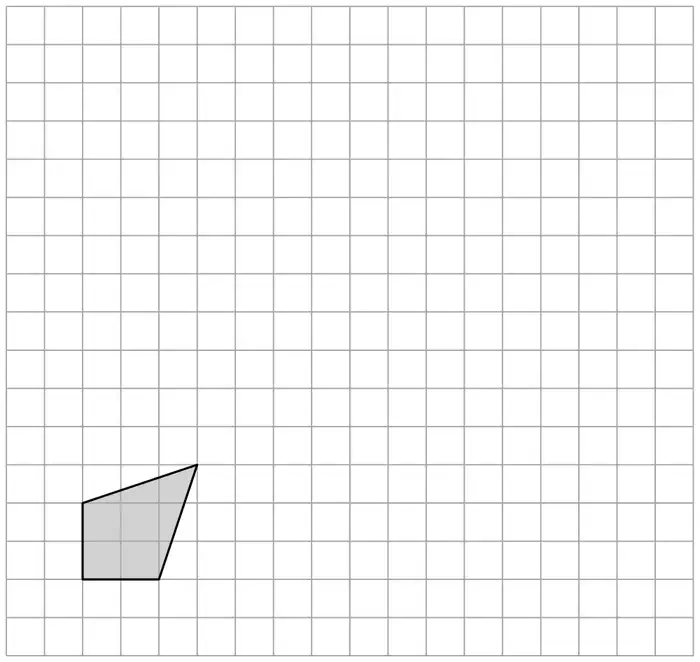
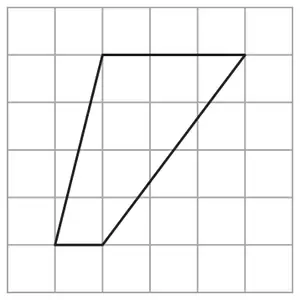
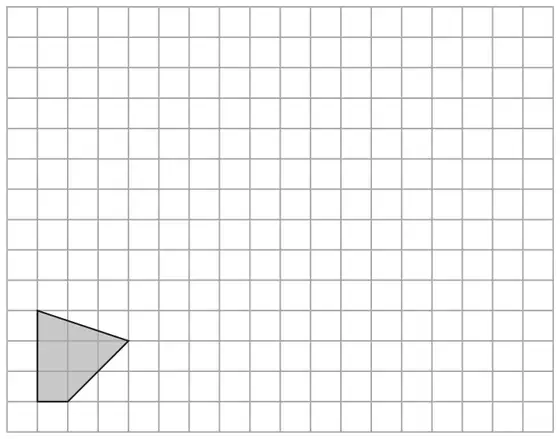
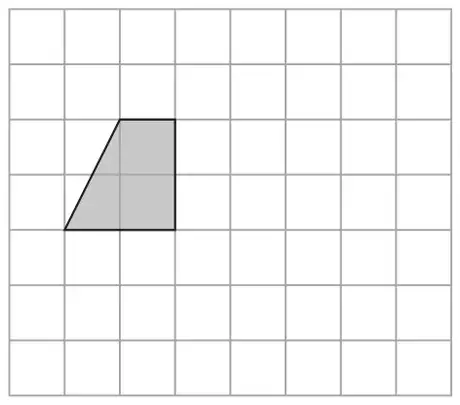
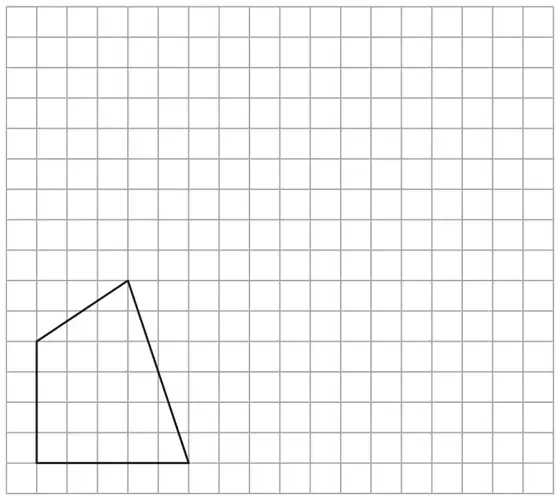
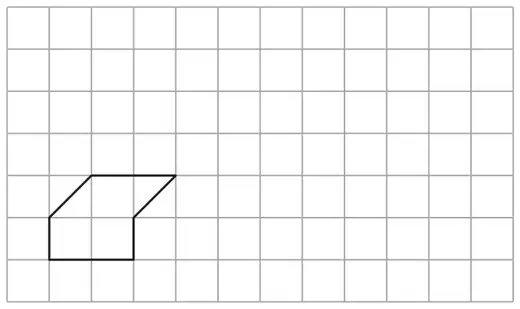
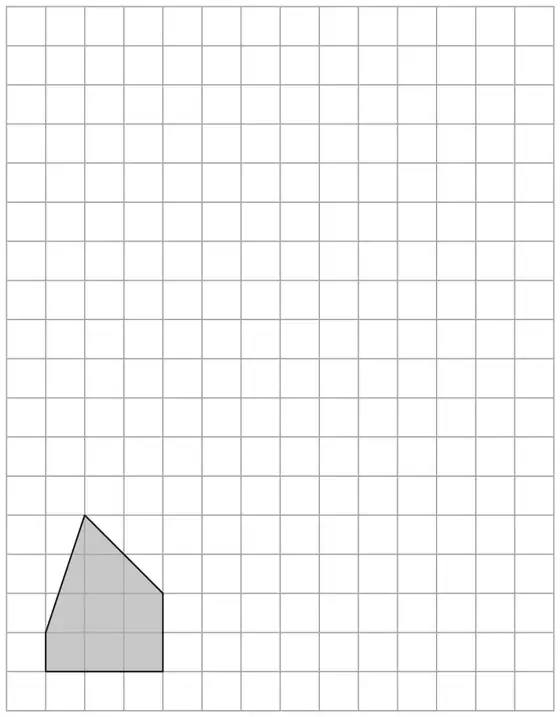
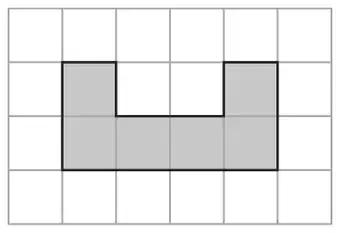
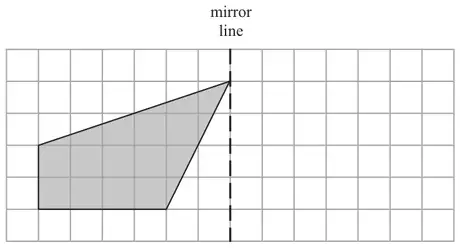
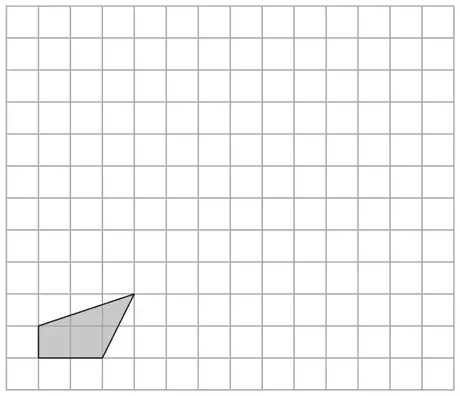
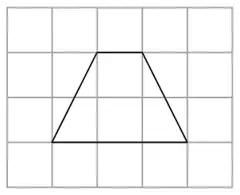
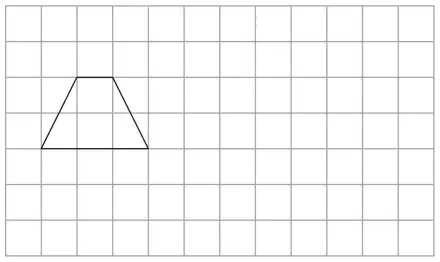
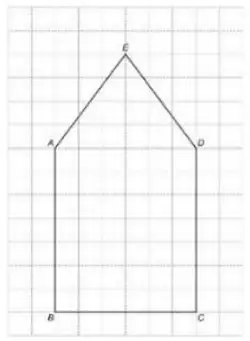
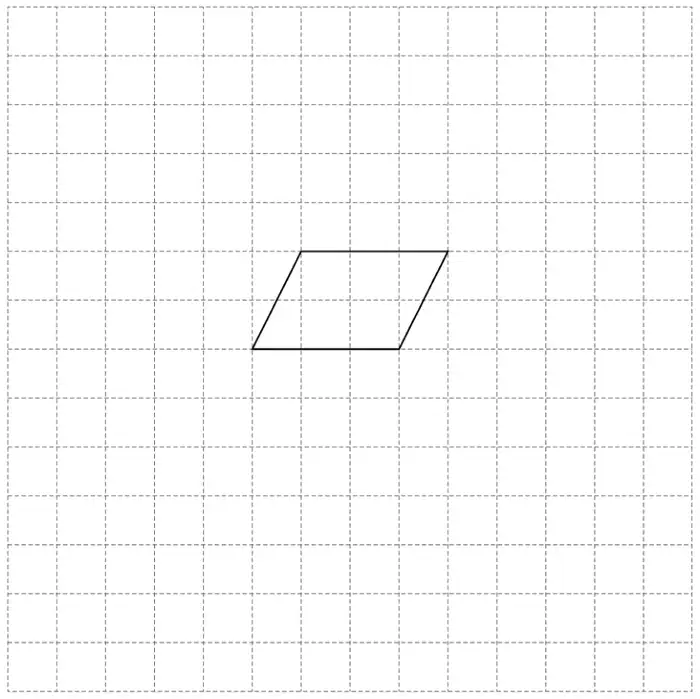
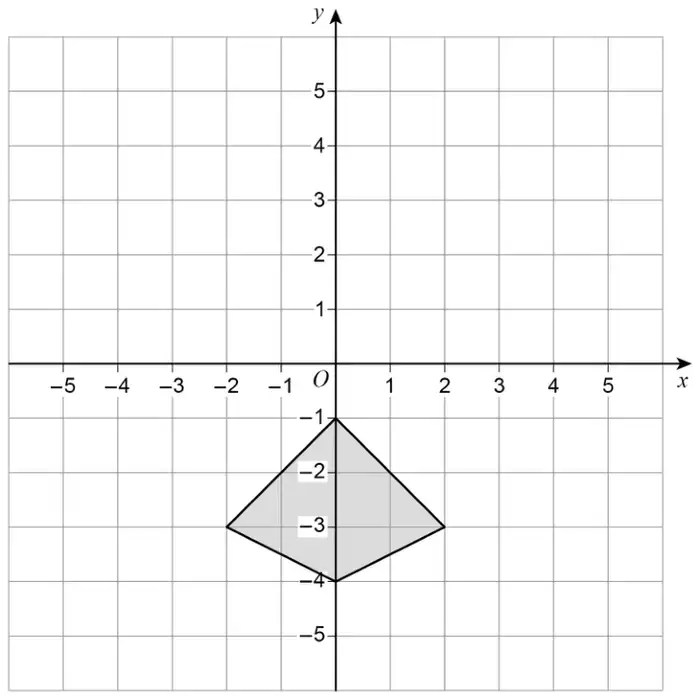
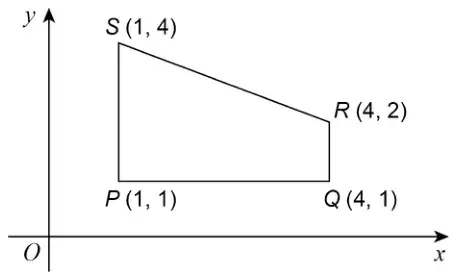
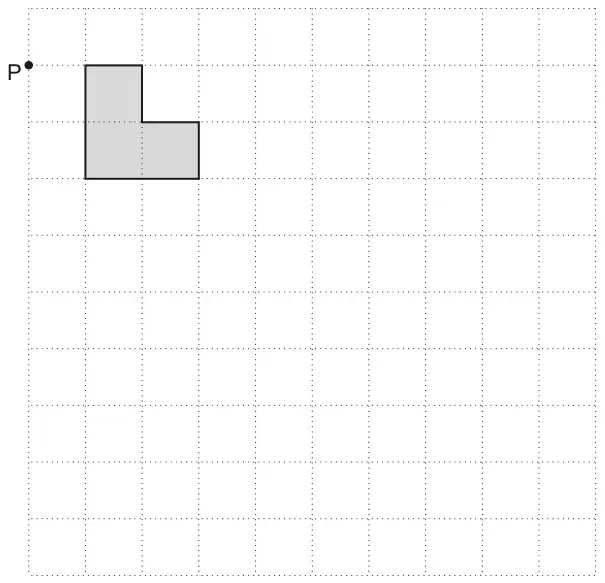
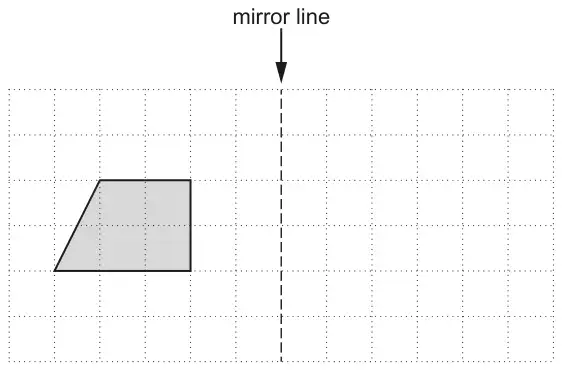
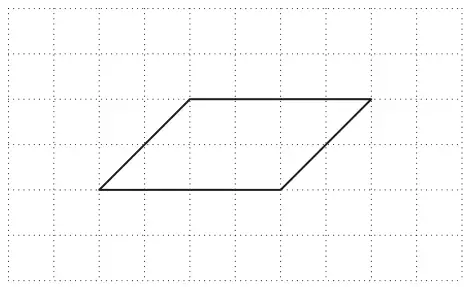
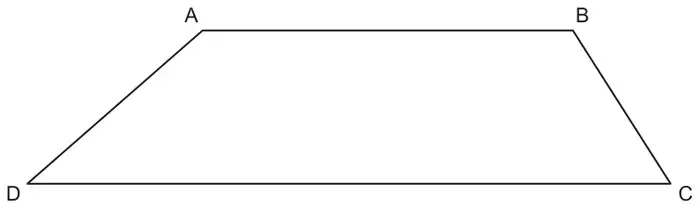
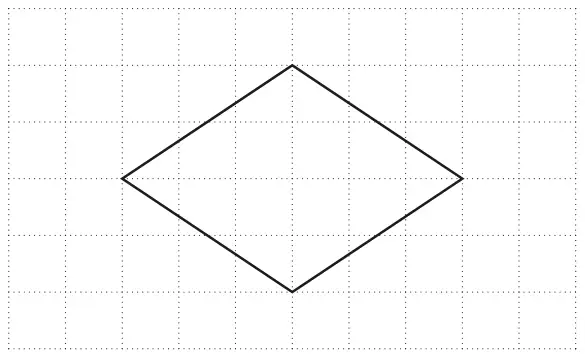
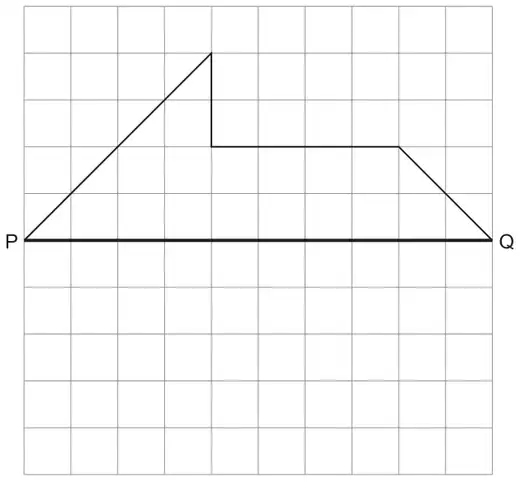
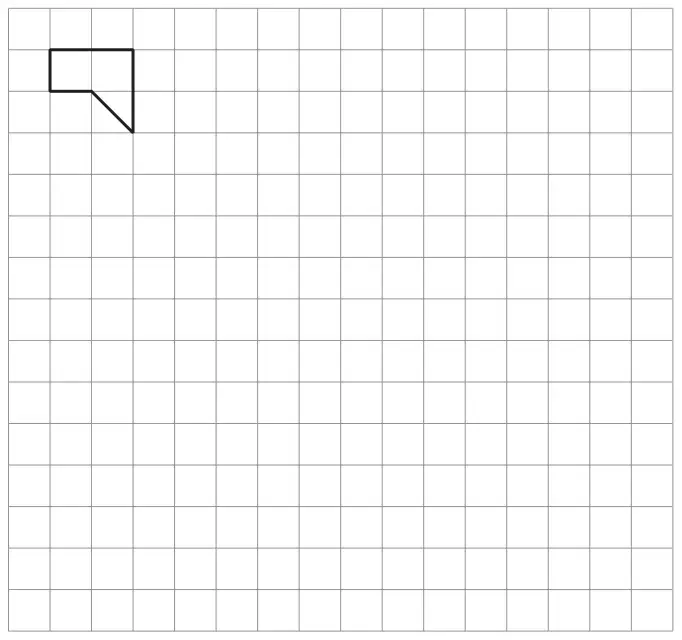
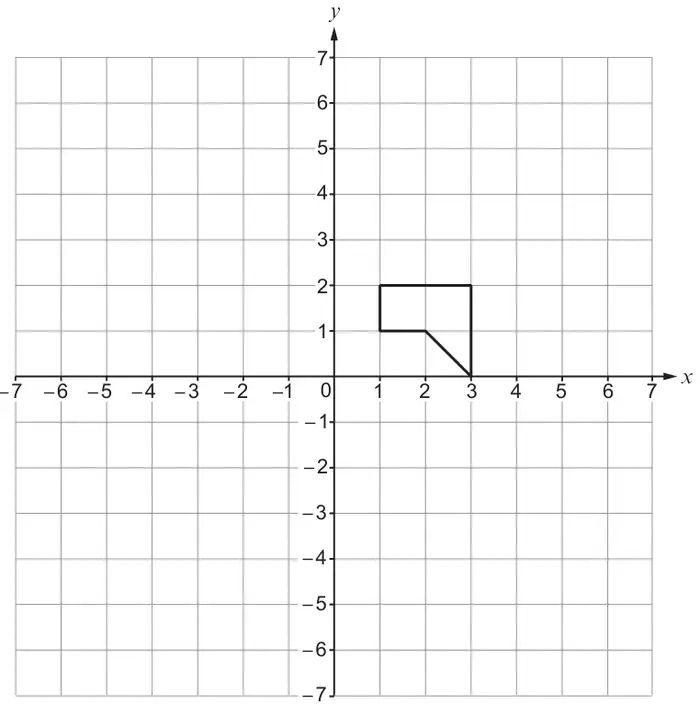
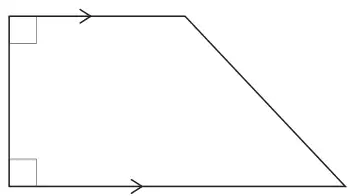
15 A quadrilateral has been drawn on a centimetre grid.
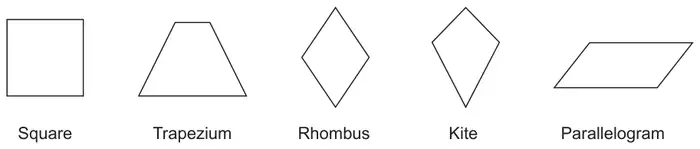
(a) Write down the mathematical name of this quadrilateral. (1)
(b) Work out the area of the quadrilateral. (2)
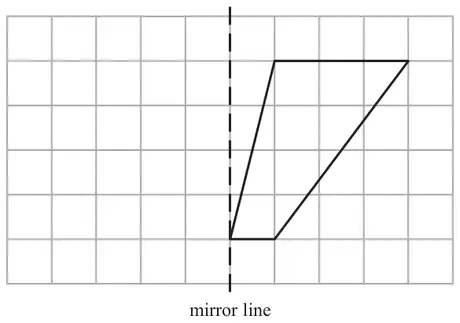
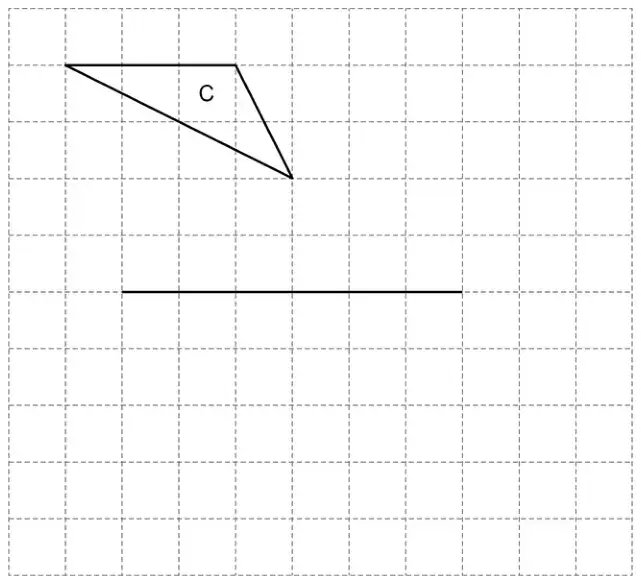
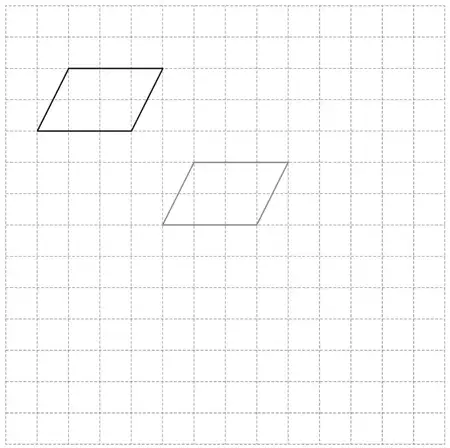
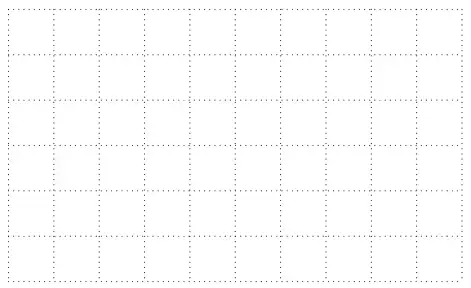
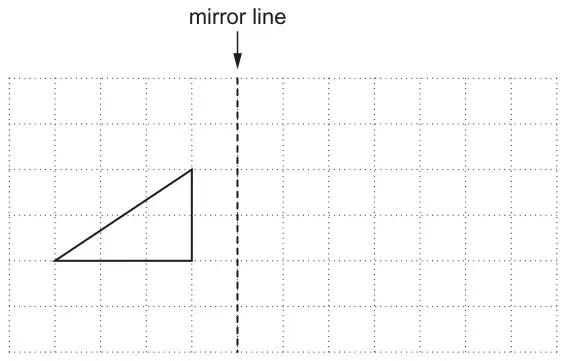
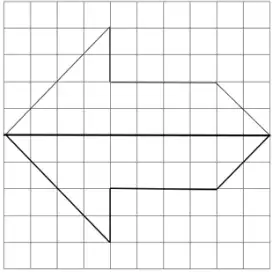
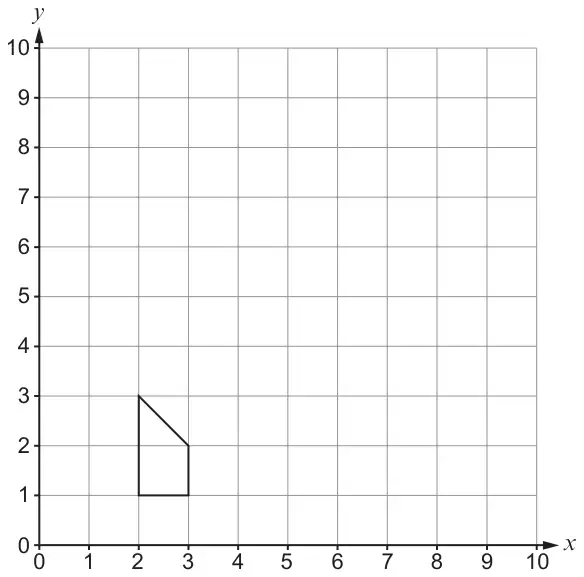
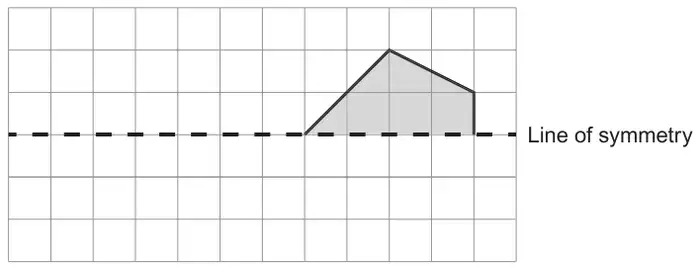
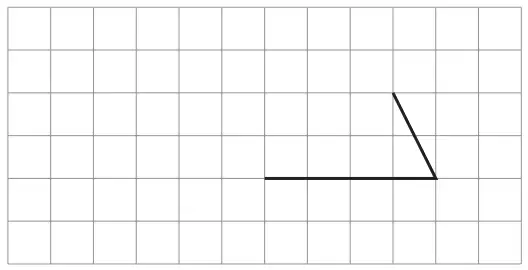
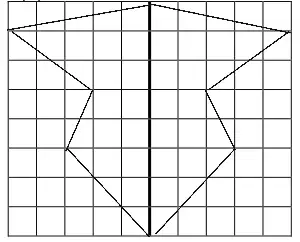
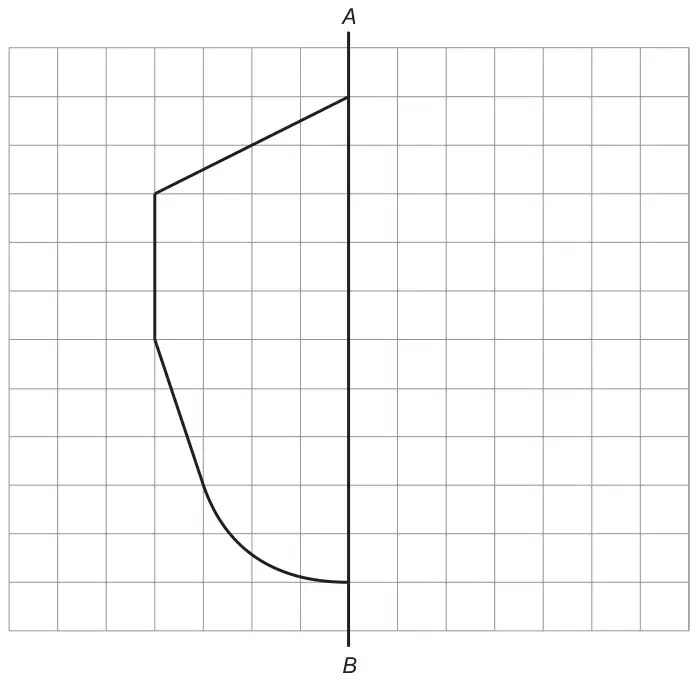
(c) On the grid below, reflect the quadrilateral in the mirror line.(2)
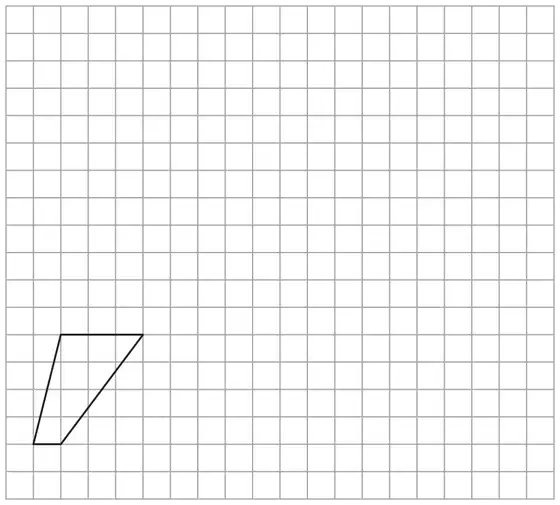
(d) On the grid, draw an enlargement of the quadrilateral with a scale factor of 3 (2)
Mark scheme (a)
Answer
Mark
Notes
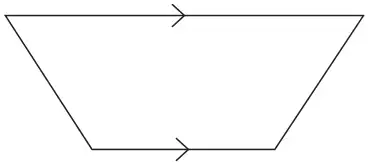
trapezium
1
B1 cao
Mark scheme (b)
Answer
Mark
Notes
8
2
M1 for a strategy to find the area, eg splitting the shape into two triangles or drawing a rectangle around it or using the formula for the area of a trapezium A1 cao
Mark scheme (c)
Answer
Mark
Notes
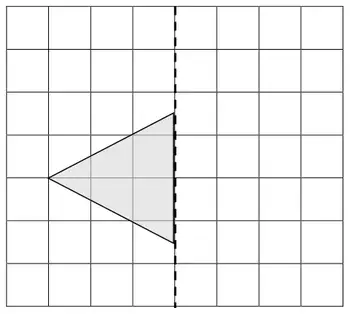
Shape reflected
2
B2 for correct reflection drawn (B1 for 3 vertices correct or correct orientation, incorrect position)
Mark scheme (d)
Answer
Mark
Notes
Enlargement sf 3 drawn
2
B2 correct enlargement drawn (B1 for any two sides correct or a correct enlargement with scale factor other than 3)
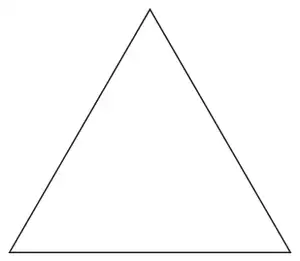
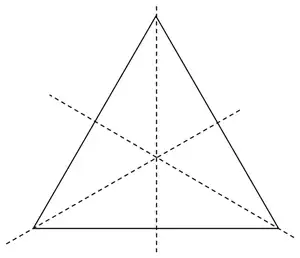
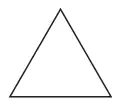
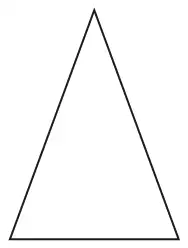
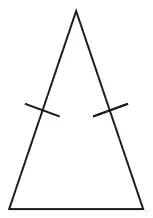
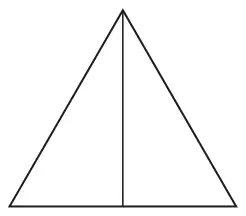
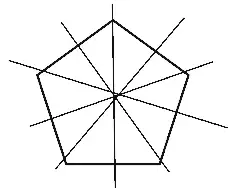
(a) On the triangle, draw all the lines of symmetry. (2)
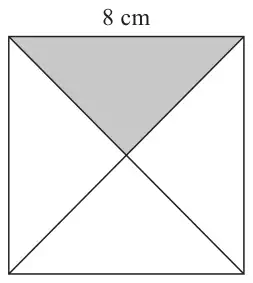
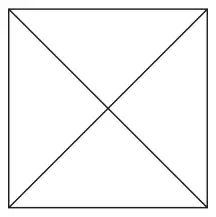
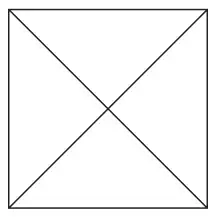
The diagram shows a square and its diagonals.
Diagram NOT accurately drawn
The square has sides of length 8 cm.
(b) Work out the area of the shaded triangle. (3)
Mark scheme (a)
Answer
Mark
Notes
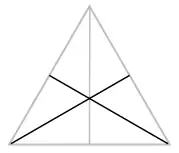
Correct lines
2
B2 exactly 3 correct lines of symmetry (B1 for 1 or 2 correct lines and no incorrect lines)
Mark scheme (b)
Answer
Mark
Notes
16
3
M1 for a method to find the area of the square e.g. \(8 \times 8\) (= 64) or the height of the shaded triangle e.g. \(8 \div 2\) (= 4) M1 for a complete method to find the area of the shaded triangle e.g. \(\text{``}64\text{''} \div 4\) or \(\frac{1}{2} \times 8 \times \text{``}4\text{''}\) A1 cao
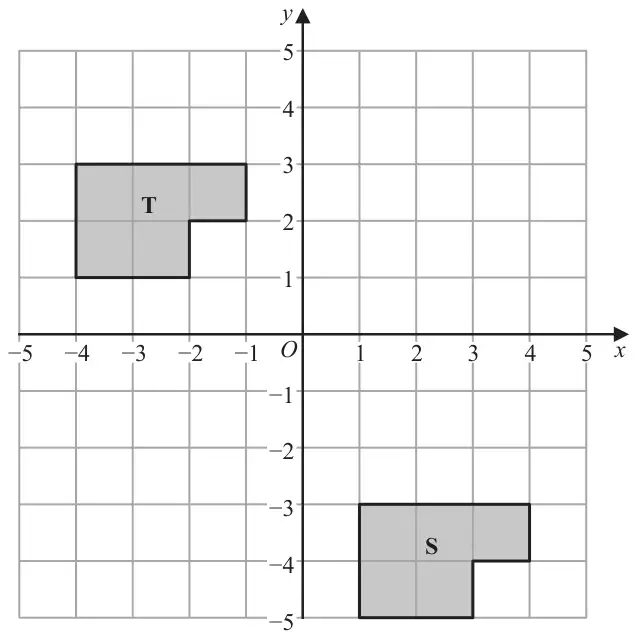
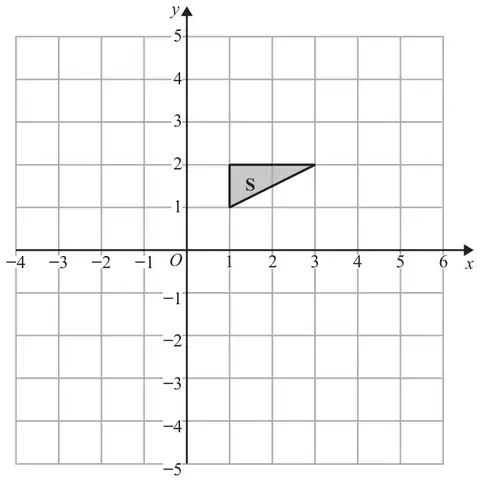
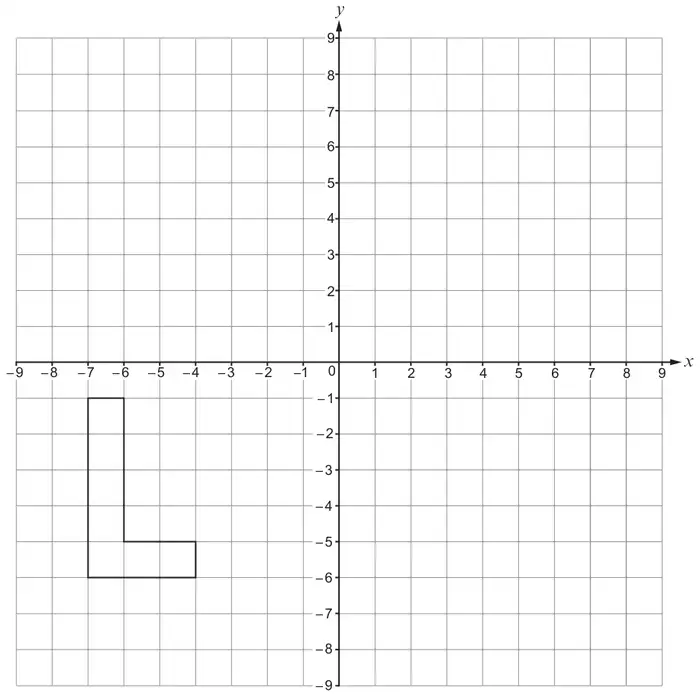
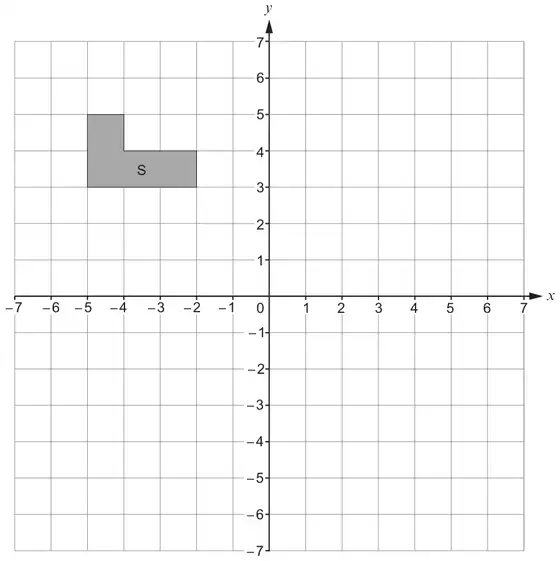
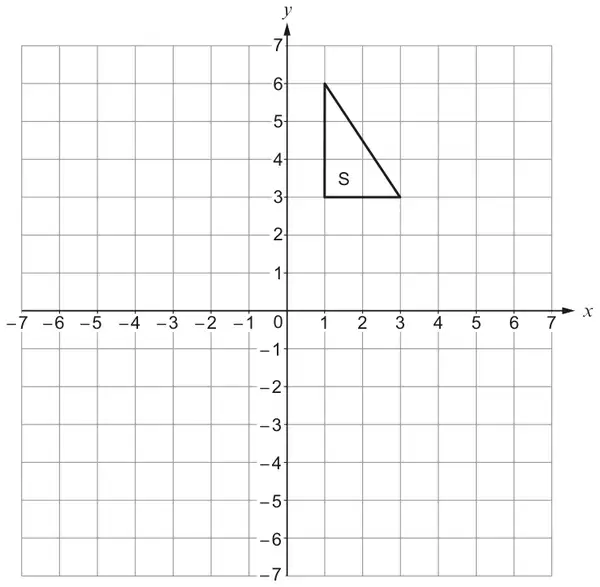
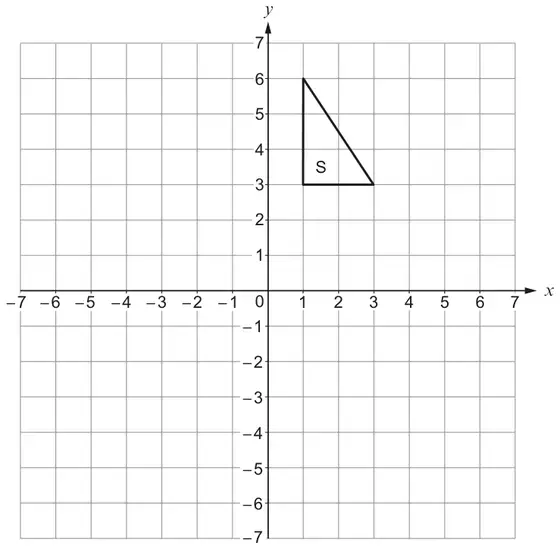
(a) On the grid, rotate shape S by \(90^\circ\) anticlockwise about the origin. (2)
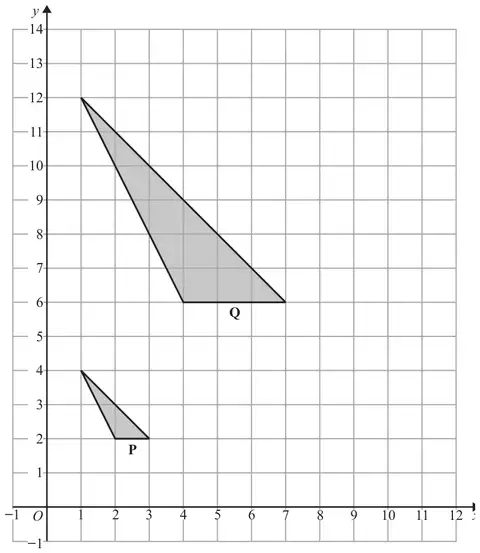
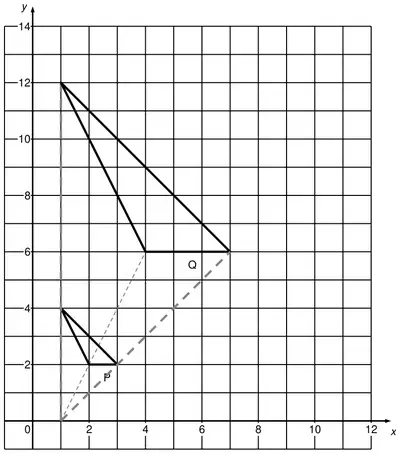
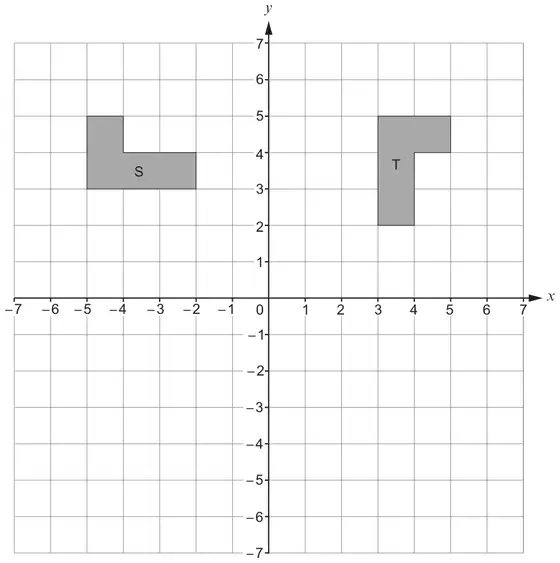
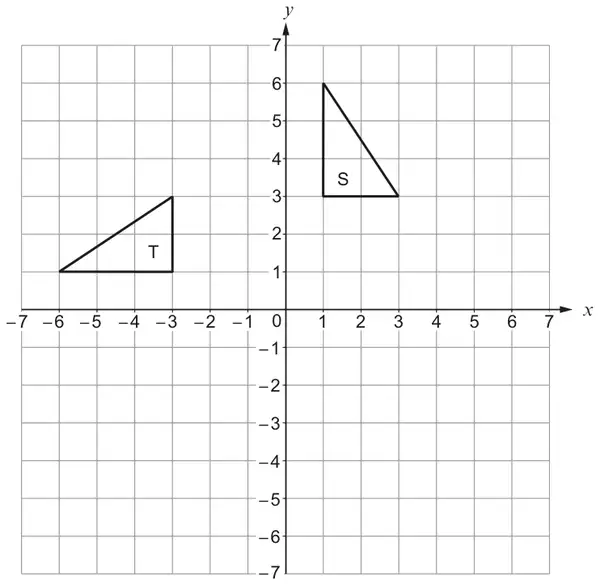
(b) Describe fully the single transformation that maps shape P onto shape Q. (3)
Mark scheme (a)
Answer
Mark
Notes
Transformation
2
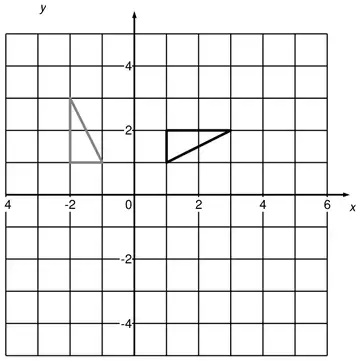
B2 for a triangle with vertices at \((-1, 1)\), \((-2, 3)\) and \((-2, 1)\) (B1 for a triangle in correct orientation or rotated \(90^\circ\) clockwise centre the origin)
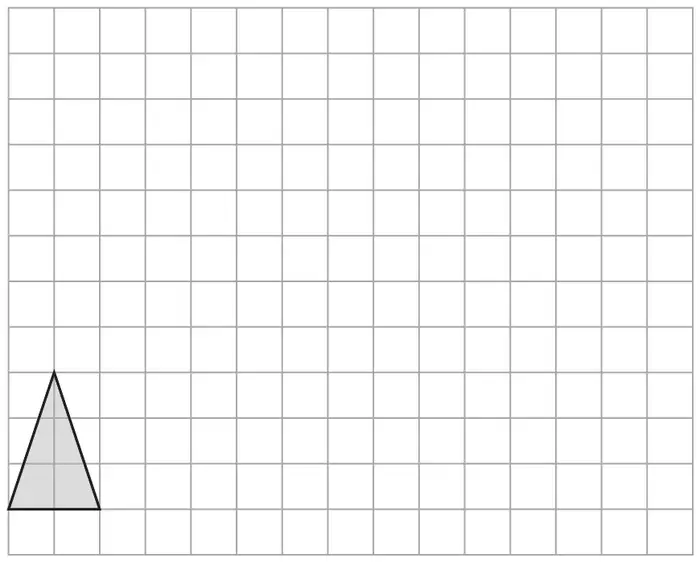
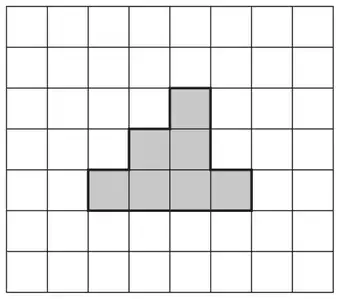
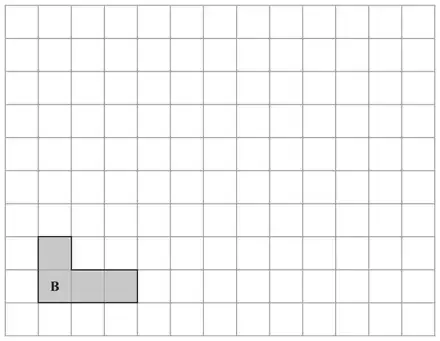
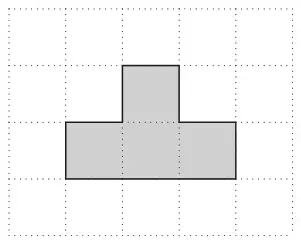
(a) On the grid, draw an enlargement of the shape using a scale factor of 3(2)
(b) On the grid below, show how the shape tessellates. You should draw at least 6 shapes.(2)
Mark scheme (a)
Answer
Mark
Notes
Diagram
2
B2 for a correct enlargement scale factor 3 (B1 for at least 2 lines correctly enlarged or any enlargement using an incorrect scale factor, sf \(\ne\) 1)
Mark scheme (b)
Answer
Mark
Notes
Diagram
2
B2 for correct tessellation (at least 5 more shapes) (B1 for at least 4 shapes, including initial shape, correctly tessellating ignoring extra shapes)
Triangle A is rotated \(90^\circ\) clockwise about the point (0, 1) to give triangle B.
Triangle B is translated by the vector \(\begin{pmatrix} -3 \\ -1 \end{pmatrix}\) to give triangle C.
Describe fully the single transformation that maps triangle A onto triangle C. (3)
Mark scheme
Working
Answer
Mark
Notes
B at (1, 0), (1, \(-1\)), (3, \(-2\)) C at (\(-2\), \(-1\)), (\(-2\), \(-2\)), (0, \(-3\)) Rotation \(90^\circ\) clockwise (or \(270^\circ\) anti-clockwise) about (\(-2\), 2)
Rotation \(90^\circ\) clockwise centre (\(-2\), 2)
3
M2 for stating rotation \(90^\circ\) clockwise (or \(270^\circ\) anti-clockwise) or centre (\(-2\), 2) (M1 for showing B and C correctly on the grid) A1 for a fully correct description
NB Award a maximum of M1 if more than one transformation is given
On the grid, enlarge the shape by scale factor 3, centre \(A\). (3)
Mark scheme
Answer
Mark
Notes
Diagram drawn
3
B3 for fully correct shape (B2 for 3 or 4 vertices correct or enlargement scale factor 3 in wrong position or enlargement, centre \(A\), with different scale factor) (B1 for 2 vertices correct or enlargement, not from \(A\), with different scale factor)
(b) Rotate shape P \(90^\circ\) anticlockwise about (0, 1). (2)
Mark scheme (a)
Answer
Mark
Notes
Correct shape
2
B2 for correct reflection with vertices \((-4, 2)\) \((-6, 3)\) \((-6, 7)\) \((-4, 6)\) (B1 for reflection in a vertical or horizontal line)
Mark scheme (b)
Answer
Mark
Notes
Correct shape
2
B2 for correct rotation with vertices \((-1, 3)\) \((-5, 3)\) \((-6, 5)\) \((-2, 5)\) (B1 for rotation of \(90^\circ\) clockwise about (0,1) or correct orientation fully in correct quadrant)
(b) Rotate shape P \(90^\circ\) anticlockwise about (0, 1). (2)
Mark scheme (a)
Answer
Mark
Notes
Correct shape
2
B2 for correct reflection with vertices \((-4, 2)\) \((-6, 3)\) \((-6, 7)\) \((-4, 6)\) (B1 for reflection in a vertical or horizontal line)
Mark scheme (b)
Answer
Mark
Notes
Correct shape
2
B2 for correct rotation with vertices \((-1, 3)\) \((-5, 3)\) \((-6, 5)\) \((-2, 5)\) (B1 for rotation of 90(°) clockwise about (0,1) or correct orientation fully in top left quadrant)
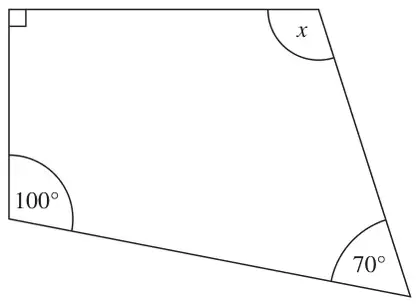
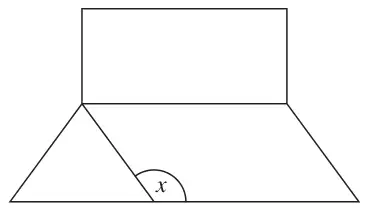
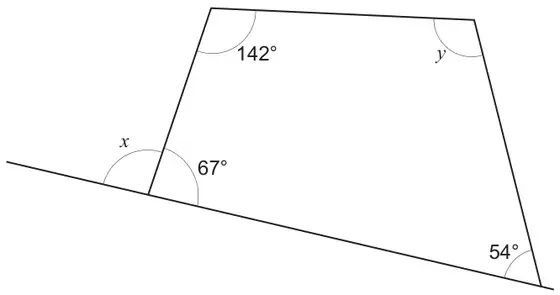
(*a) Explain why the angle marked \(x\) cannot be a right angle. (3)
(b) On the grid below, show how the shape tessellates. You should draw at least 6 shapes. (2)
Mark scheme (a)
Answer
Mark
Notes
Explanation
3
M1 for recognition of sum to \(360^\circ\) A1 for eg sum to 350 or subtraction to 100 or difference of 10 C1 (dep on at least M1) for correct explanation supported by their figures and working
Mark scheme (b)
Answer
Mark
Notes
Tessellation
2
B2 for at least 6 correct shapes (including the initial shape) correctly tessellating (B1 for at least 4 correct shapes, including initial shape, correctly tessellating ignore any additional sections attempted, gaps or incorrectly shaped tiles)
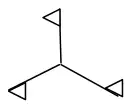
(a) On the triangle, draw all the lines of symmetry. (2)
(b) In the space below, use ruler and compasses to construct an equilateral triangle with sides of length 6 centimetres. You must show all your construction lines. (2)
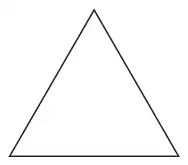
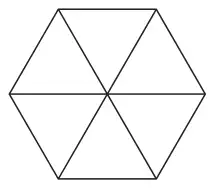
Here is an equilateral triangle.
Diagram NOT accurately drawn
The perimeter of this equilateral triangle is 24 cm.
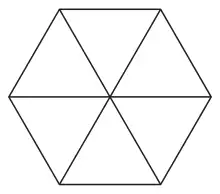
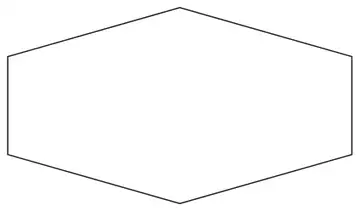
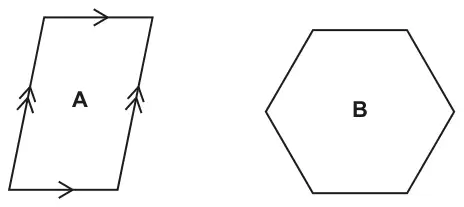
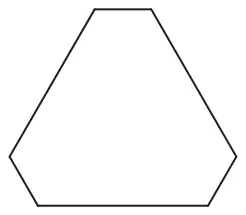
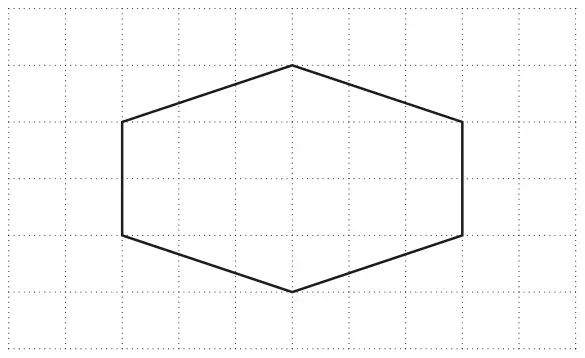
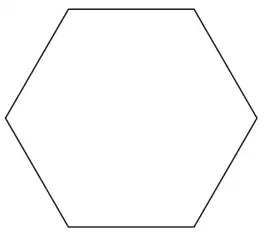
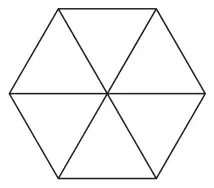
The hexagon below is made from 6 of these triangles.
(c) Work out the perimeter of this hexagon. (2)
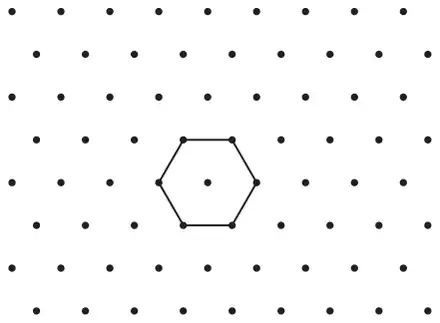
(d) On the grid below, show how the hexagon tessellates. You should draw at least 6 hexagons. (2)
Mark scheme (a)
Answer
Mark
Notes
2
M1 for any 1 correct line of symmetry, allow extras A1 for all 3 lines and no extras
Mark scheme (b)
Answer
Mark
Notes
Triangle drawn
2
M1 for intersecting arcs of radii 6cm or an accurate triangle with no arcs A1 for a fully correct triangle with arcs
Mark scheme (c)
Answer
Mark
Notes
48
2
M1 for \(24 \div 3\) (= 8) A1 cao
Mark scheme (d)
Answer
Mark
Notes
Tessellation
2
B2 for correct tessellation (at least 5 more shapes) (B1 for at least 4 shapes, including initial shape, correctly tessellating)
(a) Rotate triangle A \(90^\circ\) anticlockwise with centre \(O\).(2)
(b) Describe fully the single transformation that maps triangle B onto triangle C.(2)
Mark scheme (a)
Answer
Mark
Notes
Triangle with vertices at (–3, 3), (–3, 4) and (–1, 4)
2
B2 for a triangle with vertices at (–3, 3), (–3, 4), (–1, 4) (B1 for triangle in correct orientation and size or rotated \(90^\circ\) clockwise about centre \(O\) or three correct vertices without joining)
Mark scheme (b)
Answer
Mark
Notes
Reflection in line \(y = x\)
2
B1 for reflection B1 for (in the line) \(y = x\) Note: award no marks if more than one transformation is given
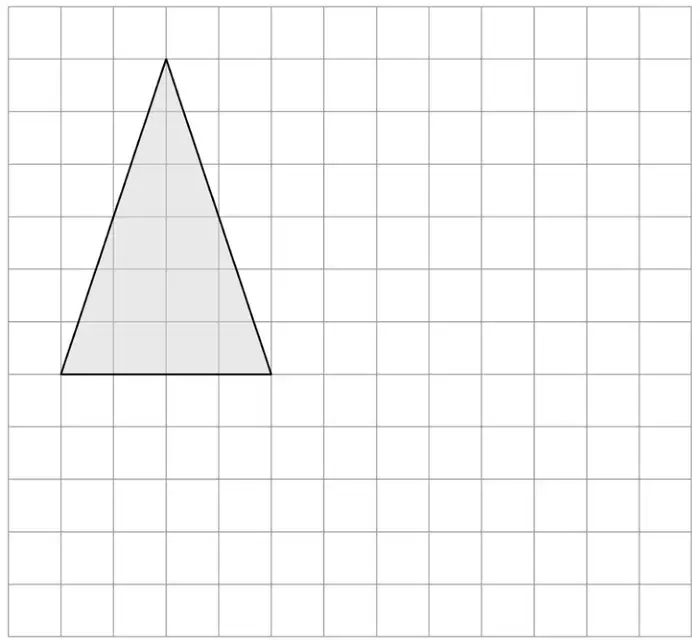
On the grid, enlarge the shape by a scale factor of 2, centre \(A\). (2)
Mark scheme
Answer
Mark
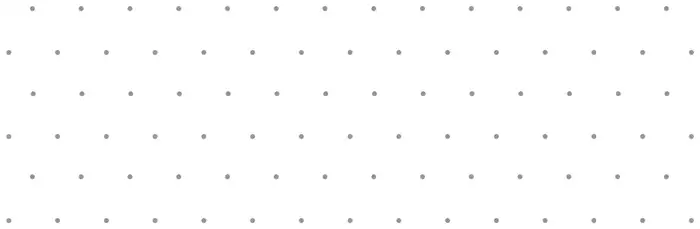
Notes
Enlargement
2
B2 for fully correct triangle (B1 for 2 vertices correct or enlargement scale factor 2 in the wrong position or enlargement, centre A, with a different scale factor)
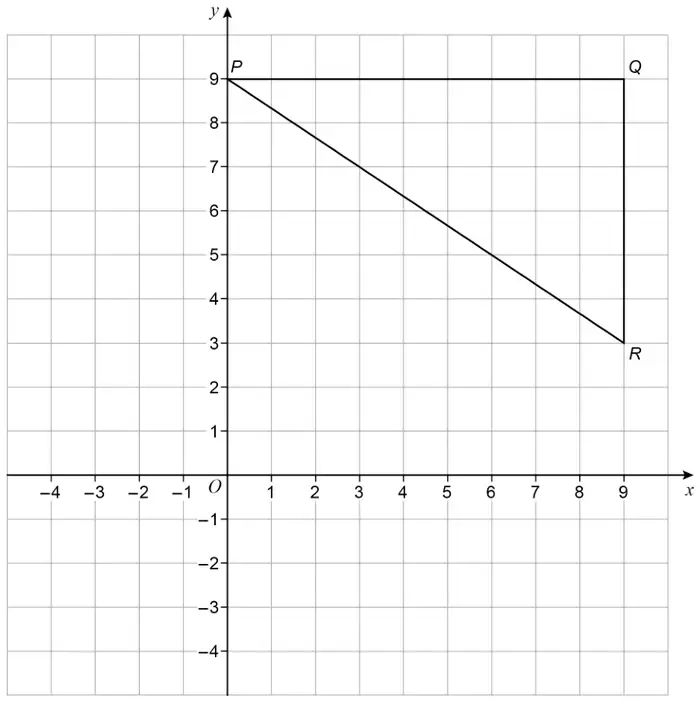
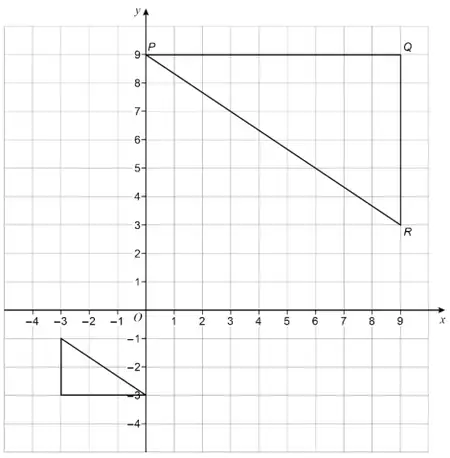
(a) On the grid, rotate shape A \(180^\circ\) about the point (1, 1). (2)
(b) On the grid, enlarge triangle B by scale factor 3, centre (0, 0). (2)
Mark scheme (a)
Answer
Mark
Notes
Shape drawn
2
B2 for shape with vertices at \((0, -1)\), \((-1, -3)\), \((-2, -3)\), \((-2, -1)\) (B1 for rotation of 180° about the wrong centre)
Mark scheme (b)
Answer
Mark
Notes
Triangle drawn
2
B2 for triangle with vertices at (6, 9), (9, 9), (9, 3) (B1 for 2 vertices correct or enlargement sf 3 in wrong position or enlargement, centre (0, 0), but sf \(\gt 1\), \(\neq 3\))
B2 for correct shape in correct position (B1 for any incorrect translation of correct shape)
Mark scheme (b)
Answer
Mark
Notes
Rotation 180° (0, 1)
3
B1 for rotation B1 for 180° (ignore direction) B1 for (0, 1) OR B1 for enlargement B1 for scale factor \(-1\) B1 for (0, 1) (NB: a combination of transformations gets B0)
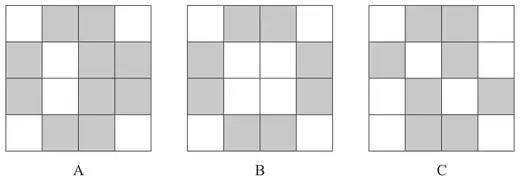
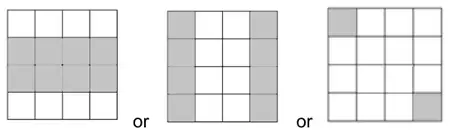
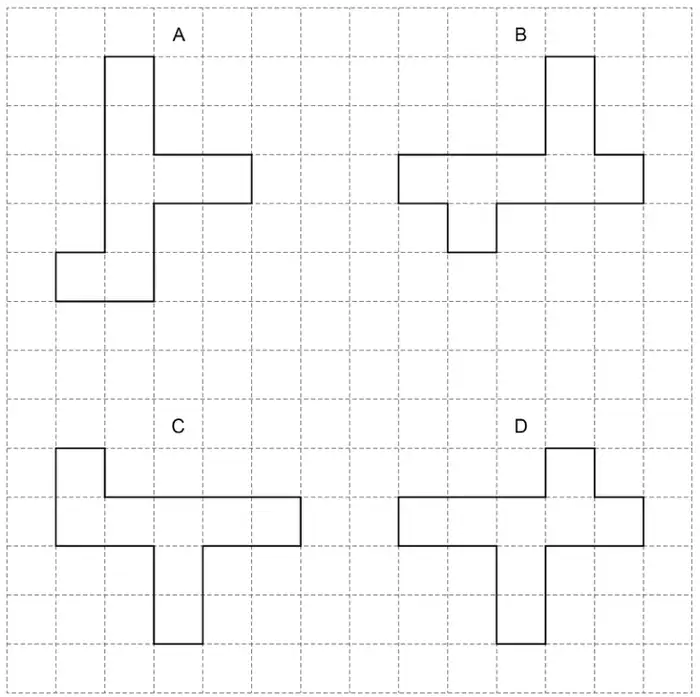
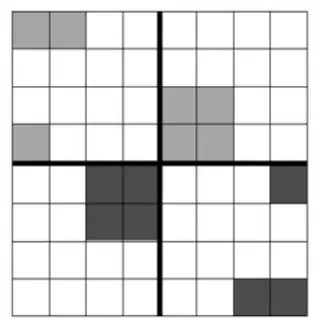
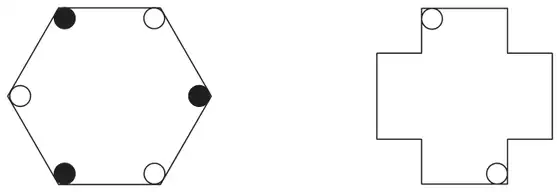
21 The diagrams show patterns made from grey tiles and white tiles.
One of the patterns has exactly 1 line of symmetry.
(a) Write down the letter of this pattern. (1)
(b) Write down the order of rotational symmetry of pattern C. (1)
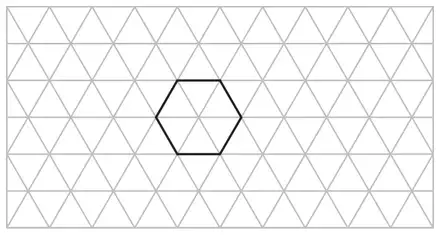
The diagram on the grid shows a tile in the shape of a hexagon.
(c) On the grid, show how the tile will tessellate. You should draw at least 6 tiles.(2)
Mark scheme (a)
Answer
Mark
Notes
A
1
B1 cao
Mark scheme (b)
Answer
Mark
Notes
2
1
B1 cao
Mark scheme (c)
Answer
Mark
Notes
Tessellation
2
B2 for at least 6 correct shapes, including initial shape, correctly tessellating with at least 2 points where 3 tiles meet and no incorrectly drawn tiles or gaps. (B1 for at least 4 correct shapes, including initial shape, correctly tessellating with at least one point where 3 tiles meet; ignore any additional sections attempted, gaps or incorrect shaped tiles)
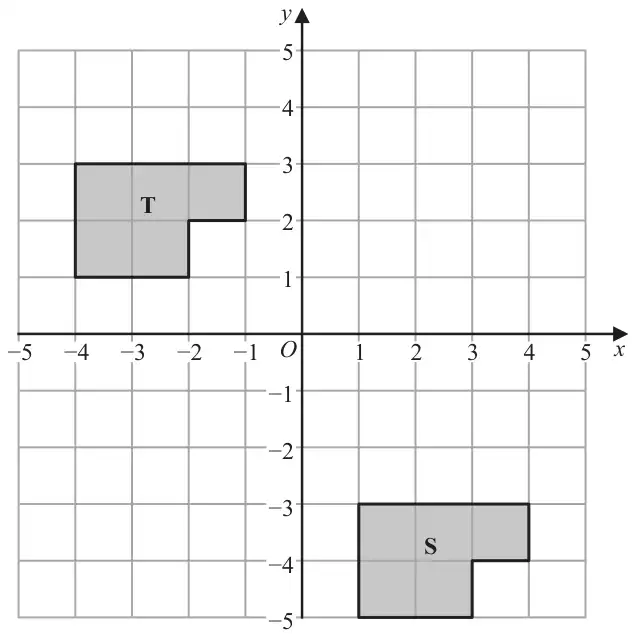
Shape P is reflected in the line \(x = -1\) to give shape Q. Shape Q is reflected in the line \(y = 0\) to give shape R.
Describe fully the single transformation that maps shape P onto shape R. (3)
Mark scheme
Working
Answer
Mark
Notes
Q at \((-3, 1)\), \((-6, 1)\), \((-5, 3)\), \((-3, 3)\) R at \((-3, -1)\), \((-6, -1)\), \((-5, -3)\), \((-3, -3)\)
Rotation \(180^\circ\) about \((-1, 0)\)
3
M1 for showing R correctly on the grid without showing Q or for showing Q and R correctly on the grid A1 for rotation of \(180^\circ\) A1 for (centre) \((-1, 0)\) Or M1 for showing R correctly on the grid without showing Q or for showing Q and R correctly on the grid A1 for Enlargement Scale Factor \(-1\) A1 for centre \((-1, 0)\) NB Award no marks for any correct answer from an incorrect diagram or any Accuracy marks if more than one transformation is given
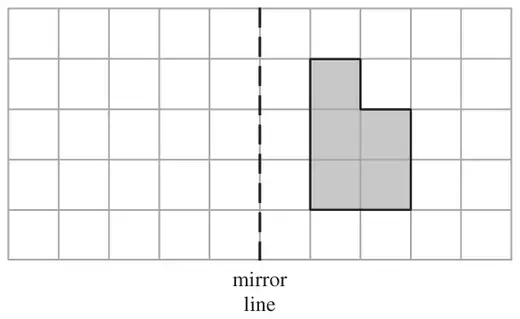
(a) Reflect the shaded shape in the mirror line. (2)
(b) On the grid, enlarge the shaded shape using a scale factor of 3 (2)
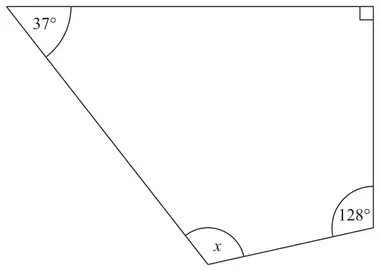
Here is a different shape.
Diagram NOT accurately drawn
(c) Work out the size of angle \(x\). (2)
Mark scheme (a)
Answer
Mark
Notes
reflection
2
B2 for correct reflection in correct position (B1 for at least 2 vertices in the correct position)
Mark scheme (b)
Answer
Mark
Notes
enlargement
2
B2 for correct enlargement scale factor 3 (B1 for at least 2 lines correctly enlarged or any enlargement using an incorrect scale factor, sf \(\ne 1\))
Mark scheme (c)
Answer
Mark
Notes
105
2
M1 for \(360 - (90 + 128 + 37)\) oe or \(x + 90 + 128 + 37 = 360\) A1 cao
(b) Describe fully the single transformation that maps triangle A onto triangle B. (2)
Mark scheme (a)
Answer
Mark
Notes
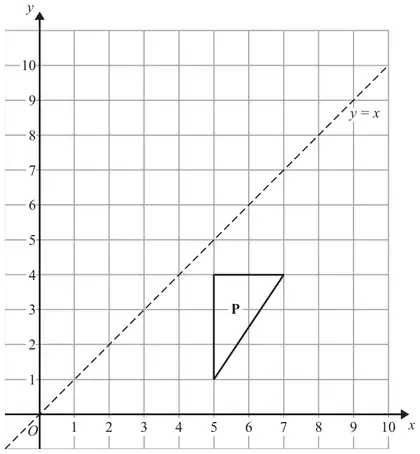
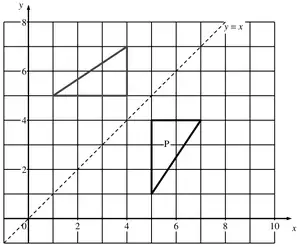
Triangle with vertices (1, 5) (4, 5) (4,7)
2
B2 correct reflection (B1 a translation of the correct answer with the final shape above \(y = x\) or any two correct vertices) SC : B1 for a triangle with vertices at (2, 5) (4, 5) (4, 8)
Mark scheme (b)
Answer
Mark
Notes
Translation by \(\begin{pmatrix} -2 \\ -4 \end{pmatrix}\)
2
B1 Translation B1 \(\begin{pmatrix} -2 \\ -4 \end{pmatrix}\) NB. Award no marks for a combination of transformations
(b) Draw an enlargement, scale factor 3, of shape B. (2)
Mark scheme (a)
Answer
Mark
Notes
Triangle with vertices (2,1) (2, 4) (4,4)
2
B2 for triangle with vertices (2,1) (2,4) (4,4) (B1 for triangle reflected in any line parallel to \(x\)–axis or for correct reflection in \(y\) axis (triangle at (−2,−1) (−2,−4) (−4,−4)) ( B1 for a configuration which is the original triangle reflected successively in the \(x\) and \(y\) axes to give 3 triangles)
Mark scheme (b)
Answer
Mark
Notes
Enlarged shape
2
M1 for any 3 sides enlarged correctly A1 for correctly enlarged shape (SC : B1 for correct enlargement with a scale factor of 2 or 4 or for a geometrically correct shape in a wrong orientation)
M1 for \(\frac{1}{2} \times 4 \times 3\) oe M1 for \(\left(\frac{1}{2}\right)^2 \times\) “6” A1 cao OR M2 for \(\frac{1}{2} \times 2 \times 1.5\) oe (M1 for triangle with all lengths \(\frac{1}{2}\) corresponding lengths of triangle \(ABC\) seen in any position or vertices seen at (1, 1) (3,1) and (2.5, 2.5) or stated) A1 cao
(a) Rotate triangle A \(90^\circ\) clockwise, centre \(O\). (2)
(b) Enlarge triangle B by scale factor 3, centre (1, 2). (3)
Mark scheme (a)
Answer
Mark
Notes
Triangle with vertices (2,–1) (4, –1) (4, –4)
2
B2 for triangle with vertices (2,–1) (4, –1) (4, –4) (B1 for triangle in correct orientation or rotated 90° anticlockwise centre O
Mark scheme (b)
Answer
Mark
Notes
Triangle with vertices (7, 2) (13, 2) (7, 11)
3
B3 for triangle with vertices (7, 2) (13, 2) (7, 11) (B2 for 2 vertices correct or enlargement scale factor 3 in wrong position or enlargement, centre (1,2), with different scale factor) (B1 for 1 vertex correct or enlargement, not from (1,2), different scale factor)
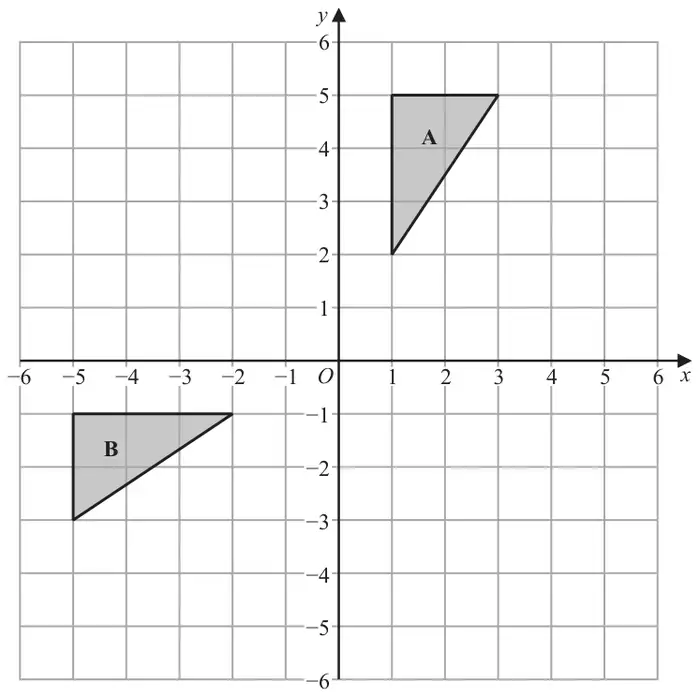
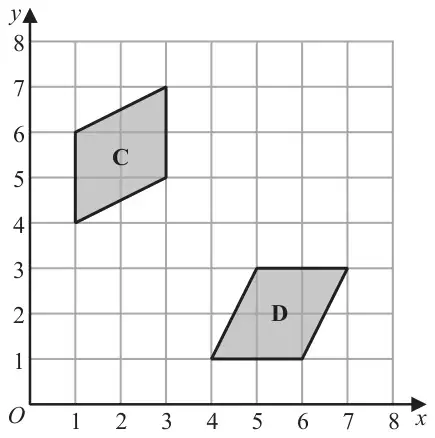
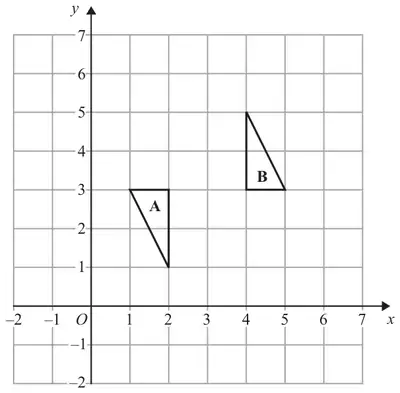
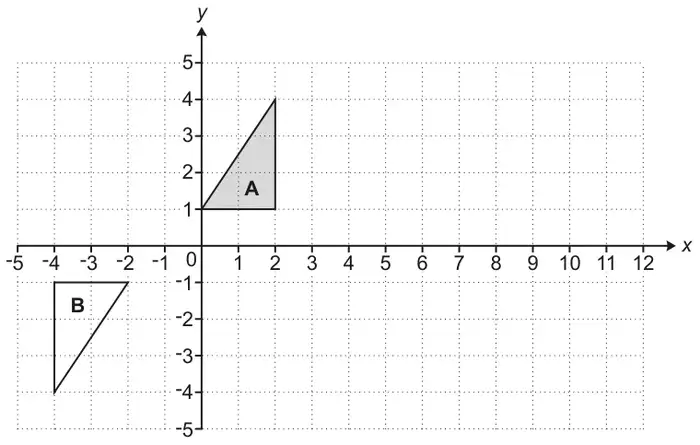
(a) Write down the translation vector that maps shape A to shape B. [1 mark]
(b) Describe fully a rotation that maps A to B. [2 marks]
Mark scheme (a)
Answer
Mark
Comments
\(\begin{pmatrix} 6 \\ -2 \end{pmatrix}\)
B1
condone \(\begin{pmatrix} +6 \\ -2 \end{pmatrix}\) or written as a fraction
Mark scheme (b)
Answer
Mark
Comments
Alternative method 1: rotation 180°
\(180^\circ\) or \(\dfrac{1}{2}\) turn and (0, 3)
B2
ignore clockwise or anticlockwise B1 \(180^\circ\) or \(\dfrac{1}{2}\) turn or (0, 3) with incorrect rotation
Alternative method 2: rotation 90° clockwise
\(90^\circ\) clockwise or \(270^\circ\) anticlockwise or \(\dfrac{1}{4}\) turn clockwise or \(\dfrac{3}{4}\) turn anticlockwise and (−1, 0)
B2
B1 \(90^\circ\) clockwise or \(270^\circ\) anticlockwise or \(\dfrac{1}{4}\) turn clockwise or \(\dfrac{3}{4}\) turn anticlockwise or (−1, 0) with incorrect rotation
Alternative method 3: rotation 90° anticlockwise
\(90^\circ\) anticlockwise or \(270^\circ\) clockwise or \(\dfrac{1}{4}\) turn anticlockwise or \(\dfrac{3}{4}\) turn clockwise and (1, 6)
B2
B1 \(90^\circ\) anticlockwise or \(270^\circ\) clockwise or \(\dfrac{1}{4}\) turn anticlockwise or \(\dfrac{3}{4}\) turn clockwise or (1, 6) with incorrect rotation
Additional guidance
Accept counterclockwise for anticlockwise
For the centre of rotation, condone missing brackets on coordinates, but not written as a vector
Other or compound transformation stated or implied eg ‘about the line’ or ‘scale factor’ or ‘moved by \(\begin{pmatrix} 0 \\ 3 \end{pmatrix}\)’
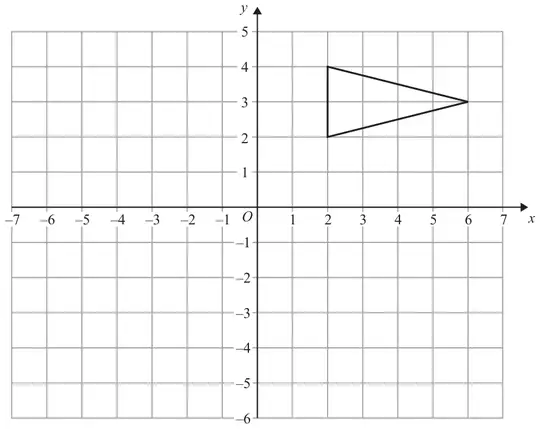
14 Enlarge triangle \(PQR\) by scale factor \(-\dfrac{1}{3}\) with centre (0, 0) [3 marks]
Mark scheme
Answer
Mark
Comments
Triangle with vertices (−3, −1) and (−3, −3) and (0, −3)
B3
B2 triangle of correct size and orientation but incorrect position or correct vertices plotted but no triangle drawn or any negative enlargement with centre (0, 0) B1 triangle of correct size but incorrect orientation or two correct vertices plotted or any negative enlargement with centre not (0, 0)
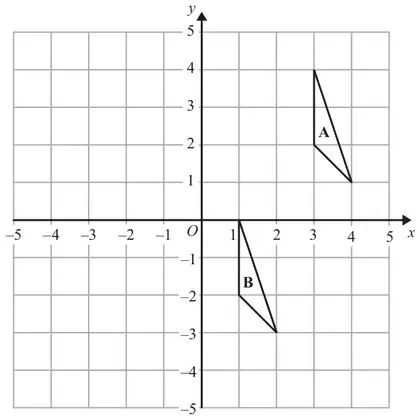
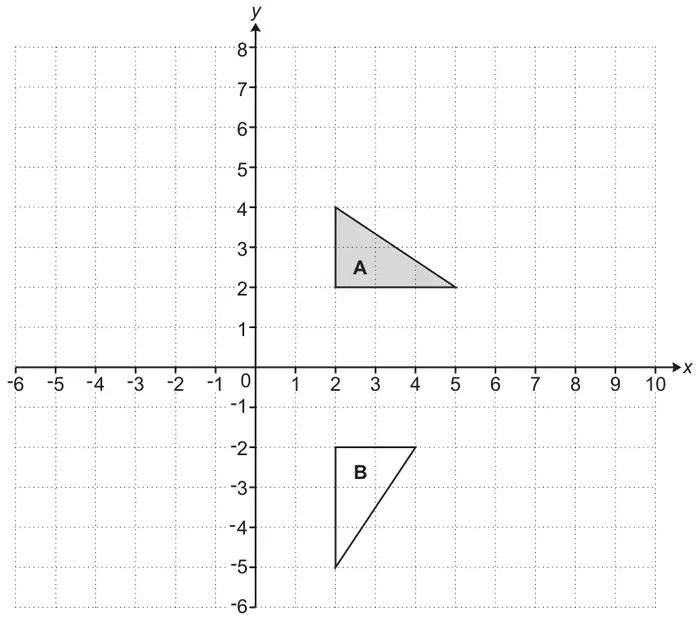
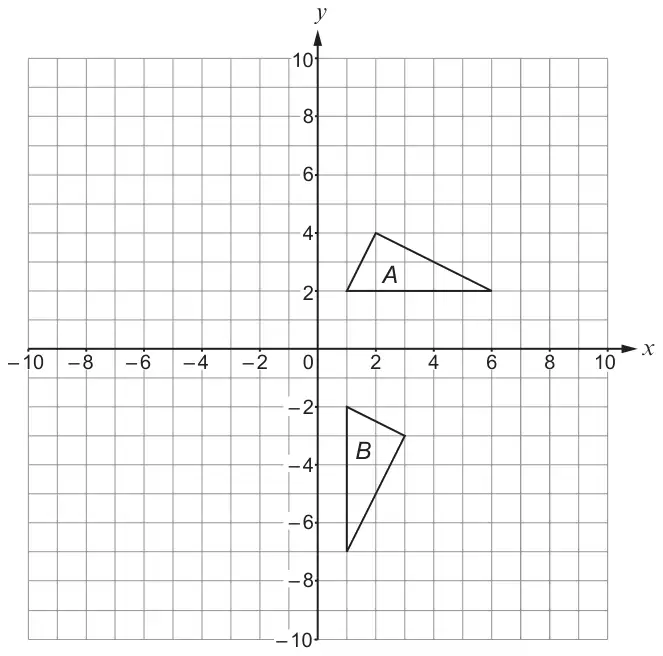
20 Write down the translation vector that maps shape A onto shape B. [2 marks]
Mark scheme
Answer
Mark
Comments
\(\begin{pmatrix}4\\-3\end{pmatrix}\)
B2
B1 \(\begin{pmatrix}4\\\ldots\end{pmatrix}\) or \(\begin{pmatrix}\ldots\\-3\end{pmatrix}\) SC1 \(\begin{pmatrix}-4\\3\end{pmatrix}\)
Additional guidance
\((4, -3)\) or \(\begin{pmatrix}-3\\4\end{pmatrix}\)
B0
Ignore words if a vector is also seen eg1 Reflection \(\begin{pmatrix}4\\-3\end{pmatrix}\) eg2 4 right 3 up and \(\begin{pmatrix}4\\3\end{pmatrix}\) eg3 4 right 3 down eg4 Rotate 4 left and 3 up and \(\begin{pmatrix}-4\\3\end{pmatrix}\)
B2 B1 B0 SC1
Condone any type of brackets
Condone missing brackets for B2 or B1 or SC1 but must have two numbers in a column
Condone ‘fraction line’ for B2 or B1 or SC1 but must have two numbers in a column
\(\begin{pmatrix}4x\\-3y\end{pmatrix}\) or \(\begin{pmatrix}x4\\-y3\end{pmatrix}\) or \(\begin{pmatrix}x + 4\\y - 3\end{pmatrix}\) or \(\begin{pmatrix}\text{4 right}\\\text{3 down}\end{pmatrix}\) or \(\begin{pmatrix}\text{4 r}\\\text{3 d}\end{pmatrix}\) or \(\begin{pmatrix}4 \rightarrow\\3 \downarrow\end{pmatrix}\)
Work out the vector that translates shape A to shape B. [2 marks]
Mark scheme
Answer
Mark
Comments
\(\begin{pmatrix} 7 \\ -2 \end{pmatrix}\)
B2
B1 \(\begin{pmatrix} 7 \\ a \end{pmatrix}\) or \(\begin{pmatrix} b \\ -2 \end{pmatrix}\) or \(\begin{pmatrix} -2 \\ 7 \end{pmatrix}\) or \(\begin{pmatrix} 7x \\ -2y \end{pmatrix}\) or \(\begin{pmatrix} -7 \\ 2 \end{pmatrix}\)
SC1 7 right 2 down or 2 down 7 right or \((7, -2)\)
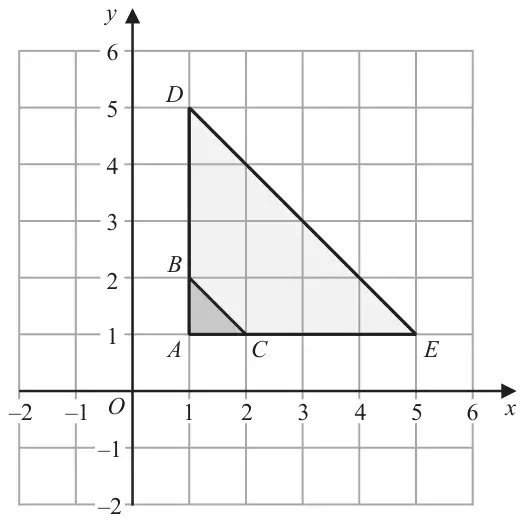
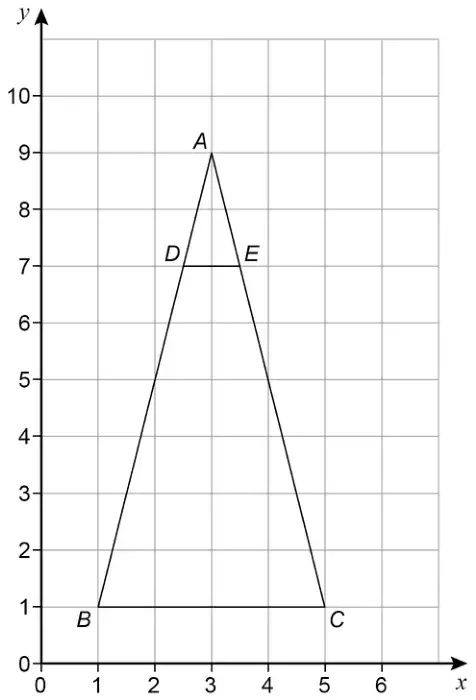
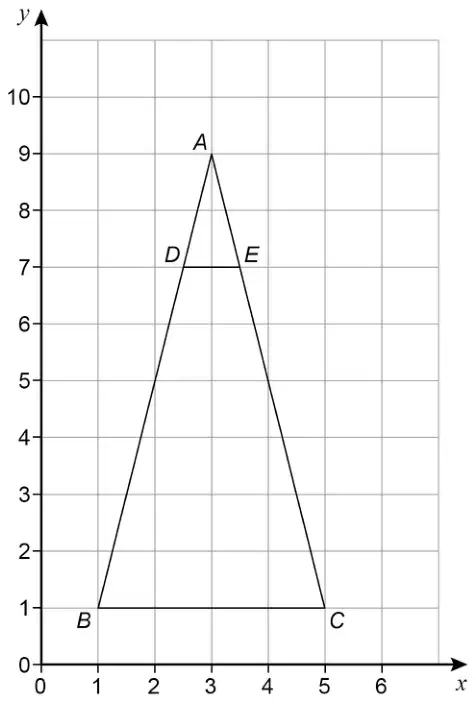
Describe fully the single transformation that maps triangle \(ABC\) to triangle \(ADE\). [3 marks]
Mark scheme
Answer
Mark
Comments
Enlargement
B1
\(\dfrac{1}{4}\)
B1
scale factor oe eg 0.25
(3, 9) or \(A\)
B1
centre do not allow \(\begin{pmatrix} 3 \\ 9 \end{pmatrix}\)
Additional guidance
Do not accept reduction or unenlargement or negative
1st B0
Do not accept \(\div\) 4
2nd B0
A combination of transformations cannot score the first B1 eg1 Enlarge sf \(\dfrac{1}{4}\) Translate \(\begin{pmatrix} 0 \\ 6 \end{pmatrix}\) eg2 Enlarge sf \(\dfrac{1}{4}\) 1.5 right up 6 (3, 9)
B0B1B0 B0B1B1
Do not allow \(\begin{pmatrix} 3 \\ 9 \end{pmatrix}\) for (3, 9) but do not regard as implying a combination of transformations eg Enlargement sf 0.25 \(\begin{pmatrix} 3 \\ 9 \end{pmatrix}\)
B1B1B0
Enlargement, sf 4 about (3, 9)
B1B0B1
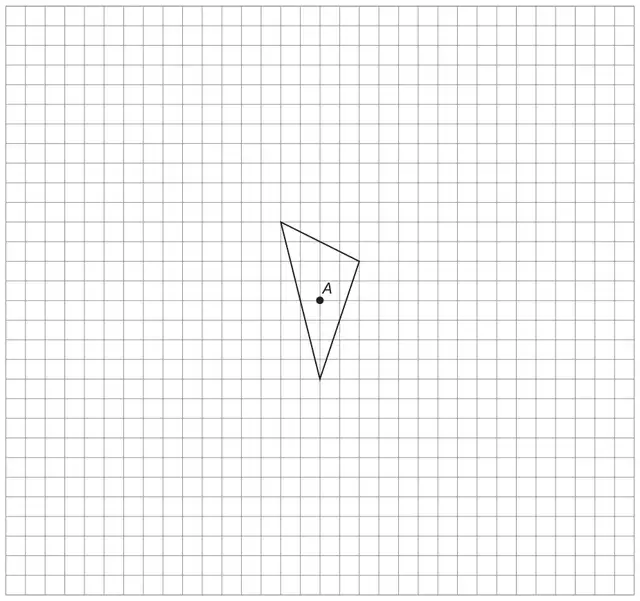
Enlarge(d) 0.25 \(A\)
B1B1B1
Condone \(ABC\) is an enlargement of \(ADE\)
1st B1
Condone enlargement with other words unless referring to another transformation eg1 Enlargement making shapes bigger eg2 Enlarged then moved using a vector eg3 Enlarged which means \(B\) moves to \(D\) and \(C\) moves to \(E\)
1st B1 1st B0 1st B1
If more than one point is listed it must be clear which point is their centre eg (1, 1) (5, 1) (3, 9) (2, 7)
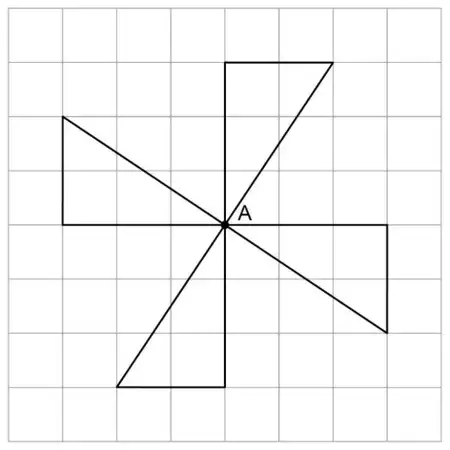
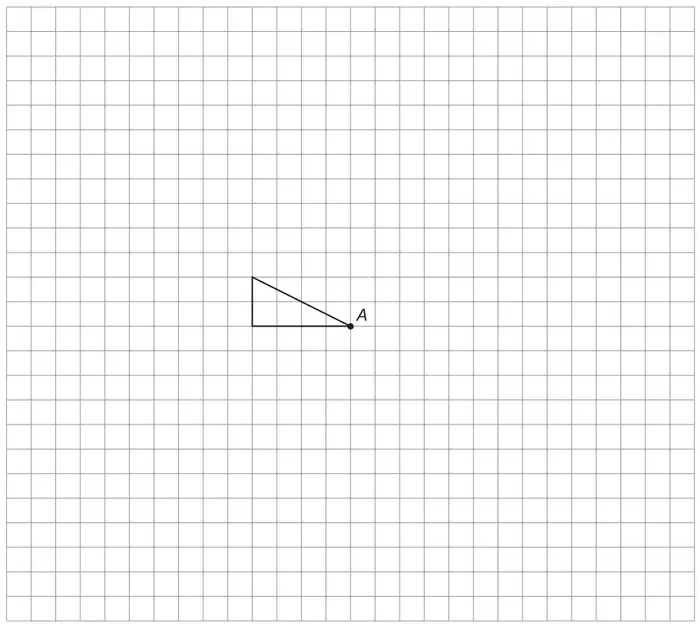
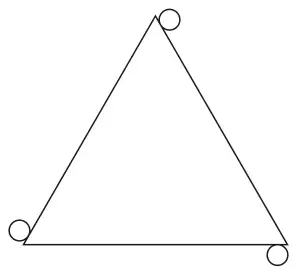
rotational symmetry of order 4 centre of rotation at point A. [2 marks]
Mark scheme
Answer
Mark
Comments
Fully correct diagram with rotational symmetry of order 4 and centre of rotation at point A
B2
B1 a correct rotation of the given triangle through 90° or 180° or 270°, centre of rotation at point A
Additional guidance
B2
Mark intention
Where there are more than 3 extra triangles drawn on the diagram, award B1 if at least one is correct
Students may amend original diagram (but still include the given triangle) and then use their new shape to give a diagram with rotational symmetry order 4 and centre of rotation at point A for B2 For B1, their new shape must be seen with a correct rotation through 90° or 180° or 270°, centre of rotation at point A
Describe fully the single transformation that maps triangle \(ABC\) to triangle \(ADE\). [3 marks]
Mark scheme
Answer
Mark
Comments
Enlargement
B1
\(\dfrac{1}{4}\)
B1
scale factor oe eg 0.25
(3, 9) or \(A\)
B1
centre do not allow \(\begin{pmatrix} 3 \\ 9 \end{pmatrix}\)
Additional guidance
Do not accept reduction or unenlargement or negative
1st B0
Do not accept \(\div\, 4\)
2nd B0
A combination of transformations cannot score the first B1 eg1 Enlarge sf \(\dfrac{1}{4}\) Translate \(\begin{pmatrix} 0 \\ 6 \end{pmatrix}\) eg2 Enlarge sf \(\dfrac{1}{4}\) 1.5 right up 6 (3, 9)
B0B1B0 B0B1B1
Do not allow \(\begin{pmatrix} 3 \\ 9 \end{pmatrix}\) for (3, 9) but do not regard as implying a combination of transformations eg Enlargement sf 0.25 \(\begin{pmatrix} 3 \\ 9 \end{pmatrix}\)
B1B1B0
Enlargement, sf 4 about (3, 9)
B1B0B1
Enlarge(d) 0.25 \(A\)
B1B1B1
Condone \(ABC\) is an enlargement of \(ADE\)
1st B1
Condone enlargement with other words unless referring to another transformation
eg1 Enlargement making shapes bigger
1st B1
eg2 Enlarged then moved using a vector
1st B0
eg3 Enlarged which means \(B\) moves to \(D\) and \(C\) moves to \(E\)
1st B1
If more than one point is listed it must be clear which point is their centre eg (1, 1) (5, 1) (3, 9) (2, 7)
A transformation that maps P to Q is a reflection in the line \(\quad x = -1\)
Make one criticism of the statement. [1 mark]
(b) Here are two shapes, C and D.
Here is a statement.
A transformation that maps C to D is a rotation through \(90^\circ\) anticlockwise.
Make one criticism of the statement. [1 mark]
Mark scheme (a)
Answer
Mark
Comments
Says that the wrong line has been given or says that for the given reflection the image would be in the second quadrant (may be implied by sketch) or says that the given line is vertical or gives the coordinates of at least one image point under the given reflection or says that after the given reflection, a rotation \(180^\circ\) (centre \((-1, -1)\)) or an enlargement, scale factor \(-1\) (centre \((-1, -1)\)) is needed
B1
eg the line should be \(y = -1\)
eg the triangle would move to the other side of the \(y\)-axis
eg \(x = -1\) is vertical
eg (1, 1) would move to \((-3, 1)\) (1, 3) would move to \((-3, 3)\) (4, 1) would move to \((-6, 1)\)
Additional guidance
It is the wrong line/axis (of reflection)
B1
It’s not \(x = -1\)
B1
The line should be horizontal
B1
\(y = -1\)
B1
\(x = -1\) line drawn with explanation that it is incorrect
B1
Q should be to the left of P
B1
Correct line drawn, with indication that it should be that line
B1
Correct statement with irrelevant statement eg It’s the wrong line and Q is in the wrong place
B1
Correct line drawn, but no explanation or equation given
B0
\(x = -1\) line drawn with no explanation that it is incorrect
B0
It should be reflected in the \(y\)-axis
B0
It is not a reflection in \(x = -1\)
B0
Should be rotation about \(y = -1\)
B0
They are not an equal distance from each other
B0
It should be the point \(x = -1\)
B0
Q is in the wrong place
B0
It is a reflection in the \(x\)-axis then a translation by \(\begin{pmatrix} 0 \\ -2 \end{pmatrix}\)
B0
Correct statement with incorrect statement eg It’s the wrong line, it should be \(x = -2\)
B0
If more than one image point is given, they must all be correct
Mark scheme (b)
Answer
Mark
Comments
Should say the centre of rotation (is \(O\))
B1
oe statement accept ‘axis of rotation’ or ‘point’
Additional guidance
Allow origin or (0, 0) for \(O\)
Should be about \(O\)
B1
There is no centre
B1
It should be around a point
B1
It doesn’t give the coordinates
B1
Should/could be \(270^\circ\) clockwise about \(O\)
B1
Should/could be \(270^\circ\) clockwise
B0
Should be rotation through \(90^\circ\) clockwise about \(O\)
B0
It is a reflection \(90^\circ\) anticlockwise with centre \(O\)
B0
It’s not reflected on a point
B0
Doesn’t say which line you’re turning around
B0
Correct statement with incorrect statement eg It should give a centre of rotation at (0, 1)
A transformation that maps P to Q is a reflection in the line \(\quad x = -1\)
Make one criticism of the statement. [1 mark]
(b) Here are two shapes, C and D.
Here is a statement.
A transformation that maps C to D is a rotation through 90° anticlockwise.
Make one criticism of the statement. [1 mark]
Mark scheme (a)
Answer
Mark
Comments
Says that the wrong line has been given or says that for the given reflection the image would be in the second quadrant (may be implied by sketch) or says that the given line is vertical or gives the coordinates of at least one image point under the given reflection or says that after the given reflection, a rotation 180° (centre (−1, −1)) or an enlargement, scale factor −1 (centre (−1, −1)) is needed
B1
eg the line should be \(y = -1\) eg the triangle would move to the other side of the \(y\)-axis eg \(x = -1\) is vertical eg (1, 1) would move to (−3, 1) (1, 3) would move to (−3, 3) (4, 1) would move to (−6, 1)
Additional guidance
It is the wrong line/axis (of reflection)
B1
It’s not \(x = -1\)
B1
The line should be horizontal
B1
\(y = -1\)
B1
\(x = -1\) line drawn with explanation that it is incorrect
B1
Q should be to the left of P
B1
Correct line drawn, with indication that it should be that line
B1
Correct statement with irrelevant statement eg It’s the wrong line and Q is in the wrong place
B1
Correct line drawn, but no explanation or equation given
B0
\(x = -1\) line drawn with no explanation that it is incorrect
B0
It should be reflected in the \(y\)-axis
B0
It is not a reflection in \(x = -1\)
B0
Should be rotation about \(y = -1\)
B0
They are not an equal distance from each other
B0
It should be the point \(x = -1\)
B0
Q is in the wrong place
B0
It is a reflection in the \(x\)-axis then a translation by \(\begin{pmatrix} 0 \\ {-}2 \end{pmatrix}\)
B0
Correct statement with incorrect statement eg It’s the wrong line, it should be \(x = -2\)
B0
If more than one image point is given, they must all be correct
Mark scheme (b)
Answer
Mark
Comments
Should say the centre of rotation (is O)
B1
oe statement accept ‘axis of rotation’ or ‘point’
Additional guidance
Allow origin or (0, 0) for O
Should be about O
B1
There is no centre
B1
It should be around a point
B1
It doesn’t give the coordinates
B1
Should/could be 270° clockwise about O
B1
Should/could be 270° clockwise
B0
Should be rotation through 90° clockwise about O
B0
It is a reflection 90° anticlockwise with centre O
B0
It’s not reflected on a point
B0
Doesn’t say which line you’re turning around
B0
Correct statement with incorrect statement eg It should give a centre of rotation at (0, 1)
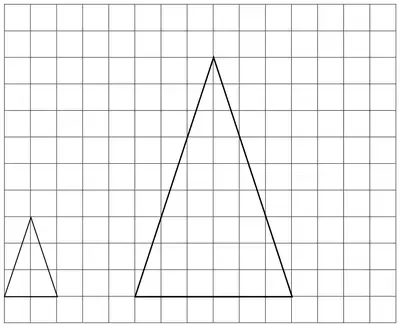
18 On the grid, draw an enlargement of the triangle with scale factor \(\dfrac{1}{2}\) [2 marks]
Mark scheme
Answer
Mark
Comments
Isosceles triangle with base 2 cm and height 3 cm in any orientation
B2
\(\pm \frac{1}{4}\) square on base or height B1 isosceles triangle with base 2 cm or height 3 cm in any orientation or acute angled triangle with base 2 cm and height 3 cm in any orientation
Additional guidance
Mark intention for isosceles triangle within tolerance, lines do not need to be ruled
Enlargement can be drawn wholly or partially inside the original
5 On the grid, draw an enlargement of the triangle with scale factor \(\dfrac{1}{2}\) [2 marks]
Mark scheme
Answer
Mark
Comments
Isosceles triangle with base 2 cm and height 3 cm in any orientation
B2
\(\pm\) ¼ square on base or height B1 isosceles triangle with base 2 cm or height 3 cm in any orientation or acute angled triangle with base 2 cm and height 3 cm in any orientation
Additional guidance
Mark intention for isosceles triangle within tolerance, lines do not need to be ruled
Enlargement can be drawn wholly or partially inside the original
(a) Reflect the triangle in the line \(\qquad x = 2\) [2 marks]
(b) Rotate the kite \(90^\circ\) anticlockwise about (0, 0) [2 marks]
Mark scheme (a)
Answer
Mark
Comments
B2
B1 for all three vertices correctly plotted but not joined or reflection in \(y = 2\)or reflection in \(x = a\), \(-2.5 \leqslant a \leqslant 2.5\) eg
Additional guidance
Tolerance – half a square for all three vertices
Vertices must be joined with intended straight lines for B2
B1 answers must lie wholly on the grid
Mark scheme (b)
Answer
Mark
Comments
B2
B1 for all four vertices correctly plotted but not joined or for rotation \(90^\circ\) clockwise about (0, 0)or any rotation of \(90^\circ\) anticlockwise eg
Additional guidance
Tolerance – half a square for all four vertices
Vertices must be joined with intended straight lines for B2
24 Describe fully the single transformation that maps triangle A to triangle B. [3 marks]
Mark scheme
Answer
Mark
Comments
Enlargement
B1
Scale factor (\(\times\)) \(\dfrac{1}{3}\)
B1
Centre (5, 1)
B1
Additional guidance
Enlarge (\(\times\)) \(\dfrac{1}{3}\) (5, 1)
B1B1B1
Reduction or makes bigger or unenlargement or increase or negative enlargement
1st B0
Any other transformation mentioned or implied such as reflection, rotation or translation loses the mark for enlargement eg enlarged and moved up 4 or enlarged and \(\begin{pmatrix} -2 \\ 2 \end{pmatrix}\)
7 Describe fully the single transformation that maps triangle \(A\) to triangle \(B\). [3 marks]
Mark scheme
Answer
Mark
Comments
Enlargement
B1
Scale factor (\(\times\)) \(\dfrac{1}{3}\)
B1
Centre (5, 1)
B1
Additional guidance
Enlarge (\(\times\)) \(\dfrac{1}{3}\) (5, 1)
B1B1B1
Reduction or makes bigger or unenlargement or increase or negative enlargement
1st B0
Any other transformation mentioned or implied such as reflection, rotation or translation loses the mark for enlargement eg enlarged and moved up 4 or enlarged and \(\begin{pmatrix} -2 \\ 2 \end{pmatrix}\)
Full descriptions are not needed, but if given must be correct For the enlargement, the scale factor of \(-1\) must be given
Transformation (6, 0)
B1
Moved 6 to the right
B1
Moved 6 squares
B0
Condone ‘turn’ with full description of \(180^\circ\), (centre) (0, 2.5)
B1
2 or more single transformations given, with at least 1 correct
B1
Mark scheme (b)
Answer
Mark
Comments
Enlargement, scale factor \(-2\), centre \((-1, 0)\)
B3
B2 Enlargement, scale factor \(-2\) or enlargement centre \((-1, 0)\) or scale factor \(-2\), centre \((-1, 0)\) B1 (Triangle with) vertices at \((0, -1)\) \((0, -3)\) and \((3, -2)\) or enlargement or scale factor \(-2\) or scale factor 2
Additional guidance
‘Scale factor’ and ‘centre’ may be implied eg enlargement, \(-2\), \((-1, 0)\)
B3
Allow ‘\(-1\) on the \(x\)-axis’ for \((-1, 0)\)
No triangle on diagram, but vertices stated as coordinates and no other marks awarded
B1
A combination of transformations can score a maximum of 1 mark for the triangle drawn or vertices identified
Correct triangle drawn and ‘enlargement’, with no other marks awarded
B1
Enlargement, (scale factor) \(-\dfrac{1}{2}\), centre \((-1, 0)\)
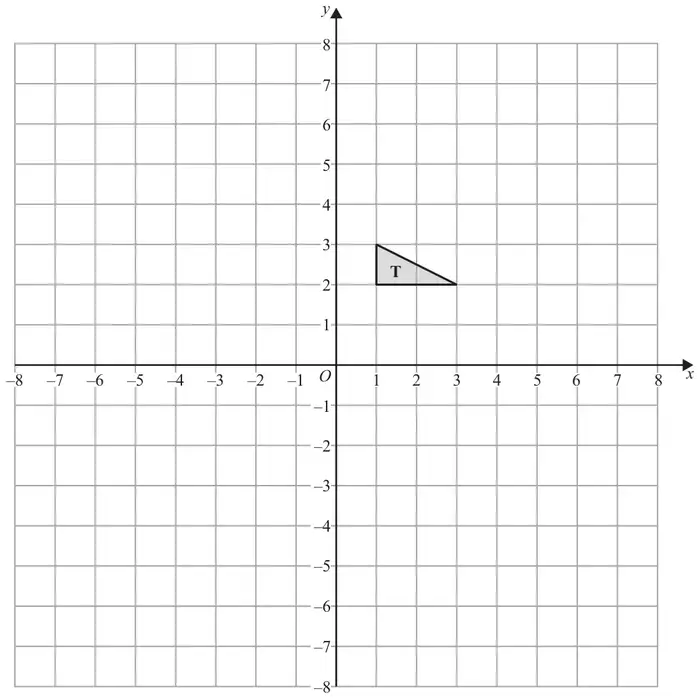
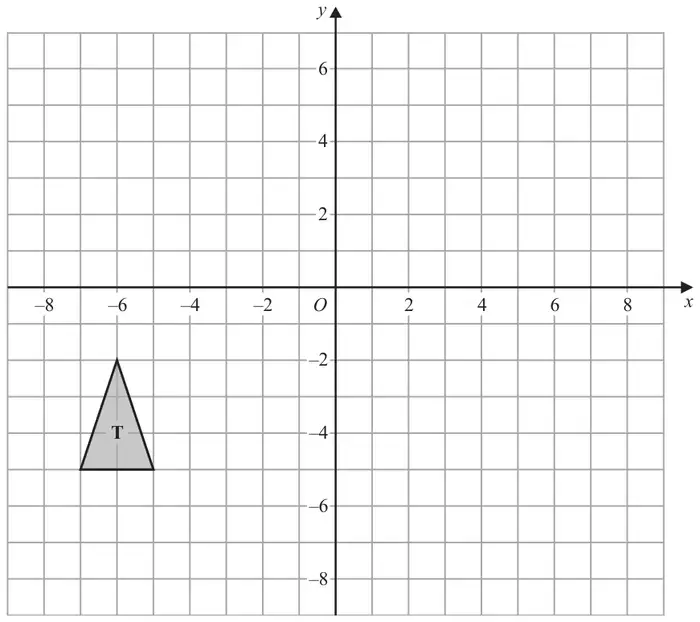
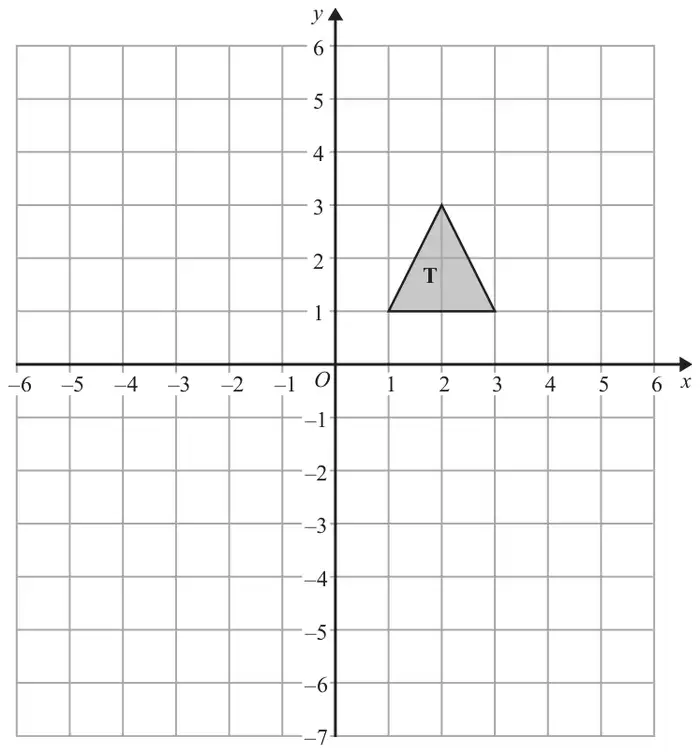
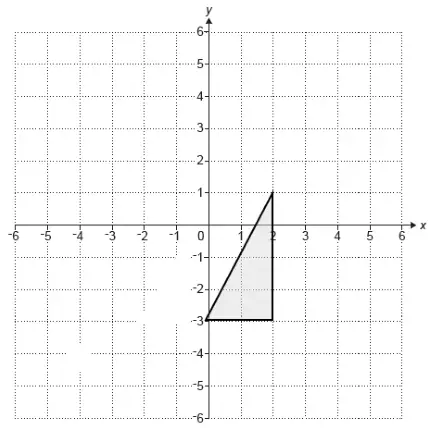
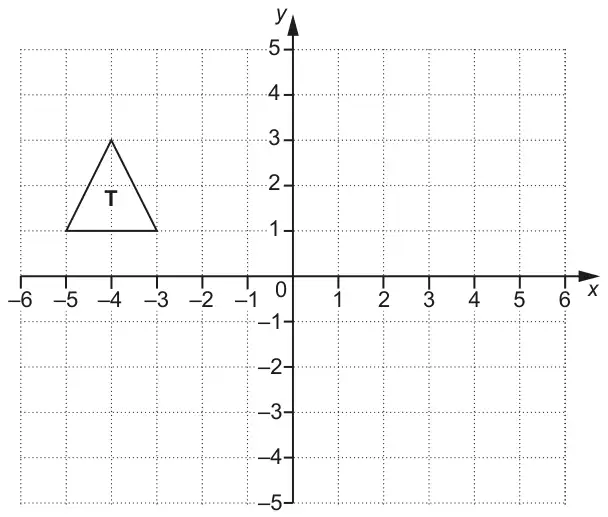
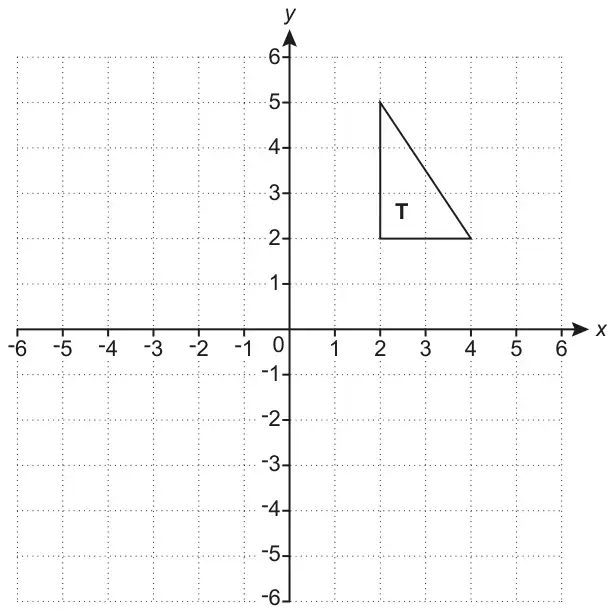
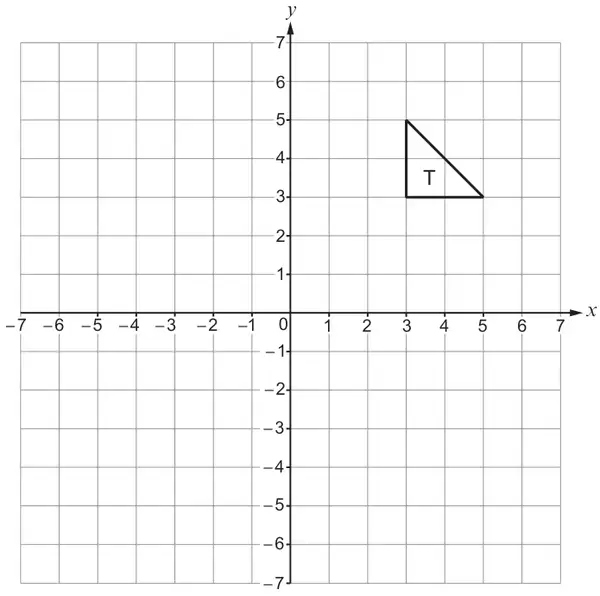
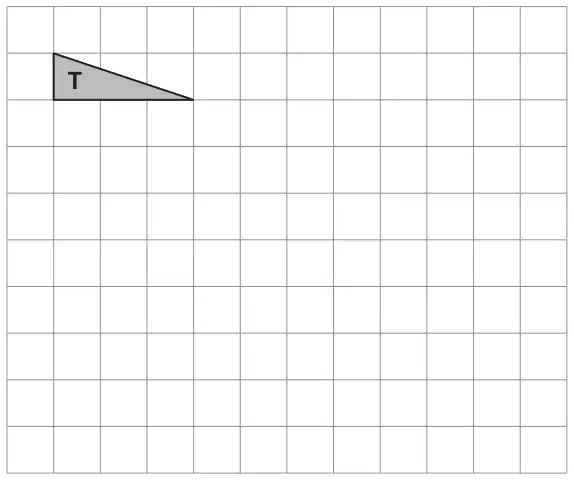
Translate triangle T by vector \(\begin{pmatrix} 3 \\ -2 \end{pmatrix}\). [2]
Mark scheme
Answer
Marks
Part marks and guidance
Correct translation
2
B1 for a translation \(\begin{pmatrix} 3 \\ k \end{pmatrix}\) or \(\begin{pmatrix} k \\ -2 \end{pmatrix}\) or three correct points not joined or three joined points and one just out of tolerance
\(k\) can be 0 mark intent (vertices within \(\pm\)2 mm of correct position by eye) Ignore “counting” dots, intermediate position dots and dots on perimeter
To be considered for the mark one point would need to be less than half way to the next gridline and the others in tolerance
Condone poor spelling Do not allow e.g. hectagon or hectogon
(ii) 2
1
Mark scheme (b)
Answer
Marks
Part marks and guidance
1
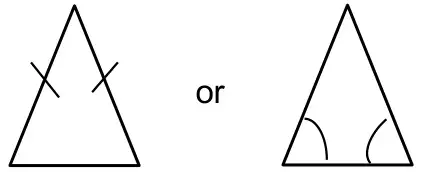
No contradictions If sides and angles indicated mark the worst Use of arrows on sides is 0 marks The number of “lines” on equal sides must be the same. Allow 70, 70, 40 labelled as angles with correct notation. 70, 70, 40 alone is 0 marks Ignore all other additions e.g. numbers for length/angles and lines of reflection and apply the scheme
13 Triangle A and triangle B are shown on the coordinate grid.
Triangle A is mapped onto triangle B using a combination of two transformations:
a transformation T, followed by
a translation of \(\begin{pmatrix} 8 \\ -5 \end{pmatrix}\).
Describe fully transformation T. [4]
Mark scheme
Answer
Marks
Part marks and guidance
Rotation
2
B1 for triangle or vertices at (−5, 1), (−1, 1) and (−1, −2)
Must be rotate or rotation, not turn etc
90° [anticlockwise] or 270° clockwise
1
(−1, 3)
1
Condone −1, 3 Condone an answer [for full or part marks] that repeats the given transformation ie rotation, 90° [anticlockwise], (−1, 3) followed by translation \(\begin{pmatrix} 8 \\ -5 \end{pmatrix}\) In other cases: If more than one transformation stated then max award is the B1 for the triangle or vertices if drawn on the grid
(a) Triangle A is translated by \(\begin{pmatrix} 6 \\ -3 \end{pmatrix}\) to give triangle T.
Draw and label triangle A on the grid. [2]
(b) Triangle T is rotated through \(90^\circ\) anticlockwise about \((0, 0)\) to give triangle B.
Draw and label triangle B on the grid. [2]
(c) Triangle T is reflected in the line \(y = -1\) to give triangle C.
Draw and label triangle C on the grid. [2]
Mark scheme (a)
Answer
Marks
Part marks and guidance
Triangle A at \((-5, 4)\) \((-3, 4)\) \((-4, 6)\)
2
B1 for translation of \(\begin{pmatrix} -6 \\ j \end{pmatrix}\) or \(\begin{pmatrix} k \\ 3 \end{pmatrix}\) or for triangle at \((7, -2)\) \((9, -2)\) \((8, 0)\)
See overlay. In all parts condone unlabelled if clear. Accept good freehand. Vertices within 2mm by eye
Blue overlay 2 Red overlay B1 Vertical line shows where bottom left vertex should be for \(\begin{pmatrix} -6 \\ j \end{pmatrix}\) Horizontal line shows where base line of triangle should be for \(\begin{pmatrix} k \\ 3 \end{pmatrix}\)
Mark scheme (b)
Answer
Marks
Part marks and guidance
Triangle B at \((-3, 2)\) \((-1, 1)\) \((-1, 3)\)
2
B1 for \(90^\circ\) clockwise rotation or correct size and orientation incorrect position
Blue overlay 2 Red overlay shows B1 for clockwise rotation
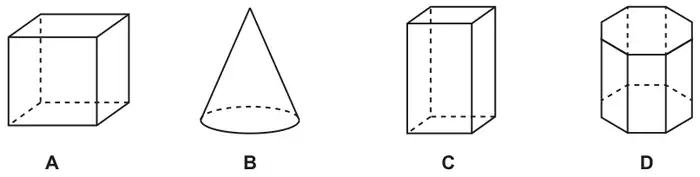
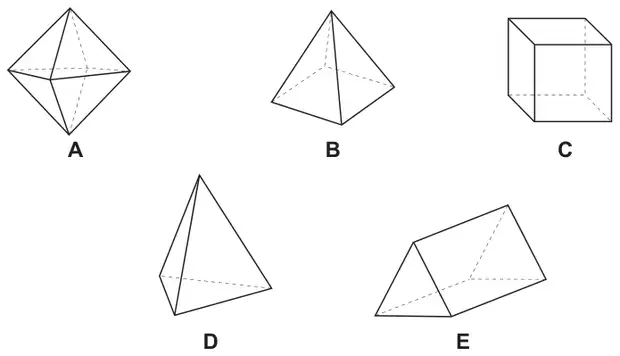
Write down the letter of the solid that is not a prism. [1]
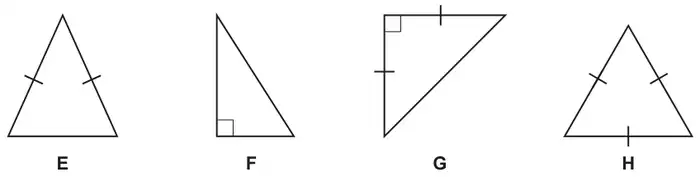
(b) These four triangles are labelled E, F, G and H.
Write down the letter of the right-angled isosceles triangle. [1]
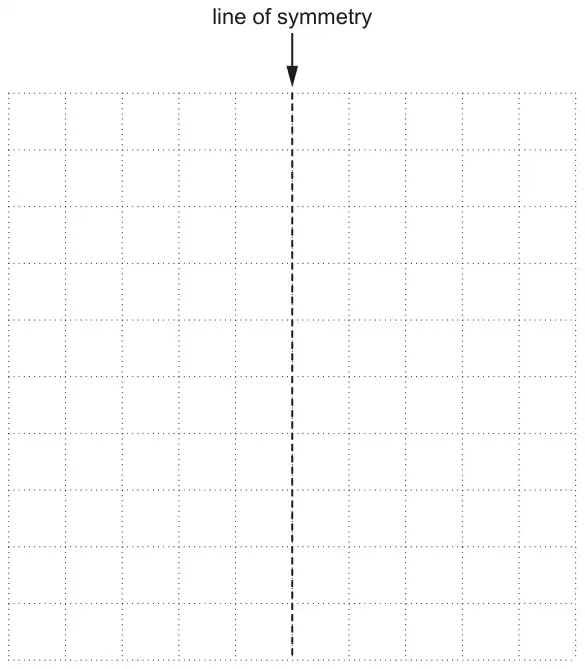
(c) A quadrilateral has
exactly one line of symmetry and
each angle is either acute or obtuse.
Draw a possible quadrilateral on this grid. The dashed line must be the line of symmetry.
[2]
Mark scheme (a)
Answer
Marks
Part marks and guidance
B
1
Accept any clear indication e.g. the cone or the second one May be on diagram
Mark scheme (b)
Answer
Marks
Part marks and guidance
G
1
Accept any clear indication e.g the third one May be on diagram
Mark scheme (c)
Answer
Marks
Part marks and guidance
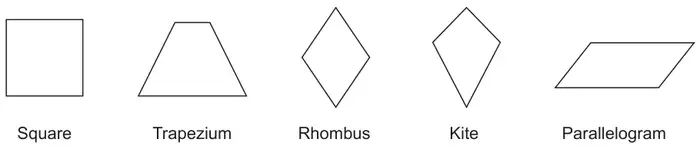
Kite or isosceles trapezium with only the given line of symmetry and no right angles
2
B1 for correct shape but inaccurate or • kite with right angle • arrowhead without right angle • rhombus
B0 for • square • rectangle • non-isosceles trapezium • arrowhead with right angle • parallelogram • triangle or shape with 5 or more sides
Mark intention: accept vertices \(\pm\) 2mm and freehand for 2 marks If in doubt, use overlay as guide. Place so the correct point would be in the centre of the square and their point must be in, or on, square formed by red lines within overlay Condone slight extensions, gaps and wobbles
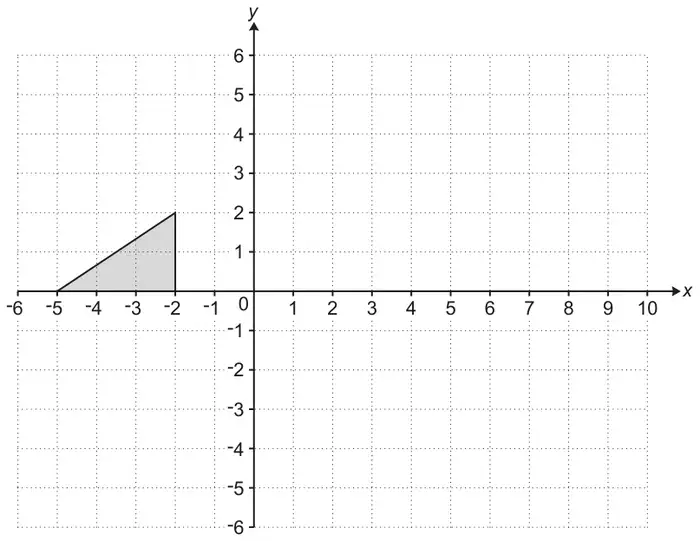
If more than 1 drawing and no clear choice mark the worst
Condone 1, 3 Allow as answer [full and part marks] Rotation, 180, (1, 3) followed by/and reflection in \(x\)-axis (repeat of info in question)
but in other cases If more than one other transformation given then B1 maximum if the triangle drawn on the grid e.g. Rotation 180 then move 1 across, up 2 is two transformations Extra properties treat as choice
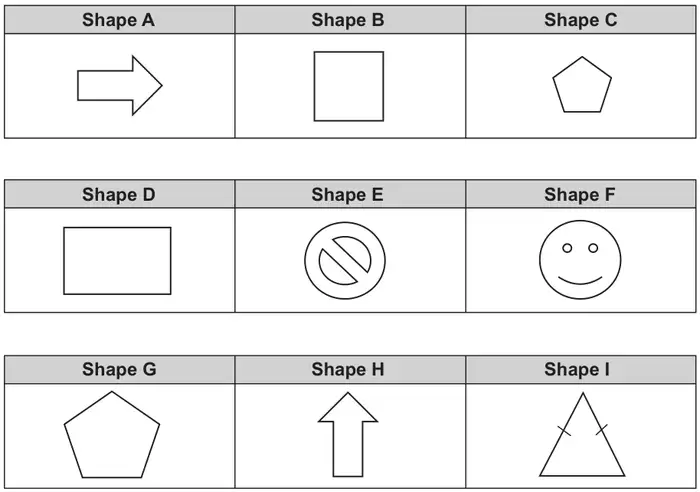
(a) Here is a shape. On the diagram, draw the shape’s two lines of symmetry.
[1]
(b) Here is another shape.
Write down the order of rotation symmetry of the shape. [1]
(c)
(i) Sketch a quadrilateral that has exactly one line of symmetry. [1]
(ii) Write down the mathematical name of your quadrilateral. [1]
Mark scheme (a)
Answer
Marks
Part marks and guidance
2 correct lines of symmetry only
1
Mark intention condoning freehand use BOD Lines should be approx half diameter or longer by eye and intersect within the crossbar and one be within the crossbar If more than one drawing and no clear choice, mark the worst (2a and 2ci)
Mark scheme (b)
Answer
Marks
Part marks and guidance
4
1
Mark scheme (c)
Answer
Marks
Part marks and guidance
(i) Sketch of a quadrilateral with exactly one line of symmetry
1
Mark intention and condone freehand kite or isosceles trapezium or arrowhead If kite, must not appear to have two pairs of parallel sides e.g. look square L of S need not be seen
(ii) Name consistent with sketch
1dep
Dep on (c)(i) being a recognisable quadrilateral
Condone poor spelling Mark name based on your decision for shape in (i)
(a) Write down the mathematical name of each of these shapes.
(i) A triangle with 3 equal sides.
.................. triangle [1]
(ii) A quadrilateral with 4 equal sides and no right angles. [1]
(b) Here is a rectangle.
(i) On the diagram, draw the rectangle’s two lines of symmetry. [1]
(ii) The rectangle has rotation symmetry of order 2.
Amaya says
A rectangle is the only quadrilateral that has rotation symmetry of order 2.
Is she correct? Show how you decide. [2]
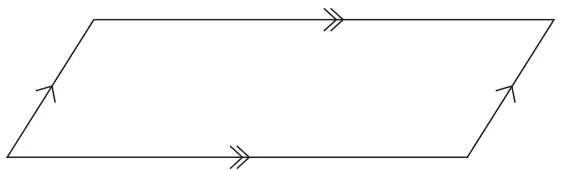
(c) Add the correct symbols to this diagram to show that line AB is parallel to line DC.
[1]
Mark scheme (a)
Answer
Marks
Part marks and guidance
(i) Equilateral
1
(ii) Rhombus
1
Mark scheme (b)
Answer
Marks
Part marks and guidance
(i) Draws both lines of symmetry correctly
1
Mark intention
(ii) She is incorrect oe and gives rhombus or parallelogram as the other quadrilateral
2
M1 for correct description of RS of any other quadrilateral e.g square has order 4
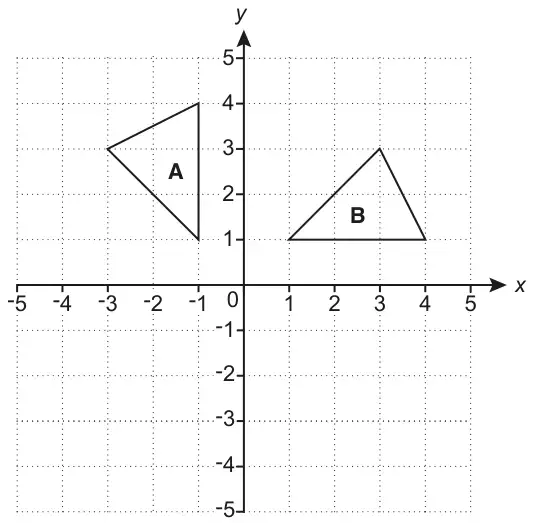
For M1 ISW other comments that do not refer to symmetry
See AG
Exemplar responses
Exemplar responses for Q5bii
Response
Mark
A rhombus has symmetry of order 2. (No decision).
1
No, other polygons have rotation symmetry of 2 eg rhombus, kite.
1
Diagram of square drawn and 4 written by the side (BOD 1 as they haven’t contradicted that the 4 isn’t order of rotation)
1
No because if you take a square or a rhombus you can also have rotation symmetry of 2 (not a completely correct statement for both marks but M1 scored for ‘rhombus….symmetry of 2’)
1
No because other quadrilaterals have rotational symmetry 2
0
No because a square has rotational symmetry 2
0
Amaya is not correct because a rectangle is not the only quadrilateral that has rotational symmetry 2. A square also has it.
0
She isn’t correct because there are a few shapes with it
0
Yes because a square is a quadrilateral but has 4 lines of symmetry
0
Squares do not have a rotational symmetry of order 2.
0
Rhombus drawn in the space provided with the correct lines of symmetry
0
No because some irregular quadrilaterals have 4 – depends on the shape if it is irregular shape
0
This because most other quadrilaterals don’t have the same sides as the others, leaving no symmetry (correct description of a scalene quadrilateral but they need to specify the shape by name)
0
Mark scheme (c)
Answer
Marks
Part marks and guidance
Arrows facing the same way added to AB and DC
1
Condone more than one arrow facing the same way on AB and DC
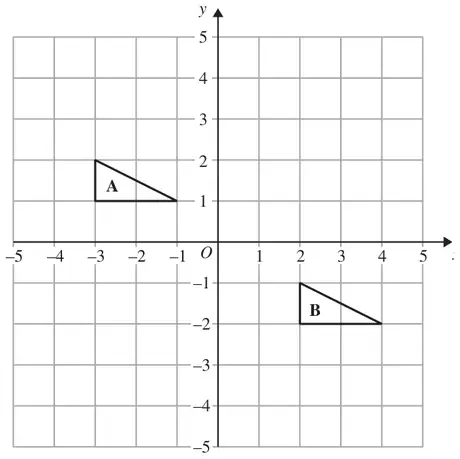
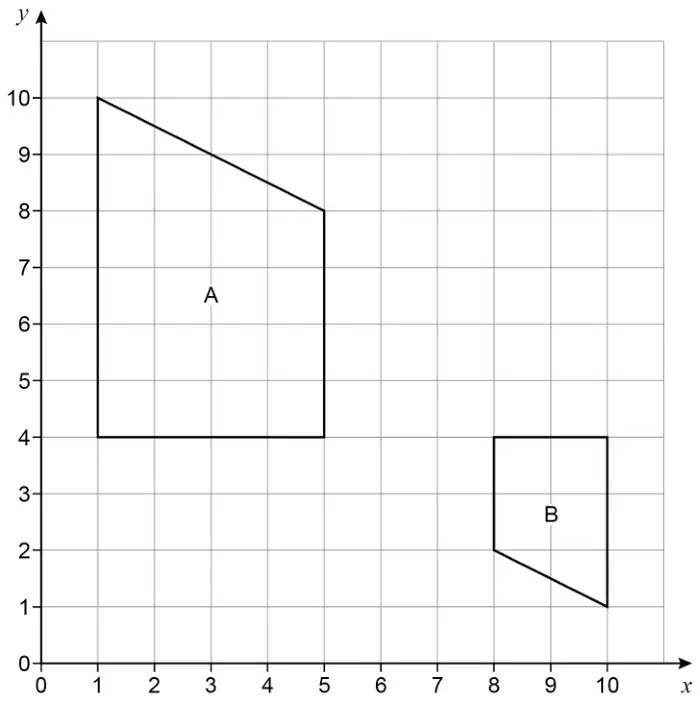
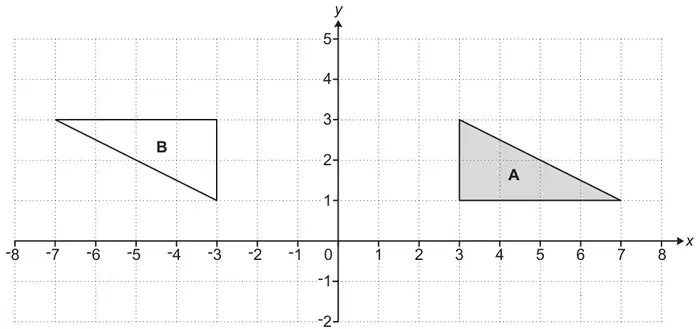
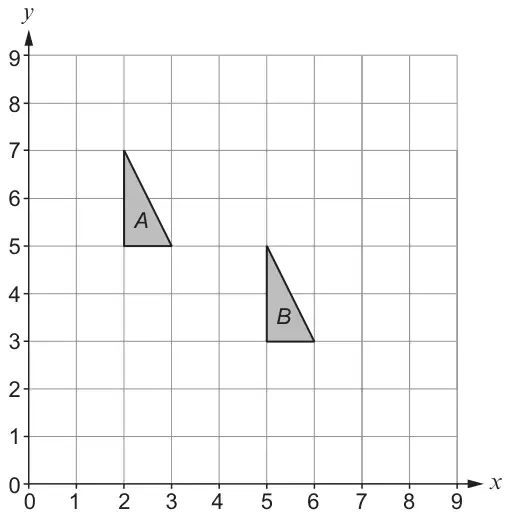
B1 for \(\begin{pmatrix} -4 \\ -3 \end{pmatrix}\) oe or for translation \(\begin{pmatrix} -4 \\ k \end{pmatrix}\) oe or translation \(\begin{pmatrix} k \\ -3 \end{pmatrix}\) oe
If 0 scored, SC1 for translation (–4, –3) or for triangle drawn on grid at (–1, 0 ), (–1, –1), (1, –1)
Extra transformations spoil all marks but allow SC1 mark Extra properties treat as choice oe e.g. 4 left and 3 down
Use overlay ignore other triangles
Mark scheme (b)
Answer
Marks
Part marks and guidance
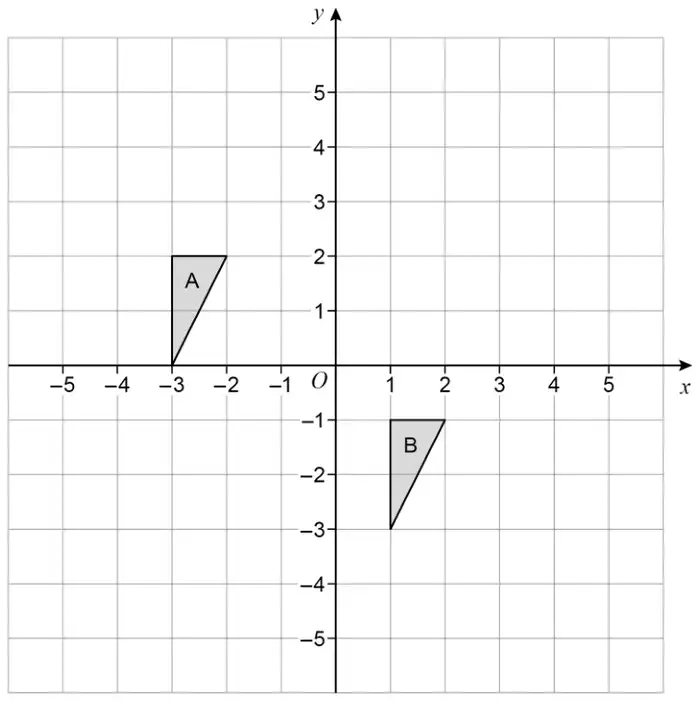
Reflection \(x\) – axis oe
3
B2 for reflection B1 for x – axis oe
If 0 scored, SC2 for image drawn at (3, –3), (3, –2) and (5, –2) SC1 for image drawn at (3, 3), (2, 3) and (2, 5)
Extra transformations spoil all marks but allow SC marks Extra properties treat as choice
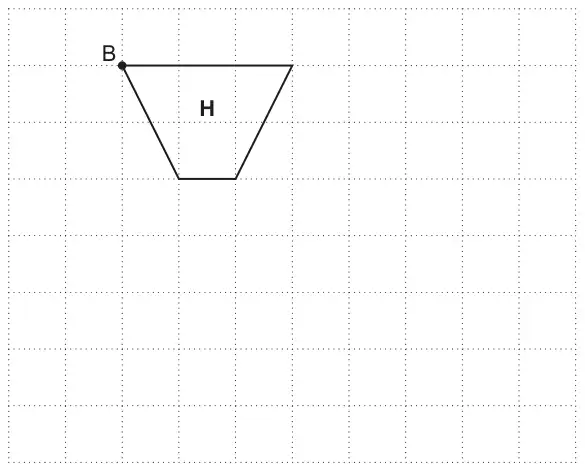
Enlarge shape H with scale factor 2 and the centre of enlargement at point B. [2]
Mark scheme (a)
Answer
Marks
Part marks and guidance
Correct ruled rotation
2
B1 for correct rotation but lines unruled or Ruled but one vertex just outside tolerance or rotation of 180° about another point and ruled and with vertices in tolerance
Use overlay as a guide. Set screen to zoom 57%. Vertices to be within overlay circles
Mark scheme (b)
Answer
Marks
Part marks and guidance
Correct ruled enlargement
2
B1 for correct unruled enlargement or ruled enlargement with one vertex just outside tolerance enlargement sf 2 but from different point
Use overlay as a guide. Set screen to zoom 57%. Vertices to be within overlay circles for all marks For B1, enlargement must fit on grid
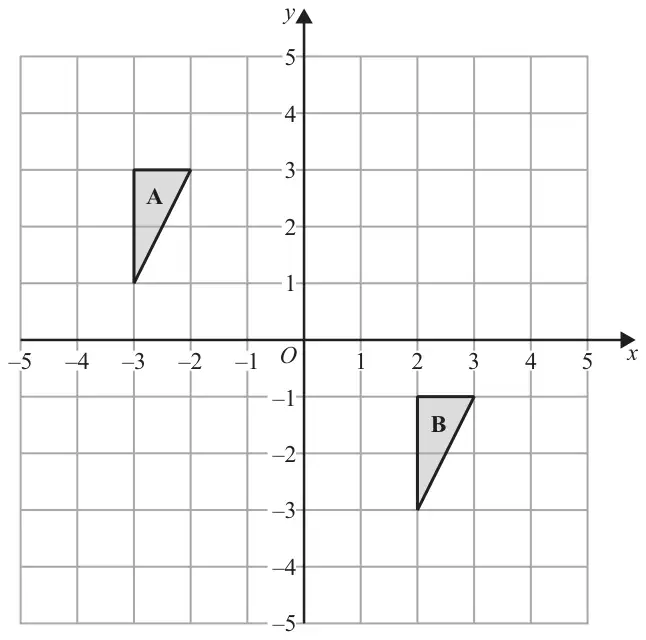
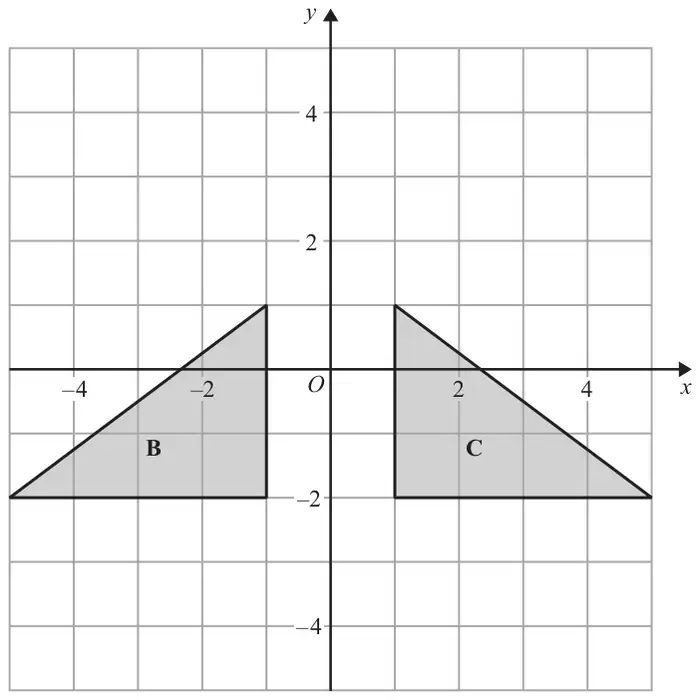
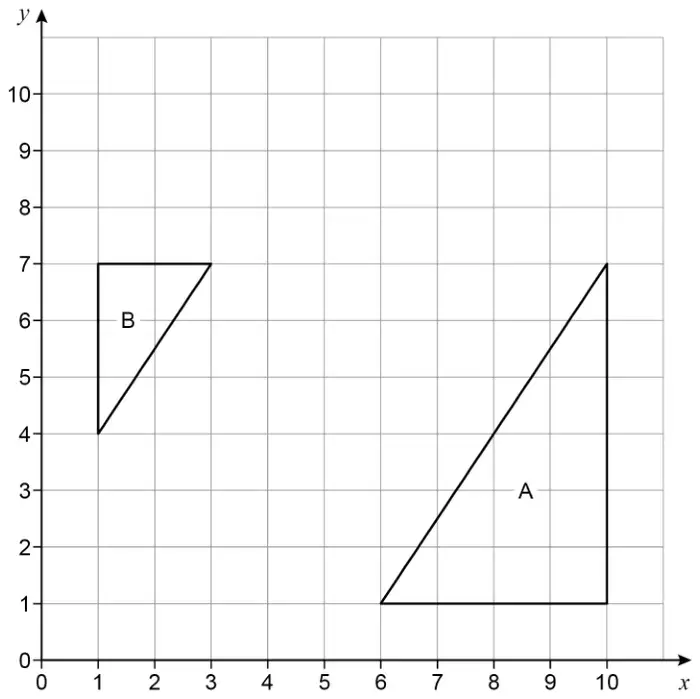
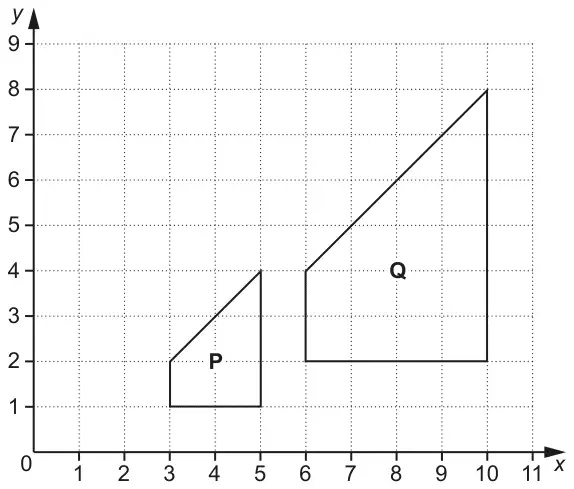
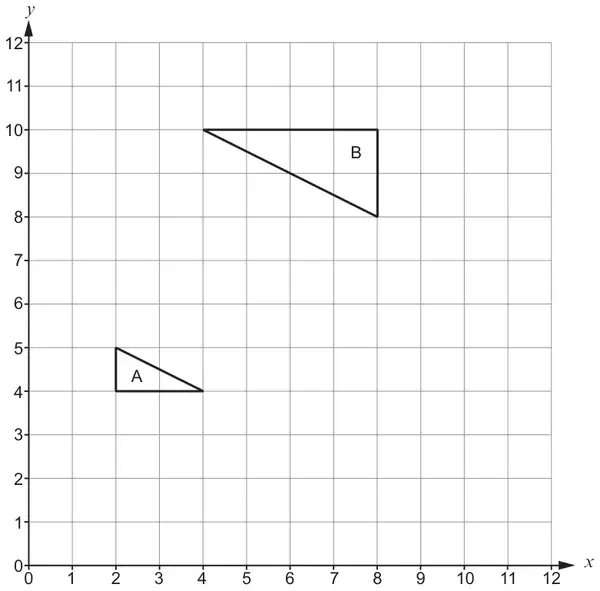
8 Triangle A and triangle B are drawn on the coordinate grid.
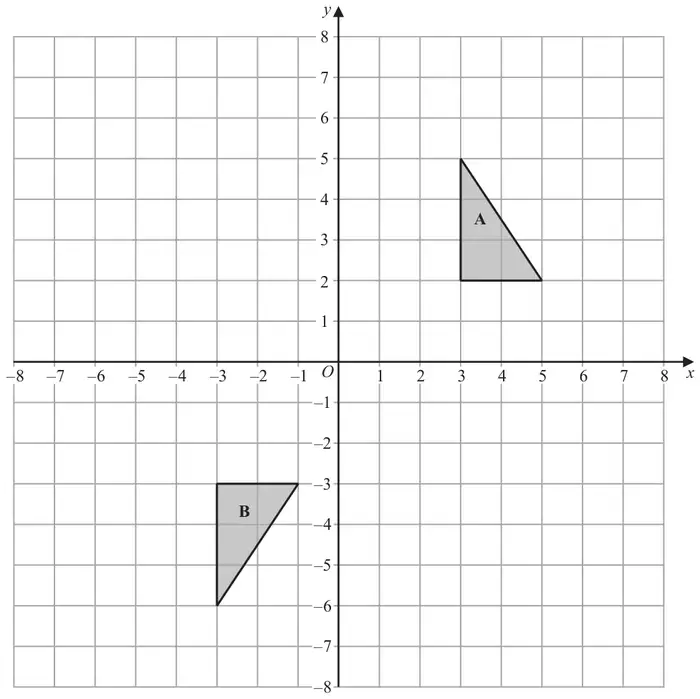
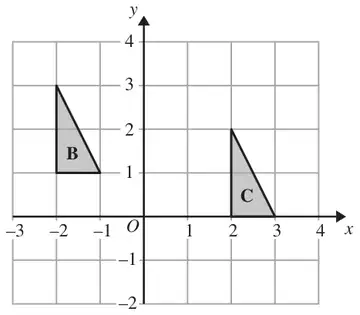
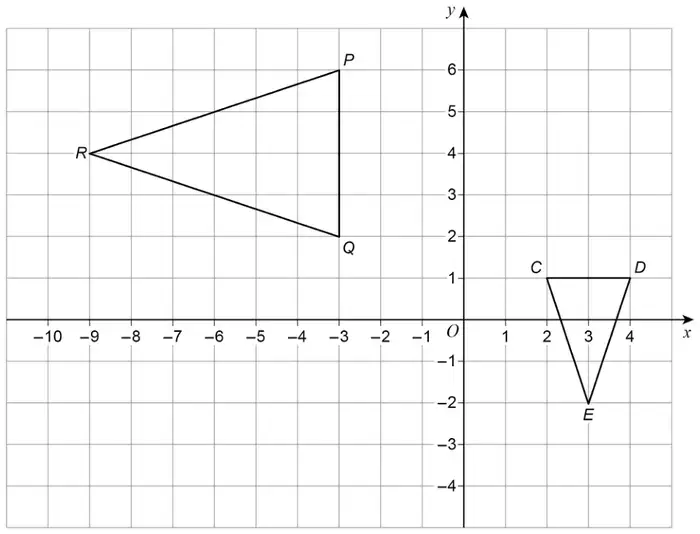
(a) Describe fully the single transformation that maps triangle A onto triangle B. [3]
(b) Describe fully the single transformation that is equivalent to:
a reflection in the line \(x = 3\), followed by
a translation by \(\begin{pmatrix} 4 \\ 0 \end{pmatrix}\).
You may use the grid above to help you. [3]
Mark scheme (a)
Answer
Marks
Part marks and guidance
Rotation [centre] (−1, 0) 180°
or
enlargement [centre] (−1, 0) [sf] −1
1 1 1
double transformation scores 0, 0, 0 must be coordinates, condone missing final bracket ignore direction
Mark scheme (b)
Answer
Marks
Part marks and guidance
Reflection
1
double transformation may only score B1 below
\(x = 5\)
2
B1 for drawing line \(x = 5\) or for a correct mirror line of their final image, not \(x = 3\), drawn or written or for a correct final image or a correct follow through translation of the reflection of their object or the correct reflection of their object
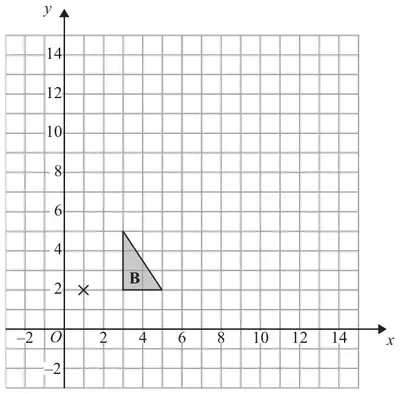
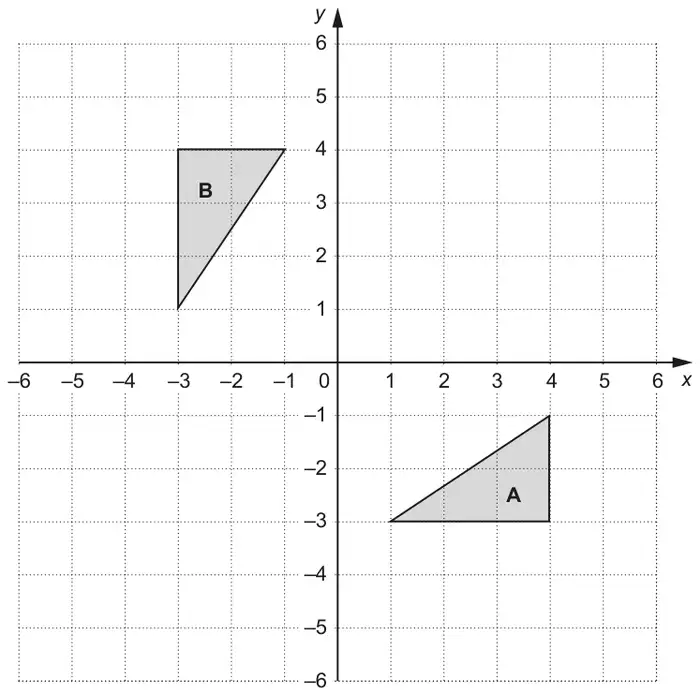
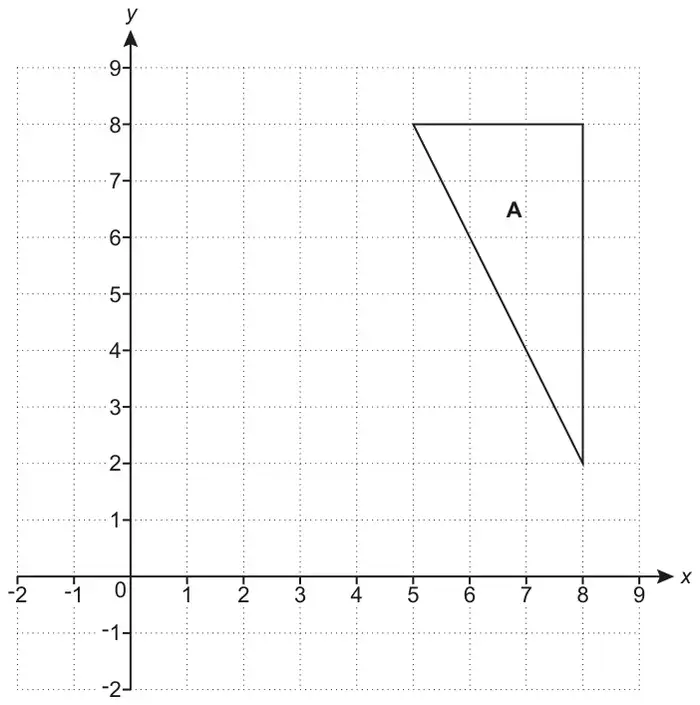
(a) Draw the image of triangle A after a reflection in the line \(y = -1\). [2]
(b) Describe fully the single transformation that maps triangle A onto triangle B. [3]
(c) Complete this statement.A rotation of 180° around (0, 0) has the same effect as an enlargement by scale factor .................... with centre of enlargement (.......... , ..........).[2]
Mark scheme (a)
Answer
Marks
Part marks and guidance
Image at (1, –3), (3, –3), (1, –6)
2
B1 for reflection in any horizontal line or for reflection in \(x = -1\)
Use overlay mark intention
isw other shapes
Mark scheme (b)
Answer
Marks
Part marks and guidance
Enlargement [sf] ½ oe [centre] (5, 7)
3
B1 for each
More than one transformation given spoils all 3 marks Extra properties treat as choice
Enlarge triangle A with scale factor \(\frac{1}{3}\) and centre of enlargement (−1, 5). [3]
(b) Prism P and prism Q are similar.
The ratio of the surface area of prism P to the surface area of prism Q is 1 : 3.
(i) Jay says
The height of prism P is one third of the height of prism Q.
Explain why he is wrong. [1]
(ii) The volume of prism Q is 86 cm\(^3\).
Calculate the volume of prism P. [3]
Mark scheme (a)
Answer
Marks
Part marks and guidance
Triangle with vertices at (1, 6), (2, 6), (2, 4)
3
B2 for triangle correct size and orientation in wrong position
OR
B1 for enlargement centre (−1, 5) incorrect scale factor < 1 or for triangle with two vertices correct or for three rays from (−1, 5) to vertices of triangle A or for triangle correct size but wrong orientation
Mark scheme (b)
Answer
Marks
Part marks and guidance
(i) Height factor is square root of area factor oe in words or figures
1
Mark the best bit so long as no contradiction
Must include correct reference to square or square root
(ii) 16.5 to 16.6
3
B2 for \(\left(\sqrt{3}\right)^3\) oe or \(\dfrac{1}{\left(\sqrt{3}\right)^3}\) oe soi by 5.19 to 5.20 or 0.192 to 0.193
OR B1 for \(\sqrt{3}\) or \(\dfrac{1}{\sqrt{3}}\) oe soi by 1.73[…] or 0.577[…]
Accept \(\dfrac{86\sqrt{3}}{9}\) oe Note that \(\left(\sqrt{3}\right)^3 = 3\sqrt{3}\) and \(\dfrac{1}{\left(\sqrt{3}\right)^3} = \dfrac{\sqrt{3}}{9}\)
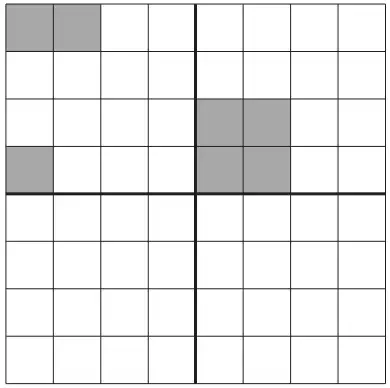
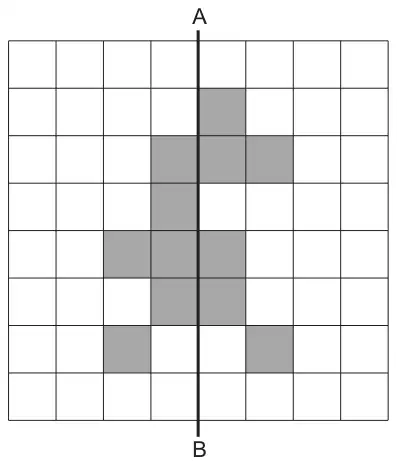
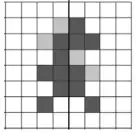
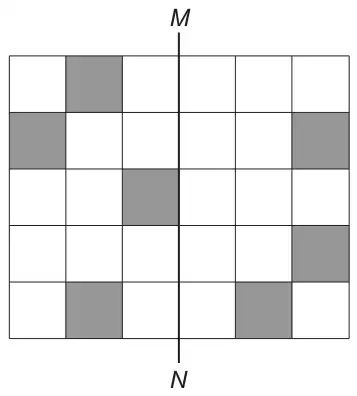
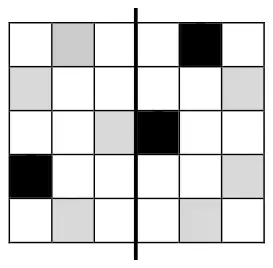
Complete the pattern below so that AB is a line of symmetry.
Shade the smallest possible number of squares. [2]
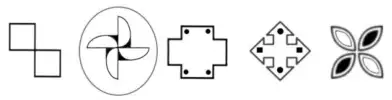
(b) Circle the shape below that has rotational symmetry of order 4. [1]
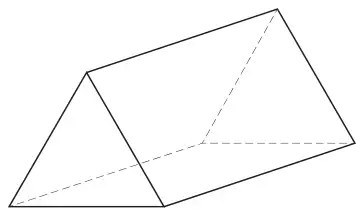
(c) The diagram below shows a triangular prism.
Diagram not drawn to scale
How many edges and vertices does the triangular prism have? [2]
Edges ………… Vertices …………
(d)
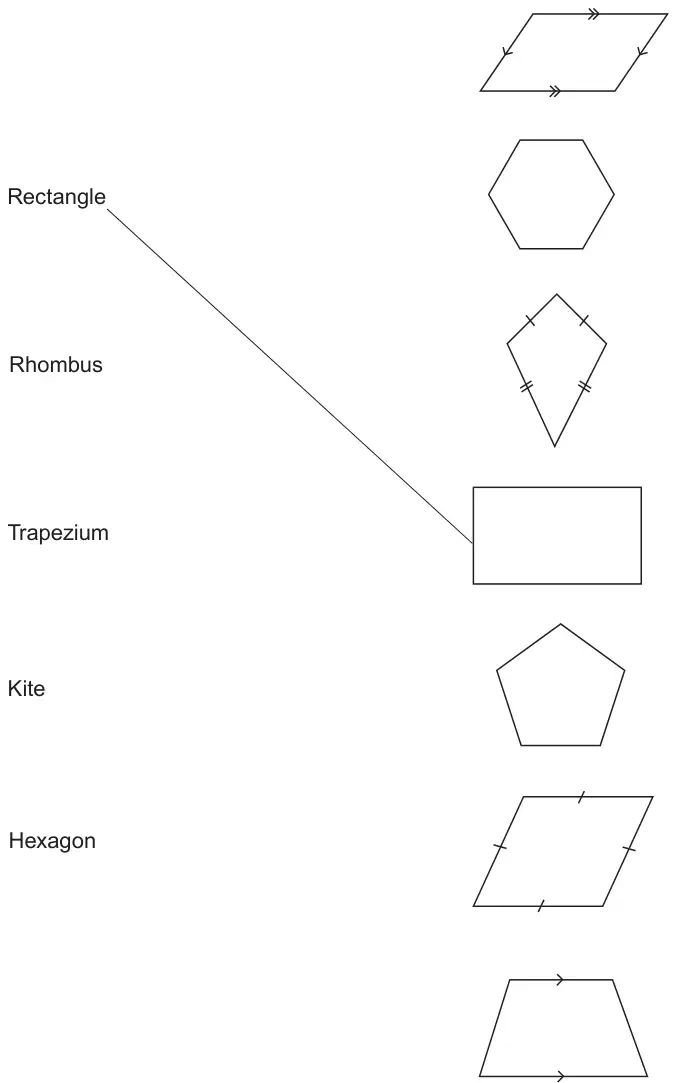
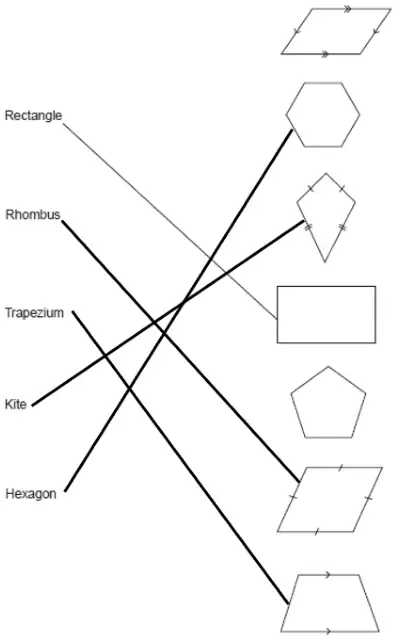
Draw one line to connect each of the following mathematical names to the correct shape. You will not need to use every shape. One has been completed for you. [2]
Mark scheme (a)
Scheme
Marks
Comments
The correct 4 squares shaded
B2
B1 for one of the following:
A symmetrical shape with the 4 correct squares and no more than 2 extra squares.
3 or 4 of the correct squares and no more than 1 incorrect square.
2 correct squares and no incorrect squares.
Mark scheme (b)
Scheme
Marks
Comments
The correct shape unambiguously indicated
B1
Mark scheme (c)
Scheme
Marks
Comments
(Edges) 9 (Vertices) 6
B2
B1 for either correct.
If no marks, award SC1 for reversed answers.
Mark scheme (d)
Scheme
Marks
Comments
All four of the remaining shapes matched correctly
B2
B1 for three of the remaining shapes matched correctly OR for 2 correct with no errors.
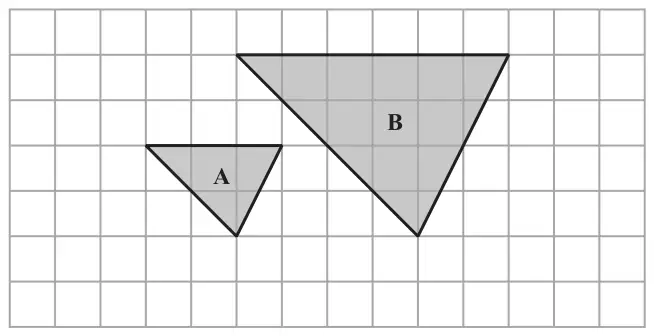
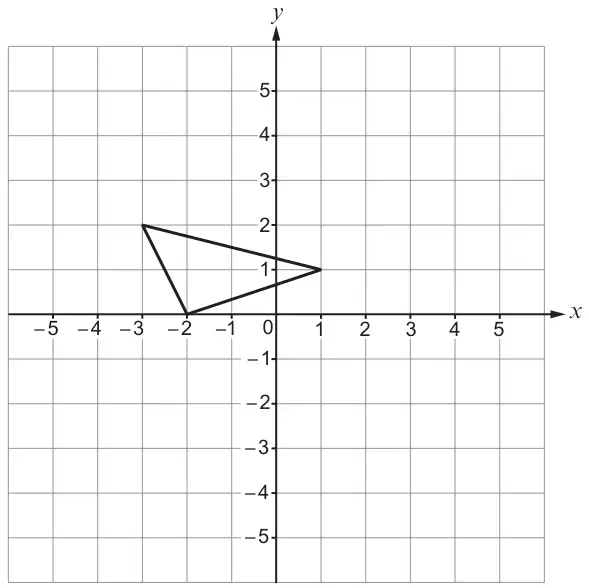
(a) Describe the single transformation that maps triangle \(A\) to triangle \(B\). [3]
(b) Triangle \(C\) was mapped to triangle \(A\) using an enlargement, scale factor \(\dfrac{1}{3}\), centre (5, 1).
Draw triangle \(C\) on the grid above. [2]
Mark scheme (a)
Scheme
Marks
Comments
Rotation 90° clockwise or 270° anti-clockwise about (−1, 0)
B3
Must be a single transformation for B3 If B3 not awarded, allow B1 for each correct ‘condition’, up to B2, from a single transformation or a multi-step transformation e.g. Award B1B1 for ‘Centre of rotation(–1, 0)’ Award B1B1 for ‘Rotationclockwise 90°, and then a translation 1 to the left and 1 down’.
Mark scheme (b)
Scheme
Marks
Comments
Correct triangle with vertices at (−4, 10), (−7, 4), (8, 4)
B2
B1 for any one of the following:
A triangle with 2 correct vertices
3 vertices correctly plotted, but not joined
for a correct enlargement from an incorrect centre
an enlargement using an different scale factor (\(\neq 1\)) from the centre (5, 1)
(a) Describe the single transformation that maps triangle ABC to triangle PQR. [2]
(b) On the grid above, draw the enlargement of triangle ABC, scale factor −1, centre (0, 3). [2]
Mark scheme (a)
Scheme
Marks
Comments
Enlargement, centre (4, 5), sf ½
B2
B1 for any 2 correct elements Allow from point (4, 5)
Mark scheme (b)
Scheme
Marks
Comments
Triangle with vertices (−4, −3), (−8, 5), (−2, 3)
B2
Allow a good freehand; ignore labels
B1 for a triangle with 2 correct vertices or for all 3 correct vertices plotted but not joined
OR for an enlargement with scale factor −1, with correct orientation with incorrect placement e.g. use of centre (3, 0) leading to triangle with vertices (4, −3), (−2, −1), (2, −9)
If no marks, award SC1 for a correct enlargement of PQR with scale factor −1 and centre (0, 3): (−3, 2), (−6, 3), (−4, −1)
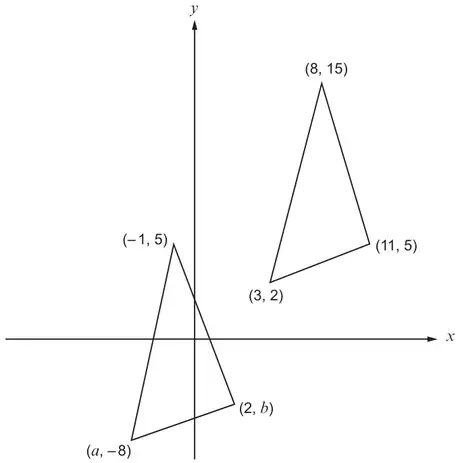
Shape A is mapped to shape B using \(\mathbf{p} + 2\mathbf{q}\).
(i) Find the column vector which translates shape A to shape B. [2]
(ii) Draw and label shape B on the grid. [2]
(b)
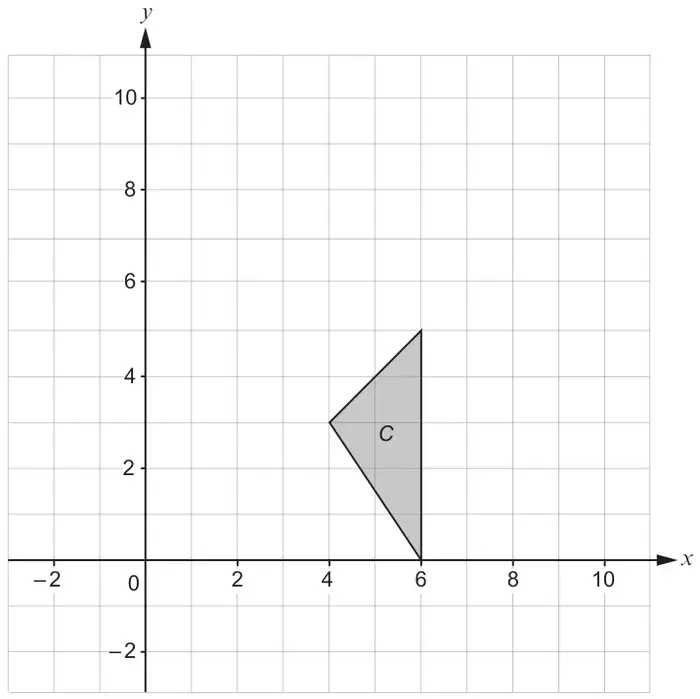
Triangle C has vertices with coordinates (4, 3), (6, 5), (6, 0). After a single transformation, the vertices of triangle C are mapped to (3, 4), (5, 6), (0, 6).
Describe the transformation. [2]
You may use this grid to help you.
Transformation: ………………
Mark scheme (a)
Scheme
Marks
Comments
(i) \(\begin{pmatrix}6\\-1\end{pmatrix}\)
B2
B1 for sight of \(\begin{pmatrix}3\\-5\end{pmatrix} + \begin{pmatrix}3\\4\end{pmatrix}\) Allow B1 for \(\begin{pmatrix}6\\-1\end{pmatrix}\) written incorrectly e.g \(\left(\dfrac{6}{-1}\right)\)
(ii) Correct shape B drawn at (2, 1), (2, 4), (3, 4), (3, 2), (4, 2), (4, 1),
B2
or correct FT; FT ‘their \(\begin{pmatrix}6\\-1\end{pmatrix}\)’;
B1 for a translation attempted with at least 4 vertices correct or shape A correctly translated by \(\begin{pmatrix}6\\y\end{pmatrix}\) where \(y \neq -1\) or \(\begin{pmatrix}x\\-1\end{pmatrix}\) where \(x \neq 6\)
If no marks in (a) then award SC1 for a clear attempt to translate by \(\begin{pmatrix}3\\-5\end{pmatrix}\) and \(\begin{pmatrix}3\\4\end{pmatrix}\).
Mark scheme (b)
Scheme
Marks
Comments
Reflection (in the line) \(y = x\)
B2
B1 for either stating a reflection or giving the equation \(y = x\)
Award no marks if more than one transformation indicated
If no marks then award SC1 for a correct diagram with the line \(y = x\) drawn.
(a)\(\mathbf{p}\) and \(\mathbf{q}\) are translation vectors with\[\mathbf{p} = \begin{pmatrix} 3 \\ -5 \end{pmatrix} \quad\text{and}\quad \mathbf{q} = \begin{pmatrix} 1{\cdot}5 \\ 2 \end{pmatrix}.\]Shape \(A\) is mapped to shape \(B\) using \(\mathbf{p} + 2\mathbf{q}\).
(i) Find the column vector which translates shape \(A\) to shape \(B\). [2]
(ii) Draw and label shape \(B\) on the grid. [2]
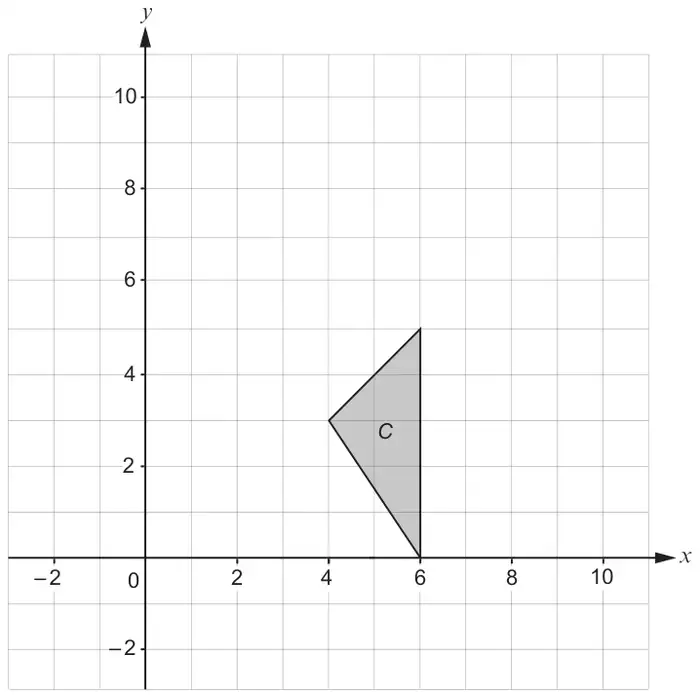
(b) Triangle \(C\) has vertices with coordinates (4, 3), (6, 5), (6, 0). After a single transformation, the vertices of triangle \(C\) are mapped to (3, 4), (5, 6), (0, 6).
Describe the transformation. [2]
You may use this grid to help you
Mark scheme (a)
Scheme
Marks
Comments
(i) \(\begin{pmatrix} 6 \\ -1 \end{pmatrix}\)
B2
B1 for sight of \(\begin{pmatrix} 3 \\ -5 \end{pmatrix} + \begin{pmatrix} 3 \\ 4 \end{pmatrix}\) Allow B1 for \(\begin{pmatrix} 6 \\ -1 \end{pmatrix}\) written incorrectly e.g. \(\left(\dfrac{6}{-1}\right)\)
(ii) Correct shape \(B\) drawn at (2, 1), (2, 4), (3, 4), (3, 2), (4, 2), (4, 1),
B2
or correct FT; FT ‘their \(\begin{pmatrix} 6 \\ -1 \end{pmatrix}\)’
B1 for a translation attempted with at least 4 vertices correct or shape \(A\) correctly translated by \(\begin{pmatrix} 6 \\ y \end{pmatrix}\) where \(y \ne -1\) or \(\begin{pmatrix} x \\ -1 \end{pmatrix}\) where \(x \ne 6\)
If no marks in (a) then award SC1 for a clear attempt to translate by \(\begin{pmatrix} 3 \\ -5 \end{pmatrix}\) and \(\begin{pmatrix} 3 \\ 4 \end{pmatrix}\).
Mark scheme (b)
Scheme
Marks
Comments
Reflection (in the line) \(y = x\)
B2
B1 for either stating a reflection or giving the equation \(y = x\)
Award no marks if more than one transformation indicated
If no marks then award SC1 for a correct diagram with the line \(y = x\) drawn.
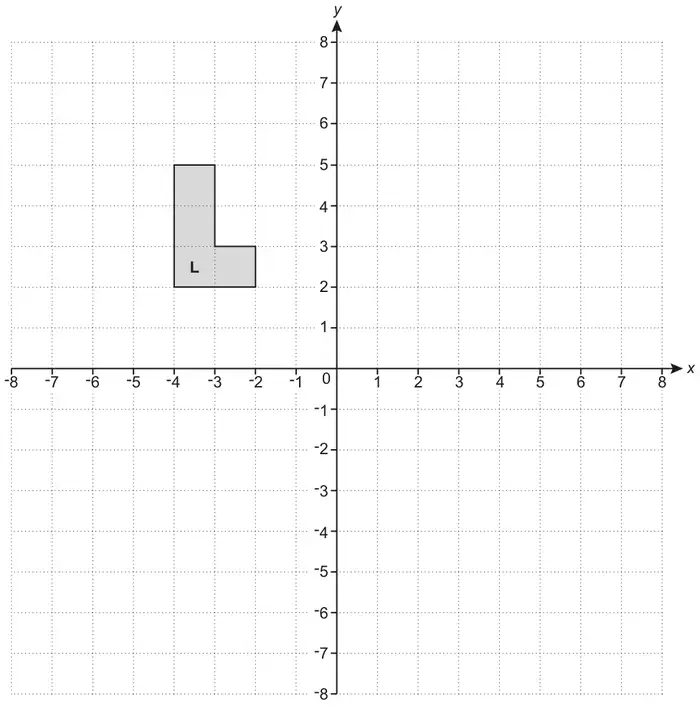
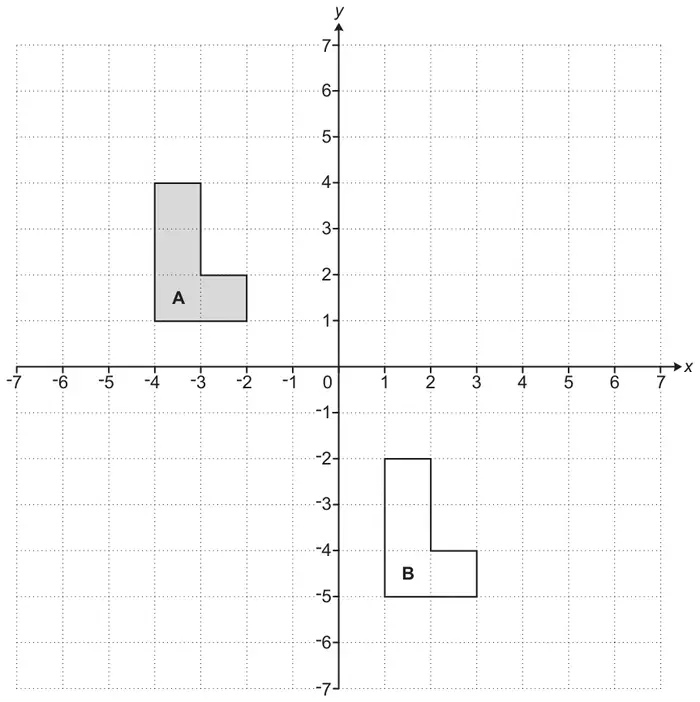
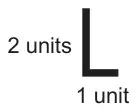
This letter is first, reflected in the line \(x = 4\), then reflected in the \(x\)-axis and finally translated through \(\begin{pmatrix} -4 \\ -2 \end{pmatrix}\).
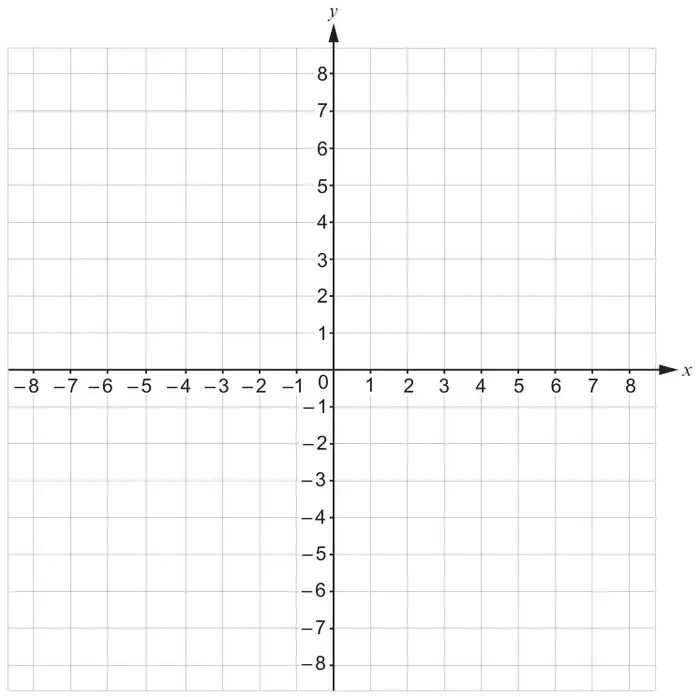
Describe the single transformation that is equivalent to these 3 transformations. [3] You may use this grid to help you.
Mark scheme
Scheme
Marks
Comments
Rotation 180° (about) (2, −1)
OR enlargement scale factor −1 centre (2, −1)
B3
Marks can only be awarded for description of a single transformation.
B2 for rotation about (2, −1) or for rotation, 180°, about ‘their (2, −1)’, provided ‘their (2, −1)’ is not (0, 0) OR for enlargement centre (2, −1) or for enlargement, scale factor −1, centre ‘their (2, −1)’ provided ‘their (2, −1)’ is not (0, 0)
or B1 for rotation about ‘their (2, −1)’ provided ‘their (2, −1)’ is not (0, 0) OR for enlargement, centre ‘their (2, −1)’ provided ‘their (2, −1)’ is not (0, 0)
If no marks award SC2 for a final answer Translation \(\begin{pmatrix} -4 \\ -10 \end{pmatrix}\) (following an initial reflection in \(y = 4\)) or SC1 for a correct diagram following an initial reflection in \(y = 4\), and the word translation or SC1 for any clear diagram showing a complete correct transformation of an appropriate L shape. (one side longer than the other)
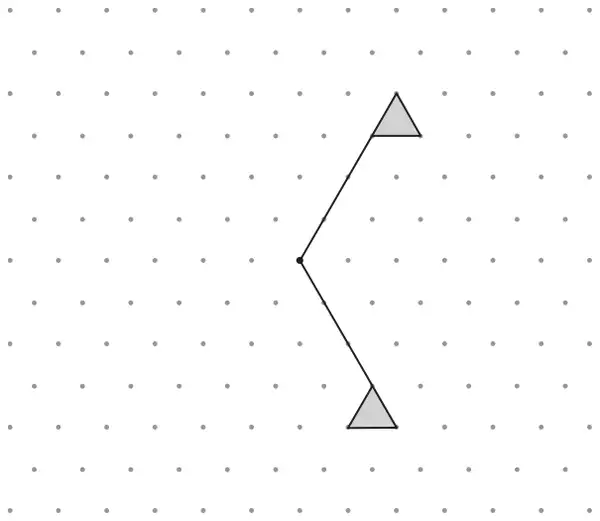
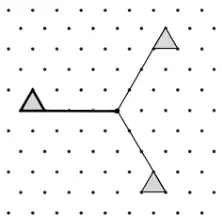
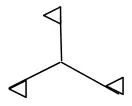
This shape is drawn on a triangular dotty grid. Complete this shape so that it has rotational symmetry of order 3. [2]
(b)
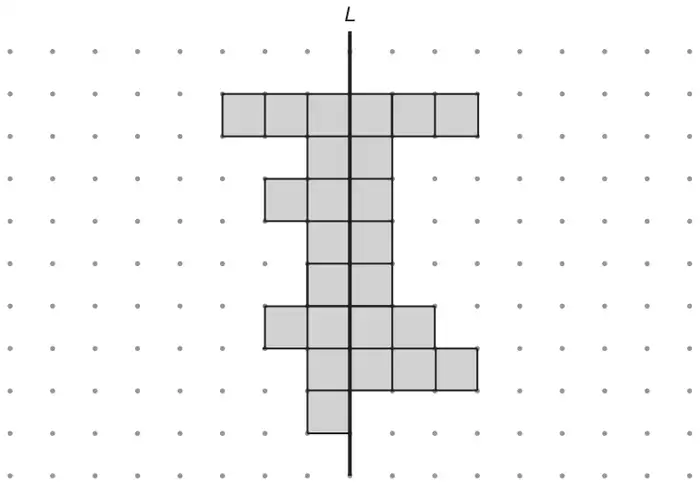
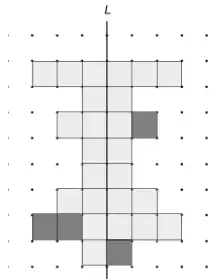
This shape is drawn on a square dotty grid. Complete the shaded shape so that \(L\) is a line of symmetry.
You must shade the smallest possible number of squares. [2]
Mark scheme (a)
Scheme
Marks
Comments
Correctly completed shape:
a single line in correct position
a single line of correct length
a triangle on the correct side of the line
B2
B1 for a line in the correct position with either correct length or with a triangle on the correct side
NB Allow unshaded triangle
No line, no marks
Mark scheme (b)
Scheme
Marks
Comments
Four correct squares shaded
B2
B1 for a symmetrical shape with 4 correct squares and no more than 2 extra squares OR B1 for 3 or 4 correct squares and no more than 1 incorrect square OR B1 for 2 correct squares and no incorrect squares
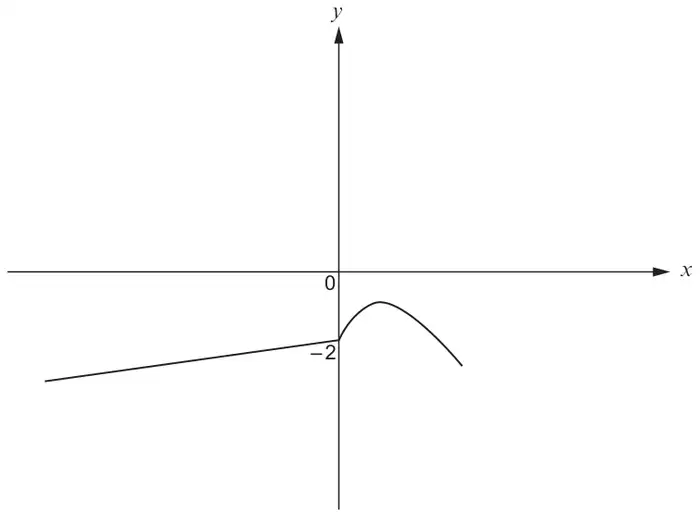
On the same diagram, sketch the curve \(y = -f(x)\). Mark clearly the coordinates of any point where this curve crosses an axis. [2]
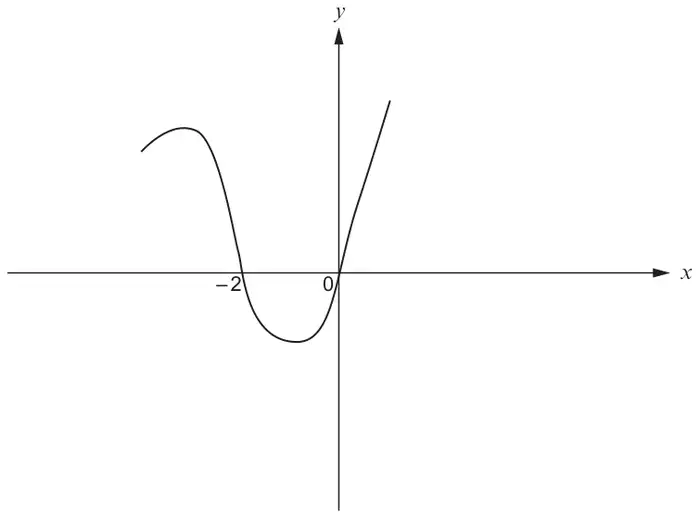
(b) The diagram shows a sketch of \(y = g(x + 2)\).
On the same diagram, sketch the curve \(y = g(x - 1)\). Mark clearly the coordinates of the points where this curve crosses the \(x\)-axis. [3]
(c) Enlarge the triangle, shown on the grid below, by a scale factor of \(-\frac{1}{2}\) with \((2, 1)\) as the centre of the enlargement. [2]
Mark scheme (a)
Scheme
Marks
Comments
Reflection in the \(x\)-axis
M1
\((0, 2)\)
A1
Accept 2 indicated correctly on the \(y\)-axis
Mark scheme (b)
Scheme
Marks
Comments
Horizontal translation
B1
Any horizontal translation without including any other transformation
Correct translation with \((1, 0)\) and \((3, 0)\) indicated on the \(x\)-axis
B2
Accept indication of 1 and 3 on the \(x\)-axis with the correct translation
B1 for a correct translation with only one of the values 1 and 3 indicated, or for a horizontal translation with \((-1, 0)\) and \((1, 0)\) indicated on the \(x\)-axis as intersections, or for a horizontal translation to show \(y = g(x)\) with \((0, 0)\) and \((2, 0)\) indicated on the \(x\)-axis as intersections
Mark scheme (c)
Scheme
Marks
Comments
Correct negative enlargement
B2
B1 an enlargement with scale factor \(-\frac12\), with correct orientation with incorrect placement.
Draw a hexagon that has exactly one line of symmetry on the grid below. [2]
(b)
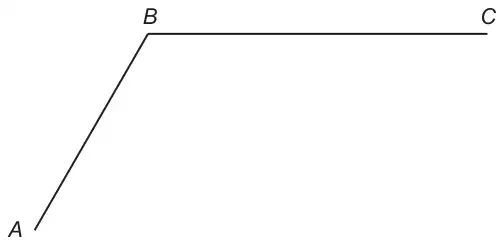
The diagram accurately shows two lines \(AB\) and \(BC\). These lines are part of a quadrilateral, \(ABCD\). Point \(D\) is missing.
On screen this diagram may not be shown at actual size. To measure it, use the question paper (PDF) printed at 100%.
(i)
Use this information to complete the quadrilateral \(ABCD\): \(AD\) is parallel to \(BC\), Angle \(BCD = 60^\circ\), \(CD\) is the same length as \(AB\). [2]
(ii) Write down the name of the quadrilateral \(ABCD\). [1]
Mark scheme (a)
Scheme
Marks
Comments
Any six-sided closed shape with exactly one line of symmetry
B2
B1 for any hexagon, or for any shape with greater than 4 sides with exactly one line of symmetry
If more than one shape has been drawn and not all are hexagons, it must be clear which shape is the answer.
Mark scheme (b)
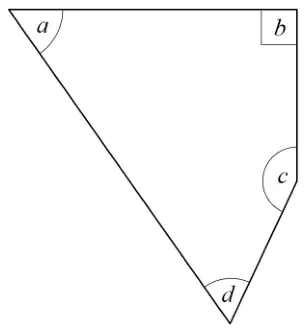
Scheme
Marks
Comments
(i) Shape completed correctly.
B2
Must be a closed shape for B2
B1 for angle BCD measuring 60° (±2°) or for side CD = 4 cm (±2mm). or for side AD parallel to BC.
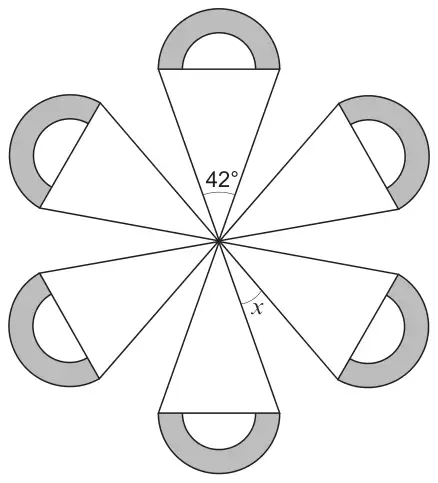
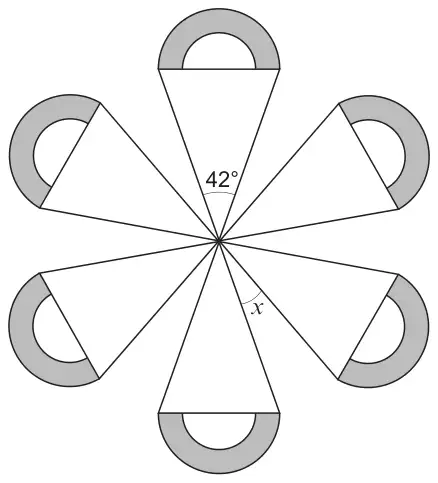
17. The shape below has rotational symmetry of order 6.
Diagram not drawn to scale
Find the size of angle \(x\). You must show all your working. [4]
Mark scheme
Scheme
Marks
Comments
(\(6x\) =) 360 – (42 × 6) (= 108(°))
M2
Check diagram for answers. Sight of 108(°) implies M2. Award M1 for sight of 42 × 6 or 252(°).
÷ 6
m1
Award m1 only if M2 awarded.
(\(x\) =) 18(°)
A1
CAO. Mark final answer. Unsupported 18 is awarded M2m1A1.
Allow an embedded answer but penalise -1 if contradicted by \(x \neq 18\) or equivalent
Award SC1 for a final answer of 30(°) or 9·4…(°) (must be clearly using rotational symmetry of order 5 or 7).
Alternative method 1
Scheme
Marks
Comments
360 ÷ 6
M1
Sight of 60(°) implies M1 A1
60(°)
A1
(\(x\) =) 60 – 42 or 42 + \(x\) = 60
m1
FT ‘their derived 60’– 42, provided M1 awarded and ‘their derived 60’ > 42. Unsupported 18 is awarded M1A1m1A1.
18(°)
A1
Mark final answer. Allow an embedded answer but penalise -1 if contradicted by \(x \neq 18\) or equivalent If FT leads to a whole number answer, it must be shown as a whole number. Otherwise accept a fraction. Award SC1 for a final answer of 30(°) or 9·4…(°) (must be clearly using rotational symmetry of order 5 or 7).
Alternative method 2
Scheme
Marks
Comments
\(6(42 + x) = 360\) or \(42 + x = 360 \div 6\)
B2
Award B1 for sight of \(6(42 + x)\) or 360 ÷ 6
\(252 + 6x = 360\) or \(42 + x = 60\)
B1
FT from \(6x = k\), if B2 B0 previously awarded.
(\(x\) =) 18(°)
B1
Mark final answer. Allow an embedded answer but penalise -1 if contradicted by \(x \neq 18\) or equivalent If FT leads to a whole number answer, it must be shown as a whole number. Otherwise accept a fraction. Award SC1 for a final answer of 30(°) or 9·4…(°) (must be clearly using rotational symmetry of order 5 or 7).
Corrected by Westie's Workshop
The board's mark scheme printed “Unsupported 18 is awarded M1A1M1A1”. Changed to “Unsupported 18 is awarded M1A1m1A1” because the third mark in this method is the dependent method mark m1 (as shown in the marks column), and the main method also writes it as m1 (M2m1A1).
Original: see the board's mark scheme PDF (link above).
8. The shape below has rotational symmetry of order 6.
Diagram not drawn to scale
Find the size of angle \(x\). You must show all your working. [4]
Mark scheme
Scheme
Marks
Comments
\((6x =)\) 360 – (42 × 6) (= 108(\(^\circ\)))
M2
Check diagram for answers. Sight of 108(\(^\circ\)) implies M2. Award M1 for sight of 42 × 6 or 252(\(^\circ\)).
÷ 6
m1
Award m1 only if M2 awarded.
\((x =)\) 18(\(^\circ\))
A1
CAO. Mark final answer. Unsupported 18 is awarded M2m1A1.
Allow an embedded answer but penalise -1 if contradicted by \(x \neq 18\) or equivalent
Award SC1 for a final answer of 30(\(^\circ\)) or 9·4...(\(^\circ\)) (must be clearly using rotational symmetry of order 5 or 7).
Alternative method 1
Scheme
Marks
Comments
360 ÷ 6 60(\(^\circ\))
M1 A1
Sight of 60(\(^\circ\)) implies M1 A1
\((x =)\) 60 – 42 or 42 + \(x\) = 60
m1
FT ‘their derived 60’– 42, provided M1 awarded and ‘their derived 60’ > 42. Unsupported 18 is awarded M1A1m1A1.
18(\(^\circ\))
A1
Mark final answer. Allow an embedded answer but penalise -1 if contradicted by \(x \neq 18\) or equivalent If FT leads to a whole number answer, it must be shown as a whole number. Otherwise accept a fraction. Award SC1 for a final answer of 30(\(^\circ\)) or 9·4... (\(^\circ\)) (must be clearly using rotational symmetry of order 5 or 7).
Alternative method 2
Scheme
Marks
Comments
\(6(42 + x) = 360\) or \(42 + x = 360 \div 6\)
B2
Award B1 for sight of \(6(42 + x)\) or 360 ÷ 6
\(252 + 6x = 360\) or \(42 + x = 60\)
B1
FT from \(6x = k\), if B2 B0 previously awarded.
\((x =)\) 18(\(^\circ\))
B1
Mark final answer. Allow an embedded answer but penalise -1 if contradicted by \(x \neq 18\) or equivalent If FT leads to a whole number answer, it must be shown as a whole number. Otherwise accept a fraction. Award SC1 for a final answer of 30(\(^\circ\)) or 9·4... (\(^\circ\)) (must be clearly using rotational symmetry of order 5 or 7).
Both alternative methods are printed in italics in the original.
Corrected by Westie's Workshop
The board's mark scheme printed “M1A1M1A1”. Changed to “M1A1m1A1” because the third mark in this method is a dependent method mark, written m1 (small m), as in the table.
Original: see the board's mark scheme PDF (link above).
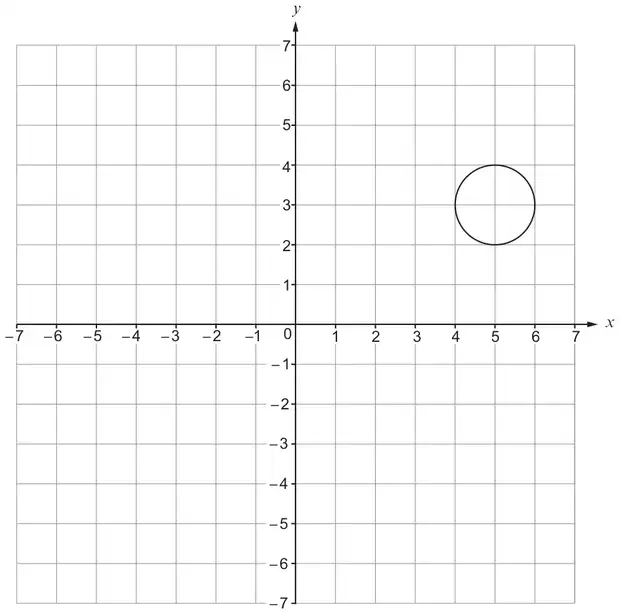
(a) Rotate the triangle through 90° clockwise, about the origin. [2]
(b) Reflect the triangle in the line \(x = -2\). [2]
Mark scheme (a)
Scheme
Marks
Comments
Correct rotation.
B2
Allow B1 for one of the following:
two correct vertices
a 90° anticlockwise rotation about the origin
a correct rotation with only one other incorrect rotation seen.
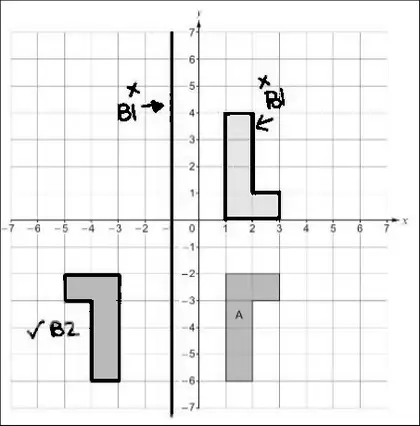
In the original mark scheme the B2 answer is shaded green (shown dark grey here), the B1 example is red with a cross through it (shown light grey).
Mark scheme (b)
Scheme
Marks
Comments
Correct reflection in \(x = -2\)
B2
B1 for one of the following:
line \(x = -2\) drawn (do not award this B1 for one side of a triangle drawn on the undrawn line \(x = -2\))
correct reflection in line \(y = -2\)
a correct reflection with only one other incorrect reflection seen.
In the original mark scheme the B2 answer is shaded green (shown dark grey here), the B1 example is red with a cross through it (shown light grey) and the line x = –2 is green.
(a) Reflect the shape A in the line \(x = -1\). [2]
(b) Enlarge the shape B by a scale factor of 2, using (1, 3) as the centre of enlargement. [3]
Mark scheme (a)
Scheme
Marks
Comments
Correct reflection.
B2
Award B1 for one of the following:
line \(x = -1\) drawn
correct reflection in line \(y = -1\)
a correct reflection with only one other incorrect reflection seen.
In the original the correct answer is shaded green and the incorrect example red, with red/green handwriting; shown here as darker grey (correct) and lighter grey (incorrect).
Mark scheme (b)
Scheme
Marks
Comments
Correct enlargement.
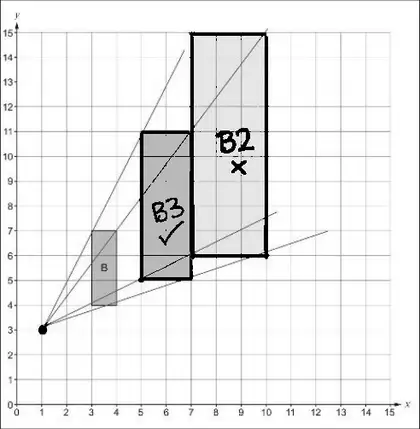
B3
Award B2 for one of the following:
an enlargement of scale factor 2 with correct orientation but not from centre (1,3)
an enlargement of scale factor 3 from centre (1,3)
4 correct vertices plotted but not joined.
Award B1 for one of the following:
an enlargement of scale factor 2 with incorrect orientation
sight of appropriate 4 ‘rays’ from point (1,3)
an enlargement of scale factor 3 with correct orientation but not from centre (1,3)
an enlargement of scale factor 2 of one of the sides, with correct orientation, from centre (1,3). (The side must be part of a rectangle).
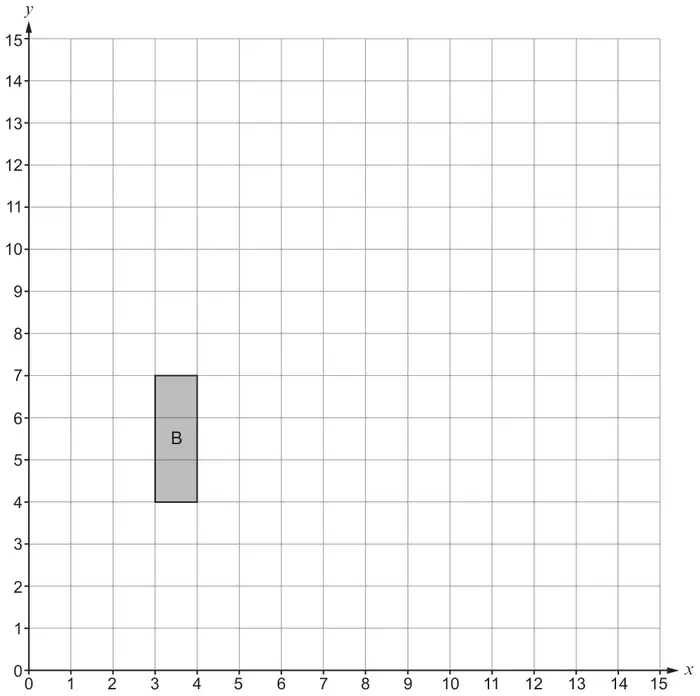
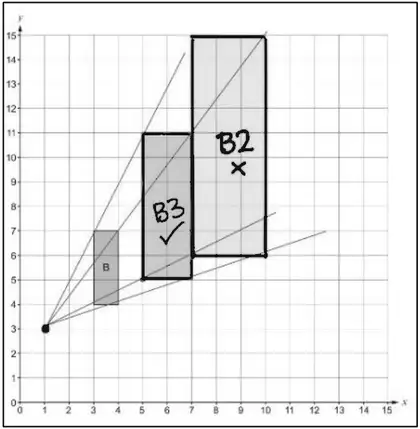
In the original the correct answer is shaded green and the incorrect example red, with red/green handwriting; shown here as darker grey (correct) and lighter grey (incorrect).
20. Rotate the shape shown below by 90° anticlockwise about the origin. [2]
Mark scheme
Scheme
Marks
Comments
B2
Award B2 for the correct rotation drawn with no other shapes drawn on the grid.
Award B1 for a 90° correct clockwise rotation with either:
no other shapes drawn on the grid
the correct rotation (no others).
In the original the correct answer is shaded green (ticked B2) and the clockwise rotation red (B1), with red/green handwriting; shown here as darker grey (correct, B2) and lighter grey (B1).
9. Enlarge the given triangle by a scale factor of –2, using point A as the centre of enlargement. [2]
Mark scheme
Scheme
Marks
Comments
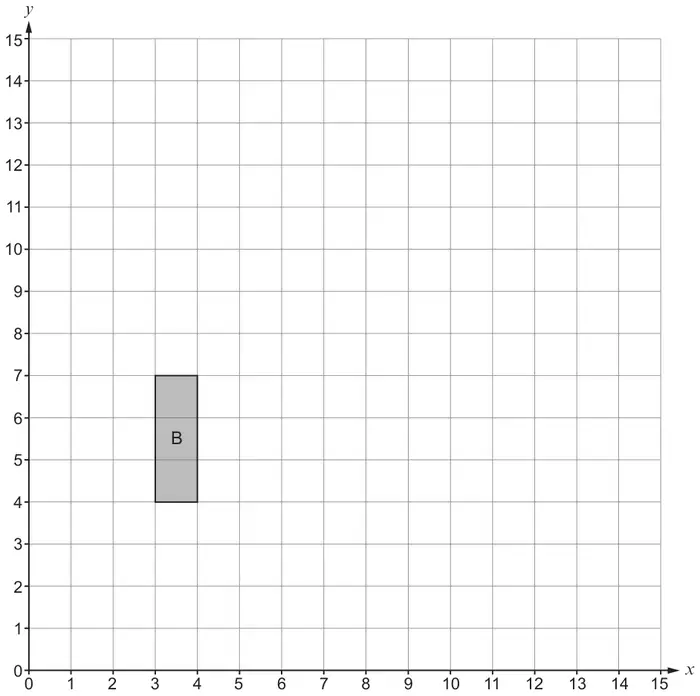
B2
B1 for 2 correct vertices within a triangle, e.g. A and 1 other vertex OR for a triangle of correct shape, size and orientation in incorrect position OR consistent correct use of an incorrect negative scale factor OR for 3 correct vertices (A implied) in the correct location not joined to form the triangle.
2. Shade the smallest number of squares needed to make AB a line of symmetry. [2]
Mark scheme
Scheme
Marks
Comments
B2
B1 for all 4 correct squares and no more than 2 incorrect squares shaded OR B1 for 3 correct squares and no more than 1 incorrect square shaded OR B1 for 2 correct squares and no incorrect squares shaded
In the scheme the four squares to be shaded are shown in grey; the squares already shaded on the question paper are black.
13. Shade the least number of squares so that the grid has rotational symmetry of order 2. The squares you shade must be in the lower two quadrants. [2]
Mark scheme
Scheme
Marks
Comments
B2
B1 for either correct quadrant. Ignore clearly deleted shading.
(a) Enlarge the shape below by a scale factor of 3. [2]
(b) Translate the shape below 2 squares to the left and 4 squares down. [1]
Mark scheme (a)
Scheme
Marks
Comments
Correct enlargement
B2
Allow correct enlargement in any orientation. B1 for three adjacent sides correctly enlarged in the same orientation. SC1 for an enlargement by a factor of 2 or 4.
Mark scheme (b)
Scheme
Marks
Comments
Correct translation.
B1
Do not award B1 for sight of a correct translation with other shapes on the grid.
The translated shape (red in the original) has vertices (−1, −1), (−1, 1), (1, 1), (1, 2), (2, 2), (2, 0), (3, 0) and (3, −1).
1. Shade the least number of squares so that the grid has rotational symmetry of order 2. The squares you shade must be in the lower two quadrants. [2]
Mark scheme
Scheme
Marks
Comments
B2
B1 for either correct quadrant. Ignore clearly deleted shading.
(a) Enlarge the shape below by a scale factor of 3. [2]
(b) Translate the shape below 2 squares to the left and 4 squares down. [1]
Mark scheme (a)
Scheme
Marks
Comments
Correct enlargement
B2
Allow correct enlargement in any orientation. B1 for three adjacent sides correctly enlarged in the same orientation. SC1 for an enlargement by a factor of 2 or 4.
Mark scheme (b)
Scheme
Marks
Comments
Correct translation.
B1
Do not award B1 for sight of a correct translation with other shapes on the grid.
The outline of the answer shape was red in the original mark scheme.
12. Enlarge the triangle below by a scale factor of –2. Use the origin as the centre of enlargement. [2]
Mark scheme
Scheme
Marks
Comments
Correct enlargement
B2
B1 for triangle enlarged with scale factor -2 (with correct orientation) in incorrect position (entirely within correct quadrant) OR consistent use of an incorrect negative scale factor (using correct centre) OR two (or three) correct vertices (not necessarily joined)
14. In the following diagram, triangle ABC has been enlarged to triangle DEF, with the centre of enlargement at O. Write down the scale factor of the enlargement. [2]
(a) Shade the least number of squares so that the grid has rotational symmetry of order 2. The squares you shade must be in the upper two quadrants. [2]
(b) Describe fully the single transformation that transforms shape A onto shape B. [2]
Mark scheme (a)
Scheme
Marks
Comments
B2
B1 for each individual shape. Ignore clearly deleted shading.
Mark scheme (b)
Scheme
Marks
Comments
Reflection (in the line) x = 5
B2
B1 for stating ‘Reflection’. Ignore extra wording once ‘reflection’ (or ‘reflected’) seen. B1 for stating x = 5 (simply drawing the line is B0)
(a) Shade the least number of squares so that the grid has rotational symmetry of order 2. The squares you shade must be in the upper two quadrants. [2]
(b) Describe fully the single transformation that transforms shape A onto shape B. [2]
Mark scheme (a)
Scheme
Marks
Comments
B2
B1 for either individual shape. Ignore clearly deleted shading.
Mark scheme (b)
Scheme
Marks
Comments
Reflection (in the line) x = 5
B2
B1 for stating ‘Reflection’. Ignore extra wording once ‘reflection’ (or ‘reflected’) seen. B1 for stating x = 5 (simply drawing the line is B0)
(a) The diagram shows two congruent triangles. The coordinates of each vertex are shown.
Diagram not drawn to scale
Find the value of \(a\) and the value of \(b\). [2]
\(a\) = …………… \(b\) = ……………
(b) Draw an enlargement of the rectangle below, using a scale factor of 3 and centre (1, 2). [3]
Mark scheme (a)
Scheme
Marks
Comments
\(a = -6\)
B1
Values may be seen on the diagram.
\(b = -5\)
B1
Mark scheme (b)
Scheme
Marks
Comments
Correct shape in correct position.
B3
B2 for a correct enlargement in incorrect position. B1 for one correct side in correct position. If no marks allow SC1 for showing all the ‘rays’ from (1,2).
11. Enlarge the given triangle by a scale factor of –3 using point \(A\) as the centre of enlargement. [2]
Mark scheme
Scheme
Marks
Comments
Correct enlargement
B2
Otherwise B1 for 2 correct vertices within a triangle. OR for 3 correct vertices in the correct location not joined to form the triangle OR triangle of correct shape, size and orientation in incorrect position OR consistent correct use of an incorrect negative scale factor.
(a) The diagram shows two congruent triangles. The coordinates of each vertex are shown.
Diagram not drawn to scale
Find the value of \(a\) and the value of \(b\). [2]
\(a =\) …………… \(b =\) ……………
(b) Draw an enlargement of the rectangle below, using a scale factor of 3 and centre (1, 2). [3]
Mark scheme (a)
Scheme
Marks
Comments
a = −6
B1
Values may be seen on the diagram.
b = −5
B1
Mark scheme (b)
Scheme
Marks
Comments
Correct shape in correct position.
B3
B2 for a correct enlargement in incorrect position. B1 for one correct side in correct position. If no marks allow SC1 for showing all the ‘rays’ from (1,2).
(a)In this part of the question, you will be assessed on the quality of your linguistic and mathematical accuracy in writing.
The shape above has been drawn on a square grid. Each square represents an area of 5 cm2. Estimate the total area of the shape. You must show all your working. [3 + 1 W]
(b) Draw a reflection of this shape in the line PQ. [1]
Mark scheme (a)
Scheme
Marks
Comments
Evidence of counting squares 32 – 42 inclusive
M1 A1
160 – 210 (cm2)
B1
FT ‘their number of squares’ × 5 evaluated correctly Award 3 marks for an unsupported answer between 160 and 210 inclusive. Mark final answer
Accuracy in writing
W1
For W1, candidates will be expected to:
show all their working
make few, if any, errors in spelling, punctuation and grammar
(a) Reflect the shape S in the line \(y = 1\). [2]
(b) Describe fully the single transformation that transforms shape S to shape T. [3]
Mark scheme (a)
Scheme
Marks
Comments
Correct reflection in y = 1.
B2
B1 for correct reflection in x = 1 OR B1 for sight of line y = 1
Mark scheme (b)
Scheme
Marks
Comments
Clockwiserotation of 90(°)about the origin.
B3
For all four components. Accept anticlockwise rotation of 270° about the origin. B2 for any three. B1 for any two. ‘Origin’ may be stated as e.g. (0,0) or 0 or O. Do not accept ‘turn’ for rotation. Allow for ‘about the origin’ any reference to the origin. e.g. ‘in the origin’, ‘around the origin’, ‘from (0,0)’ etc. If not a single transformation (e.g. ‘clockwise rotation of 90 and then …..) penalise −1 mark from any marks gained. (Above example gains B2 −1 = 1 mark.)
(a) The square drawn below has rotational symmetry of order 4. Place two identical dots (●) on the square so that it will have rotational symmetry of order 2. [1]
(b) The regular hexagon drawn below has rotational symmetry of order 6. Place three identical dots (●) on the regular hexagon so that it will have rotational symmetry of order 3. [1]
(c) Which of the following shapes has rotational symmetry of order 3, but has no line symmetry? Circle the correct shape. [1]
Mark scheme (a)
Scheme
Marks
Comments
Two dots placed at suitable points to ensure rotational order 2.
B1
Mark correct intention. B0 if extra dots offered.
Mark scheme (b)
Scheme
Marks
Comments
Three dots placed at suitable points to ensure rotational order 3.
10. Enlarge the triangle below by a scale factor of –2. Use the origin as the centre of enlargement. [2]
Mark scheme
Scheme
Marks
Comments
Correct enlargement
B2
B1 for triangle enlarged with scale factor -2 in incorrect position (within correct quadrant) OR correct enlargement with scale factor 2 (using correct centre) OR consistent use of an incorrect negative scale factor (using correct centre) OR two (or three) correct vertices (not necessarily joined)
(a) Reflect the shape S in the line \(y = 1\). [2]
(b) Describe fully the single transformation that transforms shape S to shape T. [3]
Mark scheme (a)
Scheme
Marks
Comments
Correct reflection in y = 1.
B2
B1 for correct reflection in x = 1 OR B1 for sight of line y = 1
Mark scheme (b)
Scheme
Marks
Comments
Clockwiserotation of 90(°)about the origin.
B3
For all four components. Accept anticlockwise rotation of 270° about the origin. B2 for any three. B1 for any two. ‘Origin’ may be stated as e.g. (0,0) or 0 or O. Do not accept ‘turn’ for rotation. Allow for ‘about the origin’ any reference to the origin. e.g. ‘in the origin’, ‘around the origin’, ‘from (0,0)’ etc. If not a single transformation (e.g. ‘clockwise rotation of 90 and then …..) penalise −1 mark from any marks gained. (Above example gains B2 −1 = 1 mark.)
(a) The square drawn below has rotational symmetry of order 4. Place two identical dots (●) on the square so that it will have rotational symmetry of order 2. [1]
(b) The regular hexagon drawn below has rotational symmetry of order 6. Place three identical dots (●) on the regular hexagon so that it will have rotational symmetry of order 3. [1]
(c) Which of the following shapes has rotational symmetry of order 3, but has no line symmetry? Circle the correct shape. [1]
Mark scheme (a)
Scheme
Marks
Comments
Two dots placed at suitable points to ensure rotational order 2.
B1
Mark correct intention. B0 if extra dots offered.
Mark scheme (b)
Scheme
Marks
Comments
Three dots placed at suitable points to ensure rotational order 3.
(a) Rotate triangle A through 90° anticlockwise, about the point (–2, 3). [2]
(b) Enlarge triangle B by a scale factor of \(\dfrac{1}{2}\), using (0, 0) as the centre of enlargement. [2]
Mark scheme (a)
Scheme
Marks
Comments
Correct rotation.
B2
Allow B1 for two correct vertices. B1 for a 90° clockwise rotation about (−2,3) OR B1 for a 90° anticlockwise rotation about (3,−2).
Mark scheme (b)
Scheme
Marks
Comments
Correct enlargement.
B2
Allow B1 for two correct vertices. B1 for an enlargement of scale factor ½ but not centred at (0,0). Must be in the correct orientation. SC1 for a correct enlargement using a scale factor of −1/2 centred at (0,0).
(a) Rotate triangle A through 90° anticlockwise, about the point (–2, 3). [2]
(b) Enlarge triangle B by a scale factor of \(\dfrac{1}{2}\), using (0, 0) as the centre of enlargement. [2]
Mark scheme (a)
Scheme
Marks
Comments
Correct rotation.
B2
Allow B1 for two correct vertices. B1 for a 90° clockwise rotation about (−2, 3) OR B1 for a 90° anticlockwise rotation about (3, −2).
Mark scheme (b)
Scheme
Marks
Comments
Correct enlargement.
B2
Allow B1 for two correct vertices. B1 for an enlargement of scale factor ½ but not centred at (0,0). Must be in the correct orientation. SC1 for a correct enlargement using a scale factor of −1/2 centred at (0,0).
15. Describe fully a single transformation that transforms shape A onto shape B. [3]
Mark scheme
Scheme
Marks
Comments
Enlargement with scale factor -½ and centre ( 7, 4 )
B3
Penalise -1 for further incorrect steps. Award B2 for reference to any two of ‘Enlargement’, ‘-½’ and ‘centre (7, 4)’ either identified by coordinates or joining corresponding vertices on the grid.
Award B1 for reference to any one of ‘Enlargement’, ‘-½’ and ‘centre (7, 4)’ either identified by coordinates or joining corresponding vertices on the grid.
SC2 awarded for the correct two step transformation from shape A to B, e.g. enlargement SF ½ centre origin, rotation 180° about (5.25, 3) or enlargement SF ½ and 180° rotation, (both) with centre (7, 4).
Corrected by Westie's Workshop
The board's mark scheme printed “(both) with centre (7.4)”. Changed to “(both) with centre (7, 4)” because the centre is the point (7, 4), as in the rest of this mark scheme; the full stop should be a comma.
Original: see the board's mark scheme PDF (link above).
3. Shade the smallest number of squares needed to make the line AB a line of symmetry. [2]
Mark scheme
Scheme
Marks
Comments
B2
B1 for all 4 correct squares and no more than 2 extra squares OR B1 for 3 correct squares and no more than 1 incorrect squares OR B1 for 2 correct squares and no incorrect squares
In the scheme's diagram the squares already shaded on the question paper are light grey and the 4 squares to be shaded are dark grey.
(a) Reflect the triangle S in the line \(y = 2\). [2]
(b) Describe fully a single transformation that transforms triangle S onto triangle T. [3]
Mark scheme (a)
Scheme
Marks
Comments
Correct reflection in y = 2
B2
B1 for a correct reflection in x = 2 or for sight of line y = 2.
Mark scheme (b)
Scheme
Marks
Comments
Anticlockwiserotation of 90° about the origin.
B3
For all four components. Accept clockwise rotation of 270° about the origin B2 for any three. B1 for any two. Treat ‘¼ turn’ as one component. ‘Origin’ may be stated as (0,0) or 0 or O. Allow e.g. ‘in the origin’, ‘around the origin’.
(a) Reflect the triangle S in the line \(y = 2\). [2]
(b) Describe fully a single transformation that transforms triangle S onto triangle T. [3]
(c)
(i) Translate the triangle S using the column vector \(\begin{pmatrix}-5\\-4\end{pmatrix}\). [1]
(ii) Write down the column vector that will reverse the translation in part (i). [1]
Mark scheme (a)
Scheme
Marks
Comments
Correct reflection in y = 2
B2
B1 for a correct reflection in x = 2 OR B1 for sight of line y = 2.
Mark scheme (b)
Scheme
Marks
Comments
Anticlockwiserotation of 90° about the origin.
B3
For all four components. Accept clockwise rotation of 270° about the origin. B2 for any three. B1 for any two. Treat ‘¼ turn’ as one component. ‘Origin’ may be stated as (0,0) or 0 or O. Allow e.g. ‘in the origin’, ‘around the origin’.
Mark scheme (c)
Scheme
Marks
Comments
(i) Correct translation.
B1
(ii) \(\begin{pmatrix}5\\4\end{pmatrix}\)
B1
B0 for \(\begin{matrix}5\\4\end{matrix}\) (missing brackets) OR (5,4) B0 for \(\dfrac{5}{4}\) with or without brackets.
10. Draw the enlargement of the given triangle, using
a scale factor of −2,
(−2, 1) as the centre of enlargement. [3]
Mark scheme
Scheme
Marks
Comments
Correct enlargement
B3
Otherwise B2 for 2 correct vertices within a triangle. OR for 3 correct vertices in the correct location not joined to form the triangle OR inverted triangle of correct size in incorrect position OR consistent correct use of an incorrect negative scale factor
B1 for 1 or 2 correct points OR consistent use of scale factor +2 (in correct position) OR consistent use of an incorrect negative scale factor in incorrect position.
We'd like to use Google Analytics cookies to count visits and see which pages help most. They're optional, and the site works exactly the same either way. Privacy policy