Circle A is translated by the vector \(\begin{pmatrix} 0 \\ -2 \end{pmatrix}\) to give circle B.
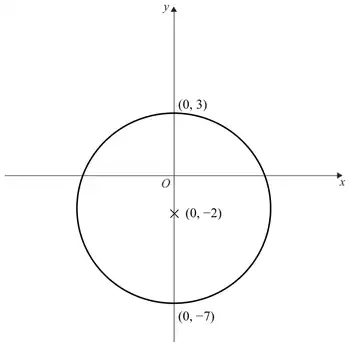
Sketch circle B. Show the coordinates of the centre of circle B and the points where circle B meets the \(y\)-axis. (3)
Mark scheme
Answer
Mark
Mark scheme
Circle radius 5 centre \((0, -2)\) and \((0, 3)\) and \((0, -7)\) labelled
B3
for a correct sketch of a circle with centre \((0, -2)\) and intercepts \((0, 3)\) and \((0, -7)\) labelled
(B2
for a sketch of a circle with two of the 3 points indicated, or for a sketch of a circle with correct centre and radius of 5 labelled or stated)
(B1
for a sketch of a circle with the correct centre or states correct centre and radius, but does not sketch)
Additional guidance
See diagram at end of scheme Allow freehand circles Ignore intersections with \(x\) axis for all marks Accepts points marked with correct \(y\)-coordinate, eg \(-2\) on \(y\)-axis for centre
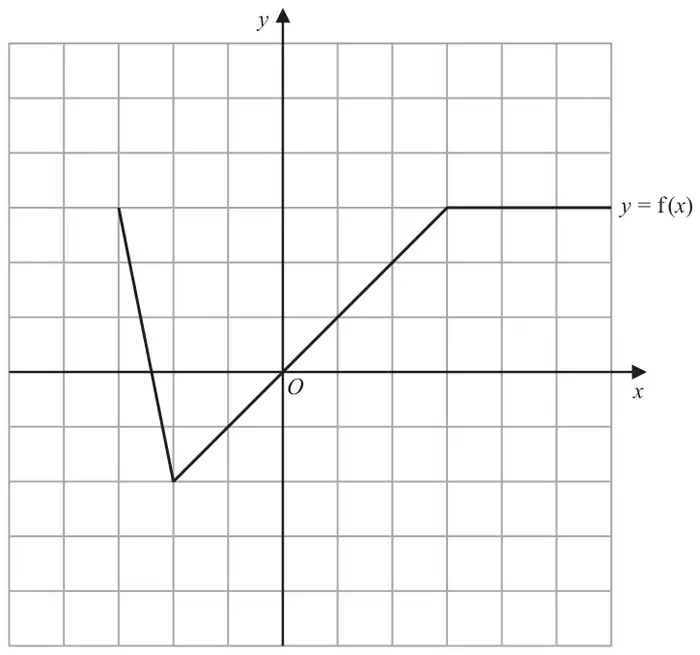
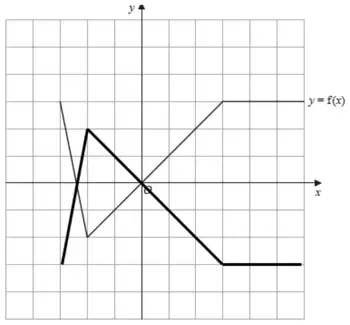
(a) On the grid, draw the graph of \(y = -\mathrm{f}(x)\) (1)
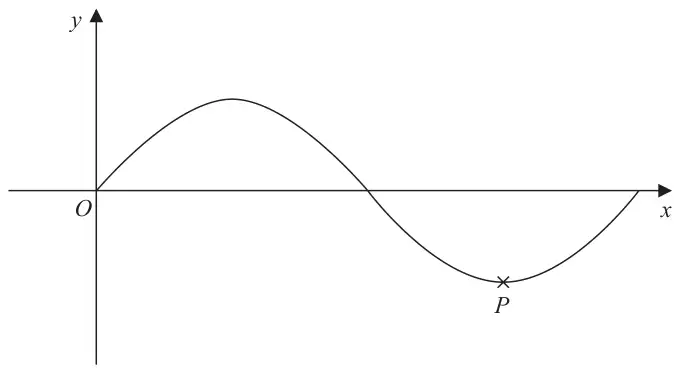
Here is a sketch of the graph of \(y = \sin x^\circ\)
The point marked \(P\) is a turning point on the graph.
The graph of \(y = \sin x^\circ\) is translated to give the graph of \(y = \sin(x + 180)^\circ + 4\)
Following the translation the point \(P\), shown on the graph above, moves to point \(R\).
(b) Find the coordinates of \(R\). (3)
Mark scheme (a)
Answer
Mark
Mark scheme
Sketch
B1
for an appropriate sketch, ie reflection in \(x\) axis
Additional guidance
Allow some tolerance on the points and in drawing the function if the intention is clear
Graph at end of mark scheme
Mark scheme (b)
Answer
Mark
Mark scheme
(90, 3)
M1
for coordinates of \(P = (270, -1)\)
M1
for describing part of the translation, eg \(\text{``}270\text{''} - 180\), or \(\text{``}{-}1\text{''} + 4\) or \([x_P] - 180\), or \([y_P] + 4\) or for an answer of \((90, b)\) or an answer of \((a, 3)\)
A1
cao
Additional guidance
May see 270 and −1 marked in the correct positions on the axes
[\(x_P\)], [\(y_P\)] must be a numerical value and clearly identified as point \(P\) by labelling or on the diagram with no contradiction