
Higher November 2024 Paper 3 Q21
21 Here is the graph of \(y = \mathrm{f}(x)\)
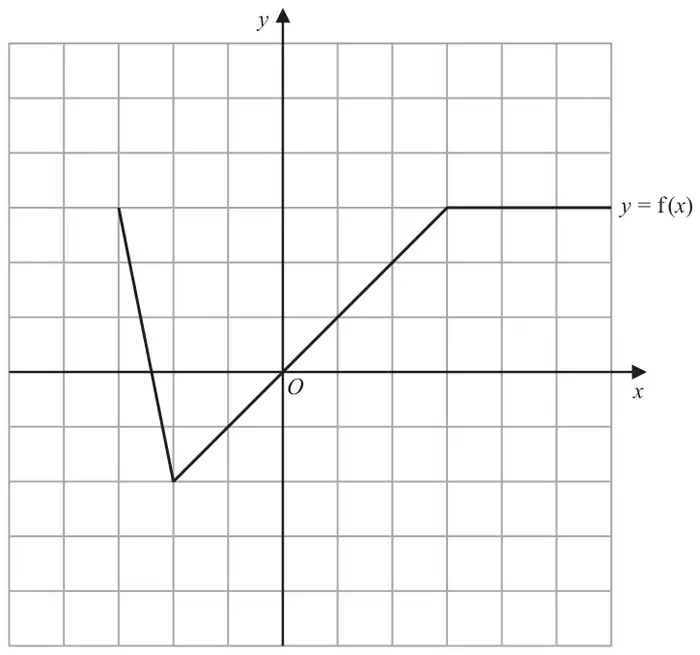
(a) On the grid, draw the graph of \(y = -\mathrm{f}(x)\) (1)
Here is a sketch of the graph of \(y = \sin x^\circ\)
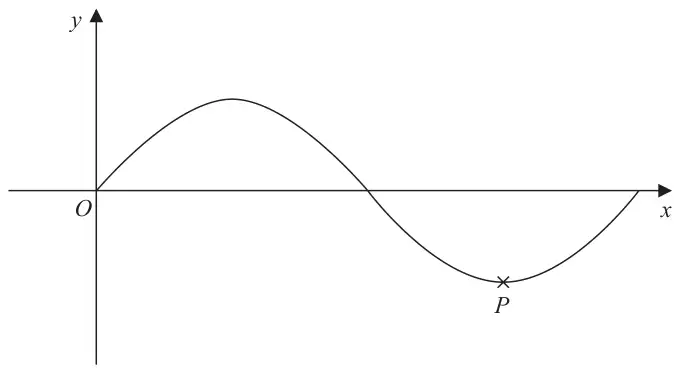
The point marked \(P\) is a turning point on the graph.
The graph of \(y = \sin x^\circ\) is translated to give the graph of \(y = \sin(x + 180)^\circ + 4\)
Following the translation the point \(P\), shown on the graph above, moves to point \(R\).
(b) Find the coordinates of \(R\). (3)
| Answer | Mark | Mark scheme |
|---|---|---|
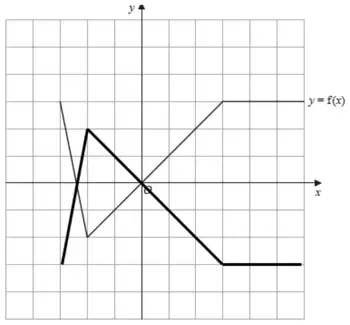
| Sketch | B1 | for an appropriate sketch, ie reflection in \(x\) axis |
Additional guidance
Allow some tolerance on the points and in drawing the function if the intention is clear
Graph at end of mark scheme
| Answer | Mark | Mark scheme |
|---|---|---|
| (90, 3) | M1 | for coordinates of \(P = (270, -1)\) |
| M1 | for describing part of the translation, eg \(\text{``}270\text{''} - 180\), or \(\text{``}{-}1\text{''} + 4\) or \([x_P] - 180\), or \([y_P] + 4\) or for an answer of \((90, b)\) or an answer of \((a, 3)\) | |
| A1 | cao |
Additional guidance
May see 270 and −1 marked in the correct positions on the axes
[\(x_P\)], [\(y_P\)] must be a numerical value and clearly identified as point \(P\) by labelling or on the diagram with no contradiction