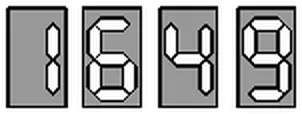
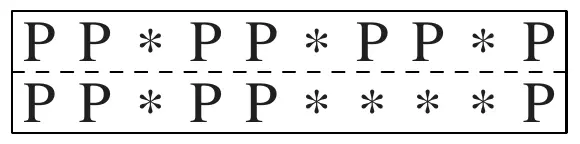
Let the other such list of numbers be \(a\), 1; \(b\), 2; \(c\), 3; \(d\), 4 and note that \(a + b + c + d = 8\) since there are 8 numbers in the list.
If \(d = 4\), then exactly two of \(a\), \(b\), \(c\) equal 4, but this would make \(a + b + c + d > 8\), so \(d \neq 4\).
Similar reasoning shows that \(d \neq 3\), so \(d = 1\) or \(d = 2\).
If \(d = 2\), then exactly one of \(a\), \(b\), \(c\) equals 4 and the remaining two both equal 1 since \(a + b + c + d = 8\). So we have \(a\), 1; \(b\), 2; \(c\), 3; 2, 4 and it is \(b\) which must equal 4 since we already have more than one 2. However, as \(a\) and \(c\) are now both equal to 1, we have 1, 1; 4, 2; 1, 3; 2, 4 and this is not correct.
So \(d = 1\) and we have \(a + b + c = 7\) and \(a, b, c \neq 4\). Clearly \(a \neq 1\), since that would give at least two 1s so \(a = 2\) or \(a = 3\).
If \(a = 2\), then we have 2, 1; \(b\), 2; \(c\), 3; 1, 4 with \(b + c = 5\) and \(b, c \neq 4\). So \(b = 2, c = 3\) or vice versa. This gives either 2, 1; 2, 2; 3, 3; 1, 4 (incorrect), or 2, 1; 3, 2; 2, 3; 1, 4 (the example given in the question).
Finally, if \(a = 3\), then we have 3, 1; \(b\), 2; \(c\), 3; 1, 4 with \(b + c = 4\). The possibilities are 3, 1; 1, 2; 3, 3; 1, 4 or 3, 1; 2, 2; 2, 3; 1, 4 or 3,1; 3, 2; 1, 3; 1, 4 but only the first of these describes itself correctly. So the total number of 1s and 3s is 6.


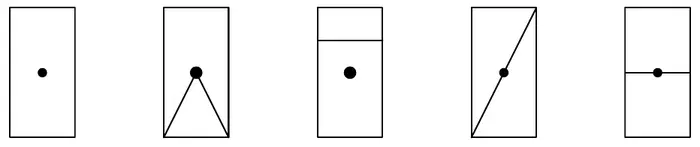






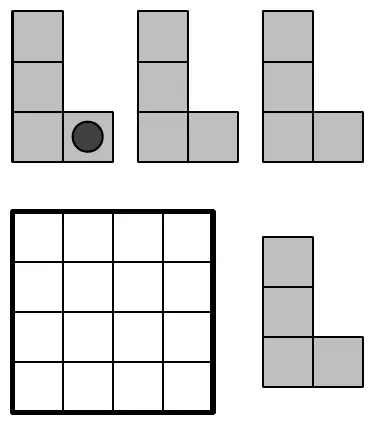
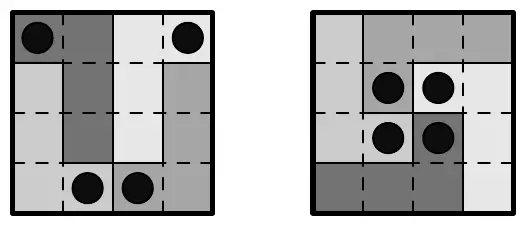
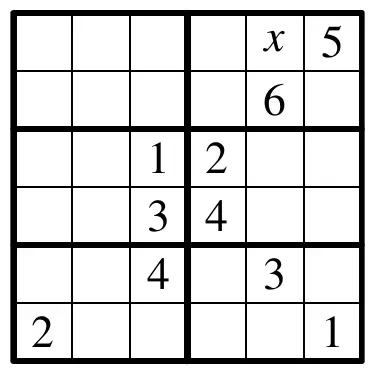
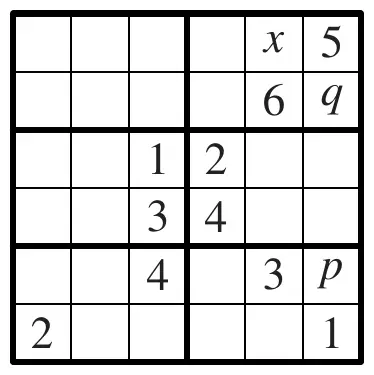







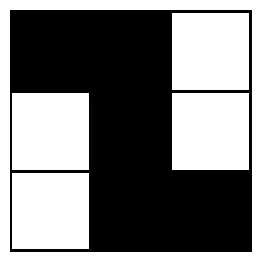




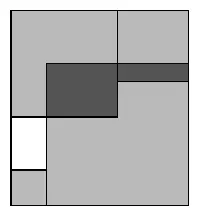

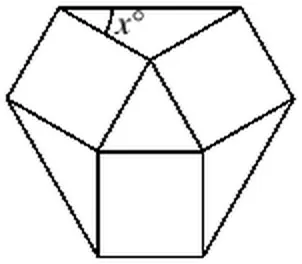



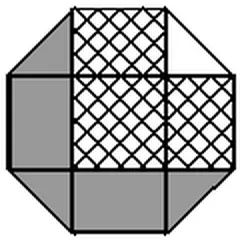
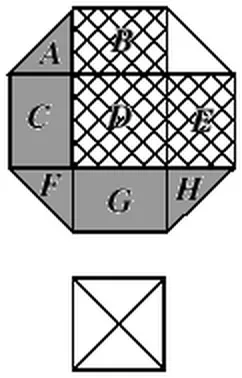
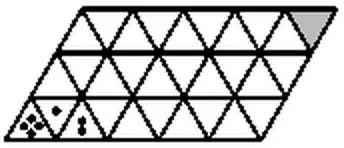
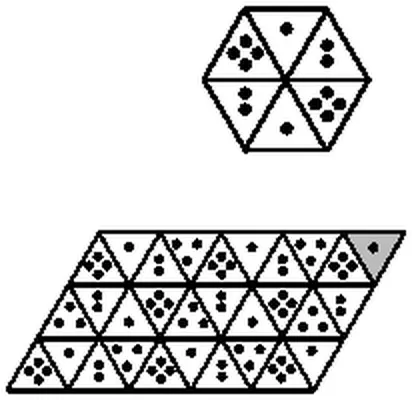



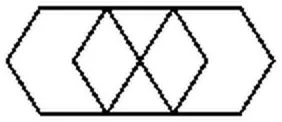
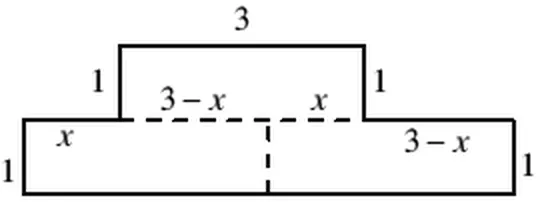
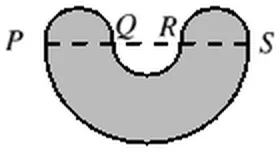
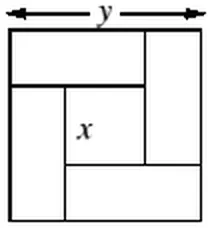
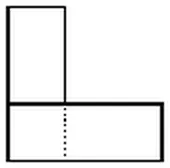
 shape. Although \(x\) is not given, it is clear that





 ?
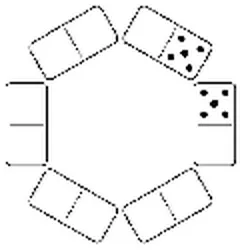


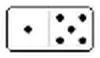 must be arranged as shown. So
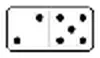 cannot be adjacent to
 . Clearly,
 cannot be adjacent to
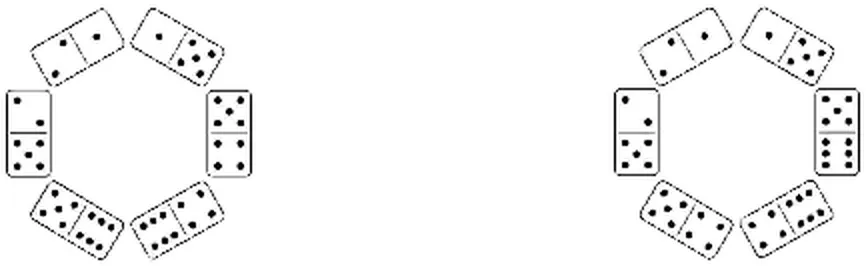
 either, but it is possible to form a ring with
 adjacent to
 or with
 adjacent to
 . These are shown below. So only two of the dominoes cannot be placed adjacent to
 .