
JMC 2016 Q23
23. The diagram shows the first few squares of a ‘spiral’ sequence of squares. All but the first three squares have been numbered. After the first six squares, the sequence is continued by placing the next square alongside three existing squares – the largest existing square and two others.
The three smallest squares have sides of length 1.
What is the side length of the 12th square?
- A 153
- B 123
- C 83
- D 53
- E 13
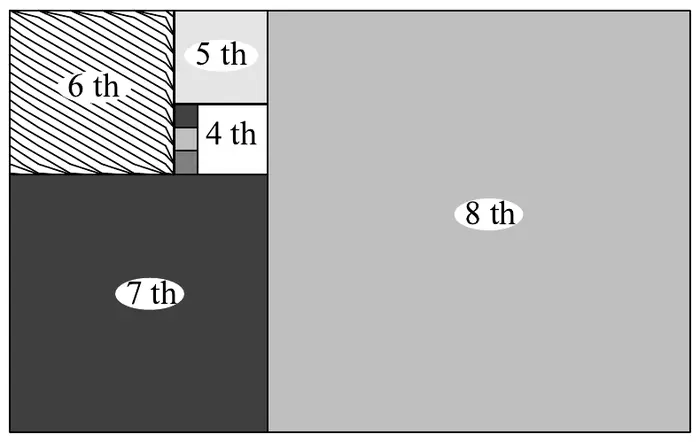
Junior Mathematical Challenge 2016, Question 23. © UK Mathematics Trust. Original paper on ukmt.org.uk
Answer: B 123
Note first that the fourth square has side length 3, the fifth square has side length 4 and the sixth square has side length 7. As described in the question, the seventh square is placed alongside the sixth square, the fourth square and one of the first three unit squares. However, it may be seen that the side length of the seventh square is equal to the sum of the side lengths of the fifth and sixth squares, which is 4 + 7 = 11. Similarly, the eighth square is placed along the fourth, fifth and seventh squares, but its side length is the sum of the side lengths of the sixth and seventh squares, which is 7 + 11 = 18. The spiral sequence continues in the same way and therefore the side length of any subsequent square may be calculated by adding together the side lengths of the two previous squares in the sequence. So from the fourth square onwards the side lengths of the squares are 3, 4, 7, 11, 18, 29, 47, 76, 123, …. Hence the side length of the twelfth square is 123.
(All of the positive integers in the sequence from the side length of the fourth square onwards are members of the sequence of Lucas numbers − a Fibonacci sequence with first term 2 and second term 1.)
Solution © UK Mathematics Trust, from the JMC 2016 solutions. Longer versions with investigations: Solutions and investigations (PDF).