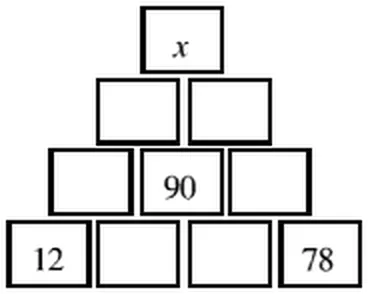
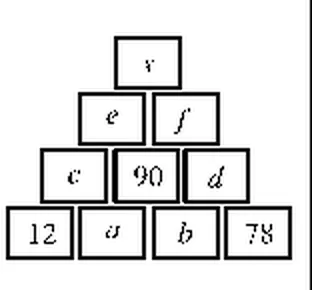
The equations may be represented as the following triangle where each digit is the sum of the two adjacent digits directly above it.
\[\begin{array}{ccccc} a && b && c \\ & d && e & \\ && f && \end{array}\]
None of the digits \(a\), \(b\), \(c\), \(d\) and \(e\) may be 0 since this would force two of the others to be equal. The digit \(f\) cannot be 0 since \(f = d + e\) and both \(d\) and \(e\) are positive.
Consider the middle row and note that both \(d\) and \(e\) must be at least 3 since they are each the sum of distinct positive integers. Now assume that \(d < e\). Since \(d \geqslant 3\) and \(f \leqslant 9\) it follows that \(e \leqslant 6\). This means that \((d, e)\) is (3, 4), (3, 5), (3, 6) or (4, 5). However, the only way to write 4 as the sum of two different nonzero digits is 1 + 3; therefore \((d, e) \neq (3, 4)\).
Suppose \((d, e) = (3, 5)\).
\[\begin{array}{ccccc} a && b && c \\ & 3 && 5 & \\ && 8 && \end{array}\]
Then \(b \neq 2\) since this would mean \(c = 3\). So it must be the case that \((a, b, c) = (2, 1, 4)\).
Now suppose \((d, e) = (3, 6)\).
\[\begin{array}{ccccc} a && b && c \\ & 3 && 6 & \\ && 9 && \end{array}\]
Then \(a\) must be 1 or 2 and so \((a, b, c)\) is (1, 2, 4) or (2, 1, 5).
Finally, suppose \((d, e) = (4, 5)\).
\[\begin{array}{ccccc} a && b && c \\ & 4 && 5 & \\ && 9 && \end{array}\]
Then \(a\) must be 1 or 3. But \(a\) cannot be equal to 3 as this would force \(c\) to be 4. So \((a, b, c) = (1, 3, 2)\).
Therefore, with the assumption that \(d < e\), there are four solutions. Another four can be obtained by assuming \(d > e\), which has the effect of reflecting each of the triangles vertically.
The solutions for \((a, b, c, d, e, f)\) are
\[\begin{array}{llll} \text{(2, 1, 4, 3, 5, 8),}\qquad & \text{(1, 2, 4, 3, 6, 9),}\qquad & \text{(2, 1, 5, 3, 6, 9),}\qquad & \text{(1, 3, 2, 4, 5, 9),} \\ \text{(4, 1, 2, 5, 3, 8),}\qquad & \text{(4, 2, 1, 6, 3, 9),}\qquad & \text{(5, 1, 2, 6, 3, 9),}\qquad & \text{(2, 3, 1, 5, 4, 9).} \end{array}\]