
JMC 2005 Q23
23. In the diagram, triangle \(XYZ\) is isosceles, with \(XY = XZ\). What is the value of \(r\) in terms of \(p\) and \(q\)?
- A \(\tfrac{1}{2}(p - q)\)
- B \(\tfrac{1}{2}(p + q)\)
- C \(p - q\)
- D \(p + q\)
- E Impossible to determine
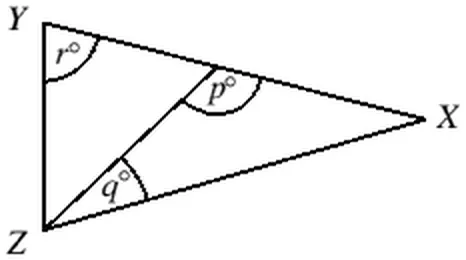
Junior Mathematical Challenge 2005, Question 23. © UK Mathematics Trust. Original paper on ukmt.org.uk
Answer: B \(\tfrac{1}{2}(p + q)\)
As \(XY = XZ\), \(\angle XZY = \angle XYZ\), so \(\angle YZW = r^\circ - q^\circ\). In a triangle, an exterior angle is equal to the sum of the two interior opposite angles. Applying this theorem to triangle \(ZYW\):
\(\angle ZWX = \angle YZW + \angle ZYW\), that is \(p = (r - q) + r\). So \(2r = p + q\).
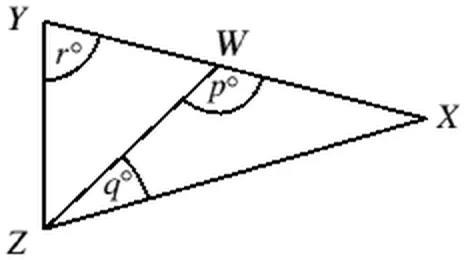
Solution © UK Mathematics Trust, from the JMC 2005 solutions.