Number & Arithmetic

Your progress
0 of 100 done
Ticks are kept only in this browser: clearing your browsing data or changing device loses them. · ·

Junior Mathematical Challenge (JMC)

Junior Kangaroo (JK)

Junior Mathematical Olympiad (JMO)

Cayley Olympiad (CAY)

JMC 2020 Q21

JMCCurrent spec6 marksNumber & Arithmetic

21. The digits of both the two-digit numbers in the first calculation below have been reversed to give the two-digit numbers in the second calculation. The answers to the two calculations are the same.

62 × 13 = 806    26 × 31 = 806

For which one of the calculations below is the same thing true?

  1. A 25 × 36
  2. B 34 × 42
  3. C 54 × 56
  4. D 42 × 48
  5. E 32 × 43

Junior Mathematical Challenge 2020, Question 21. © UK Mathematics Trust. Original paper on ukmt.org.uk

JMC 2019 Q25

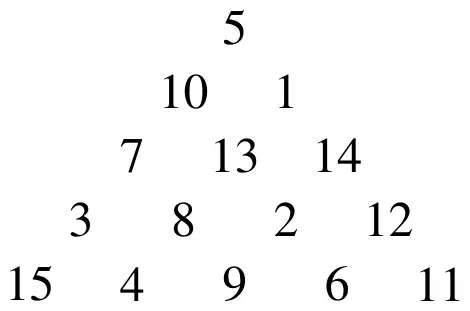
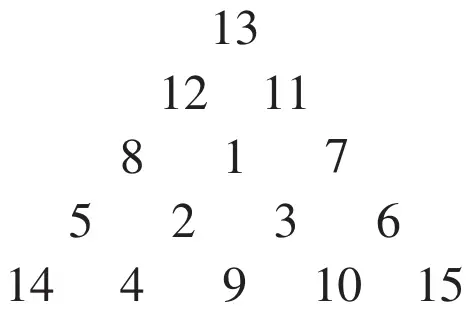
25. The diagram shows the first fifteen positive integers arranged in a ‘triangle’.
These numbers are to be rearranged so that the five integers along each ‘edge’ of the triangle have the same sum, unlike the example shown.
When this is done, what is the greatest possible such sum?

  1. A 38
  2. B 42
  3. C 48
  4. D 52
  5. E 54
The numbers 1 to 15 arranged in a triangle with five numbers along each edge

Junior Mathematical Challenge 2019, Question 25. © UK Mathematics Trust. Original paper on ukmt.org.uk

JMC 2019 Q5

JMCCurrent spec5 marksAlgebraNumber & Arithmetic

5. On Aoife’s 16th birthday, Buster was three times her age. On Aoife’s 21st birthday, how old was Buster?

  1. A 32
  2. B 48
  3. C 53
  4. D 63
  5. E 64

Junior Mathematical Challenge 2019, Question 5. © UK Mathematics Trust. Original paper on ukmt.org.uk

JMC 2018 Q11

11. How many digits are there in the correct answer to the calculation 123 123 123 123 ÷ 123?

  1. A 4
  2. B 6
  3. C 8
  4. D 10
  5. E 12

Junior Mathematical Challenge 2018, Question 11. © UK Mathematics Trust. Original paper on ukmt.org.uk

JMC 2018 Q9

9. The approximate cost of restoring the Flying Scotsman was £4 million. This was about 500 times the cost of building the steam engine in 1923.
Roughly what did the engine cost to build?

  1. A £800
  2. B £2000
  3. C £8000
  4. D £20 000
  5. E £80 000

Junior Mathematical Challenge 2018, Question 9. © UK Mathematics Trust. Original paper on ukmt.org.uk

JMC 2018 Q7

JMCCurrent spec5 marksNumber & Arithmetic

7. How many integers are greater than 20 + 18 and also less than 20 × 18?

  1. A 320
  2. B 321
  3. C 322
  4. D 323
  5. E 324

Junior Mathematical Challenge 2018, Question 7. © UK Mathematics Trust. Original paper on ukmt.org.uk

JMC 2018 Q2

JMCCurrent spec5 marksNumber & Arithmetic

2. A train carriage has 80 seats. On my journey I noticed that all the seats in my carriage were taken and 7 people were standing.
At Banbury, 9 people left the carriage, 28 people entered it and all seats were taken.
How many people now had no seat?

  1. A 0
  2. B 7
  3. C 16
  4. D 26
  5. E 35

Junior Mathematical Challenge 2018, Question 2. © UK Mathematics Trust. Original paper on ukmt.org.uk

JMC 2018 Q1

JMCCurrent spec5 marksNumber & Arithmetic

1. What is the value of (222 + 22) ÷ 2?

  1. A 111
  2. B 112
  3. C 122
  4. D 133
  5. E 233

Junior Mathematical Challenge 2018, Question 1. © UK Mathematics Trust. Original paper on ukmt.org.uk

JMC 2017 Q17

JMCCurrent spec6 marksNumber & Arithmetic

17. I add up all even numbers between 1 and 101. Then from my total I subtract all odd numbers between 0 and 100.
What is the result?

  1. A 0
  2. B 50
  3. C 100
  4. D 255
  5. E 2525

Junior Mathematical Challenge 2017, Question 17. © UK Mathematics Trust. Original paper on ukmt.org.uk

JMC 2017 Q16

16. In New Threeland there are three types of coins: the 2p; the 5p; and one other. The smallest number of coins needed to make 13p is three. The smallest number of coins needed to make 19p is three. What is the value of the third type of coin?

  1. A 4p
  2. B 6p
  3. C 7p
  4. D 9p
  5. E 12p

Junior Mathematical Challenge 2017, Question 16. © UK Mathematics Trust. Original paper on ukmt.org.uk

JMC 2017 Q13

13. Consider the following three statements.
  (i) Doubling a positive number always makes it larger.
  (ii) Squaring a positive number always makes it larger.
 (iii) Taking the positive square root of a positive number always makes it smaller.
Which statements are true?

  1. A All three
  2. B None
  3. C Only (i)
  4. D (i) and (ii)
  5. E (ii) and (iii)

Junior Mathematical Challenge 2017, Question 13. © UK Mathematics Trust. Original paper on ukmt.org.uk

JMC 2017 Q6

6. In a magic square, the numbers in each row, each column and the two main diagonals have the same total. This magic square uses the integers 2 to 10. Which of the following are the missing cells?

Five options A to E, each showing three diagonal cells: A 6, 9, 3; B 6, 3, 9; C 3, 9, 6; D 3, 6, 9; E 9, 6, 3
105
84
72

Junior Mathematical Challenge 2017, Question 6. © UK Mathematics Trust. Original paper on ukmt.org.uk

JMC 2017 Q5

JMCCurrent spec5 marksNumber & Arithmetic

5. What is the value of 201 × 7 − 7 × 10²?

  1. A 142 800
  2. B 793
  3. C 693
  4. D 607
  5. E 0

Junior Mathematical Challenge 2017, Question 5. © UK Mathematics Trust. Original paper on ukmt.org.uk

JMC 2017 Q1

JMCCurrent spec5 marksNumber & Arithmetic

1. Which of the following calculations gives the largest answer?

  1. A 2 − 1
  2. B 2 ÷ 1
  3. C 2 × 1
  4. D 1 × 2
  5. E 2 + 1

Junior Mathematical Challenge 2017, Question 1. © UK Mathematics Trust. Original paper on ukmt.org.uk

JMC 2016 Q15

15. How many of these four expressions are perfect squares?

\(1^3 + 2^3\)  \(1^3 + 2^3 + 3^3\)  \(1^3 + 2^3 + 3^3 + 4^3\)  \(1^3 + 2^3 + 3^3 + 4^3 + 5^3\)
  1. A 0
  2. B 1
  3. C 2
  4. D 3
  5. E 4

Junior Mathematical Challenge 2016, Question 15. © UK Mathematics Trust. Original paper on ukmt.org.uk

JMC 2016 Q9

9. One of the three symbols +, −, × is inserted somewhere between the digits of 2016 to give a new number. For example, 20 − 16 gives 4.
How many of the following four numbers can be obtained in this way?

36  195  207  320
  1. A 0
  2. B 1
  3. C 2
  4. D 3
  5. E 4

Junior Mathematical Challenge 2016, Question 9. © UK Mathematics Trust. Original paper on ukmt.org.uk

JMC 2016 Q8

JMCCurrent spec5 marksNumber & Arithmetic

8. What is the value of \(\dfrac{2 + 4 + 6 + 8 + 10 + 12 + 14 + 16 + 18 + 20}{1 + 2 + 3 + 4 + 5 + 6 + 7 + 8 + 9 + 10}\)?

  1. A 2
  2. B 10
  3. C 20
  4. D 40
  5. E 1024

Junior Mathematical Challenge 2016, Question 8. © UK Mathematics Trust. Original paper on ukmt.org.uk

JMC 2016 Q2

JMCCurrent spec5 marksNumber & Arithmetic

2. What number is twenty-one less than sixty thousand?

  1. A 59 979
  2. B 59 981
  3. C 57 900
  4. D 40 001
  5. E 39 000

Junior Mathematical Challenge 2016, Question 2. © UK Mathematics Trust. Original paper on ukmt.org.uk

JMC 2016 Q1

JMCCurrent spec5 marksNumber & Arithmetic

1. Which of the following is closest to zero?

  1. A 6 + 5 + 4
  2. B 6 + 5 − 4
  3. C 6 + 5 × 4
  4. D 6 − 5 × 4
  5. E 6 × 5 ÷ 4

Junior Mathematical Challenge 2016, Question 1. © UK Mathematics Trust. Original paper on ukmt.org.uk

JMC 2015 Q19

19. One of the following cubes is the smallest cube that can be written as the sum of three positive cubes. Which is it?

  1. A 27
  2. B 64
  3. C 125
  4. D 216
  5. E 512

Junior Mathematical Challenge 2015, Question 19. © UK Mathematics Trust. Original paper on ukmt.org.uk

JMC 2015 Q10

JMCCurrent spec5 marksNumber & Arithmetic

10. In the expression 1 □ 2 □ 3 □ 4 each □ is to be replaced by either + or ×.
What is the largest value of all the expressions that can be obtained in this way?

  1. A 10
  2. B 14
  3. C 15
  4. D 24
  5. E 25

Junior Mathematical Challenge 2015, Question 10. © UK Mathematics Trust. Original paper on ukmt.org.uk

JMC 2015 Q9

9. According to a newspaper report, “A 63-year-old man has rowed around the world without leaving his living room.” He clocked up 25 048 miles on a rowing machine that he received for his 50th birthday.
Roughly how many miles per year has he rowed since he was given the machine?

  1. A 200
  2. B 500
  3. C 1000
  4. D 2000
  5. E 4000

Junior Mathematical Challenge 2015, Question 9. © UK Mathematics Trust. Original paper on ukmt.org.uk

JMC 2015 Q7

7. The result of the calculation 123 456 789 × 8 is almost the same as 987 654 321 except that two of the digits are in a different order. What is the sum of these two digits?

  1. A 3
  2. B 7
  3. C 9
  4. D 15
  5. E 17

Junior Mathematical Challenge 2015, Question 7. © UK Mathematics Trust. Original paper on ukmt.org.uk

JMC 2015 Q4

JMCCurrent spec5 marksAlgebraNumber & Arithmetic

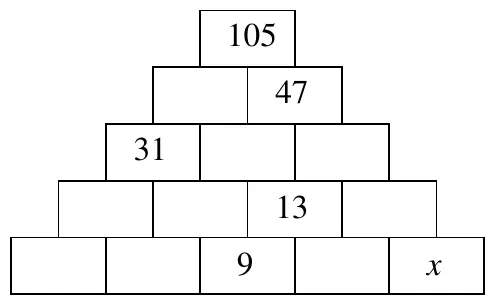
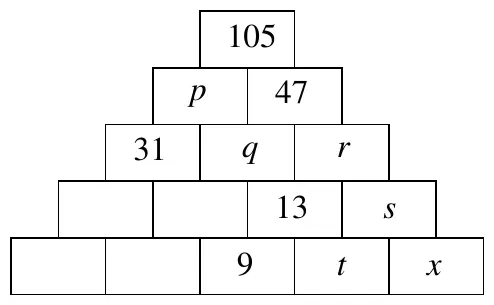
4. In this partly completed pyramid, each rectangle is to be filled with the sum of the two numbers in the rectangles immediately below it.

What number should replace \(x\)?

  1. A 3
  2. B 4
  3. C 5
  4. D 7
  5. E 12
A partly completed pyramid of rectangles with 105 at the top, 47, 31, 13 and 9 in some rectangles, and x in the bottom right rectangle

Junior Mathematical Challenge 2015, Question 4. © UK Mathematics Trust. Original paper on ukmt.org.uk

JMC 2015 Q3

JMCCurrent spec5 marksNumber & Arithmetic

3. What is the value of \(\dfrac{12\,345}{1 + 2 + 3 + 4 + 5}\)?

  1. A 1
  2. B 8
  3. C 678
  4. D 823
  5. E 12 359

Junior Mathematical Challenge 2015, Question 3. © UK Mathematics Trust. Original paper on ukmt.org.uk

JMC 2015 Q1

JMCCurrent spec5 marksNumber & Arithmetic

1. Which of the following calculations gives the largest answer?

  1. A 1 − 2 + 3 + 4
  2. B 1 + 2 − 3 + 4
  3. C 1 + 2 + 3 − 4
  4. D 1 + 2 − 3 − 4
  5. E 1 − 2 − 3 + 4

Junior Mathematical Challenge 2015, Question 1. © UK Mathematics Trust. Original paper on ukmt.org.uk

JMC 2014 Q22

JMCCurrent spec6 marksNumber & Arithmetic

22. In the division calculation 952 473 ÷ 18, which two adjacent digits should be swapped in order to increase the result by 100?

  1. A 9 and 5
  2. B 5 and 2
  3. C 2 and 4
  4. D 4 and 7
  5. E 7 and 3

Junior Mathematical Challenge 2014, Question 22. © UK Mathematics Trust. Original paper on ukmt.org.uk

JMC 2014 Q18

JMCCurrent spec6 marksNumber & Arithmetic

18. Which of these statements is true?

  1. A \(15\,614 = 1 + 5^6 - 1 \times 4\)
  2. B \(15\,615 = 1 + 5^6 - 1 \times 5\)
  3. C \(15\,616 = 1 + 5^6 - 1 \times 6\)
  4. D \(15\,617 = 1 + 5^6 - 1 \times 7\)
  5. E \(15\,618 = 1 + 5^6 - 1 \times 8\)

Junior Mathematical Challenge 2014, Question 18. © UK Mathematics Trust. Original paper on ukmt.org.uk

JMC 2014 Q12

JMCCurrent spec5 marksAlgebraNumber & Arithmetic

12. In this subtraction, \(P\), \(Q\), \(R\), \(S\) and \(T\) represent single digits.

What is the value of \(P + Q + R + S + T\) ?

  1. A 30
  2. B 29
  3. C 28
  4. D 27
  5. E 26
\(\begin{array}{cccccc} & 7 & Q & 2 & S & T\\ - & P & 3 & R & 9 & 6\\ \hline & 2 & 2 & 2 & 2 & 2\\ \hline \end{array}\)

Junior Mathematical Challenge 2014, Question 12. © UK Mathematics Trust. Original paper on ukmt.org.uk

JMC 2014 Q7

JMCCurrent spec5 marksNumber & Arithmetic

7. What is 2014 − 4102 ?

  1. A −2012
  2. B −2088
  3. C −2092
  4. D −2098
  5. E −2112

Junior Mathematical Challenge 2014, Question 7. © UK Mathematics Trust. Original paper on ukmt.org.uk

JMC 2014 Q5

JMCCurrent spec5 marksNumber & Arithmetic

5. What is the difference between the smallest 4-digit number and the largest 3-digit number?

  1. A 1
  2. B 10
  3. C 100
  4. D 1000
  5. E 9899

Junior Mathematical Challenge 2014, Question 5. © UK Mathematics Trust. Original paper on ukmt.org.uk

JMC 2014 Q4

JMCCurrent spec5 marksNumber & Arithmetic

4. The number 987 654 321 is multiplied by 9. How many times does the digit 8 occur in the result?

  1. A 1
  2. B 2
  3. C 3
  4. D 4
  5. E 9

Junior Mathematical Challenge 2014, Question 4. © UK Mathematics Trust. Original paper on ukmt.org.uk

JMC 2013 Q22

JMCCurrent spec6 marksNumber & Arithmetic

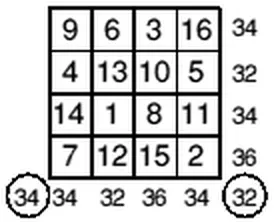
22. Two numbers in the 4 × 4 grid can be swapped to create a Magic Square (in which all rows, all columns and both main diagonals add to the same total).
What is the sum of these two numbers?

  1. A 12
  2. B 15
  3. C 22
  4. D 26
  5. E 28
96316
413105
141811
712152

Junior Mathematical Challenge 2013, Question 22. © UK Mathematics Trust. Original paper on ukmt.org.uk

JMC 2013 Q16

JMCCurrent spec6 marksAlgebraNumber & Arithmetic

16. Ulysses, Kim, Mei and Tanika have their 12th, 14th, 15th and 15th birthdays today. In what year will their ages first total 100?

  1. A 2023
  2. B 2024
  3. C 2025
  4. D 2057
  5. E 2113

Junior Mathematical Challenge 2013, Question 16. © UK Mathematics Trust. Original paper on ukmt.org.uk

JMC 2013 Q10

JMCCurrent spec5 marksNumber & Arithmetic

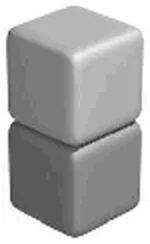
10. On standard dice the total number of pips on each pair of opposite faces is 7.
Two standard dice are placed in a stack, as shown, so that the total number of pips on the two touching faces is 5.
What is the total number of pips on the top and bottom faces of the stack?

  1. A 5
  2. B 6
  3. C 7
  4. D 8
  5. E 9
Two dice stacked one on top of the other

Junior Mathematical Challenge 2013, Question 10. © UK Mathematics Trust. Original paper on ukmt.org.uk

JMC 2013 Q8

JMCCurrent spec5 marksNumber & Arithmetic

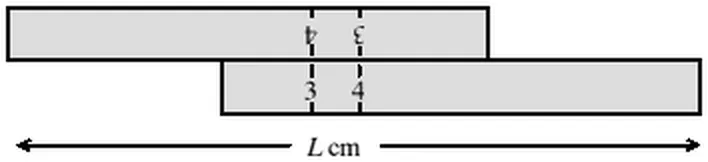
8. Two identical rulers are placed together, as shown (not to scale).
Each ruler is exactly 10 cm long and is marked in centimetres from 0 to 10. The 3 cm mark on each ruler is aligned with the 4 cm mark on the other.

Two overlapping rulers, the upper one to the left; the 3 on one ruler lines up with the 4 on the other, and an arrow below shows the overall length L cm

The overall length is \(L\) cm. What is the value of \(L\)?

  1. A 13
  2. B 14
  3. C 15
  4. D 16
  5. E 17

Junior Mathematical Challenge 2013, Question 8. © UK Mathematics Trust. Original paper on ukmt.org.uk

JMC 2013 Q6

JMCCurrent spec5 marksNumber & Arithmetic

6. What is the value of \(((1 - 1) - 1) - (1 - (1 - 1))\) ?

  1. A −2
  2. B −1
  3. C 0
  4. D 1
  5. E 2

Junior Mathematical Challenge 2013, Question 6. © UK Mathematics Trust. Original paper on ukmt.org.uk

JMC 2012 Q11

JMCCurrent spec5 marksNumber & Arithmetic

11. In the following expression, each  □  is to be replaced with either + or − in such a way that the result of the calculation is 100.

123  □  45  □  67  □  89

The number of + signs used is \(p\) and the number of − signs used is \(m\). What is the value of \(p - m\)?

  1. A −3
  2. B −1
  3. C 0
  4. D 1
  5. E 3

Junior Mathematical Challenge 2012, Question 11. © UK Mathematics Trust. Original paper on ukmt.org.uk

JMC 2012 Q5

JMCCurrent spec5 marksNumber & Arithmetic

5. One of the mascots for the 2012 Olympic Games is called ‘Wenlock’ because the town of Wenlock in Shropshire first held the Wenlock Olympian Games in 1850. How many years ago was that?

  1. A 62
  2. B 152
  3. C 158
  4. D 162
  5. E 172

Junior Mathematical Challenge 2012, Question 5. © UK Mathematics Trust. Original paper on ukmt.org.uk

JMC 2010 Q25

JMCCurrent spec6 marksAlgebraNumber & Arithmetic

25. What is the value of \(P + Q + R\) in the multiplication on the right?

  1. A 13
  2. B 12
  3. C 11
  4. D 10
  5. E 9
\(\begin{array}{cccccc} & & P & Q & P & Q\\ & \times & & R & R & R\\ \hline 6 & 3 & 9 & 0 & 2 & 7\\ \hline \end{array}\)

Junior Mathematical Challenge 2010, Question 25. © UK Mathematics Trust. Original paper on ukmt.org.uk

JMC 2010 Q14

14. The Severn Bridge has carried just over 300 million vehicles since it was opened in 1966.
On average, roughly how many vehicles is this per day?

  1. A 600
  2. B 2 000
  3. C 6 000
  4. D 20 000
  5. E 60 000

Junior Mathematical Challenge 2010, Question 14. © UK Mathematics Trust. Original paper on ukmt.org.uk

JMC 2010 Q1

JMCCurrent spec5 marksNumber & Arithmetic

1. What is 2010 + (+2010) + (−2010) − (+2010) − (−2010) ?

  1. A 0
  2. B 2010
  3. C 4020
  4. D 6030
  5. E 8040

Junior Mathematical Challenge 2010, Question 1. © UK Mathematics Trust. Original paper on ukmt.org.uk

JMC 2009 Q3

JMCCurrent spec5 marksNumber & Arithmetic

3. Which of the following is correct?

  1. A 0 × 9 + 9 × 0 = 9
  2. B 1 × 8 + 8 × 1 = 18
  3. C 2 × 7 + 7 × 2 = 27
  4. D 3 × 6 + 6 × 3 = 36
  5. E 4 × 5 + 5 × 4 = 45

Junior Mathematical Challenge 2009, Question 3. © UK Mathematics Trust. Original paper on ukmt.org.uk

JMC 2008 Q22

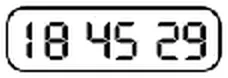
22. On a digital clock displaying hours, minutes and seconds, how many times in each 24-hour period do all six digits change simultaneously?

  1. A 0
  2. B 1
  3. C 2
  4. D 3
  5. E 24
A digital clock display reading 18 45 29

Junior Mathematical Challenge 2008, Question 22. © UK Mathematics Trust. Original paper on ukmt.org.uk

JMC 2008 Q1

JMCCurrent spec5 marksNumber & Arithmetic

1. Which of these calculations produces a multiple of 5?

  1. A 1 × 2 + 3 + 4
  2. B 1 + 2 × 3 + 4
  3. C 1 × 2 + 3 × 4
  4. D 1 + 2 × 3 × 4
  5. E 1 × 2 × 3 × 4

Junior Mathematical Challenge 2008, Question 1. © UK Mathematics Trust. Original paper on ukmt.org.uk

JMC 2007 Q18

JMCCurrent spec6 marksAlgebraNumber & Arithmetic

18. The letters \(J\), \(M\), \(C\) represent three different non-zero digits.
What is the value of \(J + M + C\) ?

  1. A 19
  2. B 18
  3. C 17
  4. D 16
  5. E 15
\(\begin{array}{ccc} & J & J\\ & M & M\\ & C & C\\ \hline J & M & C\\ \hline \end{array}\)

Junior Mathematical Challenge 2007, Question 18. © UK Mathematics Trust. Original paper on ukmt.org.uk

JMC 2007 Q15

JMCCurrent spec5 marksNumber & Arithmetic

15. I choose three numbers from this number square, including one number from each row and one number from each column. I then multiply the three numbers together. What is the largest possible product?

  1. A 72
  2. B 96
  3. C 105
  4. D 162
  5. E 504
123
456
789

Junior Mathematical Challenge 2007, Question 15. © UK Mathematics Trust. Original paper on ukmt.org.uk

JMC 2006 Q18

JMCCurrent spec6 marksAlgebraNumber & Arithmetic

18. In this magic square, which uses all whole numbers from 7 to 15 inclusive, each of the rows, columns and the two main diagonals has the same total. Which number replaces \(n\) in the completed square?

  1. A 8
  2. B 9
  3. C 10
  4. D 11
  5. E 12
n
7
14

Junior Mathematical Challenge 2006, Question 18. © UK Mathematics Trust. Original paper on ukmt.org.uk

JMC 2006 Q11

JMCCurrent spec5 marksNumber & Arithmetic

11. Travelling by train from Edinburgh to London, I passed a sign saying “London 150 miles”. After 7 more miles, I passed another sign saying “Edinburgh 250 miles”. How far is it by train from Edinburgh to London?

  1. A 407 miles
  2. B 393 miles
  3. C 257 miles
  4. D 243 miles
  5. E 157 miles

Junior Mathematical Challenge 2006, Question 11. © UK Mathematics Trust. Original paper on ukmt.org.uk

JMC 2006 Q9

JMCCurrent spec5 marksNumber & Arithmetic

9. Four of these calculations give the same answer. Which is the odd one out?

  1. A \(2 \times \sqrt{64}\)
  2. B 22 − 2 × 3
  3. C 24
  4. D 52 − 32
  5. E 4 + 4 × 2

Junior Mathematical Challenge 2006, Question 9. © UK Mathematics Trust. Original paper on ukmt.org.uk

JMC 2006 Q6

JMCCurrent spec5 marksAlgebraNumber & Arithmetic

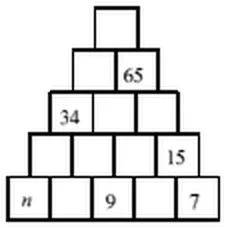
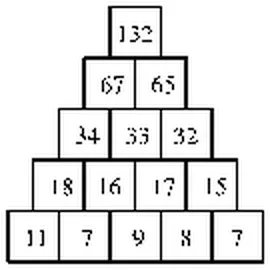
6. Each block shown in this tower is to have a number displayed on it. Some are already done. For each block above the bottom row, the number on it should be the sum of the numbers on the two blocks it stands upon.
What number should replace \(n\)?

  1. A 3
  2. B 6
  3. C 10
  4. D 11
  5. E 13
A tower of blocks with rows of 5, 4, 3, 2 and 1 blocks; the bottom row reads n, blank, 9, blank, 7; the second row has 15 at the right; the third row has 34 at the left; the fourth row has 65 at the right

Junior Mathematical Challenge 2006, Question 6. © UK Mathematics Trust. Original paper on ukmt.org.uk

JMC 2006 Q5

JMCCurrent spec5 marksNumber & Arithmetic

5. Euclid Gardens has 123 houses in it, numbered consecutively from 1 to 123. Houses 29 to 37 inclusive are knocked down to make space for a multi-storey car park. How many houses remain in Euclid Gardens?

  1. A 86
  2. B 114
  3. C 115
  4. D 116
  5. E 117

Junior Mathematical Challenge 2006, Question 5. © UK Mathematics Trust. Original paper on ukmt.org.uk

JMC 2006 Q2

JMCCurrent spec5 marksNumber & Arithmetic

2. Horatio the hamster likes to eat parts of clock faces. In which of these clock faces has the largest sum of numbers been eaten?

Five clock faces with Roman numerals labelled A to E, each with a different part bitten away: A is missing the bottom, B a small part on the left, C the top right, D the lower left and E the right-hand side

Junior Mathematical Challenge 2006, Question 2. © UK Mathematics Trust. Original paper on ukmt.org.uk

JMC 2005 Q22

JMCCurrent spec6 marksNumber & Arithmetic

22. In a certain code, A = 1, B = 2, C =3 etc. Words are encoded by multiplying together the values of their letters, so the code for SQUARE is 19 × 17 × 21 × 1 × 18 × 5 = 610 470. Similarly, the code for RECTANGLE is 31 752 000. What is the code for TRIANGLE?

  1. A 2 116 800
  2. B 2 721 600
  3. C 19 051 200
  4. D 25 401 600
  5. E 52 920 000

Junior Mathematical Challenge 2005, Question 22. © UK Mathematics Trust. Original paper on ukmt.org.uk

JMC 2005 Q18

JMCCurrent spec6 marksAlgebraNumber & Arithmetic

18. In the subtraction sum on the right \(a\), \(b\) and \(c\) are digits, and \(a\) is less than \(b\). What is the value of \(c\)?

  1. A 3
  2. B 4
  3. C 5
  4. D 6
  5. E a number greater than 6
\(\begin{array}{ccc} & b & a\\ - & a & b\\ \hline & c & 6 \end{array}\)

Junior Mathematical Challenge 2005, Question 18. © UK Mathematics Trust. Original paper on ukmt.org.uk

JMC 2005 Q16

JMCCurrent spec6 marksNumber & Arithmetic

16. ‘Saturn’ chocolate bars are packed either in boxes of 5 or boxes of 12. What is the smallest number of full boxes required to pack exactly 2005 ‘Saturn’ bars?

  1. A 118
  2. B 167
  3. C 168
  4. D 170
  5. E 401

Junior Mathematical Challenge 2005, Question 16. © UK Mathematics Trust. Original paper on ukmt.org.uk

JMC 2005 Q12

JMCCurrent spec5 marksNumber & Arithmetic

12. Which one of these calculations is incorrect?

  1. A 4 × 5 + 67 = 45 + 6 × 7
  2. B 3 × 7 + 48 = 37 + 4 × 8
  3. C 6 × 3 + 85 = 63 + 8 × 5
  4. D 2 × 5 + 69 = 25 + 6 × 9
  5. E 9 × 6 + 73 = 96 + 7 × 3

Junior Mathematical Challenge 2005, Question 12. © UK Mathematics Trust. Original paper on ukmt.org.uk

JMC 2005 Q10

JMCCurrent spec5 marksNumber & Arithmetic

10. On Monday last week Dilly started to learn the Tlingit language. Every day she learnt five new words, but when she woke every morning she had forgotten two of the words learnt the day before. When did Dilly first achieve her target of learning fourteen words?

  1. A Friday
  2. B Monday
  3. C Saturday
  4. D Thursday
  5. E Wednesday

Junior Mathematical Challenge 2005, Question 10. © UK Mathematics Trust. Original paper on ukmt.org.uk

JMC 2005 Q5

JMCCurrent spec5 marksNumber & Arithmetic

5. Which of the following numbers is not the difference between two of the others?

  1. A 1
  2. B 7
  3. C 6
  4. D 5
  5. E 2

Junior Mathematical Challenge 2005, Question 5. © UK Mathematics Trust. Original paper on ukmt.org.uk

JMC 2004 Q23

JMCCurrent spec6 marksAlgebraNumber & Arithmetic

23. In this addition each letter stands for a different digit, with \(S\) standing for 3. What is the value of \(Y \times O\)?

  1. A 0
  2. B 2
  3. C 36
  4. D 40
  5. E 42
\(\begin{array}{ccccc} & & & S & O\\ + & M & A & N & Y\\ \hline & S & U & M & S \end{array}\)

Junior Mathematical Challenge 2004, Question 23. © UK Mathematics Trust. Original paper on ukmt.org.uk

JMC 2004 Q22

JMCCurrent spec6 marksNumber & Arithmetic

22. The digits in the product 13 × 2 = 26 can be rearranged to give 16 × 2 = 32 as well as 31 × 2 = 62. In which one of the following can the digits not be rearranged to give another correct product?

  1. A 12 × 3 = 36
  2. B 12 × 7 = 84
  3. C 26 × 3 = 78
  4. D 16 × 3 = 48
  5. E 39 × 2 = 78

Junior Mathematical Challenge 2004, Question 22. © UK Mathematics Trust. Original paper on ukmt.org.uk

JMC 2004 Q17

JMCCurrent spec6 marksNumber & Arithmetic

17. Exactly one of these statements is correct. Which one?

  1. A 442 + 772 = 4477
  2. B 552 + 662 = 5566
  3. C 662 + 552 = 6655
  4. D 882 + 332 = 8833
  5. E 992 + 222 = 9922

Junior Mathematical Challenge 2004, Question 17. © UK Mathematics Trust. Original paper on ukmt.org.uk

JMC 2004 Q12

12. The White Rabbit has an appointment to see the Red Queen at 4pm every day apart from weekends. On Monday, he arrives 16 minutes late. Each day after that he hurries more and more and so manages to halve the amount of time that he arrives late each day. On what day of the week does he arrive just 15 seconds late?

  1. A Monday
  2. B Tuesday
  3. C Wednesday
  4. D Thursday
  5. E Friday

Junior Mathematical Challenge 2004, Question 12. © UK Mathematics Trust. Original paper on ukmt.org.uk

JMC 2004 Q10

JMCCurrent spec5 marksNumber & Arithmetic

10. When Harry bought his train ticket he received £2.50 in change. He noticed that for each coin in his change there was exactly one other coin of the same value. What was the coin of smallest value in Harry's change?

  1. A 2p
  2. B 5p
  3. C 10p
  4. D 20p
  5. E 50p

Junior Mathematical Challenge 2004, Question 10. © UK Mathematics Trust. Original paper on ukmt.org.uk

JMC 2004 Q3

JMCCurrent spec5 marksNumber & Arithmetic

3. The year 2004 has the units digit equal to twice the thousands digit. How many years will it be before this next happens?

  1. A 10
  2. B 36
  3. C 220
  4. D 1002
  5. E 2004

Junior Mathematical Challenge 2004, Question 3. © UK Mathematics Trust. Original paper on ukmt.org.uk

JK 2019 Q16

16. Eight cards are numbered from 1 to 8. The cards are placed in two boxes \(P\) and \(Q\) so that the sum of the numbers on the three cards in box \(P\) is equal to the sum of the numbers on the five cards in box \(Q\). Which of the following statements must be true?

  1. A The card numbered 1 is not in box \(Q\)
  2. B Four cards in box \(Q\) have even numbers on
  3. C The card numbered 5 is in box \(Q\)
  4. D The card numbered 2 is in box \(Q\)
  5. E Exactly three cards in box \(Q\) have odd numbers on.

Junior Kangaroo 2019, Question 16. © UK Mathematics Trust. Original paper on ukmt.org.uk

JK 2019 Q14

JKCurrent spec5 marksNumber & Arithmetic

14. Henry starts to read a 290-page book on a Sunday. He reads four pages every day except on Sundays when he reads 25 pages. How many days does it take him to finish the book?

  1. A 41
  2. B 40
  3. C 35
  4. D 12
  5. E 6

Junior Kangaroo 2019, Question 14. © UK Mathematics Trust. Original paper on ukmt.org.uk

JK 2018 Q22

JKCurrent spec6 marksNumber & Arithmetic

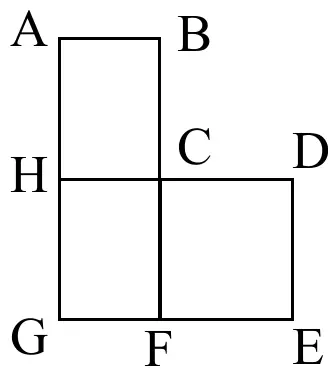
22. The diagram shows a plan of a town with various bus stops.
There are four bus routes in the town.
Route 1 goes C − D − E − F − G − H − C and is 17 km long.
Route 2 goes A − B − C − F − G − H − A and is 12 km long.
Route 3 goes A − B − C − D − E − F − G − H − A and is 20 km long.
Route 4 goes C − F − G − H − C.
How long is route 4?

  1. A 10 km
  2. B 9 km
  3. C 8 km
  4. D 7 km
  5. E 6 km
A plan of roads: a tall rectangle ABFG divided by a horizontal road through H and C, with a smaller rectangle CDEF attached on the right; bus stops at A, B, C, D, E, F, G and H

Junior Kangaroo 2018, Question 22. © UK Mathematics Trust. Original paper on ukmt.org.uk

JK 2018 Q11

JKCurrent spec5 marksAlgebraNumber & Arithmetic

11. The five symbols @, *, #, & and ^ used in the equations below represent different digits.

@ + @ + @ = *      # + # + # = ^      * + ^ = &

What is the value of &?

  1. A 0
  2. B 2
  3. C 3
  4. D 6
  5. E 9

Junior Kangaroo 2018, Question 11. © UK Mathematics Trust. Original paper on ukmt.org.uk

JK 2018 Q4

JKCurrent spec5 marksNumber & Arithmetic

4. Milly likes to multiply by 3, Abby likes to add 2 and Sam likes to subtract 1. In what order should they perform their favourite actions to start with 3 and end with 14?

  1. A MAS
  2. B MSA
  3. C AMS
  4. D ASM
  5. E SMA

Junior Kangaroo 2018, Question 4. © UK Mathematics Trust. Original paper on ukmt.org.uk

JK 2018 Q1

JKCurrent spec5 marksNumber & Arithmetic

1. Which calculation gives the largest result?

  1. A 2 + 0 + 1 + 8
  2. B 2 × 0 + 1 + 8
  3. C 2 + 0 × 1 + 8
  4. D 2 + 0 + 1 × 8
  5. E 2 × 0 + 1 × 8

Junior Kangaroo 2018, Question 1. © UK Mathematics Trust. Original paper on ukmt.org.uk

JK 2016 Q2

2. Twelve people, and no more, can sit evenly spaced around a large square table. Rohan arranges eight of these square tables in a row to make one long rectangular table. What is the maximum number of people that can sit evenly spaced around this long table?

  1. A 48
  2. B 54
  3. C 60
  4. D 80
  5. E 96

Junior Kangaroo 2016, Question 2. © UK Mathematics Trust. Original paper on ukmt.org.uk

JK 2015 Q13

JKCurrent spec5 marksNumber & Arithmetic

13. The sum of 10 distinct positive integers is 100. What is the largest possible value of any of the 10 integers?

  1. A 55
  2. B 56
  3. C 60
  4. D 65
  5. E 91

Junior Kangaroo 2015, Question 13. © UK Mathematics Trust. Original paper on ukmt.org.uk

JK 2015 Q9

JKCurrent spec5 marksAlgebraNumber & Arithmetic

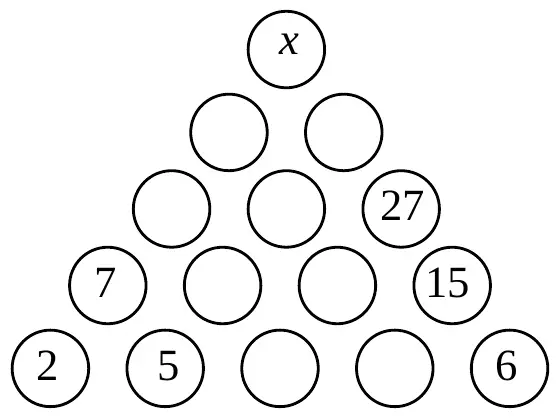
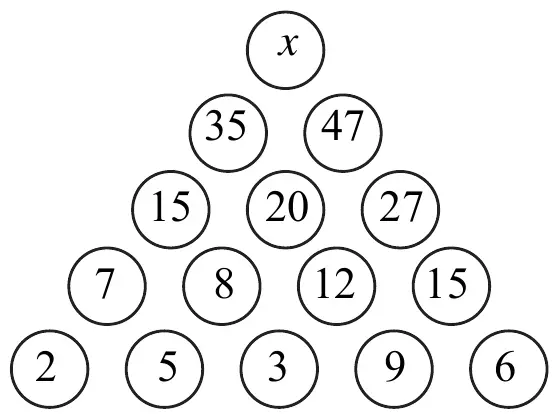
9. In the diagram on the right, the number in each circle is the sum of the numbers in the two circles below it. What is the value of \(x\)?

  1. A 100
  2. B 82
  3. C 55
  4. D 50
  5. E 32
A triangle of circles in five rows: x at the top; the second row empty; the third row empty, empty, 27; the fourth row 7, empty, empty, 15; the bottom row 2, 5, empty, empty, 6

Junior Kangaroo 2015, Question 9. © UK Mathematics Trust. Original paper on ukmt.org.uk

JK 2015 Q7

7. Selina takes a sheet of paper and cuts it into 10 pieces. She then takes one of these pieces and cuts it into 10 smaller pieces. She then takes another piece and cuts it into 10 smaller pieces and finally cuts one of the smaller pieces into 10 tiny pieces. How many pieces of paper has the original sheet been cut into?

  1. A 27
  2. B 30
  3. C 37
  4. D 40
  5. E 47

Junior Kangaroo 2015, Question 7. © UK Mathematics Trust. Original paper on ukmt.org.uk

JK 2015 Q2

JKCurrent spec5 marksAlgebraNumber & Arithmetic

2. The sum of five consecutive integers is 2015. What is the smallest of these integers?

  1. A 401
  2. B 403
  3. C 405
  4. D 407
  5. E 409

Junior Kangaroo 2015, Question 2. © UK Mathematics Trust. Original paper on ukmt.org.uk

JK 2015 Q1

JKCurrent spec5 marksNumber & Arithmetic

1. Ben lives in a large house with his father, mother, sister and brother as well as 2 dogs, 3 cats, 4 parrots and 5 goldfish. How many legs are there in the house?

  1. A 18
  2. B 36
  3. C 38
  4. D 46
  5. E 66

Junior Kangaroo 2015, Question 1. © UK Mathematics Trust. Original paper on ukmt.org.uk

JMO 2019 B1

JMOCurrent spec10 marksAlgebraNumber & Arithmetic

B1. In this word-sum, each letter stands for one of the digits 0–9, and stands
for the same digit each time it appears. Different letters stand for different
digits. No number starts with 0.

Find all the possible solutions of the word-sum shown here.

\(J\)\(M\)\(O\)
\(J\)\(M\)\(O\)
+\(J\)\(M\)\(O\)
\(I\)\(M\)\(O\)

Junior Mathematical Olympiad 2019, Question B1. © UK Mathematics Trust. Original paper on ukmt.org.uk

JMO 2019 A2

JMOCurrent spec1 markNumber & Arithmetic

A2. Six standard, fair dice are rolled once. The total of the scores rolled is 32.

What is the smallest possible score that could have appeared on any of the dice?

Junior Mathematical Olympiad 2019, Question A2. © UK Mathematics Trust. Original paper on ukmt.org.uk

JMO 2017 A4

JMOCurrent spec1 markNumber & Arithmetic

A4. A bookmark-maker sells bookmarks for £1 each or 7 for £6. What is the smallest amount you could pay for 2017 of her bookmarks?

Junior Mathematical Olympiad 2017, Question A4. © UK Mathematics Trust. Original paper on ukmt.org.uk

JMO 2016 B6

JMOCurrent spec10 marksAlgebraNumber & Arithmetic

B6. For which values of the positive integer \(n\) is it possible to divide the first \(3n\) positive integers into three groups each of which has the same sum?

Junior Mathematical Olympiad 2016, Question B6. © UK Mathematics Trust. Original paper on ukmt.org.uk

JMO 2016 A3

JMOCurrent spec1 markNumber & Arithmetic

A3. The first term of a sequence is 0. Each term of the sequence after the first term is equal to \(10p + 1\), where \(p\) is the previous term.

What is the sum of the first ten terms?

Junior Mathematical Olympiad 2016, Question A3. © UK Mathematics Trust. Original paper on ukmt.org.uk

JMO 2015 A6

A6. There are 81 players taking part in a knock-out quiz tournament. Each match in the tournament involves 3 players and only the winner of the match remains in the tournament − the other two players are knocked out. How many matches are required until there is an overall winner?

Junior Mathematical Olympiad 2015, Question A6. © UK Mathematics Trust. Original paper on ukmt.org.uk

JMO 2015 A2

JMOCurrent spec1 markNumber & Arithmetic

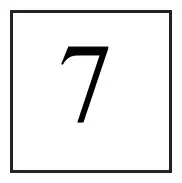
A2. The diagram shows what I see when I look straight down on the top
face of a non-standard cubical die. A positive integer is written on
each face of the die. The numbers on every pair of opposite faces add
up to 10. What is the sum of the numbers on the faces I cannot see?

Square top face of a die showing the number 7

Junior Mathematical Olympiad 2015, Question A2. © UK Mathematics Trust. Original paper on ukmt.org.uk

Cayley 2019 Q5

5. Howard chooses \(n\) different numbers from the list 2, 3, 4, 5, 6, 7, 8, 9, 10, 11, so that no two of his choices add up to a square.

What is the largest possible value of \(n\)?

Cayley Olympiad 2019, Question 5. © UK Mathematics Trust. Original paper on ukmt.org.uk

Cayley 2019 Q4

4. Arrange the digits 1, 2, 3, 4, 5, 6, 7, 8 to form two 4-digit integers whose difference is as small as possible.

Explain clearly why your arrangement achieves the smallest possible difference.

Cayley Olympiad 2019, Question 4. © UK Mathematics Trust. Original paper on ukmt.org.uk

Cayley 2019 Q2

CAYCurrent spec10 marksAlgebraNumber & Arithmetic

2. In the addition shown, each of the letters \(D\), \(O\), \(G\), \(C\), \(A\) and \(T\) represents a different digit.

What is the value of \(D + O + G + C + A + T\)?

\(D\)\(O\)\(G\)
+\(C\)\(A\)\(T\)
1000

Cayley Olympiad 2019, Question 2. © UK Mathematics Trust. Original paper on ukmt.org.uk

Cayley 2018 Q6

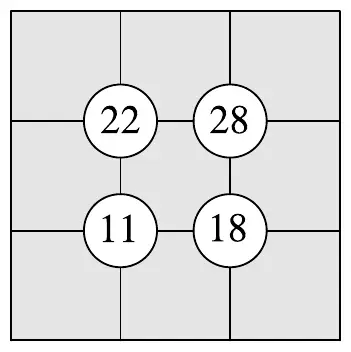
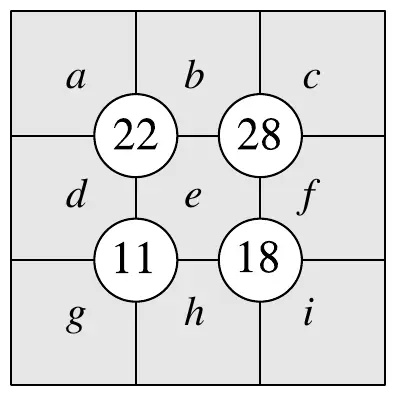
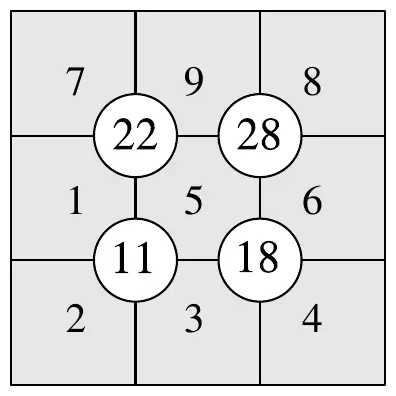
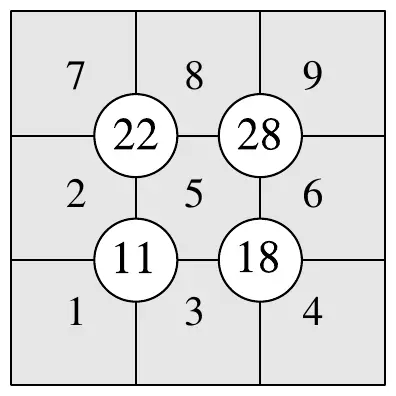
6. In the puzzle Suko, the numbers from 1 to 9 are to be placed in the spaces (one number in each) so that the number in each circle is equal to the sum of the numbers in the four surrounding spaces.

How many solutions are there to the Suko puzzle shown alongside?

A Suko grid: a 3 by 3 grid of spaces with four circles containing 22 (top left), 28 (top right), 11 (bottom left) and 18 (bottom right) at the inner corners

Cayley Olympiad 2018, Question 6. © UK Mathematics Trust. Original paper on ukmt.org.uk

Cayley 2018 Q5

5. In the expression below, three of the + signs are changed into − signs so that the expression is equal to 100:

\(0 + 1 + 2 + 3 + 4 + 5 + 6 + 7 + 8 + 9 + 10\)
\(\phantom{0}{} + 11 + 12 + 13 + 14 + 15 + 16 + 17 + 18 + 19 + 20.\)

In how many ways can this be done?

Cayley Olympiad 2018, Question 5. © UK Mathematics Trust. Original paper on ukmt.org.uk

Cayley 2018 Q3

3. The addition sum \(XCV + XXV = CXX\) is true in Roman numerals.

In this question, however, the sum is actually the letter-sum shown alongside, in which: each letter stands for one of the digits 0 to 9, and stands for the same digit each time it occurs; different letters stand for different digits; and no number starts with a zero.

Find all solutions, and explain how you can be sure you have found every solution.

XCV
+XXV
CXX

Cayley Olympiad 2018, Question 3. © UK Mathematics Trust. Original paper on ukmt.org.uk

Cayley 2017 Q3

CAYCurrent spec10 marksAlgebraNumber & Arithmetic

3. Peaches spends exactly £3.92 on some fruit, choosing from apples costing 20p each and pears costing 28p each.

How many of each type of fruit might she have bought?

Cayley Olympiad 2017, Question 3. © UK Mathematics Trust. Original paper on ukmt.org.uk