17. A rectangle is three times as long as it is high. The area of a square is twelve times the area of the rectangle. What is the ratio of the perimeter of the square to the perimeter of the rectangle?
Let the height of the rectangle be \(x\). Then its length is \(3x\) and its area is \(3x^2\). So the area of the square is \(12 \times 3x^2 = 36x^2\) and hence its side-length is \(\sqrt{36x^2} = 6x\). So the perimeter of the rectangle is \(2(x + 3x) = 8x\) and the perimeter of the square is \(4 \times 6x = 24x\). Therefore the required ratio is \(24x : 8x = 3 : 1\).
7. The shortest street in the UK, Ebenezer Place in Wick, is 2.06 m long. The Trans-Canada Highway, one of the world’s longest roads, is approximately 7821 km in length.
Approximately, how many times longer than the street is the highway?
The length of the Trans-Canada Highway is 7821 km = 7 821 000 m, which is approximately 8 000 000 m. So its length is roughly 4 000 000 times greater than 2.06 m-long Ebenezer Place.
14. Billy has three times as many llamas as lambs. Milly has twice as many lambs as llamas. They have 17 animals in total. How many of the animals are llamas?
Let Billy have \(b\) lambs and \(3b\) llamas. Let Milly have \(m\) llamas and \(2m\) lambs. Therefore, as they have 17 animals in total, \(4b + 3m = 17\). The only positive integer solution of this equation is \(b = 2\),\(m = 3\). So the number of llamas is \(3b + m = 3 \times 2 + 3 = 6 + 3 = 9\).
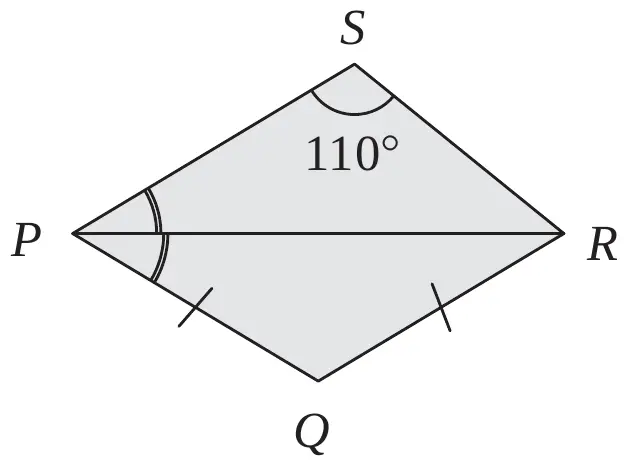
12. The diagram shows a quadrilateral \(PQRS\) in which \(PQ\) and \(QR\) have the same length. Also \(PR\) bisects \(\angle SPQ\), the ratio of \(\angle SPR\) to \(\angle PRS\) is 2 : 3 and \(\angle PSR = 110°\). How large is angle \(PQR\)?
The sum of the interior angles of a triangle equals 180°. So, as \(\angle PSR = 110°\),\(\angle SPR + \angle PRS = 70°\). Therefore \(\angle SPR = \tfrac{2}{5} \times 70° = 28°\). Now \(PR\) bisects \(\angle SPQ\), so \(\angle QPR = \angle SPR = 28°\). In triangle \(PQR\), we know that \(PQ = QR\) so \(\angle QRP = \angle QPR = 28°\). Therefore \(\angle PQR = 180° - 2 \times 28° = 124°\).
9. The approximate cost of restoring the Flying Scotsman was £4 million. This was about 500 times the cost of building the steam engine in 1923. Roughly what did the engine cost to build?
The required time is the difference between 06:15 and 08:48. This is a time difference of 2 hours and 33 minutes. So the length of the journey in minutes is 2 × 60 + 33 = 120 + 33 = 153.
4. The perimeter of the regular decagon \(P\) is 8 times the perimeter of the regular octagon \(Q\). Each edge of the regular octagon \(Q\) is 10 cm long. How long is each edge of the regular decagon \(P\)?
The perimeter of the regular octagon \(Q\) is 8 × 10 cm = 80 cm. So the perimeter of the regular decagon \(P\) is 8 × 80 cm = 640 cm. Therefore the length of each edge of \(P\) is (640 ÷ 10) cm = 64 cm.
25. The distance between Exeter and London is 175 miles. Sam left Exeter at 10:00 on Tuesday for London. Morgan left London for Exeter at 13:00 the same day. They travelled on the same road. Up to the time when they met, Sam's average speed was 25 miles per hour, and Morgan's average speed was 35 miles an hour. At what time did Sam and Morgan meet?
Sam left Exeter three hours before Morgan left London, and travelled 3 × 25 miles = 75 miles in the three hours to 13:00. So at 13:00, the distance between Sam and Morgan was (175 − 75) miles = 100 miles. Let the time in hours between 13:00 and the time at which Sam and Morgan met be \(t\). Then \(25t + 35t = 100\). So \(t = \tfrac{100}{60}\) hours = 100 minutes = 1 hour 40 minutes. So Sam and Morgan met at 14:40.
12. Last year, at the school where Gill teaches Mathematics, 315 out of the 600 pupils were girls. This year, the number of pupils in the school has increased to 640. The proportion of girls is the same as it was last year. How many girls are there at the school this year?
Last year, the fraction of girls at the school was \(\tfrac{315}{600} = \tfrac{63}{120} = \tfrac{21}{40}\). This year, there are 40 more pupils at the school, but the proportion of girls has remained the same. So there are 21 more girls at the school this year, making a total of 315 + 21 = 336.
9. In William Shakespeare's play As You Like It, Rosalind speaks to Orlando about “He that will divide a minute into a thousand parts”. Which of the following is equal to the number of seconds in one thousandth of one minute?
2. Nadiya is baking a cake. The recipe says that her cake should be baked in the oven for 1 hour and 35 minutes. She puts the cake in the oven at 11:40 am. At what time should she take the cake out of the oven?
Nadiya puts her cake into the oven at 11:40 am. So 20 minutes later, it will be 12:00. Then, there will still be 1 hour and 15 minutes before the cake is due to be taken out of the oven. So she should take her cake out at 1:15 pm.
Initially there are 48 children of whom \(\tfrac{3}{8}\) are boys and \(\tfrac{5}{8}\) are girls, so there are 18 boys and 30 girls. When more boys join, there are still 30 girls but now they form \(\tfrac{3}{8}\) of the total. So the total number of pupils is now \(\tfrac{8}{3} \times 30 = 80\), of whom 80 − 30 = 50 are boys. Hence the number of boys joining is 50 − 18 = 32.
12. The musical Rent contains a song that starts ‘Five hundred and twenty five thousand six hundred minutes’. Which of the following is closest to this length of time?
4. In January 1859, an eight-year-old boy dropped a newly-hatched eel into a well in Sweden (apparently in order to keep the water free of insects). The eel, named Åle, finally died in August 2014. How many years old was Åle when it died?
There are 41 years from January 1859 to January 1900 and a further 114 years to January 2014. So, since Åle died in August 2014, its age in years when it died was 41 + 114 = 155.
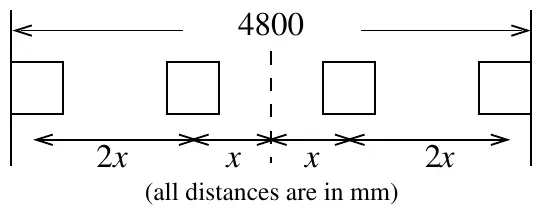
21. Gill is now 27 and has moved into a new flat. She has four pictures to hang in a horizontal row on a wall which is 4800 mm wide. The pictures are identical in size and are 420 mm wide. Gill hangs the first two pictures so that one is on the extreme left of the wall and one is on the extreme right of the wall. She wants to hang the remaining two pictures so that all four pictures are equally spaced. How far should Gill place the centre of each of the two remaining pictures from a vertical line down the centre of the wall?
The diagram shows part of the wall of width 4800 mm and the four equally spaced pictures, each of width 420 mm. Let \(x\) be the required distance, that is the distance from the centre of each of the two pictures in the middle of the wall to a vertical line down the centre of the wall (marked by a broken line). Then the distance between the centres of any two adjacent pictures is \(2x\). Note that the distance between the centres of the two pictures on the extremes of the wall is (4800 − 2 × 210) mm = 4380 mm. Therefore \(2x + x + x + 2x = 4380\). So \(x = 4380 \div 6 = 730\). Hence the required distance is 730 mm.
9. According to a newspaper report, “A 63-year-old man has rowed around the world without leaving his living room.” He clocked up 25 048 miles on a rowing machine that he received for his 50th birthday. Roughly how many miles per year has he rowed since he was given the machine?
The man has rowed the equivalent of just over 25 000 miles in approximately 13 years. So the mean number of ‘miles’ rowed per year is approximately \(\dfrac{25\,000}{13} \approx \dfrac{26\,000}{13} = 2000\).
At 22:22, there are 60 − 22 = 38 minutes to 23:00. There are then a further 60 minutes to midnight. So the number of minutes which remain until midnight is 38 + 60 = 98.
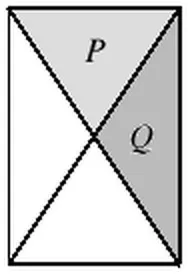
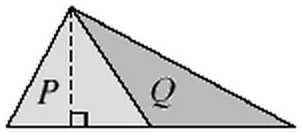
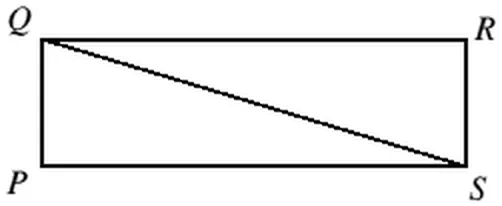
The diagram shows part of the given diagram after a rotation so that the diagonal shown is horizontal. The perpendicular height of triangle \(P\) is shown and it can be seen that this is also the perpendicular height of triangle \(Q\). The diagonals of a rectangle bisect each other, so triangles \(P\) and \(Q\) have bases of equal length and the same perpendicular height. Therefore their areas are equal.
There are 24 hours in one day, so \(\tfrac{1}{12}\) of a day is 2 hours. Therefore the number of minutes in \(\tfrac{1}{12}\) of a day is 2 × 60 = 120.
19. A swimming club has three categories of members: junior, senior, veteran. The ratio of junior to senior members is 3 : 2 and the ratio of senior members to veterans is 5 : 2. Which of the following could be the total number of members in the swimming club?
For every 2 senior members in the swimming club there are 3 junior members. For every 5 senior members there are 2 veteran members. The lowest common multiple of 2 and 5 is 10, so it may be deduced that the number of senior members is a multiple of 10. For every 10 senior members in the swimming club there are 15 junior members and 4 veteran members. So the total number of members is a multiple of 29. Of the alternatives given, the only multiple of 29 is 58.
11. Usain runs twice as fast as his mum. His mum runs five times as fast as his pet tortoise, Turbo. They all set off together for a run down the same straight path. When Usain has run 100 m, how far apart are his mum and Turbo the tortoise?
Distance travelled = average speed × time of travel, so Gill travelled between 15 km and 20 km. Of the alternatives given, only 19 km lies in this interval.
50 months = 4 years and 2 months; 50 weeks and 50 days = 57 weeks and 1 day, i.e. just over 1 year and 1 month. So Aroon is just over 55 years and 3 months old and will, therefore, be 56 on his next birthday.
As \(\angle QPS = 90^\circ\),\(\angle PSQ + \angle PQS = 90^\circ\). So, since the ratio of these angles is 1:5, \(\angle PSQ = 15^\circ\) and \(\angle PQS = 75^\circ\). Now \(\angle QSR = \angle PQS\) (alternate angles). So \(\angle QSR = 75^\circ\).
7. A small ink cartridge has enough ink to print 600 pages. Three small cartridges can print as many pages as two medium cartridges. Three medium cartridges can print as many pages as two large cartridges. How many pages can be printed using a large cartridge?
Two medium cartridges can print as many pages as three small cartridges, i.e. 1800 pages. So three medium cartridges can print 1800 × 3/2 pages, i.e. 2700 pages. This is the same number of pages as two large cartridges can print, so one large cartridge can print 2700 ÷ 2, i.e. 1350, pages.
21. Gill leaves Lille by train at 09:00. The train travels the first 27 km at 96 km/h. It then stops at Lens for 3 minutes before travelling the final 29 km to Lillers at 96 km/h. At what time does Gill arrive at Lillers?
In total the train travels 27 km + 29 km = 56 km. So the combined time for these two parts of the journey is \(\dfrac{56}{96}\) hours = \(\dfrac{7}{12}\) hours = 35 minutes. The total journey time, therefore, is 38 minutes. So Gill arrives at 09:38.
18. Peri the winkle leaves on Monday to go and visit Granny, 90m away. Except for rest days, Peri travels 1m each day (24-hour period) at a constant rate and without pause. However, Peri stops for a 24-hour rest every tenth day, that is, after every nine days' travelling. On which day of the week does Peri arrive at Granny's?
Until Peri reaches Granny's, he travels 9m in every 10 days. So he takes 90 days to travel the first 81m of his journey. There remains a distance of 9m to be covered and so, after a further 9 days, Peri is at Granny's. Therefore the length of Peri's journey is 99 days, that is 14 weeks 1 day. So Peri arrives at Granny's on Tuesday.
17. Last year's match at Wimbledon between John Isner and Nicolas Mahut, which lasted 11 hours and 5 minutes, set a record for the longest match in tennis history. The fifth set of the match lasted 8 hours and 11 minutes. Approximately what fraction of the whole match was taken up by the fifth set?
The lengths in minutes of the fifth set and the whole match are 491 and 665 respectively. So the required fraction is \(\dfrac{491}{665} = \dfrac{491 \times 3}{665 \times 3} \approx \dfrac{1500}{2000} = \dfrac{3}{4}\).
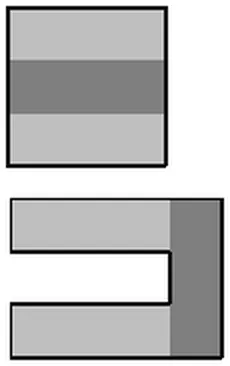
8. A square is divided into three congruent rectangles. The middle rectangle is removed and replaced on the side of the original square to form an octagon as shown. What is the ratio of the length of the perimeter of the square to the length of the perimeter of the octagon?
Let the original square have side \(3x\). Then its perimeter is \(12x\). The perimeter of the octagon is \(2 \times 4x + 3 \times 3x + 3 \times x = 8x + 9x + 3x = 20x\).
7. Peter Piper picked a peck of pickled peppers. 1 peck = \(\tfrac{1}{4}\) bushel and 1 bushel = \(\tfrac{1}{9}\) barrel. How many more pecks must Peter Piper pick to fill a barrel?
4. The world's largest coin, made by the Royal Mint of Canada, was auctioned in June 2010. The coin has mass 100 kg, whereas a standard British £1 coin has mass 10 g. What sum of money in £1 coins has the same mass as the record-breaking coin?
100 kg = 100 000 g. So the sum of money in £1 coins which would have the same mass as the world's largest coin is £(100 000 ÷ 10) = £10 000. (The coin was sold for $4m (£2.6m) at an auction in Vienna in June 2010.)
The average number of vehicles per day \(\approx \dfrac{300\,000\,000}{44 \times 365} \approx \dfrac{300\,000\,000}{40 \times 400}\) \(= \dfrac{300\,000\,000}{16\,000} \approx \dfrac{300\,000\,000}{15\,000} = 20\,000.\)
10. At the Marldon Apple-Pie-Fayre bake-off, prize money is awarded for 1st, 2nd and 3rd places in the ratio 3 : 2 : 1. Last year Mrs Keat and Mr Jewell shared third prize equally. What fraction of the total prize money did Mrs Keat receive?
One year is, at most, 366 days, so one-third of a year is less than 125 days. No month is longer than 31 days, so 4 months is also less than 125 days, as is 17.5 weeks which equals 122.5 days. However 3002 hours equals 125 days 2 hours, so this is the longest of the five periods of time.
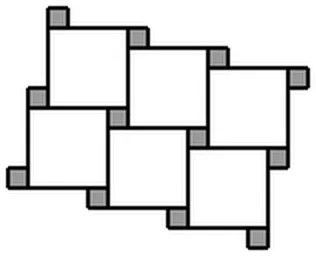
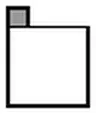
17. The tiling pattern shown uses two sizes of square, with sides of length 1 and 4. A very large number of these squares is used to tile an enormous floor in this pattern. Which of the following is closest to the ratio of the number of grey tiles on the floor to the number of white tiles?
7. King Harry's arm is twice as long as his forearm, which is twice as long as his hand, which is twice as long as his middle finger, which is twice as long as his thumb. His new bed is as long as four arms. How many thumbs length is that?
The thickness of the line is 0.2 mm, that is 0.0002 m. So, in order to cover an area of one square metre, the length of the line would need to be \(\dfrac{1}{0.0002}\) m, that is 5000 m.
2. My train was scheduled to leave at 17:40 and to arrive at 18:20. However, it started five minutes late and the journey then took 42 minutes. At what time did I arrive?
Let the number of girls at the camp be \(x\). Then there are \(\dfrac{3x}{4}\) boys and \(\dfrac{7x}{5}\) adults. So the ratio of children to adults is \(\tfrac{7x}{4} : \tfrac{7x}{5}\), that is 5:4.
19. Pinocchio's nose is 5 cm long. Each time he tells a lie his nose doubles in length. After he has told nine lies, his nose will be roughly the same length as a:
After Pinocchio has told 9 lies, the length of his nose will be 29 × 5 cm = 512 × 5 cm = 25.6 m. This is close to the length of a tennis court, which is 23.8 m.
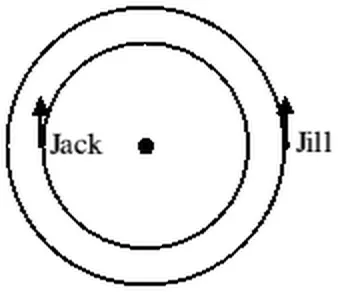
24. Jack dances clockwise around the Maypole, making one revolution every five seconds. Starting from a point diametrically opposite Jack's starting point, Jill dances anticlockwise, making one revolution every six seconds. How many times do they pass each other in the first minute?
As Jack makes one revolution every five seconds, and Jill one revolution every six seconds, on average they turn through angles of 72° and 60° respectively every second. So, as they are travelling in opposite directions, Jill turns, on average, through an angle of 132° per second relative to Jack. In one minute, therefore, she will turn through an angle of 60 × 132°, that is 22 complete revolutions, relative to Jack. So they will pass each other 22 times in the first minute.
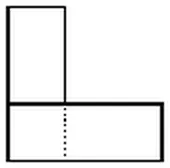
19. Two identical rectangular cards are glued together as shown to form an 'L' shape. The perimeter of this 'L' shape is 40 cm. What is the ratio of the lengths of the sides of one of the original cards?
Let the length and breadth of one of the original cards be \(l\) and \(b\) respectively. Then the lengths of the six sides of the ‘L’ shape (moving clockwise from the bottom left-hand corner) are \(l\),\(b\),\(l - b\),\(l - b\),\(b\), \(l\) respectively. So \(2l + 2b + 2(l - b) = 40\), that is \(4l = 40\). We may deduce, therefore, that \(l\) is 10, but there is insufficient information for us to find the ratio \(b : l\).
7. The lightest seeds in the world are probably those of the Creeping Lady's-tresses Orchid, 500 000 of which would weigh 1 gram. How many millions of these seeds weigh 1 kilogram?
12. The White Rabbit has an appointment to see the Red Queen at 4pm every day apart from weekends. On Monday, he arrives 16 minutes late. Each day after that he hurries more and more and so manages to halve the amount of time that he arrives late each day. On what day of the week does he arrive just 15 seconds late?
On Tuesday the White Rabbit will be 8 minutes late, on Wednesday 4 minutes late, on Thursday 2 minutes late and on Friday 1 minute late. So on the following Monday the White Rabbit will be 30 seconds late and on the day after that he will be 15 seconds late.
7. In music, a demisemiquaver is half of half of half a crotchet, and there are four crotchets in a semibreve. How many demisemiquavers are there in a semibreve?
24. There are two ponds at the bottom of Gabrielle’s garden, each containing frogs and toads. In one pond the ratio of frogs to toads is 3 : 4. In the other pond the ratio of frogs to toads is 5 : 6. Suppose there are 36 frogs in total. What then would be the largest possible total number of toads in the ponds?
Since the ratios of frogs to toads in the two ponds are 3 : 4 and 5 : 6 respectively, the numbers of frogs and toads are \(3x\) and \(4x\) in the first pond and \(5y\) and \(6y\) in the second pond for some positive integers \(x\) and \(y\). Therefore, since there are 36 frogs in total, we have \(3x + 5y = 36\). Since both 3 and 36 are multiples of 3, \(y\) is also a multiple of 3 and since \(5y \leq 36\) we have \(y = 3\) or 6. If \(y\) were 3, \(x\) would be 7 and the total number of toads would be 4 × 7 + 6 × 3 = 46. Similarly, if \(y\) were 6, \(x\) would be 2 and the total number of toads would be 4 × 2 + 6 × 6 = 44. Hence, the largest possible number of toads in the ponds would be 46.
22. Geraint always cycles to work, leaving at 8am every morning. When he averages 15 km/h, he arrives 10 minutes late. However, when he averages 30 km/h, he arrives 10 minutes early. What speed should he average to arrive on time?
Let \(x\) km be the distance Geraint cycles and let \(t\) hours be the time his journey should take if he is to be on time. Since \(\frac{\text{distance}}{\text{speed}}\) = time, the information in the question tells us that \(\frac{x}{15} = t + \frac{1}{6}\) and that \(\frac{x}{30} = t - \frac{1}{6}\). When we subtract the second equation from the first, we obtain \(\frac{x}{30} = \frac{2}{6}\) and so \(x = 10\). Hence, from the second equation, \(\frac{10}{30} = t - \frac{1}{6}\) and so \(t = \frac{1}{3} + \frac{1}{6} = \frac{1}{2}\). Therefore, to arrive on time, Geraint needs to travel 10 km in \(\frac{1}{2}\) hour, which is an average speed of 20 km/h.
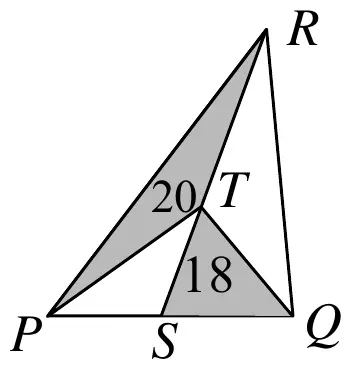
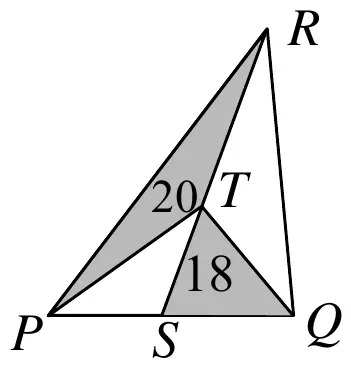
21. In triangle \(PQR\), the point \(S\) is on \(PQ\) so that the ratio of the length of \(PS\) to the length of \(SQ\) is 2: 3. The point \(T\) lies on \(SR\) so that the area of triangle \(PTR\) is 20 and the area of triangle \(SQT\) is 18, as shown in the diagram. What is the area of triangle \(PQR\)?
Note first that the triangles \(PST\) and \(SQT\) have the same perpendicular height. Hence the ratio of their areas is equal to the ratio of their bases. Therefore area of triangle \(PST\) : 18 = 2 : 3 and hence the area of triangle \(PST\) is 12. Similarly, triangles \(PSR\) and \(SQR\) have the same perpendicular height and hence (12 + 20): area of triangle \(SQR\) = 2 : 3. Therefore the area of triangle \(SQR\) is \(\frac{3}{2}\) × 32 = 48. Therefore the total area of triangle \(PQR\) is 12 + 20 + 48 = 80.
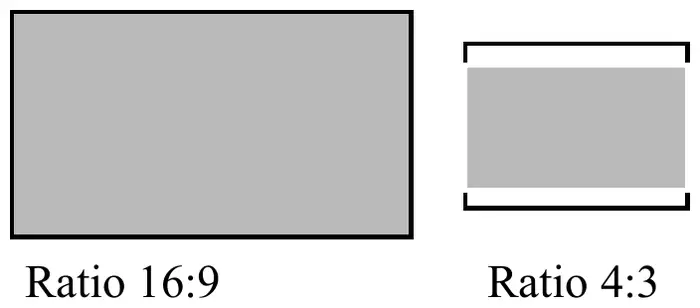
19. My TV screen has sides in the ratio 16 : 9. My mother's TV screen has sides in the ratio 4 : 3. A picture which exactly fills the screen of my TV only fills the width of the screen of my mother's TV. What fraction of the screen on my mother's TV is not covered?
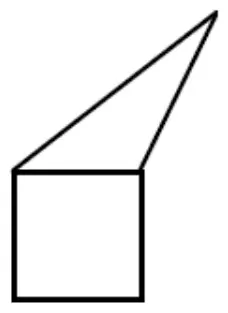
13. The diagram shows a triangle joined to a square to form an irregular pentagon. The triangle has the same perimeter as the square. What is the ratio of the perimeter of the pentagon to the perimeter of the square?
Let the length of the edge of the square be 1 unit. Therefore the perimeter of the square and hence the perimeter of the triangle is 4 units. Since the pentagon is made by joining the square and the triangle along one common edge, the perimeter of the pentagon is equal to the sum of their perimeters minus twice the length of the common edge or (4 + 4 − 2) units = 6 units. Therefore the ratio of the perimeter of the pentagon to the perimeter of the square is 6 : 4 = 3 : 2.
6. Hasan writes down a two-digit number. He then writes the same two-digit number next to his original number to form a four-digit number. What is the ratio of his four-digit number to his two-digit number ?
Let Hasan's two-digit number be ‘ab’, which is equal to \(10a + b\). The four-digit number he forms is therefore ‘abab’, which is equal to \(1000a + 100b + 10a + b\) and hence to \(100(10a + b) + 10a + b = 101 \times (10a + b)\). Therefore the ratio of his four-digit number to his two-digit number is 101 : 1.
3. Ben has exactly the right number of cubes, each of side 5 cm, to make a solid cube of side 1 m. He places the smaller cubes side by side to form a single row. How long is this row?
The number of small cubes along each edge of the large cube is 100 ÷ 5 = 20. Therefore Ben has 20 × 20 × 20 = 8000 small cubes in total. Hence the row he forms is 8000 × 5 cm = 40 000 cm long. Since there are 100 cm in 1 m, his row is 400 m long.
22. Lewis drives from London to Brighton at an average speed of 60 mph. On the way back, he gets stuck in traffic and his average speed is only 40 mph. What is his average speed for the whole journey?
Let the distance from London to Brighton be \(d\) miles. Since time = distance/speed, the times Lewis spent on the two parts of his journey are \(\frac{d}{60}\) hours and \(\frac{d}{40}\) hours. Hence the total time in hours that he travelled is \[\frac{d}{60} + \frac{d}{40} = \frac{2d + 3d}{120} = \frac{5d}{120} = \frac{d}{24}.\] Therefore his average speed for the whole journey is \(2d \div \left(\frac{d}{24}\right)\) mph = 48 mph.
19. Adam, Bill and Chris went swimming 15 times last summer. Adam paid for everyone eight times and Bill paid for everyone seven times. At the end of the summer, Chris calculated that he owed £30. How should he split this between Adam and Bill so that each has paid the same amount?
If each person paid their fair share, each would have paid five times. Therefore Adam has paid on an extra three occasions and Bill has paid on an extra two occasions. Hence the £30 Chris owes should be divided in the ratio 3:2. Therefore Adam should get \(\frac{3}{5}\) × £30 = £18 and Bill should get \(\frac{2}{5}\) × £30 = £12.
25. Anna, Bridgit and Carol run in a 100 m race. When Anna finishes, Bridgit is 16 m behind her and when Bridgit finishes, Carol is 25 m behind her. The girls run at constant speeds throughout the race. How far behind was Carol when Anna finished?
Carol finishes 25 metres behind Bridgit, so she travels 75 metres while Bridgit runs 100 metres. Therefore she runs 3 metres for every 4 metres Bridgit runs. When Anna finishes, Bridgit has run 84 metres, so that at that time Carol has run \(\frac{3}{4}\) × 84 metres = 63 metres. Hence Carol finishes (100 − 63) metres = 37 metres behind Anna.
19. From noon till midnight, Clever Cat sleeps under the oak tree and from midnight till noon he is awake telling stories. A poster on the tree above him says “Two hours ago, Clever Cat was doing the same thing as he will be doing in one hour's time”. For how many hours a day does the poster tell the truth?
Consider the times when the poster does not tell the truth. The poster will not tell the truth one hour before Clever Cat changes his activity and will remain untrue until he has been doing his new activity for two hours. Hence the poster does not tell the truth for three hours around each change of activity but tells the truth the rest of the time. Therefore, the poster will tell the truth for (24 − 2 × 3) hours = 18 hours.
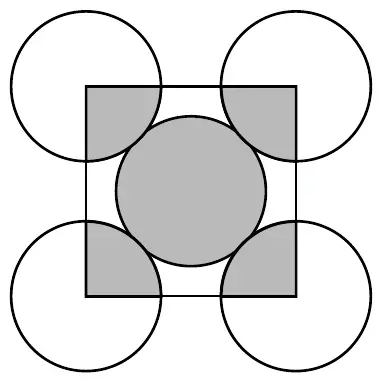
14. The diagram shows five circles of the same radius touching each other. A square is drawn so that its vertices are at the centres of the four outer circles. What is the ratio of the area of the shaded parts of the circles to the area of the unshaded parts of the circles?
The shaded area is equal to that of 1 circle + 4 × \(\frac{1}{4}\) circles = 2 circles. The area of the unshaded parts of the circles is equal to that of 4 × \(\frac{3}{4}\) circles = 3 circles. Hence the required ratio is 2 : 3.
8. John takes 40 minutes to walk to school and then to run home. When he runs both ways, it takes him 24 minutes. He has one fixed speed whenever he walks, and another fixed speed whenever he runs. How long would it take him to walk both ways?
It takes John 24 minutes to run both ways so it will take him \(\frac{1}{2}\) × 24 minutes = 12 minutes to run one way. Also, it takes him 40 minutes to walk one way and run the other so walking one way takes him (40 − 12) minutes = 28 minutes. Hence it will take 2 × 28 minutes = 56 minutes to walk both ways.
One day contains 24 hours. Hence \(\frac{1}{8}\) of a day is three hours and \(\frac{1}{6}\) of this is half an hour. Half an hour contains \((\frac{1}{2} \times 60 \times 60)\) seconds = 1800 seconds and \(\frac{1}{4}\) of this is 450 seconds. Hence there are 450 seconds in the required fraction of a day.
B3. It takes one minute for a train travelling at constant speed to pass completely through a tunnel that is 120 metres long. The same train, travelling at the same constant speed, takes 20 seconds from the instant its front enters the tunnel to it being completely inside the tunnel.
Let \(L\) be the length of the train in metres. It takes one minute for the train to pass completely through a tunnel, which is 120m long. Therefore, in 60 seconds the train travels \((L + 120)\) m and its average speed is \(\frac{L+120}{60}\) m/s. Travelling at the same speed, the train takes 20 seconds to travel \(L\) m. Hence,
Let the three positive integers be \(A\), \(Ak\) and \(Ak^2\), where \(A\) is a positive constant. Therefore \(A + Ak + Ak^2 = A(1 + k + k^2) = 93 = 3 \times 31\). If \(k = 1\) and \(A = 31\),\(A^3k^3 = 31^3 \times 1^3 \neq 3375\). Therefore, since 3 and 31 are prime, \(A = 3\) and \(1 + k + k^2 = 31\). Hence, \(k = 5\) and the three integers are 3, 15 and 75.
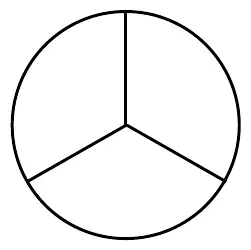
Let the radius of the circle be \(r\). As each sector is a third of the circle, the length of the perimeter of each sector is \(\frac{2\pi r}{3} + 2r\). Therefore, the ratio of the length of the perimeter of one of the three sectors to the length of the circumference of the circle is \(\left(\frac{2\pi r}{3} + 2r\right) : 2\pi r = \left(\frac{\pi}{3} + 1\right) : \pi\) or \((\pi + 3) : 3\pi\).
A10. Two concentric circles are drawn, as shown in the diagram. Concentric circles share the same point as their centre. The radius of the smaller circle is a third of the radius of the larger circle. The top half of the larger circle which is outside the smaller circle, is shaded in grey. The ratio of the grey shaded area to the area of the smaller circle in its simplest form is \(a : b\). What are the values of \(a\) and \(b\)?
Let the radius of the smaller circle be \(r\), so the radius of the larger circle is \(3r\). The area of the smaller circle is \(\pi r^2\) and the grey shaded area is \(\frac{1}{2}\pi(3r)^2 - \frac{1}{2}\pi r^2 = 4\pi r^2\).
Therefore the ratio of the grey shaded area to the area of the smaller circle is \(4\pi r^2 : \pi r^2 = 4 : 1\), and hence \(a = 4\) and \(b = 1\).
Let \(m\) be the original number of marbles in the jar. Therefore, as Jenny replaces 2 of the white marbles with 7 red marbles, there are now \(m + 5\) marbles in the jar. We know that \(\frac{4}{5}\) of the original number of marbles were white, that 2 white marbles were removed and that now \(\frac{3}{5}\) of the jar’s marbles are white. Hence
\(\frac{4}{5}m - 2 = \frac{3}{5}(m + 5)\).
Solving this equation, gives \(m = 25\). Therefore the ratio of the total number of marbles in the jar now to the number in the jar before is 30 : 25 = 6 : 5.
A5. In 1866, the yacht Henrietta – with Gordon Bennett aboard – won the Great Ocean Yacht Race, travelling a distance of approximately 3000 nautical miles. The winning time was 13 days and 22 hours, to the nearest hour.
What was the yacht's average speed in nautical miles per hour, to the nearest integer?
Since 13 days and 22 hours are equivalent to 334 hours, the yacht travels 3000 nautical miles in 334 hours. Therefore the yacht travels \(\frac{3000}{334}\) nautical miles in 1 hour. Hence the yacht's average speed in nautical miles per hour is 9 (to the nearest integer).
A6. The points \(A\),\(B\),\(C\), \(D\) and \(E\) lie in that order along a straight line so that \(AB : BC = 1 : 2\), \(BC : CD = 1 : 3\) and \(CD : DE = 1 : 4\). What is \(AB : BE\)?
A4. My fruit basket contains apples and oranges. The ratio of apples to oranges in the basket is 3 : 8. When I remove one apple the ratio changes to 1 : 3.
Suppose there are initially \(m\) apples and \(n\) oranges in the basket. Since \(m : n = 3 : 8\), it follows that \(8m = 3n\). After removing one apple, the ratio becomes \((m - 1) : n = 1 : 3\), and so \(3\,(m - 1) = n\). Putting these two equations together,
1. A train travelling at constant speed takes five seconds to pass completely through a tunnel which is 85 m long, and eight seconds to pass completely through a second tunnel which is 160 m long.
When the train passes completely through the tunnel, it travels the length of the tunnel plus its own length.
Therefore the first fact tells us that the train travels \(85 + l\) metres in five seconds, and the second fact tells us that it travels \(160 + l\) metres in eight seconds.
By subtraction, we see that the train travels a distance of \((160 + l) - (85 + l)\) metres in \(8 - 5\) seconds, that is, it travels 75 metres in 3 seconds, which corresponds to a speed of 25 m/s.
We'd like to use Google Analytics cookies to count visits and see which pages help most. They're optional, and the site works exactly the same either way. Privacy policy