16. You are given the sequence of digits "0625", and can insert a decimal point at the beginning, at the end, or at any of the other three positions. Which of these numbers can you not make?
Note that \(\tfrac{6}{25}=\tfrac{24}{100}=0.24\). Therefore \(\tfrac{6}{25}\) cannot be made from the sequence "0625". Of the other four options, \(\tfrac{5}{8}=0.625\);\(\tfrac{1}{16}=.0625\);\(\tfrac{25}{4}=06.25\);\(25^2=0625\). Hence \(\tfrac{6}{25}\) is the only option which cannot be made from the given sequence.
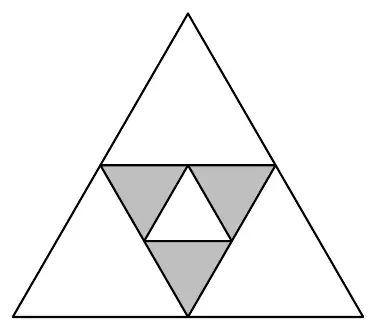
12. The diagram shows an equilateral triangle divided into four smaller equilateral triangles. One of these triangles has itself been divided into four smaller equilateral triangles. What fraction of the area of the large triangle has been shaded?
The large equilateral triangle has been divided into four congruent equilateral triangles. Therefore each of these triangles has an area equal to one quarter of the area of the large triangle. Similarly, the equilateral triangle which is partly shaded has been divided into four congruent equilateral triangles, three of which are shaded. Therefore the fraction of the area of the large triangle which has been shaded is \(\tfrac{3}{4}\times\tfrac{1}{4}=\tfrac{3}{16}\).
Let the required number be \(n\). Then, \(\tfrac{1}{2}\times\tfrac{1}{3}\times\tfrac{1}{4}\times\tfrac{1}{5}\times n=2\). Therefore \(\tfrac{1}{120}\times n=2\). Hence \(n=120\times 2=240\).
The value of \(\dfrac{6}{12}-\dfrac{5}{12}+\dfrac{4}{12}-\dfrac{3}{12}+\dfrac{2}{12}-\dfrac{1}{12}=\dfrac{1}{12}+\dfrac{1}{12}+\dfrac{1}{12}=\dfrac{3}{12}=\dfrac{1}{4}\).
As \(1 = 1^3\) and \(8000 = 20^3\), there are 20 cubes from 1 to 8000. So the fraction of the integers from 1 to 8000 inclusive which are cubes is \(\dfrac{20}{8000} = \dfrac{1}{400}\).
It is a general rule that \(x\)% of \(y\) equals \(y\)% of \(x\). This is because \(x\)% of \(y = \dfrac{x}{100} \times y = \dfrac{xy}{100}\) and \(y\)% of \(x = \dfrac{y}{100} \times x = \dfrac{yx}{100}\).
So 50% of 18.3 plus 18.3% of 50 = 50% of 18.3 plus 50% of 18.3 = 100% of 18.3 = 18.3.
10. Adding four of the five fractions \(\dfrac{1}{2}, \dfrac{1}{3}, \dfrac{1}{6}, \dfrac{1}{9}\) and \(\dfrac{1}{18}\) gives a total of 1. Which of the fractions is not used?
The sum of the five given fractions is \(\dfrac{1}{2} + \dfrac{1}{3} + \dfrac{1}{6} + \dfrac{1}{9} + \dfrac{1}{18} = \dfrac{9 + 6 + 3 + 2 + 1}{18}\) \(= \dfrac{21}{18} = \dfrac{7}{6} = 1\dfrac{1}{6}\). So the fraction which is not used is \(\dfrac{1}{6}\).
8. Gill scored a goal half way through the second quarter of a ‘teachers versus pupils’ netball match. At that point, what fraction of the whole match remained to be played?
When Gill scored the goal, half of the second quarter of the match remained to be played, plus the third and fourth quarters. So the fraction of the match remaining to be played is equal to \(\dfrac{1}{2} \times \dfrac{1}{4} + \dfrac{1}{4} + \dfrac{1}{4} = \dfrac{1}{8} + \dfrac{1}{2} = \dfrac{5}{8}\).
12. Last year, at the school where Gill teaches Mathematics, 315 out of the 600 pupils were girls. This year, the number of pupils in the school has increased to 640. The proportion of girls is the same as it was last year. How many girls are there at the school this year?
Last year, the fraction of girls at the school was \(\tfrac{315}{600} = \tfrac{63}{120} = \tfrac{21}{40}\). This year, there are 40 more pupils at the school, but the proportion of girls has remained the same. So there are 21 more girls at the school this year, making a total of 315 + 21 = 336.
9. In William Shakespeare's play As You Like It, Rosalind speaks to Orlando about “He that will divide a minute into a thousand parts”. Which of the following is equal to the number of seconds in one thousandth of one minute?
The values of the options are: A \(\tfrac{22}{15} = 1\tfrac{7}{15}\); B \(\tfrac{8}{15}\); C \(\tfrac{11}{4} = 2\tfrac{3}{4}\); D \(\tfrac{5}{6}\); E \(\tfrac{15}{8} = 1\tfrac{7}{8}\). In ascending order these are: \(\tfrac{8}{15}\);\(\tfrac{5}{6}\);\(1\tfrac{7}{15}\);\(1\tfrac{7}{8}\);\(2\tfrac{3}{4}\).
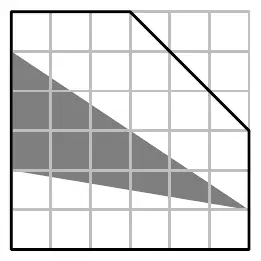
21. The diagram shows a pentagon drawn on a square grid. All vertices of the pentagon and triangle are grid points. What fraction of the area of the pentagon is shaded?
The area of the shaded triangle is \(\tfrac{1}{2} \times 3 \times 6 = 9\). The area of the square grid is 6 × 6 = 36, and the area of the triangle which is not part of the area of the pentagon is \(\tfrac{1}{2} \times 3 \times 3 = \tfrac{9}{2}\). So the area of the pentagon is \(36 - \tfrac{9}{2} = \tfrac{63}{2}\). Hence the required fraction is \(9 \div \tfrac{63}{2} = 9 \times \tfrac{2}{63} = \tfrac{2}{7}\).
19. Three boxes under my stairs contain apples or pears or both. Each box contains the same number of pieces of fruit. The first box contains all twelve of the apples and one-ninth of the pears. How many pieces of fruit are there in each box?
Let \(p\) be the total number of pears. Then \(12 + \dfrac{p}{9} = \dfrac{1}{2}\left(p - \dfrac{p}{9}\right) = \dfrac{4p}{9}\). So \(12 = \tfrac{3p}{9} = \tfrac{p}{3}\). Therefore \(p = 3 \times 12 = 36\). So the number of pieces of fruit in each box is \(\tfrac{12 + 36}{3} = 16\).
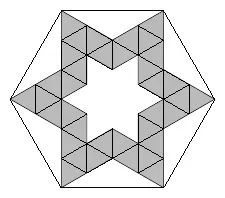
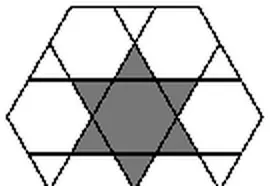
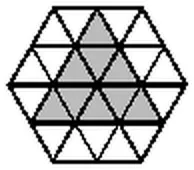
22. The diagram shows a shaded region inside a regular hexagon. The shaded region is divided into equilateral triangles. What fraction of the area of the hexagon is shaded?
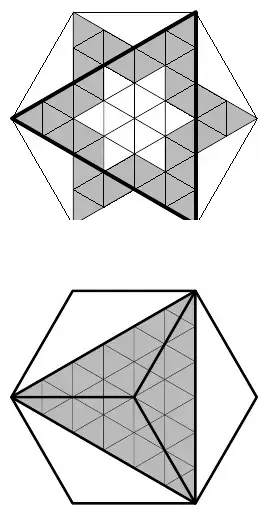
In the diagram, the shaded small equilateral triangles have been divided into those which lie within the highlighted large equilateral triangle and the twelve small equilateral triangles which lie outside the large triangle. Note that the unshaded star shape in the centre of the large triangle is made up of twelve small equilateral triangles, so the small triangles outside the large triangle could be moved into the large triangle so that the large triangle is shaded completely and the rest of the hexagon is unshaded as in the lower diagram. The lower diagram shows that the hexagon may be divided into six congruent triangles, three of which are shaded and three of which are unshaded. So the required fraction is \(\tfrac{1}{2}\).
18. Each of the fractions \(\dfrac{2637}{18\,459}\) and \(\dfrac{5274}{36\,918}\) uses the digits 1 to 9 exactly once. The first fraction simplifies to \(\dfrac{1}{7}\). What is the simplified form of the second fraction?
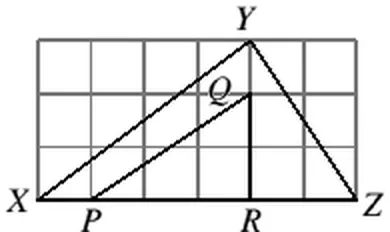
The area of a triangle = \(\tfrac{1}{2}\) × base × height. If we let the length of the sides of each square in the grid be 1, then the area of triangle \(PQR\) is \(\tfrac{1}{2}\) × 3 × 2 = 3. The area of triangle \(XYZ\) is \(\tfrac{1}{2}\) × 6 × 3 = 9. So the required fraction is \(\tfrac{3}{9} = \tfrac{1}{3}\).
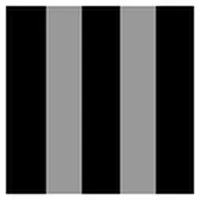
6. The diagram shows a square divided into strips of equal width. Three strips are black and two are grey. What fraction of the perimeter of the square is grey?
Let the width of each strip be 1. Then the square has side 5 and perimeter 20. The grey strips contribute 4 to the perimeter, so the fraction of the perimeter which is grey is \(\tfrac{4}{20} = \tfrac{1}{5}\).
There are 24 hours in one day, so \(\tfrac{1}{12}\) of a day is 2 hours. Therefore the number of minutes in \(\tfrac{1}{12}\) of a day is 2 × 60 = 120.
15. The Grand Old Duke of York had 10 000 men. He lost 10% of them on the way to the top of the hill, and he lost 15% of the rest as he marched them back down the hill. What percentage of the 10 000 men were still there when they reached the bottom of the hill?
When he starts to come down the hill, the Grand Old Duke of York has 90% of his men left. He loses 15% of these, so at the bottom of the hill he has 85% of 90% of the original number left. As \(\dfrac{85}{100} \times 90 = 76\dfrac{1}{2}\), this means that \(76\tfrac{1}{2}\)% of his men were still there when they reached the bottom of the hill.
13. When painting the lounge, I used half of a 3 litre can to complete the first coat of paint. I then used two thirds of what was left to complete the second coat. How much paint was left after both coats were complete?
After the first coat, half of the paint is left. So after the second coat, the volume of paint remaining is one third of half of the capacity of the tin, i.e. one sixth of three litres = 500 ml.
All of the alternatives involve subtracting a number from 1. The largest result, therefore, will correspond to the smallest number to be subtracted, i.e. 0.00001.
24. After playing 500 games, my success rate at Spider Solitaire is 49%. Assuming I win every game from now on, how many extra games do I need to play in order that my success rate increases to 50% ?
After 500 games, I have won 500 × \(\tfrac{49}{100}\) = 245 games. So I have lost 255 games. Therefore I need to win the next 10 games to have a 50% success rate.
22. The diagram shows a design formed by drawing six lines in a regular hexagon. The lines divide each edge of the hexagon into three equal parts. What fraction of the hexagon is shaded?
The original hexagon has been divided into seven regular hexagons and twelve equilateral triangles. Six equilateral triangles are equal in area to one smaller hexagon, so the large hexagon is equal in area to nine of the smaller hexagons. (This may also be deduced from the fact that their sides are in the ratio 3:1.) The shaded area consists of one smaller hexagon and six equilateral triangles, which is equivalent to the area of two of the smaller hexagons. So \(\tfrac{2}{9}\) of the large hexagon is shaded.
15. Talulah plants 60 tulip bulbs. When they flower, she notes that half are yellow; one third of those which are not yellow are red; and one quarter of those which are neither yellow nor red are pink. The remainder are white. What fraction of the tulips are white?
In total, the fraction of tulips which are either yellow or red is \(\tfrac{1}{2} + \tfrac{1}{3} \times \tfrac{1}{2} = \tfrac{2}{3}\). So one third of the tulips are pink or white. Of these, one quarter are pink, so the fraction of tulips which are white is \(\tfrac{3}{4} \times \tfrac{1}{3} = \tfrac{1}{4}\).
17. Last year's match at Wimbledon between John Isner and Nicolas Mahut, which lasted 11 hours and 5 minutes, set a record for the longest match in tennis history. The fifth set of the match lasted 8 hours and 11 minutes. Approximately what fraction of the whole match was taken up by the fifth set?
The lengths in minutes of the fifth set and the whole match are 491 and 665 respectively. So the required fraction is \(\dfrac{491}{665} = \dfrac{491 \times 3}{665 \times 3} \approx \dfrac{1500}{2000} = \dfrac{3}{4}\).
The mean of \(\dfrac{2}{3}\) and \(\dfrac{4}{9}\) is \(\left(\dfrac{2}{3} + \dfrac{4}{9}\right) \div 2 = \left(\dfrac{6}{9} + \dfrac{4}{9}\right) \div 2 = \dfrac{10}{9} \div 2 = \dfrac{5}{9}\). (Note that the mean of two numbers lies midway between those two numbers.)
7. Peter Piper picked a peck of pickled peppers. 1 peck = \(\tfrac{1}{4}\) bushel and 1 bushel = \(\tfrac{1}{9}\) barrel. How many more pecks must Peter Piper pick to fill a barrel?
5. All old Mother Hubbard had in her cupboard was a Giant Bear chocolate bar. She gave each of her children one-twelfth of the chocolate bar. One third of the bar was left. How many children did she have?
One third is equal to four twelfths. Hence the children ate eight twelfths of the bar between them. Each child ate one twelfth of the bar, so old Mother Hubbard had eight children.
16. One of the examination papers for Amy’s Advanced Arithmetic Award was worth 18% of the final total. The maximum possible mark on this paper was 108 marks. How many marks were available overall?
10. At the Marldon Apple-Pie-Fayre bake-off, prize money is awarded for 1st, 2nd and 3rd places in the ratio 3 : 2 : 1. Last year Mrs Keat and Mr Jewell shared third prize equally. What fraction of the total prize money did Mrs Keat receive?
16. The kettle in Keith’s kitchen is 80% full. After 20% of the water in it has been poured out, there are 1152 ml of water left. What volume of water does Keith’s kitchen kettle hold when it is full?
20% of the 80% is 16% of the kettle's capacity. Therefore the volume of water left in the kettle after Keith has poured out 20% of the original amount is 64% of the kettle's capacity. So when full, the kettle holds \(\dfrac{1152}{64}\) × 100 ml, that is 1800 ml.
12. Gill is 21 this year. At the famous visit to the clinic in 1988, her weight was calculated to be 5kg, but she now weighs 50kg. What has been the percentage increase in Gill's weight from 1988 to 2009?
The increase in Gill's weight is 45 kg, which is 9 times her weight in 1988. So the percentage increase in weight is 900%. (The problem refers to Q14 in the very first Schools Mathematical Challenge – the forerunner of the current Junior and Intermediate Mathematical Challenges – in 1988. This was ‘Weighing the baby at the clinic was a problem. The baby would not keep still and caused the scales to wobble. So I held the baby and stood on the scales while the nurse read off 78 kg. Then the nurse held the baby while I read off 69 kg. Finally I held the nurse while the baby read off 137 kg. What is the combined weight of all three (in kg)? A 142 B 147 C 206 D 215 E 284.’)
17. In this Multiplication Magic Square, the product of the three numbers in each row, each column and each of the diagonals is 1. What is the value of \(r + s\)?
14. A solid wooden cube is painted blue on the outside. The cube is then cut into eight smaller cubes of equal size. What fraction of the total surface area of these new cubes is blue?
As the original cube was divided into eight cubes of equal size, these smaller cubes have side equal to half the side of the original cube. So each of the new cubes originally occupied one corner of the large cube and hence has three faces painted blue and three faces unpainted. So the fraction of the total surface area of the new cubes which is blue equals one half.
11. In 1833 a ship arrived in Calcutta with 120 tons remaining of its cargo of ice. One third of the original cargo was lost because it had melted on the voyage. How many tons of ice was the ship carrying when it set sail?
20. At halftime, Boarwarts Academy had scored all of the points so far in their annual match against Range Hill School. In the second half, each side scored three points. At the end of the match, Boarwarts Academy had scored 90% of the points. What fraction of the points in the match was scored in the second half?
Range Hill scored only three points in the match and these were scored in the second half. They represent 10% of the total points scored. As Boarwarts Academy also scored three points in the second half, the proportion of points scored after halftime was 20%, that is \(\dfrac{1}{5}\).
When put in their correct places on the number line, the order of the fractions is: \(-\dfrac{1}{3}\),\(-\dfrac{1}{5}\),\(-\dfrac{1}{7}\),\(\dfrac{1}{6}\),\(\dfrac{1}{4}\).
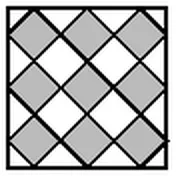
The area of the large square may be considered to consist of thirteen equal squares (nine of which are shaded) plus eight ‘half squares’ and four ‘quarter squares’ (all of which are unshaded). So the total unshaded area is (4 + 8 × \(\tfrac{1}{2}\) + 4 × \(\tfrac{1}{4}\)) squares = 9 squares. Hence half of the large square is shaded.
If \(\tfrac{1}{2}n\) is a three-digit whole number, then \(n\) is an even number between 200 and 1998 inclusive. If \(2n\) is a three-digit whole number, then \(n\) is a whole number between 50 and 499 inclusive. So for both conditions to hold, \(n\) is an even number between 200 and 499 inclusive and there are 150 such numbers.
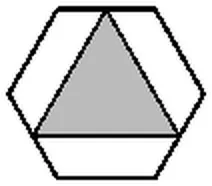
16. The diagram shows an equilateral triangle with its corners at the mid-points of alternate sides of a regular hexagon. What fraction of the area of the hexagon is shaded?
The diagram shows that the regular hexagon may be divided into six congruent equilateral triangles, each of which may be further divided into four smaller congruent equilateral triangles. So the hexagon consists of 24 congruent triangles, 9 of which make up the shaded equilateral triangle.
6957 is less than 7000 and 31248 is greater than 28000, so \(\dfrac{6957}{31248} < \dfrac{1}{4}\). It is left as an exercise for the reader to confirm that in the other four fractions the denominator is four times the numerator. (Note that each of these fractions uses all the digits from 1 to 9 inclusive exactly once. The question includes the only four fractions of this type which simplify to \(\tfrac{1}{4}\).)
The fractions could be placed in order by writing them all with a common denominator of 630, or by writing them as decimal fractions. However, as they are all close in value to \(\tfrac{1}{2}\), we may consider the value of each fraction minus \(\tfrac{1}{2}\). These are, respectively, 0, \(+\tfrac{1}{6}\),\(+\tfrac{1}{10}\), \(+\tfrac{1}{14}\) and \(+\tfrac{1}{18}\). So, when they are placed in increasing order of size, the fractions are \(\tfrac{1}{2}\),\(\tfrac{5}{9}\),\(\tfrac{4}{7}\), \(\tfrac{3}{5}\) and \(\tfrac{2}{3}\).
15. Granny spends one third of her weekly pension on Thursday night, and one quarter of what remains on Friday. What fraction of the original amount is left for her big night out on Saturday?
After Thursday, two thirds of Granny's pension is left. So after she has spent one quarter of this amount on Friday, the fraction of the original amount which remains is three quarters of two thirds, i.e. one half.
7. In music, a demisemiquaver is half of half of half a crotchet, and there are four crotchets in a semibreve. How many demisemiquavers are there in a semibreve?
The differences between the given fractions and 1 are, respectively, \(\tfrac{11}{23}\),\(\tfrac{11}{34}\),\(\tfrac{11}{45}\), \(\tfrac{11}{56}\) and \(\tfrac{11}{67}\). The smallest of these is \(\tfrac{11}{67}\), so \(\tfrac{56}{67}\) is nearest to 1.
3. A bridge is built across a river. One quarter of the bridge is over the left bank of the river and one third of the bridge is over the right bank. The river is 120 m wide. How long is the bridge?
The river is 120 m wide and represents \((1 - \frac{1}{4} - \frac{1}{3}) = \frac{5}{12}\) of the length of the bridge. Therefore \(\frac{1}{12}\) of the length of the bridge is 24 m. Hence the total length of the bridge is 12 × 24 m = 288 m.
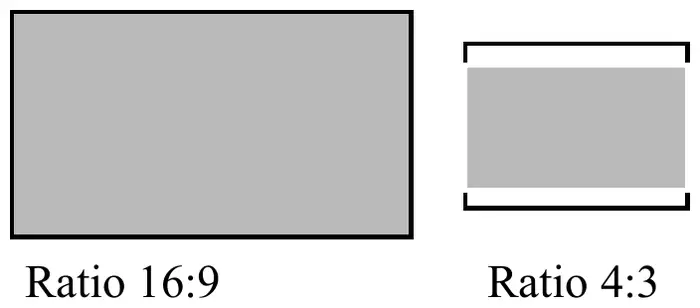
19. My TV screen has sides in the ratio 16 : 9. My mother's TV screen has sides in the ratio 4 : 3. A picture which exactly fills the screen of my TV only fills the width of the screen of my mother's TV. What fraction of the screen on my mother's TV is not covered?
16. Ali is arranging the books on his bookshelves. He puts half his books on the bottom shelf and two-thirds of what remains on the second shelf. Finally he splits the rest of his books over the other two shelves so that the third shelf contains four more books than the top shelf. There are three books on the top shelf. How many books are on the bottom shelf?
Since Ali places half his books on the bottom shelf and \(\frac{2}{3}\) of the remainder on the second shelf, he places \(\frac{2}{3} \times \frac{1}{2} = \frac{1}{3}\) of his books on the second shelf, leaving \((1 - \frac{1}{2} - \frac{1}{3}) = \frac{1}{6}\) of his books for the top two shelves. There are three books on the top shelf and four more, so seven books, on the third shelf. Therefore these 10 books represent \(\frac{1}{6}\) of the total number of books on the bookshelves. Hence there are 60 books on the bookshelves and half of these, or 30 books, on the bottom shelf.
3. Each of the designs shown is initially divided into squares. For how many of the designs is the total area of the shaded region equal to three-fifths of the area of the whole design?
The fractions of the shapes which are shaded are \(\dfrac{3}{8}\),\(\dfrac{12}{20}\),\(\dfrac{2}{3}\), \(\dfrac{15}{25}\) and \(\dfrac{4}{8}\) respectively. Of these, only \(\dfrac{12}{20}\) and \(\dfrac{15}{25}\) are equivalent to \(\dfrac{3}{5}\). Therefore two designs (B and D) have three-fifths of the shape shaded.
24. Jacob and Zain take pencils from a box of 21 pencils without replacing them. On Monday Jacob takes \(\frac{2}{3}\) of the number of pencils that Zain takes. On Tuesday Jacob takes \(\frac{1}{2}\) of the number of pencils that Zain takes. On Wednesday morning the box is empty. How many pencils does Jacob take?
Let the number of pencils Zain takes on Monday and Tuesday be \(x\) and \(y\) respectively. Therefore \(x + \frac{2}{3}x + y + \frac{1}{2}y = 21\). Hence, when we multiply the equation through by 6 to eliminate the fractions and simplify, we obtain \(10x + 9y = 126\). Since \(x\) and \(y\) are both positive integers and since the units digit of \(10x\) is 0, the units digit of \(9y\) is 6 and hence \(y = 4\). Therefore \(x = 9\) and hence the number of pencils Zain takes is 9 + 4 = 13. Therefore the number of pencils Jacob takes is 21 − 13 = 8.
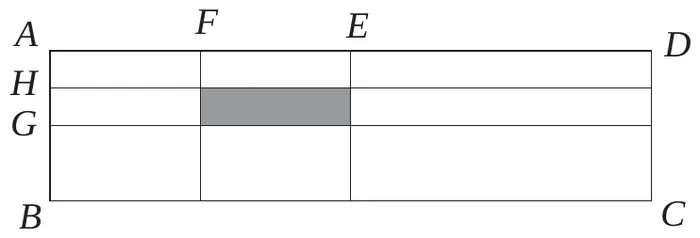
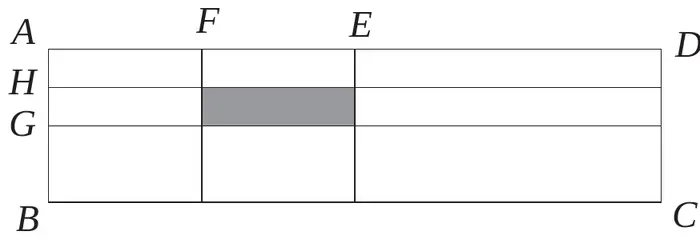
12. The diagram shows a rectangle \(ABCD\) in which \(AB = 1\) metre and \(AD = 4\) metres. The points \(E\) and \(G\) are the midpoints of \(AD\) and \(AB\) and the points \(F\) and \(H\) are the midpoints of \(AE\) and \(AG\).
Since \(E\) is the midpoint of \(AD\) and \(F\) is the midpoint of \(AE\), the length of \(FE\) is \(\frac{1}{2} \times \frac{1}{2} \times 4\) cm = 1 cm. Similarly, since \(G\) is the midpoint of \(AB\) and \(H\) is the midpoint of \(AG\), the length of \(HG\) is \(\frac{1}{2} \times \frac{1}{2} \times 1\) cm = \(\frac{1}{4}\) cm. Therefore the area of the shaded rectangle is \((1 \times \frac{1}{4})\) cm2 = \(\frac{1}{4}\) cm2.
One day contains 24 hours. Hence \(\frac{1}{8}\) of a day is three hours and \(\frac{1}{6}\) of this is half an hour. Half an hour contains \((\frac{1}{2} \times 60 \times 60)\) seconds = 1800 seconds and \(\frac{1}{4}\) of this is 450 seconds. Hence there are 450 seconds in the required fraction of a day.
First note that \(\frac{1}{6} = \frac{5}{30}\) and \(\frac{1}{3} = \frac{10}{30}\). Any fraction of the form \(\frac{k}{30}\) between (and including) these two values, where \(k\) is an even number, will simplify to have a denominator of 15. Therefore, \(k = 6\), 8 or 10 and so there are three fractions.
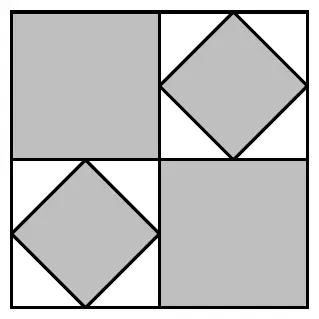
A2. A large square is split into four congruent squares, two of which are shaded. The other two squares have smaller shaded squares drawn in them whose vertices are the midpoints of the sides of the unshaded squares. What fraction of the large square is shaded?
The two larger grey squares make up \(\frac{1}{2}\) of the large square. Each white square is \(\frac{1}{4}\) of the large square and \(\frac{1}{2}\) of each of these squares is shaded. Therefore, the two smaller grey squares account for \(2 \times \frac{1}{2} \times \frac{1}{4} = \frac{1}{4}\) of the large square. Therefore, \(\frac{1}{2} + \frac{1}{4} = \frac{3}{4}\) of the large square is shaded.
The required percentage is \(\dfrac{9}{9.5} \times 100 = \dfrac{18}{19} \times 100 = \dfrac{1800}{19} \approx 94.7\) by long division. This is 95% to the nearest 1%.
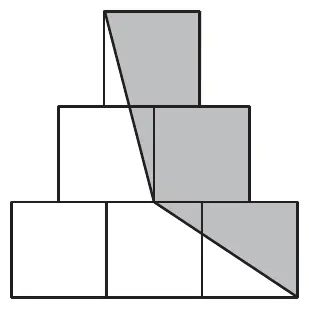
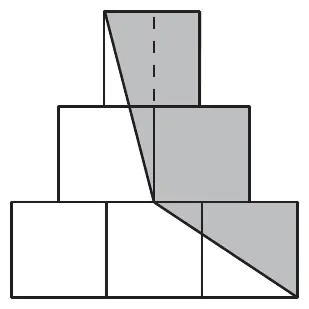
There are several ways to solve this problem. This solution is just one example. Without loss of generality, let each square have a side length of 2 units. Hence the six identical squares have a total area of \(6 \times 2^2 = 24\) square units. The grey shaded area can be thought of as consisting of two triangles, one rectangle and one square, as shown on the diagram. Therefore the grey shaded area is
Howard has completed \(\frac{1}{2}\) of the run. He is now \(\frac{3}{5}\) of the way through the second half. Hence he has completed \(\frac{1}{2} + \frac{3}{5} \times \frac{1}{2} = \frac{1}{2} + \frac{3}{10} = \frac{4}{5}\) of the whole run.
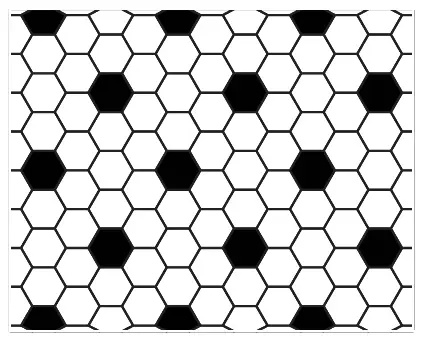
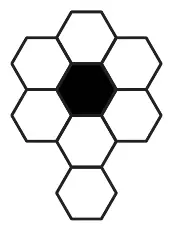
A9. The figure shows part of a tiling, which extends indefinitely in every direction across the whole plane. Each tile is a regular hexagon. Some of the tiles are white, the others are black.
3. Four friends rent a cottage for a total of £300 for the weekend. The first friend pays half of the sum of the amounts paid by the other three friends. The second friend pays one third of the sum of the amounts paid by the other three friends. The third friend pays one quarter of the sum of the amounts paid by the other three friends.
Let \(f_a\) represent the amount of money the \(a^{\text{th}}\) friend pays, in pounds. Therefore the sum of the amounts paid by the other three friends is \(300 - f_a\) pounds.
The first friend pays half of the amount paid by the other three friends so \(f_1 = \frac{1}{2}(300 - f_1)\). Multiplying both sides by 2 gives \(2f_1 = 300 - f_1\). Adding \(f_1\) to both sides gives \(3f_1 = 300\) and so \(f_1 = 100\).
Similarly, the second friend pays one third of the amount paid by the other three friends so \(f_2 = \frac{1}{3}(300 - f_2)\). Multiplying both sides by 3 gives \(3f_2 = 300 - f_2\). Adding \(f_2\) to both sides gives \(4f_2 = 300\) and so \(f_2 = 75\).
Finally, the third friend pays a quarter of the amount paid by the other three friends so \(f_3 = \frac{1}{4}(300 - f_3)\). Multiplying both sides by 4 gives \(4f_3 = 300 - f_3\). Adding \(f_3\) to both sides gives \(5f_3 = 300\) and so \(f_3 = 60\).
This means that the fourth friend must pay \(300 - 100 - 75 - 60\) pounds.
We'd like to use Google Analytics cookies to count visits and see which pages help most. They're optional, and the site works exactly the same either way. Privacy policy