Counting, Probability & Logic

Your progress
0 of 142 done
Ticks are kept only in this browser: clearing your browsing data or changing device loses them. · ·

Junior Mathematical Challenge (JMC)

Junior Kangaroo (JK)

Junior Mathematical Olympiad (JMO)

Cayley Olympiad (CAY)

JMC 2020 Q24

JMCCurrent spec6 marksCounting, Probability & Logic

24. Susan is attending a talk at her son’s school. There are 8 rows of 10 chairs where 54 parents are sitting. Susan notices that every parent is either sitting on their own or next to just one other person.
What is the largest possible number of adjacent empty chairs in a single row at that talk?

  1. A 3
  2. B 4
  3. C 5
  4. D 7
  5. E 8

Junior Mathematical Challenge 2020, Question 24. © UK Mathematics Trust. Original paper on ukmt.org.uk

JMC 2020 Q15

JMCCurrent spec5 marksCounting, Probability & Logic

15. A group of 42 children all play tennis or football, or both sports. The same number play tennis as play just football. Twice as many play both tennis and football as play just tennis.
How many of the children play football?

  1. A 7
  2. B 14
  3. C 21
  4. D 28
  5. E 35

Junior Mathematical Challenge 2020, Question 15. © UK Mathematics Trust. Original paper on ukmt.org.uk

JMC 2020 Q8

JMCCurrent spec5 marksCounting, Probability & Logic

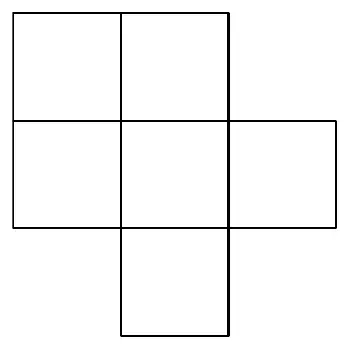
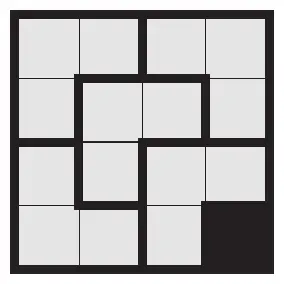
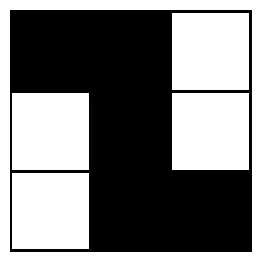
8. Wesley has a grid of six cells. He wants to colour two of the cells black so that the two black cells share a vertex but not a side. In how many ways can he achieve this?

  1. A 2
  2. B 3
  3. C 4
  4. D 5
  5. E 6
A grid of six square cells

Junior Mathematical Challenge 2020, Question 8. © UK Mathematics Trust. Original paper on ukmt.org.uk

JMC 2019 Q25

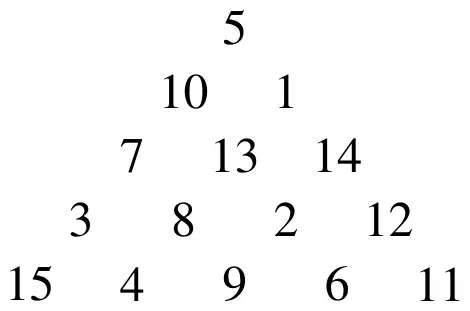
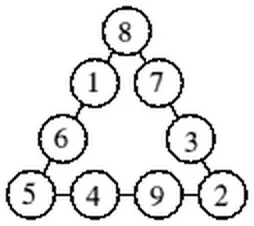
25. The diagram shows the first fifteen positive integers arranged in a ‘triangle’.
These numbers are to be rearranged so that the five integers along each ‘edge’ of the triangle have the same sum, unlike the example shown.
When this is done, what is the greatest possible such sum?

  1. A 38
  2. B 42
  3. C 48
  4. D 52
  5. E 54
The numbers 1 to 15 arranged in a triangle with five numbers along each edge

Junior Mathematical Challenge 2019, Question 25. © UK Mathematics Trust. Original paper on ukmt.org.uk

JMC 2019 Q19

JMCCurrent spec6 marksCounting, Probability & Logic

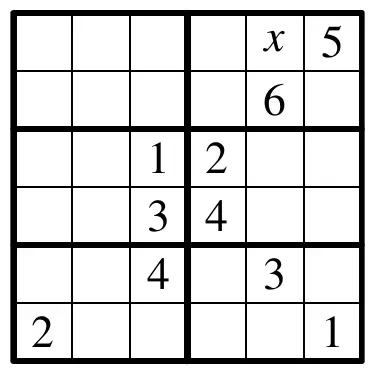
19. Each row, each column and each of the bold 2 by 3 rectangles in the grid has to contain each of the numbers 1, 2, 3, 4, 5 and 6 (one number in each cell).

What number should go in the cell marked \(x\)?

  1. A 1
  2. B 2
  3. C 3
  4. D 4
  5. E 6
A 6 by 6 grid split into bold 2 by 3 rectangles, with some numbers filled in and one cell marked x

Junior Mathematical Challenge 2019, Question 19. © UK Mathematics Trust. Original paper on ukmt.org.uk

JMC 2019 Q15

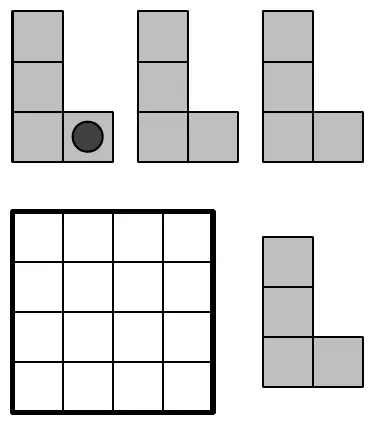
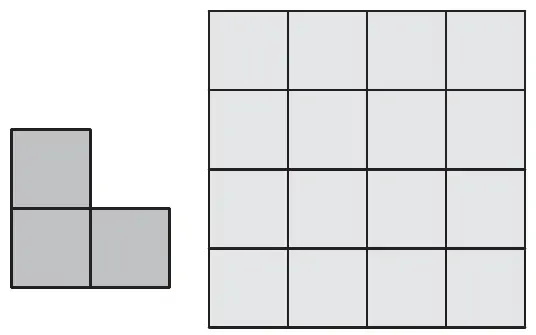
15. All four L-shapes shown in the diagram are to be placed in the 4 by 4 grid so that all sixteen cells are covered and there is no overlap. Each piece can be rotated or reflected before being placed and the black dot is visible from both sides.

How many of the 16 cells of the grid could contain the black dot?

  1. A 4
  2. B 7
  3. C 8
  4. D 12
  5. E 16
Four L-shaped pieces made of four cells, one with a black dot, and an empty 4 by 4 grid

Junior Mathematical Challenge 2019, Question 15. © UK Mathematics Trust. Original paper on ukmt.org.uk

JMC 2019 Q14

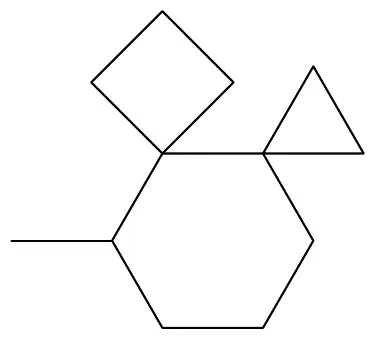
14. Each edge in the diagram has length 1 cm.

What is the length of the longest path that can be followed along the edges, starting at a vertex and without revisiting any vertex?

  1. A 7 cm
  2. B 8 cm
  3. C 9 cm
  4. D 10 cm
  5. E 11 cm
A regular hexagon with a square on one upper edge, a triangle on another, and a line sticking out from the left vertex

Junior Mathematical Challenge 2019, Question 14. © UK Mathematics Trust. Original paper on ukmt.org.uk

JMC 2019 Q13

JMCCurrent spec5 marksCounting, Probability & Logic

13. In how many different ways can you spell out JMC, starting at the centre, and moving to the next letter in a neighbouring square – horizontally, vertically, or diagonally – each time?

  1. A 8
  2. B 16
  3. C 24
  4. D 25
  5. E 32
CCCCC
CMMMC
CMJMC
CMMMC
CCCCC

Junior Mathematical Challenge 2019, Question 13. © UK Mathematics Trust. Original paper on ukmt.org.uk

JMC 2019 Q11

JMCCurrent spec5 marksCounting, Probability & Logic

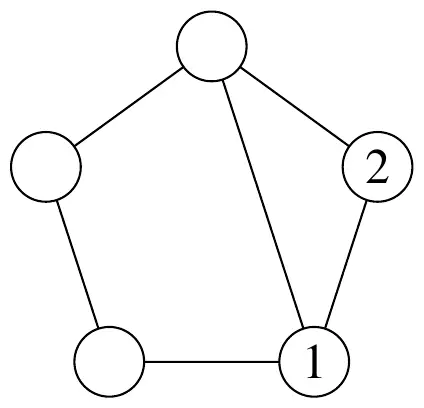
11. Two players \(X\) and \(Y\) take alternate turns in a game, starting with the diagram alongside.

At each turn, one player writes one of 1, 2 or 3 in an empty circle, so that no two circles connected by an edge contain the same number. A player loses when they cannot go. In each of the five diagrams below it is \(Y\)’s turn.

In which of the diagrams can \(Y\)’s move ensure that \(X\) loses the game?

Five versions of the diagram, labelled A to E, with different circles already numbered
Five circles joined by edges like a pentagon with one diagonal; two circles contain 2 and 1

Junior Mathematical Challenge 2019, Question 11. © UK Mathematics Trust. Original paper on ukmt.org.uk

JMC 2018 Q21

JMCCurrent spec6 marksCounting, Probability & Logic
21.
There are ——— vowels in this short sentence.

Which of the following options should replace "———" to make the sentence in the box true?

  1. A twelve
  2. B thirteen
  3. C fourteen
  4. D fifteen
  5. E sixteen

Junior Mathematical Challenge 2018, Question 21. © UK Mathematics Trust. Original paper on ukmt.org.uk

JMC 2018 Q20

JMCCurrent spec6 marksCounting, Probability & Logic

20. A drawer contains ten identical yellow socks, eight identical blue socks and four identical pink socks.
Amrita picks socks from the drawer without looking.
What is the smallest number of socks she must pick to be sure that she has at least two pairs of matching socks?

  1. A 5
  2. B 6
  3. C 8
  4. D 11
  5. E 13

Junior Mathematical Challenge 2018, Question 20. © UK Mathematics Trust. Original paper on ukmt.org.uk

JMC 2018 Q15

15. Beatrix places copies of the L-shape shown on a 4 × 4 board so that each L-shape covers exactly three cells of the board. She is allowed to turn around or turn over an L-shape.
What is the largest number of L-shapes she can place on the board without overlaps?

  1. A 2
  2. B 3
  3. C 4
  4. D 5
  5. E 6
An L-shape made of three squares and an empty 4 by 4 board

Junior Mathematical Challenge 2018, Question 15. © UK Mathematics Trust. Original paper on ukmt.org.uk

JMC 2017 Q24

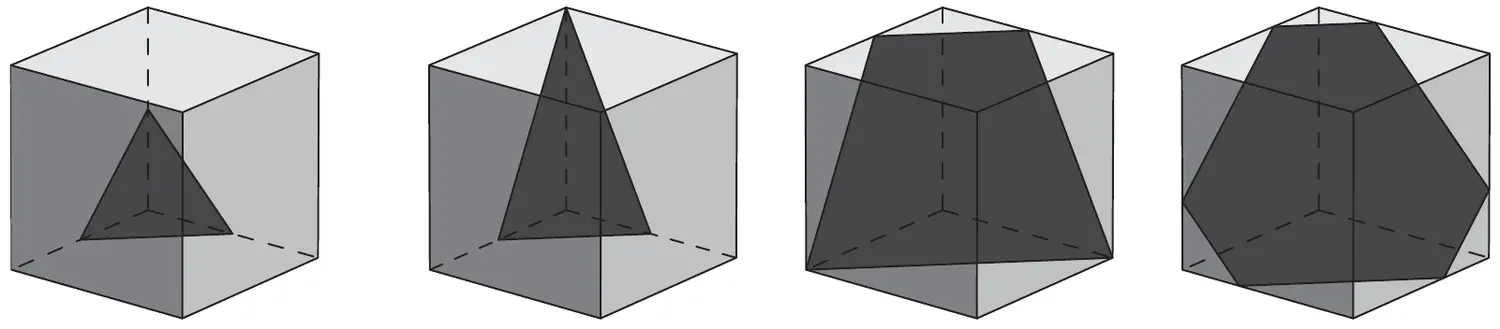
24. A large solid cube is cut into two pieces by a single plane cut. How many of the following four shapes could be the shape of the cross-section formed by the cut?

Four grey shapes: an equilateral triangle, a tall isosceles triangle, a trapezium and a hexagon
  1. A 0
  2. B 1
  3. C 2
  4. D 3
  5. E 4

Junior Mathematical Challenge 2017, Question 24. © UK Mathematics Trust. Original paper on ukmt.org.uk

JMC 2017 Q23

23. The positive integers from 1 to 150 inclusive are placed in a 10 by 15 grid so that each cell contains exactly one integer. Then the multiples of 3 are given a red mark, the multiples of 5 are given a blue mark, and the multiples of 7 are given a green mark.
How many cells have more than 1 mark?

  1. A 10
  2. B 12
  3. C 15
  4. D 18
  5. E 19

Junior Mathematical Challenge 2017, Question 23. © UK Mathematics Trust. Original paper on ukmt.org.uk

JMC 2017 Q16

16. In New Threeland there are three types of coins: the 2p; the 5p; and one other. The smallest number of coins needed to make 13p is three. The smallest number of coins needed to make 19p is three. What is the value of the third type of coin?

  1. A 4p
  2. B 6p
  3. C 7p
  4. D 9p
  5. E 12p

Junior Mathematical Challenge 2017, Question 16. © UK Mathematics Trust. Original paper on ukmt.org.uk

JMC 2017 Q14

14. Mathias is given a grid of twelve small squares. He is asked to shade grey exactly four of the small squares so that his grid has two lines of reflection symmetry.
How many different grids could he produce?

  1. A 2
  2. B 3
  3. C 4
  4. D 5
  5. E 6

Junior Mathematical Challenge 2017, Question 14. © UK Mathematics Trust. Original paper on ukmt.org.uk

JMC 2017 Q13

13. Consider the following three statements.
  (i) Doubling a positive number always makes it larger.
  (ii) Squaring a positive number always makes it larger.
 (iii) Taking the positive square root of a positive number always makes it smaller.
Which statements are true?

  1. A All three
  2. B None
  3. C Only (i)
  4. D (i) and (ii)
  5. E (ii) and (iii)

Junior Mathematical Challenge 2017, Question 13. © UK Mathematics Trust. Original paper on ukmt.org.uk

JMC 2017 Q6

6. In a magic square, the numbers in each row, each column and the two main diagonals have the same total. This magic square uses the integers 2 to 10. Which of the following are the missing cells?

Five options A to E, each showing three diagonal cells: A 6, 9, 3; B 6, 3, 9; C 3, 9, 6; D 3, 6, 9; E 9, 6, 3
105
84
72

Junior Mathematical Challenge 2017, Question 6. © UK Mathematics Trust. Original paper on ukmt.org.uk

JMC 2016 Q25

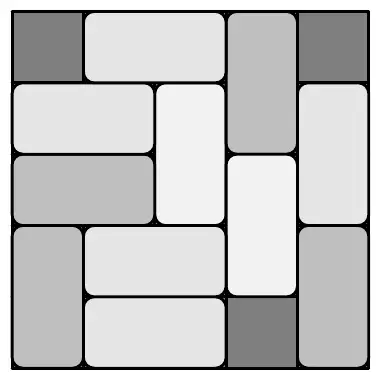
25. Beatrix places dominoes on a 5 × 5 board, either horizontally or vertically, so that each domino covers two small squares. She stops when she cannot place another domino, as in the example shown in the diagram.
When Beatrix stops, what is the largest possible number of squares that may still be uncovered?

  1. A 4
  2. B 5
  3. C 6
  4. D 7
  5. E 8
A 5 by 5 board with dominoes placed on it so that no more can be added, leaving some squares uncovered

Junior Mathematical Challenge 2016, Question 25. © UK Mathematics Trust. Original paper on ukmt.org.uk

JMC 2016 Q24

JMCCurrent spec6 marksCounting, Probability & Logic

24. Part of a wall is to be decorated with a row of four square tiles. Three different colours of tiles are available and there are at least two tiles of each colour available. Tiles of all three colours must be used.
In how many ways can the row of four tiles be chosen?

  1. A 12
  2. B 18
  3. C 24
  4. D 36
  5. E 48

Junior Mathematical Challenge 2016, Question 24. © UK Mathematics Trust. Original paper on ukmt.org.uk

JMC 2016 Q16

16. Each of the nine small squares in this grid can be coloured completely black or completely white.
What is the largest number of squares that can be coloured black so that the design created has rotational symmetry of order 2, but no lines of symmetry?

  1. A 4
  2. B 5
  3. C 6
  4. D 7
  5. E 8

Junior Mathematical Challenge 2016, Question 16. © UK Mathematics Trust. Original paper on ukmt.org.uk

JMC 2016 Q13

JMCCurrent spec5 marksCounting, Probability & Logic

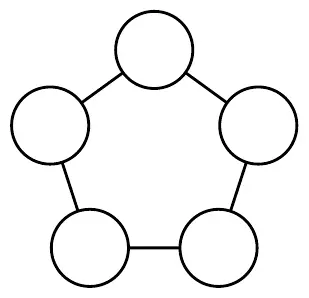
13. The diagram shows five circles placed at the corners of a pentagon.
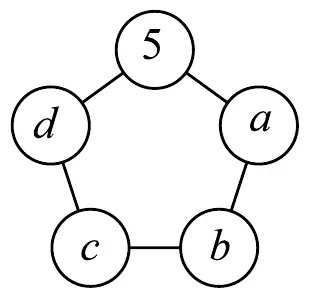
The numbers 1, 2, 3, 4, 5 are placed in the circles shown, one in each, so that the numbers in adjacent circles always differ by more than 1.
What is the sum of the numbers in the two circles adjacent to the circle which contains the number 5?

  1. A 3
  2. B 4
  3. C 5
  4. D 6
  5. E 7
Five empty circles at the corners of a pentagon, joined by its edges

Junior Mathematical Challenge 2016, Question 13. © UK Mathematics Trust. Original paper on ukmt.org.uk

JMC 2016 Q9

9. One of the three symbols +, −, × is inserted somewhere between the digits of 2016 to give a new number. For example, 20 − 16 gives 4.
How many of the following four numbers can be obtained in this way?

36  195  207  320
  1. A 0
  2. B 1
  3. C 2
  4. D 3
  5. E 4

Junior Mathematical Challenge 2016, Question 9. © UK Mathematics Trust. Original paper on ukmt.org.uk

JMC 2015 Q17

JMCCurrent spec6 marksCounting, Probability & Logic
17.
Knave of Hearts: “I stole the tarts.”
Knave of Clubs: “The Knave of Hearts is lying.”
Knave of Diamonds: “The Knave of Clubs is lying.”
Knave of Spades: “The Knave of Diamonds is lying.”

How many of the four Knaves were telling the truth?

  1. A 1
  2. B 2
  3. C 3
  4. D 4
  5. E more information needed

Junior Mathematical Challenge 2015, Question 17. © UK Mathematics Trust. Original paper on ukmt.org.uk

JMC 2015 Q14

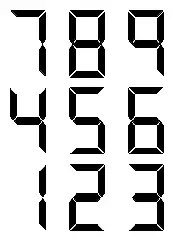
14. Digits on a calculator are represented by a number of horizontal and vertical illuminated bars. The digits and the bars which represent them are shown in the diagram.
How many digits are both prime and represented by a prime number of illuminated bars?

  1. A 0
  2. B 1
  3. C 2
  4. D 3
  5. E 4
The calculator digits 7, 8, 9, 4, 5, 6, 1, 2 and 3 made of illuminated bars

Junior Mathematical Challenge 2015, Question 14. © UK Mathematics Trust. Original paper on ukmt.org.uk

JMC 2015 Q13

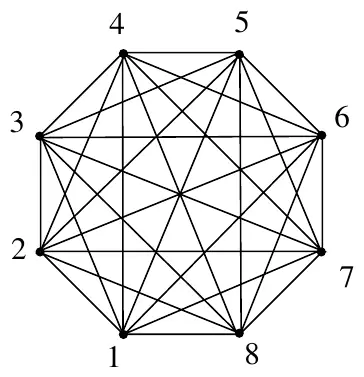
13. In the figure shown, each line joining two numbers is to be labelled with the sum of the two numbers that are at its end points.

How many of these labels are multiples of 3?

  1. A 10
  2. B 9
  3. C 8
  4. D 7
  5. E 6
The numbers 1 to 8 at the vertices of an octagon, with every pair of numbers joined by a line

Junior Mathematical Challenge 2015, Question 13. © UK Mathematics Trust. Original paper on ukmt.org.uk

JMC 2014 Q25

JMCCurrent spec6 marksCounting, Probability & Logic

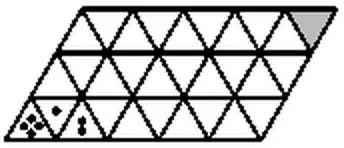
25. A die has the shape of a regular tetrahedron, with the four faces having 1, 2, 3 and 4 pips. The die is placed with 4 pips ‘face down’ in one corner of the triangular grid shown, so that the face with 4 pips precisely covers the triangle marked with 4 pips. The die is now ‘rolled’, by rotating about an edge without slipping, so that 1 pip is face down. It is rolled again, so that 2 pips are face down, as indicated. The rolling continues until the die rests on the shaded triangle in the opposite corner of the grid. How many pips are now face down?

  1. A 1
  2. B 2
  3. C 3
  4. D 4
  5. E it depends on the route taken
A parallelogram-shaped grid of small equilateral triangles; the bottom left triangle shows 4 pips, the next shows 1 pip and the next 2 pips, and the triangle in the opposite top right corner is shaded

Junior Mathematical Challenge 2014, Question 25. © UK Mathematics Trust. Original paper on ukmt.org.uk

JMC 2014 Q23

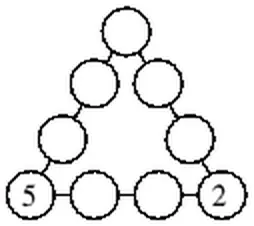
23. Sam wants to complete the diagram so that each of the nine circles contains one of the digits from 1 to 9 inclusive and each contains a different digit. Also, the digits in each of the three lines of four circles must have the same total. What is this total?

  1. A 17
  2. B 18
  3. C 19
  4. D 20
  5. E 21
Nine circles arranged in a triangle with four circles on each side; the bottom left corner contains 5 and the bottom right corner contains 2

Junior Mathematical Challenge 2014, Question 23. © UK Mathematics Trust. Original paper on ukmt.org.uk

JMC 2014 Q21

JMCCurrent spec6 marksCounting, Probability & Logic

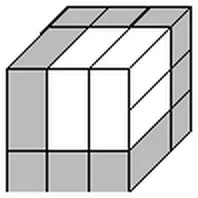
21. Pablo's teacher has given him 27 identical white cubes. She asks him to paint some of the faces of these cubes grey and then stack the cubes so that they appear as shown. What is the largest possible number of the individual white cubes which Pablo can leave with no faces painted grey?

  1. A 8
  2. B 12
  3. C 14
  4. D 15
  5. E 16
A 3 by 3 by 3 stack of cubes; some visible faces are grey and the rest white

Junior Mathematical Challenge 2014, Question 21. © UK Mathematics Trust. Original paper on ukmt.org.uk

JMC 2014 Q17

JMCCurrent spec6 marksCounting, Probability & Logic

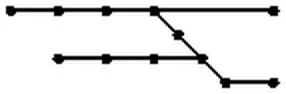
17. The diagram is a ‘map’ of Jo's local rail network, where the dots represent stations and the lines are routes. Jo wants to visit all the stations, travelling only by train, starting at any station and ending at any station, with no restrictions on which routes are taken.

What is the smallest number of stations that Jo must go to more than once?

  1. A 1
  2. B 2
  3. C 3
  4. D 4
  5. E 5
A rail map: a top line of five stations, a lower line of four stations, and a diagonal link from the top line through a station to the lower line, which continues to two more stations

Junior Mathematical Challenge 2014, Question 17. © UK Mathematics Trust. Original paper on ukmt.org.uk

JMC 2014 Q16

JMCCurrent spec6 marksCounting, Probability & Logic

16. Only one of the following statements is true. Which one?

  1. A ‘B is true’
  2. B ‘E is false’
  3. C ‘Statements A to E are true’
  4. D ‘Statements A to E are false’
  5. E ‘A is false’

Junior Mathematical Challenge 2014, Question 16. © UK Mathematics Trust. Original paper on ukmt.org.uk

JMC 2014 Q3

JMCCurrent spec5 marksCounting, Probability & Logic

3. In my row in the theatre the seats are numbered consecutively from T1 to T50. I am sitting in seat T17 and you are sitting in seat T39. How many seats are there between us?

  1. A 23
  2. B 22
  3. C 21
  4. D 20
  5. E 19

Junior Mathematical Challenge 2014, Question 3. © UK Mathematics Trust. Original paper on ukmt.org.uk

JMC 2013 Q25

JMCCurrent spec6 marksCounting, Probability & Logic

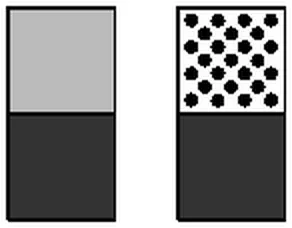
25. For Beatrix's latest art installation, she has fixed a 2 × 2 square sheet of steel to a wall. She has two 1 × 2 magnetic tiles, both of which she attaches to the steel sheet, in any orientation, so that none of the sheet is visible and the line separating the two tiles cannot be seen. As shown alongside, one tile has one black cell and one grey cell; the other tile has one black cell and one spotted cell.
How many different looking 2 × 2 installations can Beatrix obtain?

  1. A 4
  2. B 8
  3. C 12
  4. D 14
  5. E 24
Two 1 by 2 tiles standing upright: the first has a grey cell above a black cell; the second has a spotted cell above a black cell

Junior Mathematical Challenge 2013, Question 25. © UK Mathematics Trust. Original paper on ukmt.org.uk

JMC 2013 Q21

JMCCurrent spec6 marksCounting, Probability & Logic

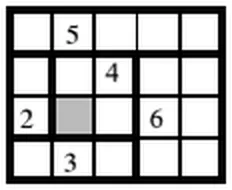
21. The 5 × 4 grid is divided into blocks. Each block is a square or a rectangle and contains the number of cells indicated by the integer within it.
Which integer will be in the same block as the shaded cell?

  1. A 2
  2. B 3
  3. C 4
  4. D 5
  5. E 6
5
4
26
3

Junior Mathematical Challenge 2013, Question 21. © UK Mathematics Trust. Original paper on ukmt.org.uk

JMC 2013 Q20

JMCCurrent spec6 marksCounting, Probability & Logic

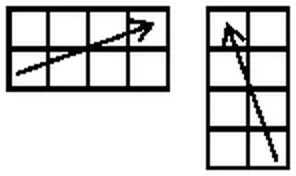
20. A ‘long knight’ moves on a square grid. A single move, as shown, consists of moving three squares in one direction (horizontally or vertically) and then one square at right angles to the first direction. What is the smallest number of moves a long knight requires to go from one corner of an 8 × 8 square board to the diagonally opposite corner?

  1. A 4
  2. B 5
  3. C 6
  4. D 7
  5. E 8
Two examples of a long knight move on a grid: three squares across then one up, and three squares up then one across

Junior Mathematical Challenge 2013, Question 20. © UK Mathematics Trust. Original paper on ukmt.org.uk

JMC 2013 Q14

14. Each side of an isosceles triangle is a whole number of centimetres. Its perimeter has length 20 cm. How many possibilities are there for the lengths of its sides?

  1. A 3
  2. B 4
  3. C 5
  4. D 6
  5. E 7

Junior Mathematical Challenge 2013, Question 14. © UK Mathematics Trust. Original paper on ukmt.org.uk

JMC 2013 Q12

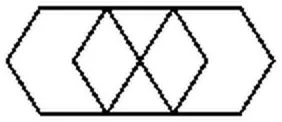
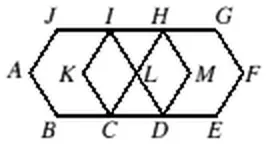
12. How many hexagons are there in the diagram?

  1. A 4
  2. B 6
  3. C 8
  4. D 10
  5. E 12
A long hexagon containing two overlapping diamonds

Junior Mathematical Challenge 2013, Question 12. © UK Mathematics Trust. Original paper on ukmt.org.uk

JMC 2012 Q21

JMCCurrent spec6 marksCounting, Probability & Logic
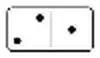
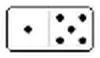
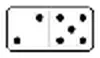
Six dominoes: 1 and 2, 1 and 5, 2 and 5, 4 and 5, 4 and 6, 5 and 6

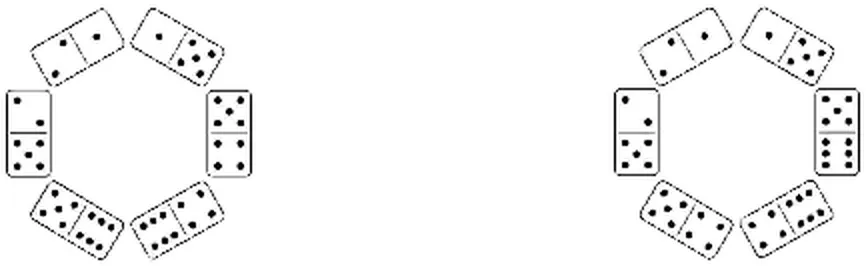
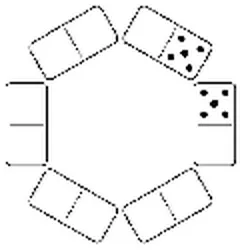
21. Dominic wants to place the six dominoes above in a hexagonal ring so that, for every pair of adjacent dominoes, the numbers of pips match. The ring on the right indicates how one adjacent pair match.
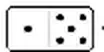
In a completed ring, how many of the other five dominoes can he definitely not place adjacent to domino 1 and 5 ?
  1. A 1
  2. B 2
  3. C 3
  4. D 4
  5. E 5
A hexagonal ring of six domino outlines, with two adjacent dominoes showing matching pips

Junior Mathematical Challenge 2012, Question 21. © UK Mathematics Trust. Original paper on ukmt.org.uk

JMC 2012 Q16

JMCCurrent spec6 marksCounting, Probability & Logic

16. Beth, Carolyn and George love reading their favourite bedtime story together. They take it in turns to read a page, always in the order Beth, then Carolyn, then George. All twenty pages of the story are read on each occasion. One evening, Beth is staying at Grandma’s house but Carolyn and George still read the same bedtime story and take it in turns to read a page with Carolyn reading the first page.
In total, how many pages are read by the person who usually reads that page?

  1. A 1
  2. B 2
  3. C 4
  4. D 6
  5. E 7

Junior Mathematical Challenge 2012, Question 16. © UK Mathematics Trust. Original paper on ukmt.org.uk

JMC 2012 Q14

JMCCurrent spec5 marksCounting, Probability & Logic

14. A pattern that repeats every six symbols starts as shown below:

♥   ♣   ♥   ♦   ♥   ♠   ♥   ♣   ♥   ♦   ♥   ♠   …

Which are the 100th and 101st symbols, in that order, in the pattern?

  1. A ♦♥
  2. B ♥♦
  3. C ♥♣
  4. D ♠♥
  5. E ♣♥

Junior Mathematical Challenge 2012, Question 14. © UK Mathematics Trust. Original paper on ukmt.org.uk

JMC 2012 Q9

JMCCurrent spec5 marksCounting, Probability & Logic

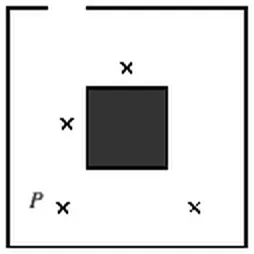
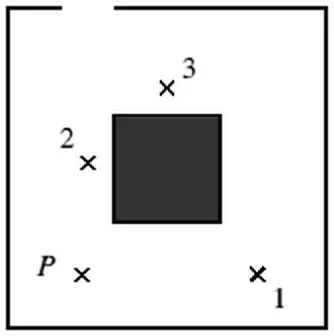
9. The diagram on the right shows the positions of four people (each marked ×) in an Art Gallery. In the middle of the room is a stone column. Ali can see none of the other three people. Bea can see only Caz. Caz can see Bea and Dan. Dan can see only Caz.
Who is at position \(P\)?

  1. A Ali
  2. B Bea
  3. C Caz
  4. D Dan
  5. E More information needed
A square room with a doorway in the top wall and a dark square stone column in the middle; four positions are marked with crosses, one of them labelled P in the bottom left

Junior Mathematical Challenge 2012, Question 9. © UK Mathematics Trust. Original paper on ukmt.org.uk

JMC 2011 Q25

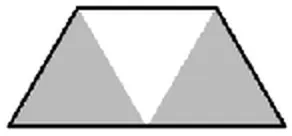
25. The diagram shows a trapezium made from three equilateral triangles.
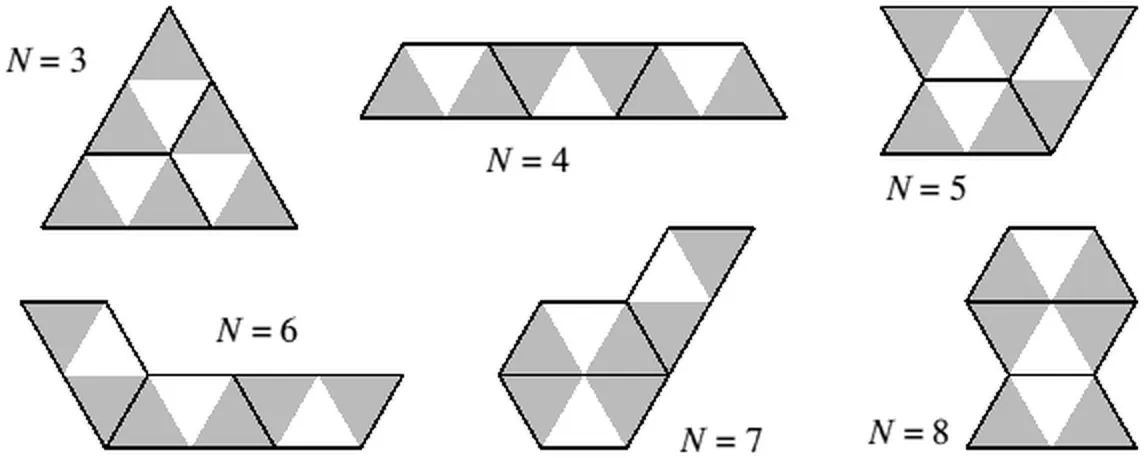
Three copies of the trapezium are placed together, without gaps or overlaps and so that only complete edges coincide, to form a polygon with \(N\) sides.
How many different values of \(N\) are possible?

  1. A 4
  2. B 5
  3. C 6
  4. D 7
  5. E 8
A trapezium made from three equilateral triangles, two shaded grey and the middle one white

Junior Mathematical Challenge 2011, Question 25. © UK Mathematics Trust. Original paper on ukmt.org.uk

JMC 2011 Q24

JMCCurrent spec6 marksCounting, Probability & Logic

24. Two adults and two children wish to cross a river. They make a raft but it will carry only the weight of one adult or two children. What is the minimum number of times the raft must cross the river to get all four people to the other side? (N.B. The raft may not cross the river without at least one person on board.)

  1. A 3
  2. B 5
  3. C 7
  4. D 9
  5. E 11

Junior Mathematical Challenge 2011, Question 24. © UK Mathematics Trust. Original paper on ukmt.org.uk

JMC 2011 Q16

16. The pupils in Year 8 are holding a mock election. A candidate receiving more votes than any other wins. The four candidates receive 83 votes between them. What is the smallest number of votes the winner could receive?

  1. A 21
  2. B 22
  3. C 23
  4. D 41
  5. E 42

Junior Mathematical Challenge 2011, Question 16. © UK Mathematics Trust. Original paper on ukmt.org.uk

JMC 2011 Q10

JMCCurrent spec5 marksCounting, Probability & Logic

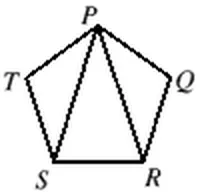
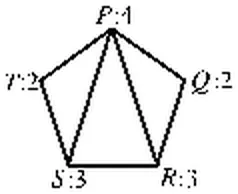
10. You want to draw the shape on the right without taking your pen off the paper and without going over any line more than once. Where should you start?

  1. A only at \(T\) or \(Q\)
  2. B only at \(P\)
  3. C only at \(S\) or \(R\)
  4. D at any point
  5. E the task is impossible
A pentagon PQRST with the two diagonals PS and PR drawn

Junior Mathematical Challenge 2011, Question 10. © UK Mathematics Trust. Original paper on ukmt.org.uk

JMC 2011 Q3

JMCCurrent spec5 marksCounting, Probability & Logic

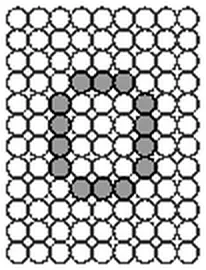
3. A train display shows letters by lighting cells in a grid, such as the letter ‘o’ shown. A letter is made bold by also lighting any unlit cell immediately to the right of one in the normal letter. How many cells are lit in a bold ‘o’?

  1. A 22
  2. B 24
  3. C 26
  4. D 28
  5. E 30
A grid of circular cells, some shaded grey to form the letter o

Junior Mathematical Challenge 2011, Question 3. © UK Mathematics Trust. Original paper on ukmt.org.uk

JMC 2010 Q24

24. The year 2010 belongs to a special sequence of twenty-five consecutive years: each number from 1988 to 2012 contains a repeated digit.
Each of the following belongs to a sequence of consecutive years, where each number in the sequence contains at least one repeated digit.
Which of them belongs to the next such sequence of at least twenty years?

  1. A 2099
  2. B 2120
  3. C 2199
  4. D 2989
  5. E 3299

Junior Mathematical Challenge 2010, Question 24. © UK Mathematics Trust. Original paper on ukmt.org.uk

JMC 2010 Q23

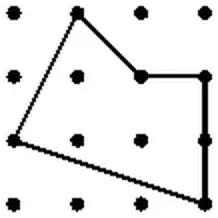
23. A single polygon is made by joining dots in the 4 × 4 grid with straight lines, which meet only at dots at their end points. No dot is at more than one corner. The diagram shows a five-sided polygon formed in this way. What is the greatest possible number of sides of a polygon formed by joining the dots using these same rules?

  1. A 12
  2. B 13
  3. C 14
  4. D 15
  5. E 16
A 4 by 4 grid of dots with a five-sided polygon drawn joining five of the dots

Junior Mathematical Challenge 2010, Question 23. © UK Mathematics Trust. Original paper on ukmt.org.uk

JMC 2010 Q19

JMCCurrent spec6 marksCounting, Probability & Logic

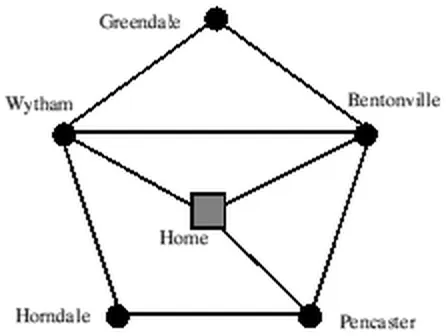
19. Pat needs to travel down every one of the roads shown at least once, starting and finishing at home. What is the smallest number of the five villages that Pat will have to visit more than once?

  1. A 1
  2. B 2
  3. C 3
  4. D 4
  5. E 5
A road map: villages Greendale, Bentonville, Pencaster, Horndale and Wytham at the corners of a pentagon, with Home in the middle; roads join Wytham to Bentonville, and Home to Wytham, Bentonville and Pencaster

Junior Mathematical Challenge 2010, Question 19. © UK Mathematics Trust. Original paper on ukmt.org.uk

JMC 2010 Q13

JMCCurrent spec5 marksCounting, Probability & Logic

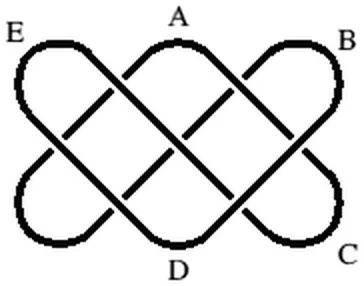
13. The diagram shows a Lusona, a sand picture of the Tshokwe people from the West Central Bantu area of Africa. To draw a Lusona the artist uses a stick to draw a single line in the sand, starting and ending in the same place without lifting the stick in between. At which point could this Lusona have started?

  1. A  
  2. B  
  3. C  
  4. D  
  5. E  
A Lusona: a single looped line forming a chain of crossings, with points A, B, C, D and E marked around it

Junior Mathematical Challenge 2010, Question 13. © UK Mathematics Trust. Original paper on ukmt.org.uk

JMC 2010 Q5

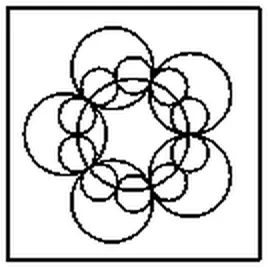
5. The diagram shows a pattern of 16 circles inside a square.
The central circle passes through the points where the other circles touch.
The circles divide the square into regions. How many regions are there?

  1. A 17
  2. B 26
  3. C 30
  4. D 32
  5. E 38
A square containing a ring of five overlapping circles around a central circle

Junior Mathematical Challenge 2010, Question 5. © UK Mathematics Trust. Original paper on ukmt.org.uk

JMC 2009 Q22

JMCCurrent spec6 marksCounting, Probability & Logic

22. Starting at the square containing the 2, you are allowed to move from one square to the next either across a common edge, or diagonally through a common corner. How many different routes are there passing through exactly two squares containing a 0 and ending in one of the squares containing a 9?

  1. A 7
  2. B 13
  3. C 15
  4. D 25
  5. E 32
2009
0009
0009
9999

Junior Mathematical Challenge 2009, Question 22. © UK Mathematics Trust. Original paper on ukmt.org.uk

JMC 2009 Q15

JMCCurrent spec5 marksCounting, Probability & Logic

15. In Matt’s pocket there are 8 watermelon jellybeans, 4 vanilla jellybeans and 4 butter popcorn jellybeans. What is the smallest number of jellybeans he must take out of his pocket to be certain that he takes at least one of each flavour?

  1. A 3
  2. B 4
  3. C 8
  4. D 9
  5. E 13

Junior Mathematical Challenge 2009, Question 15. © UK Mathematics Trust. Original paper on ukmt.org.uk

JMC 2008 Q24

JMCCurrent spec6 marksCounting, Probability & Logic

24. The list 2, 1; 3, 2; 2, 3; 1, 4; describes itself, since there are two 1s, three 2s, two 3s and one 4. There is exactly one other list of eight numbers containing only the numbers 1, 2, 3, and 4 that, in the same way, describes the numbers of 1s, 2s, 3s and 4s in that order. What is the total number of 1s and 3s in this other list?

  1. A 2
  2. B 3
  3. C 4
  4. D 5
  5. E 6

Junior Mathematical Challenge 2008, Question 24. © UK Mathematics Trust. Original paper on ukmt.org.uk

JMC 2008 Q22

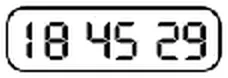
22. On a digital clock displaying hours, minutes and seconds, how many times in each 24-hour period do all six digits change simultaneously?

  1. A 0
  2. B 1
  3. C 2
  4. D 3
  5. E 24
A digital clock display reading 18 45 29

Junior Mathematical Challenge 2008, Question 22. © UK Mathematics Trust. Original paper on ukmt.org.uk

JMC 2008 Q20

JMCCurrent spec6 marksCounting, Probability & Logic

20. If all the whole numbers from 1 to 1000 inclusive are written down, which digit appears the smallest number of times?

  1. A 0
  2. B 2
  3. C 5
  4. D 9
  5. E none: no single digit appears fewer times than all the others

Junior Mathematical Challenge 2008, Question 20. © UK Mathematics Trust. Original paper on ukmt.org.uk

JMC 2008 Q13

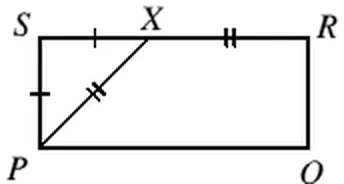
13. A rectangle \(PQRS\) is cut into two pieces along \(PX\), where \(PX = XR\) and \(PS = SX\) as shown. The two pieces are reassembled without turning either piece over, by matching two edges of equal length. Not counting the original rectangle, how many different shapes are possible?

  1. A 1
  2. B 2
  3. C 3
  4. D 4
  5. E 5
Rectangle PQRS with P bottom left, Q bottom right, R top right and S top left; X is on SR and the line PX is drawn; PS and SX are marked equal, and PX and XR are marked equal

Junior Mathematical Challenge 2008, Question 13. © UK Mathematics Trust. Original paper on ukmt.org.uk

JMC 2008 Q12

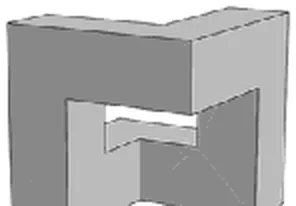
12. The sculpture ‘Cubo Vazado’ [Emptied Cube] by the Brazilian artist Franz Weissmann is formed by removing cubical blocks from a solid cube to leave the symmetrical shape shown.
If all the edges have length 1, 2 or 3, what is the volume of the sculpture?

  1. A 9
  2. B 11
  3. C 12
  4. D 14
  5. E 18
A grey sculpture made from a cube with two cubical blocks removed from opposite corners, leaving a symmetrical shape with a gap through the middle

Junior Mathematical Challenge 2008, Question 12. © UK Mathematics Trust. Original paper on ukmt.org.uk

JMC 2008 Q10

JMCCurrent spec5 marksCounting, Probability & Logic

10. The faces of a cube are painted so that any two faces which have an edge in common are painted different colours. What is the smallest number of colours required?

  1. A 2
  2. B 3
  3. C 4
  4. D 5
  5. E 6

Junior Mathematical Challenge 2008, Question 10. © UK Mathematics Trust. Original paper on ukmt.org.uk

JMC 2008 Q2

JMCCurrent spec5 marksCounting, Probability & Logic

2. Which of these diagrams could be drawn without taking the pen off the page and without drawing along a line already drawn?

Five diagrams labelled A to E: A a square divided into four smaller squares; B a square with both diagonals; C two diamonds joined point to point, each with a horizontal line across; D a horizontal ellipse crossed by a tall thin ellipse; E three overlapping circles

Junior Mathematical Challenge 2008, Question 2. © UK Mathematics Trust. Original paper on ukmt.org.uk

JMC 2007 Q24

JMCCurrent spec6 marksCounting, Probability & Logic

24. The pages of a book are numbered 1, 2, 3, … . In total, it takes 852 digits to number all the pages of the book. What is the number of the last page?
  1. A 215
  2. B 314
  3. C 320
  4. D 329
  5. E 422

Junior Mathematical Challenge 2007, Question 24. © UK Mathematics Trust. Original paper on ukmt.org.uk

JMC 2007 Q21

JMCCurrent spec6 marksCounting, Probability & Logic

21. A list of ten numbers contains two of each of the numbers 0, 1, 2, 3, 4. The two 0s are next to each other, the two 1s are separated by one number, the two 2s by two numbers, the two 3s by three numbers and the two 4s by four numbers. The list starts 3, 4, … . What is the last number?

  1. A 0
  2. B 1
  3. C 2
  4. D 3
  5. E 4

Junior Mathematical Challenge 2007, Question 21. © UK Mathematics Trust. Original paper on ukmt.org.uk

JMC 2007 Q17

17. Just William's cousin, Sweet William, has a rectangular block of fudge measuring 2 inches by 3 inches by 6 inches. He wants to cut the block up into cubes whose side lengths are whole numbers of inches. What is the smallest number of cubes he can obtain?

  1. A 3
  2. B 8
  3. C 15
  4. D 29
  5. E 36

Junior Mathematical Challenge 2007, Question 17. © UK Mathematics Trust. Original paper on ukmt.org.uk

JMC 2007 Q11

JMCCurrent spec5 marksCounting, Probability & Logic

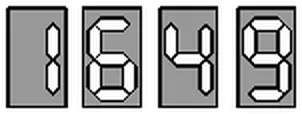
11. A station clock shows each digit by illuminating up to seven bars in a display. For example, the displays for 1, 6, 4 and 9 are shown.
When all the digits from 0 to 9 are shown in turn, which bar is used least?

Five single-bar displays labelled A to E: A the lower left bar, B the upper left bar, C the top bar, D the middle bar and E the bottom bar
Four seven-bar digital displays showing the digits 1, 6, 4 and 9

Junior Mathematical Challenge 2007, Question 11. © UK Mathematics Trust. Original paper on ukmt.org.uk

JMC 2007 Q8

JMCCurrent spec5 marksCounting, Probability & Logic

8. Amy, Ben and Chris are standing in a row. If Amy is to the left of Ben and Chris is to the right of Amy, which of these statements must be true?

  1. A Ben is furthest to the left
  2. B Chris is furthest to the right
  3. C Amy is in the middle
  4. D Amy is furthest to the left
  5. E None of statements A, B, C, D is true

Junior Mathematical Challenge 2007, Question 8. © UK Mathematics Trust. Original paper on ukmt.org.uk

JMC 2006 Q25

25. For how many positive values of \(n\) are both \(\tfrac{1}{2}n\) and \(2n\) three-digit whole numbers?

  1. A 0
  2. B 150
  3. C 200
  4. D 300
  5. E 500

Junior Mathematical Challenge 2006, Question 25. © UK Mathematics Trust. Original paper on ukmt.org.uk

JMC 2006 Q17

JMCCurrent spec6 marksCounting, Probability & Logic

17. In how many different ways can a row of five “on/off” switches be set so that no two adjacent switches are in the “off” position?

  1. A 5
  2. B 10
  3. C 11
  4. D 13
  5. E 15

Junior Mathematical Challenge 2006, Question 17. © UK Mathematics Trust. Original paper on ukmt.org.uk

JMC 2006 Q12

JMCCurrent spec5 marksCounting, Probability & Logic
12.
This sentence contains the letter e _____ times.
seveneightnineteneleven

How many of the five words above can be placed in the gap to make the sentence in the box true?

  1. A 0
  2. B 1
  3. C 2
  4. D 3
  5. E 4

Junior Mathematical Challenge 2006, Question 12. © UK Mathematics Trust. Original paper on ukmt.org.uk

JMC 2006 Q10

JMCCurrent spec5 marksCounting, Probability & Logic

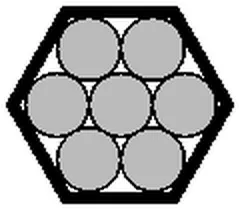
10. The diagram shows 7 identical coins which fit exactly inside a wooden frame. As a result each coin is prevented from sliding. What is the largest number of coins that may be removed one by one so that, at each stage, each remaining coin is still unable to slide?

  1. A 0
  2. B 1
  3. C 2
  4. D 3
  5. E 4
Seven identical grey coins, one in the middle and six around it, fitting exactly inside a black hexagonal frame

Junior Mathematical Challenge 2006, Question 10. © UK Mathematics Trust. Original paper on ukmt.org.uk

JMC 2006 Q4

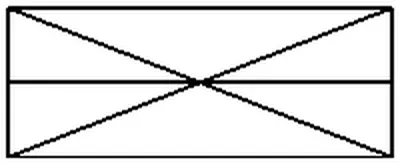
4. How many triangles of any size are there in this diagram?

  1. A 8
  2. B 10
  3. C 12
  4. D 14
  5. E 16
A rectangle with both diagonals drawn and a horizontal line across the middle through the point where the diagonals cross

Junior Mathematical Challenge 2006, Question 4. © UK Mathematics Trust. Original paper on ukmt.org.uk

JMC 2006 Q3

JMCCurrent spec5 marksCounting, Probability & Logic

3. Among the children in a certain family, each child has at least one brother and at least one sister. What is the smallest possible number of children in the family?

  1. A 2
  2. B 3
  3. C 4
  4. D 5
  5. E 6

Junior Mathematical Challenge 2006, Question 3. © UK Mathematics Trust. Original paper on ukmt.org.uk

JMC 2005 Q25

JMCCurrent spec6 marksCounting, Probability & Logic

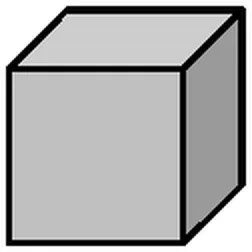
25. The diagram shows a unit cube coloured blue. Additional blue unit cubes are glued face-to-face to each of its six faces to form a three-dimensional “cross”. If unit cubes coloured yellow are now glued face-to-face to all the spare faces of this cross, how many yellow unit cubes are required?

  1. A 6
  2. B 18
  3. C 24
  4. D 30
  5. E 36
A single unit cube drawn in perspective

Junior Mathematical Challenge 2005, Question 25. © UK Mathematics Trust. Original paper on ukmt.org.uk

JMC 2005 Q21

JMCCurrent spec6 marksCounting, Probability & Logic

21. If the square is completed with the letters A, B, C, D and E so that no row, column or either of the two main diagonal lines contains the same letter more than once, which letter should replace the asterisk?

  1. A ​
  2. B ​
  3. C ​
  4. D ​
  5. E ​
*A
B
DC
E

Junior Mathematical Challenge 2005, Question 21. © UK Mathematics Trust. Original paper on ukmt.org.uk

JMC 2005 Q20

JMCCurrent spec6 marksCounting, Probability & Logic

20. How many of the statements in the box are true?

  1. A 0
  2. B 1
  3. C 2
  4. D 3
  5. E 4
None of these statements is true.
Exactly one of these statements is true.
Exactly two of these statements are true.
All of these statements are true.

Junior Mathematical Challenge 2005, Question 20. © UK Mathematics Trust. Original paper on ukmt.org.uk

JMC 2005 Q17

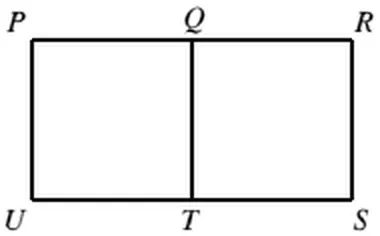
17. The figure shows rectangle \(PRSU\) and line \(QT\), which divides the rectangle into two squares. How many right-angled triangles can be drawn using any three of the points \(P\), \(Q\), \(R\), \(S\), \(T\), \(U\) as corners?

  1. A 8
  2. B 9
  3. C 10
  4. D 12
  5. E 14
Rectangle PRSU with P top left, R top right, S bottom right and U bottom left, divided into two squares by the line QT from Q on the top side to T on the bottom side

Junior Mathematical Challenge 2005, Question 17. © UK Mathematics Trust. Original paper on ukmt.org.uk

JMC 2005 Q9

JMCCurrent spec5 marksCounting, Probability & Logic
9.
On the far left a grey rectangular sheet of paper; on the near left a small grey rectangle, the folded sheet, with a round hole punched through it

Beatrix takes a sheet of paper (shown on the far left), folds the sheet in half 4 times and punches a hole all the way through the folded sheet, as shown on the near left. She then unfolds the sheet. How many holes are there now in the unfolded sheet?

  1. A 4
  2. B 6
  3. C 8
  4. D 12
  5. E 16

Junior Mathematical Challenge 2005, Question 9. © UK Mathematics Trust. Original paper on ukmt.org.uk

JMC 2005 Q6

JMCCurrent spec5 marksCounting, Probability & Logic

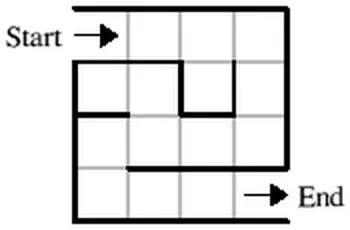
6. Jonny's rat is a slow learner! Every time it goes through this maze, it visits every square at least once. What is the smallest possible number of squares it visits more than once when it goes through the maze?

  1. A 0
  2. B 1
  3. C 2
  4. D 3
  5. E 4
A maze on a grid of squares four rows high and four columns wide, entered by an arrow marked Start at the top left and left by an arrow marked End at the bottom right, with walls inside

Junior Mathematical Challenge 2005, Question 6. © UK Mathematics Trust. Original paper on ukmt.org.uk

JMC 2004 Q14

JMCCurrent spec5 marksCounting, Probability & Logic

14. The Kings of Clubs, Diamonds, Hearts and Spades, and their respective Queens, are having an arm wrestling competition. Everyone must wrestle everyone else, except that no King will wrestle his own Queen. How many wrestling bouts are there?

  1. A 12
  2. B 16
  3. C 24
  4. D 28
  5. E 64

Junior Mathematical Challenge 2004, Question 14. © UK Mathematics Trust. Original paper on ukmt.org.uk

JMC 2004 Q8

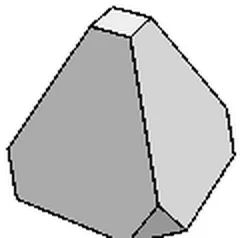
8. A solid square-based pyramid has all of its corners cut off, as shown. How many edges does the resulting shape have?

  1. A 8
  2. B 13
  3. C 15
  4. D 20
  5. E 24
A solid square-based pyramid with all five corners cut off, shown in grey

Junior Mathematical Challenge 2004, Question 8. © UK Mathematics Trust. Original paper on ukmt.org.uk

JMC 2004 Q4

JMCCurrent spec5 marksCounting, Probability & Logic

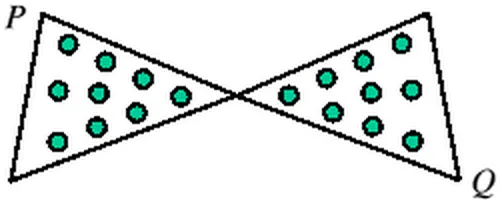
4. A ladybird has landed at point \(P\) on Sam's bow-tie. If it travels only along the edges of the bow-tie, but cannot travel along any edge more than once, how many different ways are there for it to get from \(P\) to \(Q\)?

  1. A 1
  2. B 2
  3. C 3
  4. D 4
  5. E 5
A bow-tie made of two triangles meeting at a centre point, decorated with dots, with P at the top left corner and Q at the bottom right corner

Junior Mathematical Challenge 2004, Question 4. © UK Mathematics Trust. Original paper on ukmt.org.uk

JK 2019 Q25

25. The room numbers of a hotel are all three-digit numbers. The first digit represents the floor and the last two digits represent the room number. The hotel has rooms on five floors, numbered 1 to 5. It has 35 rooms on each floor, numbered n01 to n35 where n is the number of the floor. In numbering all the rooms, how many times will the digit 2 be used?

  1. A 60
  2. B 65
  3. C 95
  4. D 100
  5. E 105

Junior Kangaroo 2019, Question 25. © UK Mathematics Trust. Original paper on ukmt.org.uk

JK 2019 Q23

JKCurrent spec6 marksCounting, Probability & Logic

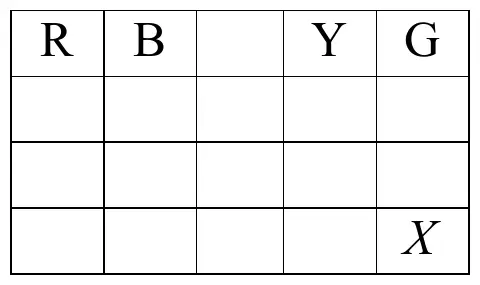
23. Sid is colouring the cells in the grid using the four colours red, blue, yellow and green in such a way that any two cells that share a vertex are coloured differently. He has already coloured some of the cells as shown.

What colour will he use for the cell marked \(X\)?

  1. A Red
  2. B Blue
  3. C Yellow
  4. D Green
  5. E You can’t be certain
A grid of four rows and five columns, the middle column wider; the top row reads R, B, empty, Y, G and the bottom right cell is marked X

Junior Kangaroo 2019, Question 23. © UK Mathematics Trust. Original paper on ukmt.org.uk

JK 2019 Q16

16. Eight cards are numbered from 1 to 8. The cards are placed in two boxes \(P\) and \(Q\) so that the sum of the numbers on the three cards in box \(P\) is equal to the sum of the numbers on the five cards in box \(Q\). Which of the following statements must be true?

  1. A The card numbered 1 is not in box \(Q\)
  2. B Four cards in box \(Q\) have even numbers on
  3. C The card numbered 5 is in box \(Q\)
  4. D The card numbered 2 is in box \(Q\)
  5. E Exactly three cards in box \(Q\) have odd numbers on.

Junior Kangaroo 2019, Question 16. © UK Mathematics Trust. Original paper on ukmt.org.uk

JK 2019 Q15

JKCurrent spec5 marksCounting, Probability & Logic

15. Amy, Bob, Cat and Dee occupy the top four positions in a chess tournament. The sum of Amy’s position, Bob’s position and Dee’s position is 6. The sum of Bob’s position and Cat’s position is 6. Bob finished ahead of Amy. Who came first in the tournament?

  1. A Amy
  2. B Bob
  3. C Cat
  4. D Dee
  5. E You can’t be certain

Junior Kangaroo 2019, Question 15. © UK Mathematics Trust. Original paper on ukmt.org.uk

JK 2019 Q11

11. Two of the following four facts about a positive integer \(N\) are true and two are false.

\(N\) is divisible by 5
\(N\) is divisible by 11
\(N\) is divisible by 55
\(N\) is less than 10

What is the value of \(N\)?

  1. A 5
  2. B 10
  3. C 11
  4. D 55
  5. E 110

Junior Kangaroo 2019, Question 11. © UK Mathematics Trust. Original paper on ukmt.org.uk

JK 2019 Q7

7. There are 30 pupils in my class. 20 pupils like Maths and 18 pupils like English. Twice as many pupils like both subjects as like neither of them. How many pupils like only Maths?

  1. A 20
  2. B 16
  3. C 12
  4. D 8
  5. E 4

Junior Kangaroo 2019, Question 7. © UK Mathematics Trust. Original paper on ukmt.org.uk

JK 2019 Q1

1. Riana has been asked to erase digits from the number 12 323 314 to obtain a number which reads the same from left to right as it does from right to left. What is the smallest number of digits Riana needs to erase?

  1. A 1
  2. B 2
  3. C 3
  4. D 4
  5. E 5

Junior Kangaroo 2019, Question 1. © UK Mathematics Trust. Original paper on ukmt.org.uk

JK 2018 Q23

JKCurrent spec6 marksCounting, Probability & Logic

23. Three friends, Ms Raja, Ms Omar and Ms Beatty all live in the same street. They are a doctor, an engineer and a musician in some order. The youngest one, the doctor, does not have a brother. Ms Beatty is older than the engineer and is married to Ms Omar's brother.
What are the names, in order, of the doctor and the engineer?

  1. A Raja and Omar
  2. B Omar and Beatty
  3. C Beatty and Omar
  4. D Raja and Beatty
  5. E Omar and Raja

Junior Kangaroo 2018, Question 23. © UK Mathematics Trust. Original paper on ukmt.org.uk

JK 2018 Q18

JKCurrent spec6 marksCounting, Probability & Logic

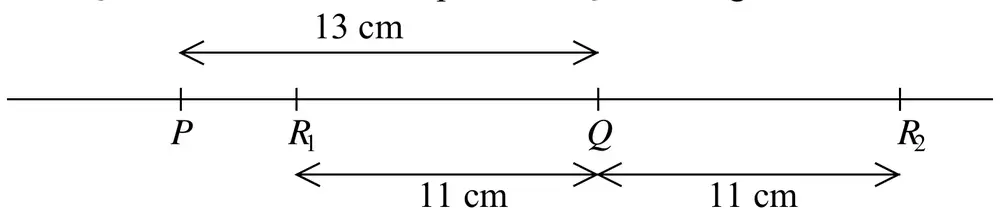
18. The points \(P\), \(Q\), \(R\) and \(S\) are marked on a straight line in some order. The lengths of the line segments \(PQ\), \(QR\), \(RS\) and \(SP\) are 13 cm, 11 cm, 14 cm and 12 cm respectively. What is the distance between the two points that are furthest apart?

  1. A 14 cm
  2. B 25 cm
  3. C 27 cm
  4. D 38 cm
  5. E 50 cm

Junior Kangaroo 2018, Question 18. © UK Mathematics Trust. Original paper on ukmt.org.uk

JK 2018 Q17

JKCurrent spec6 marksCounting, Probability & Logic

17. A large circular table has 60 chairs around it. What is the largest number of people who can sit around the table so that each person is only sitting next to exactly one other person?

  1. A 40
  2. B 36
  3. C 30
  4. D 25
  5. E 20

Junior Kangaroo 2018, Question 17. © UK Mathematics Trust. Original paper on ukmt.org.uk

JK 2018 Q14

14. A box contains seven cards, each with a different integer from 1 to 7 written on it. Avani takes three cards from the box and then Niamh takes two cards, leaving two cards in the box. Avani looks at her cards and then tells Niamh “I know the sum of the numbers on your cards is even.” What is the sum of the numbers on Avani's cards?

  1. A 6
  2. B 9
  3. C 10
  4. D 11
  5. E 12

Junior Kangaroo 2018, Question 14. © UK Mathematics Trust. Original paper on ukmt.org.uk

JK 2018 Q12

JKCurrent spec5 marksCounting, Probability & Logic

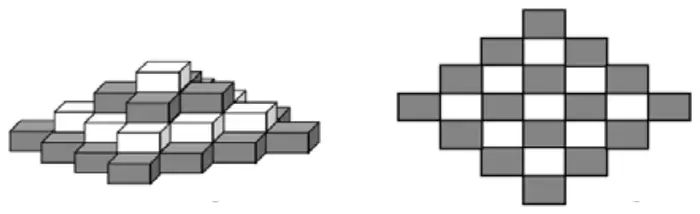
12. The two diagrams show a side view and a plan view of a tower made with light and dark coloured blocks. In the tower, only dark coloured blocks are placed on top of dark coloured blocks and only light coloured blocks are placed on top of light coloured blocks. How many blocks in the tower are light coloured?

  1. A 9
  2. B 13
  3. C 18
  4. D 20
  5. E 24
A side view of a stepped tower of light and dark blocks, and a plan view showing a chequered cross-shaped pattern of light and dark squares

Junior Kangaroo 2018, Question 12. © UK Mathematics Trust. Original paper on ukmt.org.uk

JK 2018 Q10

JKCurrent spec5 marksCounting, Probability & Logic

10. The diagram below shows five rectangles, each containing some of the letters P, R, I, S and M.

Five rectangles: rectangle 1 contains P and S; rectangle 2 contains P, I, S and R; rectangle 3 contains I and P; rectangle 4 contains S; rectangle 5 contains P, R, M, I and S

Harry wants to cross out letters so that each rectangle contains only one letter and each rectangle contains a different letter. Which letter does he not cross out in rectangle 2?

  1. A P
  2. B R
  3. C I
  4. D S
  5. E M

Junior Kangaroo 2018, Question 10. © UK Mathematics Trust. Original paper on ukmt.org.uk

JK 2018 Q9

JKCurrent spec5 marksCounting, Probability & Logic

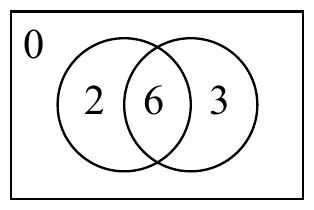
9. Tom throws two darts at the target shown in the diagram. Both his darts hit the target. For each dart, he scores the number of points shown in the region he hits. How many different totals could he score?

  1. A 6
  2. B 7
  3. C 8
  4. D 9
  5. E 10
A rectangle labelled 0 containing two overlapping circles; the left circle is labelled 2, the overlap 6 and the right circle 3

Junior Kangaroo 2018, Question 9. © UK Mathematics Trust. Original paper on ukmt.org.uk

JK 2018 Q8

8. William has four cards with different integers written on them. Three of these integers are 2, 3 and 4. He puts one card in each cell of the 2 × 2 grid shown.
The sum of the two integers in the second row is 6. The sum of the two integers in the second column is 10. Which number is on the card he places in the top left cell?

  1. A 2
  2. B 3
  3. C 4
  4. D 6
  5. E Can't be sure

Junior Kangaroo 2018, Question 8. © UK Mathematics Trust. Original paper on ukmt.org.uk

JK 2017 Q22

22. Harriet tells Topaz that she is thinking of three positive integers, not necessarily all different. She tells her that the product of her three integers is 36. She also tells her the sum of her three integers. However, Topaz still cannot work out what the three integers are.
What is the sum of Harriet's three integers?

  1. A 10
  2. B 11
  3. C 13
  4. D 14
  5. E 16

Junior Kangaroo 2017, Question 22. © UK Mathematics Trust. Original paper on ukmt.org.uk

JK 2017 Q21

JKCurrent spec6 marksCounting, Probability & Logic

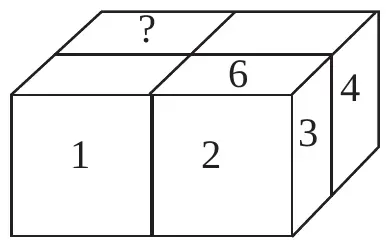
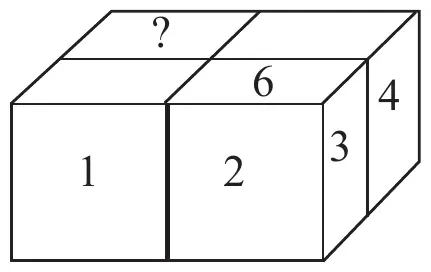
21. Rory uses four identical standard dice to build the solid shown in the diagram.
Whenever two dice touch, the numbers on the touching faces are the same. The numbers on some of the faces of the solid are shown. What number is written on the face marked with question mark?
(On a standard die, the numbers on opposite faces add to 7.)

  1. A 6
  2. B 5
  3. C 4
  4. D 3
  5. E 2
Four dice forming a 2 by 2 by 1 block; visible numbers are 1 and 2 on the front faces, 3 and 4 on the right-hand faces, 6 on the top of the front right die, and a question mark on the top of the rear left die

Junior Kangaroo 2017, Question 21. © UK Mathematics Trust. Original paper on ukmt.org.uk

JK 2017 Q10

JKCurrent spec5 marksCounting, Probability & Logic

10. In the sequence of letters KANGAROOKANGAROOKANG... the word KANGAROO is repeated indefinitely. What is the 2017th letter in this sequence?

  1. A K
  2. B N
  3. C G
  4. D R
  5. E O

Junior Kangaroo 2017, Question 10. © UK Mathematics Trust. Original paper on ukmt.org.uk

JK 2017 Q9

JKCurrent spec5 marksCounting, Probability & Logic

9. Alex colours all the small squares that lie on the two longest diagonals of a square grid. She colours 2017 small squares. What is the size of the square grid?

  1. A 1009 × 1009
  2. B 1008 × 1008
  3. C 2017 × 2017
  4. D 2016 × 2016
  5. E 2015 × 2015

Junior Kangaroo 2017, Question 9. © UK Mathematics Trust. Original paper on ukmt.org.uk

JK 2017 Q4

JKCurrent spec5 marksCounting, Probability & Logic

4. Beattie wants to walk from \(P\) to \(Q\) along the paths shown, always moving in the direction from \(P\) to \(Q\).

Paths from P to Q: the route splits into two paths three times in a row; the first pair of paths is numbered 1 (top) and 2 (bottom), the second pair 3 and 4, and the third pair 5 and 6

She will add the numbers on the paths she walks along. How many different totals could she obtain?

  1. A 3
  2. B 4
  3. C 5
  4. D 6
  5. E 8

Junior Kangaroo 2017, Question 4. © UK Mathematics Trust. Original paper on ukmt.org.uk

JK 2017 Q2

JKCurrent spec5 marksCounting, Probability & Logic

2. Sophie wants to complete the grid shown so that each row and each column of the grid contains the digits 1, 2 and 3 exactly once. What is the sum of the digits she will write in the shaded cells?

  1. A 2
  2. B 3
  3. C 4
  4. D 5
  5. E 6
1
21

Junior Kangaroo 2017, Question 2. © UK Mathematics Trust. Original paper on ukmt.org.uk

JK 2016 Q25

25. The whole numbers from 1 to 2016 inclusive are written on a blackboard. Moritz underlines all the multiples of two in red, all the multiples of three in blue and all the multiples of four in green. How many numbers does Moritz underline exactly twice?

  1. A 1008
  2. B 1004
  3. C 504
  4. D 336
  5. E 168

Junior Kangaroo 2016, Question 25. © UK Mathematics Trust. Original paper on ukmt.org.uk

JK 2016 Q21

JKCurrent spec6 marksCounting, Probability & Logic

21. In Carl's pencil case there are nine pencils. At least one of the pencils is blue. In any group of four pencils, at least two have the same colour. In any group of five pencils, at most three have the same colour. How many pencils are blue?

  1. A 1
  2. B 2
  3. C 3
  4. D 4
  5. E More information needed

Junior Kangaroo 2016, Question 21. © UK Mathematics Trust. Original paper on ukmt.org.uk

JK 2016 Q16

JKCurrent spec6 marksCounting, Probability & Logic

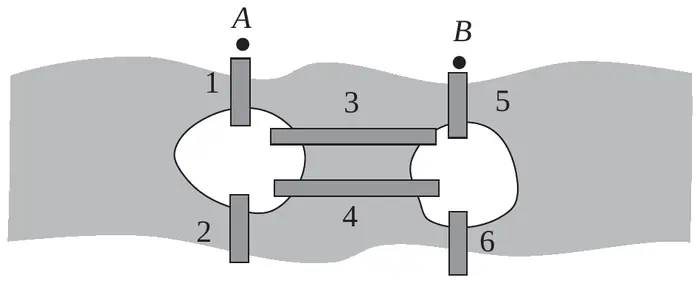
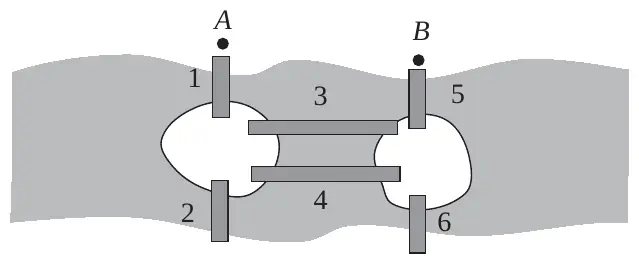
16. The diagram shows part of a river which has two islands in it. There are six bridges linking the islands and the two banks as shown. Leonhard goes for a walk every day in which he walks over each bridge exactly once. He always starts at point \(A\), goes first over bridge 1 and always finishes at point \(B\). What is the maximum number of days that he can walk without repeating the order in which he crosses the bridges?

  1. A 2
  2. B 4
  3. C 5
  4. D 6
  5. E More than 6
A grey river with two white islands; point A is on the top bank and point B on the top bank further right; bridge 1 joins the top bank to the left island, bridge 2 joins the left island to the bottom bank, bridges 3 and 4 join the two islands, bridge 5 joins the right island to the top bank and bridge 6 joins the right island to the bottom bank

Junior Kangaroo 2016, Question 16. © UK Mathematics Trust. Original paper on ukmt.org.uk

JK 2016 Q14

JKCurrent spec5 marksCounting, Probability & Logic

14. How many different cubes are there with three faces coloured red and three faces coloured blue?

  1. A 1
  2. B 2
  3. C 3
  4. D 4
  5. E 5

Junior Kangaroo 2016, Question 14. © UK Mathematics Trust. Original paper on ukmt.org.uk

JK 2016 Q2

2. Twelve people, and no more, can sit evenly spaced around a large square table. Rohan arranges eight of these square tables in a row to make one long rectangular table. What is the maximum number of people that can sit evenly spaced around this long table?

  1. A 48
  2. B 54
  3. C 60
  4. D 80
  5. E 96

Junior Kangaroo 2016, Question 2. © UK Mathematics Trust. Original paper on ukmt.org.uk

JK 2015 Q24

JKCurrent spec6 marksCounting, Probability & Logic

24. Molly, Dolly, Sally, Elly and Kelly are sitting on a park bench. Molly is not sitting on the far right and Dolly is not sitting on the far left. Sally is not sitting at either end. Kelly is not sitting next to Sally and Sally is not sitting next to Dolly. Elly is sitting to the right of Dolly but not necessarily next to her. Who is sitting at the far right end?

  1. A Molly
  2. B Dolly
  3. C Sally
  4. D Kelly
  5. E Elly

Junior Kangaroo 2015, Question 24. © UK Mathematics Trust. Original paper on ukmt.org.uk

JK 2015 Q20

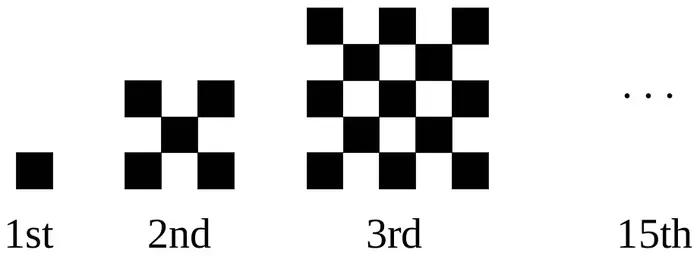
20. The diagram below shows a sequence of shapes made up of black and white floor tiles where each shape after the first has two more rows and two more columns than the one before it.

The 1st shape is a single black tile; the 2nd is a 3 by 3 chequerboard with black corners; the 3rd is a 5 by 5 chequerboard with black corners; dots lead on to the 15th

How many black tiles would be required to create the 15th shape in the sequence?

  1. A 401
  2. B 421
  3. C 441
  4. D 461
  5. E 481

Junior Kangaroo 2015, Question 20. © UK Mathematics Trust. Original paper on ukmt.org.uk

JK 2015 Q19

19. From noon till midnight, Clever Cat sleeps under the oak tree and from midnight till noon he is awake telling stories. A poster on the tree above him says “Two hours ago, Clever Cat was doing the same thing as he will be doing in one hour's time”. For how many hours a day does the poster tell the truth?

  1. A 3
  2. B 6
  3. C 12
  4. D 18
  5. E 21

Junior Kangaroo 2015, Question 19. © UK Mathematics Trust. Original paper on ukmt.org.uk

JK 2015 Q17

JKCurrent spec6 marksCounting, Probability & Logic

17. In a pirate's trunk there are 5 chests. In each chest there are 4 boxes and in each box there are 10 gold coins. The trunk, the chests and the boxes are all locked. Blind Pew unlocks 9 locks and takes all the coins in all the boxes he unlocks. What is the smallest number of gold coins he could take?

  1. A 20
  2. B 30
  3. C 40
  4. D 50
  5. E 70

Junior Kangaroo 2015, Question 17. © UK Mathematics Trust. Original paper on ukmt.org.uk

JK 2015 Q10

JKCurrent spec5 marksCounting, Probability & Logic

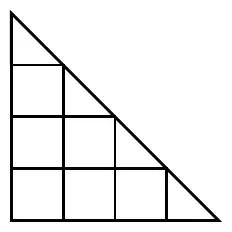
10. The diagram on the right shows a large triangle divided up into squares and triangles. \(S\) is the number of squares of any size in the diagram and \(T\) is the number of triangles of any size in the diagram. What is the value of \(S \times T\)?

  1. A 30
  2. B 35
  3. C 48
  4. D 70
  5. E 100
A right-angled triangle divided into six unit squares in a staircase, with small triangles along the sloping edge

Junior Kangaroo 2015, Question 10. © UK Mathematics Trust. Original paper on ukmt.org.uk

JK 2015 Q7

7. Selina takes a sheet of paper and cuts it into 10 pieces. She then takes one of these pieces and cuts it into 10 smaller pieces. She then takes another piece and cuts it into 10 smaller pieces and finally cuts one of the smaller pieces into 10 tiny pieces. How many pieces of paper has the original sheet been cut into?

  1. A 27
  2. B 30
  3. C 37
  4. D 40
  5. E 47

Junior Kangaroo 2015, Question 7. © UK Mathematics Trust. Original paper on ukmt.org.uk

JK 2015 Q6

JKCurrent spec5 marksCounting, Probability & Logic

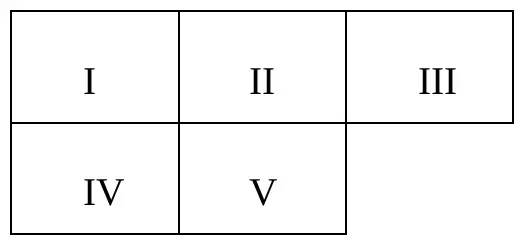
6. In the diagram, five rectangles of the same size are shown with each side labelled with a number.

Five rectangles labelled A to E with a number on each side. A: top 5, left 7, right 4, bottom 8. B: top 8, left 3, right 5, bottom 0. C: top 0, left 9, right 7, bottom 2. D: top 2, left 1, right 3, bottom 6. E: top 1, left 4, right 9, bottom 6

These rectangles are placed in the positions I to V as shown so that the numbers on the sides that touch each other are equal.

Positions I, II and III in a row of three, with positions IV and V below I and II

Which of the rectangles should be placed in position I?

  1. A  
  2. B  
  3. C  
  4. D  
  5. E  

Junior Kangaroo 2015, Question 6. © UK Mathematics Trust. Original paper on ukmt.org.uk

JMO 2019 B6

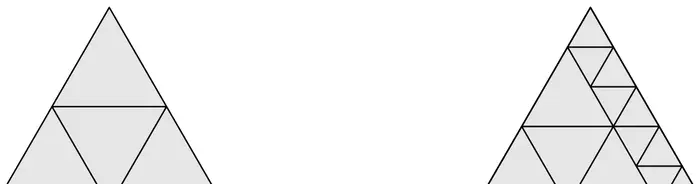
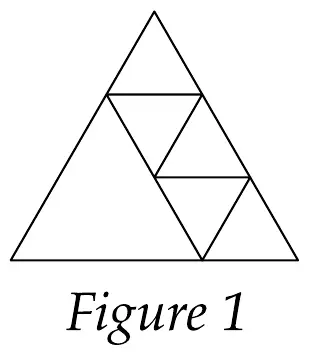
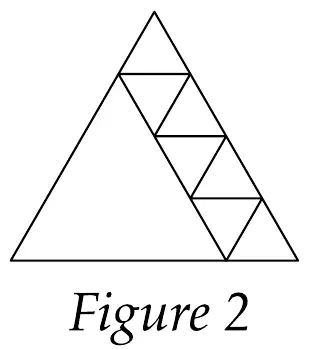
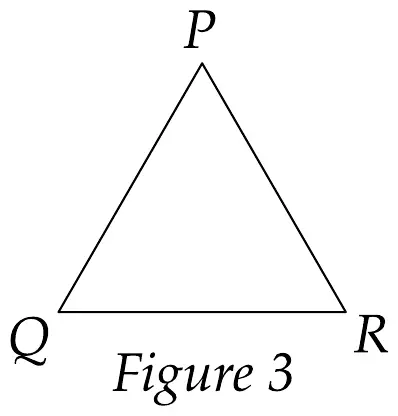
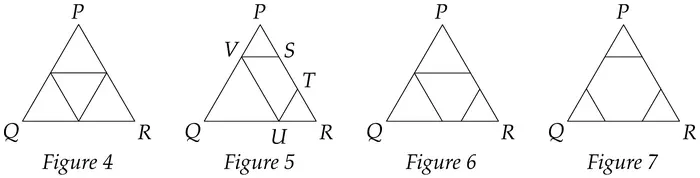
B6. An equilateral triangle is divided into smaller equilateral triangles.

Left: an equilateral triangle divided into 4 equilateral triangles. Right: an equilateral triangle divided into 13 equilateral triangles of different sizes

The diagram on the left shows that it is possible to divide it into 4 equilateral triangles.
The diagram on the right shows that it is possible to divide it into 13 equilateral triangles.

What are the integer values of \(n\), where \(n > 1\), for which it is possible to divide the triangle into \(n\) smaller equilateral triangles?

Junior Mathematical Olympiad 2019, Question B6. © UK Mathematics Trust. Original paper on ukmt.org.uk

JMO 2019 B5

JMOCurrent spec10 marksCounting, Probability & Logic

B5. My 24-hour digital clock displays hours and minutes only.

How many displayed times in a 24-hour period contain at least one occurrence of the digit 5?

Junior Mathematical Olympiad 2019, Question B5. © UK Mathematics Trust. Original paper on ukmt.org.uk

JMO 2019 A5

A5. Dani wrote the integers from 1 to \(N\). She used the digit 1 fifteen times. She used the digit 2 fourteen times.

What is \(N\)?

Junior Mathematical Olympiad 2019, Question A5. © UK Mathematics Trust. Original paper on ukmt.org.uk

JMO 2018 B6

JMOCurrent spec10 marksCounting, Probability & Logic

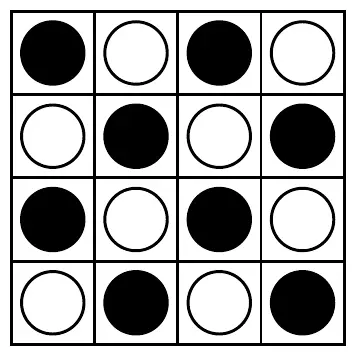
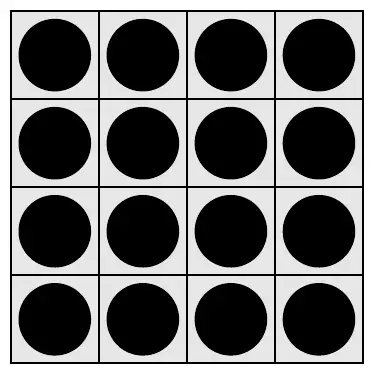
B6. Sixteen counters, which are black on one side and white on the other,
are arranged in a 4 by 4 square. Initially all the counters are facing
black side up. In one ‘move’, you must choose a 2 by 2 square within
the square and turn all four counters over once. Describe a sequence
of ‘moves’ of minimum length that finishes with the colours of the
counters of the 4 by 4 square alternating (as shown in the diagram).

A 4 by 4 square of counters alternating black and white

Junior Mathematical Olympiad 2018, Question B6. © UK Mathematics Trust. Original paper on ukmt.org.uk

JMO 2018 B5

JMOCurrent spec10 marksCounting, Probability & Logic

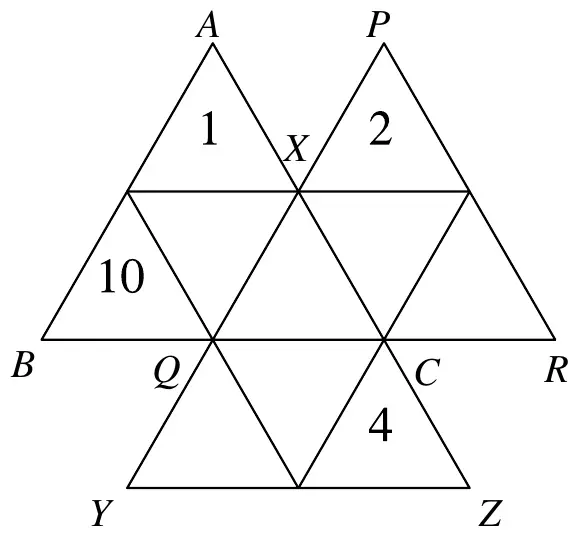
B5. The diagram shows three triangles, \(ABC\), \(PQR\) and \(XYZ\), each
of which is divided up into four smaller triangles. The diagram
is to be completed so that the positive integers from 1 to 10
inclusive are placed, one per small triangle, in the ten small
triangles. The totals of the numbers in the three triangles \(ABC\),
\(PQR\) and \(XYZ\) are the same.

Numbers 1, 2, 4 and 10 have already been placed.

In how many different ways can the diagram be completed?

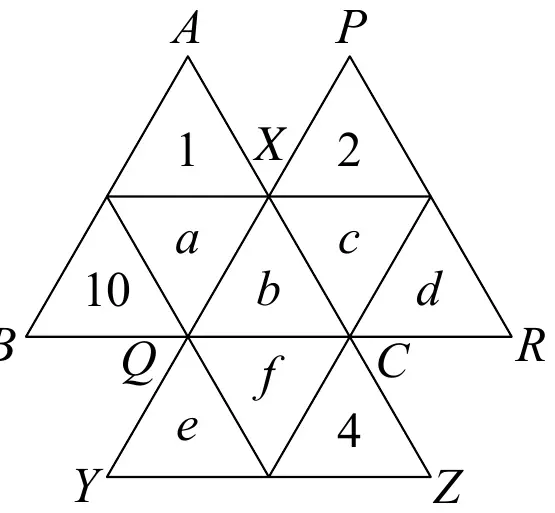
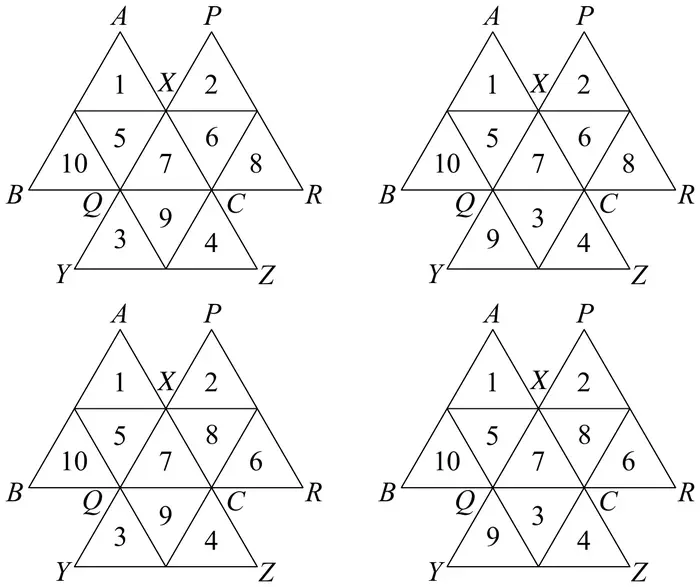
Three overlapping triangles ABC, PQR and XYZ, each divided into four small triangles, with 1, 2, 10 and 4 already placed

Junior Mathematical Olympiad 2018, Question B5. © UK Mathematics Trust. Original paper on ukmt.org.uk

JMO 2018 A8

JMOCurrent spec1 markCounting, Probability & Logic

A8. How many three-digit integers less than 1000 have exactly two different digits in their representation (for example, 232, or 466)?

Junior Mathematical Olympiad 2018, Question A8. © UK Mathematics Trust. Original paper on ukmt.org.uk

JMO 2017 B4

JMOCurrent spec10 marksCounting, Probability & Logic

B4. My uncle lives a long way away and his letters always contain puzzles. His three local teams are the Ants (A), the Bees (B), and the Cats (C), who play each other once a year.

My uncle claimed that the league table part way through the year looked like this:

PlayedWonDrawnLostGoals forGoals against
A100142
B211022
C210131

When we complained that this is impossible, he admitted that every single number was wrong but he excused himself because every number was exactly ‘1 out’.

Find the correct table, explaining clearly how you deduced the corrections.

Junior Mathematical Olympiad 2017, Question B4. © UK Mathematics Trust. Original paper on ukmt.org.uk

JMO 2017 B2

B2. A 3-digit integer is called a ‘V-number’ if the digits go ‘high-low-high’ – that is, if the tens digit is smaller than both the hundreds digit and the units (or ‘ones’) digit.

How many 3-digit ‘V-numbers’ are there?

Junior Mathematical Olympiad 2017, Question B2. © UK Mathematics Trust. Original paper on ukmt.org.uk

JMO 2017 A9

A9. How many multiples of 3 that are less than 1000 are not divisible either by 9 or by 10?

Junior Mathematical Olympiad 2017, Question A9. © UK Mathematics Trust. Original paper on ukmt.org.uk

JMO 2016 B5

JMOCurrent spec10 marksCounting, Probability & Logic

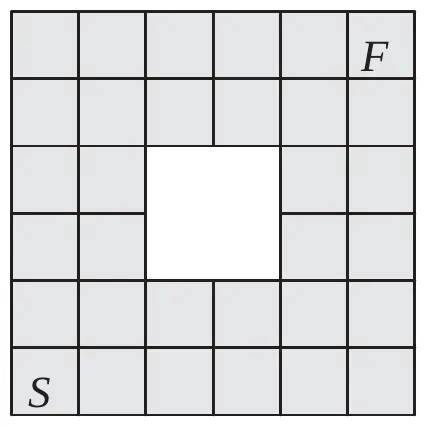
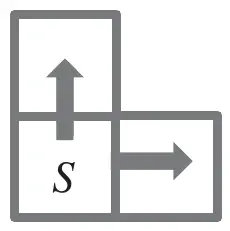
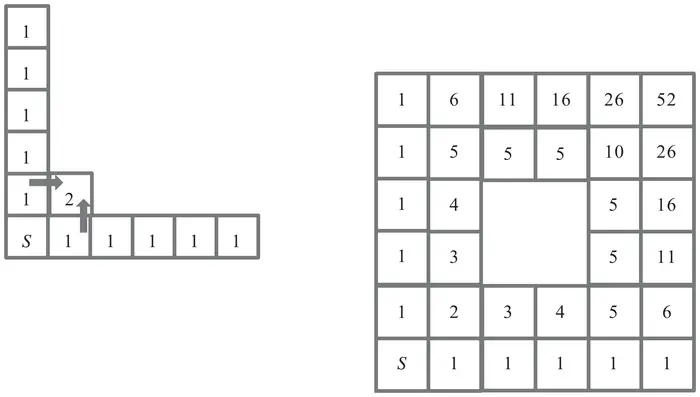
B5. The board shown has 32 cells, one of which is labelled \(S\) and another
\(F\). The shortest path starting at \(S\) and finishing at \(F\) involves exactly
nine other cells and ten moves, where each move goes from cell to
cell ‘horizontally’ or ‘vertically’ across an edge.

How many paths of this length are there from \(S\) to \(F\)?

A board of 32 cells in a 6 by 6 square with a 2 by 2 hole in the middle; S is in the bottom left cell and F in the top right cell

Junior Mathematical Olympiad 2016, Question B5. © UK Mathematics Trust. Original paper on ukmt.org.uk

JMO 2016 B3

JMOCurrent spec10 marksCounting, Probability & Logic

B3. A large cube consists of a number of identical small cubes. The number of small cubes that touch four other small cubes face-to-face is 168.

How many small cubes make up the large cube?

Junior Mathematical Olympiad 2016, Question B3. © UK Mathematics Trust. Original paper on ukmt.org.uk

JMO 2015 B6

B6. The letters \(a\), \(b\), \(c\), \(d\), \(e\) and \(f\) represent single digits and each letter represents a different digit. They satisfy the following equations:

\(a + b = d,\qquad b + c = e\qquad\) and \(\qquad d + e = f.\)

Find all possible solutions for the values of \(a\), \(b\), \(c\), \(d\), \(e\) and \(f\).

Junior Mathematical Olympiad 2015, Question B6. © UK Mathematics Trust. Original paper on ukmt.org.uk

JMO 2015 B5

B5. I have two types of square tile. One type has a side length of 1 cm and the other has a side length of 2 cm.

What is the smallest square that can be made with equal numbers of each type of tile?

Junior Mathematical Olympiad 2015, Question B5. © UK Mathematics Trust. Original paper on ukmt.org.uk

JMO 2015 B3

JMOCurrent spec10 marksCounting, Probability & Logic

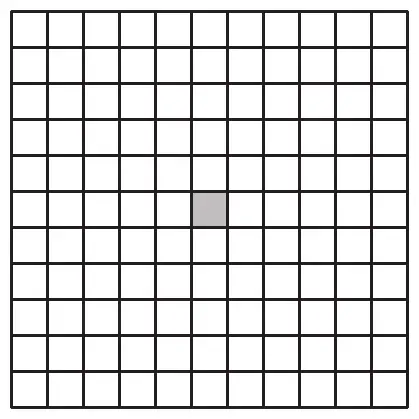
B3. Jack starts in the small square shown shaded on the
grid, and makes a sequence of moves. Each move is to
a neighbouring small square, where two small squares
are neighbouring if they have an edge in common. He
may visit a square more than once.

Jack makes four moves. In how many different small
squares could Jack finish?

A square grid of small squares with one small square near the middle shaded

Junior Mathematical Olympiad 2015, Question B3. © UK Mathematics Trust. Original paper on ukmt.org.uk

JMO 2015 A10

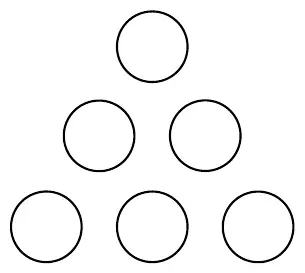
A10. Lucy wants to put the numbers 2, 3, 4, 5, 6 and 10 into the
circles so that the products of the three numbers along
each edge are the same, and as large as possible.

What is this product?

Six circles arranged in a triangle, three along each edge

Junior Mathematical Olympiad 2015, Question A10. © UK Mathematics Trust. Original paper on ukmt.org.uk

JMO 2015 A6

A6. There are 81 players taking part in a knock-out quiz tournament. Each match in the tournament involves 3 players and only the winner of the match remains in the tournament − the other two players are knocked out. How many matches are required until there is an overall winner?

Junior Mathematical Olympiad 2015, Question A6. © UK Mathematics Trust. Original paper on ukmt.org.uk

Cayley 2020 Q6

6. Martha and Nadia play a game. Each has to make her own four-digit number, choosing her four digits from eight “digit cards” labelled 1-8. First Martha chooses her thousands digit, and then Nadia chooses her thousands digit. Next, Martha chooses her hundreds digit from the remaining six cards, and then Nadia chooses her hundreds digit. This process is repeated for the tens and finally the units digits of their numbers. The two four-digit numbers produced are then added together. Martha wins if the sum is not a multiple of 6; Nadia wins if the sum is a multiple of 6.

Determine which player has a winning strategy (that is to say, which player can guarantee that she will win no matter which digits the other player chooses).

Cayley Olympiad 2020, Question 6. © UK Mathematics Trust. Original paper on ukmt.org.uk

Cayley 2020 Q5

CAYCurrent spec10 marksCounting, Probability & Logic

5. A ladybird is free to fly between the \(1 \times 1\) cells of a \(10 \times 10\) square grid. She may begin in any \(1 \times 1\) cell of the grid. Every second she flies to a different \(1 \times 1\) cell that she has not visited before.

Find the smallest number of cells the ladybird must visit, including her starting cell, so that you can be certain that there is a \(2 \times 2\) grid of adjacent cells, each of which she has visited.

Cayley Olympiad 2020, Question 5. © UK Mathematics Trust. Original paper on ukmt.org.uk

Cayley 2019 Q5

5. Howard chooses \(n\) different numbers from the list 2, 3, 4, 5, 6, 7, 8, 9, 10, 11, so that no two of his choices add up to a square.

What is the largest possible value of \(n\)?

Cayley Olympiad 2019, Question 5. © UK Mathematics Trust. Original paper on ukmt.org.uk

Cayley 2018 Q6

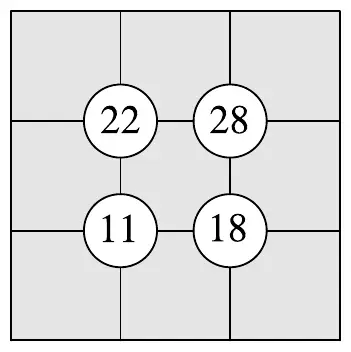
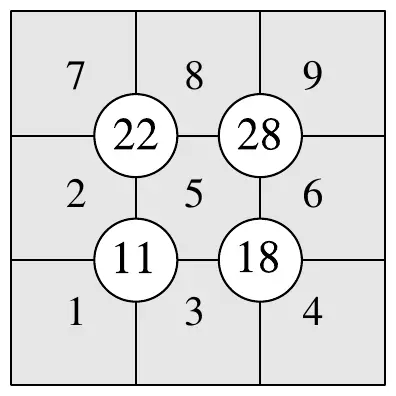
6. In the puzzle Suko, the numbers from 1 to 9 are to be placed in the spaces (one number in each) so that the number in each circle is equal to the sum of the numbers in the four surrounding spaces.

How many solutions are there to the Suko puzzle shown alongside?

A Suko grid: a 3 by 3 grid of spaces with four circles containing 22 (top left), 28 (top right), 11 (bottom left) and 18 (bottom right) at the inner corners

Cayley Olympiad 2018, Question 6. © UK Mathematics Trust. Original paper on ukmt.org.uk

Cayley 2018 Q5

5. In the expression below, three of the + signs are changed into − signs so that the expression is equal to 100:

\(0 + 1 + 2 + 3 + 4 + 5 + 6 + 7 + 8 + 9 + 10\)
\(\phantom{0}{} + 11 + 12 + 13 + 14 + 15 + 16 + 17 + 18 + 19 + 20.\)

In how many ways can this be done?

Cayley Olympiad 2018, Question 5. © UK Mathematics Trust. Original paper on ukmt.org.uk

Cayley 2018 Q3

3. The addition sum \(XCV + XXV = CXX\) is true in Roman numerals.

In this question, however, the sum is actually the letter-sum shown alongside, in which: each letter stands for one of the digits 0 to 9, and stands for the same digit each time it occurs; different letters stand for different digits; and no number starts with a zero.

Find all solutions, and explain how you can be sure you have found every solution.

XCV
+XXV
CXX

Cayley Olympiad 2018, Question 3. © UK Mathematics Trust. Original paper on ukmt.org.uk

Cayley 2018 Q1

1. The positive integer \(N\) has six digits in increasing order. For example, 124 689 is such a number.

However, unlike 124 689, three of the digits of \(N\) are 3, 4 and 5, and \(N\) is a multiple of 6.
How many possible six-digit integers \(N\) are there?

Cayley Olympiad 2018, Question 1. © UK Mathematics Trust. Original paper on ukmt.org.uk

Cayley 2017 Q5

CAYCurrent spec10 marksCounting, Probability & Logic

5. In a sports league there are four teams and every team plays every other team once. A team scores 3 points for a win, 1 point for a draw, and 0 points for a loss.

What is the smallest number of points that a team could have at the end of the league and still score more points than each of the other teams?

Cayley Olympiad 2017, Question 5. © UK Mathematics Trust. Original paper on ukmt.org.uk

Cayley 2016 Q5

5. Dean wishes to place the positive integers 1, 2, 3, …, 9 in the cells of a \(3 \times 3\) square grid so that:

(i)there is exactly one number in each cell;
(ii)the product of the numbers in each row is a multiple of four;
(iii)the product of the numbers in each column is a multiple of four.

Is Dean's task possible? Prove that your answer is correct.

Cayley Olympiad 2016, Question 5. © UK Mathematics Trust. Original paper on ukmt.org.uk

Cayley 2016 Q3

CAYCurrent spec10 marksCounting, Probability & Logic

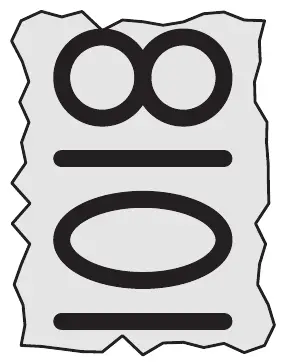
3. All the telephone numbers in Georgetown have six digits and each of them begins with the digits 81. Kate finds the scrap of paper shown, with part of Jenny's telephone number on it.

How many different possibilities are there for Jenny's telephone number?

A torn scrap of paper with the digits 8101 written on it, which reads 1018 when turned upside down

Cayley Olympiad 2016, Question 3. © UK Mathematics Trust. Original paper on ukmt.org.uk

Cayley 2016 Q1

1. How many three-digit multiples of 9 consist only of odd digits?

Cayley Olympiad 2016, Question 1. © UK Mathematics Trust. Original paper on ukmt.org.uk

Cayley 2015 Q6

CAYCurrent spec10 marksCounting, Probability & Logic

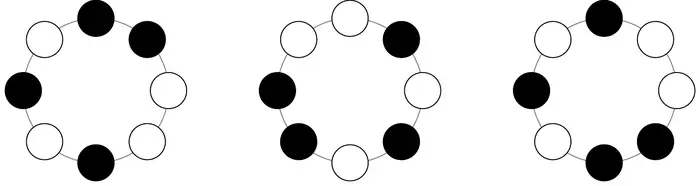
6. I have four identical black beads and four identical white beads.

Carefully explain how many different bracelets I can make using all the beads.

Cayley Olympiad 2015, Question 6. © UK Mathematics Trust. Original paper on ukmt.org.uk

Cayley 2015 Q4

4. Ten balls, each coloured green, red or blue, are placed in a bag. Ten more balls, each coloured green, red or blue, are placed in a second bag.
In one of the bags there are at least seven blue balls and in the other bag there are at least four red balls. Overall there are half as many green balls as there are blue balls.

Prove that the total number of red balls in both bags is equal to either the total number of blue balls in both bags or the total number of green balls in both bags.

Cayley Olympiad 2015, Question 4. © UK Mathematics Trust. Original paper on ukmt.org.uk