
JMO 2018 B5
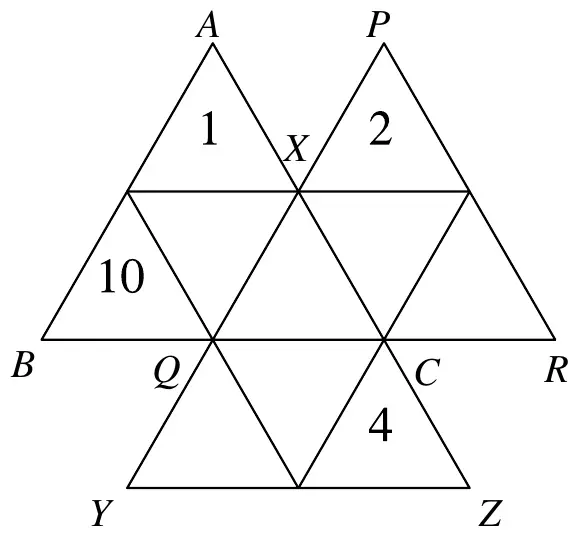
B5. The diagram shows three triangles, \(ABC\), \(PQR\) and \(XYZ\), each
of which is divided up into four smaller triangles. The diagram
is to be completed so that the positive integers from 1 to 10
inclusive are placed, one per small triangle, in the ten small
triangles. The totals of the numbers in the three triangles \(ABC\),
\(PQR\) and \(XYZ\) are the same.
Numbers 1, 2, 4 and 10 have already been placed.
In how many different ways can the diagram be completed?
Junior Mathematical Olympiad 2018, Question B5. © UK Mathematics Trust. Original paper on ukmt.org.uk
Answer: 4
Label the empty small triangles in the second row as \(a\), \(b\), \(c\) and \(d\) from left to right and the empty small triangles in the third row as \(e\) and \(f\) from left to right.
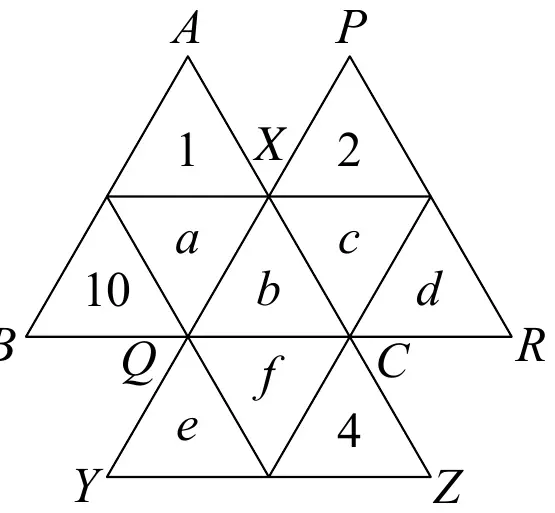
These triangles may only contain the integers 3, 5, 6, 7, 8 or 9.
Since the totals in the triangles \(ABC\), \(PQR\) and \(XYZ\) are the same and the sum of the integers 1 to 10 is 55, we can deduce that
Therefore, \(b = 7\), as it is the only remaining integer that satisfies (1). Consequently, the total in each triangle \(ABC\), \(PQR\) and \(XYZ\) is 23.
Considering the totals in the triangles \(ABC\), \(PQR\) and \(XYZ\) gives
\[\begin{aligned} a + b + 11 &= 23 &\quad (2) \\ b + c + d + 2 &= 23 &\quad (3) \\ \text{and}\quad b + e + f + 4 &= 23 &\quad (4) \end{aligned}\]
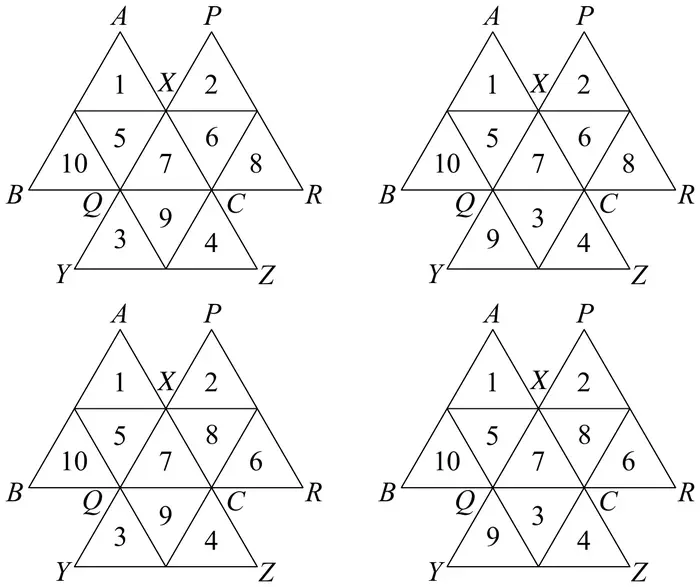
respectively. Equation (2) gives \(a = 5\). The only remaining integers now are 3, 6, 8 and 9. From equations (3) and (4), \(c + d = 14\) and \(e + f = 12\). To satisfy these equations \(c\) and \(d\) must be 8 and 6 in any order and \(e\) and \(f\) must be 3 and 9 in any order. Therefore, there are only 4 different ways in which the diagram can be completed and these are shown below:
Solution © UK Mathematics Trust, from the JMO 2018 solutions.