
JMC 2016 Q16
16. Each of the nine small squares in this grid can be coloured completely black or completely white.
What is the largest number of squares that can be coloured black so that the design created has rotational symmetry of order 2, but no lines of symmetry?
- A 4
- B 5
- C 6
- D 7
- E 8
Junior Mathematical Challenge 2016, Question 16. © UK Mathematics Trust. Original paper on ukmt.org.uk
Answer: B 5
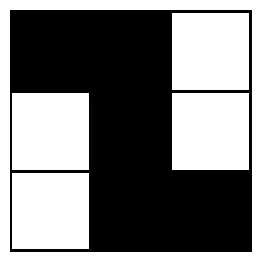
We imagine all the squares being black and consider changing as few as possible to white in order to satisfy the conditions required. First note that the colour of the centre square has no effect on the symmetries involved. So we will leave that black. If we change one corner to white, the opposite corner must also be changed to white to give the rotational symmetry. The diagram still has reflective symmetry. If you instead try changing a non-corner square to white, the opposite one must be. And you again have reflective symmetry. That shows we need to change more than two squares. The rotational symmetry means that the next possiblity is to change 4 squares to white. And the diagram shown shows that it is possible, with four white squares, to have rotational but not reflective symmetry. That means that, in the problem as stated, the maximum number of black squares is 5.
Solution © UK Mathematics Trust, from the JMC 2016 solutions. Longer versions with investigations: Solutions and investigations (PDF).