
JMO 2019 B6
B6. An equilateral triangle is divided into smaller equilateral triangles.
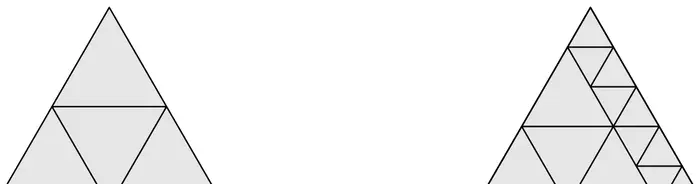
The diagram on the left shows that it is possible to divide it into 4 equilateral triangles.
The diagram on the right shows that it is possible to divide it into 13 equilateral triangles.
What are the integer values of \(n\), where \(n > 1\), for which it is possible to divide the triangle into \(n\) smaller equilateral triangles?
Junior Mathematical Olympiad 2019, Question B6. © UK Mathematics Trust. Original paper on ukmt.org.uk
Answer: all \(n > 1\) except 2, 3 and 5
In this solution we will refer to the triangle which is to be divided into smaller equilateral triangles as the original triangle.
The first diagram in the question shows that it is possible to split the original triangle into four smaller equilateral triangles. This process can be applied to any equilateral triangle, increasing the number of triangles in the dissection by three. Hence we can say that if it is possible to dissect the original triangle into \(m\) triangles, then it is also possible to dissect it into \(m + 3\) triangles by dividing one of the triangles in the manner shown. Since we know we can divide the original triangle into four smaller triangles, we can conclude that we can also divide it into 7, 10, 13 . . . triangles or more generally into \(n\) triangles where \(n\) is one more than a multiple of 3.
Consider figure 1. In this triangle, a line has been drawn parallel to one side
two-thirds of the way from a vertex creating a smaller equilateral triangle
and an isosceles trapezium. Since the angles of this trapezium are 60°, 120°,
120° and 60° and its sides are in the ratio 3 : 1 : 2 : 1, it is possible to divide
the trapezium into five smaller equilateral triangles each with side-length \(\frac{1}{3}\)
the side-length of the original triangle. This shows that a dissection into six
equilateral triangles is possible.
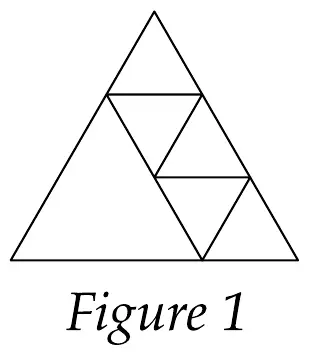
Therefore, applying the result shown above, we can conclude that it is possible to dissect the original triangle into 6, 9, 12 . . . triangles or more generally into \(n\) triangles where \(n\) is a multiple of 3 greater than 3.
Now consider figure 2. In this triangle, a very similar dissection to figure
1 has been carried out, only this time the parallel line is three-quarters of
the way from the vertex, creating an isosceles trapezium with sides in the
4 : 1 : 3 : 1, which can itself be divided into seven smaller equilateral
triangles with side-length \(\frac{1}{4}\) the side-length of the original triangle.
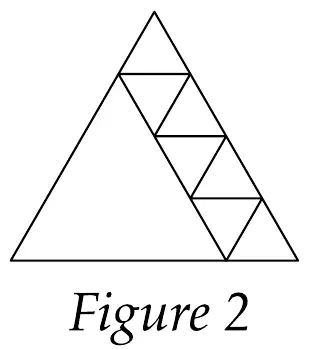
This shows that a dissection into eight equilateral triangles is possible and hence we can conclude that it is possible to dissect the original triangle into 8, 11, 14 . . . triangles or more generally into \(n\) triangles where \(n\) is a one less than a multiple of 3 greater than 6.
Combining these results, it can be seen from the working above that it is possible to dissect the original triangle into \(n\) equilateral triangles for any values of \(n\) except 2, 3 and 5. We will now consider each of these values in turn and prove that it is not possible to create any dissection giving this number of smaller triangles.
Consider the original triangle with its vertices labelled \(P\), \(Q\) and \(R\) as
shown in figure 3. Define a \(D\)-triangle as any triangle in a dissection \(D\)
of the original triangle.
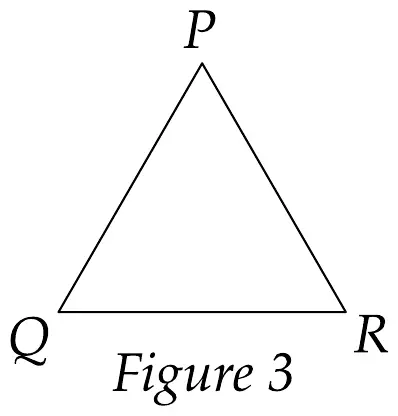
If any two vertices, say \(P\) and \(Q\), are in the same \(D\)-triangle then \(PQ\) is an edge of a \(D\)-triangle which must be the original triangle itself. Therefore it is not possible to have any dissection into two triangles as any such dissection would require one of \(P\), \(Q\) and \(R\) in a different \(D\)-triangle from the other two.
Otherwise \(P\), \(Q\) and \(R\) are in different \(D\)-triangles. Since \(\angle P = 60°\), the only edges of \(D\)-triangles that meet at \(P\) form part of \(PQ\) and \(PR\). Hence \(P\) is in just one \(D\)-triangle and the third edge of that \(D\)-triangle is parallel to the edge \(QR\). A similar argument applies to \(Q\) and \(R\).
Therefore the different possibilities according to the number of these third edges that meet are as shown in figures 4, 5, 6 and 7.
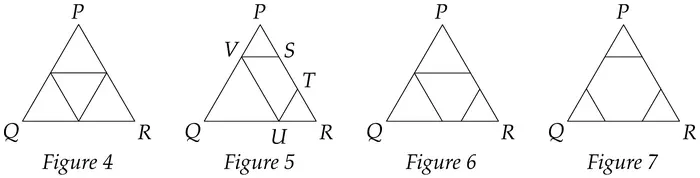
In figure 4, \(D\) consists of at least four triangles and, since none of these can be divided into two equilateral triangles, \(D\) contains either four or at least six triangles. In figure 5, the quadrilateral \(STUV\) has two adjacent angles at \(S\) and \(T\) of 120°. Therefore \(S\) and \(T\) are each vertices of at least two \(D\)-triangles other than \(PVS\) and \(RTU\). Hence \(STUV\) is divided into at least three \(D\)-triangles and so \(D\) consists of at least six triangles. The arguments for figures 6 and 7 are similar. Hence \(D\) cannot consist of 3 or 5 triangles.
Therefore it is not possible to divide the original triangle into 2, 3 or 5 triangles.
Solution © UK Mathematics Trust, from the JMO 2019 solutions.