
JMC 2016 Q13
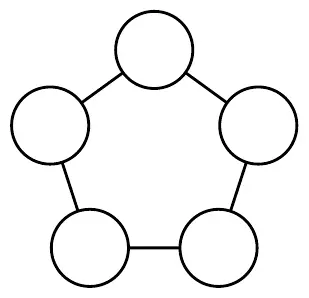
13. The diagram shows five circles placed at the corners of a pentagon.
The numbers 1, 2, 3, 4, 5 are placed in the circles shown, one in each, so that the numbers in adjacent circles always differ by more than 1.
What is the sum of the numbers in the two circles adjacent to the circle which contains the number 5?
- A 3
- B 4
- C 5
- D 6
- E 7
Junior Mathematical Challenge 2016, Question 13. © UK Mathematics Trust. Original paper on ukmt.org.uk
Answer: C 5
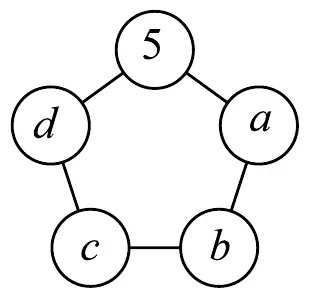
The position of the 5 is immaterial to the question asked, so let it be placed in the top circle. Now 4 differs by 1 from 5 so neither \(a\) nor \(d\) equals 4. Therefore either \(b = 4\) or \(c = 4\). It doesn't matter which it is, because the answer will be symmetric. So let \(b = 4\). Since 3 differs by 1 from 4, neither \(a\) nor \(c\) can be 3, so \(d = 3\). This leaves us with 1 and 2 to place. As 2 cannot be next to 3, \(c \neq 2\) so \(c = 1\) and \(a = 2\). Therefore the sum of the numbers in the two circles adjacent to the circle containing 5 is 3 + 2 = 5.
Solution © UK Mathematics Trust, from the JMC 2016 solutions. Longer versions with investigations: Solutions and investigations (PDF).