
Cayley 2015 Q6
6. I have four identical black beads and four identical white beads.
Carefully explain how many different bracelets I can make using all the beads.
Cayley Olympiad 2015, Question 6. © UK Mathematics Trust. Original paper on ukmt.org.uk
Answer: 8
Firstly, we note the importance of the fact that we are dealing with bracelets: a bracelet can be turned over, as well as turned round. This means that the bracelets shown in the following figures are not counted as different.
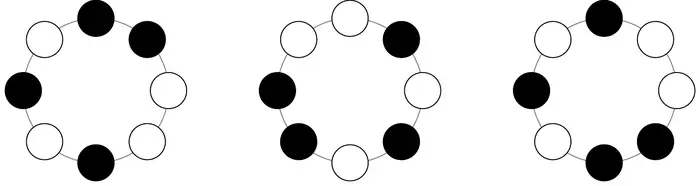
We need to deal with the possibilities in a systematic fashion, to ensure that we count everything.
Our first step is to consider the runs of consecutive black beads. There are five possibilities: 4, \(3 + 1\), \(2 + 2\), \(2 + 1 + 1\) and \(1 + 1 + 1 + 1\). Here the notation \(3 + 1\), for example, means that there is a run of three consecutive black beads and a separate run of just one black bead. We consider each case in turn.
| Case A: | 4 In this case there is only one gap for the white beads, so the four white beads are also consecutive. Just one bracelet is possible, as shown in Figure 1. |

| Case B: | \(3 + 1\) In this case there are two gaps for the white beads, so there are two possibilities for consecutive runs of white beads: \(3 + 1\) or \(2 + 2\). Therefore two bracelets are possible, shown in Figure 2 and Figure 3. |
| Case C: | \(2 + 2\) Once again there are two gaps for the white beads, so there are two possibilities for consecutive runs of white beads: \(3 + 1\) or \(2 + 2\). Therefore two bracelets are possible, shown in Figure 4 and Figure 5. |
| Case D: | \(2 + 1 + 1\) In this case there are three gaps for the white beads. So there is only one possibility for consecutive runs of white beads: \(2 + 1 + 1\). However, two bracelets are possible, shown in Figure 6 and Figure 7, depending on whether the group of two black beads is adjacent to the group of two white beads, or not. |
| Case E: | \(1 + 1 + 1 + 1\) Now there are four gaps for the white beads. So there is only one possibility for consecutive runs of white beads: \(1 + 1 + 1 + 1\). So only one bracelet is possible, shown in Figure 8. |
Therefore exactly eight different bracelets can be made.
Solution © UK Mathematics Trust, from the Cayley Olympiad 2015 solutions.