Factors, Primes & Digits

Your progress
0 of 94 done
Ticks are kept only in this browser: clearing your browsing data or changing device loses them. · ·

Junior Mathematical Challenge (JMC)

Junior Kangaroo (JK)

Junior Mathematical Olympiad (JMO)

Cayley Olympiad (CAY)

JMC 2020 Q23

JMCCurrent spec6 marksFactors, Primes & Digits

23. There is more than one integer, greater than 1, which leaves a remainder of 1 when divided by each of the four smallest primes.
What is the difference between the two smallest such integers?

  1. A 211
  2. B 210
  3. C 31
  4. D 30
  5. E 7

Junior Mathematical Challenge 2020, Question 23. © UK Mathematics Trust. Original paper on ukmt.org.uk

JMC 2020 Q18

JMCCurrent spec6 marksFactors, Primes & Digits

18. How many two-digit primes have both their digits non-prime?

  1. A 6
  2. B 5
  3. C 4
  4. D 3
  5. E 2

Junior Mathematical Challenge 2020, Question 18. © UK Mathematics Trust. Original paper on ukmt.org.uk

JMC 2020 Q7

JMCCurrent spec5 marksFactors, Primes & Digits

7. Four different positive integers have a product of 110. What is the sum of the four integers?

  1. A 19
  2. B 22
  3. C 24
  4. D 25
  5. E 28

Junior Mathematical Challenge 2020, Question 7. © UK Mathematics Trust. Original paper on ukmt.org.uk

JMC 2020 Q1

JMCCurrent spec5 marksFactors, Primes & Digits

1. Exactly one of the following five numbers is not prime. Which is it?

  1. A 101
  2. B 103
  3. C 107
  4. D 109
  5. E 111

Junior Mathematical Challenge 2020, Question 1. © UK Mathematics Trust. Original paper on ukmt.org.uk

JMC 2019 Q22

JMCCurrent spec6 marksAlgebraFactors, Primes & Digits

22. In the multiplication shown alongside, \(T\), \(R\), \(A\) and \(P\) are all different digits.

What is the value of \(R\)?

  1. A 0
  2. B 1
  3. C 5
  4. D 8
  5. E 9
\(\begin{array}{cccc} T&R&A&P\\ \times&&&9\\ \hline P&A&R&T\\ \hline\end{array}\)

Junior Mathematical Challenge 2019, Question 22. © UK Mathematics Trust. Original paper on ukmt.org.uk

JMC 2019 Q20

JMCCurrent spec6 marksFactors, Primes & Digits

20. Emily writes down the largest two-digit prime such that each of its digits is prime.
Krish writes down the smallest two-digit prime such that each of its digits is prime.
Kirsten subtracts Krish’s number from Emily’s number.
What answer does Kirsten obtain?

  1. A 14
  2. B 20
  3. C 36
  4. D 45
  5. E 50

Junior Mathematical Challenge 2019, Question 20. © UK Mathematics Trust. Original paper on ukmt.org.uk

JMC 2019 Q18

18. What fraction of the integers from 1 to 8000 inclusive are cubes?

  1. A \(\dfrac{1}{1000}\)
  2. B \(\dfrac{1}{800}\)
  3. C \(\dfrac{1}{400}\)
  4. D \(\dfrac{1}{200}\)
  5. E \(\dfrac{1}{100}\)

Junior Mathematical Challenge 2019, Question 18. © UK Mathematics Trust. Original paper on ukmt.org.uk

JMC 2019 Q16

JMCCurrent spec6 marksFactors, Primes & Digits

16. Tamsin writes down three two-digit integers. One is square, one is prime and one is triangular.
She uses the digits 3, 4, 5, 6, 7 and 8 exactly once each.

Which prime does she write?

  1. A 37
  2. B 43
  3. C 53
  4. D 73
  5. E 83

Junior Mathematical Challenge 2019, Question 16. © UK Mathematics Trust. Original paper on ukmt.org.uk

JMC 2019 Q10

JMCCurrent spec5 marksFactors, Primes & Digits

10. What is the last digit of the smallest positive integer whose digits add to 2019?

  1. A 1
  2. B 4
  3. C 6
  4. D 8
  5. E 9

Junior Mathematical Challenge 2019, Question 10. © UK Mathematics Trust. Original paper on ukmt.org.uk

JMC 2018 Q18

JMCCurrent spec6 marksFactors, Primes & Digits

18. Between them, the two five-digit integers \(M\) and \(N\) contain all ten digits from 0 to 9.
What is the least possible difference between \(M\) and \(N\)?

  1. A 123
  2. B 247
  3. C 427
  4. D 472
  5. E 742

Junior Mathematical Challenge 2018, Question 18. © UK Mathematics Trust. Original paper on ukmt.org.uk

JMC 2018 Q16

JMCCurrent spec6 marksFactors, Primes & Digits

16. How many pairs of digits \((p, q)\) are there so that the five-digit integer ‘\(p\)869\(q\)’ is a multiple of 15?

  1. A 2
  2. B 3
  3. C 4
  4. D 5
  5. E 6

Junior Mathematical Challenge 2018, Question 16. © UK Mathematics Trust. Original paper on ukmt.org.uk

JMC 2018 Q11

11. How many digits are there in the correct answer to the calculation 123 123 123 123 ÷ 123?

  1. A 4
  2. B 6
  3. C 8
  4. D 10
  5. E 12

Junior Mathematical Challenge 2018, Question 11. © UK Mathematics Trust. Original paper on ukmt.org.uk

JMC 2017 Q23

23. The positive integers from 1 to 150 inclusive are placed in a 10 by 15 grid so that each cell contains exactly one integer. Then the multiples of 3 are given a red mark, the multiples of 5 are given a blue mark, and the multiples of 7 are given a green mark.
How many cells have more than 1 mark?

  1. A 10
  2. B 12
  3. C 15
  4. D 18
  5. E 19

Junior Mathematical Challenge 2017, Question 23. © UK Mathematics Trust. Original paper on ukmt.org.uk

JMC 2017 Q18

JMCCurrent spec6 marksFactors, Primes & Digits

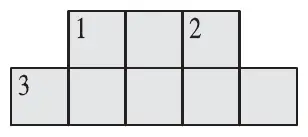
18. What is the sum of the digits in the completed crossnumber?

Across
 1. A cube
 3. A power of 11
Down
 2. A square
Crossnumber grid: a row of three cells above the right-hand three of a row of five cells; 1 is in the first top cell, 2 in the third top cell and 3 in the first bottom cell
  1. A 25
  2. B 29
  3. C 32
  4. D 34
  5. E 35

Junior Mathematical Challenge 2017, Question 18. © UK Mathematics Trust. Original paper on ukmt.org.uk

JMC 2017 Q15

JMCCurrent spec5 marksFactors, Primes & Digits

15. What is the remainder when the square of 49 is divided by the square root of 49?

  1. A 0
  2. B 2
  3. C 3
  4. D 4
  5. E 7

Junior Mathematical Challenge 2017, Question 15. © UK Mathematics Trust. Original paper on ukmt.org.uk

JMC 2017 Q10

JMCCurrent spec5 marksFactors, Primes & Digits

10. Which of the following integers is not a multiple of 45?

  1. A 765
  2. B 675
  3. C 585
  4. D 495
  5. E 305

Junior Mathematical Challenge 2017, Question 10. © UK Mathematics Trust. Original paper on ukmt.org.uk

JMC 2016 Q18

JMCCurrent spec6 marksAlgebraFactors, Primes & Digits

18. In the addition sum shown, each letter represents a different non-zero digit.
What digit does \(X\) represent?

  1. A 1
  2. B 3
  3. C 5
  4. D 7
  5. E 9
\(\begin{array}{cccc} & S & E & E\\ + & S & E & E\\ \hline A & X & E & S\end{array}\)

Junior Mathematical Challenge 2016, Question 18. © UK Mathematics Trust. Original paper on ukmt.org.uk

JMC 2016 Q15

15. How many of these four expressions are perfect squares?

\(1^3 + 2^3\)  \(1^3 + 2^3 + 3^3\)  \(1^3 + 2^3 + 3^3 + 4^3\)  \(1^3 + 2^3 + 3^3 + 4^3 + 5^3\)
  1. A 0
  2. B 1
  3. C 2
  4. D 3
  5. E 4

Junior Mathematical Challenge 2016, Question 15. © UK Mathematics Trust. Original paper on ukmt.org.uk

JMC 2016 Q11

JMCCurrent spec5 marksFactors, Primes & Digits

11. Which of the following statements is false?

  1. A 12 is a multiple of 2
  2. B 123 is a multiple of 3
  3. C 1234 is a multiple of 4
  4. D 12 345 is a multiple of 5
  5. E 123 456 is a multiple of 6

Junior Mathematical Challenge 2016, Question 11. © UK Mathematics Trust. Original paper on ukmt.org.uk

JMC 2015 Q24

JMCCurrent spec6 marksFactors, Primes & Digits

24. A palindromic number is a number that reads the same when the order of its digits is reversed. What is the difference between the largest and smallest five-digit palindromic numbers that are both multiples of 45?

  1. A 9180
  2. B 9090
  3. C 9000
  4. D 8910
  5. E 8190

Junior Mathematical Challenge 2015, Question 24. © UK Mathematics Trust. Original paper on ukmt.org.uk

JMC 2015 Q19

19. One of the following cubes is the smallest cube that can be written as the sum of three positive cubes. Which is it?

  1. A 27
  2. B 64
  3. C 125
  4. D 216
  5. E 512

Junior Mathematical Challenge 2015, Question 19. © UK Mathematics Trust. Original paper on ukmt.org.uk

JMC 2015 Q15

JMCCurrent spec5 marksFactors, Primes & Digits

15. Which of the following is divisible by all of the integers from 1 to 10 inclusive?

  1. A 23 × 34
  2. B 34 × 45
  3. C 45 × 56
  4. D 56 × 67
  5. E 67 × 78

Junior Mathematical Challenge 2015, Question 15. © UK Mathematics Trust. Original paper on ukmt.org.uk

JMC 2015 Q14

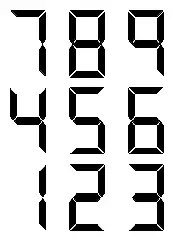
14. Digits on a calculator are represented by a number of horizontal and vertical illuminated bars. The digits and the bars which represent them are shown in the diagram.
How many digits are both prime and represented by a prime number of illuminated bars?

  1. A 0
  2. B 1
  3. C 2
  4. D 3
  5. E 4
The calculator digits 7, 8, 9, 4, 5, 6, 1, 2 and 3 made of illuminated bars

Junior Mathematical Challenge 2015, Question 14. © UK Mathematics Trust. Original paper on ukmt.org.uk

JMC 2015 Q13

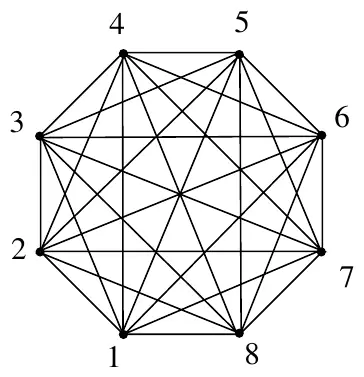
13. In the figure shown, each line joining two numbers is to be labelled with the sum of the two numbers that are at its end points.

How many of these labels are multiples of 3?

  1. A 10
  2. B 9
  3. C 8
  4. D 7
  5. E 6
The numbers 1 to 8 at the vertices of an octagon, with every pair of numbers joined by a line

Junior Mathematical Challenge 2015, Question 13. © UK Mathematics Trust. Original paper on ukmt.org.uk

JMC 2015 Q11

JMCCurrent spec5 marksFactors, Primes & Digits

11. What is the smallest prime number that is the sum of three different prime numbers?

  1. A 11
  2. B 15
  3. C 17
  4. D 19
  5. E 23

Junior Mathematical Challenge 2015, Question 11. © UK Mathematics Trust. Original paper on ukmt.org.uk

JMC 2015 Q8

JMCCurrent spec5 marksFactors, Primes & Digits

8. Which of the following has the same remainder when it is divided by 2 as when it is divided by 3?

  1. A 3
  2. B 5
  3. C 7
  4. D 9
  5. E 11

Junior Mathematical Challenge 2015, Question 8. © UK Mathematics Trust. Original paper on ukmt.org.uk

JMC 2015 Q7

7. The result of the calculation 123 456 789 × 8 is almost the same as 987 654 321 except that two of the digits are in a different order. What is the sum of these two digits?

  1. A 3
  2. B 7
  3. C 9
  4. D 15
  5. E 17

Junior Mathematical Challenge 2015, Question 7. © UK Mathematics Trust. Original paper on ukmt.org.uk

JMC 2014 Q8

JMCCurrent spec5 marksFactors, Primes & Digits

8. How many prime numbers are there in the list

1, 12, 123, 1234, 12 345, 123 456 ?
  1. A 0
  2. B 1
  3. C 2
  4. D 3
  5. E 4

Junior Mathematical Challenge 2014, Question 8. © UK Mathematics Trust. Original paper on ukmt.org.uk

JMC 2012 Q23

JMCCurrent spec6 marksFactors, Primes & Digits

23. Peter wrote a list of all the numbers that could be produced by changing one digit of the number 200. How many of the numbers on Peter’s list are prime?

  1. A 0
  2. B 1
  3. C 2
  4. D 3
  5. E 4

Junior Mathematical Challenge 2012, Question 23. © UK Mathematics Trust. Original paper on ukmt.org.uk

JMC 2012 Q13

JMCCurrent spec5 marksAlgebraFactors, Primes & Digits

13. In the multiplication grid on the right, the input factors (in the first row and the first column) are all missing and only some of the products within the table have been given.
What is the value of A + B + C + D + E?

  1. A 132
  2. B 145
  3. C 161
  4. D 178
  5. E 193
×
A1020
15B40
18C60
20D24
56E

Junior Mathematical Challenge 2012, Question 13. © UK Mathematics Trust. Original paper on ukmt.org.uk

JMC 2012 Q3

JMCCurrent spec5 marksFactors, Primes & Digits

3. Which of the following has exactly one factor other than 1 and itself?

  1. A 6
  2. B 8
  3. C 13
  4. D 19
  5. E 25

Junior Mathematical Challenge 2012, Question 3. © UK Mathematics Trust. Original paper on ukmt.org.uk

JMC 2012 Q1

JMCCurrent spec5 marksFactors, Primes & Digits

1. What is the smallest four-digit positive integer which has four different digits?

  1. A 1032
  2. B 2012
  3. C 1021
  4. D 1234
  5. E 1023

Junior Mathematical Challenge 2012, Question 1. © UK Mathematics Trust. Original paper on ukmt.org.uk

JMC 2011 Q19

JMCCurrent spec6 marksFactors, Primes & Digits

19. A list is made of every digit that is the units digit of at least one prime number. How many of the following numbers appear in the list?

  1. A 1
  2. B 2
  3. C 3
  4. D 4
  5. E 5

Junior Mathematical Challenge 2011, Question 19. © UK Mathematics Trust. Original paper on ukmt.org.uk

JMC 2011 Q9

JMCCurrent spec5 marksFactors, Primes & Digits

9. What is the smallest possible difference between two different nine-digit integers, each of which includes all of the digits 1 to 9?

  1. A 9
  2. B 18
  3. C 27
  4. D 36
  5. E 45

Junior Mathematical Challenge 2011, Question 9. © UK Mathematics Trust. Original paper on ukmt.org.uk

JMC 2011 Q2

JMCCurrent spec5 marksFactors, Primes & Digits

2. How many of the integers 123, 234, 345, 456, 567 are multiples of 3?

  1. A 1
  2. B 2
  3. C 3
  4. D 4
  5. E 5

Junior Mathematical Challenge 2011, Question 2. © UK Mathematics Trust. Original paper on ukmt.org.uk

JMC 2010 Q24

24. The year 2010 belongs to a special sequence of twenty-five consecutive years: each number from 1988 to 2012 contains a repeated digit.
Each of the following belongs to a sequence of consecutive years, where each number in the sequence contains at least one repeated digit.
Which of them belongs to the next such sequence of at least twenty years?

  1. A 2099
  2. B 2120
  3. C 2199
  4. D 2989
  5. E 3299

Junior Mathematical Challenge 2010, Question 24. © UK Mathematics Trust. Original paper on ukmt.org.uk

JMC 2010 Q22

JMCCurrent spec6 marksFactors, Primes & Digits

22. Kiran writes down six different prime numbers, \(p\), \(q\), \(r\), \(s\), \(t\), \(u\), all less than 20, such that \(p + q = r + s = t + u\). What is the value of \(p + q\)?

  1. A 16
  2. B 18
  3. C 20
  4. D 22
  5. E 24

Junior Mathematical Challenge 2010, Question 22. © UK Mathematics Trust. Original paper on ukmt.org.uk

JMC 2010 Q18

JMCCurrent spec6 marksFactors, Primes & Digits

18. Sam's 101st birthday is tomorrow. So Sam's age in years changes from a square number (100) to a prime number (101). How many times has this happened before in Sam's lifetime?

  1. A 1
  2. B 2
  3. C 3
  4. D 4
  5. E 5

Junior Mathematical Challenge 2010, Question 18. © UK Mathematics Trust. Original paper on ukmt.org.uk

JMC 2010 Q7

JMCCurrent spec5 marksFactors, Primes & Digits

7. Mr Owens wants to keep the students quiet during a Mathematics lesson. He asks them to multiply all the numbers from 1 to 99 together and then tell him the last-but-one digit of the result. What is the correct answer?

  1. A 0
  2. B 1
  3. C 2
  4. D 8
  5. E 9

Junior Mathematical Challenge 2010, Question 7. © UK Mathematics Trust. Original paper on ukmt.org.uk

JMC 2009 Q18

JMCCurrent spec6 marksFactors, Primes & Digits

18. Six friends are having dinner together in their local restaurant. The first eats there every day, the second eats there every other day, the third eats there every third day, the fourth eats there every fourth day, the fifth eats there every fifth day and the sixth eats there every sixth day. They agree to have a party the next time they all eat together there. In how many days' time is the party?

  1. A 30 days
  2. B 60 days
  3. C 90 days
  4. D 120 days
  5. E 360 days

Junior Mathematical Challenge 2009, Question 18. © UK Mathematics Trust. Original paper on ukmt.org.uk

JMC 2009 Q5

JMCCurrent spec5 marksFactors, Primes & Digits

5. Which of the following numbers is divisible by 7?

  1. A 111
  2. B 1111
  3. C 11 111
  4. D 111 111
  5. E 1 111 111

Junior Mathematical Challenge 2009, Question 5. © UK Mathematics Trust. Original paper on ukmt.org.uk

JMC 2007 Q22

JMCCurrent spec6 marksFactors, Primes & Digits

22. Only one choice of the digit \(d\) gives a prime number for each of the three-digit numbers read across and downwards in the diagram on the right.
Which digit is \(d\) ?

  1. A 4
  2. B 5
  3. C 6
  4. D 7
  5. E 8
\(\begin{array}{ccc} & 5 & \\ 1 & d & 3\\ & 7 & \end{array}\)

Junior Mathematical Challenge 2007, Question 22. © UK Mathematics Trust. Original paper on ukmt.org.uk

JMC 2007 Q4

JMCCurrent spec5 marksFactors, Primes & Digits

4. Which of the following numbers is three less than a multiple of 5 and three more than a multiple of 6?

  1. A 12
  2. B 17
  3. C 21
  4. D 22
  5. E 27

Junior Mathematical Challenge 2007, Question 4. © UK Mathematics Trust. Original paper on ukmt.org.uk

JMC 2006 Q22

JMCCurrent spec6 marksFactors, Primes & Digits

22. A positive whole number less than 100 has remainder 2 when it is divided by 3, remainder 3 when it is divided by 4 and remainder 4 when it is divided by 5. What is its remainder when it is divided by 7?

  1. A 2
  2. B 3
  3. C 4
  4. D 5
  5. E 6

Junior Mathematical Challenge 2006, Question 22. © UK Mathematics Trust. Original paper on ukmt.org.uk

JMC 2006 Q20

JMCCurrent spec6 marksFactors, Primes & Digits

20. The sum of three different prime numbers is 40. What is the difference between the two biggest of these three numbers?

  1. A 8
  2. B 12
  3. C 16
  4. D 20
  5. E 24

Junior Mathematical Challenge 2006, Question 20. © UK Mathematics Trust. Original paper on ukmt.org.uk

JMC 2006 Q13

JMCCurrent spec5 marksFactors, Primes & Digits

13. At the end of a hard day at the mine, the seven dwarves share out all their gold nuggets, making sure that they each get the same number of nuggets. If there are any left over, they are given to Snow White. Which number of nuggets would leave Snow White with the most?

  1. A 300
  2. B 400
  3. C 500
  4. D 600
  5. E 700

Junior Mathematical Challenge 2006, Question 13. © UK Mathematics Trust. Original paper on ukmt.org.uk

JMC 2005 Q15

JMCCurrent spec5 marksFactors, Primes & Digits

15. There are six different three-digit numbers, each of which contains all the digits 1, 3 and 5.
How many of these three-digit numbers are prime?

  1. A 0
  2. B 1
  3. C 2
  4. D 3
  5. E 4

Junior Mathematical Challenge 2005, Question 15. © UK Mathematics Trust. Original paper on ukmt.org.uk

JMC 2004 Q5

JMCCurrent spec5 marksFactors, Primes & Digits

5. The word ‘thirty’ contains 6 letters and 6 = 30 ÷ 5. Similarly, the word ‘forty’ contains 5 letters and 5 = 40 ÷ 8. Which of the following is not a multiple of the number of letters it contains?

  1. A six
  2. B twelve
  3. C eighteen
  4. D seventy
  5. E ninety

Junior Mathematical Challenge 2004, Question 5. © UK Mathematics Trust. Original paper on ukmt.org.uk

JMC 2004 Q2

JMCCurrent spec5 marksFactors, Primes & Digits

2. Which of the following numbers is exactly divisible by 7?

  1. A 104
  2. B 106
  3. C 108
  4. D 110
  5. E 112

Junior Mathematical Challenge 2004, Question 2. © UK Mathematics Trust. Original paper on ukmt.org.uk

JK 2019 Q25

25. The room numbers of a hotel are all three-digit numbers. The first digit represents the floor and the last two digits represent the room number. The hotel has rooms on five floors, numbered 1 to 5. It has 35 rooms on each floor, numbered n01 to n35 where n is the number of the floor. In numbering all the rooms, how many times will the digit 2 be used?

  1. A 60
  2. B 65
  3. C 95
  4. D 100
  5. E 105

Junior Kangaroo 2019, Question 25. © UK Mathematics Trust. Original paper on ukmt.org.uk

JK 2019 Q13

13. What is the minimum number of cubes of the same size required to fill a box with dimensions 30 cm by 40 cm by 50 cm?

  1. A 20
  2. B 40
  3. C 60
  4. D 80
  5. E 120

Junior Kangaroo 2019, Question 13. © UK Mathematics Trust. Original paper on ukmt.org.uk

JK 2019 Q11

11. Two of the following four facts about a positive integer \(N\) are true and two are false.

\(N\) is divisible by 5
\(N\) is divisible by 11
\(N\) is divisible by 55
\(N\) is less than 10

What is the value of \(N\)?

  1. A 5
  2. B 10
  3. C 11
  4. D 55
  5. E 110

Junior Kangaroo 2019, Question 11. © UK Mathematics Trust. Original paper on ukmt.org.uk

JK 2019 Q9

JKCurrent spec5 marksFactors, Primes & Digits

9. What is the smallest possible sum of two positive integers whose product is 240?

  1. A 30
  2. B 31
  3. C 32
  4. D 34
  5. E 38

Junior Kangaroo 2019, Question 9. © UK Mathematics Trust. Original paper on ukmt.org.uk

JK 2019 Q1

1. Riana has been asked to erase digits from the number 12 323 314 to obtain a number which reads the same from left to right as it does from right to left. What is the smallest number of digits Riana needs to erase?

  1. A 1
  2. B 2
  3. C 3
  4. D 4
  5. E 5

Junior Kangaroo 2019, Question 1. © UK Mathematics Trust. Original paper on ukmt.org.uk

JK 2018 Q25

JKCurrent spec6 marksFactors, Primes & Digits

25. What is the largest number of digits that can be erased from the 1000-digit number 201820182018....2018 so that the sum of the remaining digits is 2018?

  1. A 343
  2. B 582
  3. C 671
  4. D 741
  5. E 746

Junior Kangaroo 2018, Question 25. © UK Mathematics Trust. Original paper on ukmt.org.uk

JK 2018 Q24

JKCurrent spec6 marksAlgebraFactors, Primes & Digits

24. In the sum \(\begin{array}{r} K\,A\,N \\ \underline{+\,G\,A} \\ R\,O\,O \end{array}\) each letter stands for a different digit.

What is the answer to the subtraction \(\begin{array}{r} R\,N \\ \underline{-\,K\,G} \end{array}\) ?

  1. A 10
  2. B 11
  3. C 12
  4. D 21
  5. E 22

Junior Kangaroo 2018, Question 24. © UK Mathematics Trust. Original paper on ukmt.org.uk

JK 2018 Q20

JKCurrent spec6 marksFactors, Primes & Digits

20. Steven subtracts the units digit from the tens digit for each two-digit number. He then finds the sum of all his answers.
What is the value of Steven's sum?

  1. A 30
  2. B 45
  3. C 55
  4. D 90
  5. E 100

Junior Kangaroo 2018, Question 20. © UK Mathematics Trust. Original paper on ukmt.org.uk

JK 2018 Q14

14. A box contains seven cards, each with a different integer from 1 to 7 written on it. Avani takes three cards from the box and then Niamh takes two cards, leaving two cards in the box. Avani looks at her cards and then tells Niamh “I know the sum of the numbers on your cards is even.” What is the sum of the numbers on Avani's cards?

  1. A 6
  2. B 9
  3. C 10
  4. D 11
  5. E 12

Junior Kangaroo 2018, Question 14. © UK Mathematics Trust. Original paper on ukmt.org.uk

JK 2018 Q2

JKCurrent spec5 marksFactors, Primes & Digits

2. Which of the following expressions, when it replaces the symbol Ω, makes the equation Ω × Ω = 2 × 2 × 2 × 2 × 3 × 3 correct?

  1. A 2
  2. B 3
  3. C 2 × 3
  4. D 2 × 3 × 3
  5. E 2 × 2 × 3

Junior Kangaroo 2018, Question 2. © UK Mathematics Trust. Original paper on ukmt.org.uk

JK 2017 Q25

JKCurrent spec6 marksAlgebraFactors, Primes & Digits

25. How many three-digit numbers are equal to 34 times the sum of their digits?

  1. A 0
  2. B 1
  3. C 2
  4. D 3
  5. E 4

Junior Kangaroo 2017, Question 25. © UK Mathematics Trust. Original paper on ukmt.org.uk

JK 2017 Q22

22. Harriet tells Topaz that she is thinking of three positive integers, not necessarily all different. She tells her that the product of her three integers is 36. She also tells her the sum of her three integers. However, Topaz still cannot work out what the three integers are.
What is the sum of Harriet's three integers?

  1. A 10
  2. B 11
  3. C 13
  4. D 14
  5. E 16

Junior Kangaroo 2017, Question 22. © UK Mathematics Trust. Original paper on ukmt.org.uk

JK 2017 Q20

JKCurrent spec6 marksFactors, Primes & Digits

20. The multiplication \(abc \times de = 7632\) uses each of the digits 1 to 9 exactly once. What is the value of \(b\)?

  1. A 1
  2. B 4
  3. C 5
  4. D 8
  5. E 9

Junior Kangaroo 2017, Question 20. © UK Mathematics Trust. Original paper on ukmt.org.uk

JK 2017 Q6

6. Hasan writes down a two-digit number. He then writes the same two-digit number next to his original number to form a four-digit number. What is the ratio of his four-digit number to his two-digit number ?

  1. A 2 : 1
  2. B 100 : 1
  3. C 101 : 1
  4. D 1001 : 1
  5. E It depends on his number

Junior Kangaroo 2017, Question 6. © UK Mathematics Trust. Original paper on ukmt.org.uk

JK 2016 Q25

25. The whole numbers from 1 to 2016 inclusive are written on a blackboard. Moritz underlines all the multiples of two in red, all the multiples of three in blue and all the multiples of four in green. How many numbers does Moritz underline exactly twice?

  1. A 1008
  2. B 1004
  3. C 504
  4. D 336
  5. E 168

Junior Kangaroo 2016, Question 25. © UK Mathematics Trust. Original paper on ukmt.org.uk

JK 2016 Q23

JKCurrent spec6 marksAlgebraFactors, Primes & Digits

23. In the addition sum below, \(a\), \(b\) and \(c\) stand for different digits.
\[\begin{array}{cr} & a\,b\,c \\ + & \underline{a\,c\,b} \\ & c\;4\;a. \end{array}\]
What is the value of \(a + b + c\)?

  1. A 20
  2. B 19
  3. C 18
  4. D 17
  5. E 16

Junior Kangaroo 2016, Question 23. © UK Mathematics Trust. Original paper on ukmt.org.uk

JK 2016 Q13

JKCurrent spec5 marksAlgebraFactors, Primes & Digits

13. The tens digit of a two-digit number is three more than the units digit. When this two-digit number is divided by the sum of its digits, the answer is 7 remainder 3. What is the sum of the digits of the two-digit number?

  1. A 5
  2. B 7
  3. C 9
  4. D 11
  5. E 13

Junior Kangaroo 2016, Question 13. © UK Mathematics Trust. Original paper on ukmt.org.uk

JK 2016 Q11

JKCurrent spec5 marksFactors, Primes & Digits

11. Joey calculated the sum of the largest and smallest two-digit numbers that are multiples of three. Zoë calculated the sum of the largest and smallest two-digit numbers that are not multiples of three. What is the difference between their answers?

  1. A 2
  2. B 3
  3. C 4
  4. D 5
  5. E 6

Junior Kangaroo 2016, Question 11. © UK Mathematics Trust. Original paper on ukmt.org.uk

JK 2015 Q23

JKCurrent spec6 marksFactors, Primes & Digits

23. How many three-digit numbers have an odd number of factors?

  1. A 5
  2. B 10
  3. C 20
  4. D 21
  5. E 22

Junior Kangaroo 2015, Question 23. © UK Mathematics Trust. Original paper on ukmt.org.uk

JK 2015 Q21

JKCurrent spec6 marksFactors, Primes & Digits

21. Peter has a lock with a three-digit code. He knows that all the digits of his code are different and that if he divides the second digit by the third and then squares his answer, he will get the first digit. What is the difference between the largest and smallest possible codes?

  1. A 42
  2. B 468
  3. C 499
  4. D 510
  5. E 541

Junior Kangaroo 2015, Question 21. © UK Mathematics Trust. Original paper on ukmt.org.uk

JK 2015 Q12

JKCurrent spec5 marksFactors, Primes & Digits

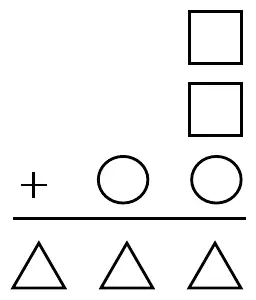
12. In the sum shown, different shapes represent different digits.
What digit does the square represent?

  1. A 2
  2. B 4
  3. C 6
  4. D 8
  5. E 9
A column addition: a square, a square below it, then plus a circle and a circle, giving the answer of three triangles

Junior Kangaroo 2015, Question 12. © UK Mathematics Trust. Original paper on ukmt.org.uk

JMO 2019 B2

JMOCurrent spec10 marksFactors, Primes & Digits

B2. The product \(8000 \times K\) is a square, where \(K\) is a positive integer.

What is the smallest possible value of \(K\)?

Junior Mathematical Olympiad 2019, Question B2. © UK Mathematics Trust. Original paper on ukmt.org.uk

JMO 2019 A9

JMOCurrent spec1 markFactors, Primes & Digits

A9. The number 3600 can be written as \(2^a \times 3^b \times 4^c \times 5^d\), where \(a\), \(b\), \(c\) and \(d\) are all positive integers. It is given that \(a + b + c + d = 7\).

What is the value of \(c\)?

Junior Mathematical Olympiad 2019, Question A9. © UK Mathematics Trust. Original paper on ukmt.org.uk

JMO 2019 A7

JMOCurrent spec1 markFactors, Primes & Digits

A7. Two 2-digit multiples of 7 have a product of 7007.

What is their sum?

Junior Mathematical Olympiad 2019, Question A7. © UK Mathematics Trust. Original paper on ukmt.org.uk

JMO 2019 A5

A5. Dani wrote the integers from 1 to \(N\). She used the digit 1 fifteen times. She used the digit 2 fourteen times.

What is \(N\)?

Junior Mathematical Olympiad 2019, Question A5. © UK Mathematics Trust. Original paper on ukmt.org.uk

JMO 2018 B3

JMOCurrent spec10 marksFactors, Primes & Digits

B3. The letters \(a\), \(b\) and \(c\) stand for non-zero digits. The integer ‘\(abc\)’ is a multiple of 3; the integer ‘\(cbabc\)’ is a multiple of 15; and the integer ‘\(abcba\)’ is a multiple of 8.

What is the integer ‘\(abc\)’?

Junior Mathematical Olympiad 2018, Question B3. © UK Mathematics Trust. Original paper on ukmt.org.uk

JMO 2018 A10

JMOCurrent spec1 markAlgebraFactors, Primes & Digits

A10. A four-digit integer has its digits increasing from left to right. When we reverse the order of the digits, we obtain a four-digit integer whose digits decrease from left to right. A third four-digit integer uses exactly the same digits, but in a different order. The sum of the three integers is 26 352.

What is the value of the smallest of the three integers?

Junior Mathematical Olympiad 2018, Question A10. © UK Mathematics Trust. Original paper on ukmt.org.uk

JMO 2018 A6

JMOCurrent spec1 markFactors, Primes & Digits

A6. A two-digit number ‘\(ab\)’ is multiplied by its reverse ‘\(ba\)’. The ones (units) and tens digits of the four-digit answer are both 0.

What is the value of the smallest such two-digit number ‘\(ab\)’?

Junior Mathematical Olympiad 2018, Question A6. © UK Mathematics Trust. Original paper on ukmt.org.uk

JMO 2018 A3

JMOCurrent spec1 markFactors, Primes & Digits

A3. What is the largest integer for which each pair of consecutive digits is a square?

Junior Mathematical Olympiad 2018, Question A3. © UK Mathematics Trust. Original paper on ukmt.org.uk

JMO 2017 B6

JMOCurrent spec10 marksFactors, Primes & Digits

B6. The 9-digit positive integer \(N\) with digit pattern \(ABCABCBBB\) is divisible by every integer from 1 to 17 inclusive.

The digits \(A\), \(B\) and \(C\) are distinct. What are the values of \(A\), \(B\) and \(C\)?

Junior Mathematical Olympiad 2017, Question B6. © UK Mathematics Trust. Original paper on ukmt.org.uk

JMO 2017 B2

B2. A 3-digit integer is called a ‘V-number’ if the digits go ‘high-low-high’ – that is, if the tens digit is smaller than both the hundreds digit and the units (or ‘ones’) digit.

How many 3-digit ‘V-numbers’ are there?

Junior Mathematical Olympiad 2017, Question B2. © UK Mathematics Trust. Original paper on ukmt.org.uk

JMO 2017 A9

A9. How many multiples of 3 that are less than 1000 are not divisible either by 9 or by 10?

Junior Mathematical Olympiad 2017, Question A9. © UK Mathematics Trust. Original paper on ukmt.org.uk

JMO 2016 A7

JMOCurrent spec1 markFactors, Primes & Digits

A7. A certain positive integer has exactly eight factors. Two of these factors are 15 and 21.

What is the sum of all eight factors?

Junior Mathematical Olympiad 2016, Question A7. © UK Mathematics Trust. Original paper on ukmt.org.uk

JMO 2016 A1

JMOCurrent spec1 markFactors, Primes & Digits

A1. Roger picks two consecutive integers, one of which ends in a 5. He multiplies the integers together and then squares the result.

What are the last two digits of his answer?

Junior Mathematical Olympiad 2016, Question A1. © UK Mathematics Trust. Original paper on ukmt.org.uk

JMO 2015 B1

JMOCurrent spec10 marksFactors, Primes & Digits

B1. Let \(N\) be the smallest positive integer whose digits add up to 2015.

What is the sum of the digits of \(N + 1\)?

Junior Mathematical Olympiad 2015, Question B1. © UK Mathematics Trust. Original paper on ukmt.org.uk

JMO 2015 A10

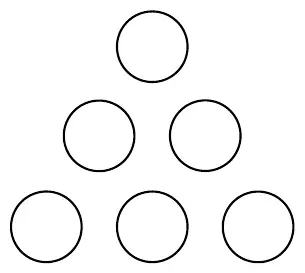
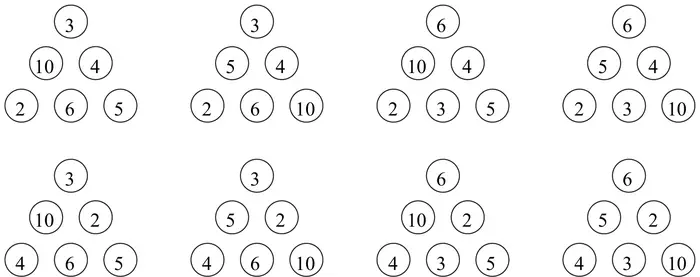
A10. Lucy wants to put the numbers 2, 3, 4, 5, 6 and 10 into the
circles so that the products of the three numbers along
each edge are the same, and as large as possible.

What is this product?

Six circles arranged in a triangle, three along each edge

Junior Mathematical Olympiad 2015, Question A10. © UK Mathematics Trust. Original paper on ukmt.org.uk

JMO 2015 A8

JMOCurrent spec1 markFactors, Primes & Digits

A8. What is the units digit in the answer to the sum \(9^{2015} + 9^{2016}\)?

Junior Mathematical Olympiad 2015, Question A8. © UK Mathematics Trust. Original paper on ukmt.org.uk

Cayley 2020 Q6

6. Martha and Nadia play a game. Each has to make her own four-digit number, choosing her four digits from eight “digit cards” labelled 1-8. First Martha chooses her thousands digit, and then Nadia chooses her thousands digit. Next, Martha chooses her hundreds digit from the remaining six cards, and then Nadia chooses her hundreds digit. This process is repeated for the tens and finally the units digits of their numbers. The two four-digit numbers produced are then added together. Martha wins if the sum is not a multiple of 6; Nadia wins if the sum is a multiple of 6.

Determine which player has a winning strategy (that is to say, which player can guarantee that she will win no matter which digits the other player chooses).

Cayley Olympiad 2020, Question 6. © UK Mathematics Trust. Original paper on ukmt.org.uk

Cayley 2020 Q2

CAYCurrent spec10 marksFactors, Primes & Digits

2. The digits 1, 2, 3, 4, 5, \(A\) and \(B\) are all different and nonzero. Each of the two six-digit integers ‘A12345’ and ‘12345A’ is divisible by \(B\).

Find all possible pairs of values of \(A\) and \(B\).

Cayley Olympiad 2020, Question 2. © UK Mathematics Trust. Original paper on ukmt.org.uk

Cayley 2019 Q4

4. Arrange the digits 1, 2, 3, 4, 5, 6, 7, 8 to form two 4-digit integers whose difference is as small as possible.

Explain clearly why your arrangement achieves the smallest possible difference.

Cayley Olympiad 2019, Question 4. © UK Mathematics Trust. Original paper on ukmt.org.uk

Cayley 2018 Q1

1. The positive integer \(N\) has six digits in increasing order. For example, 124 689 is such a number.

However, unlike 124 689, three of the digits of \(N\) are 3, 4 and 5, and \(N\) is a multiple of 6.
How many possible six-digit integers \(N\) are there?

Cayley Olympiad 2018, Question 1. © UK Mathematics Trust. Original paper on ukmt.org.uk

Cayley 2017 Q6

CAYCurrent spec10 marksAlgebraFactors, Primes & Digits

6. We write ‘pq’ to denote the two-digit integer with tens digit \(p\) and units digit \(q\).

For which values of \(a\), \(b\) and \(c\) are the two fractions \(\dfrac{\text{‘}ab\text{’}}{\text{‘}ba\text{’}}\) and \(\dfrac{\text{‘}bc\text{’}}{\text{‘}cb\text{’}}\) equal and different from 1?

Cayley Olympiad 2017, Question 6. © UK Mathematics Trust. Original paper on ukmt.org.uk

Cayley 2016 Q5

5. Dean wishes to place the positive integers 1, 2, 3, …, 9 in the cells of a \(3 \times 3\) square grid so that:

(i)there is exactly one number in each cell;
(ii)the product of the numbers in each row is a multiple of four;
(iii)the product of the numbers in each column is a multiple of four.

Is Dean's task possible? Prove that your answer is correct.

Cayley Olympiad 2016, Question 5. © UK Mathematics Trust. Original paper on ukmt.org.uk

Cayley 2016 Q1

1. How many three-digit multiples of 9 consist only of odd digits?

Cayley Olympiad 2016, Question 1. © UK Mathematics Trust. Original paper on ukmt.org.uk