
JMC 2012 Q22
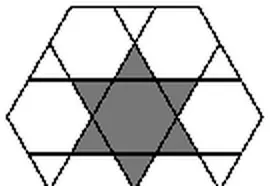
22. The diagram shows a design formed by drawing six lines in a regular hexagon. The lines divide each edge of the hexagon into three equal parts.
What fraction of the hexagon is shaded?
- A \(\dfrac{1}{5}\)
- B \(\dfrac{2}{9}\)
- C \(\dfrac{1}{4}\)
- D \(\dfrac{3}{10}\)
- E \(\dfrac{5}{16}\)
Junior Mathematical Challenge 2012, Question 22. © UK Mathematics Trust. Original paper on ukmt.org.uk
Answer: B \(\dfrac{2}{9}\)
The original hexagon has been divided into seven regular hexagons and twelve equilateral triangles. Six equilateral triangles are equal in area to one smaller hexagon, so the large hexagon is equal in area to nine of the smaller hexagons. (This may also be deduced from the fact that their sides are in the ratio 3:1.) The shaded area consists of one smaller hexagon and six equilateral triangles, which is equivalent to the area of two of the smaller hexagons. So \(\tfrac{2}{9}\) of the large hexagon is shaded.
Solution © UK Mathematics Trust, from the JMC 2012 solutions. Longer versions with investigations: Solutions and investigations (PDF).