The mean of four positive integers is 5. Therefore the sum of the four integers is 4 × 5 = 20. The median of the integers is the mean of the two middle integers. Since this median is 6, the sum of the two middle integers is 2 × 6 = 12. Hence the sum of the smallest and largest of the four integers is 20 − 12 = 8. Therefore the mean of the largest and smallest of the integers is 8 ÷ 2 = 4.
Since the range is 20 there must be more than one integer in the list. Could we manage with just two integers? If so one would need to be 10 greater than the median of 17 and the other 10 less than 17. This is indeed possible with the list 7, 27. So two is the smallest possible number of integers.
The mean of \(\dfrac{2}{3}\) and \(\dfrac{4}{9}\) is \(\left(\dfrac{2}{3} + \dfrac{4}{9}\right) \div 2 = \left(\dfrac{6}{9} + \dfrac{4}{9}\right) \div 2 = \dfrac{10}{9} \div 2 = \dfrac{5}{9}\). (Note that the mean of two numbers lies midway between those two numbers.)
The seven numbers must total 49 if their mean is to be 7. The largest possible number will occur when the other six numbers are as small as possible, that is 1, 2, 3, 4, 5, 6. So the required number is 49 − 21 = 28.
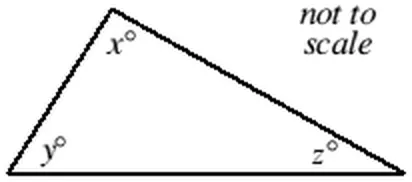
If the mean of \(y\) and \(z\) is \(x\), then \(y + z = 2x\). So the sum of the interior angles of the triangle is \((x + y + z)^\circ = 3x^\circ\). So \(3x = 180\), that is \(x = 60\).
12. The six-member squad for the Ladybirds five-a-side team consists of a 2-spot ladybird, a 10-spot, a 14-spot, an 18-spot, a 24-spot and a pine ladybird (on the bench). The average number of spots for members of the squad is 12. How many spots has the pine ladybird?
The total number of spots which the six ladybirds have is 6 × 12 = 72. So the number of spots which the pine ladybird has is 72 − (2 + 10 + 14 + 18 + 24) = 4.
8. The mean of five numbers is 25. Abbie adds 5 to the first number, 10 to the second number, 15 to the third number, 20 to the fourth number and 25 to the fifth number to obtain a new set of five numbers. What is the mean of the numbers in the new set?
Since the mean of the original five numbers is 25, their total is 25 × 5 = 125. The total of the new set of five numbers is 125 + 5 + 10 + 15 + 20 + 25 = 200. Therefore the mean of the new set of five numbers is 200 ÷ 5 = 40.
1. Four times the average of two different positive numbers is equal to three times the greater one. The difference between the numbers is three less than the average.
It is good to give the numbers names, so let them be \(a\) and \(b\), where \(b\) is the larger. The first fact we are given says that
\[4 \times \frac{a + b}{2} = 3b,\]
and the second says that
\[b - a = \frac{a + b}{2} - 3.\]
We may simplify the first fact to obtain \(2(a + b) = 3b\), that is, \(2a = b\); multiplying the second fact by two, we get \(2b - 2a = a + b - 6\), that is, \(b = 3a - 6\).
Equating these values of \(b\), we get \(2a = 3a - 6\), that is, \(6 = a\), and hence \(b = 12\).
We'd like to use Google Analytics cookies to count visits and see which pages help most. They're optional, and the site works exactly the same either way. Privacy policy