The whole Junior Mathematical Challenge 2005 paper, one question at a time in order (25 questions). Press Mark as done after each one: your marks add up below.
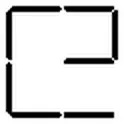
2. The diagram shows a pattern made from matchsticks stuck to a piece of card. What is the smallest number of matchsticks that need to be added so that the resulting pattern has a line of symmetry?
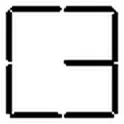
The original figure does not have a line of symmetry, so at least one match must be added. The figure shown, which is created by adding one extra match, does have a line of symmetry, so the smallest number of matches that need to be added is one.
As the numbers are all positive, the largest number cannot be the difference between two of the others. Checking all the other options: 1 = 7 − 6; 6 = 7 − 1; 5 = 7 − 2; 2 = 7 − 5.
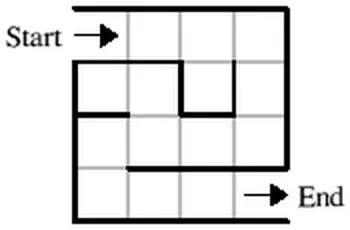
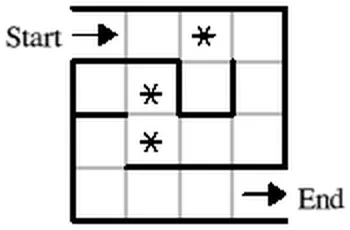
6. Jonny's rat is a slow learner! Every time it goes through this maze, it visits every square at least once. What is the smallest possible number of squares it visits more than once when it goes through the maze?
7. The lightest seeds in the world are probably those of the Creeping Lady's-tresses Orchid, 500 000 of which would weigh 1 gram. How many millions of these seeds weigh 1 kilogram?
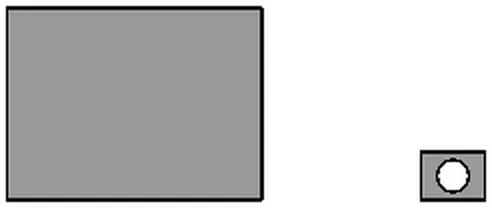
Beatrix takes a sheet of paper (shown on the far left), folds the sheet in half 4 times and punches a hole all the way through the folded sheet, as shown on the near left. She then unfolds the sheet. How many holes are there now in the unfolded sheet?
If the sheet of paper had been folded in half once then there would have been two holes in the unfolded sheet. Each additional fold doubles the eventual number of holes in the unfolded sheet so after four folds there will be sixteen holes.
10. On Monday last week Dilly started to learn the Tlingit language. Every day she learnt five new words, but when she woke every morning she had forgotten two of the words learnt the day before. When did Dilly first achieve her target of learning fourteen words?
When Tilly woke on Thursday morning, she had learned fifteen new words, but had forgotten six of these, so she knew nine words. On Thursday, she learned five new words, so this was the first day on which she reached her target of fourteen words.
Remembering that, in the absence of brackets, multiplication is performed before addition, we see that 9 × 6 + 73 = 54 + 73 = 127, whereas 96 + 7 × 3 = 96 + 21 = 117. It is left as an exercise for the reader to check that the other four calculations are correct.
The fractions could be placed in order by writing them all with a common denominator of 630, or by writing them as decimal fractions. However, as they are all close in value to \(\tfrac{1}{2}\), we may consider the value of each fraction minus \(\tfrac{1}{2}\). These are, respectively, 0, \(+\tfrac{1}{6}\),\(+\tfrac{1}{10}\), \(+\tfrac{1}{14}\) and \(+\tfrac{1}{18}\). So, when they are placed in increasing order of size, the fractions are \(\tfrac{1}{2}\),\(\tfrac{5}{9}\),\(\tfrac{4}{7}\), \(\tfrac{3}{5}\) and \(\tfrac{2}{3}\).
16. ‘Saturn’ chocolate bars are packed either in boxes of 5 or boxes of 12. What is the smallest number of full boxes required to pack exactly 2005 ‘Saturn’ bars?
2005 ÷ 12 = 167 remainder 1 so if 167 of the larger boxes are used, one bar will remain. If 166 of the larger boxes are used, 13 bars will remain and these cannot fill a whole number of smaller boxes. However, if 165 larger boxes are used, the 25 remaining bars will fill 5 smaller boxes. Using fewer than 165 larger boxes will increase the total number of boxes required since proportionately more of the smaller boxes would be needed, so the required number of boxes is 165 + 5.
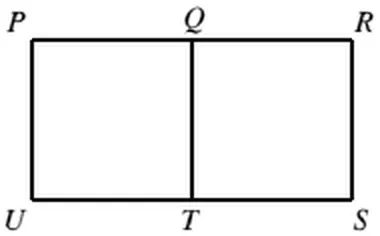
17. The figure shows rectangle \(PRSU\) and line \(QT\), which divides the rectangle into two squares. How many right-angled triangles can be drawn using any three of the points \(P\),\(Q\),\(R\),\(S\),\(T\), \(U\) as corners?
There are two right-angled triangles which have their right angle at \(P\): triangles \(UPQ\) and \(UPR\). Similarly, there are two right-angled triangles in each case which have their right angle at \(R\), \(S\) and \(U\). There are three right-angled triangles which have their right angle at \(Q\): triangles \(PQT\), \(RQT\) and \(UQS\). Similarly, there are three right-angled triangles which have their right angle at \(T\), making 14 in all.
The subtraction shows the number \(10a + b\) subtracted from the number \(10b + a\). Their difference is \(9b - 9a\). So \(9(b - a)\) has unit digit 6 and must therefore have value 36 since this is the only two-digit multiple of 9 which ends in 6. So \(c\) is 3. Note that the values of \(a\) and \(b\) are not unique. Provided that \(b - a\) is 4, the difference of the two numbers will be 36, for example 51 − 15 = 36; 62 − 26 = 36; 73 − 37 = 36 etc.
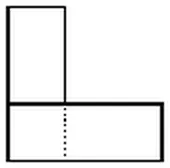
19. Two identical rectangular cards are glued together as shown to form an 'L' shape. The perimeter of this 'L' shape is 40 cm. What is the ratio of the lengths of the sides of one of the original cards?
Let the length and breadth of one of the original cards be \(l\) and \(b\) respectively. Then the lengths of the six sides of the ‘L’ shape (moving clockwise from the bottom left-hand corner) are \(l\),\(b\),\(l - b\),\(l - b\),\(b\), \(l\) respectively. So \(2l + 2b + 2(l - b) = 40\), that is \(4l = 40\). We may deduce, therefore, that \(l\) is 10, but there is insufficient information for us to find the ratio \(b : l\).
At most one of the statements is true (as they are mutually contradictory). Indeed, the second statement is true and there is exactly one true statement.
21. If the square is completed with the letters A, B, C, D and E so that no row, column or either of the two main diagonal lines contains the same letter more than once, which letter should replace the asterisk?
The square labelled A1 is in the same row as C and D, the same column as E and the same diagonal as B. So it must be A. The square labelled E2 is the next to be filled in as it is in the same row as A, C and D and in the same diagonal as B. The square labelled B3 now completes the fourth row. The bottom left-hand corner square must now be A. This is because one of the three remaining squares in the diagonal which runs from bottom left to top right must be A, but the A at the end of row 2 means that A cannot be in either of the last two squares of this diagonal. The squares D5 and C6 may now be filled in. We now see that the square marked * is in the same diagonal as A, B and C and in the same column as E, so it must be D. It is left as an exercise for the reader to complete the grid.
22. In a certain code, A = 1, B = 2, C =3 etc. Words are encoded by multiplying together the values of their letters, so the code for SQUARE is 19 × 17 × 21 × 1 × 18 × 5 = 610 470. Similarly, the code for RECTANGLE is 31 752 000. What is the code for TRIANGLE?
The letters used in TRIANGLE are the same as those used in RECTANGLE, except that C and E have been replaced by I. So the code for TRIANGLE is 9 × 31 752 000 ÷ (3 × 5), that is 19 051 200.
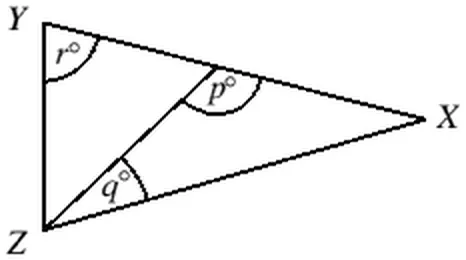
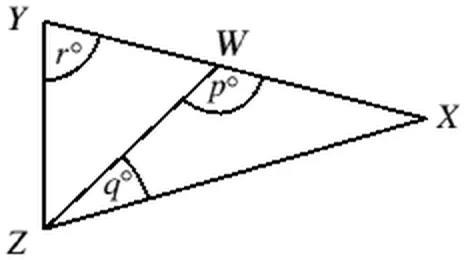
As \(XY = XZ\),\(\angle XZY = \angle XYZ\), so \(\angle YZW = r^\circ - q^\circ\). In a triangle, an exterior angle is equal to the sum of the two interior opposite angles. Applying this theorem to triangle \(ZYW\): \(\angle ZWX = \angle YZW + \angle ZYW\), that is \(p = (r - q) + r\). So \(2r = p + q\).
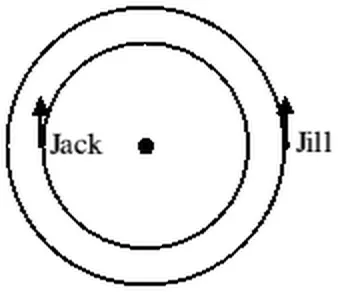
24. Jack dances clockwise around the Maypole, making one revolution every five seconds. Starting from a point diametrically opposite Jack's starting point, Jill dances anticlockwise, making one revolution every six seconds. How many times do they pass each other in the first minute?
As Jack makes one revolution every five seconds, and Jill one revolution every six seconds, on average they turn through angles of 72° and 60° respectively every second. So, as they are travelling in opposite directions, Jill turns, on average, through an angle of 132° per second relative to Jack. In one minute, therefore, she will turn through an angle of 60 × 132°, that is 22 complete revolutions, relative to Jack. So they will pass each other 22 times in the first minute.
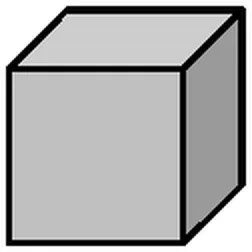
25. The diagram shows a unit cube coloured blue. Additional blue unit cubes are glued face-to-face to each of its six faces to form a three-dimensional “cross”. If unit cubes coloured yellow are now glued face-to-face to all the spare faces of this cross, how many yellow unit cubes are required?
Imagine the cross to consist of three horizontal layers: the first layer contains only the cube which was glued to the top face of the original cube. The second layer contains the original cube plus four additional cubes glued to the side faces of that cube. The third layer contains only the cube which was glued to the bottom face of the original cube. When yellow cubes are now added, one cube will be glued to the top face of the blue cube on the top layer and four to its side faces. Eight yellow cubes will be glued to the blue cubes in the second layer and the single blue cube in the third layer will have five yellow cubes glued to it: one to its bottom face and four to its side faces. So, overall, 18 yellow cubes are required.
We'd like to use Google Analytics cookies to count visits and see which pages help most. They're optional, and the site works exactly the same either way. Privacy policy