The whole Junior Mathematical Challenge 2011 paper, one question at a time in order (25 questions). Press Mark as done after each one: your marks add up below.
If the sum of the digits is a multiple of 3 then the number is a multiple of 3. The sums of the digits of the given numbers are 6, 9, 12, 15, 18, so they are all multiples of 3. (Can you prove that all numbers consisting of three consecutive digits are multiples of 3? Hint: let the second digit be n.)
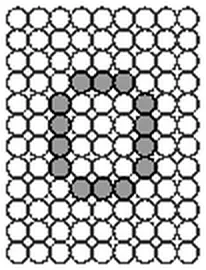
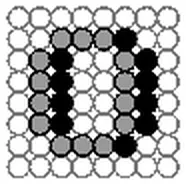
3. A train display shows letters by lighting cells in a grid, such as the letter ‘o’ shown. A letter is made bold by also lighting any unlit cell immediately to the right of one in the normal letter. How many cells are lit in a bold ‘o’?
4. The world's largest coin, made by the Royal Mint of Canada, was auctioned in June 2010. The coin has mass 100 kg, whereas a standard British £1 coin has mass 10 g. What sum of money in £1 coins has the same mass as the record-breaking coin?
100 kg = 100 000 g. So the sum of money in £1 coins which would have the same mass as the world's largest coin is £(100 000 ÷ 10) = £10 000. (The coin was sold for $4m (£2.6m) at an auction in Vienna in June 2010.)
5. All old Mother Hubbard had in her cupboard was a Giant Bear chocolate bar. She gave each of her children one-twelfth of the chocolate bar. One third of the bar was left. How many children did she have?
One third is equal to four twelfths. Hence the children ate eight twelfths of the bar between them. Each child ate one twelfth of the bar, so old Mother Hubbard had eight children.
7. Peter Piper picked a peck of pickled peppers. 1 peck = \(\tfrac{1}{4}\) bushel and 1 bushel = \(\tfrac{1}{9}\) barrel. How many more pecks must Peter Piper pick to fill a barrel?
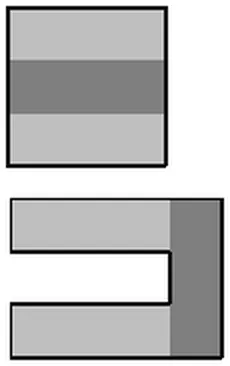
8. A square is divided into three congruent rectangles. The middle rectangle is removed and replaced on the side of the original square to form an octagon as shown. What is the ratio of the length of the perimeter of the square to the length of the perimeter of the octagon?
Let the original square have side \(3x\). Then its perimeter is \(12x\). The perimeter of the octagon is \(2 \times 4x + 3 \times 3x + 3 \times x = 8x + 9x + 3x = 20x\).
1 + 2 + 3 + 4 + 5 + 6 + 7 + 8 + 9 = 45 is the sum of the digits of each such number. As 45 is a multiple of 9, each such number is a multiple of 9 and so too is the difference between two of them. Thus the smallest feasible difference is 9. The two numbers 123 456 798 and 123 456 789 show that this can occur.
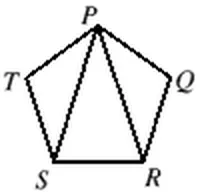
10. You want to draw the shape on the right without taking your pen off the paper and without going over any line more than once. Where should you start?
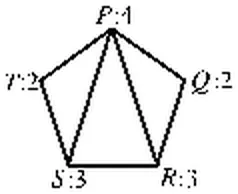
The diagram shows the number of lines which meet at the vertices \(P\),\(Q\),\(R\),\(S\),\(T\). When the path around the diagram passes through a vertex, it uses up two of the edges. So, apart from the first and last vertex used, each vertex must have an even number of edges meeting at it. So we are obliged to use \(R\) or \(S\) as the first vertex, and the other as the last. The path RQPTSRPS, together with its reverse, shows that either is a possible start. (It is a fact that such a path can be drawn through a connected graph precisely when either all, or all but 2, vertices have an even number of edges meeting there.)
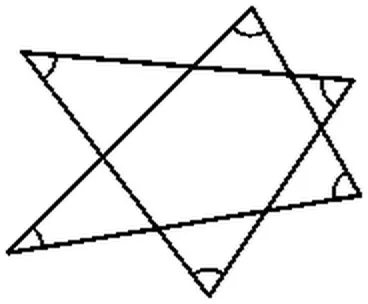
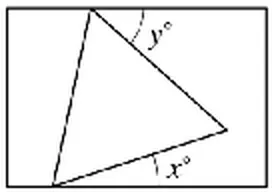
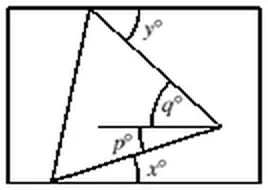
A line segment which is parallel to two sides of the rectangle has been added to the diagram, as shown. The angle marked \(p\)° is equal to the angle marked \(x\)° as these are alternate angles between parallel lines. So \(x = p\). Similarly \(y = q\). The angles marked \(p\)° and \(q\)° together form one interior angle of an equilateral triangle. Therefore \(x + y = p + q = 60\).
The mean of \(\dfrac{2}{3}\) and \(\dfrac{4}{9}\) is \(\left(\dfrac{2}{3} + \dfrac{4}{9}\right) \div 2 = \left(\dfrac{6}{9} + \dfrac{4}{9}\right) \div 2 = \dfrac{10}{9} \div 2 = \dfrac{5}{9}\). (Note that the mean of two numbers lies midway between those two numbers.)
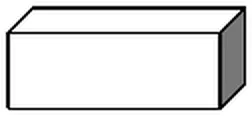
14. The diagram shows a cuboid in which the area of the shaded face is one-quarter of the area of each of the two visible unshaded faces. The total surface area of the cuboid is 72 cm2. What, in cm2, is the area of one of the visible unshaded faces of the cuboid?
Let the area of the shaded face be \(x\) cm2. Then the cuboid has two faces of area \(x\) cm2 and four faces of area \(4x\) cm2. So its total surface area is \(18x\) cm2. Therefore \(18x = 72\), that is \(x = 4\). So the area of one of the visible unshaded faces is 4 × 4 cm2 = 16 cm2.
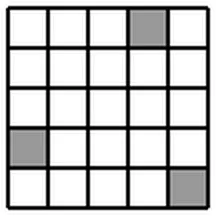
15. What is the smallest number of additional squares which must be shaded so that this figure has at least one line of symmetry and rotational symmetry of order 2 ?
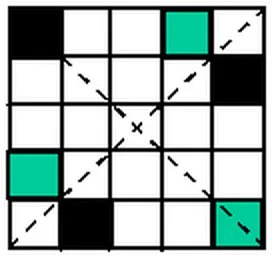
In order that the figure has rotational symmetry of order 2, the three squares which appear in black must be shaded. When this has been done, we note that the broken lines shown are both lines of symmetry. So the minimum number of squares which must be shaded is 3.
16. The pupils in Year 8 are holding a mock election. A candidate receiving more votes than any other wins. The four candidates receive 83 votes between them. What is the smallest number of votes the winner could receive?
The smallest possible number of votes the winner could receive corresponds to the situation in which the numbers of votes received by each of the candidates are as close together as possible. As 83 ÷ 4 = 20.75, at least one of the candidates receives 21 votes or more. However, it is not possible for the winner to receive 21 votes, since there are still 62 votes to be allocated which makes it impossible for each of the other three candidates to receive fewer than 21 votes. So the winner must receive more than 21 votes. If the numbers of votes received by the candidates are 22, 21, 20, 20 then there is a winner and, therefore, 22 is the smallest number of votes the winner could receive.
17. Last year's match at Wimbledon between John Isner and Nicolas Mahut, which lasted 11 hours and 5 minutes, set a record for the longest match in tennis history. The fifth set of the match lasted 8 hours and 11 minutes. Approximately what fraction of the whole match was taken up by the fifth set?
The lengths in minutes of the fifth set and the whole match are 491 and 665 respectively. So the required fraction is \(\dfrac{491}{665} = \dfrac{491 \times 3}{665 \times 3} \approx \dfrac{1500}{2000} = \dfrac{3}{4}\).
18. Peri the winkle leaves on Monday to go and visit Granny, 90m away. Except for rest days, Peri travels 1m each day (24-hour period) at a constant rate and without pause. However, Peri stops for a 24-hour rest every tenth day, that is, after every nine days' travelling. On which day of the week does Peri arrive at Granny's?
Until Peri reaches Granny's, he travels 9m in every 10 days. So he takes 90 days to travel the first 81m of his journey. There remains a distance of 9m to be covered and so, after a further 9 days, Peri is at Granny's. Therefore the length of Peri's journey is 99 days, that is 14 weeks 1 day. So Peri arrives at Granny's on Tuesday.
Of the given numbers, 2, 3 and 5 are all prime and therefore appear in the list. In addition, 1 appears in the list as it is the units digit of 11 and also of many other primes. However, all numbers with units digit 4 are even and therefore not prime, because the only even prime is 2. So only 1, 2, 3, 5 appear in the list.
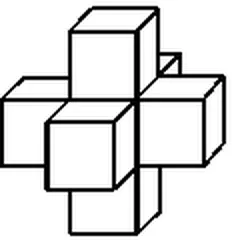
20. One cube has each of its faces covered by one face of an identical cube, making a solid as shown. The volume of the solid is 875 cm3. What, in cm2, is the surface area of the solid?
Let the length of the side of each cube be \(x\) cm. Then the volume of the solid is \(7x^3\) cm3. Therefore \(7x^3 = 875\), that is \(x^3 = 125\). So \(x = 5\). The surface area of the solid comprises five of the faces of each of six cubes. Each face has area 25 cm2 so the required area is 5 × 6 × 25 cm2 = 750 cm2.
21. Gill leaves Lille by train at 09:00. The train travels the first 27 km at 96 km/h. It then stops at Lens for 3 minutes before travelling the final 29 km to Lillers at 96 km/h. At what time does Gill arrive at Lillers?
In total the train travels 27 km + 29 km = 56 km. So the combined time for these two parts of the journey is \(\dfrac{56}{96}\) hours = \(\dfrac{7}{12}\) hours = 35 minutes. The total journey time, therefore, is 38 minutes. So Gill arrives at 09:38.
22. Last week Evariste and Sophie both bought some stamps for their collections. Each stamp Evariste bought cost him £1.10, whilst Sophie paid 70p for each of her stamps. Between them they spent exactly £10. How many stamps did they buy in total?
Let the numbers of stamps bought by Evariste and Sophie be \(x\) and \(y\) respectively. Then \(1.1x + 0.7y = 10\), that is \(11x + 7y = 100\). As 100 has remainder 2 when divided by 7, we need a multiple of 11 which is two more than a multiple of 7. The multiples of 11 less than 100 are 11, 22, 33, 44, 55, 66, 77, 88, 99. Of these only 44 is two more than a multiple of 7. So the only positive integer solutions of the Diophantine equation \(11x + 7y = 100\) are \(x = 4\),\(y = 8\). Therefore Evariste buys 4 stamps, costing £4.40, and Sophie buys 8 stamps, costing £5.60.
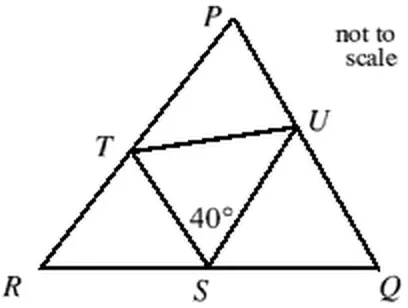
23. The points \(S\),\(T\), \(U\) lie on the sides of the triangle PQR, as shown, so that \(QS = QU\) and \(RS = RT\). \(\angle TSU = 40^\circ\). What is the size of \(\angle TPU\)?
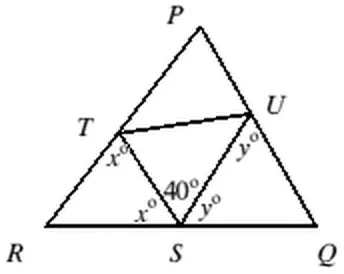
Let \(\angle RTS = x^\circ\). Then \(\angle RST = x^\circ\) as \(RS = RT\). Let \(\angle QUS = y^\circ\). Then \(\angle QSU = y^\circ\) as \(QS = QU\). As RSQ is a straight line, \(x + y + 40 = 180\); so \(x + y = 140\).
24. Two adults and two children wish to cross a river. They make a raft but it will carry only the weight of one adult or two children. What is the minimum number of times the raft must cross the river to get all four people to the other side? (N.B. The raft may not cross the river without at least one person on board.)
(We may assume that the party is initially on the near bank and wishes to cross to the far bank.) If an adult crosses to the far bank then there has to be a child waiting there to bring the raft back (unless an adult immediately brings the raft back – but this represents a wasted journey). This is possible only if the first two crossings involve both children crossing to the far bank and one of them staying there whilst the other brings the raft back. The third crossing involves the first adult crossing to the far bank and on the fourth crossing the child waiting on the far bank brings the raft back to the near bank. So after four crossings, one of the adults is on the far bank and the remainder of the party is on the near bank. This procedure is repeated so that after eight crossings, both adults are on the far bank and both children are on the near bank. A ninth and final crossing then takes both children to the far bank.
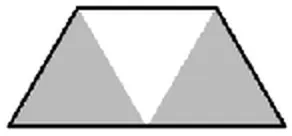
25. The diagram shows a trapezium made from three equilateral triangles. Three copies of the trapezium are placed together, without gaps or overlaps and so that only complete edges coincide, to form a polygon with \(N\) sides. How many different values of \(N\) are possible?
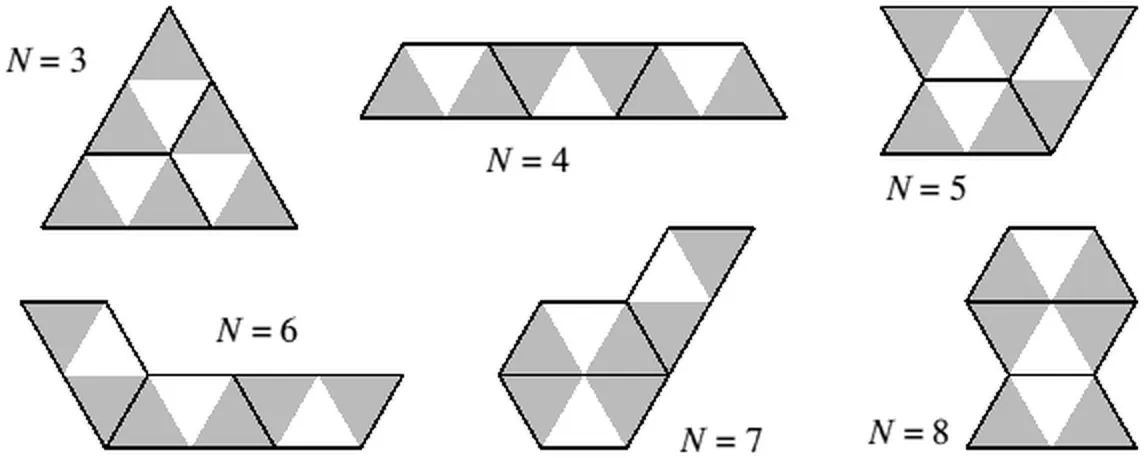
The three trapezia have 12 edges in total. Whenever two trapezia are joined together the total number of edges is reduced by at least 2. Therefore the maximum possible value of \(N\) is 12 − 2 × 2 = 8. As the shapes form a polygon, \(N\) cannot be less than 3. The diagrams below show that all values of \(N\) from 3 to 8 are indeed possible, so there are 6 different values of \(N\).
We'd like to use Google Analytics cookies to count visits and see which pages help most. They're optional, and the site works exactly the same either way. Privacy policy