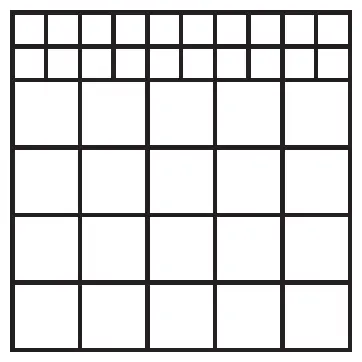
Junior Mathematical Olympiad (JMO)

Practise one competitionJunior Mathematical Challenge 424 questions, 2004–2020Junior Kangaroo 125 questions, 2015–2019Junior Mathematical Olympiad 80 questions, 2015–2019

80 Junior Mathematical Olympiad questions from every year we have, newest year first. Use Difficulty › Position in the paper to practise the early (easier) or late (harder) questions, or the Year filter for one year.

Whole paper 2019 2018 2017 2016 2015

Questions and solutions © UK Mathematics Trust, shown with permission. Papers and more at ukmt.org.uk.

JMO 2019

JMO 2018

JMO 2017

JMO 2016

JMO 2015

JMO 2019 A2

JMOCurrent spec1 markNumber & Arithmetic

A2. Six standard, fair dice are rolled once. The total of the scores rolled is 32.

What is the smallest possible score that could have appeared on any of the dice?

Junior Mathematical Olympiad 2019, Question A2. © UK Mathematics Trust. Original paper on ukmt.org.uk

JMO 2019 A3

JMOCurrent spec1 markRatio, Rates & Measures

A3. A satellite orbits the Earth once every 7 hours.

How many orbits of the Earth does the satellite make in one week?

Junior Mathematical Olympiad 2019, Question A3. © UK Mathematics Trust. Original paper on ukmt.org.uk

JMO 2019 A4

JMOCurrent spec1 markAlgebraGeometry & Angles

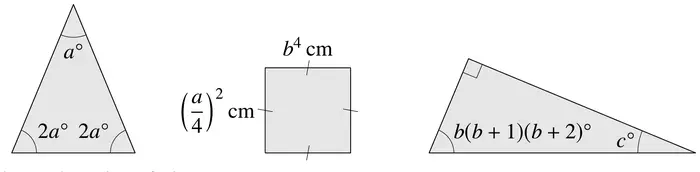
A4.

Three shapes: an isosceles triangle with angles a, 2a and 2a degrees; a square with sides labelled b to the power 4 cm and (a over 4) squared cm; a right-angled triangle with angles b(b + 1)(b + 2) degrees and c degrees

What is the value of \(c\)?

Junior Mathematical Olympiad 2019, Question A4. © UK Mathematics Trust. Original paper on ukmt.org.uk

JMO 2019 A5

A5. Dani wrote the integers from 1 to \(N\). She used the digit 1 fifteen times. She used the digit 2 fourteen times.

What is \(N\)?

Junior Mathematical Olympiad 2019, Question A5. © UK Mathematics Trust. Original paper on ukmt.org.uk

JMO 2019 A6

A6. How many fractions between \(\frac{1}{6}\) and \(\frac{1}{3}\) inclusive can be written with a denominator of 15?

Junior Mathematical Olympiad 2019, Question A6. © UK Mathematics Trust. Original paper on ukmt.org.uk

JMO 2019 A7

JMOCurrent spec1 markFactors, Primes & Digits

A7. Two 2-digit multiples of 7 have a product of 7007.

What is their sum?

Junior Mathematical Olympiad 2019, Question A7. © UK Mathematics Trust. Original paper on ukmt.org.uk

JMO 2019 A8

JMOCurrent spec1 markAlgebraArea, Perimeter & Shape

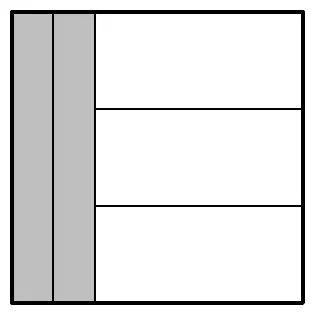
A8. The diagram shows a square made from five rectangles. Each of
these rectangles has the same perimeter.

What is the ratio of the area of a shaded rectangle to the area of an
unshaded rectangle?

A square made from five rectangles: two thin shaded rectangles side by side on the left and three unshaded rectangles stacked on the right

Junior Mathematical Olympiad 2019, Question A8. © UK Mathematics Trust. Original paper on ukmt.org.uk

JMO 2019 A9

JMOCurrent spec1 markFactors, Primes & Digits

A9. The number 3600 can be written as \(2^a \times 3^b \times 4^c \times 5^d\), where \(a\), \(b\), \(c\) and \(d\) are all positive integers. It is given that \(a + b + c + d = 7\).

What is the value of \(c\)?

Junior Mathematical Olympiad 2019, Question A9. © UK Mathematics Trust. Original paper on ukmt.org.uk

JMO 2019 A10

JMOCurrent spec1 markAlgebraRatio, Rates & Measures

A10. Three positive integers add to 93 and have a product of 3375. The integers are in the ratio \(1 : k : k^2\).

What are the three integers?

Junior Mathematical Olympiad 2019, Question A10. © UK Mathematics Trust. Original paper on ukmt.org.uk

JMO 2019 B1

JMOCurrent spec10 marksAlgebraNumber & Arithmetic

B1. In this word-sum, each letter stands for one of the digits 0–9, and stands
for the same digit each time it appears. Different letters stand for different
digits. No number starts with 0.

Find all the possible solutions of the word-sum shown here.

\(J\)\(M\)\(O\)
\(J\)\(M\)\(O\)
+\(J\)\(M\)\(O\)
\(I\)\(M\)\(O\)

Junior Mathematical Olympiad 2019, Question B1. © UK Mathematics Trust. Original paper on ukmt.org.uk

JMO 2019 B2

JMOCurrent spec10 marksFactors, Primes & Digits

B2. The product \(8000 \times K\) is a square, where \(K\) is a positive integer.

What is the smallest possible value of \(K\)?

Junior Mathematical Olympiad 2019, Question B2. © UK Mathematics Trust. Original paper on ukmt.org.uk

JMO 2019 B3

JMOCurrent spec10 marksAlgebraRatio, Rates & Measures

B3. It takes one minute for a train travelling at constant speed to pass completely through a tunnel that is 120 metres long. The same train, travelling at the same constant speed, takes 20 seconds from the instant its front enters the tunnel to it being completely inside the tunnel.

How long is the train?

Junior Mathematical Olympiad 2019, Question B3. © UK Mathematics Trust. Original paper on ukmt.org.uk

JMO 2019 B4

JMOCurrent spec10 marksArea, Perimeter & Shape

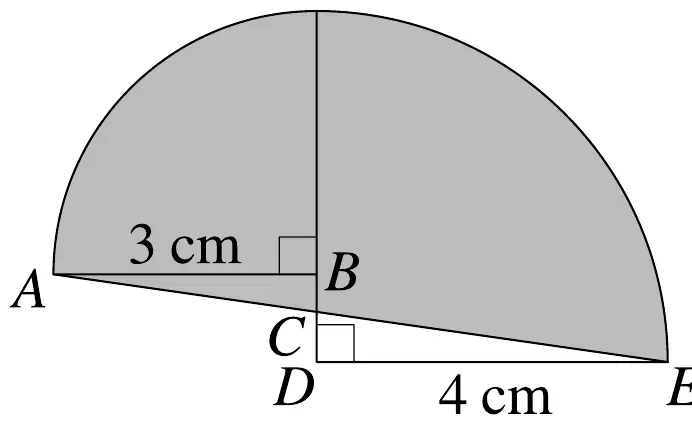
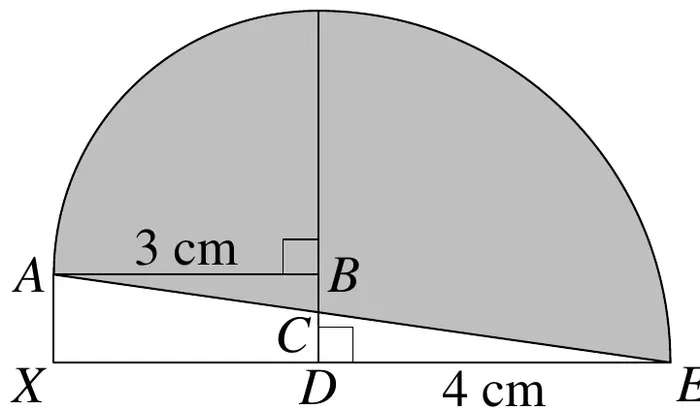
B4. The diagram alongside shows two quarter-circles
and two triangles, \(ABC\) and \(CDE\). One quarter-
circle has radius \(AB\), where \(AB = 3\) cm. The other
quarter-circle has radius \(DE\), where \(DE = 4\) cm.

The area enclosed by the line \(AE\) and the arcs of
the two quarter-circles is shaded.

What is the total shaded area, in cm2?

Two shaded quarter-circles: one with radius AB = 3 cm and one with radius DE = 4 cm, with right-angled triangles ABC and CDE; the line AE bounds the shaded region below

Junior Mathematical Olympiad 2019, Question B4. © UK Mathematics Trust. Original paper on ukmt.org.uk

JMO 2019 B5

JMOCurrent spec10 marksCounting, Probability & Logic

B5. My 24-hour digital clock displays hours and minutes only.

How many displayed times in a 24-hour period contain at least one occurrence of the digit 5?

Junior Mathematical Olympiad 2019, Question B5. © UK Mathematics Trust. Original paper on ukmt.org.uk

JMO 2019 B6

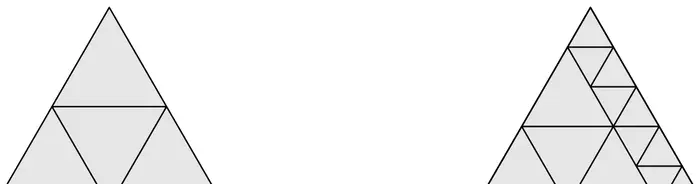
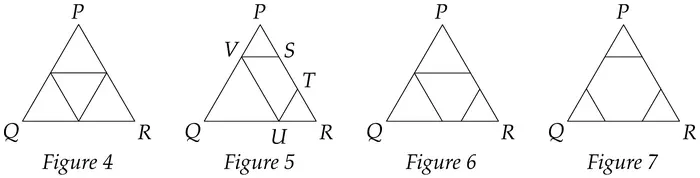
B6. An equilateral triangle is divided into smaller equilateral triangles.

Left: an equilateral triangle divided into 4 equilateral triangles. Right: an equilateral triangle divided into 13 equilateral triangles of different sizes

The diagram on the left shows that it is possible to divide it into 4 equilateral triangles.
The diagram on the right shows that it is possible to divide it into 13 equilateral triangles.

What are the integer values of \(n\), where \(n > 1\), for which it is possible to divide the triangle into \(n\) smaller equilateral triangles?

Junior Mathematical Olympiad 2019, Question B6. © UK Mathematics Trust. Original paper on ukmt.org.uk

JMO 2018 A2

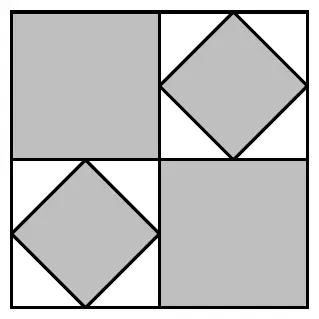
A2. A large square is split into four congruent squares, two of which are
shaded. The other two squares have smaller shaded squares drawn in
them whose vertices are the midpoints of the sides of the unshaded
squares.
What fraction of the large square is shaded?

A large square split into four squares: two are shaded grey and the other two each contain a smaller shaded square with vertices at the midpoints of their sides

Junior Mathematical Olympiad 2018, Question A2. © UK Mathematics Trust. Original paper on ukmt.org.uk

JMO 2018 A3

JMOCurrent spec1 markFactors, Primes & Digits

A3. What is the largest integer for which each pair of consecutive digits is a square?

Junior Mathematical Olympiad 2018, Question A3. © UK Mathematics Trust. Original paper on ukmt.org.uk

JMO 2018 A5

JMOCurrent spec1 markGeometry & Angles

A5. The sizes in degrees of the interior angles of a pentagon are consecutive even numbers.

What is the size of the largest of these angles?

Junior Mathematical Olympiad 2018, Question A5. © UK Mathematics Trust. Original paper on ukmt.org.uk

JMO 2018 A6

JMOCurrent spec1 markFactors, Primes & Digits

A6. A two-digit number ‘\(ab\)’ is multiplied by its reverse ‘\(ba\)’. The ones (units) and tens digits of the four-digit answer are both 0.

What is the value of the smallest such two-digit number ‘\(ab\)’?

Junior Mathematical Olympiad 2018, Question A6. © UK Mathematics Trust. Original paper on ukmt.org.uk

JMO 2018 A7

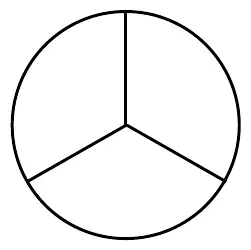
A7. The diagram shows a circle divided into three equal sectors.

What is the ratio of the length of the perimeter of one of these sectors
to the length of the circumference of the circle?

A circle divided into three equal sectors

Junior Mathematical Olympiad 2018, Question A7. © UK Mathematics Trust. Original paper on ukmt.org.uk

JMO 2018 A8

JMOCurrent spec1 markCounting, Probability & Logic

A8. How many three-digit integers less than 1000 have exactly two different digits in their representation (for example, 232, or 466)?

Junior Mathematical Olympiad 2018, Question A8. © UK Mathematics Trust. Original paper on ukmt.org.uk

JMO 2018 A9

JMOCurrent spec1 markArea, Perimeter & Shape

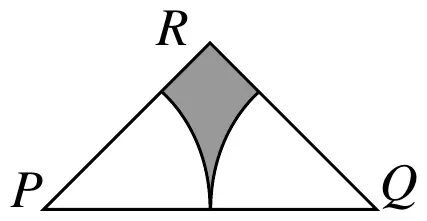
A9. The triangle \(PQR\) is isosceles with \(PR = QR\). Angle \(PRQ = 90°\) and
length \(PQ = 2\) cm. Two arcs of radius 1 cm are drawn inside triangle
\(PQR\). One arc has its centre at \(P\) and intersects \(PR\) and \(PQ\). The other
arc has its centre at \(Q\) and intersects \(QR\) and \(PQ\).

What is the area of the shaded region, in cm2?

Right-angled isosceles triangle PQR with arcs centred at P and Q; the region between the arcs near R is shaded

Junior Mathematical Olympiad 2018, Question A9. © UK Mathematics Trust. Original paper on ukmt.org.uk

JMO 2018 A10

JMOCurrent spec1 markAlgebraFactors, Primes & Digits

A10. A four-digit integer has its digits increasing from left to right. When we reverse the order of the digits, we obtain a four-digit integer whose digits decrease from left to right. A third four-digit integer uses exactly the same digits, but in a different order. The sum of the three integers is 26 352.

What is the value of the smallest of the three integers?

Junior Mathematical Olympiad 2018, Question A10. © UK Mathematics Trust. Original paper on ukmt.org.uk

JMO 2018 B1

JMOCurrent spec10 marksAlgebra

B1. Polly Garter had her first child on her 20th birthday, her second child exactly two years later, and her third child exactly two years after that.

How old was Polly when her age was equal to the sum of her three children's ages?

Junior Mathematical Olympiad 2018, Question B1. © UK Mathematics Trust. Original paper on ukmt.org.uk

JMO 2018 B2

JMOCurrent spec10 marksGeometry & Angles

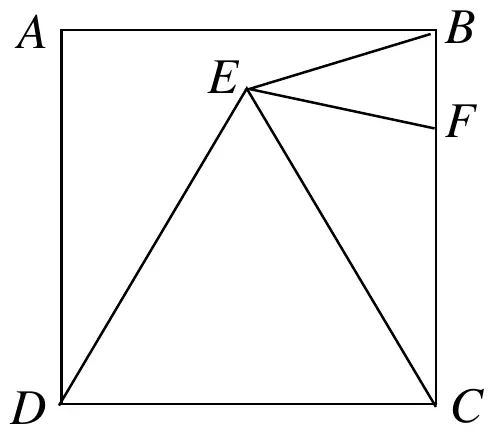
B2. In the diagram shown, \(ABCD\) is a square and point \(F\) lies on \(BC\).
Triangle \(DEC\) is equilateral and \(EB = EF\).

What is the size of \(\angle CEF\)?

Square ABCD with equilateral triangle DEC inside it and point F on BC joined to E; E is also joined to B

Junior Mathematical Olympiad 2018, Question B2. © UK Mathematics Trust. Original paper on ukmt.org.uk

JMO 2018 B3

JMOCurrent spec10 marksFactors, Primes & Digits

B3. The letters \(a\), \(b\) and \(c\) stand for non-zero digits. The integer ‘\(abc\)’ is a multiple of 3; the integer ‘\(cbabc\)’ is a multiple of 15; and the integer ‘\(abcba\)’ is a multiple of 8.

What is the integer ‘\(abc\)’?

Junior Mathematical Olympiad 2018, Question B3. © UK Mathematics Trust. Original paper on ukmt.org.uk

JMO 2018 B4

JMOCurrent spec10 marksGeometry & Angles

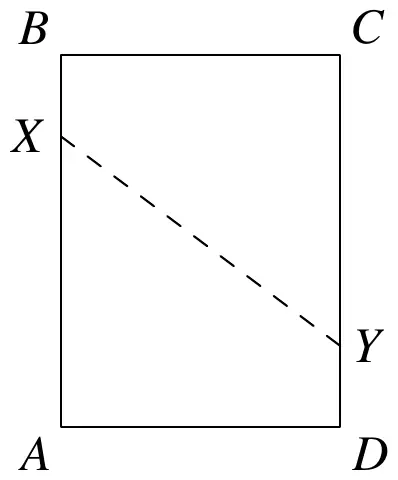
B4. A rectangular sheet of paper is labelled \(ABCD\), with \(AB\) one of the longer sides. The sheet is folded so that vertex \(A\) is placed exactly on top of the opposite vertex \(C\). The fold line is \(XY\), where \(X\) lies on \(AB\) and \(Y\) lies on \(CD\).

Prove that triangle \(CXY\) is isosceles.

Junior Mathematical Olympiad 2018, Question B4. © UK Mathematics Trust. Original paper on ukmt.org.uk

JMO 2018 B5

JMOCurrent spec10 marksCounting, Probability & Logic

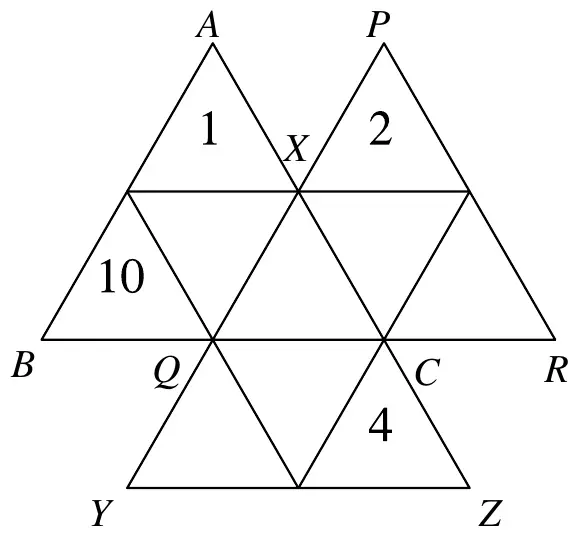
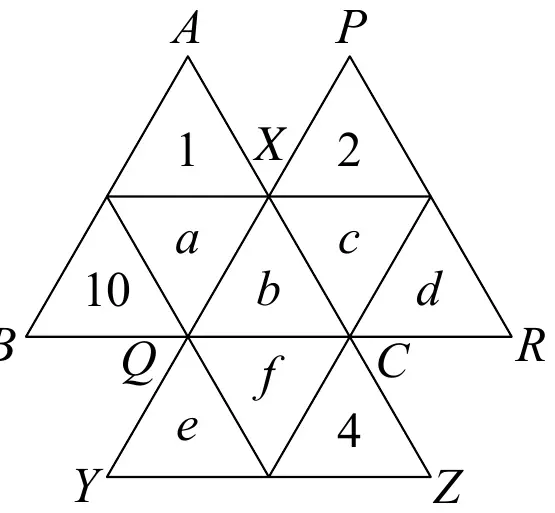
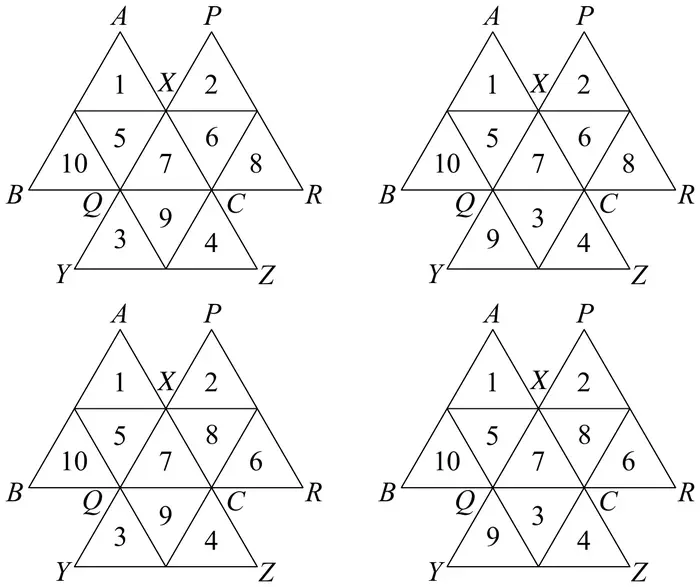
B5. The diagram shows three triangles, \(ABC\), \(PQR\) and \(XYZ\), each
of which is divided up into four smaller triangles. The diagram
is to be completed so that the positive integers from 1 to 10
inclusive are placed, one per small triangle, in the ten small
triangles. The totals of the numbers in the three triangles \(ABC\),
\(PQR\) and \(XYZ\) are the same.

Numbers 1, 2, 4 and 10 have already been placed.

In how many different ways can the diagram be completed?

Three overlapping triangles ABC, PQR and XYZ, each divided into four small triangles, with 1, 2, 10 and 4 already placed

Junior Mathematical Olympiad 2018, Question B5. © UK Mathematics Trust. Original paper on ukmt.org.uk

JMO 2018 B6

JMOCurrent spec10 marksCounting, Probability & Logic

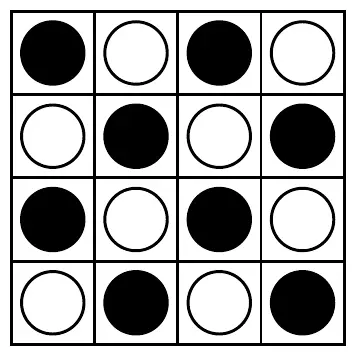
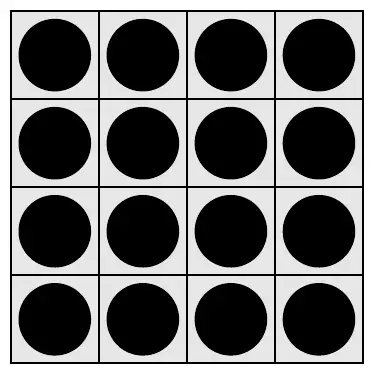
B6. Sixteen counters, which are black on one side and white on the other,
are arranged in a 4 by 4 square. Initially all the counters are facing
black side up. In one ‘move’, you must choose a 2 by 2 square within
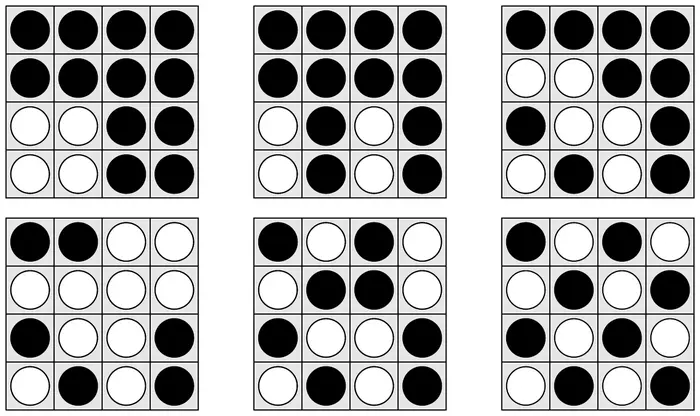
the square and turn all four counters over once. Describe a sequence
of ‘moves’ of minimum length that finishes with the colours of the
counters of the 4 by 4 square alternating (as shown in the diagram).

A 4 by 4 square of counters alternating black and white

Junior Mathematical Olympiad 2018, Question B6. © UK Mathematics Trust. Original paper on ukmt.org.uk

JMO 2017 A2

JMOCurrent spec1 markArea, Perimeter & Shape

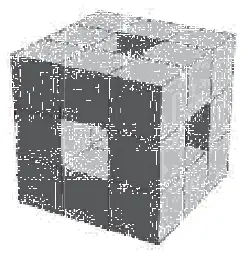
A2. The solid shown is formed by taking a 3 cm × 3 cm × 3 cm cube and
drilling a 1 cm × 1 cm square hole from the centre of each face to the
centre of the opposite face.

What is the volume in cm3 of the solid?

A 3 by 3 by 3 cube with a square hole drilled through the centre of each face

Junior Mathematical Olympiad 2017, Question A2. © UK Mathematics Trust. Original paper on ukmt.org.uk

JMO 2017 A3

A3. Howard is out running. He is now \(\frac{3}{5}\) of the way through the second half of his run. What fraction of the whole run has he completed?

Junior Mathematical Olympiad 2017, Question A3. © UK Mathematics Trust. Original paper on ukmt.org.uk

JMO 2017 A4

JMOCurrent spec1 markNumber & Arithmetic

A4. A bookmark-maker sells bookmarks for £1 each or 7 for £6. What is the smallest amount you could pay for 2017 of her bookmarks?

Junior Mathematical Olympiad 2017, Question A4. © UK Mathematics Trust. Original paper on ukmt.org.uk

JMO 2017 A5

JMOCurrent spec1 markRatio, Rates & Measures

A5. In 1866, the yacht Henrietta – with Gordon Bennett aboard – won the Great Ocean Yacht Race, travelling a distance of approximately 3000 nautical miles. The winning time was 13 days and 22 hours, to the nearest hour.

What was the yacht's average speed in nautical miles per hour, to the nearest integer?

Junior Mathematical Olympiad 2017, Question A5. © UK Mathematics Trust. Original paper on ukmt.org.uk

JMO 2017 A6

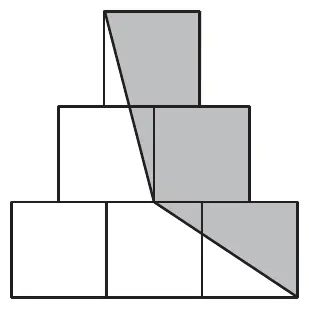
A6. The diagram shows six identical squares arranged symmetrically.

What fraction of the diagram is shaded?

Six identical squares arranged symmetrically in rows of three, two and one, with part of the diagram shaded

Junior Mathematical Olympiad 2017, Question A6. © UK Mathematics Trust. Original paper on ukmt.org.uk

JMO 2017 A7

A7. A fully-grown long-tailed tit − Aegithalos caudatus − weighs only 9 g, whereas a £1 coin weighs 9.5 g.

To the nearest 1 %, what percentage of the weight of a £1 coin is the weight of a fully-grown long-tailed tit?

Junior Mathematical Olympiad 2017, Question A7. © UK Mathematics Trust. Original paper on ukmt.org.uk

JMO 2017 A8

JMOCurrent spec1 markAlgebraRatio, Rates & Measures

A8. A jar contains red and white marbles in the ratio 1 : 4. When Jenny replaces 2 of the white marbles with 7 red marbles, the ratio becomes 2 : 3.

What is the ratio of the total number of marbles in the jar now to the total number in the jar before?

Junior Mathematical Olympiad 2017, Question A8. © UK Mathematics Trust. Original paper on ukmt.org.uk

JMO 2017 A9

A9. How many multiples of 3 that are less than 1000 are not divisible either by 9 or by 10?

Junior Mathematical Olympiad 2017, Question A9. © UK Mathematics Trust. Original paper on ukmt.org.uk

JMO 2017 A10

A10. Two concentric circles are drawn, as shown in the diagram.
Concentric circles share the same point as their centre. The
radius of the smaller circle is a third of the radius of the larger
circle. The top half of the larger circle which is outside the
smaller circle, is shaded in grey.
The ratio of the grey shaded area to the area of the smaller circle
in its simplest form is \(a : b\). What are the values of \(a\) and \(b\)?

Two concentric circles; the top half of the larger circle outside the smaller circle is grey and the bottom half is black

Junior Mathematical Olympiad 2017, Question A10. © UK Mathematics Trust. Original paper on ukmt.org.uk

JMO 2017 B1

JMOCurrent spec10 marksAlgebra

B1. An amount of money is to be divided equally between a group of children. If there was 20p more than this amount, then there would be enough for each child to receive 70p. However, if each child was to receive 60p, then £2.10 would be left over.

How many children are there in the group?

Junior Mathematical Olympiad 2017, Question B1. © UK Mathematics Trust. Original paper on ukmt.org.uk

JMO 2017 B2

B2. A 3-digit integer is called a ‘V-number’ if the digits go ‘high-low-high’ – that is, if the tens digit is smaller than both the hundreds digit and the units (or ‘ones’) digit.

How many 3-digit ‘V-numbers’ are there?

Junior Mathematical Olympiad 2017, Question B2. © UK Mathematics Trust. Original paper on ukmt.org.uk

JMO 2017 B3

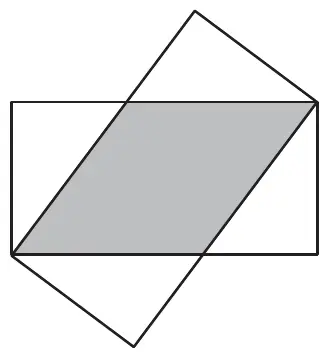
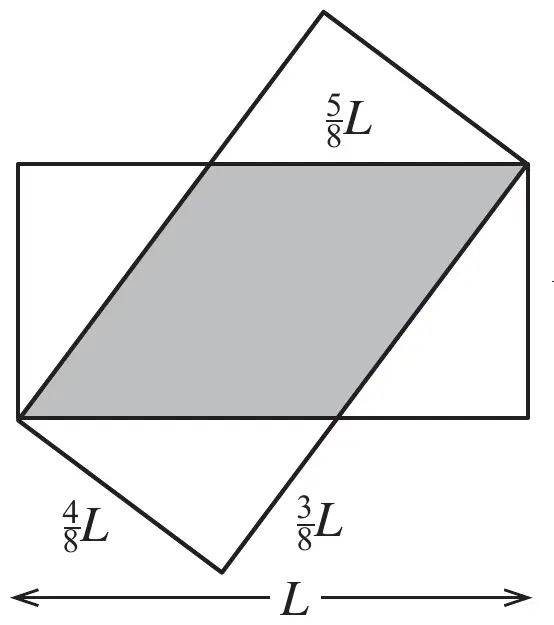
B3. Two identical rectangles overlap in such a way that a
rhombus is formed, as indicated in the diagram. The area of
the rhombus is five-eighths of the area of each rectangle.

What is the ratio of the length of the longer side of the
rectangle to the length of the shorter side?

Two identical rectangles overlapping at an angle so that their overlap is a shaded rhombus

Junior Mathematical Olympiad 2017, Question B3. © UK Mathematics Trust. Original paper on ukmt.org.uk

JMO 2017 B4

JMOCurrent spec10 marksCounting, Probability & Logic

B4. My uncle lives a long way away and his letters always contain puzzles. His three local teams are the Ants (A), the Bees (B), and the Cats (C), who play each other once a year.

My uncle claimed that the league table part way through the year looked like this:

PlayedWonDrawnLostGoals forGoals against
A100142
B211022
C210131

When we complained that this is impossible, he admitted that every single number was wrong but he excused himself because every number was exactly ‘1 out’.

Find the correct table, explaining clearly how you deduced the corrections.

Junior Mathematical Olympiad 2017, Question B4. © UK Mathematics Trust. Original paper on ukmt.org.uk

JMO 2017 B5

JMOCurrent spec10 marksGeometry & Angles

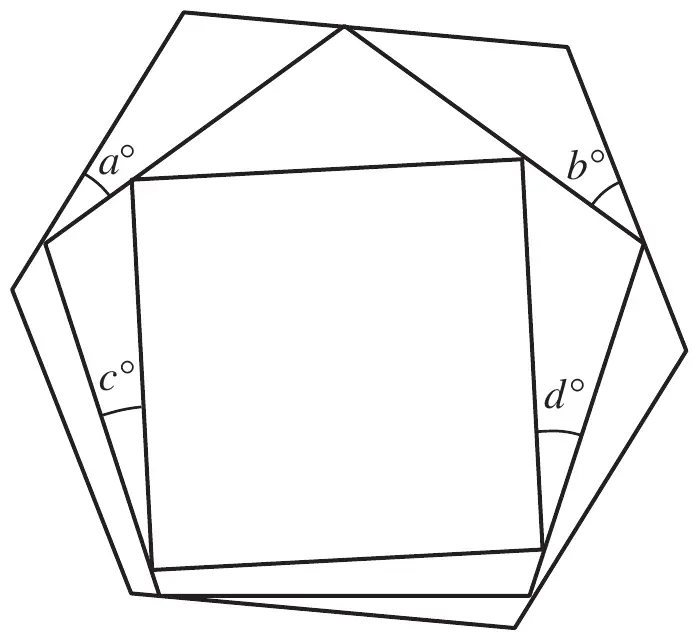
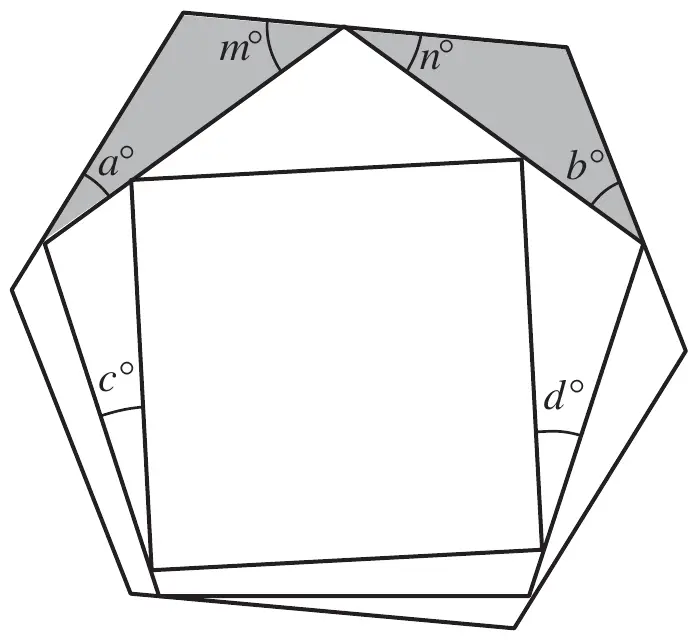
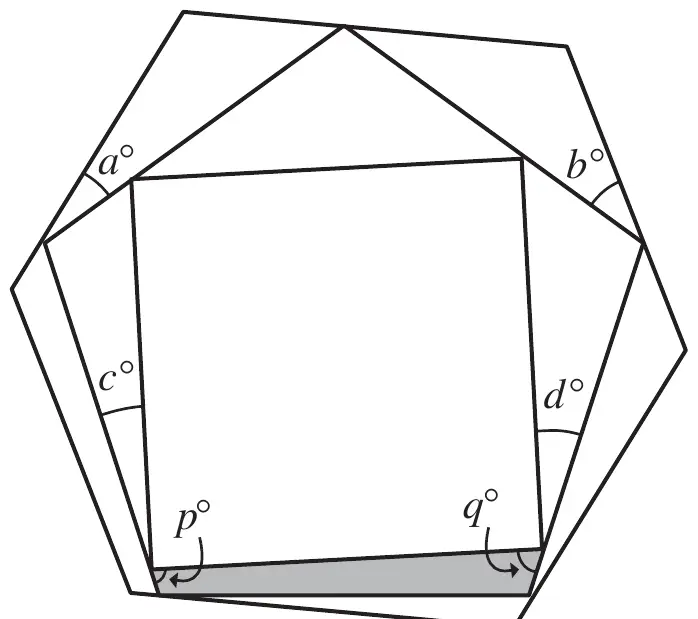
B5. The diagram shows a square whose vertices
touch the sides of a regular pentagon. Each
vertex of the pentagon touches a side of a
regular hexagon.

Find the value of \(a + b + c + d\).

A square inside a regular pentagon inside a regular hexagon, with angles a, b, c and d degrees marked between the sides of the hexagon and the pentagon and between the pentagon and the square

Junior Mathematical Olympiad 2017, Question B5. © UK Mathematics Trust. Original paper on ukmt.org.uk

JMO 2017 B6

JMOCurrent spec10 marksFactors, Primes & Digits

B6. The 9-digit positive integer \(N\) with digit pattern \(ABCABCBBB\) is divisible by every integer from 1 to 17 inclusive.

The digits \(A\), \(B\) and \(C\) are distinct. What are the values of \(A\), \(B\) and \(C\)?

Junior Mathematical Olympiad 2017, Question B6. © UK Mathematics Trust. Original paper on ukmt.org.uk

JMO 2016 A1

JMOCurrent spec1 markFactors, Primes & Digits

A1. Roger picks two consecutive integers, one of which ends in a 5. He multiplies the integers together and then squares the result.

What are the last two digits of his answer?

Junior Mathematical Olympiad 2016, Question A1. © UK Mathematics Trust. Original paper on ukmt.org.uk

JMO 2016 A2

JMOCurrent spec1 markGeometry & Angles

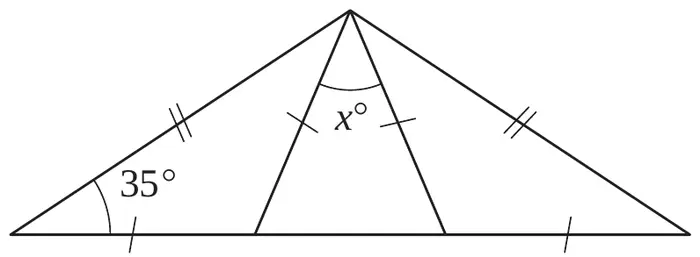
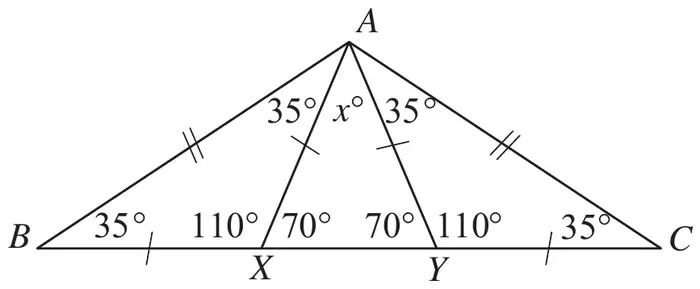
A2. Three isosceles triangles are put together to
create a larger isosceles triangle, as shown.

What is the value of \(x\)?

A large isosceles triangle made from three isosceles triangles; the base angle at the left is 35 degrees and the angle at the top of the middle triangle is x degrees

Junior Mathematical Olympiad 2016, Question A2. © UK Mathematics Trust. Original paper on ukmt.org.uk

JMO 2016 A3

JMOCurrent spec1 markNumber & Arithmetic

A3. The first term of a sequence is 0. Each term of the sequence after the first term is equal to \(10p + 1\), where \(p\) is the previous term.

What is the sum of the first ten terms?

Junior Mathematical Olympiad 2016, Question A3. © UK Mathematics Trust. Original paper on ukmt.org.uk

JMO 2016 A4

JMOCurrent spec1 markArea, Perimeter & Shape

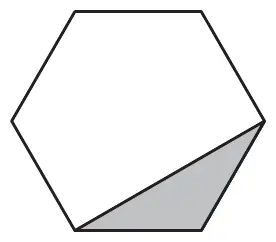
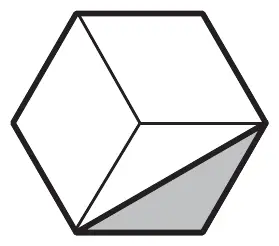
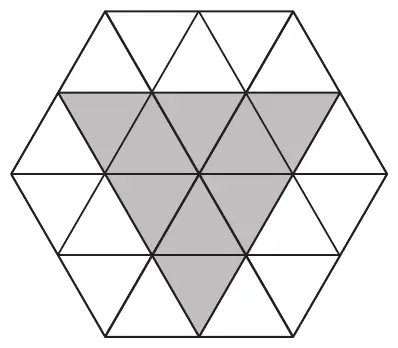
A4. The diagram shows a regular hexagon with area 48 m2.

What is the area of the shaded triangle?

A regular hexagon with a shaded triangle at its lower right

Junior Mathematical Olympiad 2016, Question A4. © UK Mathematics Trust. Original paper on ukmt.org.uk

JMO 2016 A5

JMOCurrent spec1 markArea, Perimeter & Shape

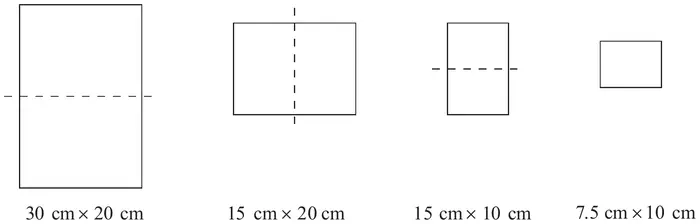
A5. Linda has a very thin sheet of paper measuring 20 cm by 30 cm. She repeatedly folds her paper in half by folding along the shorter line of symmetry. She finishes when she has a rectangle with area 75 cm2.

What is the perimeter of her final rectangle?

Junior Mathematical Olympiad 2016, Question A5. © UK Mathematics Trust. Original paper on ukmt.org.uk

JMO 2016 A6

JMOCurrent spec1 markRatio, Rates & Measures

A6. The points \(A\), \(B\), \(C\), \(D\) and \(E\) lie in that order along a straight line so that \(AB : BC = 1 : 2\), \(BC : CD = 1 : 3\) and \(CD : DE = 1 : 4\). What is \(AB : BE\)?

Junior Mathematical Olympiad 2016, Question A6. © UK Mathematics Trust. Original paper on ukmt.org.uk

JMO 2016 A7

JMOCurrent spec1 markFactors, Primes & Digits

A7. A certain positive integer has exactly eight factors. Two of these factors are 15 and 21.

What is the sum of all eight factors?

Junior Mathematical Olympiad 2016, Question A7. © UK Mathematics Trust. Original paper on ukmt.org.uk

JMO 2016 A8

JMOCurrent spec1 markAlgebra

A8. Julie and her daughters Megan and Zoey have the same birthday. Today, Julie is 32, Megan is 4 and Zoey is 1.

How old will Julie be when her age is the sum of the ages of Megan and Zoey?

Junior Mathematical Olympiad 2016, Question A8. © UK Mathematics Trust. Original paper on ukmt.org.uk

JMO 2016 A9

JMOCurrent spec1 markArea, Perimeter & Shape

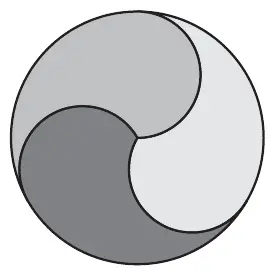
A9. A circle of radius 18 cm is divided into three identical regions by
the three semicircles, as shown.

What is the length of the perimeter of one of these regions?

A circle divided into three identical shaded regions by three semicircles

Junior Mathematical Olympiad 2016, Question A9. © UK Mathematics Trust. Original paper on ukmt.org.uk

JMO 2016 A10

JMOCurrent spec1 markArea, Perimeter & Shape

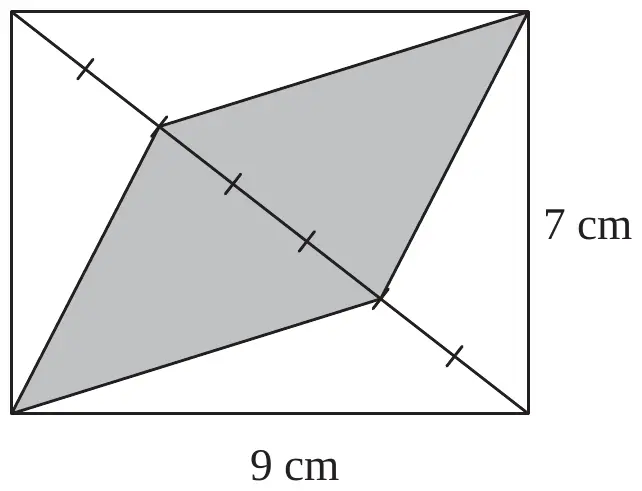
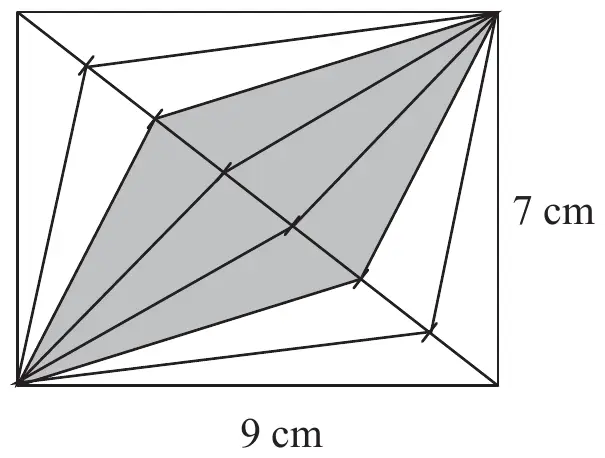
A10. The diagram shows a rectangle with length 9 cm
and width 7 cm. One of the diagonals of the
rectangle has been divided into seven equal parts.

What is the area of the shaded region?

A 9 cm by 7 cm rectangle with one diagonal divided into seven equal parts; a shaded quadrilateral joins two opposite corners to two of the division points

Junior Mathematical Olympiad 2016, Question A10. © UK Mathematics Trust. Original paper on ukmt.org.uk

JMO 2016 B1

JMOCurrent spec10 marksAlgebraGeometry & Angles

B1. In a certain triangle, the size of each of the angles is a whole number of degrees. Also, one angle is 30° larger than the average of the other two angles.

What is the largest possible size of an angle in this triangle?

Junior Mathematical Olympiad 2016, Question B1. © UK Mathematics Trust. Original paper on ukmt.org.uk

JMO 2016 B2

JMOCurrent spec10 marksAlgebraGeometry & Angles

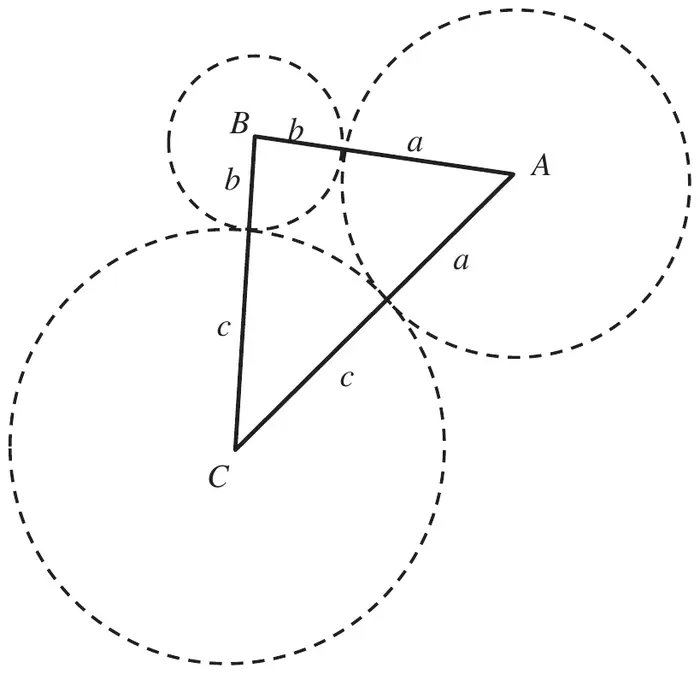
B2. The points \(A\), \(B\) and \(C\) are the centres of three circles. Each circle touches the other two circles, and each centre lies outside the other two circles. The sides of the triangle \(ABC\) have lengths 13 cm, 16 cm and 20 cm.

What are the radii of the three circles?

Junior Mathematical Olympiad 2016, Question B2. © UK Mathematics Trust. Original paper on ukmt.org.uk

JMO 2016 B3

JMOCurrent spec10 marksCounting, Probability & Logic

B3. A large cube consists of a number of identical small cubes. The number of small cubes that touch four other small cubes face-to-face is 168.

How many small cubes make up the large cube?

Junior Mathematical Olympiad 2016, Question B3. © UK Mathematics Trust. Original paper on ukmt.org.uk

JMO 2016 B4

JMOCurrent spec10 marksGeometry & Angles

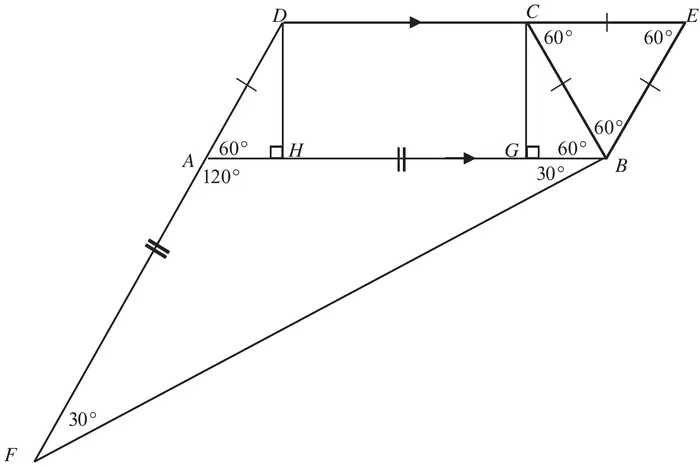
B4. In the trapezium \(ABCD\), the lines \(AB\) and \(CD\) are parallel. Also \(AB = 2DC\) and \(DA = CB\).

The line \(DC\) is extended (beyond \(C\)) to the point \(E\) so that \(EC = CB = BE\). The line \(DA\) is extended (beyond \(A\)) to the point \(F\) so that \(AF = BA\).

Prove that \(\angle FBC = 90°\).

Junior Mathematical Olympiad 2016, Question B4. © UK Mathematics Trust. Original paper on ukmt.org.uk

JMO 2016 B5

JMOCurrent spec10 marksCounting, Probability & Logic

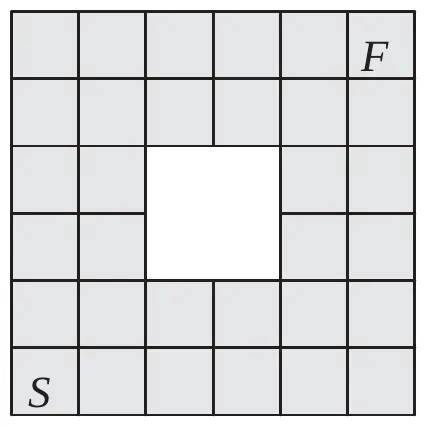
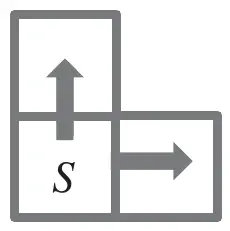
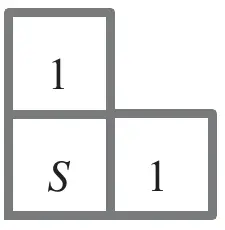
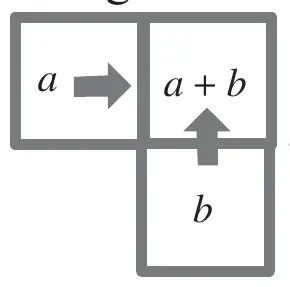
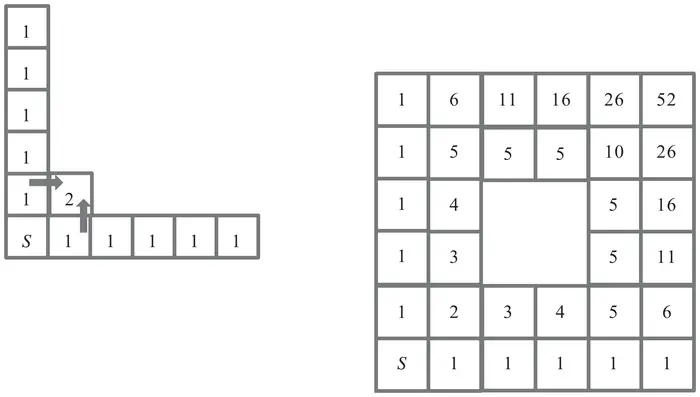
B5. The board shown has 32 cells, one of which is labelled \(S\) and another
\(F\). The shortest path starting at \(S\) and finishing at \(F\) involves exactly
nine other cells and ten moves, where each move goes from cell to
cell ‘horizontally’ or ‘vertically’ across an edge.

How many paths of this length are there from \(S\) to \(F\)?

A board of 32 cells in a 6 by 6 square with a 2 by 2 hole in the middle; S is in the bottom left cell and F in the top right cell

Junior Mathematical Olympiad 2016, Question B5. © UK Mathematics Trust. Original paper on ukmt.org.uk

JMO 2016 B6

JMOCurrent spec10 marksAlgebraNumber & Arithmetic

B6. For which values of the positive integer \(n\) is it possible to divide the first \(3n\) positive integers into three groups each of which has the same sum?

Junior Mathematical Olympiad 2016, Question B6. © UK Mathematics Trust. Original paper on ukmt.org.uk

JMO 2015 A1

JMOCurrent spec1 markRatio, Rates & Measures

A1. It is 225 minutes until midnight. What time is it on a 24-hour digital clock?

Junior Mathematical Olympiad 2015, Question A1. © UK Mathematics Trust. Original paper on ukmt.org.uk

JMO 2015 A2

JMOCurrent spec1 markNumber & Arithmetic

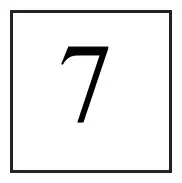
A2. The diagram shows what I see when I look straight down on the top
face of a non-standard cubical die. A positive integer is written on
each face of the die. The numbers on every pair of opposite faces add
up to 10. What is the sum of the numbers on the faces I cannot see?

Square top face of a die showing the number 7

Junior Mathematical Olympiad 2015, Question A2. © UK Mathematics Trust. Original paper on ukmt.org.uk

JMO 2015 A3

JMOCurrent spec1 markArea, Perimeter & Shape

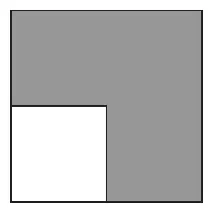
A3. The diagram shows one square inside another. The perimeter of the
shaded region has length 24 cm.

What is the area of the larger square?

A small white square in the bottom left corner of a larger square; the rest of the larger square is shaded

Junior Mathematical Olympiad 2015, Question A3. © UK Mathematics Trust. Original paper on ukmt.org.uk

JMO 2015 A4

JMOCurrent spec1 markAlgebraRatio, Rates & Measures

A4. My fruit basket contains apples and oranges. The ratio of apples to oranges in the basket is 3 : 8. When I remove one apple the ratio changes to 1 : 3.

How many oranges are in the basket?

Junior Mathematical Olympiad 2015, Question A4. © UK Mathematics Trust. Original paper on ukmt.org.uk

JMO 2015 A5

JMOCurrent spec1 markArea, Perimeter & Shape

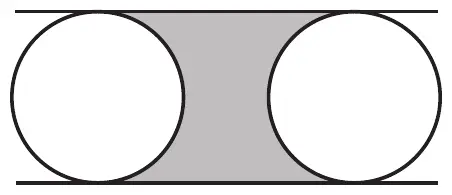
A5. Two circles of radius 1 cm fit exactly between two parallel
lines, as shown in the diagram. The centres of the circles are
3 cm apart.

What is the area of the shaded region bounded by the circles
and the lines?

Two circles between two parallel lines, touching both lines; the region between the circles and the lines is shaded

Junior Mathematical Olympiad 2015, Question A5. © UK Mathematics Trust. Original paper on ukmt.org.uk

JMO 2015 A6

A6. There are 81 players taking part in a knock-out quiz tournament. Each match in the tournament involves 3 players and only the winner of the match remains in the tournament − the other two players are knocked out. How many matches are required until there is an overall winner?

Junior Mathematical Olympiad 2015, Question A6. © UK Mathematics Trust. Original paper on ukmt.org.uk

JMO 2015 A7

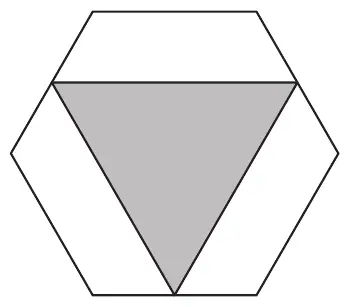
A7. The diagram shows an equilateral triangle inside a regular
hexagon that has sides of length 14 cm. The vertices of the
triangle are midpoints of sides of the hexagon.

What is the length of the perimeter of the triangle?

A regular hexagon with a shaded equilateral triangle whose vertices are midpoints of three of its sides

Junior Mathematical Olympiad 2015, Question A7. © UK Mathematics Trust. Original paper on ukmt.org.uk

JMO 2015 A8

JMOCurrent spec1 markFactors, Primes & Digits

A8. What is the units digit in the answer to the sum \(9^{2015} + 9^{2016}\)?

Junior Mathematical Olympiad 2015, Question A8. © UK Mathematics Trust. Original paper on ukmt.org.uk

JMO 2015 A9

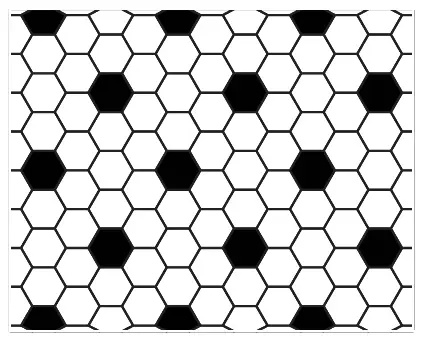
A9. The figure shows part of a tiling, which extends
indefinitely in every direction across the whole plane.
Each tile is a regular hexagon. Some of the tiles are
white, the others are black.

What fraction of the plane is black?

Part of a tiling of regular hexagons, some white and some black

Junior Mathematical Olympiad 2015, Question A9. © UK Mathematics Trust. Original paper on ukmt.org.uk

JMO 2015 A10

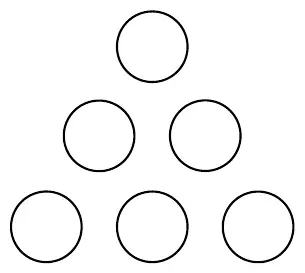
A10. Lucy wants to put the numbers 2, 3, 4, 5, 6 and 10 into the
circles so that the products of the three numbers along
each edge are the same, and as large as possible.

What is this product?

Six circles arranged in a triangle, three along each edge

Junior Mathematical Olympiad 2015, Question A10. © UK Mathematics Trust. Original paper on ukmt.org.uk

JMO 2015 B1

JMOCurrent spec10 marksFactors, Primes & Digits

B1. Let \(N\) be the smallest positive integer whose digits add up to 2015.

What is the sum of the digits of \(N + 1\)?

Junior Mathematical Olympiad 2015, Question B1. © UK Mathematics Trust. Original paper on ukmt.org.uk

JMO 2015 B2

JMOCurrent spec10 marksGeometry & Angles

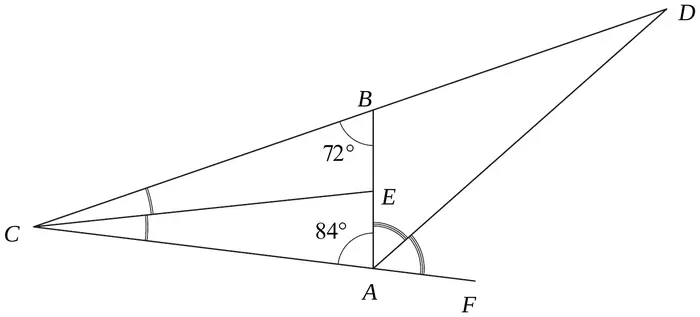
B2. The diagram shows triangle \(ABC\), in which \(\angle ABC = 72°\) and \(\angle CAB = 84°\). The point \(E\) lies on \(AB\) so that \(EC\) bisects \(\angle BCA\). The point \(F\) lies on \(CA\) extended. The point \(D\) lies on \(CB\) extended so that \(DA\) bisects \(\angle BAF\).

Triangle ABC with angle ABC 72 degrees and angle CAB 84 degrees; E on AB with CE bisecting angle BCA; CA extended to F; CB extended to D with DA bisecting angle BAF

Prove that \(AD = CE\).

Junior Mathematical Olympiad 2015, Question B2. © UK Mathematics Trust. Original paper on ukmt.org.uk

JMO 2015 B3

JMOCurrent spec10 marksCounting, Probability & Logic

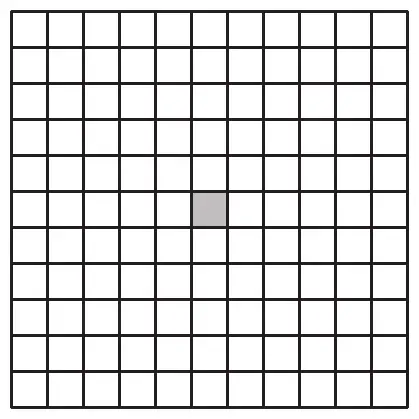
B3. Jack starts in the small square shown shaded on the
grid, and makes a sequence of moves. Each move is to
a neighbouring small square, where two small squares
are neighbouring if they have an edge in common. He
may visit a square more than once.

Jack makes four moves. In how many different small
squares could Jack finish?

A square grid of small squares with one small square near the middle shaded

Junior Mathematical Olympiad 2015, Question B3. © UK Mathematics Trust. Original paper on ukmt.org.uk

JMO 2015 B4

JMOCurrent spec10 marksGeometry & Angles

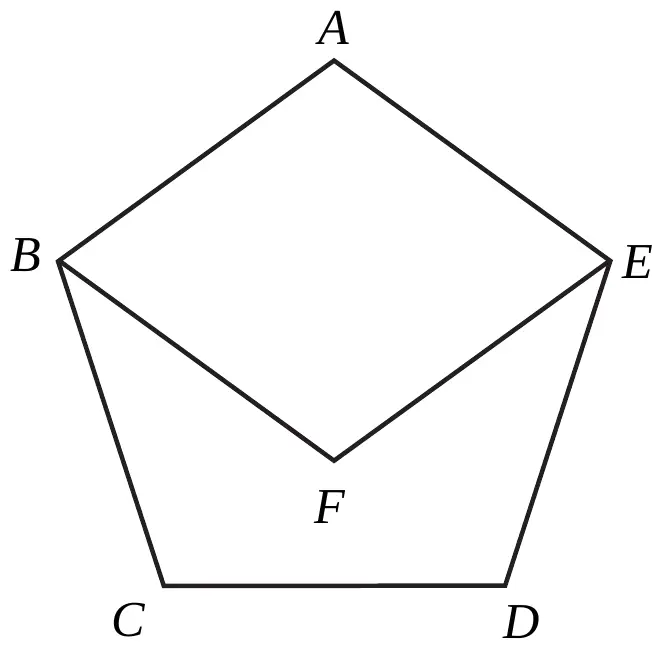
B4. The point \(F\) lies inside the regular pentagon \(ABCDE\) so that \(ABFE\) is a rhombus. Prove that \(EFC\) is a straight line.

Junior Mathematical Olympiad 2015, Question B4. © UK Mathematics Trust. Original paper on ukmt.org.uk

JMO 2015 B5

B5. I have two types of square tile. One type has a side length of 1 cm and the other has a side length of 2 cm.

What is the smallest square that can be made with equal numbers of each type of tile?

Junior Mathematical Olympiad 2015, Question B5. © UK Mathematics Trust. Original paper on ukmt.org.uk

JMO 2015 B6

B6. The letters \(a\), \(b\), \(c\), \(d\), \(e\) and \(f\) represent single digits and each letter represents a different digit. They satisfy the following equations:

\(a + b = d,\qquad b + c = e\qquad\) and \(\qquad d + e = f.\)

Find all possible solutions for the values of \(a\), \(b\), \(c\), \(d\), \(e\) and \(f\).

Junior Mathematical Olympiad 2015, Question B6. © UK Mathematics Trust. Original paper on ukmt.org.uk