
JMO 2017 B3
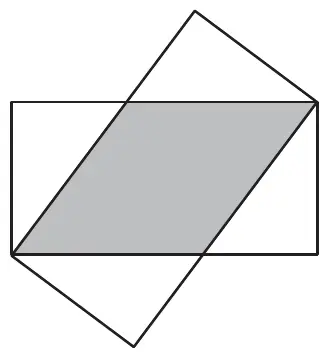
B3. Two identical rectangles overlap in such a way that a
rhombus is formed, as indicated in the diagram. The area of
the rhombus is five-eighths of the area of each rectangle.
What is the ratio of the length of the longer side of the
rectangle to the length of the shorter side?
Junior Mathematical Olympiad 2017, Question B3. © UK Mathematics Trust. Original paper on ukmt.org.uk
Answer: 2 : 1
Let the length of the longer side and of the shorter
side of the rectangle be \(L\) and \(W\) respectively.
Since the area of the rhombus is \(\frac{5}{8}\) of the area of each
rectangle, the area of the rhombus is \(\frac{5}{8}LW\). Also,
since the area of a rhombus is equal to base ×
perpendicular height and the perpendicular height of
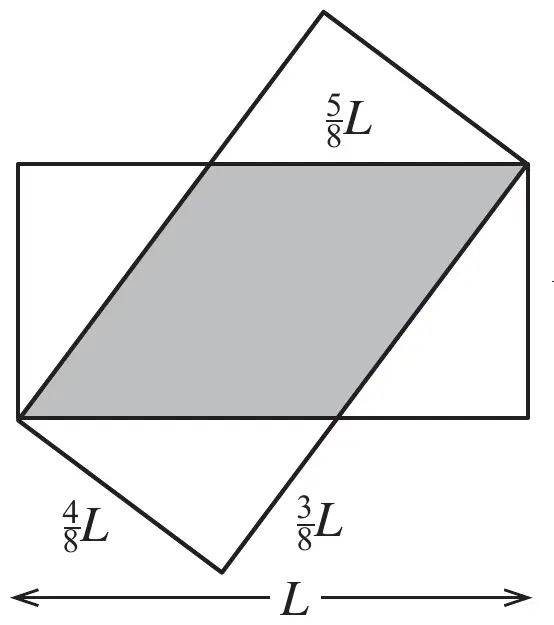
the shaded rhombus is \(W\), the length of each side of
the rhombus is \(\frac{5}{8}L\).
Consider one of the white right-angled triangles.
The length of the hypotenuse is \(\frac{5}{8}L\) and the length of
one other side is \(L - \frac{5}{8}L = \frac{3}{8}L\). Therefore, using
Pythagoras' Theorem, we can find the length of the
third side in terms of \(L\) since the triangle is a 3: 4: 5 triangle. Hence \(W = \frac{4}{8}L\) and the ratio of the length of the longer side of the rectangle to the length of the shorter side of the rectangle is \(L : \frac{4}{8}L = 2 : 1\).
Solution © UK Mathematics Trust, from the JMO 2017 solutions.