Junior Mathematical Olympiad (JMO): Counting, Probability & Logic

Practise one competitionJunior Mathematical Challenge 424 questions, 2004–2020Junior Kangaroo 125 questions, 2015–2019Junior Mathematical Olympiad 80 questions, 2015–2019

16 Junior Mathematical Olympiad questions from every year we have, newest year first. Use Difficulty › Position in the paper to practise the early (easier) or late (harder) questions, or the Year filter for one year.

Whole paper 2019 2018 2017 2016 2015

Questions and solutions © UK Mathematics Trust, shown with permission. Papers and more at ukmt.org.uk.

JMO 2019

JMO 2018

JMO 2017

JMO 2016

JMO 2015

JMO 2019 A5

A5. Dani wrote the integers from 1 to \(N\). She used the digit 1 fifteen times. She used the digit 2 fourteen times.

What is \(N\)?

Junior Mathematical Olympiad 2019, Question A5. © UK Mathematics Trust. Original paper on ukmt.org.uk

JMO 2019 B5

JMOCurrent spec10 marksCounting, Probability & Logic

B5. My 24-hour digital clock displays hours and minutes only.

How many displayed times in a 24-hour period contain at least one occurrence of the digit 5?

Junior Mathematical Olympiad 2019, Question B5. © UK Mathematics Trust. Original paper on ukmt.org.uk

JMO 2019 B6

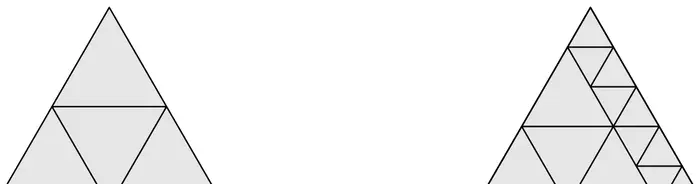
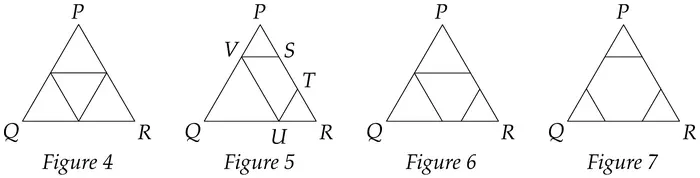
B6. An equilateral triangle is divided into smaller equilateral triangles.

Left: an equilateral triangle divided into 4 equilateral triangles. Right: an equilateral triangle divided into 13 equilateral triangles of different sizes

The diagram on the left shows that it is possible to divide it into 4 equilateral triangles.
The diagram on the right shows that it is possible to divide it into 13 equilateral triangles.

What are the integer values of \(n\), where \(n > 1\), for which it is possible to divide the triangle into \(n\) smaller equilateral triangles?

Junior Mathematical Olympiad 2019, Question B6. © UK Mathematics Trust. Original paper on ukmt.org.uk

JMO 2018 A8

JMOCurrent spec1 markCounting, Probability & Logic

A8. How many three-digit integers less than 1000 have exactly two different digits in their representation (for example, 232, or 466)?

Junior Mathematical Olympiad 2018, Question A8. © UK Mathematics Trust. Original paper on ukmt.org.uk

JMO 2018 B5

JMOCurrent spec10 marksCounting, Probability & Logic

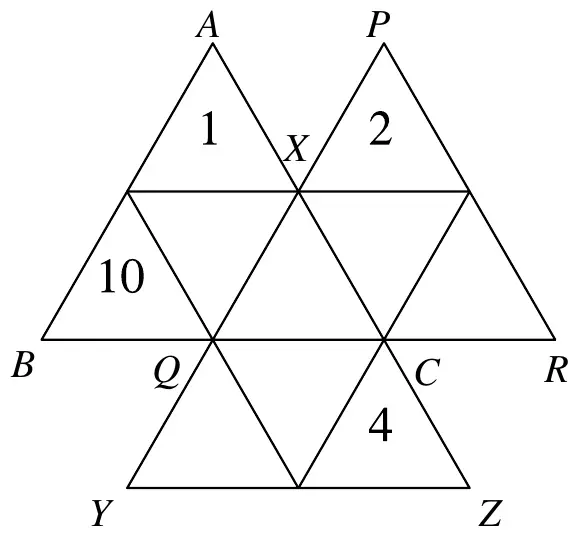
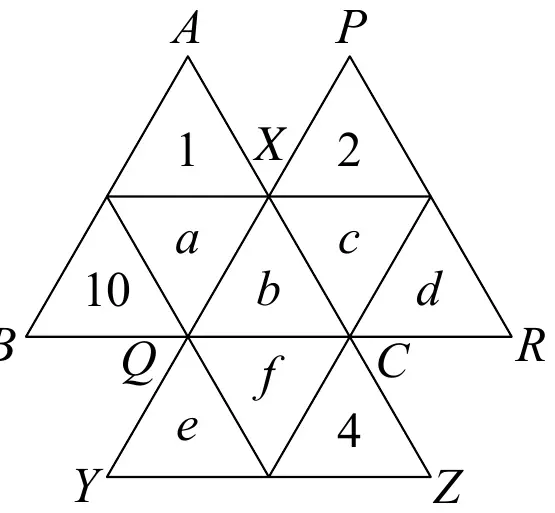
B5. The diagram shows three triangles, \(ABC\), \(PQR\) and \(XYZ\), each
of which is divided up into four smaller triangles. The diagram
is to be completed so that the positive integers from 1 to 10
inclusive are placed, one per small triangle, in the ten small
triangles. The totals of the numbers in the three triangles \(ABC\),
\(PQR\) and \(XYZ\) are the same.

Numbers 1, 2, 4 and 10 have already been placed.

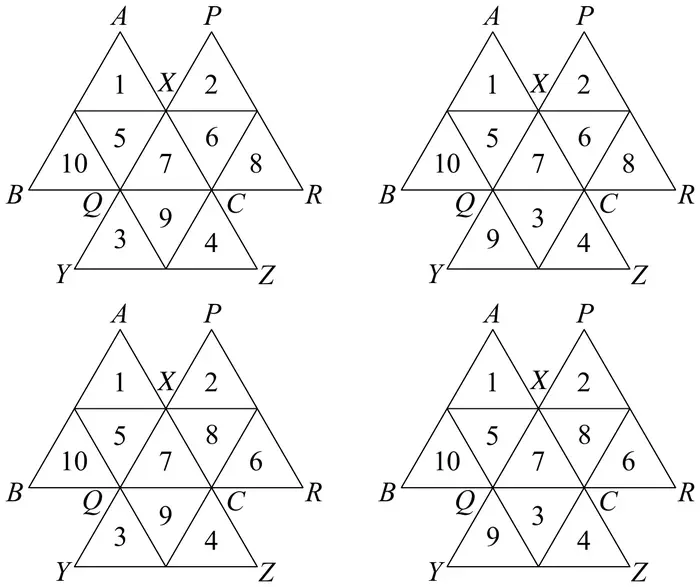
In how many different ways can the diagram be completed?

Three overlapping triangles ABC, PQR and XYZ, each divided into four small triangles, with 1, 2, 10 and 4 already placed

Junior Mathematical Olympiad 2018, Question B5. © UK Mathematics Trust. Original paper on ukmt.org.uk

JMO 2018 B6

JMOCurrent spec10 marksCounting, Probability & Logic

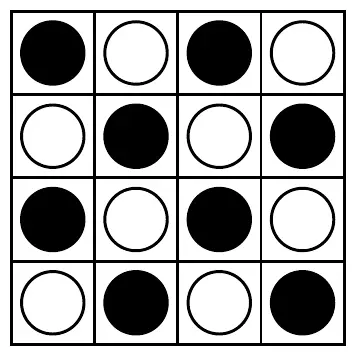
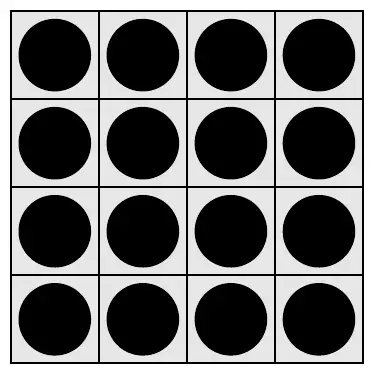
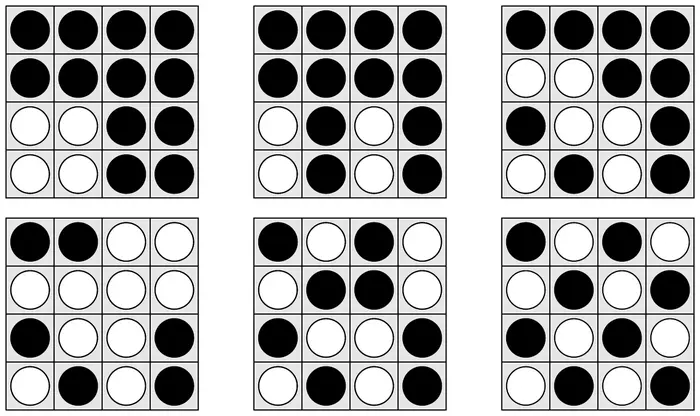
B6. Sixteen counters, which are black on one side and white on the other,
are arranged in a 4 by 4 square. Initially all the counters are facing
black side up. In one ‘move’, you must choose a 2 by 2 square within
the square and turn all four counters over once. Describe a sequence
of ‘moves’ of minimum length that finishes with the colours of the
counters of the 4 by 4 square alternating (as shown in the diagram).

A 4 by 4 square of counters alternating black and white

Junior Mathematical Olympiad 2018, Question B6. © UK Mathematics Trust. Original paper on ukmt.org.uk

JMO 2017 A9

A9. How many multiples of 3 that are less than 1000 are not divisible either by 9 or by 10?

Junior Mathematical Olympiad 2017, Question A9. © UK Mathematics Trust. Original paper on ukmt.org.uk

JMO 2017 B2

B2. A 3-digit integer is called a ‘V-number’ if the digits go ‘high-low-high’ – that is, if the tens digit is smaller than both the hundreds digit and the units (or ‘ones’) digit.

How many 3-digit ‘V-numbers’ are there?

Junior Mathematical Olympiad 2017, Question B2. © UK Mathematics Trust. Original paper on ukmt.org.uk

JMO 2017 B4

JMOCurrent spec10 marksCounting, Probability & Logic

B4. My uncle lives a long way away and his letters always contain puzzles. His three local teams are the Ants (A), the Bees (B), and the Cats (C), who play each other once a year.

My uncle claimed that the league table part way through the year looked like this:

PlayedWonDrawnLostGoals forGoals against
A100142
B211022
C210131

When we complained that this is impossible, he admitted that every single number was wrong but he excused himself because every number was exactly ‘1 out’.

Find the correct table, explaining clearly how you deduced the corrections.

Junior Mathematical Olympiad 2017, Question B4. © UK Mathematics Trust. Original paper on ukmt.org.uk

JMO 2016 B3

JMOCurrent spec10 marksCounting, Probability & Logic

B3. A large cube consists of a number of identical small cubes. The number of small cubes that touch four other small cubes face-to-face is 168.

How many small cubes make up the large cube?

Junior Mathematical Olympiad 2016, Question B3. © UK Mathematics Trust. Original paper on ukmt.org.uk

JMO 2016 B5

JMOCurrent spec10 marksCounting, Probability & Logic

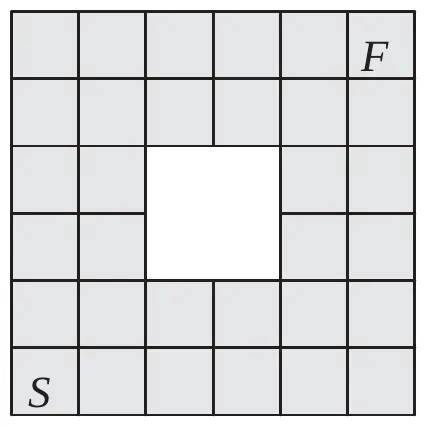
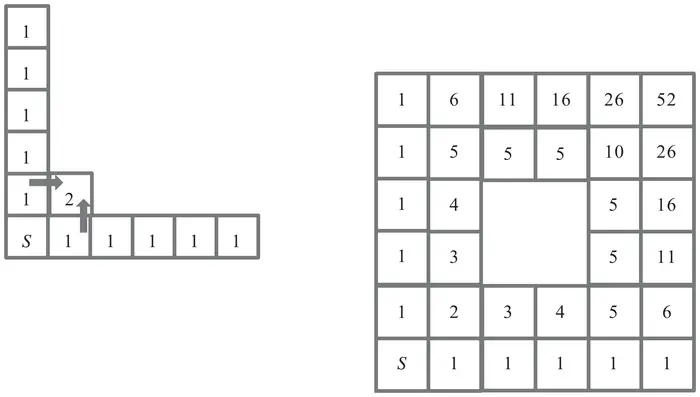
B5. The board shown has 32 cells, one of which is labelled \(S\) and another
\(F\). The shortest path starting at \(S\) and finishing at \(F\) involves exactly
nine other cells and ten moves, where each move goes from cell to
cell ‘horizontally’ or ‘vertically’ across an edge.

How many paths of this length are there from \(S\) to \(F\)?

A board of 32 cells in a 6 by 6 square with a 2 by 2 hole in the middle; S is in the bottom left cell and F in the top right cell

Junior Mathematical Olympiad 2016, Question B5. © UK Mathematics Trust. Original paper on ukmt.org.uk

JMO 2015 A6

A6. There are 81 players taking part in a knock-out quiz tournament. Each match in the tournament involves 3 players and only the winner of the match remains in the tournament − the other two players are knocked out. How many matches are required until there is an overall winner?

Junior Mathematical Olympiad 2015, Question A6. © UK Mathematics Trust. Original paper on ukmt.org.uk

JMO 2015 A10

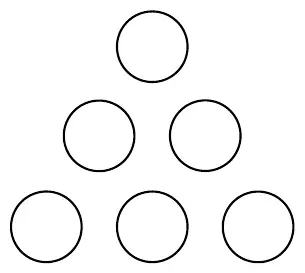
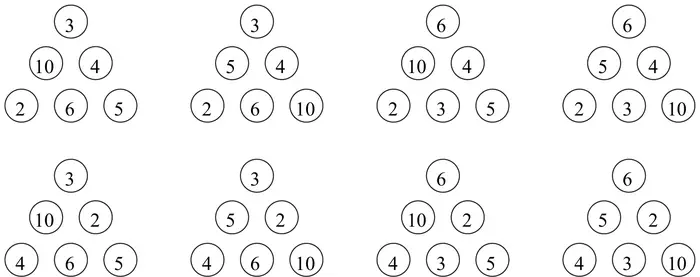
A10. Lucy wants to put the numbers 2, 3, 4, 5, 6 and 10 into the
circles so that the products of the three numbers along
each edge are the same, and as large as possible.

What is this product?

Six circles arranged in a triangle, three along each edge

Junior Mathematical Olympiad 2015, Question A10. © UK Mathematics Trust. Original paper on ukmt.org.uk

JMO 2015 B3

JMOCurrent spec10 marksCounting, Probability & Logic

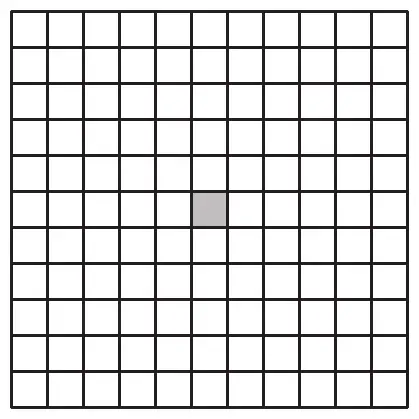
B3. Jack starts in the small square shown shaded on the
grid, and makes a sequence of moves. Each move is to
a neighbouring small square, where two small squares
are neighbouring if they have an edge in common. He
may visit a square more than once.

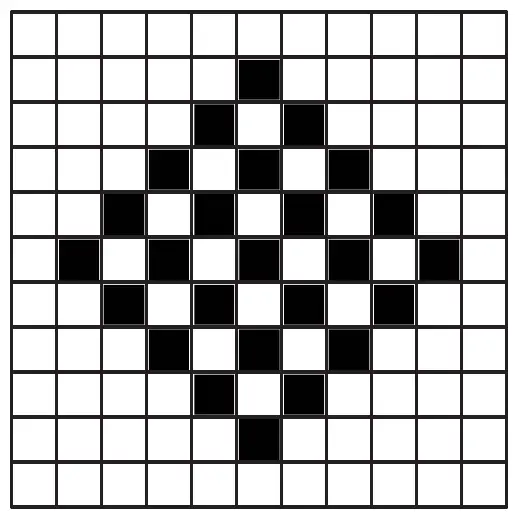
Jack makes four moves. In how many different small
squares could Jack finish?

A square grid of small squares with one small square near the middle shaded

Junior Mathematical Olympiad 2015, Question B3. © UK Mathematics Trust. Original paper on ukmt.org.uk

JMO 2015 B5

B5. I have two types of square tile. One type has a side length of 1 cm and the other has a side length of 2 cm.

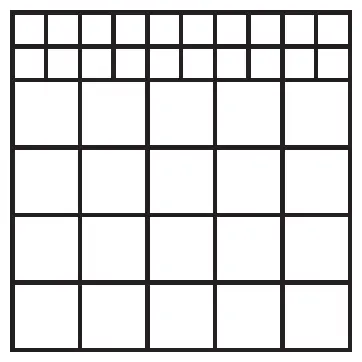
What is the smallest square that can be made with equal numbers of each type of tile?

Junior Mathematical Olympiad 2015, Question B5. © UK Mathematics Trust. Original paper on ukmt.org.uk

JMO 2015 B6

B6. The letters \(a\), \(b\), \(c\), \(d\), \(e\) and \(f\) represent single digits and each letter represents a different digit. They satisfy the following equations:

\(a + b = d,\qquad b + c = e\qquad\) and \(\qquad d + e = f.\)

Find all possible solutions for the values of \(a\), \(b\), \(c\), \(d\), \(e\) and \(f\).

Junior Mathematical Olympiad 2015, Question B6. © UK Mathematics Trust. Original paper on ukmt.org.uk