The whole Junior Mathematical Olympiad 2019 paper, one question at a time in order (16 questions). Press Mark as done after each one: your marks add up below.
To achieve the smallest possible score on any of the dice, the other five dice must show their maximum score. If each of these five dice shows a six, the sixth die must show a two.
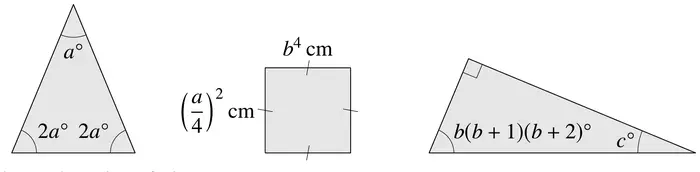
Since angles in a triangle sum to 180°, we have \(5a = 180\) and therefore \(a = 36\). From the middle diagram, \(b^4 = \left(\frac{a}{4}\right)^2 = \left(\frac{36}{4}\right)^2 = 81\). Hence, as \(b > 0\),\(b = 3\). From the third diagram and, again since angles in a triangle sum to 180°, we have \(b(b + 1)(b + 2) + c = 3 \times 4 \times 5 + c = 60 + c = 90\). Therefore, \(c = 30\).
In writing the integers 1 to 9, both the digit 1 and the digit 2 are used once. In writing the integers 10 to 19, the digit 1 is used 11 times and the digit 2 is used once. The opposite happens in writing the integers 20 to 29 with the digit 2 used 11 times and the digit 1 used once. Therefore, after writing the integers 1 to 29, both digit 1 and digit 2 have been used 13 times. Both digit 1 and digit 2 are used once when writing the integers 30 to 39 making 14 uses in total for both. Therefore, the possible values of \(N\) are the next integer which contains a digit 1 and above, up to and excluding an integer containing a digit 2. As 42 contains a digit 2, there is only one value of \(N\) which satisfies the given conditions. Hence, \(N\) is 41.
First note that \(\frac{1}{6} = \frac{5}{30}\) and \(\frac{1}{3} = \frac{10}{30}\). Any fraction of the form \(\frac{k}{30}\) between (and including) these two values, where \(k\) is an even number, will simplify to have a denominator of 15. Therefore, \(k = 6\), 8 or 10 and so there are three fractions.
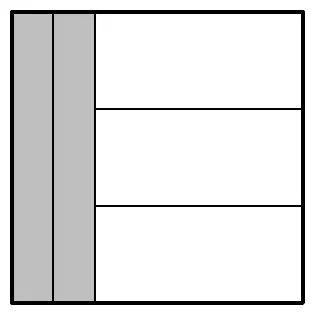
Let the width and length of a shaded rectangle be \(x\) and \(3y\) respectively and the length of an unshaded rectangle be \(l\). Since each rectangle has the same perimeter we have \(2(l + y) = 2(x + 3y)\) and hence \(l + y = x + 3y\), which gives \(l = x + 2y\). Since the original shape is a square we have \(2x + l = 3y\), which gives \(l = 3y - 2x\). Therefore, \(x + 2y = 3y - 2x\) and hence \(y = 3x\). The area of a shaded rectangle is \(3xy\) and the area of an unshaded rectangle is \(ly = y(x + 2y) = y(x + 6x) = 7xy\). Therefore, the ratio of the area of a shaded rectangle to the area of an unshaded rectangle is \(3xy : 7xy = 3 : 7\).
A9. The number 3600 can be written as \(2^a \times 3^b \times 4^c \times 5^d\), where \(a\),\(b\), \(c\) and \(d\) are all positive integers. It is given that \(a + b + c + d = 7\).
First note that \(3600 = 2^4 \times 3^2 \times 5^2\). We require \(3600 = 2^a \times 3^b \times 4^c \times 5^d\). Comparing the two expressions gives \(b = 2\), \(d = 2\) and \(2^4 = 2^a \times 4^c\). Since \(4^c = 2^{2c}\), we have \(a + 2c = 4\) and so \(a = 4 - 2c\). Also, since \(a + b + c + d = 7\), we have \(4 - 2c + 2 + c + 2 = 7\) which has solution \(c = 1\).
Let the three positive integers be \(A\), \(Ak\) and \(Ak^2\), where \(A\) is a positive constant. Therefore \(A + Ak + Ak^2 = A(1 + k + k^2) = 93 = 3 \times 31\). If \(k = 1\) and \(A = 31\),\(A^3k^3 = 31^3 \times 1^3 \neq 3375\). Therefore, since 3 and 31 are prime, \(A = 3\) and \(1 + k + k^2 = 31\). Hence, \(k = 5\) and the three integers are 3, 15 and 75.
B1. In this word-sum, each letter stands for one of the digits 0–9, and stands for the same digit each time it appears. Different letters stand for different digits. No number starts with 0.
Find all the possible solutions of the word-sum shown here.
Answer: ‘\(JMO\)’ = 150 with ‘\(IMO\)’ = 450 and ‘\(JMO\)’ = 250 with ‘\(IMO\)’ = 750
Solution (UKMT)
To find \(O\), we add three \(O\)s to find a number that has an \(O\) in the units place. Hence we require \(3O = O\) or \(3O = O + 10\) or \(3O = O + 20\). Therefore, \(2O = 0\) or \(2O = 10\) or \(2O = 20\) respectively. The only digits which satisfy any of these conditions are 0 and 5.
If \(O = 0\), there are no tens to “carry” to the middle column and so we are seeking a digit for \(M\), for which three \(M\)s have an \(M\) in the units place. Therefore, using a similar argument as the one for \(O\), \(M\) is 0 or 5. However, \(O = 0\) and so \(M = 5\) (as different letters stand for different digits).
If \(O = 5\), the total of three \(O\)s is 15 and so we have a ‘1’ to carry to the middle column. Hence, we require \(3M + 1 = M\) or \(3M + 1 = M + 10\) or \(3M + 1 = M + 20\), which implies \(2M + 1 = 0\), \(2M + 1 = 10\) or \(2M + 1 = 20\) respectively. However, there are no digit values of \(M\) which satisfy these conditions.
Hence, \(O = 0\) and \(M = 5\). If \(J = 1\),\(I = 4\). If \(J = 2\),\(I = 7\). If \(J > 2\), 3 × ‘\(JMO\)’ does not give a 3-digit number and so there are only 2 possible values for \(J\).
The only solutions are ‘\(JMO\)’ = 150 with ‘\(IMO\)’ = 450 and ‘\(JMO\)’ = 250 with ‘\(IMO\)’ = 750.
B3. It takes one minute for a train travelling at constant speed to pass completely through a tunnel that is 120 metres long. The same train, travelling at the same constant speed, takes 20 seconds from the instant its front enters the tunnel to it being completely inside the tunnel.
Let \(L\) be the length of the train in metres. It takes one minute for the train to pass completely through a tunnel, which is 120m long. Therefore, in 60 seconds the train travels \((L + 120)\) m and its average speed is \(\frac{L+120}{60}\) m/s. Travelling at the same speed, the train takes 20 seconds to travel \(L\) m. Hence,
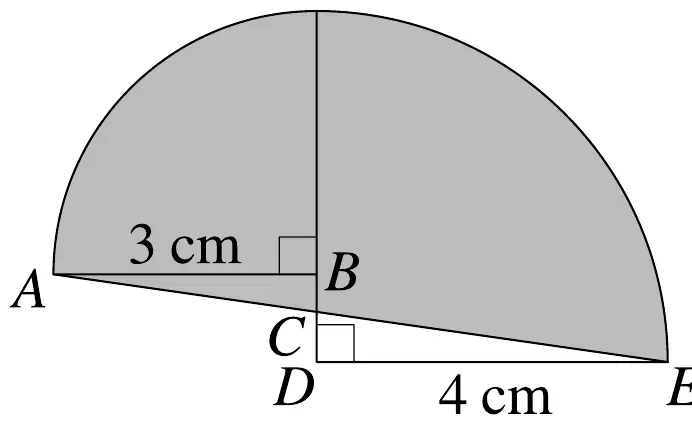
B4. The diagram alongside shows two quarter-circles and two triangles, \(ABC\) and \(CDE\). One quarter- circle has radius \(AB\), where \(AB = 3\) cm. The other quarter-circle has radius \(DE\), where \(DE = 4\) cm.
The area enclosed by the line \(AE\) and the arcs of the two quarter-circles is shaded.
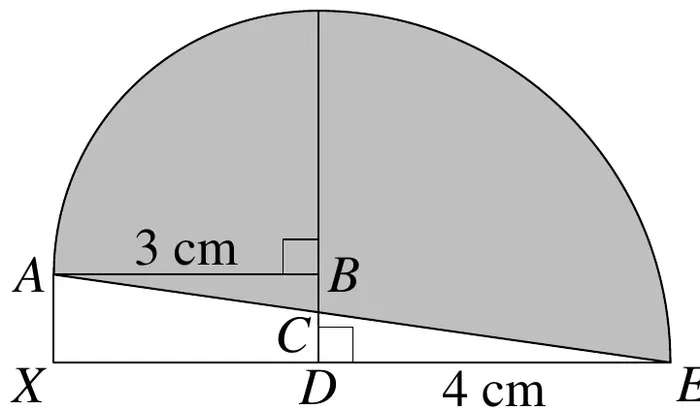
Add a point \(X\) to the diagram, directly below point \(A\) such that the lines \(AX\) and \(XD\) are perpendicular. This whole new shape consists of two quarter-circles and one rectangle (\(ABDX\)). The area, in cm2, of this new shape is
There are only 2 hours in the period with a ‘5’ in the hours display (05:00-05:59 and 15:00-15:59). During these times, every minute shows a ‘5’ in the display and, therefore, there are 60 times to count per hour.
In the remaining 22 hours, in each hour at ‘05’, ‘15’, ‘25’, ‘35’, ‘45’ and ‘50’ to ‘59’ minutes past the hour, there is at least one occurrence of a ‘5’ and hence there are 15 times in each of these 22 hours where at least one digit 5 occurs.
Therefore, the total number of different times displaying at least one occurrence of the digit ‘5’ is
B6. An equilateral triangle is divided into smaller equilateral triangles.
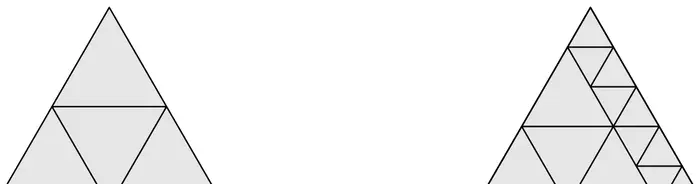
The diagram on the left shows that it is possible to divide it into 4 equilateral triangles. The diagram on the right shows that it is possible to divide it into 13 equilateral triangles.
What are the integer values of \(n\), where \(n > 1\), for which it is possible to divide the triangle into \(n\) smaller equilateral triangles?
In this solution we will refer to the triangle which is to be divided into smaller equilateral triangles as the original triangle.
The first diagram in the question shows that it is possible to split the original triangle into four smaller equilateral triangles. This process can be applied to any equilateral triangle, increasing the number of triangles in the dissection by three. Hence we can say that if it is possible to dissect the original triangle into \(m\) triangles, then it is also possible to dissect it into \(m + 3\) triangles by dividing one of the triangles in the manner shown. Since we know we can divide the original triangle into four smaller triangles, we can conclude that we can also divide it into 7, 10, 13 . . . triangles or more generally into \(n\) triangles where \(n\) is one more than a multiple of 3.
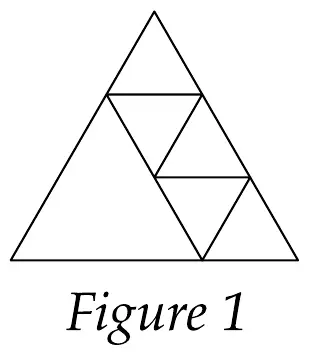
Consider figure 1. In this triangle, a line has been drawn parallel to one side two-thirds of the way from a vertex creating a smaller equilateral triangle and an isosceles trapezium. Since the angles of this trapezium are 60°, 120°, 120° and 60° and its sides are in the ratio 3 : 1 : 2 : 1, it is possible to divide the trapezium into five smaller equilateral triangles each with side-length \(\frac{1}{3}\) the side-length of the original triangle. This shows that a dissection into six equilateral triangles is possible.
Therefore, applying the result shown above, we can conclude that it is possible to dissect the original triangle into 6, 9, 12 . . . triangles or more generally into \(n\) triangles where \(n\) is a multiple of 3 greater than 3.
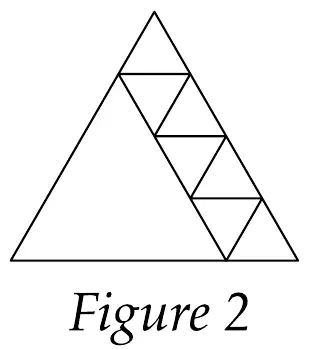
Now consider figure 2. In this triangle, a very similar dissection to figure 1 has been carried out, only this time the parallel line is three-quarters of the way from the vertex, creating an isosceles trapezium with sides in the 4 : 1 : 3 : 1, which can itself be divided into seven smaller equilateral triangles with side-length \(\frac{1}{4}\) the side-length of the original triangle.
This shows that a dissection into eight equilateral triangles is possible and hence we can conclude that it is possible to dissect the original triangle into 8, 11, 14 . . . triangles or more generally into \(n\) triangles where \(n\) is a one less than a multiple of 3 greater than 6.
Combining these results, it can be seen from the working above that it is possible to dissect the original triangle into \(n\) equilateral triangles for any values of \(n\) except 2, 3 and 5. We will now consider each of these values in turn and prove that it is not possible to create any dissection giving this number of smaller triangles.
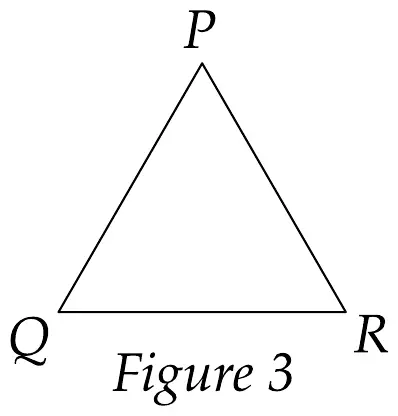
Consider the original triangle with its vertices labelled \(P\), \(Q\) and \(R\) as shown in figure 3. Define a \(D\)-triangle as any triangle in a dissection \(D\) of the original triangle.
If any two vertices, say \(P\) and \(Q\), are in the same \(D\)-triangle then \(PQ\) is an edge of a \(D\)-triangle which must be the original triangle itself. Therefore it is not possible to have any dissection into two triangles as any such dissection would require one of \(P\), \(Q\) and \(R\) in a different \(D\)-triangle from the other two.
Otherwise \(P\), \(Q\) and \(R\) are in different \(D\)-triangles. Since \(\angle P = 60°\), the only edges of \(D\)-triangles that meet at \(P\) form part of \(PQ\) and \(PR\). Hence \(P\) is in just one \(D\)-triangle and the third edge of that \(D\)-triangle is parallel to the edge \(QR\). A similar argument applies to \(Q\) and \(R\).
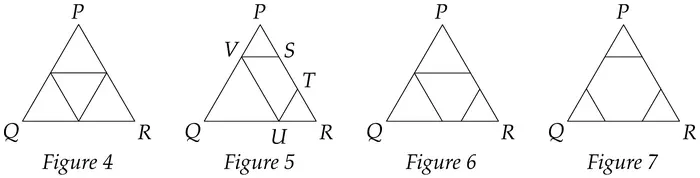
Therefore the different possibilities according to the number of these third edges that meet are as shown in figures 4, 5, 6 and 7.
In figure 4, \(D\) consists of at least four triangles and, since none of these can be divided into two equilateral triangles, \(D\) contains either four or at least six triangles. In figure 5, the quadrilateral \(STUV\) has two adjacent angles at \(S\) and \(T\) of 120°. Therefore \(S\) and \(T\) are each vertices of at least two \(D\)-triangles other than \(PVS\) and \(RTU\). Hence \(STUV\) is divided into at least three \(D\)-triangles and so \(D\) consists of at least six triangles. The arguments for figures 6 and 7 are similar. Hence \(D\) cannot consist of 3 or 5 triangles.
Therefore it is not possible to divide the original triangle into 2, 3 or 5 triangles.
We'd like to use Google Analytics cookies to count visits and see which pages help most. They're optional, and the site works exactly the same either way. Privacy policy