The whole Junior Mathematical Olympiad 2018 paper, one question at a time in order (16 questions). Press Mark as done after each one: your marks add up below.
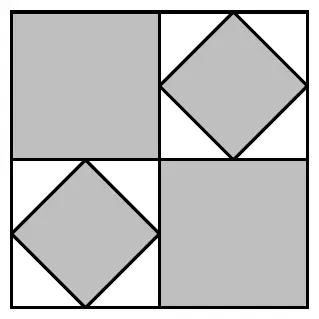
A2. A large square is split into four congruent squares, two of which are shaded. The other two squares have smaller shaded squares drawn in them whose vertices are the midpoints of the sides of the unshaded squares. What fraction of the large square is shaded?
The two larger grey squares make up \(\frac{1}{2}\) of the large square. Each white square is \(\frac{1}{4}\) of the large square and \(\frac{1}{2}\) of each of these squares is shaded. Therefore, the two smaller grey squares account for \(2 \times \frac{1}{2} \times \frac{1}{4} = \frac{1}{4}\) of the large square. Therefore, \(\frac{1}{2} + \frac{1}{4} = \frac{3}{4}\) of the large square is shaded.
Two digit squares can only start with 1, 2, 3, 4, 6 or 8.
The sequence starting 2 goes 2 → 5 and then can’t continue while the sequences starting with 3 or 1 go 3 (or 1) → 6 → 4 → 9 and so are longer than any sequence starting with 4 or 6. However, the sequence starting with 8 is 8 → 1 → 6 → 4 → 9 which is the longest. Therefore, 81649 is the largest integer.
Let the interior angles of the pentagon be \(2n°\),\((2n + 2)°\),\((2n + 4)°\), \((2n + 6)°\) and \((2n + 8)°\). The interior angles of a pentagon sum to 540°. Therefore, \(2n + 2n + 2 + 2n + 4 + 2n + 6 + 2n + 8 = 540\), which gives \(10n + 20 = 540\) and \(2n = 104\). Hence, the size of the largest angle is \((104 + 8)° = 112°\).
Since the units digit of the answer is a zero, either \(a\) or \(b\) must be 5. Without loss of generality, assume \(a = 5\). Therefore, \(b\) is even.
Since the answer ends in ‘00’, it is a multiple of 100 and hence is a multiple of 25. Therefore, since \(b \neq 0\) and ‘\(ba\)’ ends in 5, ‘\(ba\)’ has a factor of 25. The only 2-digit multiples of 25 ending in 5 are 25 and 75. However 7 is not even. Therefore ‘\(ba\)’ = 25 and the smallest two-digit number is 25.
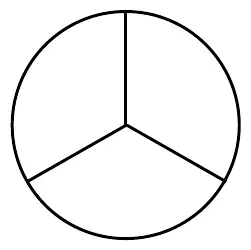
Let the radius of the circle be \(r\). As each sector is a third of the circle, the length of the perimeter of each sector is \(\frac{2\pi r}{3} + 2r\). Therefore, the ratio of the length of the perimeter of one of the three sectors to the length of the circumference of the circle is \(\left(\frac{2\pi r}{3} + 2r\right) : 2\pi r = \left(\frac{\pi}{3} + 1\right) : \pi\) or \((\pi + 3) : 3\pi\).
There are 9 integers with two zeros, i.e. \(100, 200, \cdots, 800, 900\). When the repeated digit is non-zero, the integers have the form ‘\(xxy\)’, ‘\(xyx\)’ or ‘\(yxx\)’. If \(x = 1\), \(y\) can be 0, 2, 3, 4, 5, 6, 7, 8 or 9, although we must ignore ‘011’ as this is a two-digit integer. This gives 26 different integers. Similarly, there will be an additional 26 integers for every non-zero \(x\) value. Therefore, the total number of three-digit integers less than 1000 that have exactly two different digits in their representation is \(9 + 9 \times 26 = 243\).
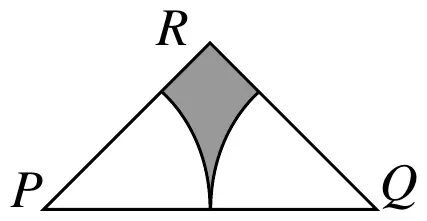
A9. The triangle \(PQR\) is isosceles with \(PR = QR\). Angle \(PRQ = 90°\) and length \(PQ = 2\) cm. Two arcs of radius 1 cm are drawn inside triangle \(PQR\). One arc has its centre at \(P\) and intersects \(PR\) and \(PQ\). The other arc has its centre at \(Q\) and intersects \(QR\) and \(PQ\).
Using Pythagoras’ Theorem, \(PR = QR = \sqrt{2}\). The area of the triangle, in cm2, is \(\frac{1}{2} \times \sqrt{2} \times \sqrt{2} = 1\). The total area, in cm2, of the unshaded regions, which is equivalent to the area of a quarter of a circle with radius 1 cm, is \(\frac{\pi}{4}\). Therefore, the area of the shaded region, in cm2, is \(\left(1 - \frac{\pi}{4}\right)\).
A10. A four-digit integer has its digits increasing from left to right. When we reverse the order of the digits, we obtain a four-digit integer whose digits decrease from left to right. A third four-digit integer uses exactly the same digits, but in a different order. The sum of the three integers is 26 352.
What is the value of the smallest of the three integers?
Let Polly be \(x\) years old when her age was equal to the sum of her three children’s ages. At this time, her three children were \(x - 20\), \(x - 22\) and \(x - 24\) years old. This leads to the equation
\[x = x - 20 + x - 22 + x - 24.\]
Hence
\[\begin{aligned} x &= 3x - 66 \\ 2x &= 66 \\ x &= 33. \end{aligned}\]
Therefore, Polly was 33 years old when her age was equal to the sum of her three children’s ages.
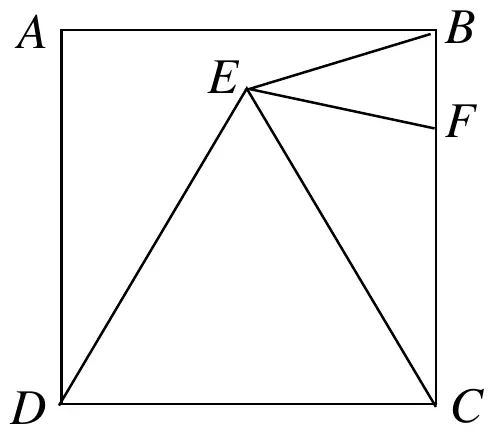
Since triangle \(DEC\) is equilateral, \(\angle DCE = 60°\). Therefore, since \(ABCD\) is a square, \(\angle ECF = 30°\). Since \(DC = CE\) and \(DC = CB\), we have \(CE = CB\) and hence triangle \(ECB\) is isosceles.
As triangle \(EBF\) is isosceles, \(\angle CBE = \angle BFE\). Therefore,
\[\angle BFE = \frac{180° - 30°}{2} = 75° \text{ (angles in a triangle sum to 180°)}\]
and, consequently,
\[\angle EFC = 105° \text{ (angles on a straight line sum to 180°).}\]
Hence, using the fact that angles in a triangle sum to 180°,
B3. The letters \(a\), \(b\) and \(c\) stand for non-zero digits. The integer ‘\(abc\)’ is a multiple of 3; the integer ‘\(cbabc\)’ is a multiple of 15; and the integer ‘\(abcba\)’ is a multiple of 8.
The question tells us that ‘\(abcba\)’ is a multiple of 8. Therefore, since 1000 and hence any multiple of 1000, is a multiple of 8, ‘\(cba\)’ is a multiple of 8.
The question also tells us that ‘\(abc\)’ is a multiple of 3 and hence, since the digit sums of ‘\(abc\)’ and ‘\(cba\)’ are the same, ‘\(cba\)’ is also a multiple of 3. Hence, ‘\(cba\)’ is a multiple of 24.
Finally, we are told that ‘\(cbabc\)’ is a multiple of 15. Since \(c \neq 0\), then \(c = 5\) and \(c + b\) is a multiple of 3.
The three-digit multiples of 24 which are the possible values of ‘\(cba\)’ beginning with ‘5’ are 504, 528, 552 and 576 and, of these, only 576 has \(c + b\) as a multiple of 3.
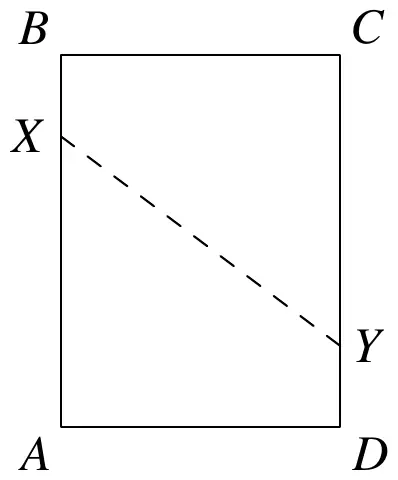
B4. A rectangular sheet of paper is labelled \(ABCD\), with \(AB\) one of the longer sides. The sheet is folded so that vertex \(A\) is placed exactly on top of the opposite vertex \(C\). The fold line is \(XY\), where \(X\) lies on \(AB\) and \(Y\) lies on \(CD\).
The construction of the fold means that \(\angle AXY = \angle CXY\). By alternate angles, \(\angle AXY = \angle CYX\). Hence \(\angle CXY = \angle CYX\) and so triangle \(CXY\) is isosceles.
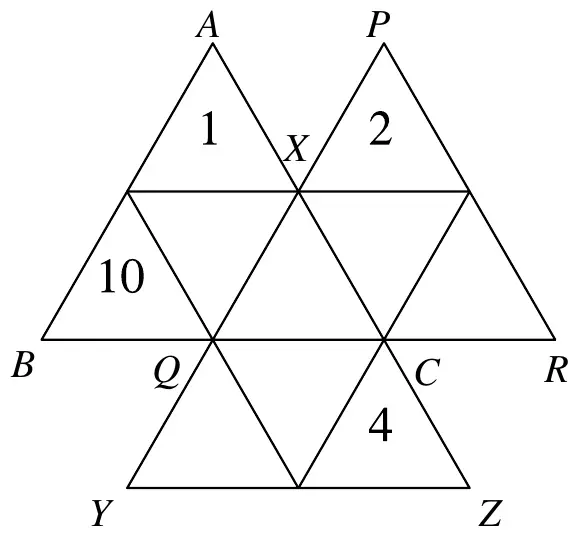
B5. The diagram shows three triangles, \(ABC\), \(PQR\) and \(XYZ\), each of which is divided up into four smaller triangles. The diagram is to be completed so that the positive integers from 1 to 10 inclusive are placed, one per small triangle, in the ten small triangles. The totals of the numbers in the three triangles \(ABC\), \(PQR\) and \(XYZ\) are the same.
Numbers 1, 2, 4 and 10 have already been placed.
In how many different ways can the diagram be completed?
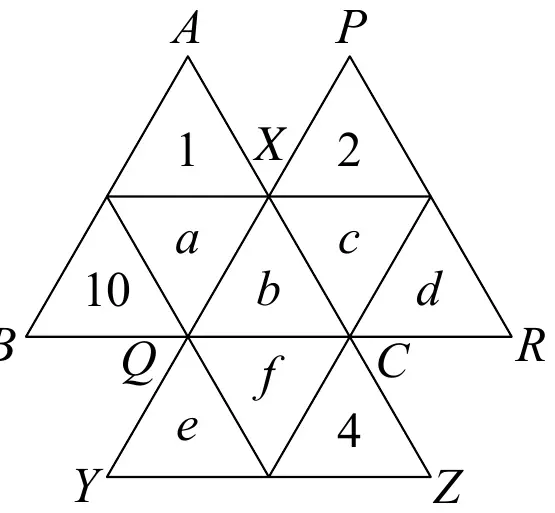
Label the empty small triangles in the second row as \(a\),\(b\), \(c\) and \(d\) from left to right and the empty small triangles in the third row as \(e\) and \(f\) from left to right.
These triangles may only contain the integers 3, 5, 6, 7, 8 or 9.
Since the totals in the triangles \(ABC\), \(PQR\) and \(XYZ\) are the same and the sum of the integers 1 to 10 is 55, we can deduce that
\(55 + 2b \text{ is a multiple of 3.}\)
(1)
Therefore, \(b = 7\), as it is the only remaining integer that satisfies (1). Consequently, the total in each triangle \(ABC\), \(PQR\) and \(XYZ\) is 23.
Considering the totals in the triangles \(ABC\), \(PQR\) and \(XYZ\) gives
\[\begin{aligned} a + b + 11 &= 23 &\quad (2) \\ b + c + d + 2 &= 23 &\quad (3) \\ \text{and}\quad b + e + f + 4 &= 23 &\quad (4) \end{aligned}\]
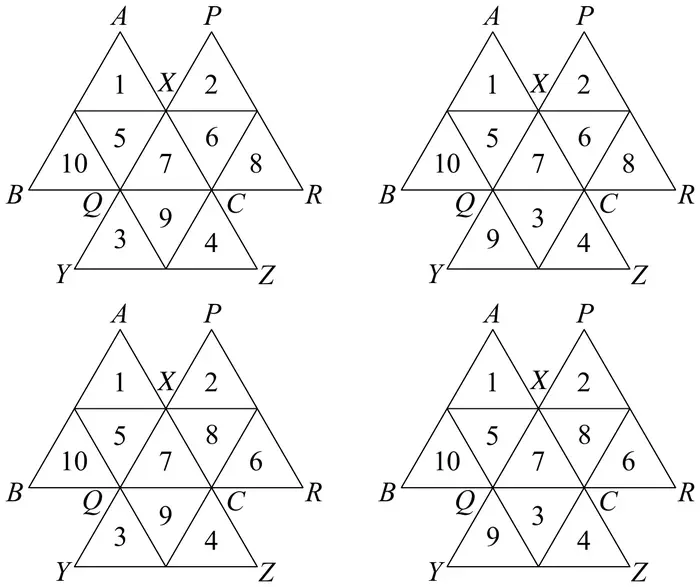
respectively. Equation (2) gives \(a = 5\). The only remaining integers now are 3, 6, 8 and 9. From equations (3) and (4), \(c + d = 14\) and \(e + f = 12\). To satisfy these equations \(c\) and \(d\) must be 8 and 6 in any order and \(e\) and \(f\) must be 3 and 9 in any order. Therefore, there are only 4 different ways in which the diagram can be completed and these are shown below:
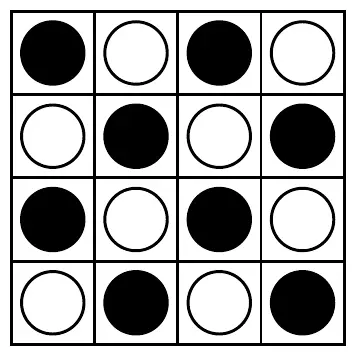
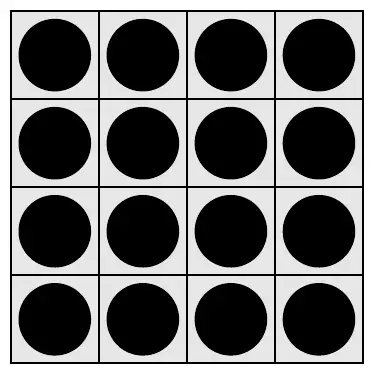
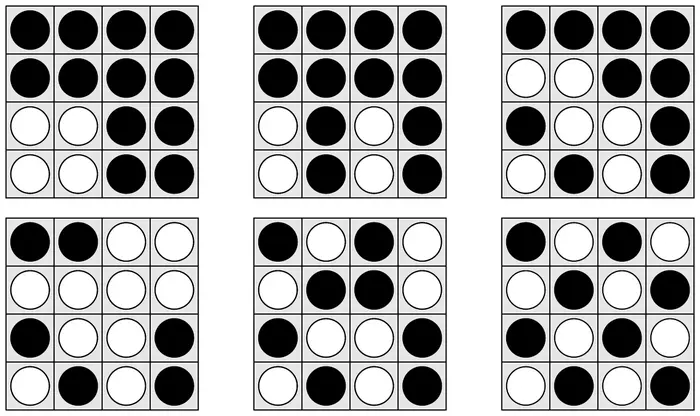
B6. Sixteen counters, which are black on one side and white on the other, are arranged in a 4 by 4 square. Initially all the counters are facing black side up. In one ‘move’, you must choose a 2 by 2 square within the square and turn all four counters over once. Describe a sequence of ‘moves’ of minimum length that finishes with the colours of the counters of the 4 by 4 square alternating (as shown in the diagram).
Define a set of coordinates from the bottom left corner, such that (1, 1) relates to the counter in the bottom left corner, (1, 4) relates to the counter in the top left corner, (4, 1) relates to the counter in the bottom right corner, etc.
Consider the counter at (1, 1). This must be flipped and can only be flipped by flipping the bottom left 2 by 2 square.
Now both the counter at (1, 2) and (2, 1) need to be flipped and it is not possible to flip both together without also changing (1, 1). Therefore flip the counters in the 2 by 2 square with lower left corner at (2, 1) and in the 2 by 2 square with lower left corner at (1, 2). Since the counter at (2, 2) will have then been flipped three times, it will be of the opposite colour to its original colour as required. Therefore we have completed the square in the bottom left corner with three ‘moves’.
A similar argument can be applied to the counter at (4, 4) and the top right 2 by 2 square which has not been affected by any of the moves so far. Three more ‘moves’ are required to turn all four counters in this 2 by 2 square to the required colour.
In fact, this completes the pattern of the 4 by 4 square as a whole. Therefore a minimum of six ‘moves’ is required.
We'd like to use Google Analytics cookies to count visits and see which pages help most. They're optional, and the site works exactly the same either way. Privacy policy