JMO 2017 A1
A1. How many centimetres are there in 1 km 2 m 3 cm 4 mm?
Junior Mathematical Olympiad 2017, Question A1. © UK Mathematics Trust. Original paper on ukmt.org.uk
Answer: 100 203.4

Understand it. Practise it. Enjoy it. All for free.
Junior Mathematical Olympiad 2017
The whole Junior Mathematical Olympiad 2017 paper, one question at a time in order (16 questions). Press Mark as done after each one: your marks add up below.
Questions and solutions © UK Mathematics Trust, shown with permission. Papers and more at ukmt.org.uk.
A1. How many centimetres are there in 1 km 2 m 3 cm 4 mm?
Junior Mathematical Olympiad 2017, Question A1. © UK Mathematics Trust. Original paper on ukmt.org.uk
Answer: 100 203.4
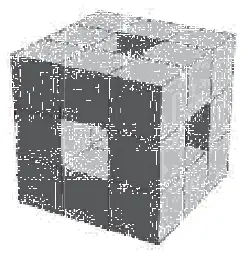
A2. The solid shown is formed by taking a 3 cm × 3 cm × 3 cm cube and
drilling a 1 cm × 1 cm square hole from the centre of each face to the
centre of the opposite face.
What is the volume in cm3 of the solid?
Junior Mathematical Olympiad 2017, Question A2. © UK Mathematics Trust. Original paper on ukmt.org.uk
Answer: 20
A3. Howard is out running. He is now \(\frac{3}{5}\) of the way through the second half of his run. What fraction of the whole run has he completed?
Junior Mathematical Olympiad 2017, Question A3. © UK Mathematics Trust. Original paper on ukmt.org.uk
Answer: \(\frac{4}{5}\)
Howard has completed \(\frac{1}{2}\) of the run. He is now \(\frac{3}{5}\) of the way through the second half. Hence he has completed \(\frac{1}{2} + \frac{3}{5} \times \frac{1}{2} = \frac{1}{2} + \frac{3}{10} = \frac{4}{5}\) of the whole run.
Solution © UK Mathematics Trust, from the JMO 2017 solutions.
A4. A bookmark-maker sells bookmarks for £1 each or 7 for £6. What is the smallest amount you could pay for 2017 of her bookmarks?
Junior Mathematical Olympiad 2017, Question A4. © UK Mathematics Trust. Original paper on ukmt.org.uk
Answer: £1729
Since \(2017 = 288 \times 7 + 1\), you can buy 288 lots of 7 bookmarks at £6 each. Hence the smallest amount you could pay for 2017 of the bookmarks is £6 × 288 + £1 × 1 = £1729.
Solution © UK Mathematics Trust, from the JMO 2017 solutions.
A5. In 1866, the yacht Henrietta – with Gordon Bennett aboard – won the Great Ocean Yacht Race, travelling a distance of approximately 3000 nautical miles. The winning time was 13 days and 22 hours, to the nearest hour.
What was the yacht's average speed in nautical miles per hour, to the nearest integer?
Junior Mathematical Olympiad 2017, Question A5. © UK Mathematics Trust. Original paper on ukmt.org.uk
Answer: 9
Since 13 days and 22 hours are equivalent to 334 hours, the yacht travels 3000 nautical miles in 334 hours. Therefore the yacht travels \(\frac{3000}{334}\) nautical miles in 1 hour. Hence the yacht's average speed in nautical miles per hour is 9 (to the nearest integer).
Solution © UK Mathematics Trust, from the JMO 2017 solutions.
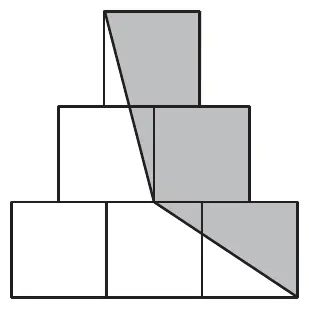
A6. The diagram shows six identical squares arranged symmetrically.
What fraction of the diagram is shaded?
Junior Mathematical Olympiad 2017, Question A6. © UK Mathematics Trust. Original paper on ukmt.org.uk
Answer: \(\frac{11}{24}\)
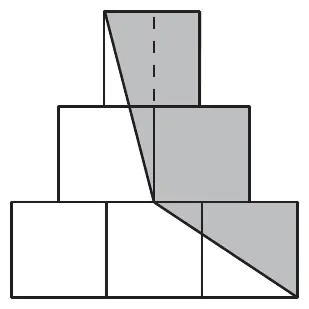
There are several ways to solve this problem. This solution
is just one example. Without loss of generality, let each
square have a side length of 2 units. Hence the six identical
squares have a total area of \(6 \times 2^2 = 24\) square units. The
grey shaded area can be thought of as consisting of two
triangles, one rectangle and one square, as shown on the
diagram. Therefore the grey shaded area is
\[\tfrac{1}{2} \times 1 \times 4 + \tfrac{1}{2} \times 3 \times 2 + 1 \times 2 + 2^2 = 11 \text{ square units.}\]
Hence \(\frac{11}{24}\) of the diagram is shaded.
Solution © UK Mathematics Trust, from the JMO 2017 solutions.
A7. A fully-grown long-tailed tit − Aegithalos caudatus − weighs only 9 g, whereas a £1 coin weighs 9.5 g.
To the nearest 1 %, what percentage of the weight of a £1 coin is the weight of a fully-grown long-tailed tit?
Junior Mathematical Olympiad 2017, Question A7. © UK Mathematics Trust. Original paper on ukmt.org.uk
Answer: 95%
The required percentage is \(\dfrac{9}{9.5} \times 100 = \dfrac{18}{19} \times 100 = \dfrac{1800}{19} \approx 94.7\) by long division. This is 95% to the nearest 1%.
Solution © UK Mathematics Trust, from the JMO 2017 solutions.
A8. A jar contains red and white marbles in the ratio 1 : 4. When Jenny replaces 2 of the white marbles with 7 red marbles, the ratio becomes 2 : 3.
What is the ratio of the total number of marbles in the jar now to the total number in the jar before?
Junior Mathematical Olympiad 2017, Question A8. © UK Mathematics Trust. Original paper on ukmt.org.uk
Answer: 6 : 5
Let \(m\) be the original number of marbles in the jar. Therefore, as Jenny replaces 2 of the white marbles with 7 red marbles, there are now \(m + 5\) marbles in the jar. We know that \(\frac{4}{5}\) of the original number of marbles were white, that 2 white marbles were removed and that now \(\frac{3}{5}\) of the jar’s marbles are white. Hence
\(\frac{4}{5}m - 2 = \frac{3}{5}(m + 5)\).
Solving this equation, gives \(m = 25\). Therefore the ratio of the total number of marbles in the jar now to the number in the jar before is 30 : 25 = 6 : 5.
Solution © UK Mathematics Trust, from the JMO 2017 solutions.
A9. How many multiples of 3 that are less than 1000 are not divisible either by 9 or by 10?
Junior Mathematical Olympiad 2017, Question A9. © UK Mathematics Trust. Original paper on ukmt.org.uk
Answer: 200
There are 333 multiples of 3 less than 1000, and there are 111 multiples of 9 less than 1000. As numbers that are multiples of both 3 and 10 are multiples of 30, consider the 33 multiples of 30 that are less than 1000. The lowest common multiple of 9 and 30 is 90 and there are 11 multiples of 90 less than 1000. Hence the number of multiples of 3 that are less than 1000 but not divisible by either 9 or by 10 is 333 − 111 − 33 + 11 = 200.
Solution © UK Mathematics Trust, from the JMO 2017 solutions.
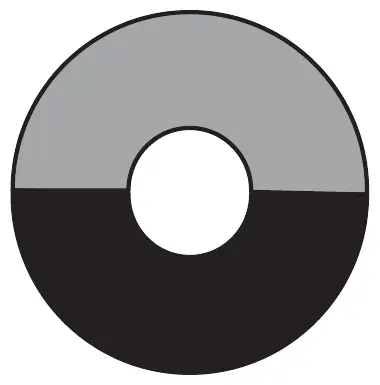
A10. Two concentric circles are drawn, as shown in the diagram.
Concentric circles share the same point as their centre. The
radius of the smaller circle is a third of the radius of the larger
circle. The top half of the larger circle which is outside the
smaller circle, is shaded in grey.
The ratio of the grey shaded area to the area of the smaller circle
in its simplest form is \(a : b\). What are the values of \(a\) and \(b\)?
Junior Mathematical Olympiad 2017, Question A10. © UK Mathematics Trust. Original paper on ukmt.org.uk
Answer: 4, 1
Let the radius of the smaller circle be \(r\), so the radius of the larger circle is \(3r\). The area of the smaller circle is \(\pi r^2\) and the grey shaded area is \(\frac{1}{2}\pi(3r)^2 - \frac{1}{2}\pi r^2 = 4\pi r^2\).
Therefore the ratio of the grey shaded area to the area of the smaller circle is \(4\pi r^2 : \pi r^2 = 4 : 1\), and hence \(a = 4\) and \(b = 1\).
Solution © UK Mathematics Trust, from the JMO 2017 solutions.
B1. An amount of money is to be divided equally between a group of children. If there was 20p more than this amount, then there would be enough for each child to receive 70p. However, if each child was to receive 60p, then £2.10 would be left over.
How many children are there in the group?
Junior Mathematical Olympiad 2017, Question B1. © UK Mathematics Trust. Original paper on ukmt.org.uk
Answer: 23
Let \(C\) be the number of children in the group and let \(A\) be the total amount of money in pence to be divided between the children.
Then \(\dfrac{A + 20}{C} = 70\), so that \(A + 20 = 70C\) and therefore \(A = 70C - 20\).
Also \(A = 60C + 210\).
Hence \(70C - 20 = 60C + 210\).
Solving this last equation we obtain \(C = 23\). Therefore there are 23 children in the group.
It is good practice to check the solution works. The total amount of money is £15.90, and (£15.90 + £0.20) ÷ 23 = £0.70; £0.60 × 23 = £13.80, and £13.80 + £2.10 = £15.90.
Solution © UK Mathematics Trust, from the JMO 2017 solutions.
B2. A 3-digit integer is called a ‘V-number’ if the digits go ‘high-low-high’ – that is, if the tens digit is smaller than both the hundreds digit and the units (or ‘ones’) digit.
How many 3-digit ‘V-numbers’ are there?
Junior Mathematical Olympiad 2017, Question B2. © UK Mathematics Trust. Original paper on ukmt.org.uk
Answer: 285
The smallest ‘V-number’ is 101 and the largest ‘V-number’ is 989.
Consider the tens digits. The smallest tens digit is 0 and the largest tens digit is 8.
If the tens digit is 0, the hundreds digit can be 1 to 9, and the units digit can be 1 to 9, giving \(9 \times 9\) possible ‘V-numbers’.
If the tens digit is 1, then the hundreds digit can be 2 to 9 and the units digit can be 2 to 9, giving \(8 \times 8\) possible ‘V-numbers’.
If the tens digit is \(d\), where \(d\) can be any digit from 0 to 8, the hundreds digit can be \((d + 1)\) to 9 and the units digit can be \((d + 1)\) to 9, giving \((9 - d) \times (9 - d)\) possible ‘V-numbers’.
The greatest value of \(d\) is 8. In this case, the hundreds digit can only be 9 and the units digit can only be 9, which gives just \(1 \times 1\) possibilities.
This gives the total number of possible ‘V-numbers’ to be \(9 \times 9 + 8 \times 8 + \ldots + 1 \times 1 = 285\), which is the sum of the squares from 1 to 9 inclusive.
Solution © UK Mathematics Trust, from the JMO 2017 solutions.
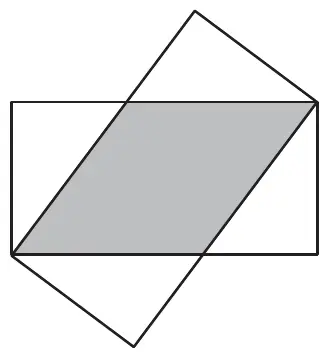
B3. Two identical rectangles overlap in such a way that a
rhombus is formed, as indicated in the diagram. The area of
the rhombus is five-eighths of the area of each rectangle.
What is the ratio of the length of the longer side of the
rectangle to the length of the shorter side?
Junior Mathematical Olympiad 2017, Question B3. © UK Mathematics Trust. Original paper on ukmt.org.uk
Answer: 2 : 1
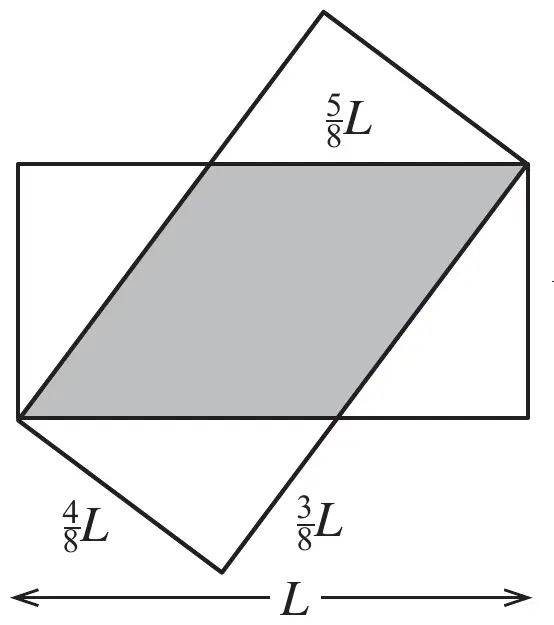
Let the length of the longer side and of the shorter
side of the rectangle be \(L\) and \(W\) respectively.
Since the area of the rhombus is \(\frac{5}{8}\) of the area of each
rectangle, the area of the rhombus is \(\frac{5}{8}LW\). Also,
since the area of a rhombus is equal to base ×
perpendicular height and the perpendicular height of
the shaded rhombus is \(W\), the length of each side of
the rhombus is \(\frac{5}{8}L\).
Consider one of the white right-angled triangles.
The length of the hypotenuse is \(\frac{5}{8}L\) and the length of
one other side is \(L - \frac{5}{8}L = \frac{3}{8}L\). Therefore, using
Pythagoras' Theorem, we can find the length of the
third side in terms of \(L\) since the triangle is a 3: 4: 5 triangle. Hence \(W = \frac{4}{8}L\) and the ratio of the length of the longer side of the rectangle to the length of the shorter side of the rectangle is \(L : \frac{4}{8}L = 2 : 1\).
Solution © UK Mathematics Trust, from the JMO 2017 solutions.
B4. My uncle lives a long way away and his letters always contain puzzles. His three local teams are the Ants (A), the Bees (B), and the Cats (C), who play each other once a year.
My uncle claimed that the league table part way through the year looked like this:
| Played | Won | Drawn | Lost | Goals for | Goals against | |
| A | 1 | 0 | 0 | 1 | 4 | 2 |
| B | 2 | 1 | 1 | 0 | 2 | 2 |
| C | 2 | 1 | 0 | 1 | 3 | 1 |
When we complained that this is impossible, he admitted that every single number was wrong but he excused himself because every number was exactly ‘1 out’.
Find the correct table, explaining clearly how you deduced the corrections.
Junior Mathematical Olympiad 2017, Question B4. © UK Mathematics Trust. Original paper on ukmt.org.uk
The maximum number of games any team can play is 2, as each team only plays another team once in the year and there are only 3 teams.
Therefore team B (the Bees) and team C (the Cats) played 1 game each.
Team A (the Ants) played 2 games (because if they had played 0 games they would have 0 goals for). Since each figure is ‘1 out’, team A won 1, drew 1 and lost 0 (so that the total number of matches played is 2).
Since team A won 1 match, team B lost 1 match (since team B had lost 0 games originally and team C cannot have lost 2 games). Therefore, team B won 0 games and drew 0 games.
So team A drew against team C. Therefore the number of games resulting in a draw for team C is 1 and, as they only played 1 match, they won and lost 0 games.
Since team C's only game resulted in a draw, team C's goals for and against are equal. Therefore, team C's goals for and against are 2 each.
Team B's only match resulted in a loss, so team B's goals against are greater than its goals for. Therefore, the number of team B's goals for is 1 and the number of its goals against is 3.
Because team B and team C both only played team A, the number of team A's goals for is equal to the sum of the number of team B's goals against and the number of team C's goals against. Hence the number of team A's goals for is 5. Similarly, the number of team A’s goals against is the sum of the number of team B’s goals for and the number of team C’s goals for. Therefore the number of team A’s goals against is 3.
So the correct table is
| Team | Played | Won | Drawn | Lost | Goals for | Goals against |
| A | 2 | 1 | 1 | 0 | 5 | 3 |
| B | 1 | 0 | 0 | 1 | 1 | 3 |
| C | 1 | 0 | 1 | 0 | 2 | 2 |
Solution © UK Mathematics Trust, from the JMO 2017 solutions.
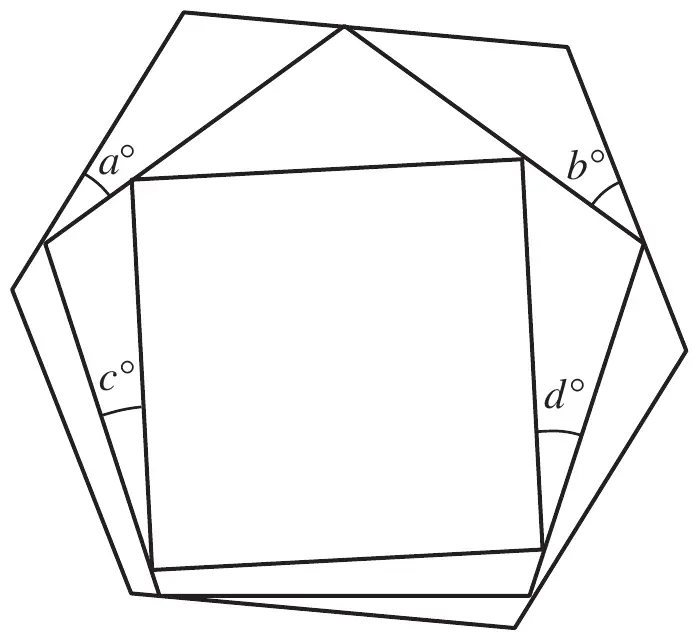
B5. The diagram shows a square whose vertices
touch the sides of a regular pentagon. Each
vertex of the pentagon touches a side of a
regular hexagon.
Find the value of \(a + b + c + d\).
Junior Mathematical Olympiad 2017, Question B5. © UK Mathematics Trust. Original paper on ukmt.org.uk
Answer: 84
Each interior angle of a regular pentagon is 108° and each interior angle of a regular hexagon is 120°.
Consider the two shaded triangles in the diagram
alongside, which contain the angles \(a°\) and \(b°\) and
the side of the hexagon that these triangles have in
common.
Let the two angles shown be \(m°\) and \(n°\). Since the
sum of the interior angles in a triangle is 180°, we
have \(120 + a + m = 180\) and \(120 + b + n = 180\).
Therefore, \(m = 60 - a\) and \(n = 60 - b\). Now,
since the sum of the angles on a straight line is
180°, we have \(m + 108 + n = 180\). Hence
\(60 - a + 108 + 60 - b = 180\). Therefore \(a + b = 48\).
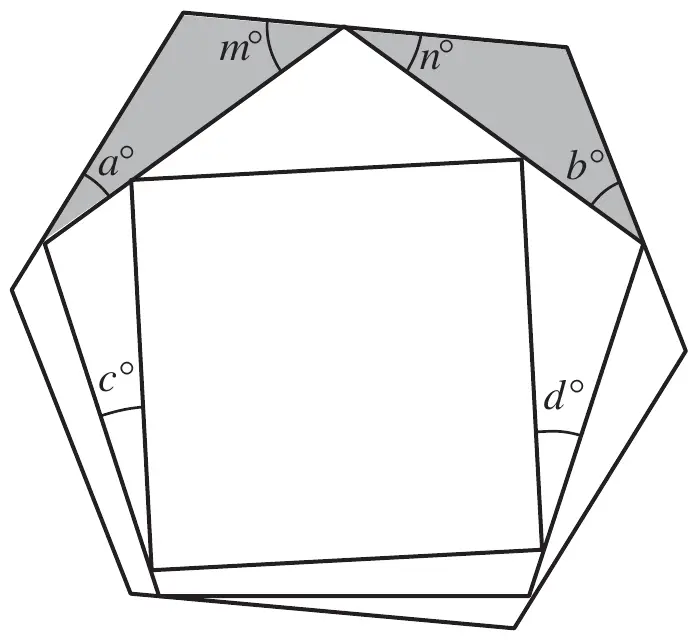
The region outside the square but inside the
pentagon consists of a quadrilateral, shown
shaded in the diagram alongside, and three
triangles. We now consider the quadrilateral.
Let the two angles shown be \(p°\) and \(q°\). Since the
interior angles of a square are 90° and the sum of
the angles on a straight line is 180°, we have
\(c + 90 + p = 180\) and \(d + 90 + q = 180\).
Therefore \(p = 90 - c\) and \(q = 90 - d\). Now,
since the sum of the angles in a quadrilateral is
360° and two of these angles are interior angles
of a regular pentagon, we have
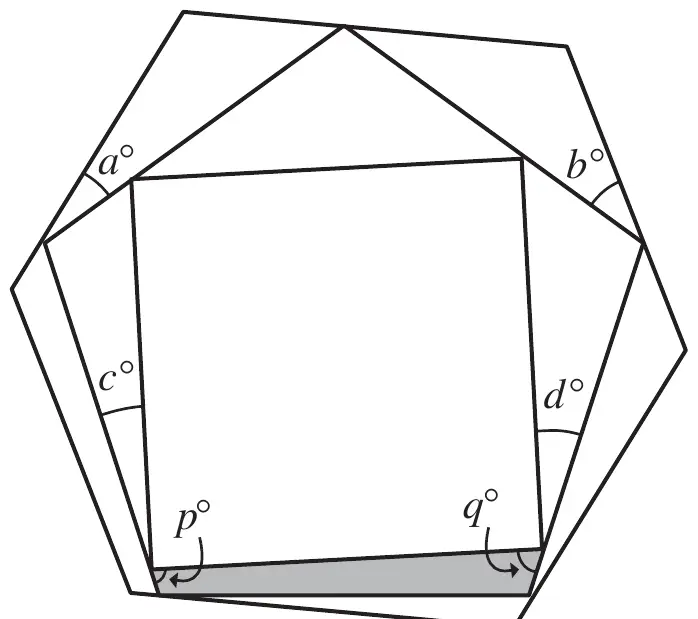
\(108 + p + q + 108 = 360\). Hence \(216 + 90 - c + 90 - d = 360\). Therefore \(c + d = 36\).
Hence
\[\begin{aligned} a + b + c + d &= 48 + 36 \\[6pt] &= 84. \end{aligned}\]
Solution © UK Mathematics Trust, from the JMO 2017 solutions.
B6. The 9-digit positive integer \(N\) with digit pattern \(ABCABCBBB\) is divisible by every integer from 1 to 17 inclusive.
The digits \(A\), \(B\) and \(C\) are distinct. What are the values of \(A\), \(B\) and \(C\)?
Junior Mathematical Olympiad 2017, Question B6. © UK Mathematics Trust. Original paper on ukmt.org.uk
Answer: \(A = 3\), \(B = 0\) and \(C = 6\)
Since \(N\) is divisible by both 2 and 5, \(N\) is divisible by 10 and hence \(B = 0\). Therefore \(N\) is of the form \(A0CA0C000 = A0C \times 1001 \times 1000\).
Now \(1001 = 7 \times 11 \times 13\) and \(1000 = 2 \times 2 \times 2 \times 5 \times 5 \times 5\). Hence \(A0CA0C000\) is certainly divisible by 1, 2, 4, 5, 7, 8, 11, 13 and 14.
We are told that \(N\) is divisible by every integer from 1 to 17. Hence, in particular, N is divisible by 9. Therefore, since the rule for divisibility by 9 is that the sum of the digits of the number is also divisible by 9, we have \(2A + 2C\) is a multiple of 9 and hence \(A + C\) is a multiple of 9. Also, since \(A\) and \(C\) are distinct, \(A + C = 9\).
Once \(A\) and \(C\) are chosen so that \(N\) is divisible by 9, \(N\) will also be divisible by 3, 6, 12 and 15.
Since \(N = A0C \times 1001 \times 1000\) is divisible by 16, \(A0C\) is divisible by 2 and hence \(C\) is even. Therefore, the only options for \(A\) and \(C\) (in that order) are 1 and 8, 3 and 6, 5 and 4, or 7 and 2.
To ensure \(N\) is divisible by 17, we must now ensure that \(A\) and \(C\) are chosen so that \(A0C\) is divisible by 17. When we look at each case in turn, we find that \(108 = 6 \times 17 + 6\), \(306 = 18 \times 17\), \(504 = 29 \times 17 + 11\) and \(702 = 41 \times 17 + 5\). Therefore \(A = 3\), \(B = 0\) and \(C = 6\).
Solution © UK Mathematics Trust, from the JMO 2017 solutions.
No questions match these filters.