
JMO 2017 B5
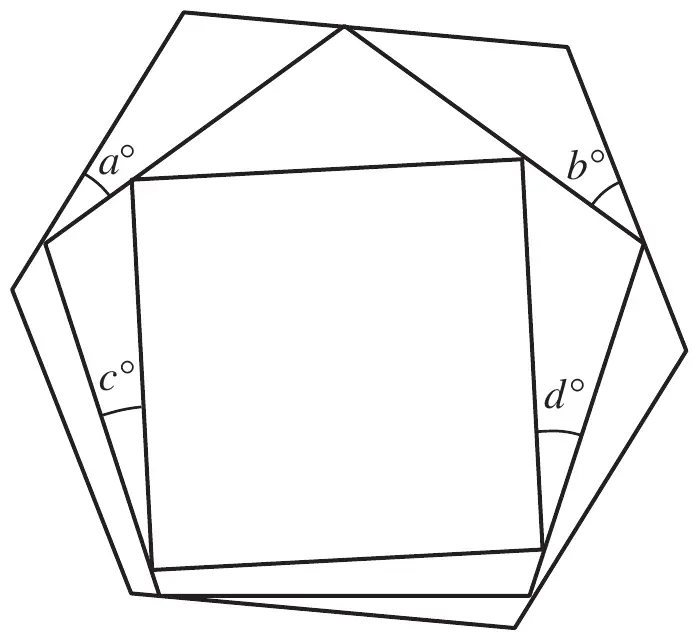
B5. The diagram shows a square whose vertices
touch the sides of a regular pentagon. Each
vertex of the pentagon touches a side of a
regular hexagon.
Find the value of \(a + b + c + d\).
Junior Mathematical Olympiad 2017, Question B5. © UK Mathematics Trust. Original paper on ukmt.org.uk
Answer: 84
Each interior angle of a regular pentagon is 108° and each interior angle of a regular hexagon is 120°.
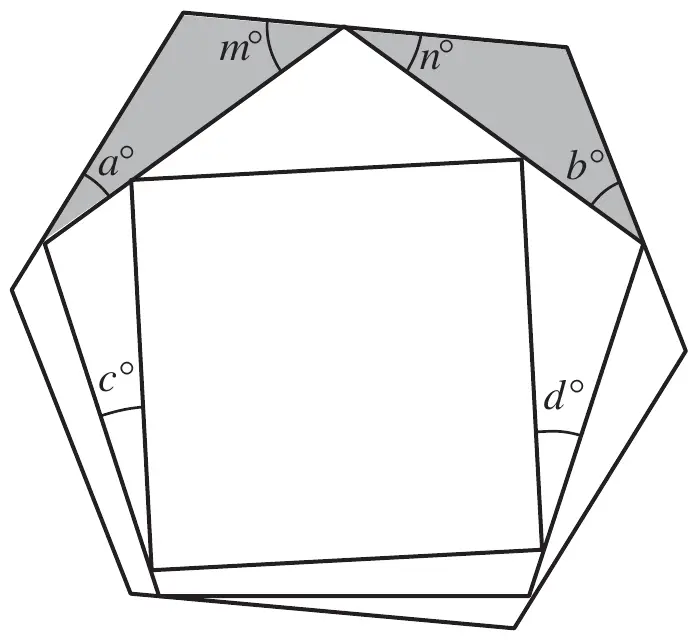
Consider the two shaded triangles in the diagram
alongside, which contain the angles \(a°\) and \(b°\) and
the side of the hexagon that these triangles have in
common.
Let the two angles shown be \(m°\) and \(n°\). Since the
sum of the interior angles in a triangle is 180°, we
have \(120 + a + m = 180\) and \(120 + b + n = 180\).
Therefore, \(m = 60 - a\) and \(n = 60 - b\). Now,
since the sum of the angles on a straight line is
180°, we have \(m + 108 + n = 180\). Hence
\(60 - a + 108 + 60 - b = 180\). Therefore \(a + b = 48\).
The region outside the square but inside the
pentagon consists of a quadrilateral, shown
shaded in the diagram alongside, and three
triangles. We now consider the quadrilateral.
Let the two angles shown be \(p°\) and \(q°\). Since the
interior angles of a square are 90° and the sum of
the angles on a straight line is 180°, we have
\(c + 90 + p = 180\) and \(d + 90 + q = 180\).
Therefore \(p = 90 - c\) and \(q = 90 - d\). Now,
since the sum of the angles in a quadrilateral is
360° and two of these angles are interior angles
of a regular pentagon, we have
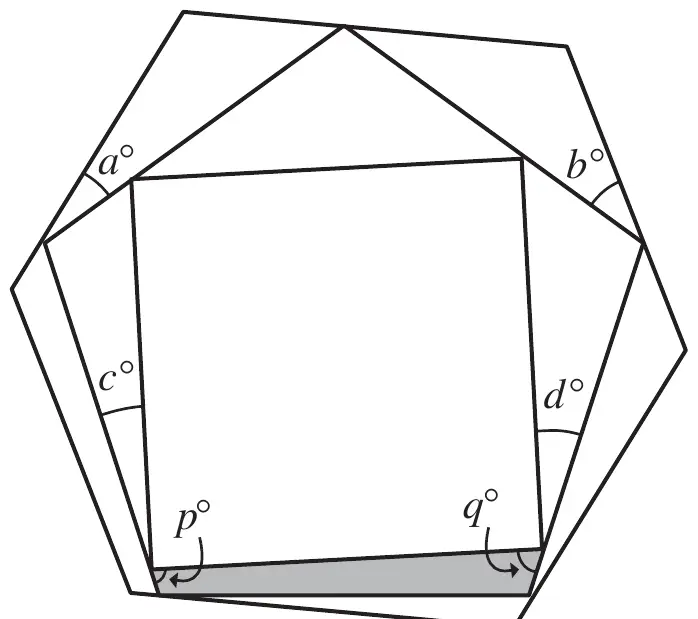
\(108 + p + q + 108 = 360\). Hence \(216 + 90 - c + 90 - d = 360\). Therefore \(c + d = 36\).
Hence
\[\begin{aligned} a + b + c + d &= 48 + 36 \\[6pt] &= 84. \end{aligned}\]
Solution © UK Mathematics Trust, from the JMO 2017 solutions.