14 Junior Mathematical Olympiad questions from every year we have, newest year first. Use Difficulty › Position in the paper to practise the early (easier) or late (harder) questions, or the Year filter for one year.
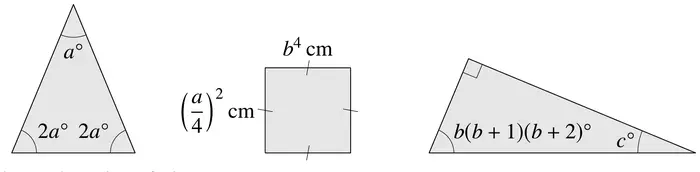
Since angles in a triangle sum to 180°, we have \(5a = 180\) and therefore \(a = 36\). From the middle diagram, \(b^4 = \left(\frac{a}{4}\right)^2 = \left(\frac{36}{4}\right)^2 = 81\). Hence, as \(b > 0\),\(b = 3\). From the third diagram and, again since angles in a triangle sum to 180°, we have \(b(b + 1)(b + 2) + c = 3 \times 4 \times 5 + c = 60 + c = 90\). Therefore, \(c = 30\).
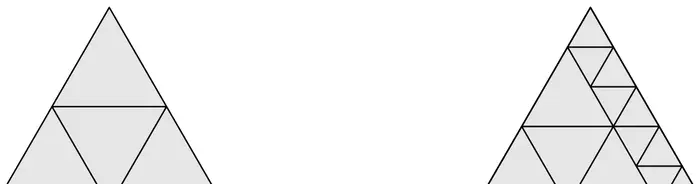
B6. An equilateral triangle is divided into smaller equilateral triangles.
The diagram on the left shows that it is possible to divide it into 4 equilateral triangles. The diagram on the right shows that it is possible to divide it into 13 equilateral triangles.
What are the integer values of \(n\), where \(n > 1\), for which it is possible to divide the triangle into \(n\) smaller equilateral triangles?
In this solution we will refer to the triangle which is to be divided into smaller equilateral triangles as the original triangle.
The first diagram in the question shows that it is possible to split the original triangle into four smaller equilateral triangles. This process can be applied to any equilateral triangle, increasing the number of triangles in the dissection by three. Hence we can say that if it is possible to dissect the original triangle into \(m\) triangles, then it is also possible to dissect it into \(m + 3\) triangles by dividing one of the triangles in the manner shown. Since we know we can divide the original triangle into four smaller triangles, we can conclude that we can also divide it into 7, 10, 13 . . . triangles or more generally into \(n\) triangles where \(n\) is one more than a multiple of 3.
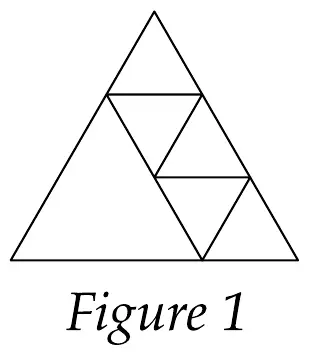
Consider figure 1. In this triangle, a line has been drawn parallel to one side two-thirds of the way from a vertex creating a smaller equilateral triangle and an isosceles trapezium. Since the angles of this trapezium are 60°, 120°, 120° and 60° and its sides are in the ratio 3 : 1 : 2 : 1, it is possible to divide the trapezium into five smaller equilateral triangles each with side-length \(\frac{1}{3}\) the side-length of the original triangle. This shows that a dissection into six equilateral triangles is possible.
Therefore, applying the result shown above, we can conclude that it is possible to dissect the original triangle into 6, 9, 12 . . . triangles or more generally into \(n\) triangles where \(n\) is a multiple of 3 greater than 3.
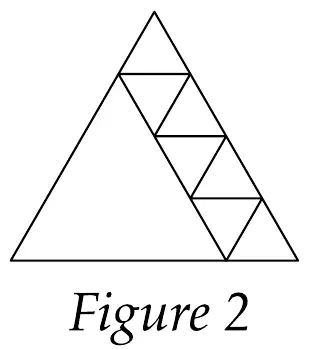
Now consider figure 2. In this triangle, a very similar dissection to figure 1 has been carried out, only this time the parallel line is three-quarters of the way from the vertex, creating an isosceles trapezium with sides in the 4 : 1 : 3 : 1, which can itself be divided into seven smaller equilateral triangles with side-length \(\frac{1}{4}\) the side-length of the original triangle.
This shows that a dissection into eight equilateral triangles is possible and hence we can conclude that it is possible to dissect the original triangle into 8, 11, 14 . . . triangles or more generally into \(n\) triangles where \(n\) is a one less than a multiple of 3 greater than 6.
Combining these results, it can be seen from the working above that it is possible to dissect the original triangle into \(n\) equilateral triangles for any values of \(n\) except 2, 3 and 5. We will now consider each of these values in turn and prove that it is not possible to create any dissection giving this number of smaller triangles.
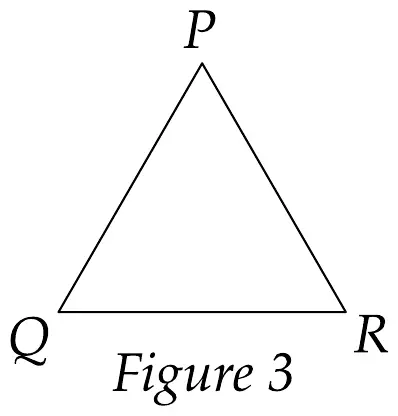
Consider the original triangle with its vertices labelled \(P\), \(Q\) and \(R\) as shown in figure 3. Define a \(D\)-triangle as any triangle in a dissection \(D\) of the original triangle.
If any two vertices, say \(P\) and \(Q\), are in the same \(D\)-triangle then \(PQ\) is an edge of a \(D\)-triangle which must be the original triangle itself. Therefore it is not possible to have any dissection into two triangles as any such dissection would require one of \(P\), \(Q\) and \(R\) in a different \(D\)-triangle from the other two.
Otherwise \(P\), \(Q\) and \(R\) are in different \(D\)-triangles. Since \(\angle P = 60°\), the only edges of \(D\)-triangles that meet at \(P\) form part of \(PQ\) and \(PR\). Hence \(P\) is in just one \(D\)-triangle and the third edge of that \(D\)-triangle is parallel to the edge \(QR\). A similar argument applies to \(Q\) and \(R\).
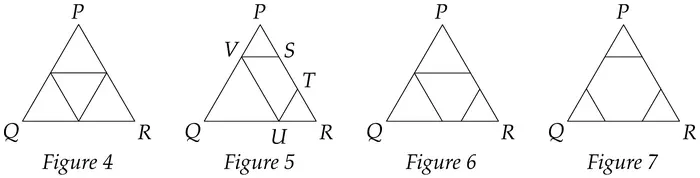
Therefore the different possibilities according to the number of these third edges that meet are as shown in figures 4, 5, 6 and 7.
In figure 4, \(D\) consists of at least four triangles and, since none of these can be divided into two equilateral triangles, \(D\) contains either four or at least six triangles. In figure 5, the quadrilateral \(STUV\) has two adjacent angles at \(S\) and \(T\) of 120°. Therefore \(S\) and \(T\) are each vertices of at least two \(D\)-triangles other than \(PVS\) and \(RTU\). Hence \(STUV\) is divided into at least three \(D\)-triangles and so \(D\) consists of at least six triangles. The arguments for figures 6 and 7 are similar. Hence \(D\) cannot consist of 3 or 5 triangles.
Therefore it is not possible to divide the original triangle into 2, 3 or 5 triangles.
Let the interior angles of the pentagon be \(2n°\),\((2n + 2)°\),\((2n + 4)°\), \((2n + 6)°\) and \((2n + 8)°\). The interior angles of a pentagon sum to 540°. Therefore, \(2n + 2n + 2 + 2n + 4 + 2n + 6 + 2n + 8 = 540\), which gives \(10n + 20 = 540\) and \(2n = 104\). Hence, the size of the largest angle is \((104 + 8)° = 112°\).
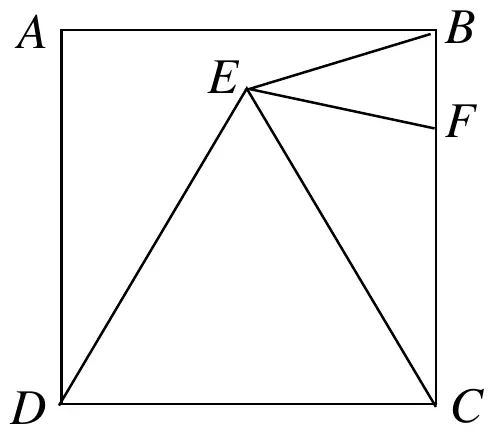
Since triangle \(DEC\) is equilateral, \(\angle DCE = 60°\). Therefore, since \(ABCD\) is a square, \(\angle ECF = 30°\). Since \(DC = CE\) and \(DC = CB\), we have \(CE = CB\) and hence triangle \(ECB\) is isosceles.
As triangle \(EBF\) is isosceles, \(\angle CBE = \angle BFE\). Therefore,
\[\angle BFE = \frac{180° - 30°}{2} = 75° \text{ (angles in a triangle sum to 180°)}\]
and, consequently,
\[\angle EFC = 105° \text{ (angles on a straight line sum to 180°).}\]
Hence, using the fact that angles in a triangle sum to 180°,
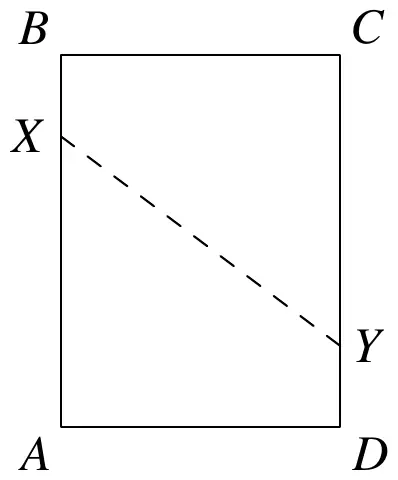
B4. A rectangular sheet of paper is labelled \(ABCD\), with \(AB\) one of the longer sides. The sheet is folded so that vertex \(A\) is placed exactly on top of the opposite vertex \(C\). The fold line is \(XY\), where \(X\) lies on \(AB\) and \(Y\) lies on \(CD\).
The construction of the fold means that \(\angle AXY = \angle CXY\). By alternate angles, \(\angle AXY = \angle CYX\). Hence \(\angle CXY = \angle CYX\) and so triangle \(CXY\) is isosceles.
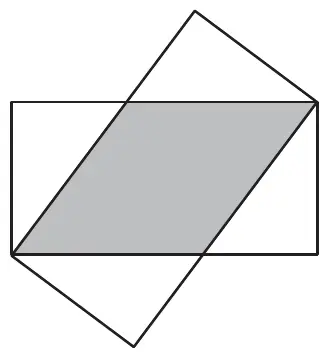
B3. Two identical rectangles overlap in such a way that a rhombus is formed, as indicated in the diagram. The area of the rhombus is five-eighths of the area of each rectangle.
What is the ratio of the length of the longer side of the rectangle to the length of the shorter side?
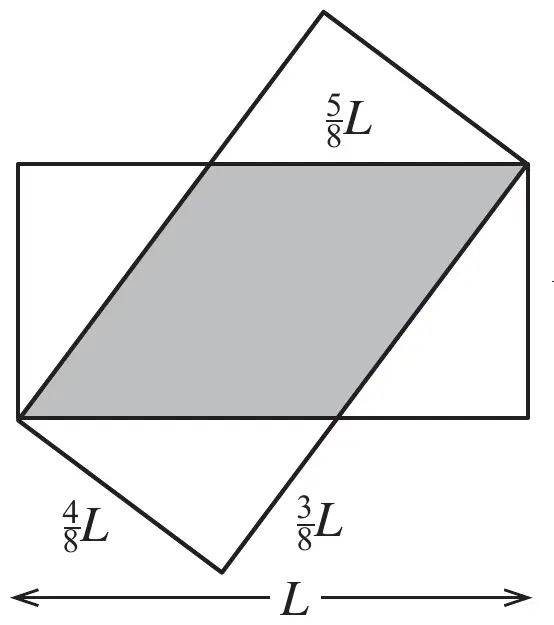
Let the length of the longer side and of the shorter side of the rectangle be \(L\) and \(W\) respectively.
Since the area of the rhombus is \(\frac{5}{8}\) of the area of each rectangle, the area of the rhombus is \(\frac{5}{8}LW\). Also, since the area of a rhombus is equal to base × perpendicular height and the perpendicular height of the shaded rhombus is \(W\), the length of each side of the rhombus is \(\frac{5}{8}L\).
Consider one of the white right-angled triangles. The length of the hypotenuse is \(\frac{5}{8}L\) and the length of one other side is \(L - \frac{5}{8}L = \frac{3}{8}L\). Therefore, using Pythagoras' Theorem, we can find the length of the third side in terms of \(L\) since the triangle is a 3: 4: 5 triangle. Hence \(W = \frac{4}{8}L\) and the ratio of the length of the longer side of the rectangle to the length of the shorter side of the rectangle is \(L : \frac{4}{8}L = 2 : 1\).
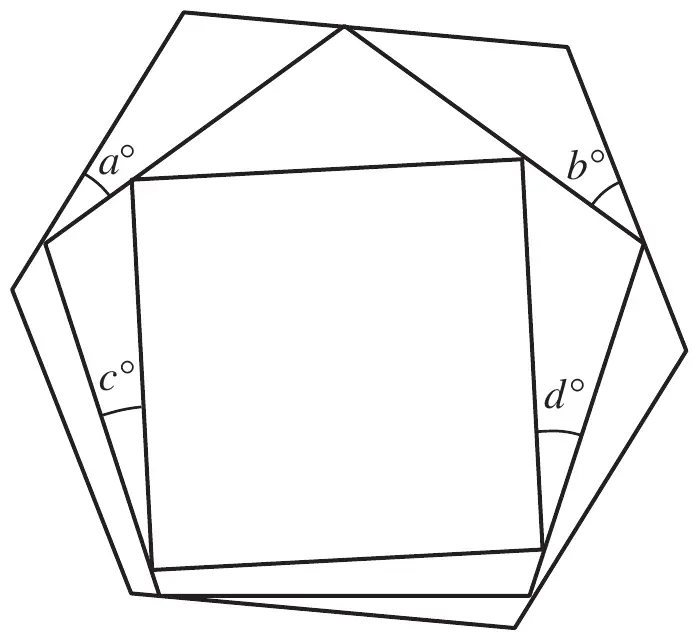
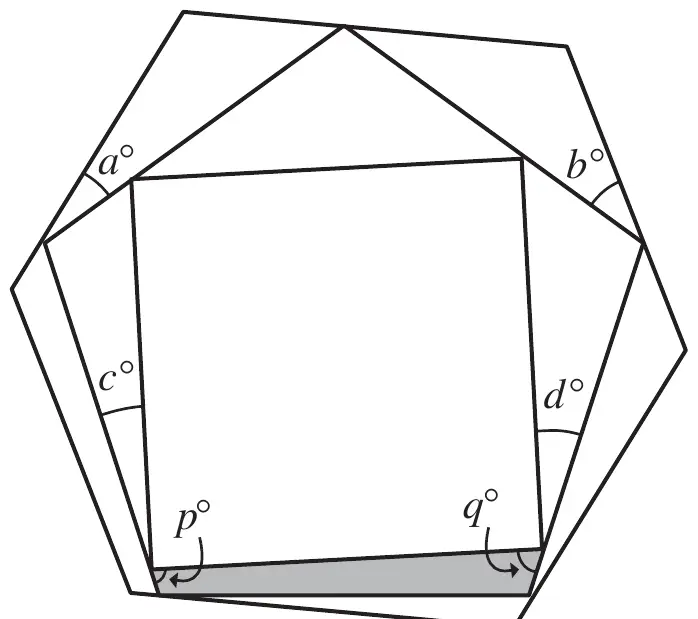
Each interior angle of a regular pentagon is 108° and each interior angle of a regular hexagon is 120°.
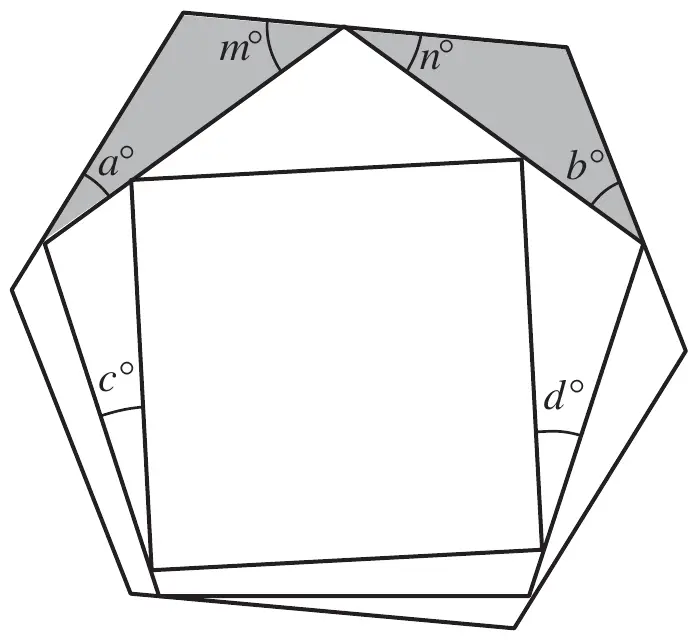
Consider the two shaded triangles in the diagram alongside, which contain the angles \(a°\) and \(b°\) and the side of the hexagon that these triangles have in common.
Let the two angles shown be \(m°\) and \(n°\). Since the sum of the interior angles in a triangle is 180°, we have \(120 + a + m = 180\) and \(120 + b + n = 180\). Therefore, \(m = 60 - a\) and \(n = 60 - b\). Now, since the sum of the angles on a straight line is 180°, we have \(m + 108 + n = 180\). Hence \(60 - a + 108 + 60 - b = 180\). Therefore \(a + b = 48\).
The region outside the square but inside the pentagon consists of a quadrilateral, shown shaded in the diagram alongside, and three triangles. We now consider the quadrilateral.
Let the two angles shown be \(p°\) and \(q°\). Since the interior angles of a square are 90° and the sum of the angles on a straight line is 180°, we have \(c + 90 + p = 180\) and \(d + 90 + q = 180\). Therefore \(p = 90 - c\) and \(q = 90 - d\). Now, since the sum of the angles in a quadrilateral is 360° and two of these angles are interior angles of a regular pentagon, we have
\(108 + p + q + 108 = 360\). Hence \(216 + 90 - c + 90 - d = 360\). Therefore \(c + d = 36\).
Hence
\[\begin{aligned} a + b + c + d &= 48 + 36 \\[6pt] &= 84. \end{aligned}\]
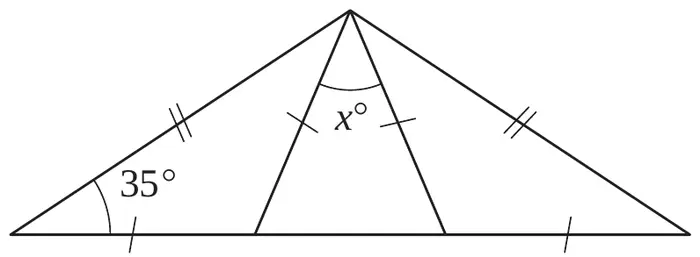
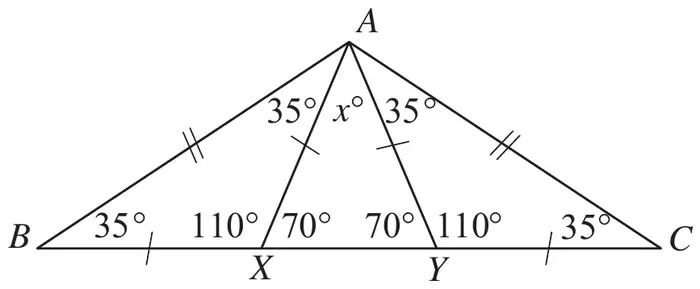
Using the angle sum of a triangle, the isosceles triangles \(ABX\) and \(ACY\) have angles of 35°, 35° and 180° − 35° − 35° = 110°. Angles on a straight line add to 180° and so \(\angle AXY = \angle XYA = 180° - 110° = 70°\). Using the angle sum of a triangle again, we have \(x = 180 - 70 - 70 = 40\).
Alternative Solution
Since \(\triangle ABC\) is isosceles, \(\angle ACB = 35°\).
Since \(\triangle ABX\) is isosceles, \(\angle BAX = 35°\).
Since \(\triangle ACY\) is isosceles, \(\angle CAY = 35°\).
Hence, from the angle sum in \(\triangle ABC\) we have \(x = 180 - 4 \times 35 = 40\).
B1. In a certain triangle, the size of each of the angles is a whole number of degrees. Also, one angle is 30° larger than the average of the other two angles.
What is the largest possible size of an angle in this triangle?
Let two of the angles measure \(a°\) and \(b°\). Then the third angle is \(\big(30 + \frac{1}{2}(a + b)\big)°\). The angle sum of a triangle is 180° which gives \(180° = \big(a + b + 30 + \frac{1}{2}(a + b)\big)° = \big(30 + \frac{3}{2}(a + b)\big)°\) and so \(\frac{3}{2}(a + b) = 150\), giving \(a + b = 100\). The sizes of all the angles are integers so that the largest either \(a\) or \(b\) can be is 99. This gives a triangle with angles 1°, 80° and 99° and so the largest possible such angle is 99°.
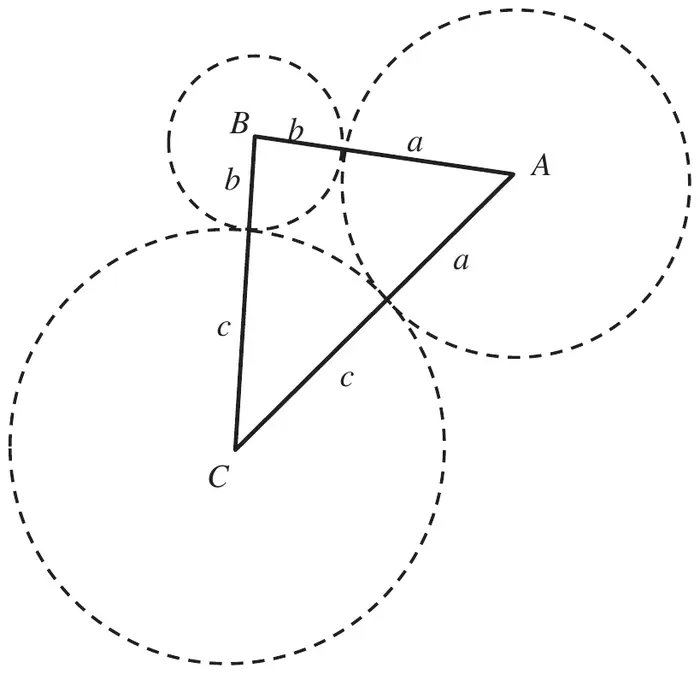
B2. The points \(A\), \(B\) and \(C\) are the centres of three circles. Each circle touches the other two circles, and each centre lies outside the other two circles. The sides of the triangle \(ABC\) have lengths 13 cm, 16 cm and 20 cm.
Answer: \(8\frac{1}{2}\) cm, \(4\frac{1}{2}\) cm and \(11\frac{1}{2}\) cm
Solution (UKMT)
Since the circles touch, for each pair of circles, the distance between their centres is the sum of their radii. Let the radii of the three circles (in cm) be \(a\), \(b\) and \(c\). Then we can form equations for the lengths of the sides of the triangle:
\[\begin{aligned} a + b &= 13 \\ b + c &= 16 \\ a + c &= 20. \end{aligned}\]
Adding these equations together, we obtain
\[2a + 2b + 2c = 49.\]
So \(a + b + c = 24\frac{1}{2}\). But \(a + b = 13\) giving \(c = 11\frac{1}{2}\). Then \(b = 16 - 11\frac{1}{2} = 4\frac{1}{2}\) and \(a = 20 - 11\frac{1}{2} = 8\frac{1}{2}\).
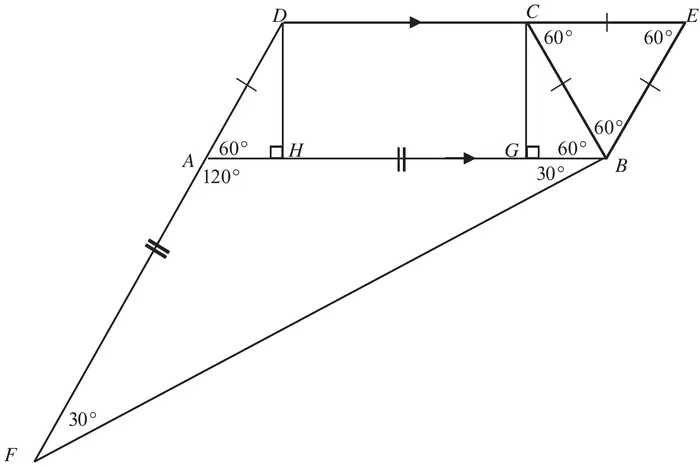
B4. In the trapezium \(ABCD\), the lines \(AB\) and \(CD\) are parallel. Also \(AB = 2DC\) and \(DA = CB\).
The line \(DC\) is extended (beyond \(C\)) to the point \(E\) so that \(EC = CB = BE\). The line \(DA\) is extended (beyond \(A\)) to the point \(F\) so that \(AF = BA\).
Since \(EC = CB = BE\), the triangle \(ECB\) is equilateral and each of its angles is 60°.
\(ED\) and \(AB\) are parallel so \(\angle ABC = \angle BCE = 60°\) (alternate angles).
Draw perpendiculars from \(C\) and \(D\) to \(AB\) to meet \(AB\) at \(G\) and \(H\). The right-angled triangles \(DAH\) and \(CBG\) have hypotenuses of equal length and \(DH = CG\) so triangles \(DAH\) and \(CGB\) are congruent {RHS}. Thus \(\angle DAH = \angle CBG = 60°\).
\(DAF\) is a straight line so that \(\angle BAF = 180° - 60° = 120°\).
Triangle \(AFB\) is isosceles with \(\angle AFB = \angle FBA = \frac{1}{2}\big(180° - 120°\big) = 30°\) (angle sum of a triangle).
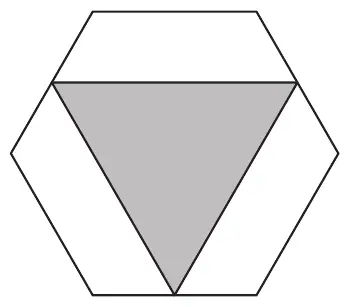
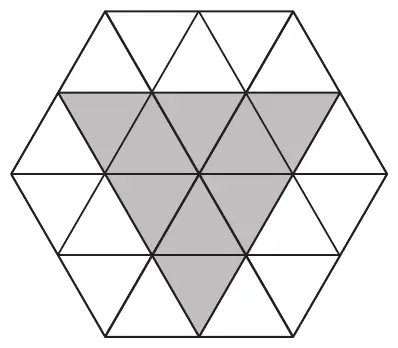
A7. The diagram shows an equilateral triangle inside a regular hexagon that has sides of length 14 cm. The vertices of the triangle are midpoints of sides of the hexagon.
What is the length of the perimeter of the triangle?
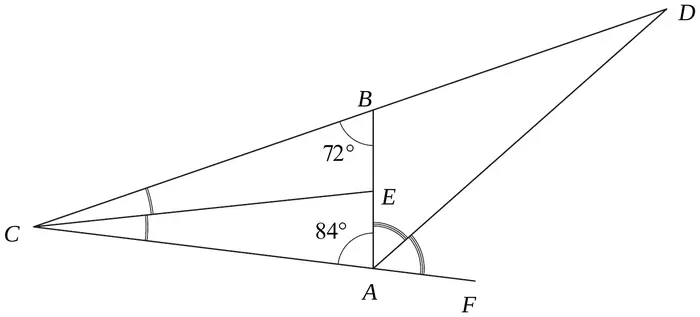
B2. The diagram shows triangle \(ABC\), in which \(\angle ABC = 72°\) and \(\angle CAB = 84°\). The point \(E\) lies on \(AB\) so that \(EC\) bisects \(\angle BCA\). The point \(F\) lies on \(CA\) extended. The point \(D\) lies on \(CB\) extended so that \(DA\) bisects \(\angle BAF\).
Look first at triangle \(ABC\). Since the angles in a triangle add to 180°, \(\angle BCA = 24°\). Hence, since \(CE\) bisects \(\angle BCA\),\(\angle BCE = \angle ECA = 12°\). Next consider triangle \(ECA\) and use the angle sum again to obtain \(\angle AEC = 84°\). Therefore \(\angle CAE = \angle AEC\) and so triangle \(ECA\) is isosceles and hence \(AC = CE\).
Consider the angles at \(A\). Since angles on a straight line add to 180°, \(\angle BAF = 96°\). Because \(AD\) bisects \(\angle BAF\),\(\angle BAD = 48°\). Finally, consider triangle \(DCA\). Since the angles in a triangle add to 180°, it must be the case that \(\angle ADC = 24°\). Therefore \(\angle BCA = \angle ADC\) and so triangle \(DCA\) is isosceles and hence \(AC = AD\). Therefore \(AD = CE\) since both are equal to \(AC\).
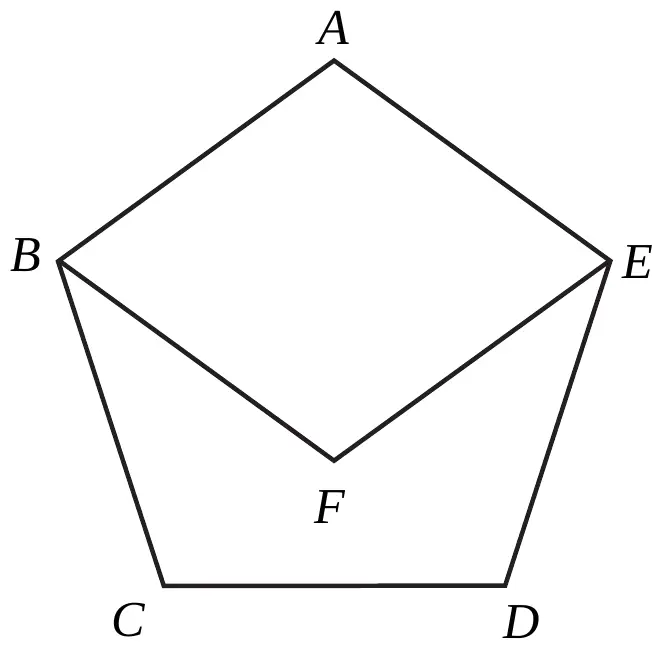
Each interior angle of a regular pentagon is 108°. The internal angles of a quadrilateral sum to 360° and so, since \(ABFE\) is a rhombus, \(\angle ABF = \angle FEA = 72°\). Therefore \(\angle FBC = 36°\). Triangle \(FBC\) is isosceles since \(BC = AB = BF\) and so \(\angle BFC = \angle BCF = 72°\). Then \(\angle EFC = \angle EFB + \angle BFC = 108° + 72° = 180°\) and so \(EFC\) is a straight line.
We'd like to use Google Analytics cookies to count visits and see which pages help most. They're optional, and the site works exactly the same either way. Privacy policy