
JMO 2015 B2
B2. The diagram shows triangle \(ABC\), in which \(\angle ABC = 72°\) and \(\angle CAB = 84°\). The point \(E\) lies on \(AB\) so that \(EC\) bisects \(\angle BCA\). The point \(F\) lies on \(CA\) extended. The point \(D\) lies on \(CB\) extended so that \(DA\) bisects \(\angle BAF\).
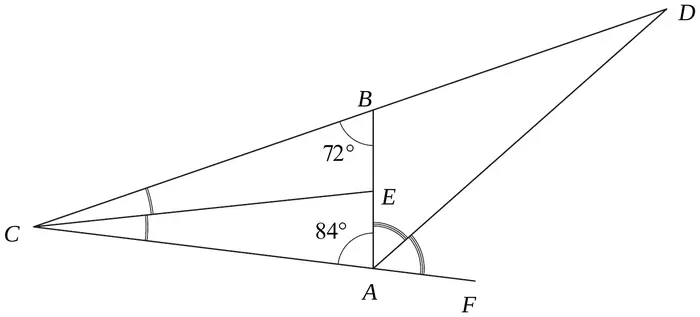
Prove that \(AD = CE\).
Junior Mathematical Olympiad 2015, Question B2. © UK Mathematics Trust. Original paper on ukmt.org.uk
Look first at triangle \(ABC\). Since the angles in a triangle add to 180°, \(\angle BCA = 24°\). Hence, since \(CE\) bisects \(\angle BCA\), \(\angle BCE = \angle ECA = 12°\). Next consider triangle \(ECA\) and use the angle sum again to obtain \(\angle AEC = 84°\). Therefore \(\angle CAE = \angle AEC\) and so triangle \(ECA\) is isosceles and hence \(AC = CE\).
Consider the angles at \(A\). Since angles on a straight line add to 180°, \(\angle BAF = 96°\). Because \(AD\) bisects \(\angle BAF\), \(\angle BAD = 48°\). Finally, consider triangle \(DCA\). Since the angles in a triangle add to 180°, it must be the case that \(\angle ADC = 24°\). Therefore \(\angle BCA = \angle ADC\) and so triangle \(DCA\) is isosceles and hence \(AC = AD\). Therefore \(AD = CE\) since both are equal to \(AC\).
Solution © UK Mathematics Trust, from the JMO 2015 solutions.