12 Junior Mathematical Olympiad questions from every year we have, newest year first. Use Difficulty › Position in the paper to practise the early (easier) or late (harder) questions, or the Year filter for one year.
Let the three positive integers be \(A\), \(Ak\) and \(Ak^2\), where \(A\) is a positive constant. Therefore \(A + Ak + Ak^2 = A(1 + k + k^2) = 93 = 3 \times 31\). If \(k = 1\) and \(A = 31\),\(A^3k^3 = 31^3 \times 1^3 \neq 3375\). Therefore, since 3 and 31 are prime, \(A = 3\) and \(1 + k + k^2 = 31\). Hence, \(k = 5\) and the three integers are 3, 15 and 75.
B3. It takes one minute for a train travelling at constant speed to pass completely through a tunnel that is 120 metres long. The same train, travelling at the same constant speed, takes 20 seconds from the instant its front enters the tunnel to it being completely inside the tunnel.
Let \(L\) be the length of the train in metres. It takes one minute for the train to pass completely through a tunnel, which is 120m long. Therefore, in 60 seconds the train travels \((L + 120)\) m and its average speed is \(\frac{L+120}{60}\) m/s. Travelling at the same speed, the train takes 20 seconds to travel \(L\) m. Hence,
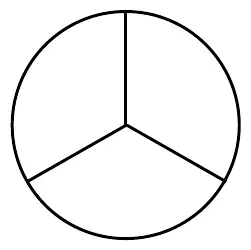
Let the radius of the circle be \(r\). As each sector is a third of the circle, the length of the perimeter of each sector is \(\frac{2\pi r}{3} + 2r\). Therefore, the ratio of the length of the perimeter of one of the three sectors to the length of the circumference of the circle is \(\left(\frac{2\pi r}{3} + 2r\right) : 2\pi r = \left(\frac{\pi}{3} + 1\right) : \pi\) or \((\pi + 3) : 3\pi\).
A5. In 1866, the yacht Henrietta – with Gordon Bennett aboard – won the Great Ocean Yacht Race, travelling a distance of approximately 3000 nautical miles. The winning time was 13 days and 22 hours, to the nearest hour.
What was the yacht's average speed in nautical miles per hour, to the nearest integer?
Since 13 days and 22 hours are equivalent to 334 hours, the yacht travels 3000 nautical miles in 334 hours. Therefore the yacht travels \(\frac{3000}{334}\) nautical miles in 1 hour. Hence the yacht's average speed in nautical miles per hour is 9 (to the nearest integer).
Let \(m\) be the original number of marbles in the jar. Therefore, as Jenny replaces 2 of the white marbles with 7 red marbles, there are now \(m + 5\) marbles in the jar. We know that \(\frac{4}{5}\) of the original number of marbles were white, that 2 white marbles were removed and that now \(\frac{3}{5}\) of the jar’s marbles are white. Hence
\(\frac{4}{5}m - 2 = \frac{3}{5}(m + 5)\).
Solving this equation, gives \(m = 25\). Therefore the ratio of the total number of marbles in the jar now to the number in the jar before is 30 : 25 = 6 : 5.
A10. Two concentric circles are drawn, as shown in the diagram. Concentric circles share the same point as their centre. The radius of the smaller circle is a third of the radius of the larger circle. The top half of the larger circle which is outside the smaller circle, is shaded in grey. The ratio of the grey shaded area to the area of the smaller circle in its simplest form is \(a : b\). What are the values of \(a\) and \(b\)?
Let the radius of the smaller circle be \(r\), so the radius of the larger circle is \(3r\). The area of the smaller circle is \(\pi r^2\) and the grey shaded area is \(\frac{1}{2}\pi(3r)^2 - \frac{1}{2}\pi r^2 = 4\pi r^2\).
Therefore the ratio of the grey shaded area to the area of the smaller circle is \(4\pi r^2 : \pi r^2 = 4 : 1\), and hence \(a = 4\) and \(b = 1\).
A6. The points \(A\),\(B\),\(C\), \(D\) and \(E\) lie in that order along a straight line so that \(AB : BC = 1 : 2\), \(BC : CD = 1 : 3\) and \(CD : DE = 1 : 4\). What is \(AB : BE\)?
A4. My fruit basket contains apples and oranges. The ratio of apples to oranges in the basket is 3 : 8. When I remove one apple the ratio changes to 1 : 3.
Suppose there are initially \(m\) apples and \(n\) oranges in the basket. Since \(m : n = 3 : 8\), it follows that \(8m = 3n\). After removing one apple, the ratio becomes \((m - 1) : n = 1 : 3\), and so \(3\,(m - 1) = n\). Putting these two equations together,
We'd like to use Google Analytics cookies to count visits and see which pages help most. They're optional, and the site works exactly the same either way. Privacy policy