Junior Mathematical Olympiad (JMO): Factors, Primes & Digits

Practise one competitionJunior Mathematical Challenge 424 questions, 2004–2020Junior Kangaroo 125 questions, 2015–2019Junior Mathematical Olympiad 80 questions, 2015–2019

16 Junior Mathematical Olympiad questions from every year we have, newest year first. Use Difficulty › Position in the paper to practise the early (easier) or late (harder) questions, or the Year filter for one year.

Whole paper 2019 2018 2017 2016 2015

Questions and solutions © UK Mathematics Trust, shown with permission. Papers and more at ukmt.org.uk.

JMO 2019

JMO 2018

JMO 2017

JMO 2016

JMO 2015

JMO 2019 A5

A5. Dani wrote the integers from 1 to \(N\). She used the digit 1 fifteen times. She used the digit 2 fourteen times.

What is \(N\)?

Junior Mathematical Olympiad 2019, Question A5. © UK Mathematics Trust. Original paper on ukmt.org.uk

JMO 2019 A7

JMOCurrent spec1 markFactors, Primes & Digits

A7. Two 2-digit multiples of 7 have a product of 7007.

What is their sum?

Junior Mathematical Olympiad 2019, Question A7. © UK Mathematics Trust. Original paper on ukmt.org.uk

JMO 2019 A9

JMOCurrent spec1 markFactors, Primes & Digits

A9. The number 3600 can be written as \(2^a \times 3^b \times 4^c \times 5^d\), where \(a\), \(b\), \(c\) and \(d\) are all positive integers. It is given that \(a + b + c + d = 7\).

What is the value of \(c\)?

Junior Mathematical Olympiad 2019, Question A9. © UK Mathematics Trust. Original paper on ukmt.org.uk

JMO 2019 B2

JMOCurrent spec10 marksFactors, Primes & Digits

B2. The product \(8000 \times K\) is a square, where \(K\) is a positive integer.

What is the smallest possible value of \(K\)?

Junior Mathematical Olympiad 2019, Question B2. © UK Mathematics Trust. Original paper on ukmt.org.uk

JMO 2018 A3

JMOCurrent spec1 markFactors, Primes & Digits

A3. What is the largest integer for which each pair of consecutive digits is a square?

Junior Mathematical Olympiad 2018, Question A3. © UK Mathematics Trust. Original paper on ukmt.org.uk

JMO 2018 A6

JMOCurrent spec1 markFactors, Primes & Digits

A6. A two-digit number ‘\(ab\)’ is multiplied by its reverse ‘\(ba\)’. The ones (units) and tens digits of the four-digit answer are both 0.

What is the value of the smallest such two-digit number ‘\(ab\)’?

Junior Mathematical Olympiad 2018, Question A6. © UK Mathematics Trust. Original paper on ukmt.org.uk

JMO 2018 A10

JMOCurrent spec1 markAlgebraFactors, Primes & Digits

A10. A four-digit integer has its digits increasing from left to right. When we reverse the order of the digits, we obtain a four-digit integer whose digits decrease from left to right. A third four-digit integer uses exactly the same digits, but in a different order. The sum of the three integers is 26 352.

What is the value of the smallest of the three integers?

Junior Mathematical Olympiad 2018, Question A10. © UK Mathematics Trust. Original paper on ukmt.org.uk

JMO 2018 B3

JMOCurrent spec10 marksFactors, Primes & Digits

B3. The letters \(a\), \(b\) and \(c\) stand for non-zero digits. The integer ‘\(abc\)’ is a multiple of 3; the integer ‘\(cbabc\)’ is a multiple of 15; and the integer ‘\(abcba\)’ is a multiple of 8.

What is the integer ‘\(abc\)’?

Junior Mathematical Olympiad 2018, Question B3. © UK Mathematics Trust. Original paper on ukmt.org.uk

JMO 2017 A9

A9. How many multiples of 3 that are less than 1000 are not divisible either by 9 or by 10?

Junior Mathematical Olympiad 2017, Question A9. © UK Mathematics Trust. Original paper on ukmt.org.uk

JMO 2017 B2

B2. A 3-digit integer is called a ‘V-number’ if the digits go ‘high-low-high’ – that is, if the tens digit is smaller than both the hundreds digit and the units (or ‘ones’) digit.

How many 3-digit ‘V-numbers’ are there?

Junior Mathematical Olympiad 2017, Question B2. © UK Mathematics Trust. Original paper on ukmt.org.uk

JMO 2017 B6

JMOCurrent spec10 marksFactors, Primes & Digits

B6. The 9-digit positive integer \(N\) with digit pattern \(ABCABCBBB\) is divisible by every integer from 1 to 17 inclusive.

The digits \(A\), \(B\) and \(C\) are distinct. What are the values of \(A\), \(B\) and \(C\)?

Junior Mathematical Olympiad 2017, Question B6. © UK Mathematics Trust. Original paper on ukmt.org.uk

JMO 2016 A1

JMOCurrent spec1 markFactors, Primes & Digits

A1. Roger picks two consecutive integers, one of which ends in a 5. He multiplies the integers together and then squares the result.

What are the last two digits of his answer?

Junior Mathematical Olympiad 2016, Question A1. © UK Mathematics Trust. Original paper on ukmt.org.uk

JMO 2016 A7

JMOCurrent spec1 markFactors, Primes & Digits

A7. A certain positive integer has exactly eight factors. Two of these factors are 15 and 21.

What is the sum of all eight factors?

Junior Mathematical Olympiad 2016, Question A7. © UK Mathematics Trust. Original paper on ukmt.org.uk

JMO 2015 A8

JMOCurrent spec1 markFactors, Primes & Digits

A8. What is the units digit in the answer to the sum \(9^{2015} + 9^{2016}\)?

Junior Mathematical Olympiad 2015, Question A8. © UK Mathematics Trust. Original paper on ukmt.org.uk

JMO 2015 A10

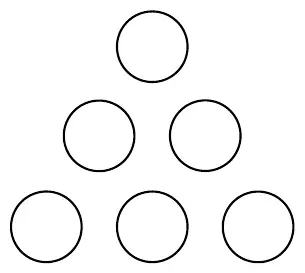
A10. Lucy wants to put the numbers 2, 3, 4, 5, 6 and 10 into the
circles so that the products of the three numbers along
each edge are the same, and as large as possible.

What is this product?

Six circles arranged in a triangle, three along each edge

Junior Mathematical Olympiad 2015, Question A10. © UK Mathematics Trust. Original paper on ukmt.org.uk

JMO 2015 B1

JMOCurrent spec10 marksFactors, Primes & Digits

B1. Let \(N\) be the smallest positive integer whose digits add up to 2015.

What is the sum of the digits of \(N + 1\)?

Junior Mathematical Olympiad 2015, Question B1. © UK Mathematics Trust. Original paper on ukmt.org.uk