18 Junior Mathematical Olympiad questions from every year we have, newest year first. Use Difficulty › Position in the paper to practise the early (easier) or late (harder) questions, or the Year filter for one year.
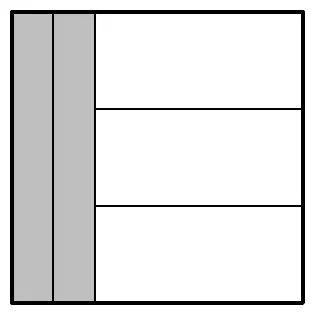
Let the width and length of a shaded rectangle be \(x\) and \(3y\) respectively and the length of an unshaded rectangle be \(l\). Since each rectangle has the same perimeter we have \(2(l + y) = 2(x + 3y)\) and hence \(l + y = x + 3y\), which gives \(l = x + 2y\). Since the original shape is a square we have \(2x + l = 3y\), which gives \(l = 3y - 2x\). Therefore, \(x + 2y = 3y - 2x\) and hence \(y = 3x\). The area of a shaded rectangle is \(3xy\) and the area of an unshaded rectangle is \(ly = y(x + 2y) = y(x + 6x) = 7xy\). Therefore, the ratio of the area of a shaded rectangle to the area of an unshaded rectangle is \(3xy : 7xy = 3 : 7\).
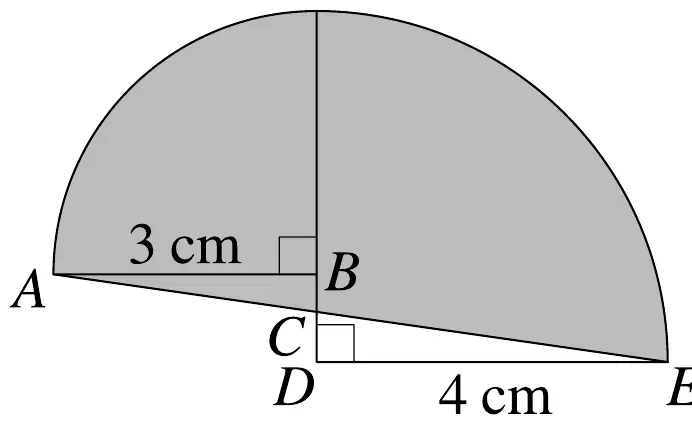
B4. The diagram alongside shows two quarter-circles and two triangles, \(ABC\) and \(CDE\). One quarter- circle has radius \(AB\), where \(AB = 3\) cm. The other quarter-circle has radius \(DE\), where \(DE = 4\) cm.
The area enclosed by the line \(AE\) and the arcs of the two quarter-circles is shaded.
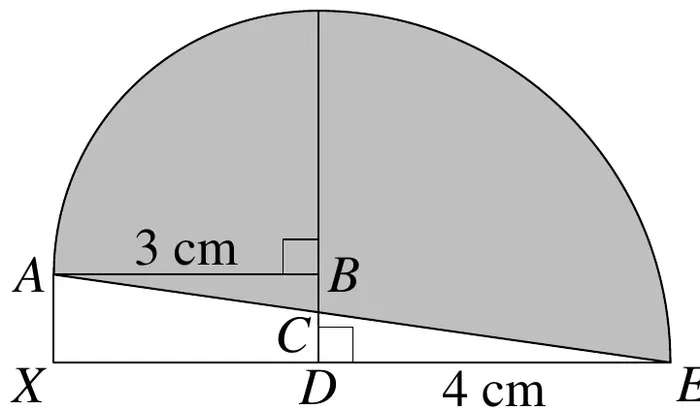
Add a point \(X\) to the diagram, directly below point \(A\) such that the lines \(AX\) and \(XD\) are perpendicular. This whole new shape consists of two quarter-circles and one rectangle (\(ABDX\)). The area, in cm2, of this new shape is
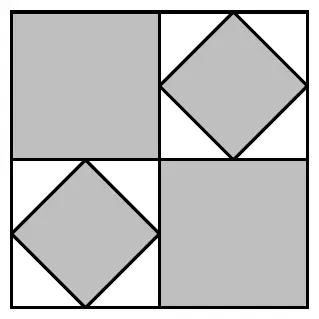
A2. A large square is split into four congruent squares, two of which are shaded. The other two squares have smaller shaded squares drawn in them whose vertices are the midpoints of the sides of the unshaded squares. What fraction of the large square is shaded?
The two larger grey squares make up \(\frac{1}{2}\) of the large square. Each white square is \(\frac{1}{4}\) of the large square and \(\frac{1}{2}\) of each of these squares is shaded. Therefore, the two smaller grey squares account for \(2 \times \frac{1}{2} \times \frac{1}{4} = \frac{1}{4}\) of the large square. Therefore, \(\frac{1}{2} + \frac{1}{4} = \frac{3}{4}\) of the large square is shaded.
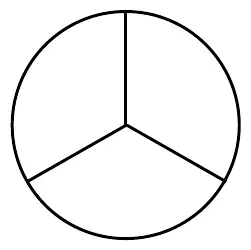
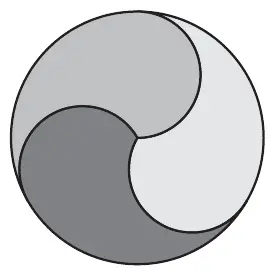
Let the radius of the circle be \(r\). As each sector is a third of the circle, the length of the perimeter of each sector is \(\frac{2\pi r}{3} + 2r\). Therefore, the ratio of the length of the perimeter of one of the three sectors to the length of the circumference of the circle is \(\left(\frac{2\pi r}{3} + 2r\right) : 2\pi r = \left(\frac{\pi}{3} + 1\right) : \pi\) or \((\pi + 3) : 3\pi\).
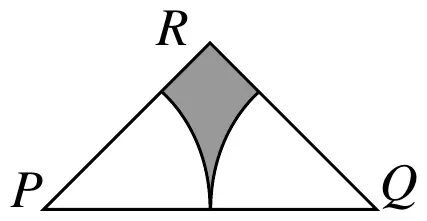
A9. The triangle \(PQR\) is isosceles with \(PR = QR\). Angle \(PRQ = 90°\) and length \(PQ = 2\) cm. Two arcs of radius 1 cm are drawn inside triangle \(PQR\). One arc has its centre at \(P\) and intersects \(PR\) and \(PQ\). The other arc has its centre at \(Q\) and intersects \(QR\) and \(PQ\).
Using Pythagoras’ Theorem, \(PR = QR = \sqrt{2}\). The area of the triangle, in cm2, is \(\frac{1}{2} \times \sqrt{2} \times \sqrt{2} = 1\). The total area, in cm2, of the unshaded regions, which is equivalent to the area of a quarter of a circle with radius 1 cm, is \(\frac{\pi}{4}\). Therefore, the area of the shaded region, in cm2, is \(\left(1 - \frac{\pi}{4}\right)\).
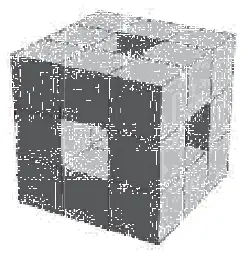
A2. The solid shown is formed by taking a 3 cm × 3 cm × 3 cm cube and drilling a 1 cm × 1 cm square hole from the centre of each face to the centre of the opposite face.
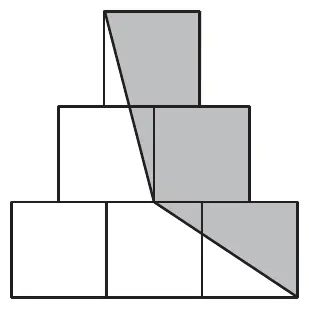
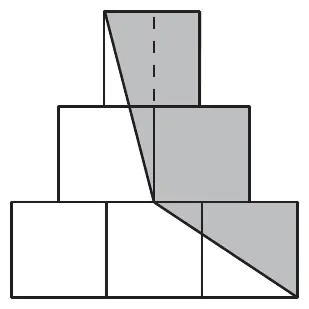
There are several ways to solve this problem. This solution is just one example. Without loss of generality, let each square have a side length of 2 units. Hence the six identical squares have a total area of \(6 \times 2^2 = 24\) square units. The grey shaded area can be thought of as consisting of two triangles, one rectangle and one square, as shown on the diagram. Therefore the grey shaded area is
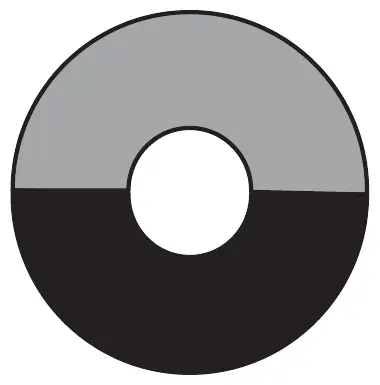
A10. Two concentric circles are drawn, as shown in the diagram. Concentric circles share the same point as their centre. The radius of the smaller circle is a third of the radius of the larger circle. The top half of the larger circle which is outside the smaller circle, is shaded in grey. The ratio of the grey shaded area to the area of the smaller circle in its simplest form is \(a : b\). What are the values of \(a\) and \(b\)?
Let the radius of the smaller circle be \(r\), so the radius of the larger circle is \(3r\). The area of the smaller circle is \(\pi r^2\) and the grey shaded area is \(\frac{1}{2}\pi(3r)^2 - \frac{1}{2}\pi r^2 = 4\pi r^2\).
Therefore the ratio of the grey shaded area to the area of the smaller circle is \(4\pi r^2 : \pi r^2 = 4 : 1\), and hence \(a = 4\) and \(b = 1\).
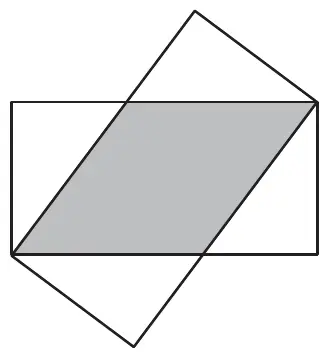
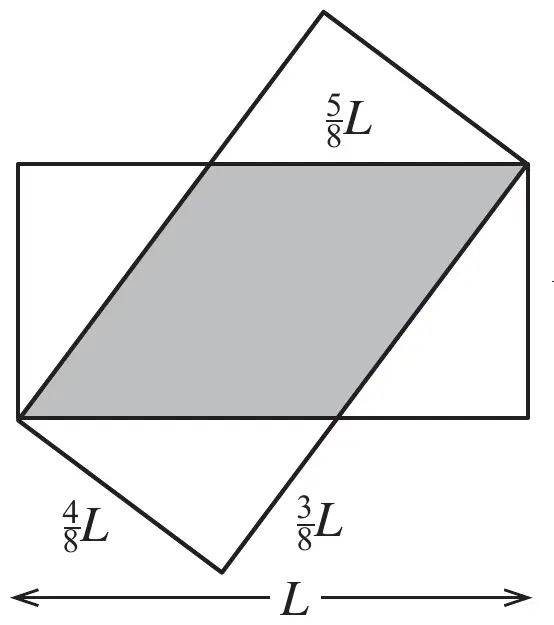
B3. Two identical rectangles overlap in such a way that a rhombus is formed, as indicated in the diagram. The area of the rhombus is five-eighths of the area of each rectangle.
What is the ratio of the length of the longer side of the rectangle to the length of the shorter side?
Let the length of the longer side and of the shorter side of the rectangle be \(L\) and \(W\) respectively.
Since the area of the rhombus is \(\frac{5}{8}\) of the area of each rectangle, the area of the rhombus is \(\frac{5}{8}LW\). Also, since the area of a rhombus is equal to base × perpendicular height and the perpendicular height of the shaded rhombus is \(W\), the length of each side of the rhombus is \(\frac{5}{8}L\).
Consider one of the white right-angled triangles. The length of the hypotenuse is \(\frac{5}{8}L\) and the length of one other side is \(L - \frac{5}{8}L = \frac{3}{8}L\). Therefore, using Pythagoras' Theorem, we can find the length of the third side in terms of \(L\) since the triangle is a 3: 4: 5 triangle. Hence \(W = \frac{4}{8}L\) and the ratio of the length of the longer side of the rectangle to the length of the shorter side of the rectangle is \(L : \frac{4}{8}L = 2 : 1\).
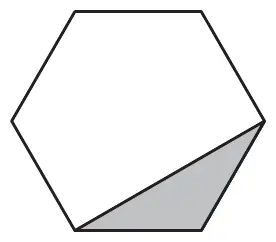
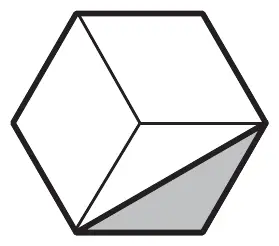
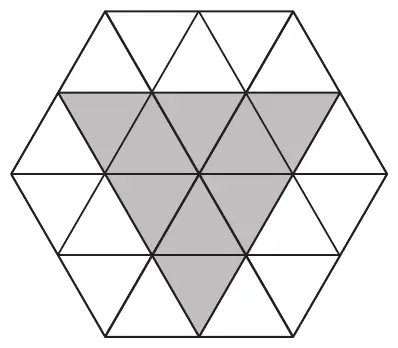
From the dissection shown, the area of the triangle is half of the area of a parallelogram which is itself a third of the area of the hexagon. So the triangle has area \(\frac{1}{2} \times \frac{1}{3} \times 48\) m2 = 8 m2.
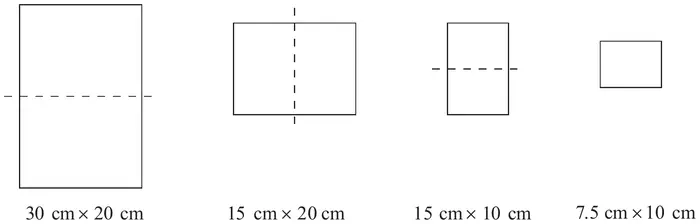
A5. Linda has a very thin sheet of paper measuring 20 cm by 30 cm. She repeatedly folds her paper in half by folding along the shorter line of symmetry. She finishes when she has a rectangle with area 75 cm2.
Each fold reduces the area by half. Therefore we require three folds to reduce the area from 600 cm2 to 75 cm2.
From the diagrams, we see that we have, in turn, areas of 600 cm2, 300 cm2, 150 cm2 and 75 cm2. The final shape has perimeter \(2\,(7.5 + 10)\) cm = 35 cm.
Each region has a perimeter consisting of the perimeters of a third of a circle of radius 18 cm and two semicircles of radius 9 cm. Using the fact that the perimeter of a circle is \(\pi\) times its diameter, the required perimeter (in cm) is \(\frac{1}{3} \times \pi \times 36 + 2 \times \frac{1}{2} \times \pi \times 18 = 30\pi\).
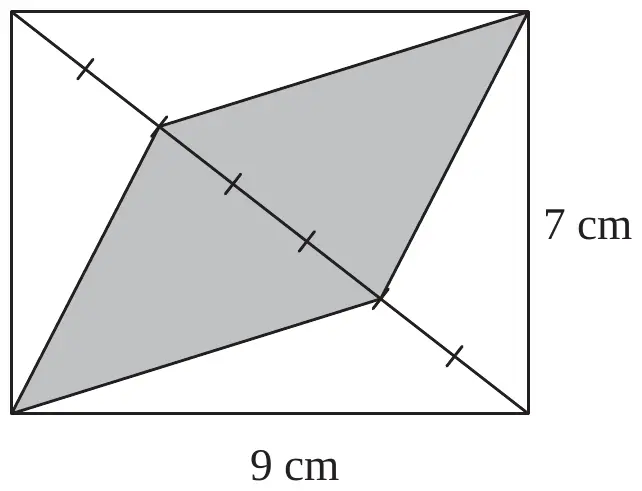
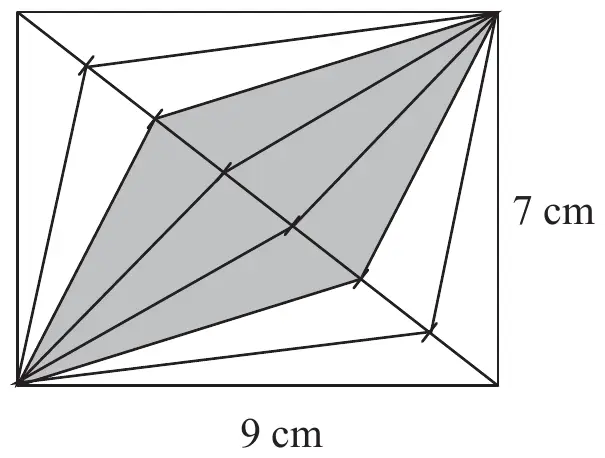
The 14 small triangles shown have equal heights and bases of equal length. Thus they have equal areas and their total area is that of the rectangle. The area of the rectangle is 7 cm × 9 cm = 63 cm2.
The area we require is made up of six small triangles. Hence, the required area is \(\frac{6}{14} \times 63\) cm2 = 27 cm2.
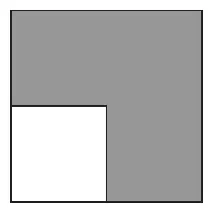
The length of the perimeter of the shaded region is the same as the length of the perimeter of the square. Hence the square has side length 6 cm and so has area 36 cm2.
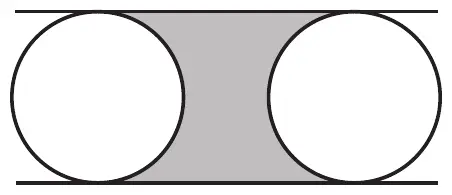
The area bounded by the circles can be calculated by subtracting the area of one circle from the area of the 3 cm × 2 cm rectangle with edges passing through the centres of the circle. Therefore the shaded area is \((6 - \pi)\) cm2.
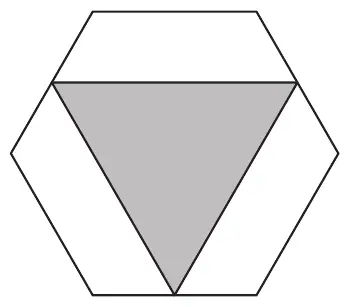
A7. The diagram shows an equilateral triangle inside a regular hexagon that has sides of length 14 cm. The vertices of the triangle are midpoints of sides of the hexagon.
What is the length of the perimeter of the triangle?
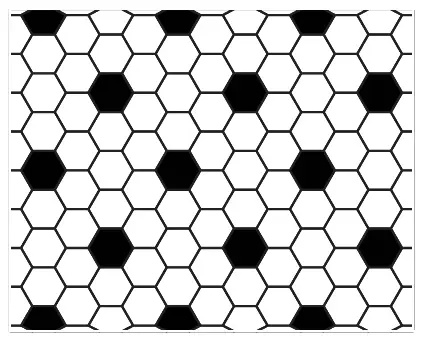
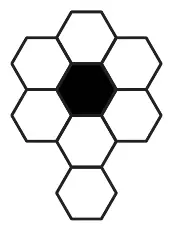
A9. The figure shows part of a tiling, which extends indefinitely in every direction across the whole plane. Each tile is a regular hexagon. Some of the tiles are white, the others are black.
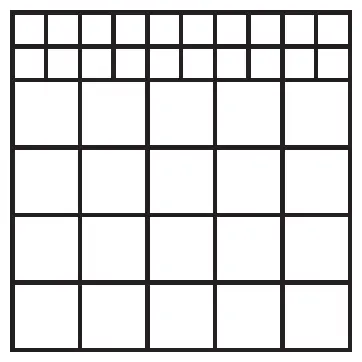
Each of the 1 cm tiles has area 1 cm2 and each of the 2 cm tiles has area 4 cm2. Suppose there are \(n\) tiles of each type. Then the assembled square must have area \(5n\) cm2 and \(5n\) must be a square number.
The smallest \(n\) could be is 5. This would require the tiles to fit together to form a 5 cm × 5 cm square. However the first four 2 cm tiles are placed in a 5 cm square, the fifth 2 cm tile cannot be placed in the remaining space. So \(n\) cannot be 5.
The next smallest \(n\) for which \(5n\) is a square is 20. This would require the tiles to fit together to form a 10 cm × 10 cm square. This arrangement is possible; an example is shown below. Hence the smallest square that can be made is a 10 cm × 10 cm square.
We'd like to use Google Analytics cookies to count visits and see which pages help most. They're optional, and the site works exactly the same either way. Privacy policy