
JMO 2019 B4
B4. The diagram alongside shows two quarter-circles
and two triangles, \(ABC\) and \(CDE\). One quarter-
circle has radius \(AB\), where \(AB = 3\) cm. The other
quarter-circle has radius \(DE\), where \(DE = 4\) cm.
The area enclosed by the line \(AE\) and the arcs of
the two quarter-circles is shaded.
What is the total shaded area, in cm2?
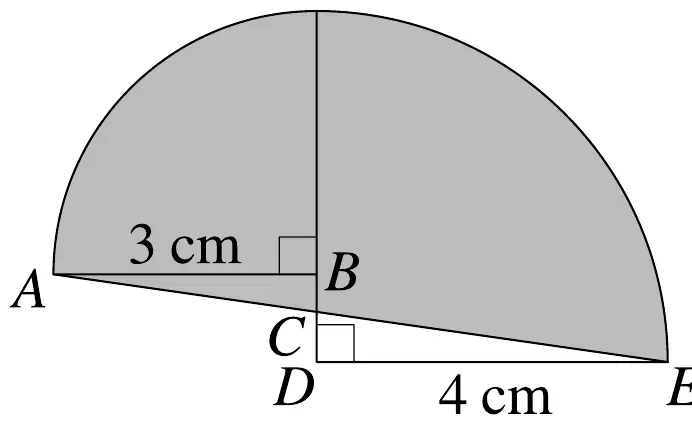
Junior Mathematical Olympiad 2019, Question B4. © UK Mathematics Trust. Original paper on ukmt.org.uk
Answer: \(\frac{25}{4}\pi - \frac{1}{2}\)
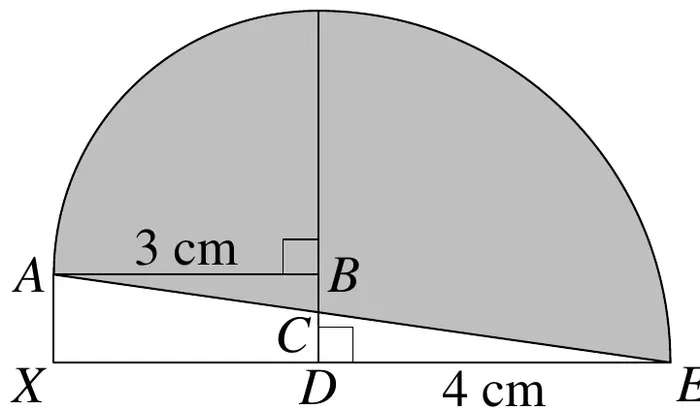
Add a point \(X\) to the diagram, directly below point \(A\) such that the lines \(AX\) and \(XD\) are perpendicular. This whole new shape consists of two quarter-circles and one rectangle (\(ABDX\)). The area, in cm2, of this new shape is
\[\frac{1}{4}\pi \times 3^2 + \frac{1}{4}\pi \times 4^2 + 3 \times 1 = \frac{25}{4}\pi + 3.\]
The shaded area is the area of the new shape minus the area of triangle \(AXE\). Hence, the shaded area, in cm2, is
\[\frac{25}{4}\pi + 3 - \frac{7}{2} = \frac{25}{4}\pi - \frac{1}{2}.\]
Solution © UK Mathematics Trust, from the JMO 2019 solutions.