
JMO 2018 B2
B2. In the diagram shown, \(ABCD\) is a square and point \(F\) lies on \(BC\).
Triangle \(DEC\) is equilateral and \(EB = EF\).
What is the size of \(\angle CEF\)?
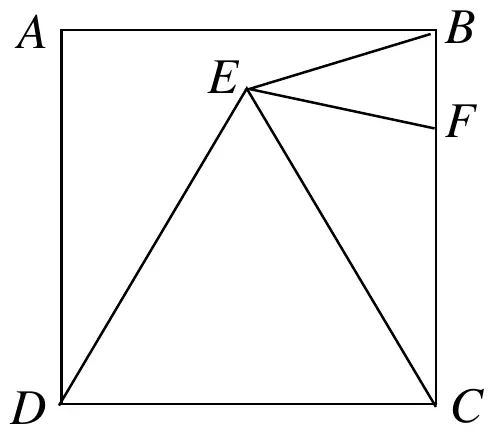
Junior Mathematical Olympiad 2018, Question B2. © UK Mathematics Trust. Original paper on ukmt.org.uk
Answer: 45°
Since triangle \(DEC\) is equilateral, \(\angle DCE = 60°\). Therefore, since \(ABCD\) is a square, \(\angle ECF = 30°\). Since \(DC = CE\) and \(DC = CB\), we have \(CE = CB\) and hence triangle \(ECB\) is isosceles.
As triangle \(EBF\) is isosceles, \(\angle CBE = \angle BFE\). Therefore,
\[\angle BFE = \frac{180° - 30°}{2} = 75° \text{ (angles in a triangle sum to 180°)}\]
and, consequently,
\[\angle EFC = 105° \text{ (angles on a straight line sum to 180°).}\]
Hence, using the fact that angles in a triangle sum to 180°,
\[\begin{aligned} \angle CEF &= 180° - \angle EFC - \angle ECF \\ &= 180° - 105° - 30° \\ &= 45°. \end{aligned}\]
Solution © UK Mathematics Trust, from the JMO 2018 solutions.