50 Junior Mathematical Challenge questions from every year we have, newest year first. Use Difficulty › Position in the paper to practise the early (easier) or late (harder) questions, or the Year filter for one year.
Note that 110 = 10 × 11 = 2 × 5 × 11, which is the prime factorisation of 110. Therefore the four different positive integers whose product is 110 are 1, 2, 5 and 11. Their sum is 19.
The digits which are non-prime are 0, 1, 4, 6, 8, 9. However, the units digit of a prime cannot be 0, 4, 6 or 8. Therefore any two-digit primes which have both their digits non-prime have a units digit of 1 or 9. The only such primes are 11, 19, 41, 61 and 89. Hence there five such primes.
23. There is more than one integer, greater than 1, which leaves a remainder of 1 when divided by each of the four smallest primes. What is the difference between the two smallest such integers?
The four smallest primes are 2, 3, 5, 7. Since these are all prime, their lowest common multiple is 2 × 3 × 5 × 7 = 210. Therefore the smallest positive integer which leaves remainder 1 when divided by each of the four smallest primes is 210 + 1 = 211. The next positive such integer is 2 × 210 + 1 = 421. Therefore the required difference is 421 − 211 = 210.
For the number to be as small as possible, we need the number of digits to be as small as possible. For instance, 111…1 (2019 1s) has a digit sum of 2019, but it is a much larger number than 333…3 (673 3s), which also has a digit sum of 2019. Clearly, to reduce the number of digits in the number, we need to make as many as possible of the digits in the number equal to 9. Now 2019 ÷ 9 = 224 remainder 3, so the smallest positive integer with digit sum of 2019 is 399…9 (224 9s). Its last digit is 9.
16. Tamsin writes down three two-digit integers. One is square, one is prime and one is triangular. She uses the digits 3, 4, 5, 6, 7 and 8 exactly once each.
First note that Tamsin can write down two squares, namely 36 and 64. Also, she can write down three triangular numbers, namely 36, 45 and 78. If she chooses 36 and 45 for the square and triangular number respectively, then the remaining digits are 7 and 8, but neither 78 nor 87 is prime. Similarly, if she chooses 36 and 78 then the remaining digits are 4 and 5, but neither 45 nor 54 is prime. So the square chosen cannot be 36 and is therefore 64. Evidently, 64 cannot be paired with 36 nor with 45, but if it is paired with 78 then the remaining digits are 3 and 5. Although 35 is not prime, 53 is prime and hence is the prime which Tamsin writes.
As \(1 = 1^3\) and \(8000 = 20^3\), there are 20 cubes from 1 to 8000. So the fraction of the integers from 1 to 8000 inclusive which are cubes is \(\dfrac{20}{8000} = \dfrac{1}{400}\).
20. Emily writes down the largest two-digit prime such that each of its digits is prime. Krish writes down the smallest two-digit prime such that each of its digits is prime. Kirsten subtracts Krish’s number from Emily’s number. What answer does Kirsten obtain?
The prime digits are 2, 3, 5 and 7. So the largest two-digit integer whose digits are both prime is 77. However, 77 is not prime, nor is 75, but 73 is prime. So Emily writes down 73. The smallest two-digit integer whose digits are both prime is 22. However, 22 is not prime, but 23 is prime. So Krish writes down 23. Therefore the answer which Kirsten obtains is 73 − 23 = 50.
Because the product has exactly four digits, it is clear that \(T = 1\) and \(P = 9\). So we have \((1000 + 100R + 10A + 9) \times 9 = 1000 \times 9 + 100A + 10R + 1\). Therefore \(9000 + 900R + 90A + 81 = 9000 + 100A + 10R + 1\). Hence \(890R + 80 = 10A\), which simplifies to \(89R + 8 = A\). Because \(A < 10\), the only solutions to this equation are \(R = 0\) and \(A = 8\). As a check, we see that 1089 × 9 is indeed 9801.
The prime factorisation of 15 is 3 × 5. Therefore for ‘\(p\)869\(q\)’ to be a multiple of 15, the sum of the digits, \(p + 8 + 6 + 9 + q\), is a multiple of 3 and \(q = 0\) or \(q = 5\). When \(q = 0\), the sum of the digits is \(23 + p\), which is a multiple of 3 when \(p = 1\), 4 or 7. When \(q = 5\), the sum of the digits is \(28 + p\), which is a multiple of 3 when \(p = 2\), 5 or 8. So the possible pairs \((p, q)\) are (1, 0), (4, 0), (7, 0), (2, 5), (5, 5) (8, 5). There are six in all.
18. Between them, the two five-digit integers \(M\) and \(N\) contain all ten digits from 0 to 9. What is the least possible difference between \(M\) and \(N\)?
The first digits of the two numbers will need to be as close as possible to each other. Since they cannot be equal, they will have to differ by 1; say they are \(n\) and \(n + 1\). The difference between the two numbers will then be minimised by making the four digits after \(n + 1\) as small as possible and the four digits after \(n\) as large as possible. The smallest four-digit number available is 0123 and the largest is 9876. So we need to make \(n = 4\) and then the required diference is 50123 − 49876 = 247.
Note that 45 = 5 × 9. As 5 and 9 are coprime, a positive integer is a multiple of 45 if and only if it is a multiple of both 5 and 9. The units digit of all five options is 5, so they are all multiples of 5. An integer is a multiple of 9 if and only if the sum of its digits is also a multiple of 9. The sums of the digits of the five options is 18, 18, 18, 18 and 8. So 305 is the only one of the options which is not a multiple of 9 and hence is not a multiple of 45.
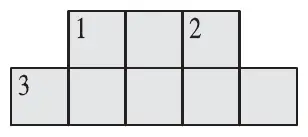
The first five positive powers of 11 are \(11^1 = 11\);\(11^2 = 121\);\(11^3 = 1331\);\(11^4 = 14641\);\(11^5 = 161051\). So 3 across is 14641, since this is the only five-digit power of 11. Therefore the solution to 2 down is a two-digit square with units digit 4 and so is \(8^2 = 64\), as the only other two-digit squares are 16, 25, 36, 49, 81. Hence 1 across is a three-digit cube with units digit 6 and so is \(6^3 = 216\), as the only other three-digit cubes are \(5^3 = 125\),\(7^3 = 343\),\(8^3 = 512\),\(9^3 = 729\). So the sum of the digits in the completed crossnumber is 2 + 1 + 6 + 1 + 4 + 6 + 4 + 1 = 25.
23. The positive integers from 1 to 150 inclusive are placed in a 10 by 15 grid so that each cell contains exactly one integer. Then the multiples of 3 are given a red mark, the multiples of 5 are given a blue mark, and the multiples of 7 are given a green mark. How many cells have more than 1 mark?
As 3 and 5 are coprime, the squares that have more than one mark are multiples of both 3 and 5, (multiples of 15); or multiples of both 3 and 7, (multiples of 21); or multiples of 5 and 7, (multiples of 35); or multiples of 3, 5 and 7, (multiples of 105). However, the latter will be included in all of the first three categories. Between 1 and 150 inclusive, there are ten multiples of 15, seven multiples of 21 and four multiples of 35, making a total of 21 multiples. However, there is one multiple of 3, 5 and 7 between 1 and 150, namely 105. So 105 has been counted three times in those 21 multiples, but corresponds to exactly one marked square. Therefore the total number of marked squares is 21 − 2 = 19.
A number is divisible by 4 if and only if its last two digits are divisible by 4. Since 34 is not divisible by 4, we deduce that 1234 is not a multiple of 4. Of the other options, 12 is even and so is a multiple of 2; the sum of the digits of 123 is 6, which is a multiple of 3, so 123 is a multiple of 3; 12 345 has a units digit of 5 and so is a multiple of 5. Finally, 123 456 is even and has a digit sum of 21, a multiple of 3. So 123 456 is a multiple of 2 and of 3 and is therefore a multiple of 6.
All four expressions are perfect squares: \(1^3 + 2^3 = 1 + 8 = 9 = 3^2\);\(1^3 + 2^3 + 3^3 = 1 + 8 + 27 = 36 = 6^2\);\(1^3 + 2^3 + 3^3 + 4^3 = 1 + 8 + 27 + 64 = 100 = 10^2\);\(1^3 + 2^3 + 3^3 + 4^3 + 5^3 = 1 + 8 + 27 + 64 + 125 = 225 = 15^2\). (It is not a coincidence that all four expressions are squares: the sum of the cubes of the first n integers is equal to the square of the sum of the first n integers for all positive integers n. For example: \(1^3 = 1^2\);\(1^3 + 2^3 = (1 + 2)^2\);\(1^3 + 2^3 + 3^3 = (1 + 2 + 3)^2\); \(1^3 + 2^3 + 3^3 + 4^3 = (1 + 2 + 3 + 4)^2\) etc.)
First note that when two numbers are added together the only possible carry from any column is 1. Now, looking at the tens column of the sum, we see that \(E + E\) leaves a total of \(E\) in the column. Since \(E\) is non-zero, the only way that this can happen is that there is a carry of 1 from the units column. So we have \(1 + E + E = 10 + E\), so \(1 + E = 10\), that is \(E = 9\). Looking at the units column we see that \(E + E = 18\), so \(S = 8\) and there is a carry of 1 to the tens column. The addition sum may now be solved: 899 + 899 = 1798. So \(X = 7\).
7. The result of the calculation 123 456 789 × 8 is almost the same as 987 654 321 except that two of the digits are in a different order. What is the sum of these two digits?
The units digit of 123 456 789 × 8 is 2, since 9 × 8 = 72. So, if the statement in the question is correct then the two digits which are in a different order are 1 and 2, whose sum is 3. As a check, 123 456 789 × 8 is indeed 987 654 312.
All of the options are odd and therefore give a remainder of 1 when divided by 2. Two of the options, 3 and 9, give remainder 0 when divided by 3. Two other options, 5 and 11, give remainder 2 when divided by 3, and 7 is the only option which gives remainder 1 when divided by 3.
It can be established that 2 is not one of the three primes to be summed since the sum of 2 and two other primes is an even number greater than 2 and therefore not prime. The smallest three odd primes are 3, 5, 7 but these sum to 15 which is not prime. The next smallest sum of three odd primes is 3 + 5 + 11 = 19, which is prime. So 19 is the smallest prime which is the sum of three different primes.
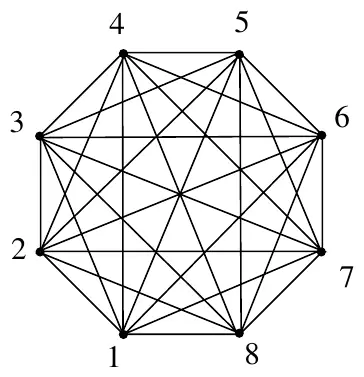
We denote the label joining \(m\) and \(n\) as \((m + n)\). The labels which are multiples of 3 are (1 + 2), (1 + 5), (1 + 8), (2 + 4), (2 + 7), (3 + 6), (4 + 5), (4 + 8), (5 + 7), (7 + 8). So 10 of the labels are multiples of 3.
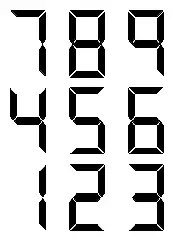
14. Digits on a calculator are represented by a number of horizontal and vertical illuminated bars. The digits and the bars which represent them are shown in the diagram. How many digits are both prime and represented by a prime number of illuminated bars?
The primes and the number of illuminated bars which represent them are: 2 → 5, 3 → 5, 5 → 5, 7 → 3. So all four prime digits are represented by a prime number of illuminated bars.
Of the options given, 23 × 34, 56 × 67 and 67 × 78 are all not divisible by 5, so may be discounted. Also 34 is not divisible by 4 and 45 is odd, so 34 × 45 may also be discounted as it is not divisible by 4. The only other option is 45 × 56. As a product of prime factors, \(45 \times 56 = 2^3 \times 3^2 \times 5 \times 7\), so it is clear that it is divisible by all of the integers from 1 to 10 inclusive.
The first six positive cubes are 1, 8, 27, 64, 125, 216. Clearly, 64 cannot be the sum of three positive cubes as the sum of all the positive cubes smaller than 64 is 1 + 8 + 27 = 36. Similarly, 125 cannot be the sum of three positive cubes as the largest sum of any three positive cubes smaller than 125 is 8 + 27 + 64 = 99. However, we note that 27 + 64 + 125 = 216, so 216 is the smallest cube which is the sum of three positive cubes.
24. A palindromic number is a number that reads the same when the order of its digits is reversed. What is the difference between the largest and smallest five-digit palindromic numbers that are both multiples of 45?
For a number to be a multiple of 45 it must be a multiple of 5 and also of 9. In order to be a multiple of 5, a number's units digit must be 0 or 5. However, the units digit of a palindromic number cannot be 0, so it may be deduced that any palindromic number which is a multiple of 45 both starts and ends in the digit 5. In order to make the desired number as large as possible, its second digit should be 9 and for it to be as small as possible its second digit should be 0. So, if possible, the numbers required are of the form ‘59\(x\)95’ and ‘50\(y\)05’. In addition, both numbers are to be multiples of 9 which means the sum of the digits of both must be a multiple of 9. For this to be the case, \(x = 8\) and \(y = 8\), giving digit sums of 36 and 18 respectively. So the two required palindromic numbers are 59895 and 50805. Their difference is 9090.
Prime numbers have exactly two distinct factors, so 1 is not a prime number as it has exactly one factor. Of the others, 12, 1234 and 123 456 are all even numbers, so are not prime as the only even prime is 2. Also, 123 = 3 × 41 and 12 345 is clearly a multiple of 5, so neither of these is prime. Therefore none of the numbers in the list is prime.
The smallest four-digit positive integer is 1000. Each of the subsequent integers up to and including 1022 has at least two digits the same. However, all digits of 1023 are different so this is the required integer.
An integer will have exactly one factor other than 1 and itself if, and only if, it is the square of a prime. Of the options given, the only such number is 25. Its factors are 1, 5, 25.
13. In the multiplication grid on the right, the input factors (in the first row and the first column) are all missing and only some of the products within the table have been given. What is the value of A + B + C + D + E?
Note that \(p\) is a factor of both 15 and 18. So \(p\) is either 1 or 3. If \(p = 1\) then \(w = 15\). However, if \(w = 15\) then \(r\) is not an integer. So \(p = 3, w = 5, x = 6\). The values of the other input factors may now be calculated: \(r = 8, s = 10, v = 2, z = 7, q = 5, y = 4, t = 6\). So A + B + C + D + E = 6 + 25 + 48 + 40 + 42 = 161.
23. Peter wrote a list of all the numbers that could be produced by changing one digit of the number 200. How many of the numbers on Peter’s list are prime?
If either of the first two digits of the number is changed, the units digit will still be 0. Therefore the new number will be either 000 or a non-zero multiple of 10 and so will not be prime. If the units digit is changed then the possible outcomes are 201, 202, 203, 204, 205, 206, 207, 208, 209. The even numbers are not prime and neither are 201 (3 × 67), 203 (7 × 29), 205 (5 × 41), 207 (3 × 69), 209 (11 × 19). So none of the numbers on Peter's list is prime.
If the sum of the digits is a multiple of 3 then the number is a multiple of 3. The sums of the digits of the given numbers are 6, 9, 12, 15, 18, so they are all multiples of 3. (Can you prove that all numbers consisting of three consecutive digits are multiples of 3? Hint: let the second digit be n.)
1 + 2 + 3 + 4 + 5 + 6 + 7 + 8 + 9 = 45 is the sum of the digits of each such number. As 45 is a multiple of 9, each such number is a multiple of 9 and so too is the difference between two of them. Thus the smallest feasible difference is 9. The two numbers 123 456 798 and 123 456 789 show that this can occur.
Of the given numbers, 2, 3 and 5 are all prime and therefore appear in the list. In addition, 1 appears in the list as it is the units digit of 11 and also of many other primes. However, all numbers with units digit 4 are even and therefore not prime, because the only even prime is 2. So only 1, 2, 3, 5 appear in the list.
7. Mr Owens wants to keep the students quiet during a Mathematics lesson. He asks them to multiply all the numbers from 1 to 99 together and then tell him the last-but-one digit of the result. What is the correct answer?
18. Sam's 101st birthday is tomorrow. So Sam's age in years changes from a square number (100) to a prime number (101). How many times has this happened before in Sam's lifetime?
The other times that this has happened previously are when Sam's age in years went from 1 to 2; from 4 to 5; from 16 to 17 and from 36 to 37. Note that since primes other than 2 are odd, the only squares which need to be checked, other than 1, are of even numbers.
22. Kiran writes down six different prime numbers, \(p\),\(q\),\(r\),\(s\),\(t\),\(u\), all less than 20, such that \(p + q = r + s = t + u\). What is the value of \(p + q\)?
The prime numbers less than 20 are 2, 3, 5, 7, 11, 13, 17, 19. It is not possible for 2 to be one of the six numbers Kiran wrote down, since that would give one of the pairs an odd sum, whereas both of the other pairs would add up to an even number. The sum of the remaining 7 primes is 75 which is a multiple of 3. The sum of the six primes making up the three pairs must also be a multiple of 3 since each pair has the same total. So the odd prime not used in the six pairs must be a multiple of 3 too. Therefore 3 is the odd prime not used. So each pair totals 72 ÷ 3, that is 24, and the pairs are 5 + 19, 7 + 17, 11 + 13.
24. The year 2010 belongs to a special sequence of twenty-five consecutive years: each number from 1988 to 2012 contains a repeated digit. Each of the following belongs to a sequence of consecutive years, where each number in the sequence contains at least one repeated digit. Which of them belongs to the next such sequence of at least twenty years?
In the 21st Century, to obtain a sequence of two years or more then either a 2 or a 0 must be repeated in each year, or the sequence include years such as 2011, 2033, 2044 etc. So the only sequence after that mentioned in the question will be from 2020 to 2030, but this is too short. In the 22nd Century, either a 2 or a 1 must be repeated. The first such sequence is 2110 to 2129 which does include 20 years, one of which is 2120.
The problem may be solved by dividing each of the alternatives in turn by 7, but the prime factorisation of 1001, i.e. 1001 = 7 × 11 × 13, leads to the conclusion that 111 111, which is 111 × 1001, is a multiple of 7.
18. Six friends are having dinner together in their local restaurant. The first eats there every day, the second eats there every other day, the third eats there every third day, the fourth eats there every fourth day, the fifth eats there every fifth day and the sixth eats there every sixth day. They agree to have a party the next time they all eat together there. In how many days' time is the party?
The lowest common multiple of 2, 3, 4, 5 and 6 is required. Of these numbers, 2, 3 and 5 are prime whilst 4 = 22 and 6 = 2 × 3. So their lowest common multiple is 22 × 3 × 5, that is 60.
Of the options given, only 27, which is three less than a multiple of 5, namely 30, and three more than a multiple of 6, namely 24, has both of the properties in the question.
22. Only one choice of the digit \(d\) gives a prime number for each of the three-digit numbers read across and downwards in the diagram on the right. Which digit is \(d\) ?
Four of the given values for \(d\) may be rejected since 143 = 11 × 13; 153 = 3 × 51; 567 = 3 × 189; 183 = 3 × 61. However, 173 and 577 are both prime, so \(d = 7\).
13. At the end of a hard day at the mine, the seven dwarves share out all their gold nuggets, making sure that they each get the same number of nuggets. If there are any left over, they are given to Snow White. Which number of nuggets would leave Snow White with the most?
As 2 is the only even prime, it must be one of the three primes which total 40 since any three odd numbers have an odd total. So the other two primes sum to 38. Different odd numbers which total 38 are (1, 37), (3, 35), (5, 33), (7, 31), (9, 29), (11, 27), (13, 25), (15, 23), (17, 21). Of these pairs, only (7, 31) consists of two primes, so the required difference is 24.
22. A positive whole number less than 100 has remainder 2 when it is divided by 3, remainder 3 when it is divided by 4 and remainder 4 when it is divided by 5. What is its remainder when it is divided by 7?
The number is 1 less than a multiple of 3, 1 less than a multiple of 4 and also 1 less than a multiple of 5. So, since 3, 4 and 5 have no factors in common, it is 1 less than a multiple of the product of 3, 4 and 5, that is 1 less than a multiple of 60. As it is less than 100, the only possibility is 59, which leaves remainder 3 when divided by 7. (Note that the Chinese Remainder Theorem provides a general method for solving problems like this.)
5. The word ‘thirty’ contains 6 letters and 6 = 30 ÷ 5. Similarly, the word ‘forty’ contains 5 letters and 5 = 40 ÷ 8. Which of the following is not a multiple of the number of letters it contains?
Eighteen has 8 letters and 18 is not a multiple of 8. Of the other options, 6 is a multiple of 3, 12 is a multiple of 6, 70 is a multiple of 7 and 90 is a multiple of 6.
We'd like to use Google Analytics cookies to count visits and see which pages help most. They're optional, and the site works exactly the same either way. Privacy policy