Junior Mathematical Challenge 2007

Practise one competitionJunior Mathematical Challenge 424 questions, 2004–2020Junior Kangaroo 125 questions, 2015–2019Junior Mathematical Olympiad 80 questions, 2015–2019

The whole Junior Mathematical Challenge 2007 paper, one question at a time in order (24 questions). Press Mark as done after each one: your marks add up below.

Questions and solutions © UK Mathematics Trust, shown with permission. Papers and more at ukmt.org.uk.

JMC

JMC 2007 Q2

JMCCurrent spec5 marksRatio, Rates & Measures

2. My train was scheduled to leave at 17:40 and to arrive at 18:20. However, it started five minutes late and the journey then took 42 minutes. At what time did I arrive?

  1. A 18:21
  2. B 18:23
  3. C 18:25
  4. D 18:27
  5. E 18:29

Junior Mathematical Challenge 2007, Question 2. © UK Mathematics Trust. Original paper on ukmt.org.uk

JMC 2007 Q4

JMCCurrent spec5 marksFactors, Primes & Digits

4. Which of the following numbers is three less than a multiple of 5 and three more than a multiple of 6?

  1. A 12
  2. B 17
  3. C 21
  4. D 22
  5. E 27

Junior Mathematical Challenge 2007, Question 4. © UK Mathematics Trust. Original paper on ukmt.org.uk

JMC 2007 Q5

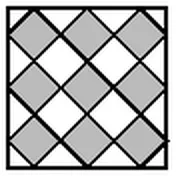
5. In the diagram, the small squares are all the same size. What fraction of the large square is shaded?

  1. A \(\dfrac{9}{20}\)
  2. B \(\dfrac{9}{16}\)
  3. C \(\dfrac{3}{7}\)
  4. D \(\dfrac{3}{5}\)
  5. E \(\dfrac{1}{2}\)
A large square tiled with small squares set diagonally; nine whole small squares are shaded grey and the half and quarter squares around the edge are white

Junior Mathematical Challenge 2007, Question 5. © UK Mathematics Trust. Original paper on ukmt.org.uk

JMC 2007 Q6

JMCCurrent spec5 marksFractions, Decimals & Percentages

6. When the following fractions are put in their correct places on the number line, which fraction is in the middle?

  1. A \(-\dfrac{1}{7}\)
  2. B \(\dfrac{1}{6}\)
  3. C \(-\dfrac{1}{5}\)
  4. D \(\dfrac{1}{4}\)
  5. E \(-\dfrac{1}{3}\)

Junior Mathematical Challenge 2007, Question 6. © UK Mathematics Trust. Original paper on ukmt.org.uk

JMC 2007 Q8

JMCCurrent spec5 marksCounting, Probability & Logic

8. Amy, Ben and Chris are standing in a row. If Amy is to the left of Ben and Chris is to the right of Amy, which of these statements must be true?

  1. A Ben is furthest to the left
  2. B Chris is furthest to the right
  3. C Amy is in the middle
  4. D Amy is furthest to the left
  5. E None of statements A, B, C, D is true

Junior Mathematical Challenge 2007, Question 8. © UK Mathematics Trust. Original paper on ukmt.org.uk

JMC 2007 Q9

JMCCurrent spec5 marksGeometry & Angles

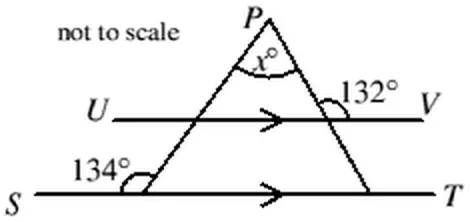
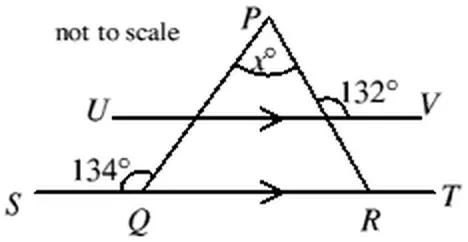
9. In the diagram on the right, \(ST\) is parallel to \(UV\).
What is the value of \(x\) ?

  1. A 46
  2. B 48
  3. C 86
  4. D 92
  5. E 94
Triangle with apex P, not to scale; line UV crosses the triangle parallel to the line ST below it; angle x degrees is at P, an angle of 132 degrees is where the right side of the triangle meets UV, and an angle of 134 degrees is where the left side meets ST

Junior Mathematical Challenge 2007, Question 9. © UK Mathematics Trust. Original paper on ukmt.org.uk

JMC 2007 Q10

JMCCurrent spec5 marksFractions, Decimals & Percentages

10. Which of the following has the largest value?

  1. A \(\dfrac{1}{2} + \dfrac{1}{4}\)
  2. B \(\dfrac{1}{2} - \dfrac{1}{4}\)
  3. C \(\dfrac{1}{2} \times \dfrac{1}{4}\)
  4. D \(\dfrac{1}{2} \div \dfrac{1}{4}\)
  5. E \(\dfrac{1}{4} \div \dfrac{1}{2}\)

Junior Mathematical Challenge 2007, Question 10. © UK Mathematics Trust. Original paper on ukmt.org.uk

JMC 2007 Q11

JMCCurrent spec5 marksCounting, Probability & Logic

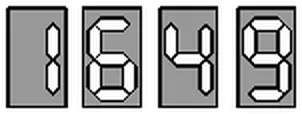
11. A station clock shows each digit by illuminating up to seven bars in a display. For example, the displays for 1, 6, 4 and 9 are shown.
When all the digits from 0 to 9 are shown in turn, which bar is used least?

Five single-bar displays labelled A to E: A the lower left bar, B the upper left bar, C the top bar, D the middle bar and E the bottom bar
Four seven-bar digital displays showing the digits 1, 6, 4 and 9

Junior Mathematical Challenge 2007, Question 11. © UK Mathematics Trust. Original paper on ukmt.org.uk

JMC 2007 Q12

JMCCurrent spec5 marksAverages & Data

12. The six-member squad for the Ladybirds five-a-side team consists of a 2-spot ladybird, a 10-spot, a 14-spot, an 18-spot, a 24-spot and a pine ladybird (on the bench). The average number of spots for members of the squad is 12. How many spots has the pine ladybird?

  1. A 4
  2. B 5
  3. C 6
  4. D 7
  5. E 8

Junior Mathematical Challenge 2007, Question 12. © UK Mathematics Trust. Original paper on ukmt.org.uk

JMC 2007 Q13

JMCCurrent spec5 marksGeometry & Angles

13. Points \(P\) and \(Q\) have coordinates (1, 4) and (1, −2) respectively. For which of the following possible coordinates of point \(R\) would triangle \(PQR\) not be isosceles?

  1. A (−5, 4)
  2. B (7, 1)
  3. C (−6, 1)
  4. D (−6, −2)
  5. E (7, −2)

Junior Mathematical Challenge 2007, Question 13. © UK Mathematics Trust. Original paper on ukmt.org.uk

JMC 2007 Q14

14. If the line on the right were 0.2 mm thick, how many metres long would the line need to be to cover an area of one square metre?

  1. A 0.5
  2. B 5
  3. C 50
  4. D 500
  5. E 5000
A short thick horizontal line

Junior Mathematical Challenge 2007, Question 14. © UK Mathematics Trust. Original paper on ukmt.org.uk

JMC 2007 Q15

JMCCurrent spec5 marksNumber & Arithmetic

15. I choose three numbers from this number square, including one number from each row and one number from each column. I then multiply the three numbers together. What is the largest possible product?

  1. A 72
  2. B 96
  3. C 105
  4. D 162
  5. E 504
123
456
789

Junior Mathematical Challenge 2007, Question 15. © UK Mathematics Trust. Original paper on ukmt.org.uk

JMC 2007 Q16

JMCCurrent spec6 marksGeometry & Angles

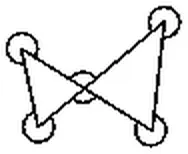
16. What is the sum of the six marked angles?

  1. A 1080°
  2. B 1440°
  3. C 1620°
  4. D 1800°
  5. E more information needed
Two triangles crossing at a common vertex like a bow tie, with the six angles marked by small circles at the five outer vertices and the crossing point

Junior Mathematical Challenge 2007, Question 16. © UK Mathematics Trust. Original paper on ukmt.org.uk

JMC 2007 Q17

17. Just William's cousin, Sweet William, has a rectangular block of fudge measuring 2 inches by 3 inches by 6 inches. He wants to cut the block up into cubes whose side lengths are whole numbers of inches. What is the smallest number of cubes he can obtain?

  1. A 3
  2. B 8
  3. C 15
  4. D 29
  5. E 36

Junior Mathematical Challenge 2007, Question 17. © UK Mathematics Trust. Original paper on ukmt.org.uk

JMC 2007 Q18

JMCCurrent spec6 marksAlgebraNumber & Arithmetic

18. The letters \(J\), \(M\), \(C\) represent three different non-zero digits.
What is the value of \(J + M + C\) ?

  1. A 19
  2. B 18
  3. C 17
  4. D 16
  5. E 15
\(\begin{array}{ccc} & J & J\\ & M & M\\ & C & C\\ \hline J & M & C\\ \hline \end{array}\)

Junior Mathematical Challenge 2007, Question 18. © UK Mathematics Trust. Original paper on ukmt.org.uk

JMC 2007 Q19

JMCCurrent spec6 marksArea, Perimeter & Shape

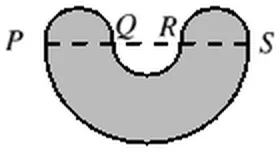
19. The points \(P\), \(Q\), \(R\), \(S\) lie in order along a straight line, with \(PQ = QR = RS = 2\) cm. Semicircles with diameters \(PQ\), \(QR\), \(RS\) and \(SP\) join to make the shape shown on the right. What, in cm2, is the area of the shape?

  1. A \(5\pi\)
  2. B \(9\pi/2\)
  3. C \(4\pi\)
  4. D \(7\pi/2\)
  5. E \(3\pi\)
A grey shape made of semicircles on the line PS through Q and R: small semicircles on PQ and RS above the line, a small semicircle on QR below it, and a large semicircle on SP below

Junior Mathematical Challenge 2007, Question 19. © UK Mathematics Trust. Original paper on ukmt.org.uk

JMC 2007 Q20

JMCCurrent spec6 marksFractions, Decimals & Percentages

20. At halftime, Boarwarts Academy had scored all of the points so far in their annual match against Range Hill School. In the second half, each side scored three points. At the end of the match, Boarwarts Academy had scored 90% of the points. What fraction of the points in the match was scored in the second half?

  1. A \(\dfrac{3}{100}\)
  2. B \(\dfrac{3}{50}\)
  3. C \(\dfrac{1}{10}\)
  4. D \(\dfrac{9}{50}\)
  5. E \(\dfrac{1}{5}\)

Junior Mathematical Challenge 2007, Question 20. © UK Mathematics Trust. Original paper on ukmt.org.uk

JMC 2007 Q21

JMCCurrent spec6 marksCounting, Probability & Logic

21. A list of ten numbers contains two of each of the numbers 0, 1, 2, 3, 4. The two 0s are next to each other, the two 1s are separated by one number, the two 2s by two numbers, the two 3s by three numbers and the two 4s by four numbers. The list starts 3, 4, … . What is the last number?

  1. A 0
  2. B 1
  3. C 2
  4. D 3
  5. E 4

Junior Mathematical Challenge 2007, Question 21. © UK Mathematics Trust. Original paper on ukmt.org.uk

JMC 2007 Q22

JMCCurrent spec6 marksFactors, Primes & Digits

22. Only one choice of the digit \(d\) gives a prime number for each of the three-digit numbers read across and downwards in the diagram on the right.
Which digit is \(d\) ?

  1. A 4
  2. B 5
  3. C 6
  4. D 7
  5. E 8
\(\begin{array}{ccc} & 5 & \\ 1 & d & 3\\ & 7 & \end{array}\)

Junior Mathematical Challenge 2007, Question 22. © UK Mathematics Trust. Original paper on ukmt.org.uk

JMC 2007 Q23

JMCCurrent spec6 marksAlgebraArea, Perimeter & Shape

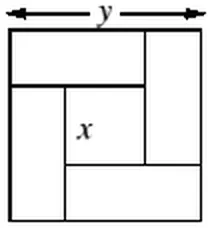
23. The diagram shows a square with sides of length \(y\) divided into a square with sides of length \(x\) and four congruent rectangles.
What is the length of the longer side of each rectangle?

  1. A \(\dfrac{y - x}{2}\)
  2. B \(\dfrac{y + 2x}{3}\)
  3. C \(y - x\)
  4. D \(\dfrac{2y}{3}\)
  5. E \(\dfrac{y + x}{2}\)
A square of side y divided into a central square of side x and four congruent rectangles arranged around it

Junior Mathematical Challenge 2007, Question 23. © UK Mathematics Trust. Original paper on ukmt.org.uk

JMC 2007 Q24

JMCCurrent spec6 marksCounting, Probability & Logic

24. The pages of a book are numbered 1, 2, 3, … . In total, it takes 852 digits to number all the pages of the book. What is the number of the last page?

  1. A 215
  2. B 314
  3. C 320
  4. D 329
  5. E 422

Junior Mathematical Challenge 2007, Question 24. © UK Mathematics Trust. Original paper on ukmt.org.uk

JMC 2007 Q25

JMCCurrent spec6 marksGeometry & Angles

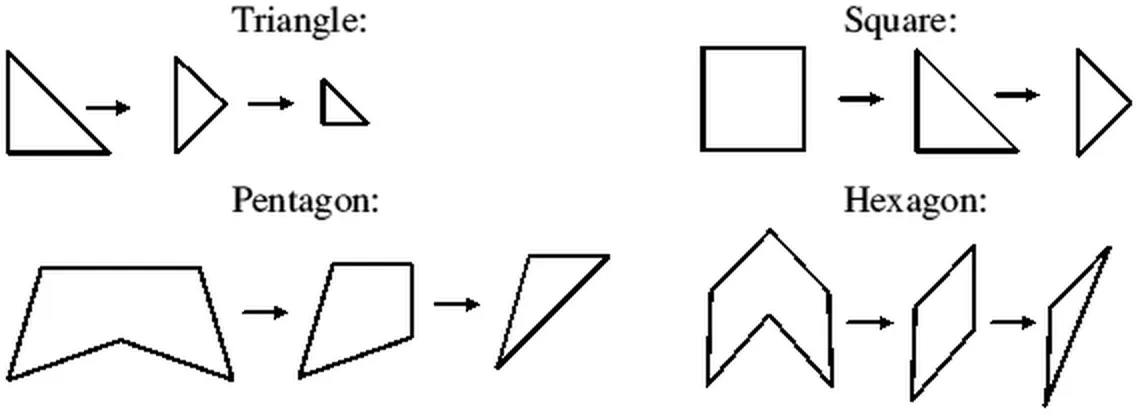
25. A piece of paper in the shape of a polygon is folded in half along a line of symmetry. The resulting shape is also folded in half, again along a line of symmetry. The final shape is a triangle. How many possibilities are there for the number of sides of the original polygon?

  1. A 3
  2. B 4
  3. C 5
  4. D 6
  5. E 7

Junior Mathematical Challenge 2007, Question 25. © UK Mathematics Trust. Original paper on ukmt.org.uk