66 Junior Mathematical Challenge questions from every year we have, newest year first. Use Difficulty › Position in the paper to practise the early (easier) or late (harder) questions, or the Year filter for one year.
In a 20 by 20 grid there are 21 horizontal wires each of length 20 cm and 21 vertical wires each of length 20 cm. Therefore the total length of wire required for a 20 by 20 grid is 42 × 20 cm = 840 cm.
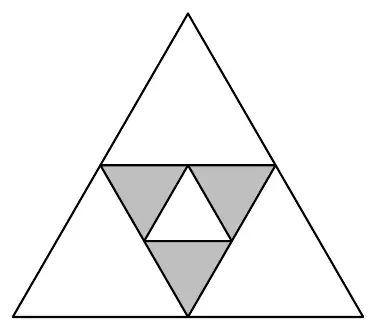
12. The diagram shows an equilateral triangle divided into four smaller equilateral triangles. One of these triangles has itself been divided into four smaller equilateral triangles. What fraction of the area of the large triangle has been shaded?
The large equilateral triangle has been divided into four congruent equilateral triangles. Therefore each of these triangles has an area equal to one quarter of the area of the large triangle. Similarly, the equilateral triangle which is partly shaded has been divided into four congruent equilateral triangles, three of which are shaded. Therefore the fraction of the area of the large triangle which has been shaded is \(\tfrac{3}{4}\times\tfrac{1}{4}=\tfrac{3}{16}\).
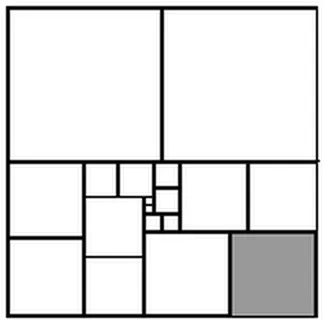
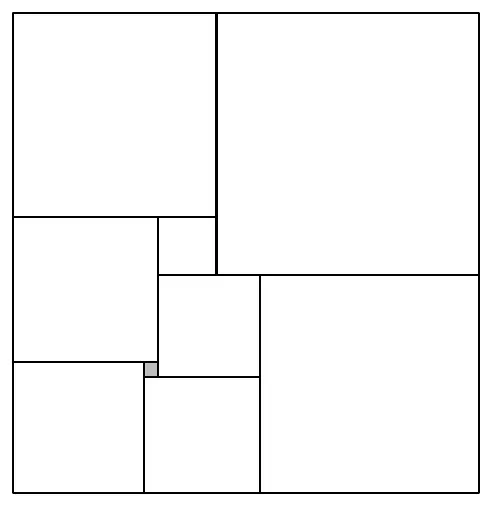
17. In 1925, Zbigniew Morón published a rectangle that could be dissected into nine different sized squares as shown in the diagram. The lengths of the sides of these squares are 1, 4, 7, 8, 9, 10, 14, 15 and 18. What is the area of Morón’s rectangle?
Label the individual squares, except for the smallest, \(P, Q, R, S, T, U, V\) and \(W\) as shown. The side-length of the smallest square is 1. Since the next smallest squares are \(W\) and \(V\), they have side-lengths 4 and 7 respectively. Therefore \(Q\) has side-length 7 + 1 = 8, \(P\) has side-length 8 + 1 = 9 and \(U\) has side-length 9 + 1 = 10. Hence \(T\) has side-length 10 + 4 = 14 and \(R\) has side-length 7 + 8 = 15. Therefore the rectangle has side-lengths 9 + 8 + 15 = 32 and 9 + 10 + 14 = 33. Therefore the area of the rectangle is 32 × 33 = 1056.
(Alternatively: the three largest squares R, S and T have side-length 15, 18 and 14 respectively. So the rectangle has sides of length 18 + 15 and 18 + 14 and so measures 33 by 32.)
20. Edmund makes a cube using eight small cubes. Samuel uses cubes of the same size as the small cubes to make a cuboid twice as long, three times as wide and four times as high as Edmund’s cube. How many more cubes does Samuel use than Edmund?
Edmund makes a cube using eight small cubes. Therefore his cube measures 2 × 2 × 2. Since Samuel makes a cuboid twice as long, three times as wide and four times as high as Edmund’s cube, Samuel’s cube measures 4 × 6 × 8. Therefore Samuel uses 192 small cubes in making his cube. Hence Samuel uses 192 − 8 = 184 more small cubes than Edmund.
22. Harriet has a square piece of paper. She folds it in half to form a rectangle and then in half again to form a second rectangle (which is not a square). The perimeter of the second rectangle is 30 cm. What is the area of the original square?
Let the side-length of Harriet’s square be \(4x\) cm. Then, the rectangle obtained when the square is folded in half measures \(4x\) cm by \(2x\) cm. When that rectangle is folded in half, it gives a rectangle which is not a square so this rectangle measures \(4x\) cm by \(x\) cm. The perimeter of the smaller rectangle is \(2(4x+x)\) cm = \(10x\) cm. Therefore, since the perimeter of the smaller rectangle is given as 30 cm, we have \(x=3\). Hence the side-length of Harriet’s square is 12 cm and its area is 144 cm2.
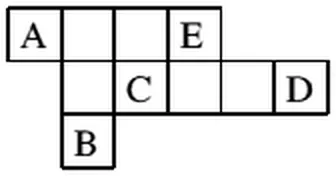
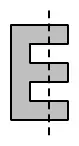
The greatest number of pieces into which figures A to D inclusive can be cut by a single straight cut are 3, 2, 3 and 2 respectively. The diagram shows how figure E may be cut into four different pieces by a single cut.
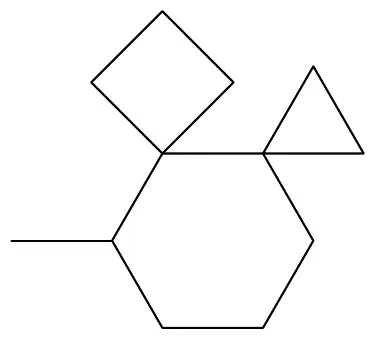
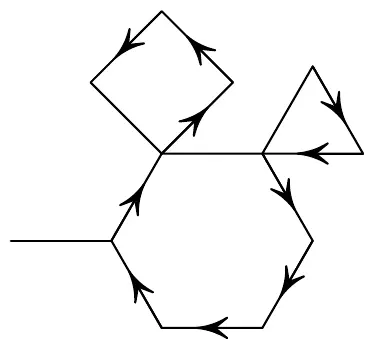
Any path can use at most 5 sides of the hexagon, 3 sides of the square, 2 sides of the triangle and just the 1 side of the protruding line. In order to use 3 sides of the square, the path would need to start or end in the square. Likewise, to use 2 sides of the triangle, it would need to start or end in the triangle. And to use the 1 protruding line, it would need to start or end at the outer point. Since the path can only start once and finish once, no path can be longer than (5 + 3 + 2) cm = 10 cm; and the diagram shows that there is a path of that length.
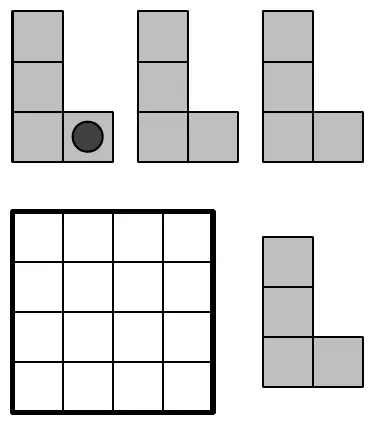
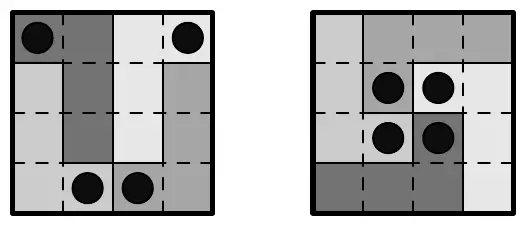
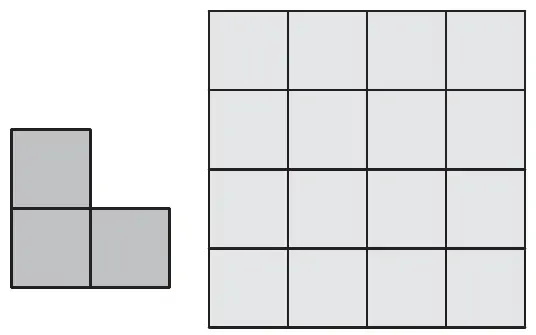
15. All four L-shapes shown in the diagram are to be placed in the 4 by 4 grid so that all sixteen cells are covered and there is no overlap. Each piece can be rotated or reflected before being placed and the black dot is visible from both sides.
How many of the 16 cells of the grid could contain the black dot?
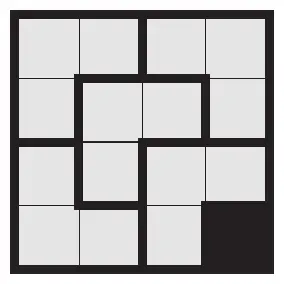
The first figure shows a possible configuration of the four L shapes fitting into the square and illustrates four cells which could contain the black dot. When this figure is rotated in one direction through 90°, 180° and 270°, it is clear that all twelve cells on the outside of the square could contain the black dot. Finally, the second figure shows that each of the four cells in the centre of the square could also contain the black dot. So each of the 16 cells in the diagram could contain the black dot.
17. A rectangle is three times as long as it is high. The area of a square is twelve times the area of the rectangle. What is the ratio of the perimeter of the square to the perimeter of the rectangle?
Let the height of the rectangle be \(x\). Then its length is \(3x\) and its area is \(3x^2\). So the area of the square is \(12 \times 3x^2 = 36x^2\) and hence its side-length is \(\sqrt{36x^2} = 6x\). So the perimeter of the rectangle is \(2(x + 3x) = 8x\) and the perimeter of the square is \(4 \times 6x = 24x\). Therefore the required ratio is \(24x : 8x = 3 : 1\).
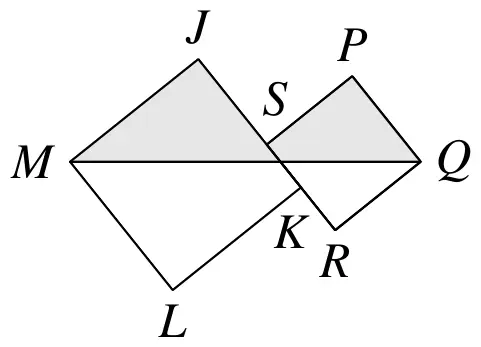
23. The diagram shows two squares \(JKLM\) and \(PQRS\). The length of \(JK\) is 6 cm and that of \(PQ\) is 4 cm. The vertex \(K\) is the midpoint of side \(RS\). What is the area of the shaded region?
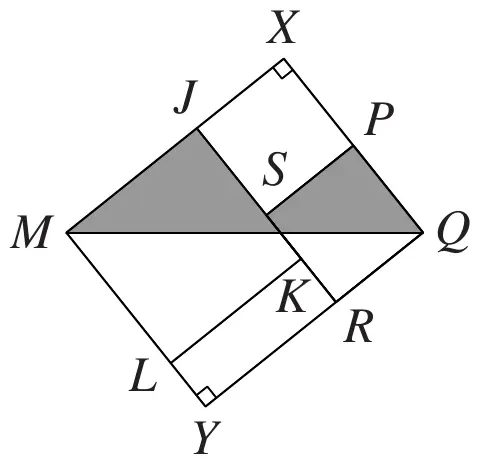
The diagram shows \(MJ\) produced and \(QP\) produced meeting at \(X\). Since \(MJ\) and \(QP\) are perpendicular to each other, \(\angle MXQ\) is a right angle. Similarly, \(ML\) produced and \(QR\) produced meet at \(Y\) and \(\angle QYM\) is a right angle. So \(MYQX\) is a rectangle. The length of the rectangle is \(MJ + JX = MJ + SP = (6 + 4)\) cm = 10 cm. As the vertex \(K\) is the midpoint of side \(RS\), then \(KR = (4 \div 2)\) cm = 2 cm. So the width of the rectangle is \(ML + LY = ML + KR = (6 + 2)\) cm = 8 cm. Also, \(JS = JK - SK = (6 - 2)\) cm = 4 cm. So \(SPXJ\) is a square of side 4 cm.
Hence the area of the shaded region is the area of triangle \(MXQ\) minus the area of square \(SPXJ\); that is, \((\tfrac{1}{2} \times 8 \times 10 - 4 \times 4)\) cm2 = 24 cm2.
4. The perimeter of the regular decagon \(P\) is 8 times the perimeter of the regular octagon \(Q\). Each edge of the regular octagon \(Q\) is 10 cm long. How long is each edge of the regular decagon \(P\)?
The perimeter of the regular octagon \(Q\) is 8 × 10 cm = 80 cm. So the perimeter of the regular decagon \(P\) is 8 × 80 cm = 640 cm. Therefore the length of each edge of \(P\) is (640 ÷ 10) cm = 64 cm.
Each of the cubes has six faces all of which are exposed. Therefore the four cubes have a total of 24 faces. Each face measures 3 cm by 3 cm and so has an an area of 9 cm2. Therefore the surface area of the shape is (24 × 9) cm2 = 216 cm2.
15. Beatrix places copies of the L-shape shown on a 4 × 4 board so that each L-shape covers exactly three cells of the board. She is allowed to turn around or turn over an L-shape. What is the largest number of L-shapes she can place on the board without overlaps?
The diagram shows that it is possible to place five L-shapes on the 4 × 4 board and, as there is now only one unfilled square, the maximum number of L-shapes which may be placed on the board is five.
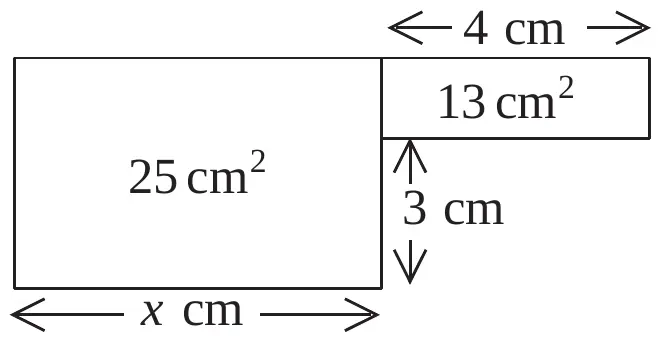
The height of the smaller rectangle is (13 ÷ 4) cm = \(\dfrac{13}{4}\) cm. Therefore the height of the larger rectangle is \(\left(3 + \dfrac{13}{4}\right)\) cm = \(\dfrac{25}{4}\) cm. So, considering the area of the larger rectangle, \(x \times \dfrac{25}{4} = 25\). Therefore \(x = 25 \div \dfrac{25}{4} = 25 \times \dfrac{4}{25} = 4\).
All five options contain four squares. When folded, these four squares form the unshaded faces in the diagram shown. So we need to work out in which of the options the two pairs of isosceles right angles fold together to make the two shaded faces. This happens only in option C.
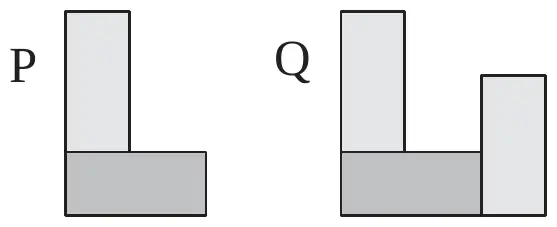
24. The shapes P and Q are formed from two and three identical rectangles, respectively. Their perimeters are 58 cm and 85 cm respectively. What is the perimeter of one of the rectangles?
Let the perimeter of one of the rectangles be \(p\) cm and let the length of one of its shorter sides be \(x\) cm. Before the rectangles in figure \(P\) are joined together, their total perimeter is \(2p\) cm. However, when they are joined together, a length equal to the lengths of two of the shorter sides is ‘lost’ at the join. So the perimeter of shape \(P\), in cm, equals \(2p - 2x\). So \(2p - 2x = 58\)… (1). Similarly, shape \(Q\) consists of three of the rectangles, but there are two joins. So a length equal to the lengths of four of the shorter sides is ‘lost’ at the joins. Therefore, the perimeter of shape \(Q\), in cm, equals \(3p - 4x\). So \(3p - 4x = 85\)… (2). Multiplying equation (1) by 2 and then subtracting equation (2) gives \(4p - 4x - (3p - 4x) = 2 \times 58 - 85\). So \(p = 31\). Therefore the perimeter of one of the rectangles is 31 cm.
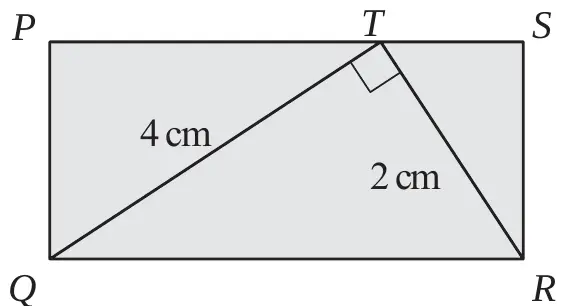
8. The diagram shows a rectangle \(PQRS\) and \(T\) is a point on \(PS\) such that \(QT\) is perpendicular to \(RT\). The length of \(QT\) is 4 cm. The length of \(RT\) is 2 cm.
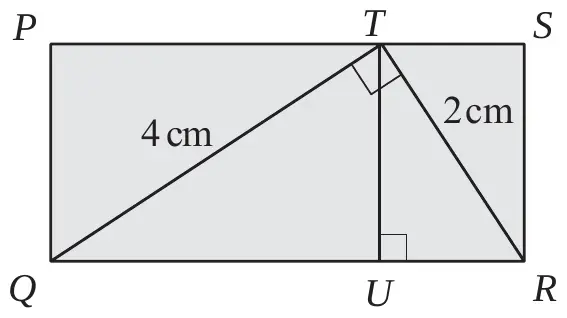
In the diagram, \(U\) is the foot of the perpendicular from \(T\) to \(QR\). The area of rectangle \(PQRS = QR \times TU\). The area of triangle \(QTR\) is \(\tfrac{1}{2} \times QR \times TU\). So the area of rectangle \(PQRS\) is equal to 2 × area of triangle \(QTR = 2 \times \left(\tfrac{1}{2} \times 2 \times 4\right)\) cm2 = 8 cm2.
14. Mathias is given a grid of twelve small squares. He is asked to shade grey exactly four of the small squares so that his grid has two lines of reflection symmetry. How many different grids could he produce?
If any corner square is shaded, then they all must be, and this gives one possible grid. Similarly if any one of \(b\),\(c\),\(j\), \(k\) is shaded then so too are the others. That leaves only all four squares in the middle row, which provides the third and final possible grid.
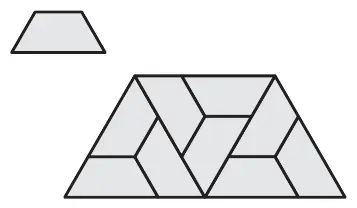
21. The small trapezium on the right has three equal sides and angles of 60° and 120°. Nine copies of this trapezium can be placed together to make a larger version of it, as shown. The larger trapezium has perimeter 18 cm. What is the perimeter of the smaller trapezium?
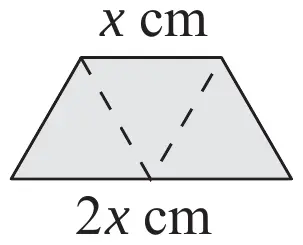
The diagram shows that the small trapezium may be divided into three congruent equilateral triangles. Let the length of each side of the triangles be \(x\) cm. Then the base of the small trapezium is \(2x\) cm. The perimeter of the larger trapezium is made up of five equal line segments each of length \((2x + x)\) cm. So \(15x = 18\). The perimeter of the smaller trapezium is \((x + x + x + 2x)\) cm = \(5x\) cm = \(5 \times \tfrac{18}{15}\) cm = 6 cm. {It is left as an exercise for the reader to prove that the small trapezium may be divided into three congruent equilateral triangles.}
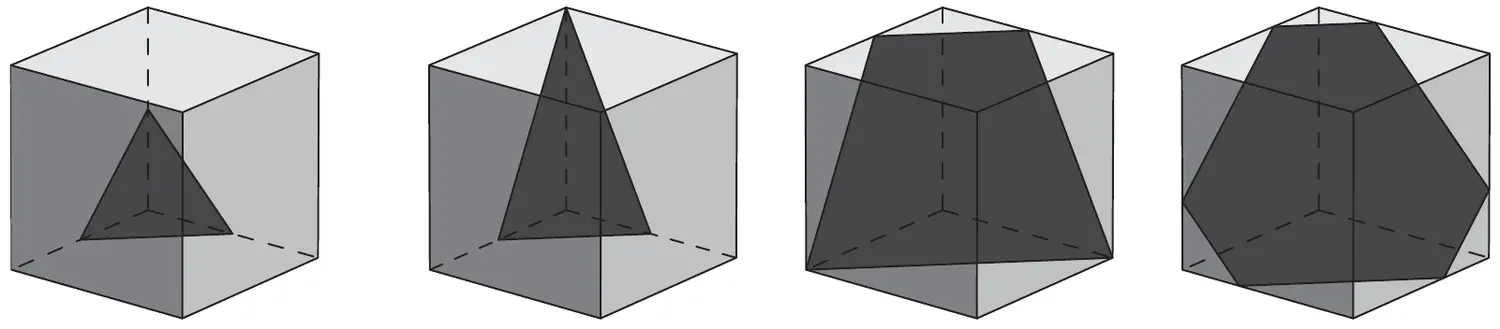
24. A large solid cube is cut into two pieces by a single plane cut. How many of the following four shapes could be the shape of the cross-section formed by the cut?
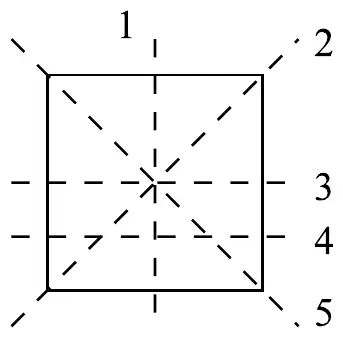
When a square is folded exactly in half, the shape obtained is a rectangle or a right-angled isosceles triangle. So to determine which of the given shapes can be obtained from a second fold we need to test which shapes form a rectangle or a right-angled isosceles triangle when joined with the image formed when the shape is reflected about an edge. Of the options given, only D does not do this. Of the others, shape A is formed by using fold line 1 first, followed by fold line 3. For shape B the fold lines are 3 followed by 4. For shapes C and E, which are similar, the fold lines are 2 followed by 5.
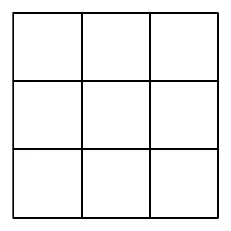
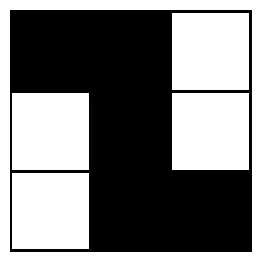
16. Each of the nine small squares in this grid can be coloured completely black or completely white. What is the largest number of squares that can be coloured black so that the design created has rotational symmetry of order 2, but no lines of symmetry?
We imagine all the squares being black and consider changing as few as possible to white in order to satisfy the conditions required. First note that the colour of the centre square has no effect on the symmetries involved. So we will leave that black. If we change one corner to white, the opposite corner must also be changed to white to give the rotational symmetry. The diagram still has reflective symmetry. If you instead try changing a non-corner square to white, the opposite one must be. And you again have reflective symmetry. That shows we need to change more than two squares. The rotational symmetry means that the next possiblity is to change 4 squares to white. And the diagram shown shows that it is possible, with four white squares, to have rotational but not reflective symmetry. That means that, in the problem as stated, the maximum number of black squares is 5.
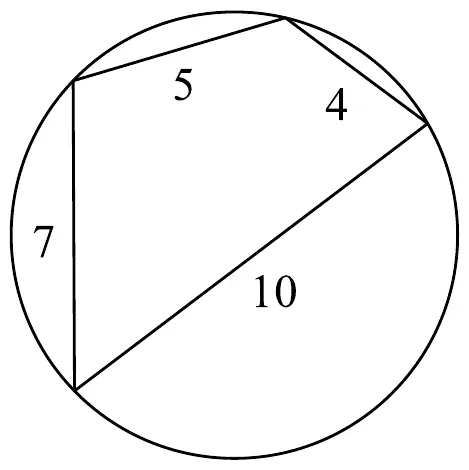
20. A cyclic quadrilateral has all four vertices on the circumference of a circle. Brahmagupta (598–670AD) gave the following formula for the area, \(A\), of a cyclic quadrilateral whose edges have lengths \(a\),\(b\),\(c\),\(d\): \(A = \sqrt{(s - a)(s - b)(s - c)(s - d)}\), where \(s\) is half of the perimeter of the quadrilateral. What is the area of the cyclic quadrilateral with sides of length 4 cm, 5 cm, 7 cm and 10 cm?
The length of \(s\), half the perimeter of the cyclic quadrilateral, is \(\tfrac{1}{2}(4 + 5 + 7 + 10)\) cm = 13 cm. So the required area, in cm2, is \(\sqrt{(13 - 4)(13 - 5)(13 - 7)(13 - 10)} = \sqrt{9 \times 8 \times 6 \times 3} = \sqrt{9 \times 144} = 3 \times 12 = 36\).
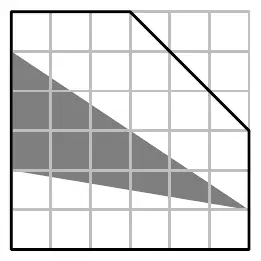
21. The diagram shows a pentagon drawn on a square grid. All vertices of the pentagon and triangle are grid points. What fraction of the area of the pentagon is shaded?
The area of the shaded triangle is \(\tfrac{1}{2} \times 3 \times 6 = 9\). The area of the square grid is 6 × 6 = 36, and the area of the triangle which is not part of the area of the pentagon is \(\tfrac{1}{2} \times 3 \times 3 = \tfrac{9}{2}\). So the area of the pentagon is \(36 - \tfrac{9}{2} = \tfrac{63}{2}\). Hence the required fraction is \(9 \div \tfrac{63}{2} = 9 \times \tfrac{2}{63} = \tfrac{2}{7}\).
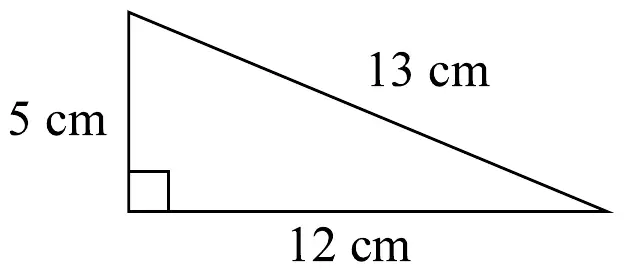
22. Four copies of the triangle shown are joined together, without gaps or overlaps, to make a parallelogram. What is the largest possible perimeter of the parallelogram?
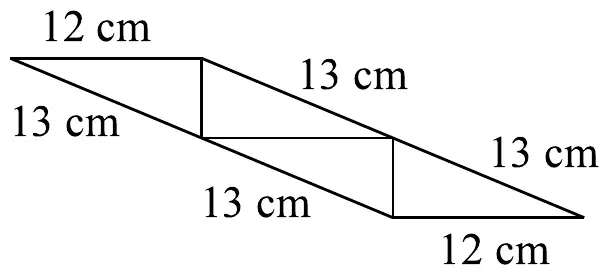
In order to join the four triangles together it is required to join together at least three pairs of edges, which consequently are not part of the perimeter of the resulting parallelogram. The four triangles have a total of 12 edges, so the maximum number of edges which can be part of the perimeter of the parallelogram is 12 − 3 × 2 = 6. For the perimeter to be as large as possible, all four 13 cm edges should be included together with two of the 12 cm edges, if this is possible. The diagram shows how it may be accomplished. So the largest possible perimeter is (4 × 13 + 2 × 12) cm = 76 cm.
25. Beatrix places dominoes on a 5 × 5 board, either horizontally or vertically, so that each domino covers two small squares. She stops when she cannot place another domino, as in the example shown in the diagram. When Beatrix stops, what is the largest possible number of squares that may still be uncovered?
First note that there are 25 squares on the board. As each domino occupies two squares, the number of squares left uncovered must be odd. The diagram on the right shows that it is possible for Beatrix to place the dominoes so that there are seven uncovered spaces when it is not possible for her to place any more dominoes. Of the options given, it is not possible to obtain eight uncovered spaces as the number of them must be odd and it has been shown that seven uncovered spaces is possible so the correct answer is seven. (For a proof that it is not possible to obtain more than seven uncovered spaces, please see the extended solutions on the UKMT website.)
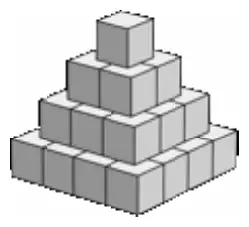
20. The diagram shows a pyramid made up of 30 cubes, each measuring 1 m × 1 m × 1 m. What is the total surface area of the whole pyramid (including its base)?
When the pyramid is viewed from above, it can be seen that the total area of the horizontal part of the surface of the pyramid (excluding its base) is the same as that of a square of side 4 metres, that is 16 m2. The area of the base of the pyramid is also 16 m2. Finally the total area of the vertical part of the pyramid is equal to (4 × 1 + 4 × 2 + 4 × 3 + 4 × 4) m2 = 40 m2. So the total surface area of the pyramid is (16 + 16 + 40) m2 = 72 m2.
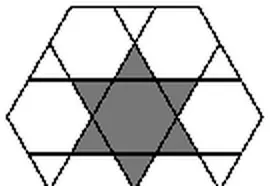
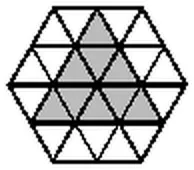
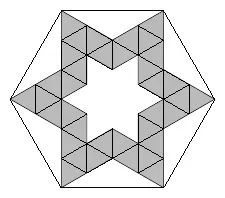
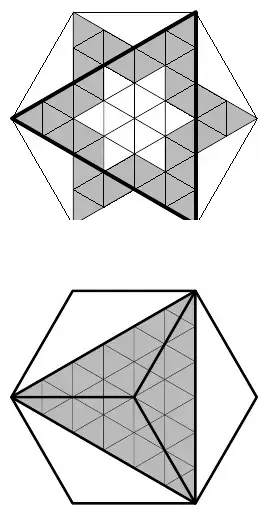
22. The diagram shows a shaded region inside a regular hexagon. The shaded region is divided into equilateral triangles. What fraction of the area of the hexagon is shaded?
In the diagram, the shaded small equilateral triangles have been divided into those which lie within the highlighted large equilateral triangle and the twelve small equilateral triangles which lie outside the large triangle. Note that the unshaded star shape in the centre of the large triangle is made up of twelve small equilateral triangles, so the small triangles outside the large triangle could be moved into the large triangle so that the large triangle is shaded completely and the rest of the hexagon is unshaded as in the lower diagram. The lower diagram shows that the hexagon may be divided into six congruent triangles, three of which are shaded and three of which are unshaded. So the required fraction is \(\tfrac{1}{2}\).
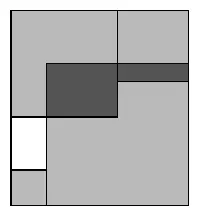
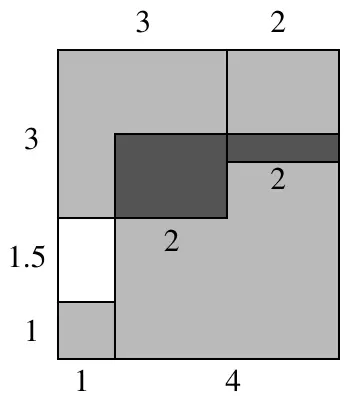
23. The diagram shows four shaded glass squares, with areas 1 cm2, 4 cm2, 9 cm2 and 16 cm2, placed in the corners of a rectangle. The largest square overlaps two others. The area of the region inside the rectangle but not covered by any square (shown unshaded) is 1.5 cm2. What is the area of the region where squares overlap (shown dark grey)?
The diagram shows some of the lengths of sides which may be deduced from the information given in the question. Note that the rectangle measures 5 cm by 5.5 cm. The sum of the areas of the four glass squares is (1 + 4 + 9 + 16) cm2 = 30 cm2. However, the total region of the rectangle occupied by the four squares is equal to (5 × 5.5 − 1.5) cm2 = 26 cm2. So the area of the overlap is (30 − 26) cm2 = 4 cm2.
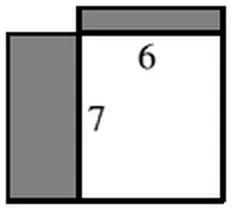
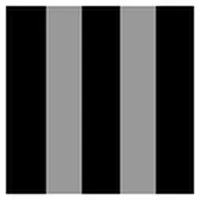
6. The diagram shows a square divided into strips of equal width. Three strips are black and two are grey. What fraction of the perimeter of the square is grey?
Let the width of each strip be 1. Then the square has side 5 and perimeter 20. The grey strips contribute 4 to the perimeter, so the fraction of the perimeter which is grey is \(\tfrac{4}{20} = \tfrac{1}{5}\).
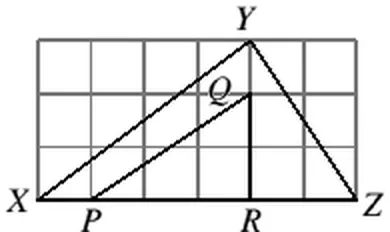
The area of a triangle = \(\tfrac{1}{2}\) × base × height. If we let the length of the sides of each square in the grid be 1, then the area of triangle \(PQR\) is \(\tfrac{1}{2}\) × 3 × 2 = 3. The area of triangle \(XYZ\) is \(\tfrac{1}{2}\) × 6 × 3 = 9. So the required fraction is \(\tfrac{3}{9} = \tfrac{1}{3}\).
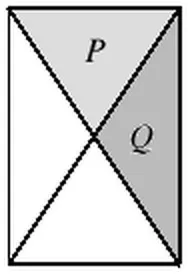
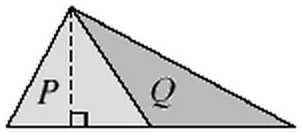
The diagram shows part of the given diagram after a rotation so that the diagonal shown is horizontal. The perpendicular height of triangle \(P\) is shown and it can be seen that this is also the perpendicular height of triangle \(Q\). The diagonals of a rectangle bisect each other, so triangles \(P\) and \(Q\) have bases of equal length and the same perpendicular height. Therefore their areas are equal.
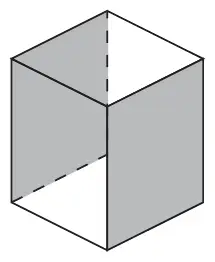
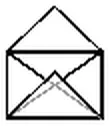
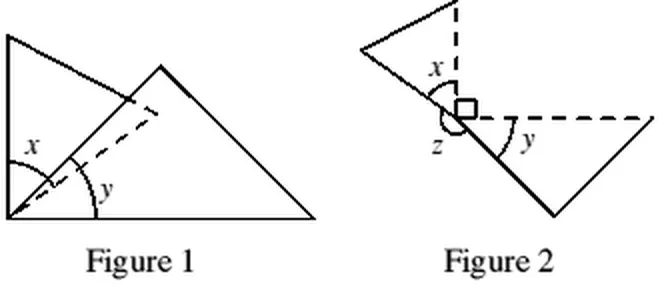
15. The diagram shows a rectangular envelope made by folding (and gluing) a single piece of paper. What could the original unfolded piece of paper look like? (The dashed lines are the fold lines.)
Consider, for example, the bottom left-hand corner of the envelope (see Figure 1). The two flaps overlap, so that the sum of the angles marked \(x\) and \(y\) is greater than 90°. So when the flaps are unfolded, as in Figure 2, the angle marked \(z\) is less than 180°. Therefore the correct answer is E.
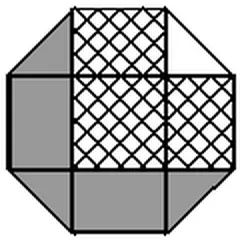
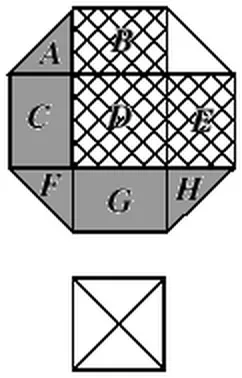
24. The diagram shows a regular octagon with sides of length 1. The octagon is divided into regions by four diagonals. What is the difference between the area of the hatched region and the area of the region shaded grey?
Note that rectangles \(B\),\(C\), \(E\) and \(G\) are all congruent. Two of these are shaded grey and two are hatched, so the difference between the area of the hatched region and the area shaded grey is the difference between the area of square \(D\) of side 1 and the sum of the areas of triangles \(A\), \(F\) and \(H\). These are all isosceles right-angled triangles with hypotenuse 1 and the lower diagram shows how a square of side 1 may be divided into 4 such triangles. So the required difference in area is \(1 - \tfrac{3}{4} = \tfrac{1}{4}\).
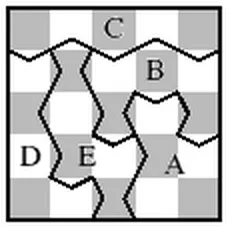
17. A 5 cm × 5 cm square is cut into five pieces, as shown. Each cut is a sequence of identical copies of the same shape but pointing up, down, left or right. Which piece has the longest perimeter?
Let \(x\) cm be the length of the shape. Although \(x\) is not given, it is clear that \(x > 1\). The lengths, in cm, of the perimeters of pieces \(A\),\(B\),\(C\),\(D\), \(E\) are \(4 + 6x\),\(2 + 10x\),\(7 + 5x\),\(6 + 6x\), \(1 + 11x\) respectively. As \(4 + 6x < 6 + 6x\), the piece with the longest perimeter is \(B\),\(C\), \(D\) or \(E\). As \(x > 1\), it may be deduced that \(7 + 5x < 6 + 6x < 2 + 10x < 1 + 11x\), so \(E\) has the longest perimeter.
24. Three congruent squares overlap as shown. The areas of the three overlapping sections are 2 cm2, 5 cm2 and 8 cm2 respectively. The total area of the non-overlapping parts of the squares is 117 cm2. What is the side-length of each square?
Each of the overlapping areas contributes to the area of exactly two squares. So the total area of the three squares is equal to the area of the non-overlapping parts of the squares plus twice the total of the three overlapping areas i.e. (117 + 2(2 + 5 + 8)) cm2 = (117 + 30) cm2 = 147 cm2. So the area of each square is (147 ÷ 3) cm2 = 49 cm2. Therefore the length of the side of each square is 7 cm.
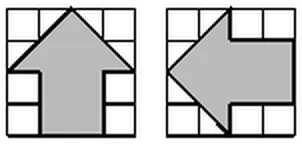
10. The diagram shows two arrows drawn on separate 4 cm × 4 cm grids. One arrow points North and the other points West. When the two arrows are drawn on the same 4 cm × 4 cm grid (still pointing North and West) they overlap. What is the area of overlap?
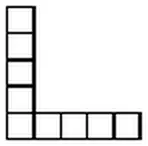
12. Laura wishes to cut this shape, which is made up of nine small squares, into pieces that she can then rearrange to make a 3 × 3 square. What is the smallest number of pieces that she needs to cut the shape into so that she can do this?
None of the pieces which Laura uses to make the 3 × 3 square can be more than 3 units long. Both the horizontal and vertical portions of the original shape are longer than 3 units, so at least two cuts will be required. Hence Laura will need at least three pieces and the diagrams on the right show that the task is possible using exactly three pieces.
22. The diagram shows a design formed by drawing six lines in a regular hexagon. The lines divide each edge of the hexagon into three equal parts. What fraction of the hexagon is shaded?
The original hexagon has been divided into seven regular hexagons and twelve equilateral triangles. Six equilateral triangles are equal in area to one smaller hexagon, so the large hexagon is equal in area to nine of the smaller hexagons. (This may also be deduced from the fact that their sides are in the ratio 3:1.) The shaded area consists of one smaller hexagon and six equilateral triangles, which is equivalent to the area of two of the smaller hexagons. So \(\tfrac{2}{9}\) of the large hexagon is shaded.
8. A square is divided into three congruent rectangles. The middle rectangle is removed and replaced on the side of the original square to form an octagon as shown. What is the ratio of the length of the perimeter of the square to the length of the perimeter of the octagon?
Let the original square have side \(3x\). Then its perimeter is \(12x\). The perimeter of the octagon is \(2 \times 4x + 3 \times 3x + 3 \times x = 8x + 9x + 3x = 20x\).
14. The diagram shows a cuboid in which the area of the shaded face is one-quarter of the area of each of the two visible unshaded faces. The total surface area of the cuboid is 72 cm2. What, in cm2, is the area of one of the visible unshaded faces of the cuboid?
Let the area of the shaded face be \(x\) cm2. Then the cuboid has two faces of area \(x\) cm2 and four faces of area \(4x\) cm2. So its total surface area is \(18x\) cm2. Therefore \(18x = 72\), that is \(x = 4\). So the area of one of the visible unshaded faces is 4 × 4 cm2 = 16 cm2.
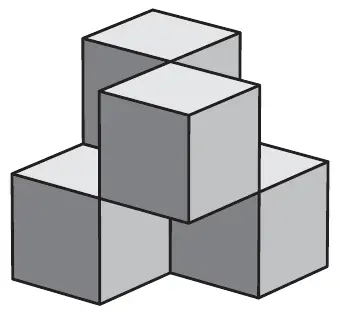
20. One cube has each of its faces covered by one face of an identical cube, making a solid as shown. The volume of the solid is 875 cm3. What, in cm2, is the surface area of the solid?
Let the length of the side of each cube be \(x\) cm. Then the volume of the solid is \(7x^3\) cm3. Therefore \(7x^3 = 875\), that is \(x^3 = 125\). So \(x = 5\). The surface area of the solid comprises five of the faces of each of six cubes. Each face has area 25 cm2 so the required area is 5 × 6 × 25 cm2 = 750 cm2.
11. In the diagram shown, all the angles are right angles and all the sides are of length 1 unit, 2 units or 3 units. What, in square units, is the area of the shaded region?
Divide the whole figure into horizontal strips of height 1 unit: its area is (3 + 6 + 8 + 8 + 8 + 6 + 3) units2 = 42 units2. Similarly, the unshaded area is (1 + 4 + 6 + 4 + 1) units2 = 16 units2. So the shaded area is 26 units2. Alternative solution: notice that if the inner polygon is moved a little, the answer remains the same – because it is just the difference between the areas of the two polygons. So, although we are not told it, we may assume that the inner one is so positioned that the outer shaded area can be split neatly into 1 by 1 squares – and there are 26 of these.
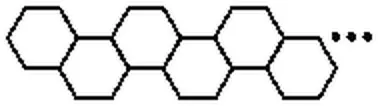
21. A shape consisting of a number of regular hexagons is made by continuing to the right the pattern shown in the diagram, with each extra hexagon sharing one side with the preceding one. Each hexagon has a side length of 1 cm. How many hexagons are required for the perimeter of the whole shape to have length 2010 cm?
The first and last hexagons both contribute 5 cm to the perimeter of the pattern. Every other hexagon in the pattern contributes 4 cm to the perimeter. The first and last thus contribute 10 cm, so we need another 2000 ÷ 4 = 500 hexagons. Therefore the total number of hexagons required is 502.
8. The figure on the right shows an arrangement of ten square tiles. Which labelled tile could be removed, but still leave the length of the perimeter unchanged?
Removing tile A or tile B or tile D has the effect of reducing the perimeter by a distance equal to twice the side of one tile, whilst removing tile C increases the perimeter by that same distance. Removing tile E, however, leaves the length of the perimeter unchanged.
17. The tiling pattern shown uses two sizes of square, with sides of length 1 and 4. A very large number of these squares is used to tile an enormous floor in this pattern. Which of the following is closest to the ratio of the number of grey tiles on the floor to the number of white tiles?
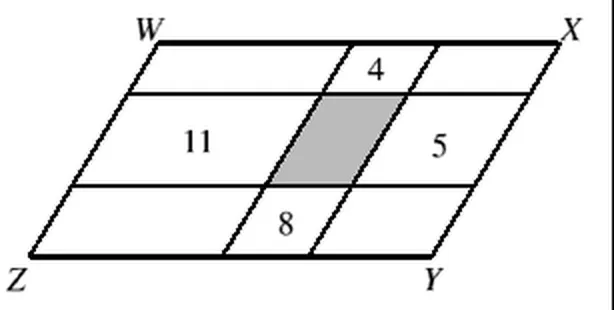
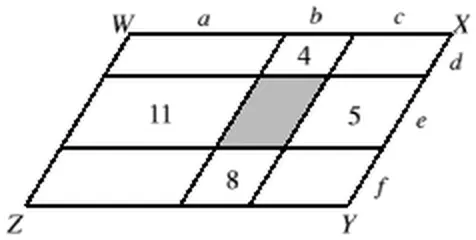
24. The parallelogram WXYZ shown in the diagram on the right has been divided into nine smaller parallelograms. The perimeters, in centimetres, of four of the smaller parallelograms are shown. The perimeter of WXYZ is 21 cm. What is the perimeter of the shaded parallelogram?
Let the lengths \(a, b, c, d, e, f\) be as shown in the diagram. Then the sum of the perimeters of the four labelled parallelograms is \(2(a + e) + 2(b + d) + 2(b + f) + 2(c + e)\) \(= 2(a + b + c + d + e + f) + 2(b + e)\) = perimeter of WXYZ + perimeter of shaded parallelogram. So the perimeter of the shaded parallelogram is \(((11 + 8 + 4 + 5) - 21)\) cm=7 cm.
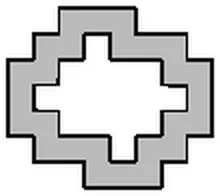
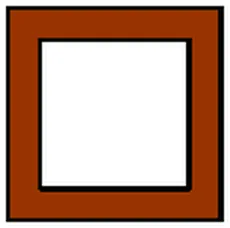
6. The diagram shows a single floor tile in which the outer square has side 8 cm and the inner square has side 6 cm. If Adam Ant walks once around the perimeter of the inner square and Annabel Ant walks once around the perimeter of the outer square, how much further does Annabel walk than Adam?
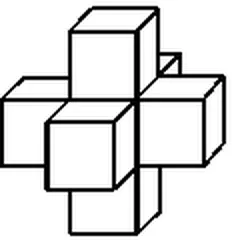
12. The sculpture ‘Cubo Vazado’ [Emptied Cube] by the Brazilian artist Franz Weissmann is formed by removing cubical blocks from a solid cube to leave the symmetrical shape shown. If all the edges have length 1, 2 or 3, what is the volume of the sculpture?
Consider the sculpture to consist of three layers, each of height 1. Then the volumes of the bottom, middle and top layers are 5, 2, 5 respectively. So the volume of the sculpture is 12. (Alternatively: the sculpture consists of a 3 × 3 × 3 cube from which two 2 × 2 × 2 cubes have been removed. The 2 × 2 × 2 cubes have exactly one 1 × 1 × 1 cube (the cube at the centre of the 3 × 3 × 3 cube) in common. So the volume of the sculpture = 27 − (2 × 8 − 1) = 12.)
14. A solid wooden cube is painted blue on the outside. The cube is then cut into eight smaller cubes of equal size. What fraction of the total surface area of these new cubes is blue?
As the original cube was divided into eight cubes of equal size, these smaller cubes have side equal to half the side of the original cube. So each of the new cubes originally occupied one corner of the large cube and hence has three faces painted blue and three faces unpainted. So the fraction of the total surface area of the new cubes which is blue equals one half.
25. A large square is divided into adjacent pairs of smaller squares with integer sides, as shown in the diagram (which is not drawn to scale). Each size of smaller square occurs only twice. The shaded square has sides of length 10. What is the area of the large square?
Let the lengths of the sides of the squares, in increasing order, be \(a, b, c, d, e, f, g, h, i\) respectively. So \(h = 10\). Note that \(c = 2b - a\) and \(d = 2c - 2a = 4b - 4a\). Also, \(e = 2d - a = 8b - 9a\). As \(h = 2e - 2a - b = 15b - 20a\), we may deduce that \(15b - 20a = 10\), that is \(3b - 4a = 2\). Since \(a\) and \(b\) are positive integers less than 10, the only possibilities are \(a = 1\), \(b = 2\) or \(a = 4\),\(b = 6\). However, \(h = 10\) therefore \(b\) cannot be greater than 4. So \(a = 1\) and \(b = 2\). It may now be deduced that \(c = 4 - 1 = 3\);\(d = 8 - 4 = 4\);\(e = 16 - 9 = 7\). Also \(2g = 2e + d\), so \(g = 9\). Now the length of the side of the larger square is \(2h + e + g = 20 + 7 + 9 = 36\), so its area is \(36^2 = 1296\). (Note that it was not necessary to find the values of f and i, but it is now quite simple to deduce that f = 8 and i = 18.)
The area of the large square may be considered to consist of thirteen equal squares (nine of which are shaded) plus eight ‘half squares’ and four ‘quarter squares’ (all of which are unshaded). So the total unshaded area is (4 + 8 × \(\tfrac{1}{2}\) + 4 × \(\tfrac{1}{4}\)) squares = 9 squares. Hence half of the large square is shaded.
The thickness of the line is 0.2 mm, that is 0.0002 m. So, in order to cover an area of one square metre, the length of the line would need to be \(\dfrac{1}{0.0002}\) m, that is 5000 m.
17. Just William's cousin, Sweet William, has a rectangular block of fudge measuring 2 inches by 3 inches by 6 inches. He wants to cut the block up into cubes whose side lengths are whole numbers of inches. What is the smallest number of cubes he can obtain?
The only possible cubes have edge size 1 or 2. It takes 8 of the former to replace one of the latter, so William needs to cut as many cubes of edge size 2 as possible, namely 3. The number of one inch cubes, therefore, is 2 × 3 × 6 − 3 × 8, that is 12. So the smallest number of cubes is 3 + 12 = 15.
19. The points \(P\),\(Q\),\(R\), \(S\) lie in order along a straight line, with \(PQ = QR = RS = 2\) cm. Semicircles with diameters \(PQ\),\(QR\), \(RS\) and \(SP\) join to make the shape shown on the right. What, in cm2, is the area of the shape?
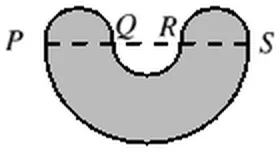
If the semicircle with diameter \(PQ\) is rotated through 180° about \(Q\), the new shape formed has the same area as the original shape. It consists of a semicircle of diameter 6 cm and a semicircle of diameter 2 cm. So its area is \((\tfrac{1}{2} \times \pi \times 3^2 + \tfrac{1}{2} \times \pi \times 1^2)\) cm2, that is \(5\pi\) cm2.
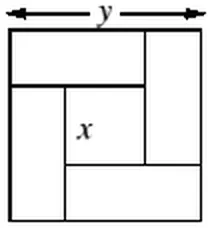
23. The diagram shows a square with sides of length \(y\) divided into a square with sides of length \(x\) and four congruent rectangles. What is the length of the longer side of each rectangle?
Let the length of the longer side of each rectangle be \(l\). Then the length of each shorter side is \(l - x\). So \(y = l + l - x\) and hence \(l = \tfrac{1}{2}(y + x)\).
14. In the rules of Association Football, Law 1 states that the field of play must be rectangular and have length from 100 to 130 yards, and width from 50 to 100 yards. What is the difference in area between the smallest possible field of play and the largest possible field of play?
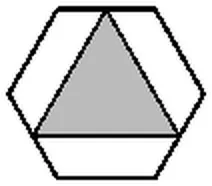
16. The diagram shows an equilateral triangle with its corners at the mid-points of alternate sides of a regular hexagon. What fraction of the area of the hexagon is shaded?
The diagram shows that the regular hexagon may be divided into six congruent equilateral triangles, each of which may be further divided into four smaller congruent equilateral triangles. So the hexagon consists of 24 congruent triangles, 9 of which make up the shaded equilateral triangle.
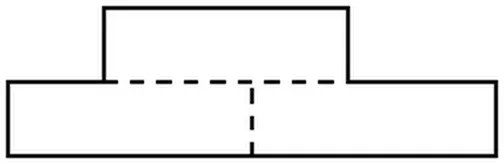
19. Two identical rectangular cards are glued together as shown to form an 'L' shape. The perimeter of this 'L' shape is 40 cm. What is the ratio of the lengths of the sides of one of the original cards?
Let the length and breadth of one of the original cards be \(l\) and \(b\) respectively. Then the lengths of the six sides of the ‘L’ shape (moving clockwise from the bottom left-hand corner) are \(l\),\(b\),\(l - b\),\(l - b\),\(b\), \(l\) respectively. So \(2l + 2b + 2(l - b) = 40\), that is \(4l = 40\). We may deduce, therefore, that \(l\) is 10, but there is insufficient information for us to find the ratio \(b : l\).
The original pyramid had 8 edges. Cutting off the top corner adds 4 edges, whilst cutting off the other 4 corners adds 3 extra edges in each case. So the total number of edges is 8 + 4 + 4 × 3 = 24.
18. A shape consisting of 2004 small squares is made by continuing the pattern shown in the diagram. The small squares have sides of length 1 cm. What is the length, in cm, of the perimeter of the whole shape?
Each of the 2004 squares, apart from those at the top and bottom of the shape, contributes 2 cm to the perimeter of the figure. The other two squares contribute 3 cm each, so the perimeter is (2002 × 2 + 2 × 3) cm = 4010 cm.
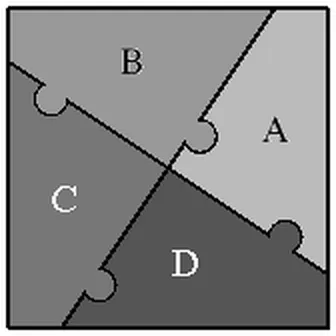
In total, the five pieces have four “holes” and six “tabs”, so we can deduce that either B or E, both of which have two “tabs”, will not be used. Shape A, therefore, is used and, after a clockwise rotation of 90°, will fit together with shape B. This suggests that it is shape E which is not used and shapes C and D will indeed complete the jigsaw after rotations of 90° and 180° anticlockwise respectively.
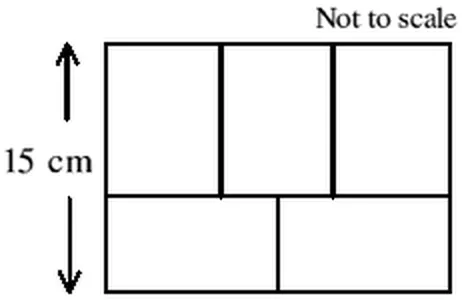
Let the length and breadth of each of the rectangles be \(a\) cm and \(b\) cm respectively. Then \(2a = 3b\) and \(a + b = 15\). So \(2a + 2b = 30\). Therefore \(3b + 2b = 30\), that is \(b = 6\). So the total area covered by the five rectangles is that of a rectangle measuring 18 cm by 15 cm, i.e. 270 cm2.
We'd like to use Google Analytics cookies to count visits and see which pages help most. They're optional, and the site works exactly the same either way. Privacy policy







 shape. Although \(x\) is not given, it is clear that