The whole Junior Mathematical Challenge 2006 paper, one question at a time in order (25 questions). Press Mark as done after each one: your marks add up below.
3. Among the children in a certain family, each child has at least one brother and at least one sister. What is the smallest possible number of children in the family?
There must be at least two boys and two girls in the family. If, for example, there was exactly one boy, then that child would not have a brother. The same argument applies to girls.
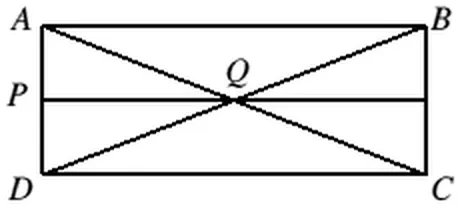
There are 4 triangles congruent to \(\Delta AQP\) (including \(\Delta AQP\) itself), 2 triangles congruent to \(\Delta AQB\), 2 triangles congruent to \(\Delta AQD\), 4 triangles congruent to \(\Delta ACD\).
5. Euclid Gardens has 123 houses in it, numbered consecutively from 1 to 123. Houses 29 to 37 inclusive are knocked down to make space for a multi-storey car park. How many houses remain in Euclid Gardens?
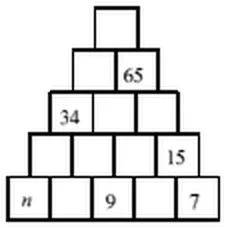
6. Each block shown in this tower is to have a number displayed on it. Some are already done. For each block above the bottom row, the number on it should be the sum of the numbers on the two blocks it stands upon. What number should replace \(n\)?
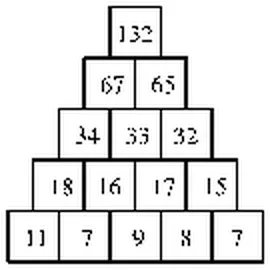
The completed tower is shown on the right. There is more than one order in which missing numbers may be inserted – and it is not necessary to complete the tower in order to determine \(n\) – but one possible order is 8, 17, 32, 33, 16, 7, 18, 11, 67, 132.
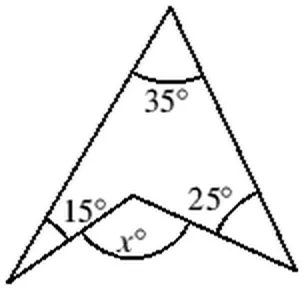
Let the size of the reflex angle in the quadrilateral be \(y\)°. Then \(x + y = 360\) (angles at a point). Furthermore, \(35 + 15 + 25 + y = 360\) (sum of interior angles of a quadrilateral). So \(x = 35 + 15 + 25\).
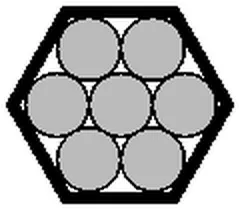
10. The diagram shows 7 identical coins which fit exactly inside a wooden frame. As a result each coin is prevented from sliding. What is the largest number of coins that may be removed one by one so that, at each stage, each remaining coin is still unable to slide?
Note that you cannot remove two touching coins; for if you did then any coin making a triangle with those two coins could then slide. So if the middle coin was removed, no other coin could then be removed. So next consider removing first an outer coin. There are two outer coins touching it – which, as argued before, cannot now be removed. We consider two cases. If the next coin to go is that opposite the coin already removed, then each remaining coin is adjacent to a removed coin – and the process stops. Finally, suppose the next coin removed is next but one (around the outer edge) from the first removed coin. Then a third coin, two further around the edge, is the only possibility for removal – and then the process halts again. So the largest number of coins that may be removed is three.
11. Travelling by train from Edinburgh to London, I passed a sign saying “London 150 miles”. After 7 more miles, I passed another sign saying “Edinburgh 250 miles”. How far is it by train from Edinburgh to London?
13. At the end of a hard day at the mine, the seven dwarves share out all their gold nuggets, making sure that they each get the same number of nuggets. If there are any left over, they are given to Snow White. Which number of nuggets would leave Snow White with the most?
14. In the rules of Association Football, Law 1 states that the field of play must be rectangular and have length from 100 to 130 yards, and width from 50 to 100 yards. What is the difference in area between the smallest possible field of play and the largest possible field of play?
6957 is less than 7000 and 31248 is greater than 28000, so \(\dfrac{6957}{31248} < \dfrac{1}{4}\). It is left as an exercise for the reader to confirm that in the other four fractions the denominator is four times the numerator. (Note that each of these fractions uses all the digits from 1 to 9 inclusive exactly once. The question includes the only four fractions of this type which simplify to \(\tfrac{1}{4}\).)
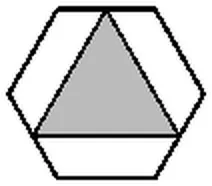
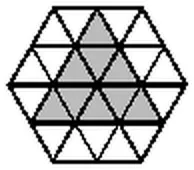
16. The diagram shows an equilateral triangle with its corners at the mid-points of alternate sides of a regular hexagon. What fraction of the area of the hexagon is shaded?
The diagram shows that the regular hexagon may be divided into six congruent equilateral triangles, each of which may be further divided into four smaller congruent equilateral triangles. So the hexagon consists of 24 congruent triangles, 9 of which make up the shaded equilateral triangle.
Clearly, there must be a minimum of two ‘on’ switches. Two ‘on’ switches and three ‘off’ switches may be set in only one way: ‘off’, ‘on’, ‘off’, ‘on’, ‘off’. Three ‘on’ switches and two ‘off’ switches may be set in six different ways. Four ‘on’ switches and one ‘off’ switch may be set in five different ways. Finally, five ‘on’ switches can be set in just one way. So there are 13 ways in all. (Note: it is left as an exercise for the reader to show that if that there are n switches then the number of different ways in which they may be set so that no two adjacent switches are in the ‘off’ position is the (n + 2)th term of the Fibonacci sequence 1, 1, 2, 3, 5, 8, 13, 21, 34, …)
18. In this magic square, which uses all whole numbers from 7 to 15 inclusive, each of the rows, columns and the two main diagonals has the same total. Which number replaces \(n\) in the completed square?
The total of the numbers in the magic square is 7 + 8 + 9 + …15, that is 99. So each row, column and main diagonal has sum 33 and we deduce that the number in the top right hand corner of the square is 12. The remaining blank squares may now be completed in terms of \(n\), as shown. Considering the middle row: \(31 - 2n + 19 - n + 7 = 33\), so \(n = 8\). Alternate solution: it is known that the number in the centre of a magic square is always equal to the mean of the nine numbers making up the square, in this case 11. So \(n = 33 - 14 - 11 = 8\).
19. Pinocchio's nose is 5 cm long. Each time he tells a lie his nose doubles in length. After he has told nine lies, his nose will be roughly the same length as a:
After Pinocchio has told 9 lies, the length of his nose will be 29 × 5 cm = 512 × 5 cm = 25.6 m. This is close to the length of a tennis court, which is 23.8 m.
As 2 is the only even prime, it must be one of the three primes which total 40 since any three odd numbers have an odd total. So the other two primes sum to 38. Different odd numbers which total 38 are (1, 37), (3, 35), (5, 33), (7, 31), (9, 29), (11, 27), (13, 25), (15, 23), (17, 21). Of these pairs, only (7, 31) consists of two primes, so the required difference is 24.
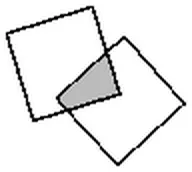
If the overlapping region is a triangle, two of its sides must be adjacent sides of one of the squares. So one of its angles will be a right angle and therefore an equilateral triangle could not appear as the overlapping region. The diagrams show how the other options could appear as the overlapping region.
22. A positive whole number less than 100 has remainder 2 when it is divided by 3, remainder 3 when it is divided by 4 and remainder 4 when it is divided by 5. What is its remainder when it is divided by 7?
The number is 1 less than a multiple of 3, 1 less than a multiple of 4 and also 1 less than a multiple of 5. So, since 3, 4 and 5 have no factors in common, it is 1 less than a multiple of the product of 3, 4 and 5, that is 1 less than a multiple of 60. As it is less than 100, the only possibility is 59, which leaves remainder 3 when divided by 7. (Note that the Chinese Remainder Theorem provides a general method for solving problems like this.)
Let the number of girls at the camp be \(x\). Then there are \(\dfrac{3x}{4}\) boys and \(\dfrac{7x}{5}\) adults. So the ratio of children to adults is \(\tfrac{7x}{4} : \tfrac{7x}{5}\), that is 5:4.
24. Amrita has written down four whole numbers. If she chooses three of her numbers at a time and adds up each triple, she obtains totals of 115, 153, 169 and 181. What is the largest of Amrita's numbers?
The total of the four triples is three times the total of the original four numbers. So these numbers have sum (115 + 153 + 169 + 181) ÷ 3, that is 206. Hence the largest of Amrita's numbers is 206 − 115, that is 91.
If \(\tfrac{1}{2}n\) is a three-digit whole number, then \(n\) is an even number between 200 and 1998 inclusive. If \(2n\) is a three-digit whole number, then \(n\) is a whole number between 50 and 499 inclusive. So for both conditions to hold, \(n\) is an even number between 200 and 499 inclusive and there are 150 such numbers.
We'd like to use Google Analytics cookies to count visits and see which pages help most. They're optional, and the site works exactly the same either way. Privacy policy