The whole Junior Mathematical Challenge 2015 paper, one question at a time in order (25 questions). Press Mark as done after each one: your marks add up below.
The values of the expressions are: A 6, B 4, C 2, D −4, E 0. (Alternative method: since every expression contains the integers 1, 2, 3 and 4, the expression which has the largest value is that in which the sum of the integers preceded by a minus sign is smallest. This is expression A.)
At 22:22, there are 60 − 22 = 38 minutes to 23:00. There are then a further 60 minutes to midnight. So the number of minutes which remain until midnight is 38 + 60 = 98.
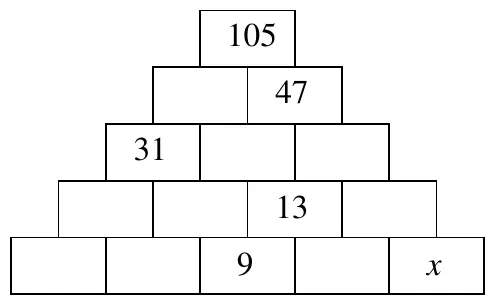
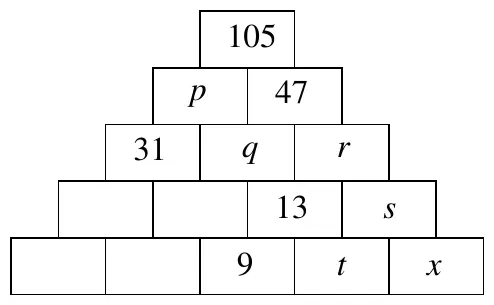
The calculations required to find the value of \(x\) are: \(p = 105 - 47 = 58\);\(q = p - 31 = 58 - 31 = 27\); \(r = 47 - q = 47 - 27 = 20\); \(s = r - 13 = 20 - 13 = 7\);\(t = 13 - 9 = 4\); \(x = s - t = 7 - 4 = 3\). (Note that the problem may be solved without finding the values of four of the numbers in the pyramid. Finding these is left as an exercise for the reader.)
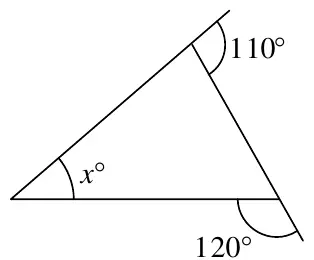
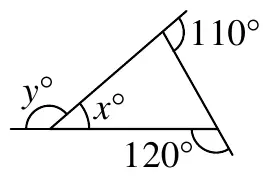
The sum of the exterior angles of any polygon is 360°. So \(y = 360 - (110 + 120) = 360 - 230 = 130\). The sum of the angles on a straight line is 180°, so \(x = 180 - y = 180 - 130 = 50\).
7. The result of the calculation 123 456 789 × 8 is almost the same as 987 654 321 except that two of the digits are in a different order. What is the sum of these two digits?
The units digit of 123 456 789 × 8 is 2, since 9 × 8 = 72. So, if the statement in the question is correct then the two digits which are in a different order are 1 and 2, whose sum is 3. As a check, 123 456 789 × 8 is indeed 987 654 312.
All of the options are odd and therefore give a remainder of 1 when divided by 2. Two of the options, 3 and 9, give remainder 0 when divided by 3. Two other options, 5 and 11, give remainder 2 when divided by 3, and 7 is the only option which gives remainder 1 when divided by 3.
9. According to a newspaper report, “A 63-year-old man has rowed around the world without leaving his living room.” He clocked up 25 048 miles on a rowing machine that he received for his 50th birthday. Roughly how many miles per year has he rowed since he was given the machine?
The man has rowed the equivalent of just over 25 000 miles in approximately 13 years. So the mean number of ‘miles’ rowed per year is approximately \(\dfrac{25\,000}{13} \approx \dfrac{26\,000}{13} = 2000\).
10. In the expression 1 □ 2 □ 3 □ 4 each □ is to be replaced by either + or ×. What is the largest value of all the expressions that can be obtained in this way?
If \(m\) and \(n\) are positive integers, then \(mn > m + n\) unless at least one of \(m\) or \(n\) is equal to 1, or \(m = n = 2\). So, to maximise the expression, we need to place multiplication signs between 2 and 3 and between 3 and 4. However, we need to place an addition sign between 1 and 2 because 1 + 2 × 3 × 4 = 25, whereas 1 × 2 × 3 × 4 = 24.
It can be established that 2 is not one of the three primes to be summed since the sum of 2 and two other primes is an even number greater than 2 and therefore not prime. The smallest three odd primes are 3, 5, 7 but these sum to 15 which is not prime. The next smallest sum of three odd primes is 3 + 5 + 11 = 19, which is prime. So 19 is the smallest prime which is the sum of three different primes.
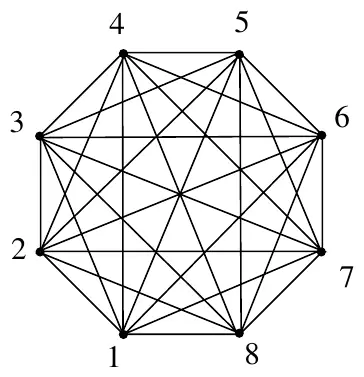
We denote the label joining \(m\) and \(n\) as \((m + n)\). The labels which are multiples of 3 are (1 + 2), (1 + 5), (1 + 8), (2 + 4), (2 + 7), (3 + 6), (4 + 5), (4 + 8), (5 + 7), (7 + 8). So 10 of the labels are multiples of 3.
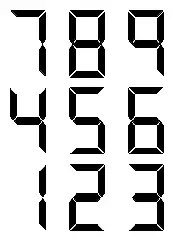
14. Digits on a calculator are represented by a number of horizontal and vertical illuminated bars. The digits and the bars which represent them are shown in the diagram. How many digits are both prime and represented by a prime number of illuminated bars?
The primes and the number of illuminated bars which represent them are: 2 → 5, 3 → 5, 5 → 5, 7 → 3. So all four prime digits are represented by a prime number of illuminated bars.
Of the options given, 23 × 34, 56 × 67 and 67 × 78 are all not divisible by 5, so may be discounted. Also 34 is not divisible by 4 and 45 is odd, so 34 × 45 may also be discounted as it is not divisible by 4. The only other option is 45 × 56. As a product of prime factors, \(45 \times 56 = 2^3 \times 3^2 \times 5 \times 7\), so it is clear that it is divisible by all of the integers from 1 to 10 inclusive.
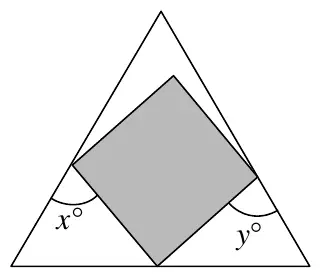
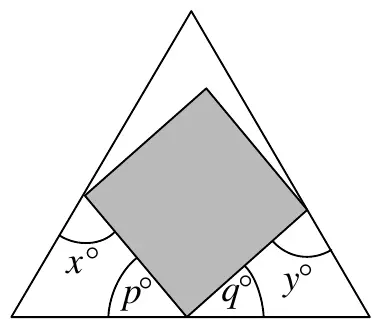
The size of each interior angle of an equilateral triangle is 60°. As the sum of the interior angles of a triangle is 180°, \(x + p + 60 = 180\), so \(p = 120 - x\). Similarly, \(q = 120 - y\). Each interior angle of a square is a right angle and the sum of the angles on a straight line is 180°, so \(p + q + 90 = 180\). Therefore \(120 - x + 120 - y + 90 = 180\), that is \(330 - (x + y) = 180\). So \(x + y = 330 - 180 = 150\).
Knave of Hearts: “I stole the tarts.” Knave of Clubs: “The Knave of Hearts is lying.” Knave of Diamonds: “The Knave of Clubs is lying.” Knave of Spades: “The Knave of Diamonds is lying.”
How many of the four Knaves were telling the truth?
If the Knave of Hearts is telling the truth then the Knave of Clubs is lying, which means that the Knave of Diamonds is telling the truth, but the Knave of Spades is lying. Alternatively, if the Knave of Hearts is lying then the Knave of Clubs is telling the truth, which means that the Knave of Diamonds is lying, but the Knave of Spades is telling the truth. In both cases, we can determine that two of the Knaves are lying, although it is not possible to determine which two they are.
18. Each of the fractions \(\dfrac{2637}{18\,459}\) and \(\dfrac{5274}{36\,918}\) uses the digits 1 to 9 exactly once. The first fraction simplifies to \(\dfrac{1}{7}\). What is the simplified form of the second fraction?
The first six positive cubes are 1, 8, 27, 64, 125, 216. Clearly, 64 cannot be the sum of three positive cubes as the sum of all the positive cubes smaller than 64 is 1 + 8 + 27 = 36. Similarly, 125 cannot be the sum of three positive cubes as the largest sum of any three positive cubes smaller than 125 is 8 + 27 + 64 = 99. However, we note that 27 + 64 + 125 = 216, so 216 is the smallest cube which is the sum of three positive cubes.
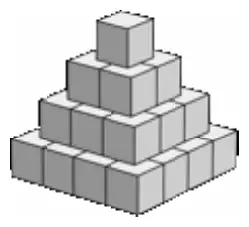
20. The diagram shows a pyramid made up of 30 cubes, each measuring 1 m × 1 m × 1 m. What is the total surface area of the whole pyramid (including its base)?
When the pyramid is viewed from above, it can be seen that the total area of the horizontal part of the surface of the pyramid (excluding its base) is the same as that of a square of side 4 metres, that is 16 m2. The area of the base of the pyramid is also 16 m2. Finally the total area of the vertical part of the pyramid is equal to (4 × 1 + 4 × 2 + 4 × 3 + 4 × 4) m2 = 40 m2. So the total surface area of the pyramid is (16 + 16 + 40) m2 = 72 m2.
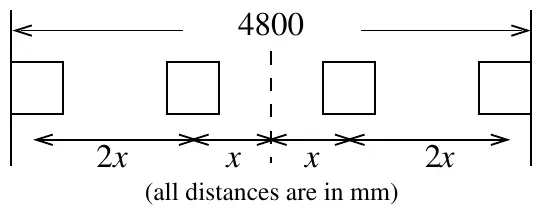
21. Gill is now 27 and has moved into a new flat. She has four pictures to hang in a horizontal row on a wall which is 4800 mm wide. The pictures are identical in size and are 420 mm wide. Gill hangs the first two pictures so that one is on the extreme left of the wall and one is on the extreme right of the wall. She wants to hang the remaining two pictures so that all four pictures are equally spaced. How far should Gill place the centre of each of the two remaining pictures from a vertical line down the centre of the wall?
The diagram shows part of the wall of width 4800 mm and the four equally spaced pictures, each of width 420 mm. Let \(x\) be the required distance, that is the distance from the centre of each of the two pictures in the middle of the wall to a vertical line down the centre of the wall (marked by a broken line). Then the distance between the centres of any two adjacent pictures is \(2x\). Note that the distance between the centres of the two pictures on the extremes of the wall is (4800 − 2 × 210) mm = 4380 mm. Therefore \(2x + x + x + 2x = 4380\). So \(x = 4380 \div 6 = 730\). Hence the required distance is 730 mm.
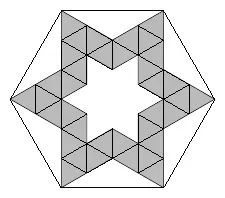
22. The diagram shows a shaded region inside a regular hexagon. The shaded region is divided into equilateral triangles. What fraction of the area of the hexagon is shaded?
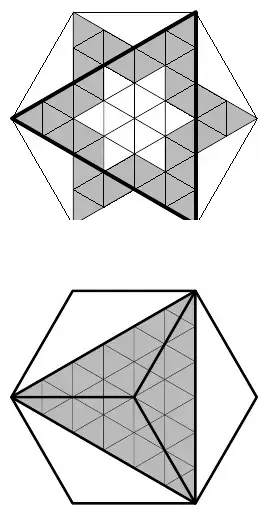
In the diagram, the shaded small equilateral triangles have been divided into those which lie within the highlighted large equilateral triangle and the twelve small equilateral triangles which lie outside the large triangle. Note that the unshaded star shape in the centre of the large triangle is made up of twelve small equilateral triangles, so the small triangles outside the large triangle could be moved into the large triangle so that the large triangle is shaded completely and the rest of the hexagon is unshaded as in the lower diagram. The lower diagram shows that the hexagon may be divided into six congruent triangles, three of which are shaded and three of which are unshaded. So the required fraction is \(\tfrac{1}{2}\).
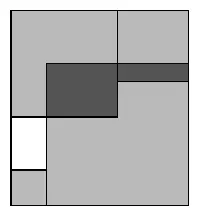
23. The diagram shows four shaded glass squares, with areas 1 cm2, 4 cm2, 9 cm2 and 16 cm2, placed in the corners of a rectangle. The largest square overlaps two others. The area of the region inside the rectangle but not covered by any square (shown unshaded) is 1.5 cm2. What is the area of the region where squares overlap (shown dark grey)?
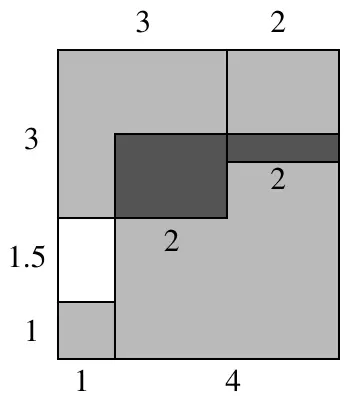
The diagram shows some of the lengths of sides which may be deduced from the information given in the question. Note that the rectangle measures 5 cm by 5.5 cm. The sum of the areas of the four glass squares is (1 + 4 + 9 + 16) cm2 = 30 cm2. However, the total region of the rectangle occupied by the four squares is equal to (5 × 5.5 − 1.5) cm2 = 26 cm2. So the area of the overlap is (30 − 26) cm2 = 4 cm2.
24. A palindromic number is a number that reads the same when the order of its digits is reversed. What is the difference between the largest and smallest five-digit palindromic numbers that are both multiples of 45?
For a number to be a multiple of 45 it must be a multiple of 5 and also of 9. In order to be a multiple of 5, a number's units digit must be 0 or 5. However, the units digit of a palindromic number cannot be 0, so it may be deduced that any palindromic number which is a multiple of 45 both starts and ends in the digit 5. In order to make the desired number as large as possible, its second digit should be 9 and for it to be as small as possible its second digit should be 0. So, if possible, the numbers required are of the form ‘59\(x\)95’ and ‘50\(y\)05’. In addition, both numbers are to be multiples of 9 which means the sum of the digits of both must be a multiple of 9. For this to be the case, \(x = 8\) and \(y = 8\), giving digit sums of 36 and 18 respectively. So the two required palindromic numbers are 59895 and 50805. Their difference is 9090.
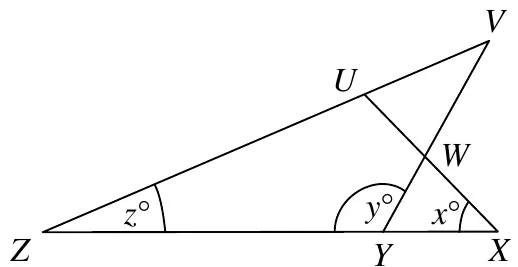
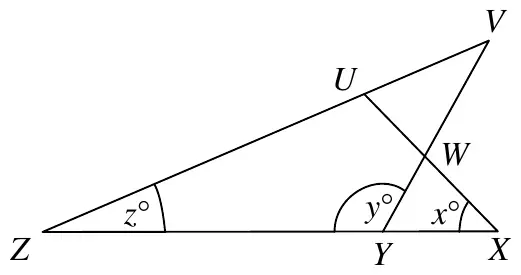
25. The four straight lines in the diagram are such that \(VU = VW\). The sizes of \(\angle UXZ\), \(\angle VYZ\) and \(\angle VZX\) are \(x°\), \(y°\) and \(z°\). Which of the following equations gives \(x\) in terms of \(y\) and \(z\)?
The exterior angle of a triangle is equal to the sum of its two interior and opposite angles. Applying this theorem to triangle \(UZX\): \(\angle VUW = z° + x°\). Similarly, in triangle \(WYX\):\(y° = \angle XWY + x°\), so \(\angle XWY = y° - x°\). As \(VU = VW\), \(\angle VUW = \angle VWU\) and also \(\angle VWU = \angle XWY\) because they are vertically opposite angles. Therefore \(\angle VUW = \angle XWY\). So \(z° + x° = y° - x°\) and hence \(x = \tfrac{1}{2}(y - z)\).
We'd like to use Google Analytics cookies to count visits and see which pages help most. They're optional, and the site works exactly the same either way. Privacy policy