The whole Junior Mathematical Challenge 2004 paper, one question at a time in order (25 questions). Press Mark as done after each one: your marks add up below.
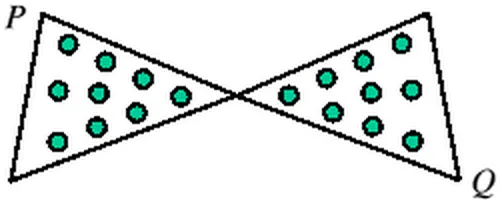
4. A ladybird has landed at point \(P\) on Sam's bow-tie. If it travels only along the edges of the bow-tie, but cannot travel along any edge more than once, how many different ways are there for it to get from \(P\) to \(Q\)?
Every allowable route must pass through the centre point of the bow tie. There are two routes from \(P\) to the centre point, and for each of these there are two routes from the centre point to \(Q\). So the total number of different routes = 2 × 2 = 4.
5. The word ‘thirty’ contains 6 letters and 6 = 30 ÷ 5. Similarly, the word ‘forty’ contains 5 letters and 5 = 40 ÷ 8. Which of the following is not a multiple of the number of letters it contains?
Eighteen has 8 letters and 18 is not a multiple of 8. Of the other options, 6 is a multiple of 3, 12 is a multiple of 6, 70 is a multiple of 7 and 90 is a multiple of 6.
The differences between the given fractions and 1 are, respectively, \(\tfrac{11}{23}\),\(\tfrac{11}{34}\),\(\tfrac{11}{45}\), \(\tfrac{11}{56}\) and \(\tfrac{11}{67}\). The smallest of these is \(\tfrac{11}{67}\), so \(\tfrac{56}{67}\) is nearest to 1.
7. In music, a demisemiquaver is half of half of half a crotchet, and there are four crotchets in a semibreve. How many demisemiquavers are there in a semibreve?
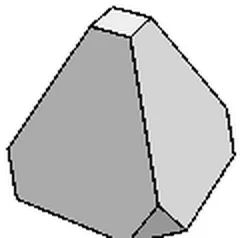
The original pyramid had 8 edges. Cutting off the top corner adds 4 edges, whilst cutting off the other 4 corners adds 3 extra edges in each case. So the total number of edges is 8 + 4 + 4 × 3 = 24.
9. The Bean family are very particular about beans. At every meal all Beans eat some beans. Pa Bean always eats more beans than Ma Bean but never eats more than half the beans. Ma Bean always eats the same number of beans as both children together and the two children always eat the same number of beans as each other. At their last meal they ate 23 beans altogether. How many beans did Pa Bean eat?
Pa Bean does not eat more than half the beans, so he eats at most 11 beans. Ma Bean eats the same number of beans as both children together, so she eats an even number of beans which is at least one quarter of the total number of beans eaten. Therefore she eats at least 6 beans. If she does eat 6 beans, then Pa Bean eats 11 beans, which is consistent with the information given. However, if Ma Bean eats 8 or more beans, then Pa Bean eats at most 7 beans and this is impossible as we are told that Pa Bean eats more beans than Ma Bean. So Pa Bean eats 11 beans.
10. When Harry bought his train ticket he received £2.50 in change. He noticed that for each coin in his change there was exactly one other coin of the same value. What was the coin of smallest value in Harry's change?
The coins consisting of one of each type must add up to £1.25. The only way that this total may be made with coins of different denominations is by using a £1 coin, a 20p coin and a 5p coin.
11. The diagram shows a rod with five equally spaced points \(A\),\(B\),\(C\), \(D\) and \(E\) marked on it.
The rod is rotated three times through 180 degrees, first about \(A\), then about \(B\) and finally about \(E\). Which point finishes in the same position as it was at the start?
The diagram shows the positions of the points after the rotations. Note that \(A_1\), which is not marked, is the same point as \(A\). Similarly, \(E_3\), which is not marked, is the same point as \(E_2\).
12. The White Rabbit has an appointment to see the Red Queen at 4pm every day apart from weekends. On Monday, he arrives 16 minutes late. Each day after that he hurries more and more and so manages to halve the amount of time that he arrives late each day. On what day of the week does he arrive just 15 seconds late?
On Tuesday the White Rabbit will be 8 minutes late, on Wednesday 4 minutes late, on Thursday 2 minutes late and on Friday 1 minute late. So on the following Monday the White Rabbit will be 30 seconds late and on the day after that he will be 15 seconds late.
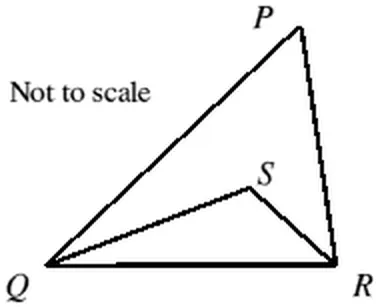
13. In the triangle \(PQR\), the angle \(QPR\) = 40° and the internal bisectors of the angles at \(Q\) and \(R\) meet at \(S\), as shown. What is the size of angle \(QSR\)?
14. The Kings of Clubs, Diamonds, Hearts and Spades, and their respective Queens, are having an arm wrestling competition. Everyone must wrestle everyone else, except that no King will wrestle his own Queen. How many wrestling bouts are there?
The 8 individuals will each wrestle 6 others. This suggests that the number of bouts is 8 × 6 = 48. However, each bout has been counted twice in this calculation, so the number of bouts is 48 ÷ 2 = 24.
15. Granny spends one third of her weekly pension on Thursday night, and one quarter of what remains on Friday. What fraction of the original amount is left for her big night out on Saturday?
After Thursday, two thirds of Granny's pension is left. So after she has spent one quarter of this amount on Friday, the fraction of the original amount which remains is three quarters of two thirds, i.e. one half.
16. A robot, which is initially facing North, is programmed to travel 5 m then turn through 10°, travel 5 m then turn through 20°, travel 5 m then turn through 30°, and so on. Each move consists of moving 5 m in a straight line and then turning clockwise through an angle which increases by 10° at each move. How far has it travelled by the time it is first facing due East at the end of a move?
The total angle turned through after each of the first 4 moves is 10°, 30°, 60° and 100°. So the robot does not face due East at the end of a move in its first complete revolution. The total angle it has turned through after each of the next 5 moves is 150°, 210°, 280°, 360° and 450°, so at the end of the 9th move the robot does face due East. As the robot moves 5 m in each move, the distance it travels is 45 m. Note that this solution assumes that the robot is not starting the process close to the North Pole!
Statements such as those in this question may sometimes be shown to be false by considering the units digit of the expressions on each side. The units digit of 442 + 772 is 5; the units digit of 552 + 662 and hence also of 662 + 552 is 1; the units digit of 882 + 332 is 3 and that of 992 + 222 is 5. So four of the statements are definitely false. It remains to check that 882 + 332 = 7744 + 1089 = 8833.
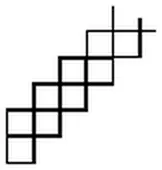
18. A shape consisting of 2004 small squares is made by continuing the pattern shown in the diagram. The small squares have sides of length 1 cm. What is the length, in cm, of the perimeter of the whole shape?
Each of the 2004 squares, apart from those at the top and bottom of the shape, contributes 2 cm to the perimeter of the figure. The other two squares contribute 3 cm each, so the perimeter is (2002 × 2 + 2 × 3) cm = 4010 cm.
From the three equations we see that \((abc)^2 = 2 \times 24 \times 3 = 144\) and so, since \(abc\) is positive, \(abc = 12\). Then the third equation tells us that \(a = \tfrac{1}{2}\), the second that \(b = 4\) and the first that \(c = 6\). Therefore \(a + b + c = 10\tfrac{1}{2}\).
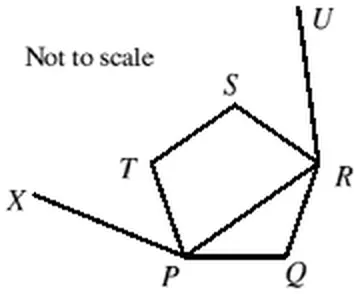
20. The figure shows a regular pentagon \(PQRST\) together with three sides \(XP\),\(PR\), \(RU\) of a regular hexagon with vertices \(PRUVWX\). What is the size of angle \(SRU\)?
As \(PQRST\) is a regular pentagon, each of its internal angles is 108°. The internal angles of the quadrilateral \(PRST\) add up to 360° and so by symmetry \(\angle PRS = \angle RPT = \tfrac{1}{2}(360^\circ - 2 \times 108^\circ) = 72^\circ\). Each interior angle of a regular hexagon is 120°, so \(\angle PRU = 120^\circ\). Therefore \(\angle SRU = \angle PRU - \angle PRS = 120^\circ - 72^\circ = 48^\circ\).
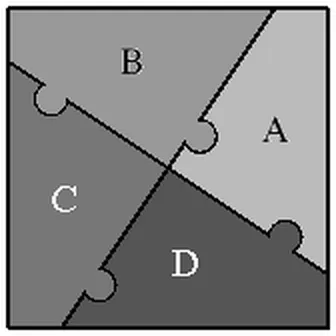
In total, the five pieces have four “holes” and six “tabs”, so we can deduce that either B or E, both of which have two “tabs”, will not be used. Shape A, therefore, is used and, after a clockwise rotation of 90°, will fit together with shape B. This suggests that it is shape E which is not used and shapes C and D will indeed complete the jigsaw after rotations of 90° and 180° anticlockwise respectively.
22. The digits in the product 13 × 2 = 26 can be rearranged to give 16 × 2 = 32 as well as 31 × 2 = 62. In which one of the following can the digits not be rearranged to give another correct product?
Consider the thousands column. The letters represent different digits so, as \(S\) is 3, \(M\) is 2 and there is a carry of 1 from the hundreds column. Therefore \(A\) is 9, \(U\) is 0 and there is also a carry of 1 from the tens column. In the units column, \(O + Y\) produces a units digit of 3, so \(O + Y = 3\) or \(O + Y = 13\). However, \(O + Y = 3\) requires one of \(O\), \(Y\) to equal zero (impossible as \(U = 0\)) or 2 (also impossible as \(M = 2\)). So \(O + Y = 13\). We can also deduce that \(N\) is 8, since, in the tens column, 1 + 3 + \(N\) = 12. The pairs of digits which produce a sum of 13 are 4 and 9, 5 and 8, 6 and 7. As \(A\) is 9 and \(N\) is 8, the only possible values for \(O\) and \(Y\) are 6 and 7. These are interchangeable, but in both cases \(Y \times O = 42\).
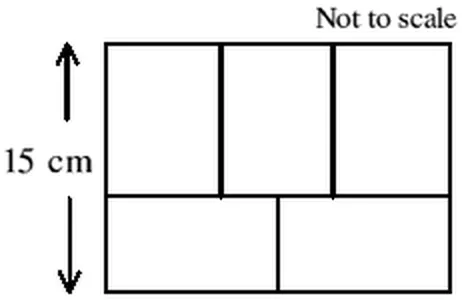
Let the length and breadth of each of the rectangles be \(a\) cm and \(b\) cm respectively. Then \(2a = 3b\) and \(a + b = 15\). So \(2a + 2b = 30\). Therefore \(3b + 2b = 30\), that is \(b = 6\). So the total area covered by the five rectangles is that of a rectangle measuring 18 cm by 15 cm, i.e. 270 cm2.
25. In a sequence of positive integers, every term after the first two terms is the sum of the two previous terms in the sequence. If the fifth term is 2004, what is the maximum possible value of the first term?
Let the first two terms of the sequence be \(a\) and \(b\) respectively. Then the next three terms are \(a + b\),\(a + 2b\),\(2a + 3b\). So \(2a + 3b = 2004\). For \(a\) to be as large as possible, we need \(b\) to be as small as possible, consistent with their both being positive integers. If \(b = 1\) then \(2a = 2001\), but \(a\) is an integer, so \(b \neq 1\). However, if \(b = 2\) then \(2a = 1998\), so the maximum possible value of \(a\) is 999.
We'd like to use Google Analytics cookies to count visits and see which pages help most. They're optional, and the site works exactly the same either way. Privacy policy