72 Junior Mathematical Challenge questions from every year we have, newest year first. Use Difficulty › Position in the paper to practise the early (easier) or late (harder) questions, or the Year filter for one year.
21. The digits of both the two-digit numbers in the first calculation below have been reversed to give the two-digit numbers in the second calculation. The answers to the two calculations are the same.
62 × 13 = 806 26 × 31 = 806
For which one of the calculations below is the same thing true?
It is possible to eliminate certain options by comparing the units digit of the original product with the units digit of the new product. The units digit of 25 × 36 is 0, but the units digit of 52 × 63 is 6. So A is not the correct option. The corresponding units digits for the other options are B: 8 and 2; C: 4 and 5; D: 6 and 6; E: 6 and 2. These calculations suggest that the correct option is D. In confirmation, note that 42 × 48 = 2 × 21 × 2 × 24 = 24 × 2 × 2 × 21 = 24 × 84.
On Aoife’s 16th birthday, Buster was three times her age, that is 48. It is then five years until Aoife’s 21st birthday, so Buster’s age at that time was 48 + 5 = 53.
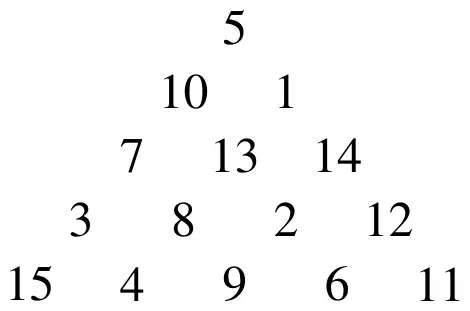
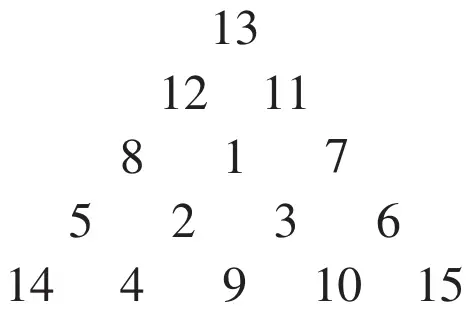
25. The diagram shows the first fifteen positive integers arranged in a ‘triangle’. These numbers are to be rearranged so that the five integers along each ‘edge’ of the triangle have the same sum, unlike the example shown. When this is done, what is the greatest possible such sum?
Note that there are three integers in the centre of the ‘triangle’. For the sum of the integers on each edge to be equal and a maximum, it is preferable for these integers to be 1, 2 and 3. When this is the case, the sum of the remaining integers is \(4 + 5 + 6 + \cdots + 13 + 14 + 15 = 114\). Note that the three integers at the vertices of the triangle contribute to the totals of the integers on two edges of the triangles. So for these three totals to be a maximum, it would be preferable for these integers at the vertices to be 13, 14 and 15. When this is the case, the sum of the integers on the three edges of the triangle is 114 + 13 + 14 + 15 = 156. So, the greatest possible total of the five integers on each edge of the triangle when these totals are equal, is at most \(\dfrac{156}{3} = 52\). The diagram shows that it is possible for the three totals to all equal 52.
2. A train carriage has 80 seats. On my journey I noticed that all the seats in my carriage were taken and 7 people were standing. At Banbury, 9 people left the carriage, 28 people entered it and all seats were taken. How many people now had no seat?
Note that 20 + 18 = 38 and 20 × 18 = 360. So we need to know the number of integers which are greater than 38 and also less than 360, that is the number of integers from 39 to 359 inclusive. This number is 359 − 39 + 1 = 320 + 1 = 321.
9. The approximate cost of restoring the Flying Scotsman was £4 million. This was about 500 times the cost of building the steam engine in 1923. Roughly what did the engine cost to build?
6. In a magic square, the numbers in each row, each column and the two main diagonals have the same total. This magic square uses the integers 2 to 10. Which of the following are the missing cells?
Let the total of each row, column and both diagonals be \(T\). Note that 2 + 3 + 4 + 5 + 6 + 7 + 8 + 9 + 10 = 54. Therefore \(3T = 54\), that is \(T = 18\). It is clear that option D is the only option which makes each row, each column and both diagonals sum to 18.
13. Consider the following three statements. (i) Doubling a positive number always makes it larger. (ii) Squaring a positive number always makes it larger. (iii) Taking the positive square root of a positive number always makes it smaller. Which statements are true?
Statement (i) is true since \(2x > x\) for all \(x > 0\). Statement (ii) is not true. For example, \(\left(\tfrac{1}{2}\right)^2 = \tfrac{1}{4}\), which is not larger than \(\tfrac{1}{2}\). Statement (iii) is also not true. For example, \(\sqrt{\tfrac{1}{9}} = \tfrac{1}{3}\), which is not smaller than \(\tfrac{1}{9}\).
16. In New Threeland there are three types of coins: the 2p; the 5p; and one other. The smallest number of coins needed to make 13p is three. The smallest number of coins needed to make 19p is three. What is the value of the third type of coin?
Since neither 13 nor 19 is a multiple of 3, one couldn't possibly use three copies of a single coin in either case. If two of the extra coins are used, that would be even, so the third coin would need to be the 5p. That would imply the extra coin would have to be a 4p or a 7p to get 13p or 19p respectively. So two of the extra coin are not used. If only one of the extra coin is used, then it would come in addition to 2p + 2p or 2p + 5p or 5p + 5p. To get 13p, you would need 9p or 6p or 3p respectively; and to get 19p you would need 15p or 12p or 9p respectively. Hence 9p is the only possible extra coin which makes both 13p and 19p possible.
9. One of the three symbols +, −, × is inserted somewhere between the digits of 2016 to give a new number. For example, 20 − 16 gives 4. How many of the following four numbers can be obtained in this way?
All four expressions are perfect squares: \(1^3 + 2^3 = 1 + 8 = 9 = 3^2\);\(1^3 + 2^3 + 3^3 = 1 + 8 + 27 = 36 = 6^2\);\(1^3 + 2^3 + 3^3 + 4^3 = 1 + 8 + 27 + 64 = 100 = 10^2\);\(1^3 + 2^3 + 3^3 + 4^3 + 5^3 = 1 + 8 + 27 + 64 + 125 = 225 = 15^2\). (It is not a coincidence that all four expressions are squares: the sum of the cubes of the first n integers is equal to the square of the sum of the first n integers for all positive integers n. For example: \(1^3 = 1^2\);\(1^3 + 2^3 = (1 + 2)^2\);\(1^3 + 2^3 + 3^3 = (1 + 2 + 3)^2\); \(1^3 + 2^3 + 3^3 + 4^3 = (1 + 2 + 3 + 4)^2\) etc.)
The values of the expressions are: A 6, B 4, C 2, D −4, E 0. (Alternative method: since every expression contains the integers 1, 2, 3 and 4, the expression which has the largest value is that in which the sum of the integers preceded by a minus sign is smallest. This is expression A.)
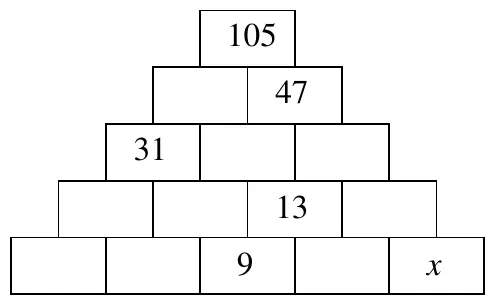
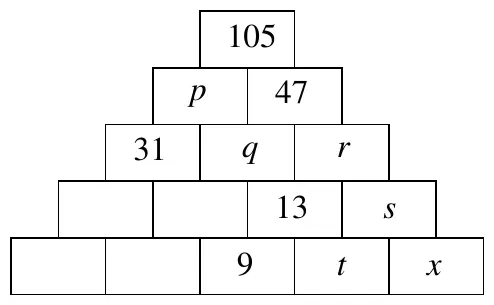
The calculations required to find the value of \(x\) are: \(p = 105 - 47 = 58\);\(q = p - 31 = 58 - 31 = 27\); \(r = 47 - q = 47 - 27 = 20\); \(s = r - 13 = 20 - 13 = 7\);\(t = 13 - 9 = 4\); \(x = s - t = 7 - 4 = 3\). (Note that the problem may be solved without finding the values of four of the numbers in the pyramid. Finding these is left as an exercise for the reader.)
7. The result of the calculation 123 456 789 × 8 is almost the same as 987 654 321 except that two of the digits are in a different order. What is the sum of these two digits?
The units digit of 123 456 789 × 8 is 2, since 9 × 8 = 72. So, if the statement in the question is correct then the two digits which are in a different order are 1 and 2, whose sum is 3. As a check, 123 456 789 × 8 is indeed 987 654 312.
9. According to a newspaper report, “A 63-year-old man has rowed around the world without leaving his living room.” He clocked up 25 048 miles on a rowing machine that he received for his 50th birthday. Roughly how many miles per year has he rowed since he was given the machine?
The man has rowed the equivalent of just over 25 000 miles in approximately 13 years. So the mean number of ‘miles’ rowed per year is approximately \(\dfrac{25\,000}{13} \approx \dfrac{26\,000}{13} = 2000\).
10. In the expression 1 □ 2 □ 3 □ 4 each □ is to be replaced by either + or ×. What is the largest value of all the expressions that can be obtained in this way?
If \(m\) and \(n\) are positive integers, then \(mn > m + n\) unless at least one of \(m\) or \(n\) is equal to 1, or \(m = n = 2\). So, to maximise the expression, we need to place multiplication signs between 2 and 3 and between 3 and 4. However, we need to place an addition sign between 1 and 2 because 1 + 2 × 3 × 4 = 25, whereas 1 × 2 × 3 × 4 = 24.
The first six positive cubes are 1, 8, 27, 64, 125, 216. Clearly, 64 cannot be the sum of three positive cubes as the sum of all the positive cubes smaller than 64 is 1 + 8 + 27 = 36. Similarly, 125 cannot be the sum of three positive cubes as the largest sum of any three positive cubes smaller than 125 is 8 + 27 + 64 = 99. However, we note that 27 + 64 + 125 = 216, so 216 is the smallest cube which is the sum of three positive cubes.
As \(7Q2ST - P3R96 = 22222\), it follows that \(7Q2ST = P3R96 + 22222\). Looking at the units column: 2 + 6 = \(T\), so \(T = 8\). Looking at the tens column, as 2 + 9 = 11, we deduce that \(S = 1\) and that 1 is carried to the hundreds column. Looking at the hundreds column: the carry of 1 + 2 + \(R\) must equal 12 since the sum has 2 in the hundreds column. So \(R = 9\) and there is a carry of 1 to the thousands column. Looking at this column: the carry of 1 + 2 + 3 = \(Q\), so \(Q = 6\). Finally, since there is no carry to the next column, 2 + \(P\) = 7, so \(P = 5\). Therefore the calculation is 76218 − 53996 = 22222 and \(P + Q + R + S + T = 5 + 6 + 9 + 1 + 8 = 29\).
The units digit of any power of 5 is 5 so the units digit of 1 + 56 is 6. Therefore the units digits of the calculations in the 5 options are 2, 1, 0, 9, 8 in that order. So the only calculation which could be correct is E. Checking this gives 1 + 56 − 8 = 1 + 15 625 − 8 = 15 626 − 8 = 15 618.
In order to increase the result of the calculation (the quotient) by 100, the number to be divided (the dividend) must be increased by 100 × 18, that is 1800. So the new dividend needs to be 952 473 + 1800, that is 954 273. So the two digits which need to be swapped are 2 and 4.
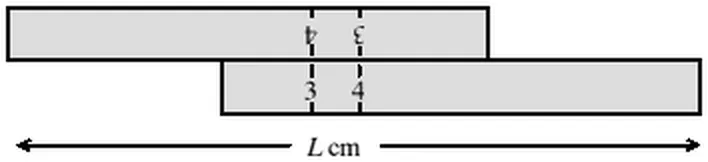
8. Two identical rulers are placed together, as shown (not to scale). Each ruler is exactly 10 cm long and is marked in centimetres from 0 to 10. The 3 cm mark on each ruler is aligned with the 4 cm mark on the other.
The overall length is \(L\) cm. What is the value of \(L\)?
The number 3 on the top ruler (which is 7cm from the left-hand end) aligns with the 4 on the bottom one (which is 6cm from the right-hand end). Thus \(L = 7 + 6 = 13\).
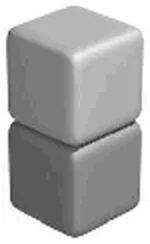
10. On standard dice the total number of pips on each pair of opposite faces is 7. Two standard dice are placed in a stack, as shown, so that the total number of pips on the two touching faces is 5. What is the total number of pips on the top and bottom faces of the stack?
The top and bottom faces of the stack and the two touching faces form two pairs of opposite faces. So the total number of pips on these four faces is 2 × 7 = 14. Therefore the total number of pips on the top and bottom faces of the stack is 14 − 5 = 9.
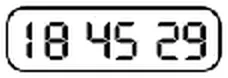
The sum of the ages of the four children is 12 + 14 + 15 + 15 = 56. Each year on their birthday, this sum increases by 4. So the number of years before the sum reaches 100 is (100 − 56) ÷ 4 = 11. Therefore their ages will first total 100 in 2024.
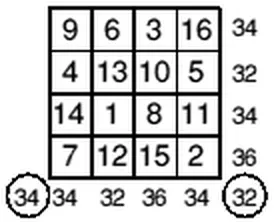
22. Two numbers in the 4 × 4 grid can be swapped to create a Magic Square (in which all rows, all columns and both main diagonals add to the same total). What is the sum of these two numbers?
The diagram shows the totals of the rows and columns. The circled numbers are the total of the numbers in the two main diagonals. Note, by considering the average values of the rows and columns, that each should total 34. Row 2 and column 2 are both 2 short. So their common entry, 13, needs to increase by 2. So 13 must be interchanged with 15. (This change also reduces row 4 and column 3 by 2 and increases the main diagonal by 2, thus making all the sums equal 34 as desired.) So the sum of the numbers to be swapped is 28.
5. One of the mascots for the 2012 Olympic Games is called ‘Wenlock’ because the town of Wenlock in Shropshire first held the Wenlock Olympian Games in 1850. How many years ago was that?
We concentrate initially on the units digits of the numbers given, noting that the 3 comes first, so is positive. Now 3 + 7 =10 but there is no way to combine 5 and 9 to get a units digit 0. So we must use 3 − 7. Hence, in the calculation, 67 must be preceded by a minus sign. Now 123 − 67 = 56. So we need to get an extra 44 by combining 45 and 89. The only way to do this is 89 − 45. So the correct calculation is 123 − 45 − 67 + 89. It has two minus signs and one plus sign, so \(p - m = 1 - 2 = -1\).
The average number of vehicles per day \(\approx \dfrac{300\,000\,000}{44 \times 365} \approx \dfrac{300\,000\,000}{40 \times 400}\) \(= \dfrac{300\,000\,000}{16\,000} \approx \dfrac{300\,000\,000}{15\,000} = 20\,000.\)
The three-digit number RRR is equal to 111 multiplied by the single digit \(R\). So \(PQPQ \times R = 639027 \div 111 = 5757\). Now PQPQ equals the two-digit number PQ multiplied by 101. So \(PQ \times R = 5757 \div 101 = 57\). The only ways in which 57 may be expressed as the product of a two-digit number and a single digit are 57 × 1 and 19 × 3. So \(P = 5, Q = 7, R = 1\) or \(P = 1, Q = 9, R = 3\). In both cases, \(P + Q + R = 13\).
15. I choose three numbers from this number square, including one number from each row and one number from each column. I then multiply the three numbers together. What is the largest possible product?
We consider the different possible choices from the top row. If 1 is chosen, then the options are 1, 5, 9 and 1, 6, 8 giving products 45 and 48 respectively. If 2 is chosen, the options are 2, 4, 9 and 2, 6, 7 giving products 72 and 84 respectively. Finally, if 3 is chosen, the options are 3, 4, 8 and 3, 5, 7 giving products 96 and 105. So 105 is the maximum.
The hundreds column shows us that \(J = 1\) or 2. [We can't carry more than 2 from the units to the tens; and 2 plus the biggest feasible values 7, 8, 9 for the three letters is only 26.] The units column shows that \(J + M\) is a multiple of 10 and it can't be 0 (or else \(J + M = 0\)); so \(J + M = 10\) and \(M = 9\) or 8 respectively. Also, the sum of the units column is \(10 + C\), so there is exactly 1 to carry to the tens column. The tens column now tells us that \(J + C + 1 = 10J\). So \(J = 2\) is not possible and therefore \(J = 1\), \(C = 8\) and \(M = 9\).
5. Euclid Gardens has 123 houses in it, numbered consecutively from 1 to 123. Houses 29 to 37 inclusive are knocked down to make space for a multi-storey car park. How many houses remain in Euclid Gardens?
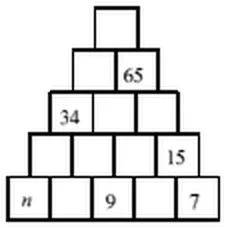
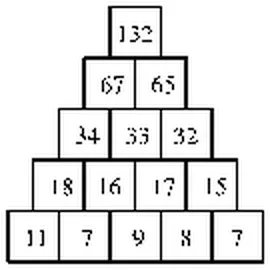
6. Each block shown in this tower is to have a number displayed on it. Some are already done. For each block above the bottom row, the number on it should be the sum of the numbers on the two blocks it stands upon. What number should replace \(n\)?
The completed tower is shown on the right. There is more than one order in which missing numbers may be inserted – and it is not necessary to complete the tower in order to determine \(n\) – but one possible order is 8, 17, 32, 33, 16, 7, 18, 11, 67, 132.
11. Travelling by train from Edinburgh to London, I passed a sign saying “London 150 miles”. After 7 more miles, I passed another sign saying “Edinburgh 250 miles”. How far is it by train from Edinburgh to London?
18. In this magic square, which uses all whole numbers from 7 to 15 inclusive, each of the rows, columns and the two main diagonals has the same total. Which number replaces \(n\) in the completed square?
The total of the numbers in the magic square is 7 + 8 + 9 + …15, that is 99. So each row, column and main diagonal has sum 33 and we deduce that the number in the top right hand corner of the square is 12. The remaining blank squares may now be completed in terms of \(n\), as shown. Considering the middle row: \(31 - 2n + 19 - n + 7 = 33\), so \(n = 8\). Alternate solution: it is known that the number in the centre of a magic square is always equal to the mean of the nine numbers making up the square, in this case 11. So \(n = 33 - 14 - 11 = 8\).
As the numbers are all positive, the largest number cannot be the difference between two of the others. Checking all the other options: 1 = 7 − 6; 6 = 7 − 1; 5 = 7 − 2; 2 = 7 − 5.
10. On Monday last week Dilly started to learn the Tlingit language. Every day she learnt five new words, but when she woke every morning she had forgotten two of the words learnt the day before. When did Dilly first achieve her target of learning fourteen words?
When Tilly woke on Thursday morning, she had learned fifteen new words, but had forgotten six of these, so she knew nine words. On Thursday, she learned five new words, so this was the first day on which she reached her target of fourteen words.
Remembering that, in the absence of brackets, multiplication is performed before addition, we see that 9 × 6 + 73 = 54 + 73 = 127, whereas 96 + 7 × 3 = 96 + 21 = 117. It is left as an exercise for the reader to check that the other four calculations are correct.
16. ‘Saturn’ chocolate bars are packed either in boxes of 5 or boxes of 12. What is the smallest number of full boxes required to pack exactly 2005 ‘Saturn’ bars?
2005 ÷ 12 = 167 remainder 1 so if 167 of the larger boxes are used, one bar will remain. If 166 of the larger boxes are used, 13 bars will remain and these cannot fill a whole number of smaller boxes. However, if 165 larger boxes are used, the 25 remaining bars will fill 5 smaller boxes. Using fewer than 165 larger boxes will increase the total number of boxes required since proportionately more of the smaller boxes would be needed, so the required number of boxes is 165 + 5.
The subtraction shows the number \(10a + b\) subtracted from the number \(10b + a\). Their difference is \(9b - 9a\). So \(9(b - a)\) has unit digit 6 and must therefore have value 36 since this is the only two-digit multiple of 9 which ends in 6. So \(c\) is 3. Note that the values of \(a\) and \(b\) are not unique. Provided that \(b - a\) is 4, the difference of the two numbers will be 36, for example 51 − 15 = 36; 62 − 26 = 36; 73 − 37 = 36 etc.
22. In a certain code, A = 1, B = 2, C =3 etc. Words are encoded by multiplying together the values of their letters, so the code for SQUARE is 19 × 17 × 21 × 1 × 18 × 5 = 610 470. Similarly, the code for RECTANGLE is 31 752 000. What is the code for TRIANGLE?
The letters used in TRIANGLE are the same as those used in RECTANGLE, except that C and E have been replaced by I. So the code for TRIANGLE is 9 × 31 752 000 ÷ (3 × 5), that is 19 051 200.
10. When Harry bought his train ticket he received £2.50 in change. He noticed that for each coin in his change there was exactly one other coin of the same value. What was the coin of smallest value in Harry's change?
The coins consisting of one of each type must add up to £1.25. The only way that this total may be made with coins of different denominations is by using a £1 coin, a 20p coin and a 5p coin.
12. The White Rabbit has an appointment to see the Red Queen at 4pm every day apart from weekends. On Monday, he arrives 16 minutes late. Each day after that he hurries more and more and so manages to halve the amount of time that he arrives late each day. On what day of the week does he arrive just 15 seconds late?
On Tuesday the White Rabbit will be 8 minutes late, on Wednesday 4 minutes late, on Thursday 2 minutes late and on Friday 1 minute late. So on the following Monday the White Rabbit will be 30 seconds late and on the day after that he will be 15 seconds late.
Statements such as those in this question may sometimes be shown to be false by considering the units digit of the expressions on each side. The units digit of 442 + 772 is 5; the units digit of 552 + 662 and hence also of 662 + 552 is 1; the units digit of 882 + 332 is 3 and that of 992 + 222 is 5. So four of the statements are definitely false. It remains to check that 882 + 332 = 7744 + 1089 = 8833.
22. The digits in the product 13 × 2 = 26 can be rearranged to give 16 × 2 = 32 as well as 31 × 2 = 62. In which one of the following can the digits not be rearranged to give another correct product?
Consider the thousands column. The letters represent different digits so, as \(S\) is 3, \(M\) is 2 and there is a carry of 1 from the hundreds column. Therefore \(A\) is 9, \(U\) is 0 and there is also a carry of 1 from the tens column. In the units column, \(O + Y\) produces a units digit of 3, so \(O + Y = 3\) or \(O + Y = 13\). However, \(O + Y = 3\) requires one of \(O\), \(Y\) to equal zero (impossible as \(U = 0\)) or 2 (also impossible as \(M = 2\)). So \(O + Y = 13\). We can also deduce that \(N\) is 8, since, in the tens column, 1 + 3 + \(N\) = 12. The pairs of digits which produce a sum of 13 are 4 and 9, 5 and 8, 6 and 7. As \(A\) is 9 and \(N\) is 8, the only possible values for \(O\) and \(Y\) are 6 and 7. These are interchangeable, but in both cases \(Y \times O = 42\).
We'd like to use Google Analytics cookies to count visits and see which pages help most. They're optional, and the site works exactly the same either way. Privacy policy