The whole Junior Mathematical Challenge 2012 paper, one question at a time in order (25 questions). Press Mark as done after each one: your marks add up below.
The smallest four-digit positive integer is 1000. Each of the subsequent integers up to and including 1022 has at least two digits the same. However, all digits of 1023 are different so this is the required integer.
An integer will have exactly one factor other than 1 and itself if, and only if, it is the square of a prime. Of the options given, the only such number is 25. Its factors are 1, 5, 25.
4. Beatrix looks at the word JUNIOR in a mirror. How many of the reflected letters never look the same as the original, no matter how Beatrix holds the mirror?
None of the letters J, N, R has an axis of symmetry, so these letters cannot look the same when reflected in a mirror, no matter how the mirror is held. However, the letters U, I, O all have at least one axis of symmetry, so each may look the same when reflected in a mirror.
5. One of the mascots for the 2012 Olympic Games is called ‘Wenlock’ because the town of Wenlock in Shropshire first held the Wenlock Olympian Games in 1850. How many years ago was that?
The first two views of the cube show that I, M, U, O are not opposite K. So P is opposite K. Similarly, the second and third views show that I is opposite O. So the remaining two faces, M and U, must be opposite each other.
7. A small ink cartridge has enough ink to print 600 pages. Three small cartridges can print as many pages as two medium cartridges. Three medium cartridges can print as many pages as two large cartridges. How many pages can be printed using a large cartridge?
Two medium cartridges can print as many pages as three small cartridges, i.e. 1800 pages. So three medium cartridges can print 1800 × 3/2 pages, i.e. 2700 pages. This is the same number of pages as two large cartridges can print, so one large cartridge can print 2700 ÷ 2, i.e. 1350, pages.
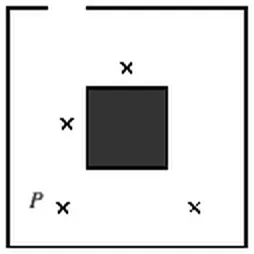
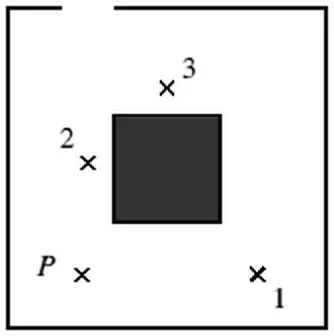
9. The diagram on the right shows the positions of four people (each marked ×) in an Art Gallery. In the middle of the room is a stone column. Ali can see none of the other three people. Bea can see only Caz. Caz can see Bea and Dan. Dan can see only Caz. Who is at position \(P\)?
The person at position P can see exactly two of the other three people, so this person is Caz. The people he can see are at positions 1 and 2 and are Bea and Dan, each of whom can see exactly one person – Caz. This leaves Ali at position 3 – a position from which none of the three people can be seen, so all of the information given is consistent with Caz being at P.
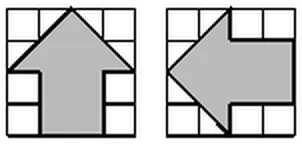
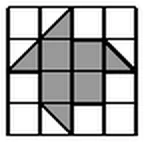
10. The diagram shows two arrows drawn on separate 4 cm × 4 cm grids. One arrow points North and the other points West. When the two arrows are drawn on the same 4 cm × 4 cm grid (still pointing North and West) they overlap. What is the area of overlap?
We concentrate initially on the units digits of the numbers given, noting that the 3 comes first, so is positive. Now 3 + 7 =10 but there is no way to combine 5 and 9 to get a units digit 0. So we must use 3 − 7. Hence, in the calculation, 67 must be preceded by a minus sign. Now 123 − 67 = 56. So we need to get an extra 44 by combining 45 and 89. The only way to do this is 89 − 45. So the correct calculation is 123 − 45 − 67 + 89. It has two minus signs and one plus sign, so \(p - m = 1 - 2 = -1\).
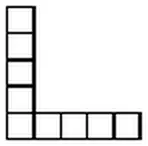
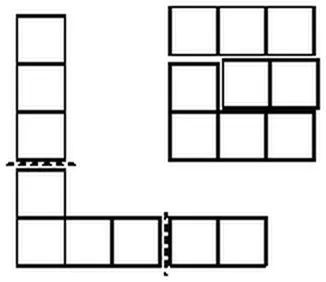
12. Laura wishes to cut this shape, which is made up of nine small squares, into pieces that she can then rearrange to make a 3 × 3 square. What is the smallest number of pieces that she needs to cut the shape into so that she can do this?
None of the pieces which Laura uses to make the 3 × 3 square can be more than 3 units long. Both the horizontal and vertical portions of the original shape are longer than 3 units, so at least two cuts will be required. Hence Laura will need at least three pieces and the diagrams on the right show that the task is possible using exactly three pieces.
13. In the multiplication grid on the right, the input factors (in the first row and the first column) are all missing and only some of the products within the table have been given. What is the value of A + B + C + D + E?
Note that \(p\) is a factor of both 15 and 18. So \(p\) is either 1 or 3. If \(p = 1\) then \(w = 15\). However, if \(w = 15\) then \(r\) is not an integer. So \(p = 3, w = 5, x = 6\). The values of the other input factors may now be calculated: \(r = 8, s = 10, v = 2, z = 7, q = 5, y = 4, t = 6\). So A + B + C + D + E = 6 + 25 + 48 + 40 + 42 = 161.
Note that 96 is a multiple of 6, so the 97th symbol is the same as the first, the 98th symbol is the same as the second and the 100th and 101st symbols are the same as the fourth and fifth symbols respectively.
15. Talulah plants 60 tulip bulbs. When they flower, she notes that half are yellow; one third of those which are not yellow are red; and one quarter of those which are neither yellow nor red are pink. The remainder are white. What fraction of the tulips are white?
In total, the fraction of tulips which are either yellow or red is \(\tfrac{1}{2} + \tfrac{1}{3} \times \tfrac{1}{2} = \tfrac{2}{3}\). So one third of the tulips are pink or white. Of these, one quarter are pink, so the fraction of tulips which are white is \(\tfrac{3}{4} \times \tfrac{1}{3} = \tfrac{1}{4}\).
16. Beth, Carolyn and George love reading their favourite bedtime story together. They take it in turns to read a page, always in the order Beth, then Carolyn, then George. All twenty pages of the story are read on each occasion. One evening, Beth is staying at Grandma’s house but Carolyn and George still read the same bedtime story and take it in turns to read a page with Carolyn reading the first page. In total, how many pages are read by the person who usually reads that page?
Normally, Beth reads pages 1, 4, 7, ... ; Carolyn reads pages 2, 5, 8, ... ; George reads pages 3, 6, 9, ... . When Beth is away, Carolyn reads all the odd-numbered pages, whilst George reads all the even-numbered pages. So the pages which are read by the person who normally reads that page are numbered 5, 11, 17 (Carolyn) and 6, 12, 18 (George).
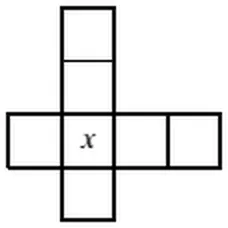
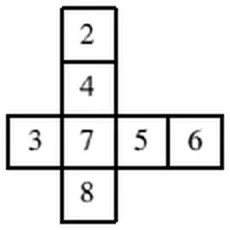
18. The numbers 2, 3, 4, 5, 6, 7, 8 are to be placed, one per square, in the diagram shown such that the four numbers in the horizontal row add up to 21 and the four numbers in the vertical column also add up to 21. Which number should replace \(x\) ?
Note that the number which replaces \(x\) appears in both the row and the column. Adding the numbers in the row and the column gives \(2 + 3 + 4 + 5 + 6 + 7 + 8 + x = 2 \times 21 = 42\). So \(35 + x = 42\) and hence \(x = 7\). The diagram shows one way in which the task may be accomplished.
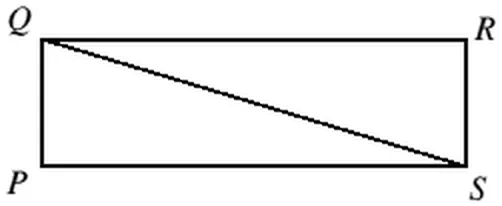
As \(\angle QPS = 90^\circ\),\(\angle PSQ + \angle PQS = 90^\circ\). So, since the ratio of these angles is 1:5, \(\angle PSQ = 15^\circ\) and \(\angle PQS = 75^\circ\). Now \(\angle QSR = \angle PQS\) (alternate angles). So \(\angle QSR = 75^\circ\).
50 months = 4 years and 2 months; 50 weeks and 50 days = 57 weeks and 1 day, i.e. just over 1 year and 1 month. So Aroon is just over 55 years and 3 months old and will, therefore, be 56 on his next birthday.
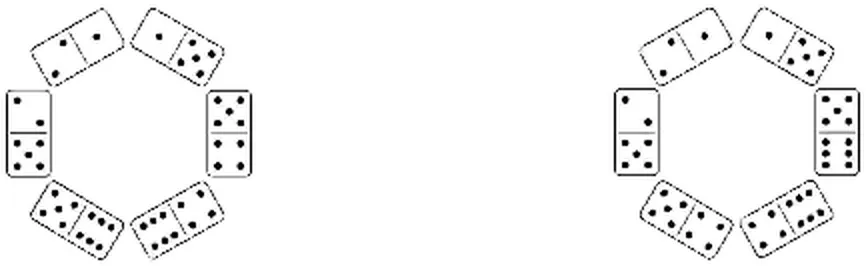
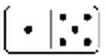
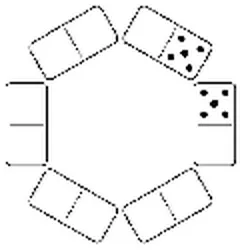
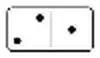
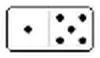
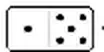
21. Dominic wants to place the six dominoes above in a hexagonal ring so that, for every pair of adjacent dominoes, the numbers of pips match. The ring on the right indicates how one adjacent pair match. In a completed ring, how many of the other five dominoes can he definitely not place adjacent to ?
Exactly two dominoes have a ‘1’ and exactly two dominoes have a ‘2’ so the dominoes must be arranged as shown. So cannot be adjacent to . Clearly, cannot be adjacent to either, but it is possible to form a ring with adjacent to or with adjacent to . These are shown below. So only two of the dominoes cannot be placed adjacent to .
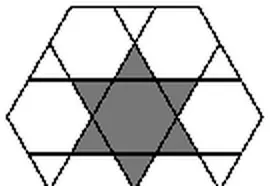
22. The diagram shows a design formed by drawing six lines in a regular hexagon. The lines divide each edge of the hexagon into three equal parts. What fraction of the hexagon is shaded?
The original hexagon has been divided into seven regular hexagons and twelve equilateral triangles. Six equilateral triangles are equal in area to one smaller hexagon, so the large hexagon is equal in area to nine of the smaller hexagons. (This may also be deduced from the fact that their sides are in the ratio 3:1.) The shaded area consists of one smaller hexagon and six equilateral triangles, which is equivalent to the area of two of the smaller hexagons. So \(\tfrac{2}{9}\) of the large hexagon is shaded.
23. Peter wrote a list of all the numbers that could be produced by changing one digit of the number 200. How many of the numbers on Peter’s list are prime?
If either of the first two digits of the number is changed, the units digit will still be 0. Therefore the new number will be either 000 or a non-zero multiple of 10 and so will not be prime. If the units digit is changed then the possible outcomes are 201, 202, 203, 204, 205, 206, 207, 208, 209. The even numbers are not prime and neither are 201 (3 × 67), 203 (7 × 29), 205 (5 × 41), 207 (3 × 69), 209 (11 × 19). So none of the numbers on Peter's list is prime.
24. After playing 500 games, my success rate at Spider Solitaire is 49%. Assuming I win every game from now on, how many extra games do I need to play in order that my success rate increases to 50% ?
After 500 games, I have won 500 × \(\tfrac{49}{100}\) = 245 games. So I have lost 255 games. Therefore I need to win the next 10 games to have a 50% success rate.
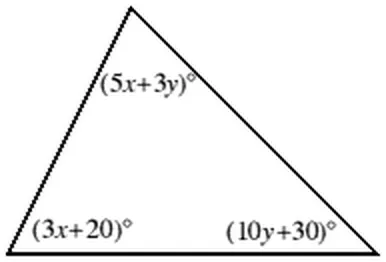
25. The interior angles of a triangle are \((5x + 3y)^\circ\), \((3x + 20)^\circ\) and \((10y + 30)^\circ\) where \(x\), \(y\) are positive integers. What is the value of \(x + y\)?
The sum of the interior angles of a triangle is 180°. Therefore \(5x + 3y + 3x + 20 + 10y + 30 = 180\), i.e. \(8x + 13y = 130\). As \(x\) and \(y\) are both positive integers, it may be deduced that \(x\) is a multiple of 13. Also, since \(y \geqslant 1, x \leqslant \dfrac{117}{8}\) so the only possible value of \(x\) is 13. If \(x = 13\) then \(y = 2\), so \(x + y = 15\).
We'd like to use Google Analytics cookies to count visits and see which pages help most. They're optional, and the site works exactly the same either way. Privacy policy



 ?

 must be arranged as shown. So
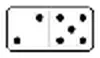 cannot be adjacent to
 . Clearly,
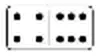 cannot be adjacent to
 either, but it is possible to form a ring with
 adjacent to
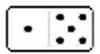 or with
 adjacent to
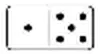 . These are shown below. So only two of the dominoes cannot be placed adjacent to
 .