67 Junior Mathematical Challenge questions from every year we have, newest year first. Use Difficulty › Position in the paper to practise the early (easier) or late (harder) questions, or the Year filter for one year.
5. Amrita thinks of a number. She doubles it, adds 9, divides her answer by 3 and finally subtracts 1. She obtains the same number she originally thought of. What was Amrita’s number?
The solutions of the four equations are, from left to right, \(x=12\);\(x=48\);\(x=8\);\(x=13\). Therefore exactly one of the equations has solution \(x=12\).
19. In the table shown, the sum of each row is shown to the right of the row and the sum of each column is shown below the column. What is the value of \(L\)?
Adding the top row and the middle column gives, \(2J+K+2K+J=5+7=12\). Hence \(3J+3K=12\). So \(J+K=4\). The first column shows that \(J+K+L=11\). Hence, \(J+K+L-(J+K)=11-4=7\). Therefore \(L=7\). (It is then possible to deduce that \(J=1\) and \(K=3\) and check that each total is correct.)
On Aoife’s 16th birthday, Buster was three times her age, that is 48. It is then five years until Aoife’s 21st birthday, so Buster’s age at that time was 48 + 5 = 53.
12. Jamal writes down a sequence of six integers. The rule he uses is, “after the first three terms, each term is the sum of the three previous terms.” His sequence is —, —, —, 8, 13, 25.
Let the first six terms of Jamal’s sequence be \(p\),\(q\),\(r\), 8, 13 and 25 respectively. Then \(r + 8 + 13 = 25\), so \(r = 4\). Hence \(q + 4 + 8 = 13\), so \(q = 1\). Therefore, \(p + 1 + 4 = 8\), so \(p = 3\). (Note that the problem may be solved without being given that the sixth term of the sequence is 25. In this case,\(q + r + 8 = 13\),so\(q + r = 5\).Also, \(p + q + r = 8\) and therefore\(p = 8 - 5 = 3\).)
Because the product has exactly four digits, it is clear that \(T = 1\) and \(P = 9\). So we have \((1000 + 100R + 10A + 9) \times 9 = 1000 \times 9 + 100A + 10R + 1\). Therefore \(9000 + 900R + 90A + 81 = 9000 + 100A + 10R + 1\). Hence \(890R + 80 = 10A\), which simplifies to \(89R + 8 = A\). Because \(A < 10\), the only solutions to this equation are \(R = 0\) and \(A = 8\). As a check, we see that 1089 × 9 is indeed 9801.
6. The diagram shows a partially completed magic square, in which all rows, all columns and both main diagonals have the same total. What is the value of \(x + y\)?
Let the number in the top right corner of the completed magic square be represented by \(z\) and let the total of each row, column and main diagonal be \(T\). So, considering the right-hand column of the square, \(T = x + y + z\). Also, considering the diagonal from bottom left to top right, \(T = 6 + 7 + z\). So \(x + y + z = 6 + 7 + z\). Hence \(x + y = 6 + 7 = 13\).
14. Billy has three times as many llamas as lambs. Milly has twice as many lambs as llamas. They have 17 animals in total. How many of the animals are llamas?
Let Billy have \(b\) lambs and \(3b\) llamas. Let Milly have \(m\) llamas and \(2m\) lambs. Therefore, as they have 17 animals in total, \(4b + 3m = 17\). The only positive integer solution of this equation is \(b = 2\),\(m = 3\). So the number of llamas is \(3b + m = 3 \times 2 + 3 = 6 + 3 = 9\).
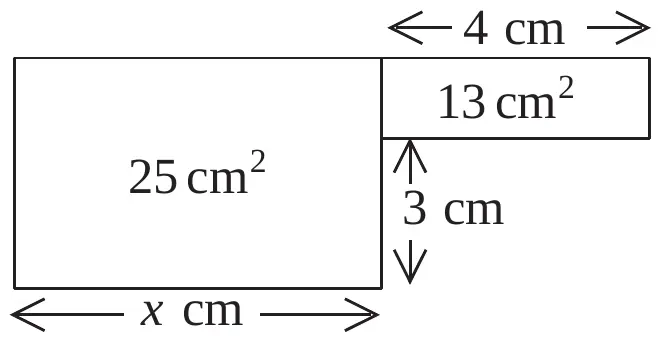
The height of the smaller rectangle is (13 ÷ 4) cm = \(\dfrac{13}{4}\) cm. Therefore the height of the larger rectangle is \(\left(3 + \dfrac{13}{4}\right)\) cm = \(\dfrac{25}{4}\) cm. So, considering the area of the larger rectangle, \(x \times \dfrac{25}{4} = 25\). Therefore \(x = 25 \div \dfrac{25}{4} = 25 \times \dfrac{4}{25} = 4\).
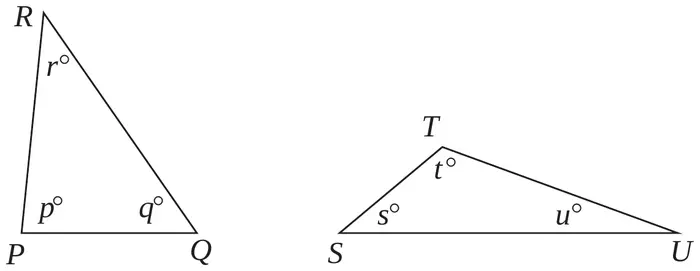
22. In the triangles \(PQR\) and \(STU\),\(\angle RPQ = 2 \times \angle UST\), \(\angle PRQ = 2 \times \angle SUT\) and \(\angle RQP = \dfrac{1}{5} \times \angle UTS\). How large is \(\angle UTS\)?
In the diagram, the sizes in degrees of the angles in triangles \(PQR\) and \(SUT\) are denoted by \(p°, q°, r°, s°, t°, u°\). Therefore \(p = 2s\);\(r = 2u\);\(q = \tfrac{1}{5}t\). Also, as the sum of the interior angles in a triangle is 180°, \(p + q + r = 180\)… (1) and \(s + u + t = 180\)… (2). Substituting for \(p\),\(q\), \(r\) in (1) gives \(2s + \tfrac{1}{5}t + 2u = 180\)… (3). Equation (2) × 2 gives \(2s + 2t + 2u = 360\)… (4). Subtracting (3) from (4) gives, \(2t - \tfrac{1}{5}t = 180\). So \(\dfrac{9t}{5} = 180\), that is \(t = 100\).
23. Ali wants to fill the empty squares so that the number in each square after the fourth from the left is the sum of the numbers in the four squares to its left. What number should Ali write in the final square?
The number in each square after the fourth from the left is the sum of the numbers in the four squares to its left. Therefore, \(s = q + 1 + r + 8\)… (1) and \(8 = 0 + q + 1 + r\)… (2). From (2), \(q + r = 7\). So, from (1), \(s = 7 + 1 + 8 = 16\). So the number which Ali will write in the final square is 16. {It is left an exercise for the reader to calculate the numbers in the other three blank squares.}
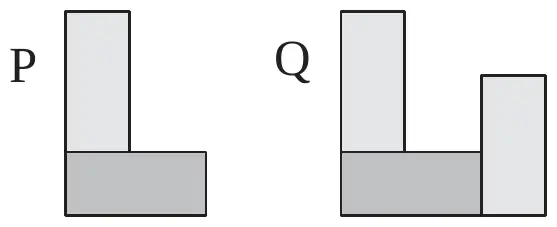
24. The shapes P and Q are formed from two and three identical rectangles, respectively. Their perimeters are 58 cm and 85 cm respectively. What is the perimeter of one of the rectangles?
Let the perimeter of one of the rectangles be \(p\) cm and let the length of one of its shorter sides be \(x\) cm. Before the rectangles in figure \(P\) are joined together, their total perimeter is \(2p\) cm. However, when they are joined together, a length equal to the lengths of two of the shorter sides is ‘lost’ at the join. So the perimeter of shape \(P\), in cm, equals \(2p - 2x\). So \(2p - 2x = 58\)… (1). Similarly, shape \(Q\) consists of three of the rectangles, but there are two joins. So a length equal to the lengths of four of the shorter sides is ‘lost’ at the joins. Therefore, the perimeter of shape \(Q\), in cm, equals \(3p - 4x\). So \(3p - 4x = 85\)… (2). Multiplying equation (1) by 2 and then subtracting equation (2) gives \(4p - 4x - (3p - 4x) = 2 \times 58 - 85\). So \(p = 31\). Therefore the perimeter of one of the rectangles is 31 cm.
22. In the window of Bradley's Bicycle Bazaar there are some unicycles, some bicycles and some tricycles. Laura sees that there are seven saddles in total, thirteen wheels in total and more bicycles than tricycles. How many unicycles are in the window?
Let the number of unicycles, bicycles and tricycles be \(u\), \(b\) and \(t\) respectively. Then \(u + b + t = 7\)… (1); \(u + 2b + 3t = 13\)… (2); also \(b > t\). (2) − (1): \(b + 2t = 6\)… (3). As \(b\) and \(t\) are both positive integers, the only values of \(b\) and \(t\) which satisfy equation (3) are \(b = 2\), \(t = 2\) and \(b = 4\),\(t = 1\). However, \(b > t\) so the only solution is \(b = 4\),\(t = 1\). Substituting in (1): \(u + 4 + 1 = 7\). So \(u = 2\).
6. Gill is now 28 years old and is a teacher of Mathematics at a school which has 600 pupils. There are 30 more girls than boys at the school. How many girls are at Gill's school?
Let there be \(g\) girls in Gill's school. Then there are \((g - 30)\) boys at the school. So \(g + g - 30 = 600\). Therefore \(2g = 630\), that is \(g = 315\).
First note that when two numbers are added together the only possible carry from any column is 1. Now, looking at the tens column of the sum, we see that \(E + E\) leaves a total of \(E\) in the column. Since \(E\) is non-zero, the only way that this can happen is that there is a carry of 1 from the units column. So we have \(1 + E + E = 10 + E\), so \(1 + E = 10\), that is \(E = 9\). Looking at the units column we see that \(E + E = 18\), so \(S = 8\) and there is a carry of 1 to the tens column. The addition sum may now be solved: 899 + 899 = 1798. So \(X = 7\).
19. Three boxes under my stairs contain apples or pears or both. Each box contains the same number of pieces of fruit. The first box contains all twelve of the apples and one-ninth of the pears. How many pieces of fruit are there in each box?
Let \(p\) be the total number of pears. Then \(12 + \dfrac{p}{9} = \dfrac{1}{2}\left(p - \dfrac{p}{9}\right) = \dfrac{4p}{9}\). So \(12 = \tfrac{3p}{9} = \tfrac{p}{3}\). Therefore \(p = 3 \times 12 = 36\). So the number of pieces of fruit in each box is \(\tfrac{12 + 36}{3} = 16\).
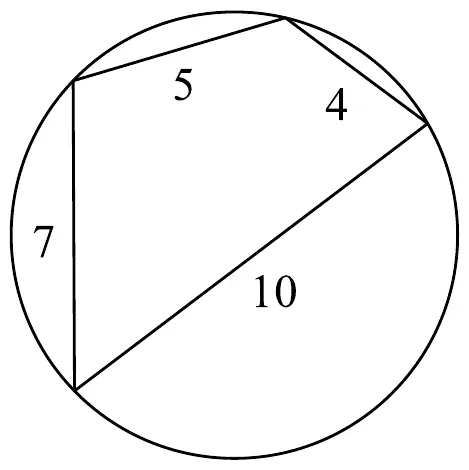
20. A cyclic quadrilateral has all four vertices on the circumference of a circle. Brahmagupta (598–670AD) gave the following formula for the area, \(A\), of a cyclic quadrilateral whose edges have lengths \(a\),\(b\),\(c\),\(d\): \(A = \sqrt{(s - a)(s - b)(s - c)(s - d)}\), where \(s\) is half of the perimeter of the quadrilateral. What is the area of the cyclic quadrilateral with sides of length 4 cm, 5 cm, 7 cm and 10 cm?
The length of \(s\), half the perimeter of the cyclic quadrilateral, is \(\tfrac{1}{2}(4 + 5 + 7 + 10)\) cm = 13 cm. So the required area, in cm2, is \(\sqrt{(13 - 4)(13 - 5)(13 - 7)(13 - 10)} = \sqrt{9 \times 8 \times 6 \times 3} = \sqrt{9 \times 144} = 3 \times 12 = 36\).
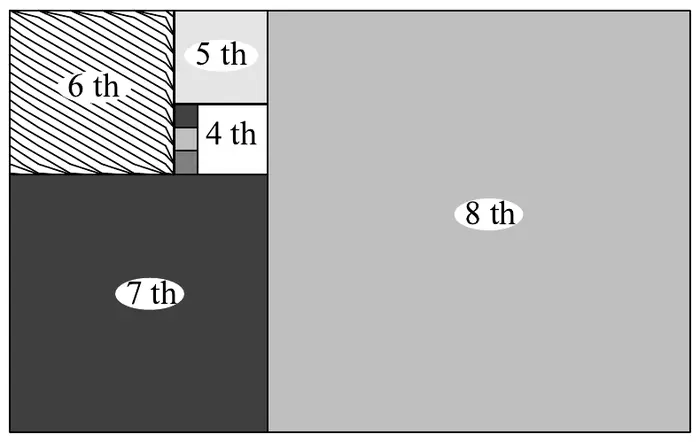
23. The diagram shows the first few squares of a ‘spiral’ sequence of squares. All but the first three squares have been numbered. After the first six squares, the sequence is continued by placing the next square alongside three existing squares – the largest existing square and two others. The three smallest squares have sides of length 1. What is the side length of the 12th square?
Note first that the fourth square has side length 3, the fifth square has side length 4 and the sixth square has side length 7. As described in the question, the seventh square is placed alongside the sixth square, the fourth square and one of the first three unit squares. However, it may be seen that the side length of the seventh square is equal to the sum of the side lengths of the fifth and sixth squares, which is 4 + 7 = 11. Similarly, the eighth square is placed along the fourth, fifth and seventh squares, but its side length is the sum of the side lengths of the sixth and seventh squares, which is 7 + 11 = 18. The spiral sequence continues in the same way and therefore the side length of any subsequent square may be calculated by adding together the side lengths of the two previous squares in the sequence. So from the fourth square onwards the side lengths of the squares are 3, 4, 7, 11, 18, 29, 47, 76, 123, …. Hence the side length of the twelfth square is 123. (All of the positive integers in the sequence from the side length of the fourth square onwards are members of the sequence of Lucas numbers − a Fibonacci sequence with first term 2 and second term 1.)
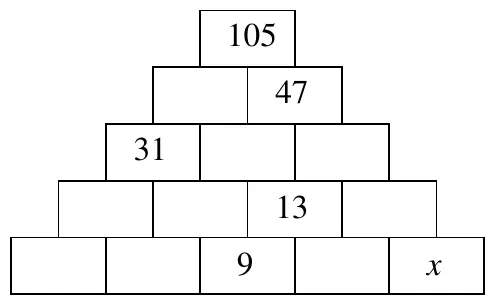
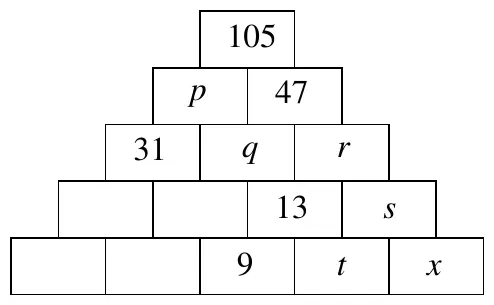
The calculations required to find the value of \(x\) are: \(p = 105 - 47 = 58\);\(q = p - 31 = 58 - 31 = 27\); \(r = 47 - q = 47 - 27 = 20\); \(s = r - 13 = 20 - 13 = 7\);\(t = 13 - 9 = 4\); \(x = s - t = 7 - 4 = 3\). (Note that the problem may be solved without finding the values of four of the numbers in the pyramid. Finding these is left as an exercise for the reader.)
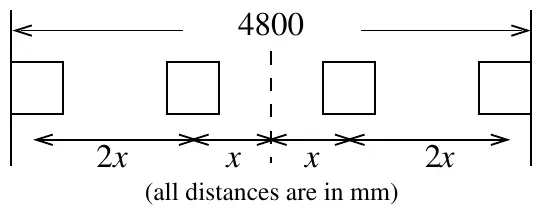
21. Gill is now 27 and has moved into a new flat. She has four pictures to hang in a horizontal row on a wall which is 4800 mm wide. The pictures are identical in size and are 420 mm wide. Gill hangs the first two pictures so that one is on the extreme left of the wall and one is on the extreme right of the wall. She wants to hang the remaining two pictures so that all four pictures are equally spaced. How far should Gill place the centre of each of the two remaining pictures from a vertical line down the centre of the wall?
The diagram shows part of the wall of width 4800 mm and the four equally spaced pictures, each of width 420 mm. Let \(x\) be the required distance, that is the distance from the centre of each of the two pictures in the middle of the wall to a vertical line down the centre of the wall (marked by a broken line). Then the distance between the centres of any two adjacent pictures is \(2x\). Note that the distance between the centres of the two pictures on the extremes of the wall is (4800 − 2 × 210) mm = 4380 mm. Therefore \(2x + x + x + 2x = 4380\). So \(x = 4380 \div 6 = 730\). Hence the required distance is 730 mm.
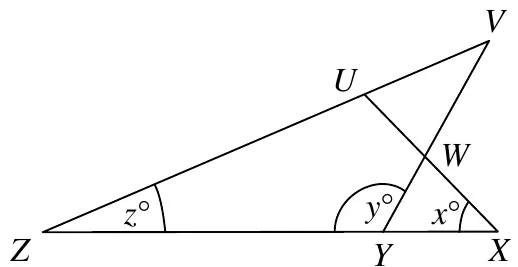
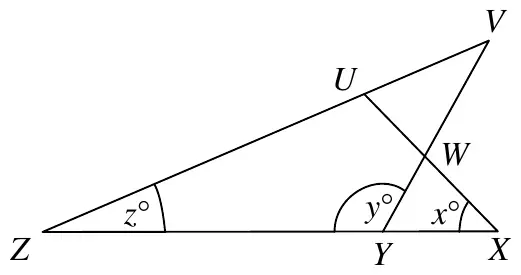
25. The four straight lines in the diagram are such that \(VU = VW\). The sizes of \(\angle UXZ\), \(\angle VYZ\) and \(\angle VZX\) are \(x°\), \(y°\) and \(z°\). Which of the following equations gives \(x\) in terms of \(y\) and \(z\)?
The exterior angle of a triangle is equal to the sum of its two interior and opposite angles. Applying this theorem to triangle \(UZX\): \(\angle VUW = z° + x°\). Similarly, in triangle \(WYX\):\(y° = \angle XWY + x°\), so \(\angle XWY = y° - x°\). As \(VU = VW\), \(\angle VUW = \angle VWU\) and also \(\angle VWU = \angle XWY\) because they are vertically opposite angles. Therefore \(\angle VUW = \angle XWY\). So \(z° + x° = y° - x°\) and hence \(x = \tfrac{1}{2}(y - z)\).
11. The first two terms of a sequence are 1 and 2. Each of the following terms in the sequence is the sum of all the terms which come before it in the sequence. Which of these is not a term in the sequence?
The third term of the sequence equals 1 + 2 = 3. Now consider the fourth term: it is the sum of the first three terms. However, as the first two terms sum to the third term, the sum of the first three terms is twice the third term, i.e. 2 × 3 = 6. So the fourth term is twice the third term. Similar reasoning applies to each subsequent term, i.e. each term after the third term is equal to twice the term which precedes it. Therefore the sequence is 1, 2, 3, 6, 12, 24, 48, 96, ….
As \(7Q2ST - P3R96 = 22222\), it follows that \(7Q2ST = P3R96 + 22222\). Looking at the units column: 2 + 6 = \(T\), so \(T = 8\). Looking at the tens column, as 2 + 9 = 11, we deduce that \(S = 1\) and that 1 is carried to the hundreds column. Looking at the hundreds column: the carry of 1 + 2 + \(R\) must equal 12 since the sum has 2 in the hundreds column. So \(R = 9\) and there is a carry of 1 to the thousands column. Looking at this column: the carry of 1 + 2 + 3 = \(Q\), so \(Q = 6\). Finally, since there is no carry to the next column, 2 + \(P\) = 7, so \(P = 5\). Therefore the calculation is 76218 − 53996 = 22222 and \(P + Q + R + S + T = 5 + 6 + 9 + 1 + 8 = 29\).
19. Jack and Jill played a game for two people. In each game, the winner was awarded 2 points and the loser 1 point. No games were drawn. Jack won exactly 4 games and Jill had a final score of 10 points. How many games did they play?
Since Jack won 4 games, Jill lost 4 games for which she was awarded 4 points. So the number of games she won is (10 − 4) ÷ 2 = 3. Therefore, they played 7 games in total.
20. Box P has \(p\) chocolates and box Q has \(q\) chocolates, where \(p\) and \(q\) are both odd and \(p > q\). What is the smallest number of chocolates which would have to be moved from box P to box Q so that box Q has more chocolates than box P?
Let the smallest number of chocolates required be \(n\). Then \(q + n > p - n\), that is \(2n > p - q\). Therefore \(n > \tfrac{1}{2}(p - q)\). Since \(p > q\) and \(p\) and \(q\) are both odd, \(\tfrac{1}{2}(p - q)\) is a positive integer. So the smallest possible value of \(n\) is \(\tfrac{1}{2}(p - q) + 1 = \tfrac{1}{2}(p - q + 2)\).
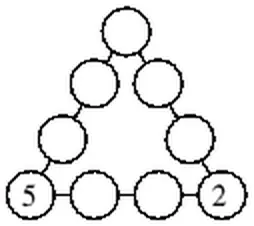
23. Sam wants to complete the diagram so that each of the nine circles contains one of the digits from 1 to 9 inclusive and each contains a different digit. Also, the digits in each of the three lines of four circles must have the same total. What is this total?
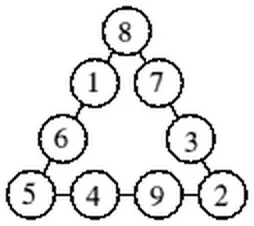
Note first that the sum of the first 9 positive integers is 45. Therefore, when the four numbers in each of the three lines are added together the total is 45 plus the sum of the numbers in the three corner circles, each of which contributes to the sum of two lines of circles. So if the number in the top circle is \(x\), the total of all 3 lines is 45 + 2 + 5 + \(x\) = 52 + \(x\). As all three lines of circles must have the same total, 52 + \(x\) must be a multiple of 3. The possible values of \(x\) are 2, 5 and 8 but 2 and 5 have already been assigned. So \(x = 8\) and the sum of each line is 60 ÷ 3 = 20. The diagram shows one way of completing the task.
7. After tennis training, Andy collects twice as many balls as Roger and five more than Maria. They collect 35 balls in total. How many balls does Andy collect?
Let the number of balls collected by Roger be \(x\). Then Andy collects \(2x\) balls and Maria collects \((2x - 5)\) balls. So \(x + 2x + 2x - 5 = 35\), i.e. \(5x = 40\), i.e. \(x = 8\). So Andy collected 16 balls.
9. Peter has three times as many sisters as brothers. His sister Louise has twice as many sisters as brothers. How many children are there in the family?
Let there be \(b\) boys and \(g\) girls in the family. Then Peter has \(g\) sisters and \((b - 1)\) brothers. So \(g = 3(b - 1)\). Louise has \((g - 1)\) sisters and \(b\) brothers. So \(g - 1 = 2b\). Therefore \(2b + 1 = 3b - 3\), i.e. \(b = 4\). So \(g = 9\). Therefore there are 4 boys and 9 girls in the family, i.e. 13 children in total.
The sum of the ages of the four children is 12 + 14 + 15 + 15 = 56. Each year on their birthday, this sum increases by 4. So the number of years before the sum reaches 100 is (100 − 56) ÷ 4 = 11. Therefore their ages will first total 100 in 2024.
18. Weighing the baby at the clinic was a problem. The baby would not keep still and caused the scales to wobble. So I held the baby and stood on the scales while the nurse read off 78 kg. Then the nurse held the baby while I read off 69 kg. Finally I held the nurse while the baby read off 137 kg. What was the combined weight of all three ?
A 142 kg
B 147 kg
C 206 kg
D 215 kg
E 284 kg
(This problem appeared in the first Schools' Mathematical Challenge in 1988 – 25 years ago.)
Let the weights, in kg, of baby, nurse and me be \(x\),\(y\), \(z\) respectively. Then \(x + z = 78\);\(x + y = 69\);\(y + z = 137\). Adding all three equations gives \(2x + 2y + 2z = 284\), so \(x + y + z = 284 \div 2 = 142\). (To find the combined weight, it is not necessary to find the individual weights, but baby weighs 5kg, nurse weighs 64 kg and I weigh 73 kg.)
23. In our school netball league a team gains a certain whole number of points if it wins a game, a lower whole number of points if it draws a game and no points if it loses a game. After 10 games my team has won 7 games, drawn 3 and gained 44 points. My sister's team has won 5 games, drawn 2 and lost 3. How many points has her team gained?
Let the points awarded for a win and a draw be \(w\) and \(d\) respectively. Then \(7w + 3d = 44\). The only positive integer solutions of this equation are \(w = 2\), \(d = 10\) and \(w = 5, d = 3\). However, more points are awarded for a win than for a draw so we deduce that 5 points are awarded for a win and 3 points for a draw. So the number of points gained by my sister's team is 5 × 5 + 2 × 3 = 31.
13. In the multiplication grid on the right, the input factors (in the first row and the first column) are all missing and only some of the products within the table have been given. What is the value of A + B + C + D + E?
Note that \(p\) is a factor of both 15 and 18. So \(p\) is either 1 or 3. If \(p = 1\) then \(w = 15\). However, if \(w = 15\) then \(r\) is not an integer. So \(p = 3, w = 5, x = 6\). The values of the other input factors may now be calculated: \(r = 8, s = 10, v = 2, z = 7, q = 5, y = 4, t = 6\). So A + B + C + D + E = 6 + 25 + 48 + 40 + 42 = 161.
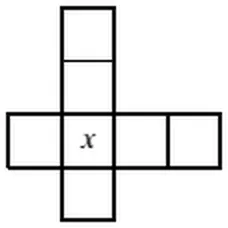
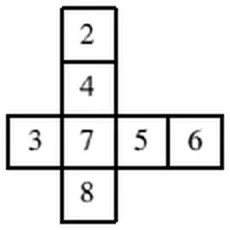
18. The numbers 2, 3, 4, 5, 6, 7, 8 are to be placed, one per square, in the diagram shown such that the four numbers in the horizontal row add up to 21 and the four numbers in the vertical column also add up to 21. Which number should replace \(x\) ?
Note that the number which replaces \(x\) appears in both the row and the column. Adding the numbers in the row and the column gives \(2 + 3 + 4 + 5 + 6 + 7 + 8 + x = 2 \times 21 = 42\). So \(35 + x = 42\) and hence \(x = 7\). The diagram shows one way in which the task may be accomplished.
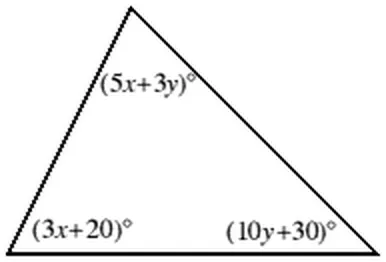
25. The interior angles of a triangle are \((5x + 3y)^\circ\), \((3x + 20)^\circ\) and \((10y + 30)^\circ\) where \(x\), \(y\) are positive integers. What is the value of \(x + y\)?
The sum of the interior angles of a triangle is 180°. Therefore \(5x + 3y + 3x + 20 + 10y + 30 = 180\), i.e. \(8x + 13y = 130\). As \(x\) and \(y\) are both positive integers, it may be deduced that \(x\) is a multiple of 13. Also, since \(y \geqslant 1, x \leqslant \dfrac{117}{8}\) so the only possible value of \(x\) is 13. If \(x = 13\) then \(y = 2\), so \(x + y = 15\).
16. The pupils in Year 8 are holding a mock election. A candidate receiving more votes than any other wins. The four candidates receive 83 votes between them. What is the smallest number of votes the winner could receive?
The smallest possible number of votes the winner could receive corresponds to the situation in which the numbers of votes received by each of the candidates are as close together as possible. As 83 ÷ 4 = 20.75, at least one of the candidates receives 21 votes or more. However, it is not possible for the winner to receive 21 votes, since there are still 62 votes to be allocated which makes it impossible for each of the other three candidates to receive fewer than 21 votes. So the winner must receive more than 21 votes. If the numbers of votes received by the candidates are 22, 21, 20, 20 then there is a winner and, therefore, 22 is the smallest number of votes the winner could receive.
22. Last week Evariste and Sophie both bought some stamps for their collections. Each stamp Evariste bought cost him £1.10, whilst Sophie paid 70p for each of her stamps. Between them they spent exactly £10. How many stamps did they buy in total?
Let the numbers of stamps bought by Evariste and Sophie be \(x\) and \(y\) respectively. Then \(1.1x + 0.7y = 10\), that is \(11x + 7y = 100\). As 100 has remainder 2 when divided by 7, we need a multiple of 11 which is two more than a multiple of 7. The multiples of 11 less than 100 are 11, 22, 33, 44, 55, 66, 77, 88, 99. Of these only 44 is two more than a multiple of 7. So the only positive integer solutions of the Diophantine equation \(11x + 7y = 100\) are \(x = 4\),\(y = 8\). Therefore Evariste buys 4 stamps, costing £4.40, and Sophie buys 8 stamps, costing £5.60.
12. Sir Lance has a lot of tables and chairs in his house. Each rectangular table seats eight people and each round table seats five people. What is the smallest number of tables he will need to use to seat 35 guests and himself, without any of the seating around these tables remaining unoccupied?
There are 36 people to be seated so at least five tables will be required. The number of circular tables must be even. However, five rectangular tables will seat 40 people and three rectangular and two circular will seat 34. So at least six tables are needed. Two rectangular and four circular tables do seat 36 people: so six is the minimum number of tables.
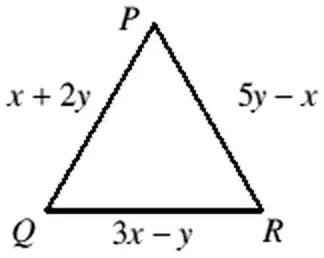
As triangle PQR is equilateral, \(x + 2y = 3x - y = 5y - x\). Equating any two of these expressions gives \(2x = 3y\). The only pair of given values which does not satisfy this equation is \(x = 10\),\(y = 6\).
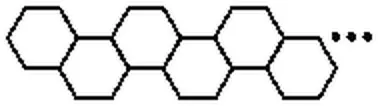
21. A shape consisting of a number of regular hexagons is made by continuing to the right the pattern shown in the diagram, with each extra hexagon sharing one side with the preceding one. Each hexagon has a side length of 1 cm. How many hexagons are required for the perimeter of the whole shape to have length 2010 cm?
The first and last hexagons both contribute 5 cm to the perimeter of the pattern. Every other hexagon in the pattern contributes 4 cm to the perimeter. The first and last thus contribute 10 cm, so we need another 2000 ÷ 4 = 500 hexagons. Therefore the total number of hexagons required is 502.
The three-digit number RRR is equal to 111 multiplied by the single digit \(R\). So \(PQPQ \times R = 639027 \div 111 = 5757\). Now PQPQ equals the two-digit number PQ multiplied by 101. So \(PQ \times R = 5757 \div 101 = 57\). The only ways in which 57 may be expressed as the product of a two-digit number and a single digit are 57 × 1 and 19 × 3. So \(P = 5, Q = 7, R = 1\) or \(P = 1, Q = 9, R = 3\). In both cases, \(P + Q + R = 13\).
11. In a sequence of numbers, each term after the first three terms is the sum of the previous three terms. The first three terms are −3, 0, 2. Which is the first term to exceed 100?
Let the ten consecutive integers be \(x - 4, x - 3, x - 2, x - 1, x, x + 1, x + 2, x + 3, x + 4\) and \(x + 5\) respectively. The sum of these is \(10x + 5\) so \(10x + 5 = 5\), that is \(x = 0\). Hence the largest of the integers is 5.
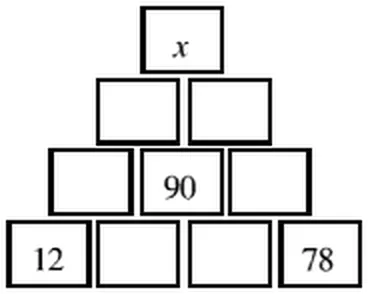
20. In the diagram on the right, the number in each box is obtained by adding the numbers in the two boxes immediately underneath. What is the value of \(x\)?
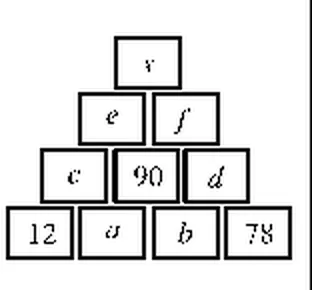
Let the numbers in the boxes be as shown in the diagram. Then \(b = 90 - a\);\(c = 12 + a\);\(d = b + 78 = 168 - a\). Also, \(e = 90 + c = 102 + a\);\(f = 90 + d = 258 - a\). So \(x = e + f = 102 + a + 258 - a = 360\).
23. The currency used on the planet Zog consists of bank notes of a fixed size differing only in colour. Three green notes and eight blue notes are worth 46 zogs; eight green notes and three blue notes are worth 31 zogs. How many zogs are two green notes and three blue notes worth?
Let the value of a green note and the value of a blue note be \(g\) zogs and \(b\) zogs respectively. Then \(3g + 8b = 46\) and \(8g + 3b = 31\). Adding these two equations gives \(11g + 11b = 77\), so \(b + g = 7\). Therefore \(3g + 3b = 21\). Subtracting this equation from the original equations in turn gives \(5b = 25\) and \(5g = 10\) respectively. So \(b = 5\), \(g = 2\) and \(2g + 3b = 19\).
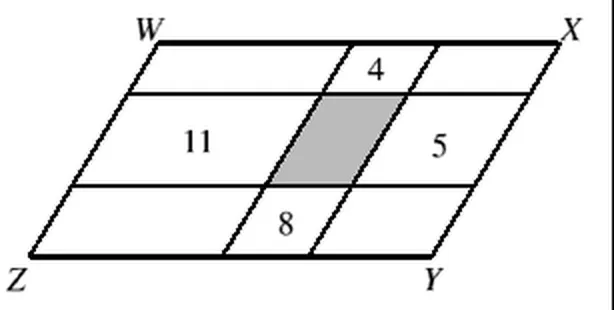
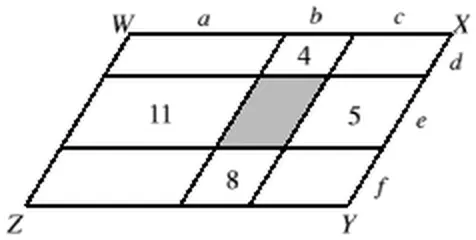
24. The parallelogram WXYZ shown in the diagram on the right has been divided into nine smaller parallelograms. The perimeters, in centimetres, of four of the smaller parallelograms are shown. The perimeter of WXYZ is 21 cm. What is the perimeter of the shaded parallelogram?
Let the lengths \(a, b, c, d, e, f\) be as shown in the diagram. Then the sum of the perimeters of the four labelled parallelograms is \(2(a + e) + 2(b + d) + 2(b + f) + 2(c + e)\) \(= 2(a + b + c + d + e + f) + 2(b + e)\) = perimeter of WXYZ + perimeter of shaded parallelogram. So the perimeter of the shaded parallelogram is \(((11 + 8 + 4 + 5) - 21)\) cm=7 cm.
25. In Miss Quaffley’s class, one third of the pupils bring a teddy bear to school. Last term, each boy took 12 books out of the library, each girl took 17 books and each teddy bear took 9 books. In total, 305 books were taken out. How many girls are there in Miss Quaffley’s class?
Let the number of boys in Miss Quaffley's class be \(b\) and the number of girls be \(g\). Then the number of teddy bears is \(\tfrac{1}{3}(b + g)\). Also, in total, the boys took out \(12b\) library books last term and the girls took out \(17g\) books. The total number of books taken out by the bears was \(9 \times \tfrac{1}{3}(b + g)\) that is \(3(b + g)\). So \(12b + 17g + 3(b + g) = 305\), that is \(15b + 20g = 305\), that is \(3b + 4g = 61\). Clearly, \(b\) and \(g\) are positive integers. The positive integer solutions of the equation \(3b + 4g = 61\) are \(b = 3, g = 13\);\(b = 7, g = 10\);\(b = 11, g = 7\);\(b = 15, g = 4\);\(b = 19, g = 1\). However, there is one further condition: the number of teddy bears, that is \(\tfrac{1}{3}(b + g)\), is also a positive integer and of the five pairs of solutions above, this condition is satisfied only by \(b = 11, g = 7\). Check: the 11 boys take out 132 books, the 7 girls take out 119 books and the 6 teddy bears take out 54 books, giving a total of 305 books. (The equation \(3b + 4g = 61\) in which \(b\) and \(g\) both represent positive integers is an example of a Diophantine equation.)
17. In this Multiplication Magic Square, the product of the three numbers in each row, each column and each of the diagonals is 1. What is the value of \(r + s\)?
18. Granny swears that she is getting younger. She has calculated that she is four times as old as I am now, but remembers that 5 years ago she was five times as old as I was at that time. What is the sum of our ages now?
23. In a 7-digit numerical code each group of four adjacent digits adds to 16 and each group of five adjacent digits adds to 19. What is the sum of all seven digits?
Let the 7-digit code be \(abcdefg\). It may be deduced that \(a = 3\) since \(b + c + d + e = 16\) and \(a + b + c + d + e = 19\). By using similar reasoning, it may be deduced that \(b = c = e = f = g = 3\). As \(a + b + c + d = 16\),\(d = 7\); so the code is 3337333.
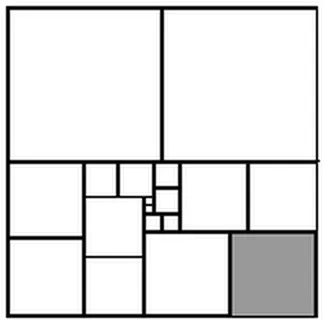
25. A large square is divided into adjacent pairs of smaller squares with integer sides, as shown in the diagram (which is not drawn to scale). Each size of smaller square occurs only twice. The shaded square has sides of length 10. What is the area of the large square?
Let the lengths of the sides of the squares, in increasing order, be \(a, b, c, d, e, f, g, h, i\) respectively. So \(h = 10\). Note that \(c = 2b - a\) and \(d = 2c - 2a = 4b - 4a\). Also, \(e = 2d - a = 8b - 9a\). As \(h = 2e - 2a - b = 15b - 20a\), we may deduce that \(15b - 20a = 10\), that is \(3b - 4a = 2\). Since \(a\) and \(b\) are positive integers less than 10, the only possibilities are \(a = 1\), \(b = 2\) or \(a = 4\),\(b = 6\). However, \(h = 10\) therefore \(b\) cannot be greater than 4. So \(a = 1\) and \(b = 2\). It may now be deduced that \(c = 4 - 1 = 3\);\(d = 8 - 4 = 4\);\(e = 16 - 9 = 7\). Also \(2g = 2e + d\), so \(g = 9\). Now the length of the side of the larger square is \(2h + e + g = 20 + 7 + 9 = 36\), so its area is \(36^2 = 1296\). (Note that it was not necessary to find the values of f and i, but it is now quite simple to deduce that f = 8 and i = 18.)
The hundreds column shows us that \(J = 1\) or 2. [We can't carry more than 2 from the units to the tens; and 2 plus the biggest feasible values 7, 8, 9 for the three letters is only 26.] The units column shows that \(J + M\) is a multiple of 10 and it can't be 0 (or else \(J + M = 0\)); so \(J + M = 10\) and \(M = 9\) or 8 respectively. Also, the sum of the units column is \(10 + C\), so there is exactly 1 to carry to the tens column. The tens column now tells us that \(J + C + 1 = 10J\). So \(J = 2\) is not possible and therefore \(J = 1\), \(C = 8\) and \(M = 9\).
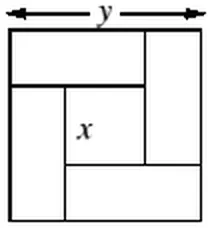
23. The diagram shows a square with sides of length \(y\) divided into a square with sides of length \(x\) and four congruent rectangles. What is the length of the longer side of each rectangle?
Let the length of the longer side of each rectangle be \(l\). Then the length of each shorter side is \(l - x\). So \(y = l + l - x\) and hence \(l = \tfrac{1}{2}(y + x)\).
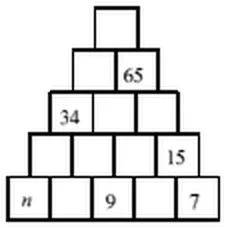
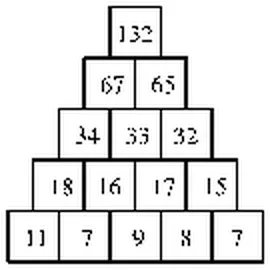
6. Each block shown in this tower is to have a number displayed on it. Some are already done. For each block above the bottom row, the number on it should be the sum of the numbers on the two blocks it stands upon. What number should replace \(n\)?
The completed tower is shown on the right. There is more than one order in which missing numbers may be inserted – and it is not necessary to complete the tower in order to determine \(n\) – but one possible order is 8, 17, 32, 33, 16, 7, 18, 11, 67, 132.
18. In this magic square, which uses all whole numbers from 7 to 15 inclusive, each of the rows, columns and the two main diagonals has the same total. Which number replaces \(n\) in the completed square?
The total of the numbers in the magic square is 7 + 8 + 9 + …15, that is 99. So each row, column and main diagonal has sum 33 and we deduce that the number in the top right hand corner of the square is 12. The remaining blank squares may now be completed in terms of \(n\), as shown. Considering the middle row: \(31 - 2n + 19 - n + 7 = 33\), so \(n = 8\). Alternate solution: it is known that the number in the centre of a magic square is always equal to the mean of the nine numbers making up the square, in this case 11. So \(n = 33 - 14 - 11 = 8\).
24. Amrita has written down four whole numbers. If she chooses three of her numbers at a time and adds up each triple, she obtains totals of 115, 153, 169 and 181. What is the largest of Amrita's numbers?
The total of the four triples is three times the total of the original four numbers. So these numbers have sum (115 + 153 + 169 + 181) ÷ 3, that is 206. Hence the largest of Amrita's numbers is 206 − 115, that is 91.
The subtraction shows the number \(10a + b\) subtracted from the number \(10b + a\). Their difference is \(9b - 9a\). So \(9(b - a)\) has unit digit 6 and must therefore have value 36 since this is the only two-digit multiple of 9 which ends in 6. So \(c\) is 3. Note that the values of \(a\) and \(b\) are not unique. Provided that \(b - a\) is 4, the difference of the two numbers will be 36, for example 51 − 15 = 36; 62 − 26 = 36; 73 − 37 = 36 etc.
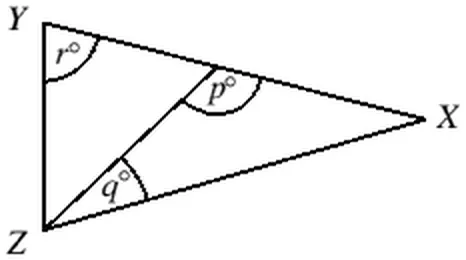
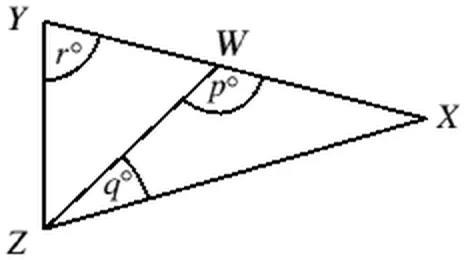
As \(XY = XZ\),\(\angle XZY = \angle XYZ\), so \(\angle YZW = r^\circ - q^\circ\). In a triangle, an exterior angle is equal to the sum of the two interior opposite angles. Applying this theorem to triangle \(ZYW\): \(\angle ZWX = \angle YZW + \angle ZYW\), that is \(p = (r - q) + r\). So \(2r = p + q\).
9. The Bean family are very particular about beans. At every meal all Beans eat some beans. Pa Bean always eats more beans than Ma Bean but never eats more than half the beans. Ma Bean always eats the same number of beans as both children together and the two children always eat the same number of beans as each other. At their last meal they ate 23 beans altogether. How many beans did Pa Bean eat?
Pa Bean does not eat more than half the beans, so he eats at most 11 beans. Ma Bean eats the same number of beans as both children together, so she eats an even number of beans which is at least one quarter of the total number of beans eaten. Therefore she eats at least 6 beans. If she does eat 6 beans, then Pa Bean eats 11 beans, which is consistent with the information given. However, if Ma Bean eats 8 or more beans, then Pa Bean eats at most 7 beans and this is impossible as we are told that Pa Bean eats more beans than Ma Bean. So Pa Bean eats 11 beans.
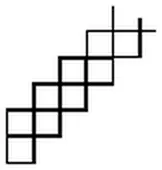
18. A shape consisting of 2004 small squares is made by continuing the pattern shown in the diagram. The small squares have sides of length 1 cm. What is the length, in cm, of the perimeter of the whole shape?
Each of the 2004 squares, apart from those at the top and bottom of the shape, contributes 2 cm to the perimeter of the figure. The other two squares contribute 3 cm each, so the perimeter is (2002 × 2 + 2 × 3) cm = 4010 cm.
From the three equations we see that \((abc)^2 = 2 \times 24 \times 3 = 144\) and so, since \(abc\) is positive, \(abc = 12\). Then the third equation tells us that \(a = \tfrac{1}{2}\), the second that \(b = 4\) and the first that \(c = 6\). Therefore \(a + b + c = 10\tfrac{1}{2}\).
Consider the thousands column. The letters represent different digits so, as \(S\) is 3, \(M\) is 2 and there is a carry of 1 from the hundreds column. Therefore \(A\) is 9, \(U\) is 0 and there is also a carry of 1 from the tens column. In the units column, \(O + Y\) produces a units digit of 3, so \(O + Y = 3\) or \(O + Y = 13\). However, \(O + Y = 3\) requires one of \(O\), \(Y\) to equal zero (impossible as \(U = 0\)) or 2 (also impossible as \(M = 2\)). So \(O + Y = 13\). We can also deduce that \(N\) is 8, since, in the tens column, 1 + 3 + \(N\) = 12. The pairs of digits which produce a sum of 13 are 4 and 9, 5 and 8, 6 and 7. As \(A\) is 9 and \(N\) is 8, the only possible values for \(O\) and \(Y\) are 6 and 7. These are interchangeable, but in both cases \(Y \times O = 42\).
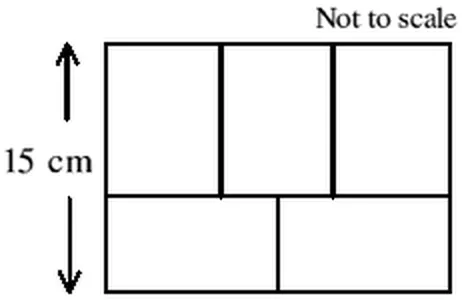
Let the length and breadth of each of the rectangles be \(a\) cm and \(b\) cm respectively. Then \(2a = 3b\) and \(a + b = 15\). So \(2a + 2b = 30\). Therefore \(3b + 2b = 30\), that is \(b = 6\). So the total area covered by the five rectangles is that of a rectangle measuring 18 cm by 15 cm, i.e. 270 cm2.
25. In a sequence of positive integers, every term after the first two terms is the sum of the two previous terms in the sequence. If the fifth term is 2004, what is the maximum possible value of the first term?
Let the first two terms of the sequence be \(a\) and \(b\) respectively. Then the next three terms are \(a + b\),\(a + 2b\),\(2a + 3b\). So \(2a + 3b = 2004\). For \(a\) to be as large as possible, we need \(b\) to be as small as possible, consistent with their both being positive integers. If \(b = 1\) then \(2a = 2001\), but \(a\) is an integer, so \(b \neq 1\). However, if \(b = 2\) then \(2a = 1998\), so the maximum possible value of \(a\) is 999.
We'd like to use Google Analytics cookies to count visits and see which pages help most. They're optional, and the site works exactly the same either way. Privacy policy