The whole Junior Mathematical Challenge 2010 paper, one question at a time in order (25 questions). Press Mark as done after each one: your marks add up below.
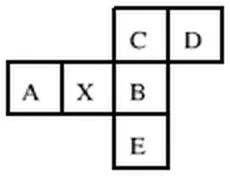
Let X be on the top face of the cube. If the base is placed on a horizontal surface, then A, B, C, E will all be on vertical faces of the cube and D will be on the base, opposite X.
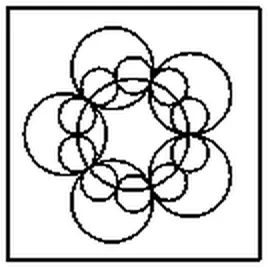
5. The diagram shows a pattern of 16 circles inside a square. The central circle passes through the points where the other circles touch. The circles divide the square into regions. How many regions are there?
Each of the five outer circles is divided into six regions, giving 30 regions in total. In addition, there is one region in the centre of the diagram and one region between the circles and the sides of the square. So, in all, there are 32 regions.
7. Mr Owens wants to keep the students quiet during a Mathematics lesson. He asks them to multiply all the numbers from 1 to 99 together and then tell him the last-but-one digit of the result. What is the correct answer?
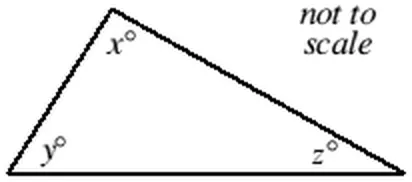
If the mean of \(y\) and \(z\) is \(x\), then \(y + z = 2x\). So the sum of the interior angles of the triangle is \((x + y + z)^\circ = 3x^\circ\). So \(3x = 180\), that is \(x = 60\).
One year is, at most, 366 days, so one-third of a year is less than 125 days. No month is longer than 31 days, so 4 months is also less than 125 days, as is 17.5 weeks which equals 122.5 days. However 3002 hours equals 125 days 2 hours, so this is the longest of the five periods of time.
10. At the Marldon Apple-Pie-Fayre bake-off, prize money is awarded for 1st, 2nd and 3rd places in the ratio 3 : 2 : 1. Last year Mrs Keat and Mr Jewell shared third prize equally. What fraction of the total prize money did Mrs Keat receive?
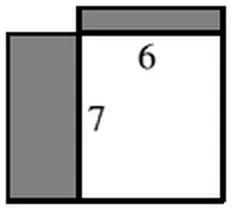
11. In the diagram shown, all the angles are right angles and all the sides are of length 1 unit, 2 units or 3 units. What, in square units, is the area of the shaded region?
Divide the whole figure into horizontal strips of height 1 unit: its area is (3 + 6 + 8 + 8 + 8 + 6 + 3) units2 = 42 units2. Similarly, the unshaded area is (1 + 4 + 6 + 4 + 1) units2 = 16 units2. So the shaded area is 26 units2. Alternative solution: notice that if the inner polygon is moved a little, the answer remains the same – because it is just the difference between the areas of the two polygons. So, although we are not told it, we may assume that the inner one is so positioned that the outer shaded area can be split neatly into 1 by 1 squares – and there are 26 of these.
12. Sir Lance has a lot of tables and chairs in his house. Each rectangular table seats eight people and each round table seats five people. What is the smallest number of tables he will need to use to seat 35 guests and himself, without any of the seating around these tables remaining unoccupied?
There are 36 people to be seated so at least five tables will be required. The number of circular tables must be even. However, five rectangular tables will seat 40 people and three rectangular and two circular will seat 34. So at least six tables are needed. Two rectangular and four circular tables do seat 36 people: so six is the minimum number of tables.
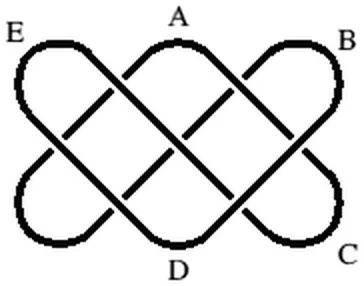
13. The diagram shows a Lusona, a sand picture of the Tshokwe people from the West Central Bantu area of Africa. To draw a Lusona the artist uses a stick to draw a single line in the sand, starting and ending in the same place without lifting the stick in between. At which point could this Lusona have started?
It is necessary to find a route for which the line is broken the first time it passes through any intersection and solid when it passes through that intersection for the second time. Only the route which starts at B and heads away from D satisfies this condition.
The average number of vehicles per day \(\approx \dfrac{300\,000\,000}{44 \times 365} \approx \dfrac{300\,000\,000}{40 \times 400}\) \(= \dfrac{300\,000\,000}{16\,000} \approx \dfrac{300\,000\,000}{15\,000} = 20\,000.\)
16. One of the examination papers for Amy’s Advanced Arithmetic Award was worth 18% of the final total. The maximum possible mark on this paper was 108 marks. How many marks were available overall?
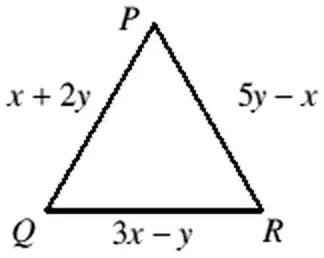
As triangle PQR is equilateral, \(x + 2y = 3x - y = 5y - x\). Equating any two of these expressions gives \(2x = 3y\). The only pair of given values which does not satisfy this equation is \(x = 10\),\(y = 6\).
18. Sam's 101st birthday is tomorrow. So Sam's age in years changes from a square number (100) to a prime number (101). How many times has this happened before in Sam's lifetime?
The other times that this has happened previously are when Sam's age in years went from 1 to 2; from 4 to 5; from 16 to 17 and from 36 to 37. Note that since primes other than 2 are odd, the only squares which need to be checked, other than 1, are of even numbers.
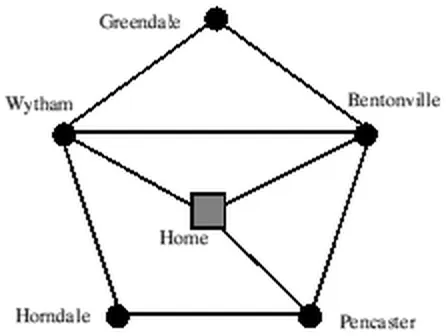
19. Pat needs to travel down every one of the roads shown at least once, starting and finishing at home. What is the smallest number of the five villages that Pat will have to visit more than once?
Villages which have more than two roads leading to them (or from them) must all be visited more than once as a single visit will involve at most two roads. So Bentonville, Pencaster and Wytham must all be visited more than once. The route Home, Bentonville, Greendale, Wytham, Bentonville, Pencaster, Home, Wytham, Horndale, Pencaster, Home starts and finishes at Home and visits both Greendale and Horndale exactly once so the minimum number of villages is three.
The seven numbers must total 49 if their mean is to be 7. The largest possible number will occur when the other six numbers are as small as possible, that is 1, 2, 3, 4, 5, 6. So the required number is 49 − 21 = 28.
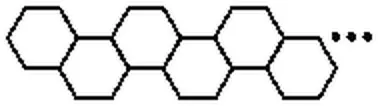
21. A shape consisting of a number of regular hexagons is made by continuing to the right the pattern shown in the diagram, with each extra hexagon sharing one side with the preceding one. Each hexagon has a side length of 1 cm. How many hexagons are required for the perimeter of the whole shape to have length 2010 cm?
The first and last hexagons both contribute 5 cm to the perimeter of the pattern. Every other hexagon in the pattern contributes 4 cm to the perimeter. The first and last thus contribute 10 cm, so we need another 2000 ÷ 4 = 500 hexagons. Therefore the total number of hexagons required is 502.
22. Kiran writes down six different prime numbers, \(p\),\(q\),\(r\),\(s\),\(t\),\(u\), all less than 20, such that \(p + q = r + s = t + u\). What is the value of \(p + q\)?
The prime numbers less than 20 are 2, 3, 5, 7, 11, 13, 17, 19. It is not possible for 2 to be one of the six numbers Kiran wrote down, since that would give one of the pairs an odd sum, whereas both of the other pairs would add up to an even number. The sum of the remaining 7 primes is 75 which is a multiple of 3. The sum of the six primes making up the three pairs must also be a multiple of 3 since each pair has the same total. So the odd prime not used in the six pairs must be a multiple of 3 too. Therefore 3 is the odd prime not used. So each pair totals 72 ÷ 3, that is 24, and the pairs are 5 + 19, 7 + 17, 11 + 13.
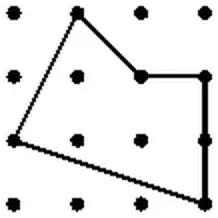
23. A single polygon is made by joining dots in the 4 × 4 grid with straight lines, which meet only at dots at their end points. No dot is at more than one corner. The diagram shows a five-sided polygon formed in this way. What is the greatest possible number of sides of a polygon formed by joining the dots using these same rules?
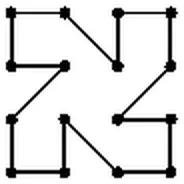
The number of sides of the polygon is equal to the number of corners it has. As no dot is at more than one corner, the maximum number of corners is 16. So the maximum possible number of sides is 16, provided that a 16-sided figure may be drawn. The figure on the right shows one of several ways in which this can be achieved.
24. The year 2010 belongs to a special sequence of twenty-five consecutive years: each number from 1988 to 2012 contains a repeated digit. Each of the following belongs to a sequence of consecutive years, where each number in the sequence contains at least one repeated digit. Which of them belongs to the next such sequence of at least twenty years?
In the 21st Century, to obtain a sequence of two years or more then either a 2 or a 0 must be repeated in each year, or the sequence include years such as 2011, 2033, 2044 etc. So the only sequence after that mentioned in the question will be from 2020 to 2030, but this is too short. In the 22nd Century, either a 2 or a 1 must be repeated. The first such sequence is 2110 to 2129 which does include 20 years, one of which is 2120.
The three-digit number RRR is equal to 111 multiplied by the single digit \(R\). So \(PQPQ \times R = 639027 \div 111 = 5757\). Now PQPQ equals the two-digit number PQ multiplied by 101. So \(PQ \times R = 5757 \div 101 = 57\). The only ways in which 57 may be expressed as the product of a two-digit number and a single digit are 57 × 1 and 19 × 3. So \(P = 5, Q = 7, R = 1\) or \(P = 1, Q = 9, R = 3\). In both cases, \(P + Q + R = 13\).
We'd like to use Google Analytics cookies to count visits and see which pages help most. They're optional, and the site works exactly the same either way. Privacy policy