The whole Junior Mathematical Challenge 2013 paper, one question at a time in order (25 questions). Press Mark as done after each one: your marks add up below.
All of the alternatives involve subtracting a number from 1. The largest result, therefore, will correspond to the smallest number to be subtracted, i.e. 0.00001.
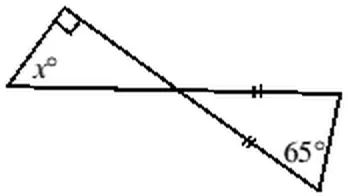
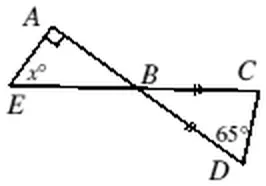
Triangle BCD is isosceles, so \(\angle BCD = \angle BDC = 65^\circ\). The sum of the interior angles of a triangle is 180° so \(\angle CBD = (180 - 2 \times 65)^\circ = 50^\circ\). Therefore \(\angle ABE = 50^\circ\) (vertically opposite angles). So \(\angle AEB = (180 - 90 - 50)^\circ = 40^\circ\).
Distance travelled = average speed × time of travel, so Gill travelled between 15 km and 20 km. Of the alternatives given, only 19 km lies in this interval.
7. After tennis training, Andy collects twice as many balls as Roger and five more than Maria. They collect 35 balls in total. How many balls does Andy collect?
Let the number of balls collected by Roger be \(x\). Then Andy collects \(2x\) balls and Maria collects \((2x - 5)\) balls. So \(x + 2x + 2x - 5 = 35\), i.e. \(5x = 40\), i.e. \(x = 8\). So Andy collected 16 balls.
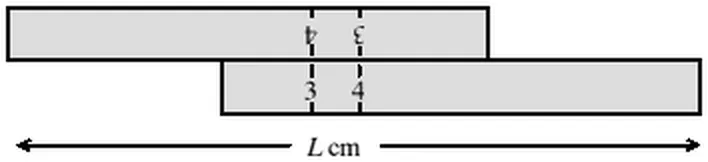
8. Two identical rulers are placed together, as shown (not to scale). Each ruler is exactly 10 cm long and is marked in centimetres from 0 to 10. The 3 cm mark on each ruler is aligned with the 4 cm mark on the other.
The overall length is \(L\) cm. What is the value of \(L\)?
The number 3 on the top ruler (which is 7cm from the left-hand end) aligns with the 4 on the bottom one (which is 6cm from the right-hand end). Thus \(L = 7 + 6 = 13\).
9. Peter has three times as many sisters as brothers. His sister Louise has twice as many sisters as brothers. How many children are there in the family?
Let there be \(b\) boys and \(g\) girls in the family. Then Peter has \(g\) sisters and \((b - 1)\) brothers. So \(g = 3(b - 1)\). Louise has \((g - 1)\) sisters and \(b\) brothers. So \(g - 1 = 2b\). Therefore \(2b + 1 = 3b - 3\), i.e. \(b = 4\). So \(g = 9\). Therefore there are 4 boys and 9 girls in the family, i.e. 13 children in total.
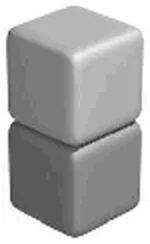
10. On standard dice the total number of pips on each pair of opposite faces is 7. Two standard dice are placed in a stack, as shown, so that the total number of pips on the two touching faces is 5. What is the total number of pips on the top and bottom faces of the stack?
The top and bottom faces of the stack and the two touching faces form two pairs of opposite faces. So the total number of pips on these four faces is 2 × 7 = 14. Therefore the total number of pips on the top and bottom faces of the stack is 14 − 5 = 9.
11. Usain runs twice as fast as his mum. His mum runs five times as fast as his pet tortoise, Turbo. They all set off together for a run down the same straight path. When Usain has run 100 m, how far apart are his mum and Turbo the tortoise?
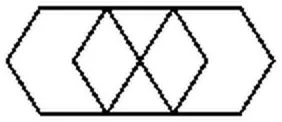
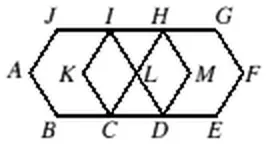
Figure ABEFGJ itself is a hexagon. There are three hexagons congruent to ABCLIJ; two hexagons congruent to ABDMHJ; four hexagons congruent to ABCKIJ; two hexagons congruent to ABDLHJ. So in total there are twelve hexagons.
13. When painting the lounge, I used half of a 3 litre can to complete the first coat of paint. I then used two thirds of what was left to complete the second coat. How much paint was left after both coats were complete?
After the first coat, half of the paint is left. So after the second coat, the volume of paint remaining is one third of half of the capacity of the tin, i.e. one sixth of three litres = 500 ml.
14. Each side of an isosceles triangle is a whole number of centimetres. Its perimeter has length 20 cm. How many possibilities are there for the lengths of its sides?
Let the two equal sides of the isosceles triangle have length \(a\) and the other side have length \(b\). Then \(2a + b = 20\). Since the sum of the lengths of any two sides of a triangle is greater than the length of the third, \(2a > b\). Hence \(4a > 2a + b\). So \(4a > 20\), i.e. \(a > 5\). Also \(a < 10\) since \(2a + b = 20\). So the possibilities are \(a = 6, b = 8\);\(a = 7, b = 6\);\(a = 8, b = 4\); and \(a = 9, b = 2\).
15. The Grand Old Duke of York had 10 000 men. He lost 10% of them on the way to the top of the hill, and he lost 15% of the rest as he marched them back down the hill. What percentage of the 10 000 men were still there when they reached the bottom of the hill?
When he starts to come down the hill, the Grand Old Duke of York has 90% of his men left. He loses 15% of these, so at the bottom of the hill he has 85% of 90% of the original number left. As \(\dfrac{85}{100} \times 90 = 76\dfrac{1}{2}\), this means that \(76\tfrac{1}{2}\)% of his men were still there when they reached the bottom of the hill.
The sum of the ages of the four children is 12 + 14 + 15 + 15 = 56. Each year on their birthday, this sum increases by 4. So the number of years before the sum reaches 100 is (100 − 56) ÷ 4 = 11. Therefore their ages will first total 100 in 2024.
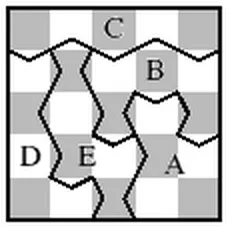
17. A 5 cm × 5 cm square is cut into five pieces, as shown. Each cut is a sequence of identical copies of the same shape but pointing up, down, left or right. Which piece has the longest perimeter?
Let \(x\) cm be the length of the shape. Although \(x\) is not given, it is clear that \(x > 1\). The lengths, in cm, of the perimeters of pieces \(A\),\(B\),\(C\),\(D\), \(E\) are \(4 + 6x\),\(2 + 10x\),\(7 + 5x\),\(6 + 6x\), \(1 + 11x\) respectively. As \(4 + 6x < 6 + 6x\), the piece with the longest perimeter is \(B\),\(C\), \(D\) or \(E\). As \(x > 1\), it may be deduced that \(7 + 5x < 6 + 6x < 2 + 10x < 1 + 11x\), so \(E\) has the longest perimeter.
18. Weighing the baby at the clinic was a problem. The baby would not keep still and caused the scales to wobble. So I held the baby and stood on the scales while the nurse read off 78 kg. Then the nurse held the baby while I read off 69 kg. Finally I held the nurse while the baby read off 137 kg. What was the combined weight of all three ?
A 142 kg
B 147 kg
C 206 kg
D 215 kg
E 284 kg
(This problem appeared in the first Schools' Mathematical Challenge in 1988 – 25 years ago.)
Let the weights, in kg, of baby, nurse and me be \(x\),\(y\), \(z\) respectively. Then \(x + z = 78\);\(x + y = 69\);\(y + z = 137\). Adding all three equations gives \(2x + 2y + 2z = 284\), so \(x + y + z = 284 \div 2 = 142\). (To find the combined weight, it is not necessary to find the individual weights, but baby weighs 5kg, nurse weighs 64 kg and I weigh 73 kg.)
19. A swimming club has three categories of members: junior, senior, veteran. The ratio of junior to senior members is 3 : 2 and the ratio of senior members to veterans is 5 : 2. Which of the following could be the total number of members in the swimming club?
For every 2 senior members in the swimming club there are 3 junior members. For every 5 senior members there are 2 veteran members. The lowest common multiple of 2 and 5 is 10, so it may be deduced that the number of senior members is a multiple of 10. For every 10 senior members in the swimming club there are 15 junior members and 4 veteran members. So the total number of members is a multiple of 29. Of the alternatives given, the only multiple of 29 is 58.
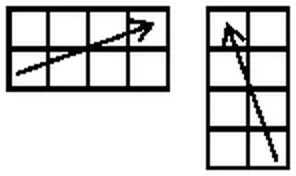
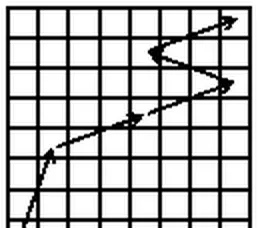
20. A ‘long knight’ moves on a square grid. A single move, as shown, consists of moving three squares in one direction (horizontally or vertically) and then one square at right angles to the first direction. What is the smallest number of moves a long knight requires to go from one corner of an 8 × 8 square board to the diagonally opposite corner?
The ‘long knight’ needs to move exactly seven squares to the right and exactly seven squares upwards. Although it is possible to move seven squares to the right in three moves (1, 3 and 3), in doing so it could move upwards by a maximum of five squares (3, 1 and 1). Similarly, it could move seven squares upwards in three moves, but could then move a maximum of five squares to the right. In four moves, the number of squares moved to the right must be even, since it is the sum of four odd numbers. So at least five moves are required and the diagram shows one way in which the task may be achieved in five moves.
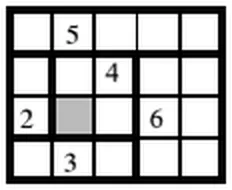
21. The 5 × 4 grid is divided into blocks. Each block is a square or a rectangle and contains the number of cells indicated by the integer within it. Which integer will be in the same block as the shaded cell?
As 5 is a prime number, it must lie in a 5 × 1 rectangle. So the only possibility is the rectangle which covers the top row of the grid. Now consider 6: there is insufficient room for a 6 × 1 rectangle so it must lie in a 3 × 2 rectangle. There are only two such rectangles which include 6 but do not include either 4 or 3. If 6 comes in the middle of the top row of a 2 × 3 rectangle then there is space for a 3 × 1 rectangle including 3. But then there is not enough space for a rectangle including 4. So 6 must be placed in the rectangle shown. There is now insufficient room to place 4 in a 4 × 1 rectangle so it must lie in the 2 × 2 square shown, which includes the shaded square. This leaves the grid to be completed as shown.
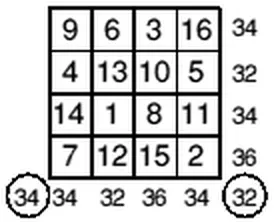
22. Two numbers in the 4 × 4 grid can be swapped to create a Magic Square (in which all rows, all columns and both main diagonals add to the same total). What is the sum of these two numbers?
The diagram shows the totals of the rows and columns. The circled numbers are the total of the numbers in the two main diagonals. Note, by considering the average values of the rows and columns, that each should total 34. Row 2 and column 2 are both 2 short. So their common entry, 13, needs to increase by 2. So 13 must be interchanged with 15. (This change also reduces row 4 and column 3 by 2 and increases the main diagonal by 2, thus making all the sums equal 34 as desired.) So the sum of the numbers to be swapped is 28.
23. In our school netball league a team gains a certain whole number of points if it wins a game, a lower whole number of points if it draws a game and no points if it loses a game. After 10 games my team has won 7 games, drawn 3 and gained 44 points. My sister's team has won 5 games, drawn 2 and lost 3. How many points has her team gained?
Let the points awarded for a win and a draw be \(w\) and \(d\) respectively. Then \(7w + 3d = 44\). The only positive integer solutions of this equation are \(w = 2\), \(d = 10\) and \(w = 5, d = 3\). However, more points are awarded for a win than for a draw so we deduce that 5 points are awarded for a win and 3 points for a draw. So the number of points gained by my sister's team is 5 × 5 + 2 × 3 = 31.
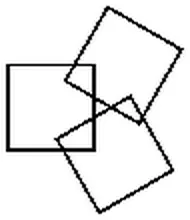
24. Three congruent squares overlap as shown. The areas of the three overlapping sections are 2 cm2, 5 cm2 and 8 cm2 respectively. The total area of the non-overlapping parts of the squares is 117 cm2. What is the side-length of each square?
Each of the overlapping areas contributes to the area of exactly two squares. So the total area of the three squares is equal to the area of the non-overlapping parts of the squares plus twice the total of the three overlapping areas i.e. (117 + 2(2 + 5 + 8)) cm2 = (117 + 30) cm2 = 147 cm2. So the area of each square is (147 ÷ 3) cm2 = 49 cm2. Therefore the length of the side of each square is 7 cm.
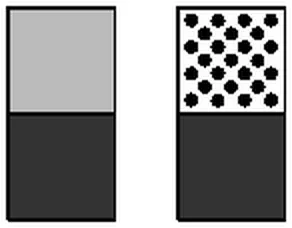
25. For Beatrix's latest art installation, she has fixed a 2 × 2 square sheet of steel to a wall. She has two 1 × 2 magnetic tiles, both of which she attaches to the steel sheet, in any orientation, so that none of the sheet is visible and the line separating the two tiles cannot be seen. As shown alongside, one tile has one black cell and one grey cell; the other tile has one black cell and one spotted cell. How many different looking 2 × 2 installations can Beatrix obtain?
By arranging the tiles in suitable positions it is possible to place the 1 × 1 spotted square in any one of four corners of the steel sheet and then to place the grey square in any one of the other three corners. The other two corners will then be occupied by black squares. So, in total, there are 4 × 3 = 12 different looking installations.)
We'd like to use Google Analytics cookies to count visits and see which pages help most. They're optional, and the site works exactly the same either way. Privacy policy


 shape. Although \(x\) is not given, it is clear that