The whole Junior Mathematical Challenge 2016 paper, one question at a time in order (25 questions). Press Mark as done after each one: your marks add up below.
4. In January 1859, an eight-year-old boy dropped a newly-hatched eel into a well in Sweden (apparently in order to keep the water free of insects). The eel, named Åle, finally died in August 2014. How many years old was Åle when it died?
There are 41 years from January 1859 to January 1900 and a further 114 years to January 2014. So, since Åle died in August 2014, its age in years when it died was 41 + 114 = 155.
6. Gill is now 28 years old and is a teacher of Mathematics at a school which has 600 pupils. There are 30 more girls than boys at the school. How many girls are at Gill's school?
Let there be \(g\) girls in Gill's school. Then there are \((g - 30)\) boys at the school. So \(g + g - 30 = 600\). Therefore \(2g = 630\), that is \(g = 315\).
9. One of the three symbols +, −, × is inserted somewhere between the digits of 2016 to give a new number. For example, 20 − 16 gives 4. How many of the following four numbers can be obtained in this way?
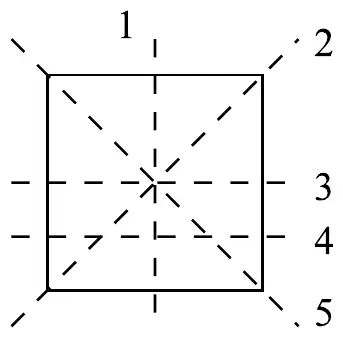
When a square is folded exactly in half, the shape obtained is a rectangle or a right-angled isosceles triangle. So to determine which of the given shapes can be obtained from a second fold we need to test which shapes form a rectangle or a right-angled isosceles triangle when joined with the image formed when the shape is reflected about an edge. Of the options given, only D does not do this. Of the others, shape A is formed by using fold line 1 first, followed by fold line 3. For shape B the fold lines are 3 followed by 4. For shapes C and E, which are similar, the fold lines are 2 followed by 5.
A number is divisible by 4 if and only if its last two digits are divisible by 4. Since 34 is not divisible by 4, we deduce that 1234 is not a multiple of 4. Of the other options, 12 is even and so is a multiple of 2; the sum of the digits of 123 is 6, which is a multiple of 3, so 123 is a multiple of 3; 12 345 has a units digit of 5 and so is a multiple of 5. Finally, 123 456 is even and has a digit sum of 21, a multiple of 3. So 123 456 is a multiple of 2 and of 3 and is therefore a multiple of 6.
12. The musical Rent contains a song that starts ‘Five hundred and twenty five thousand six hundred minutes’. Which of the following is closest to this length of time?
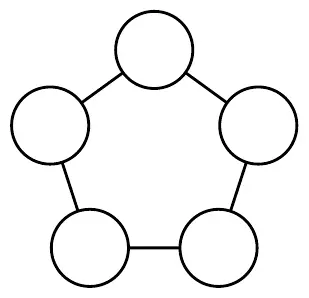
13. The diagram shows five circles placed at the corners of a pentagon. The numbers 1, 2, 3, 4, 5 are placed in the circles shown, one in each, so that the numbers in adjacent circles always differ by more than 1. What is the sum of the numbers in the two circles adjacent to the circle which contains the number 5?
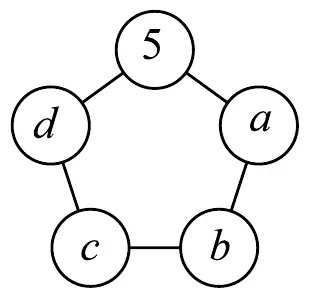
The position of the 5 is immaterial to the question asked, so let it be placed in the top circle. Now 4 differs by 1 from 5 so neither \(a\) nor \(d\) equals 4. Therefore either \(b = 4\) or \(c = 4\). It doesn't matter which it is, because the answer will be symmetric. So let \(b = 4\). Since 3 differs by 1 from 4, neither \(a\) nor \(c\) can be 3, so \(d = 3\). This leaves us with 1 and 2 to place. As 2 cannot be next to 3, \(c \neq 2\) so \(c = 1\) and \(a = 2\). Therefore the sum of the numbers in the two circles adjacent to the circle containing 5 is 3 + 2 = 5.
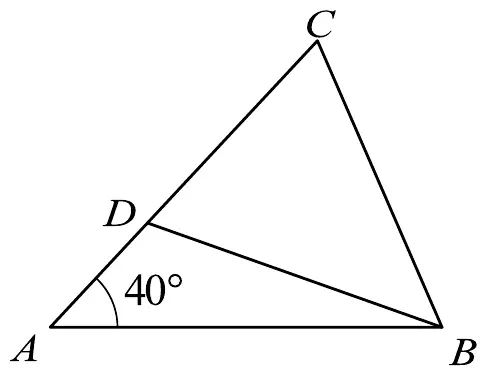
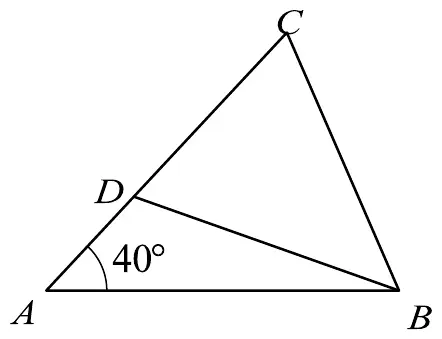
As \(AB = AC\), triangle \(ABC\) is isosceles. So \(\angle ABC = \angle ACB = \tfrac{1}{2}(180° - 40°) = 70°\) as \(\angle BAC = 40°\) and the angle sum of a triangle is 180°. Triangle \(BCD\) is also isosceles as \(BD = BC\), so \(\angle BDC = \angle BCD = 70°\). Considering triangle \(ABD\): \(\angle BDC = \angle DAB + \angle ABD\) as an exterior angle of a triangle is equal to the sum of the two interior opposite angles. So \(\angle ABD = \angle BDC - \angle DAB = 70° - 40° = 30°\).
All four expressions are perfect squares: \(1^3 + 2^3 = 1 + 8 = 9 = 3^2\);\(1^3 + 2^3 + 3^3 = 1 + 8 + 27 = 36 = 6^2\);\(1^3 + 2^3 + 3^3 + 4^3 = 1 + 8 + 27 + 64 = 100 = 10^2\);\(1^3 + 2^3 + 3^3 + 4^3 + 5^3 = 1 + 8 + 27 + 64 + 125 = 225 = 15^2\). (It is not a coincidence that all four expressions are squares: the sum of the cubes of the first n integers is equal to the square of the sum of the first n integers for all positive integers n. For example: \(1^3 = 1^2\);\(1^3 + 2^3 = (1 + 2)^2\);\(1^3 + 2^3 + 3^3 = (1 + 2 + 3)^2\); \(1^3 + 2^3 + 3^3 + 4^3 = (1 + 2 + 3 + 4)^2\) etc.)
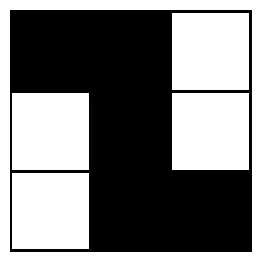
16. Each of the nine small squares in this grid can be coloured completely black or completely white. What is the largest number of squares that can be coloured black so that the design created has rotational symmetry of order 2, but no lines of symmetry?
We imagine all the squares being black and consider changing as few as possible to white in order to satisfy the conditions required. First note that the colour of the centre square has no effect on the symmetries involved. So we will leave that black. If we change one corner to white, the opposite corner must also be changed to white to give the rotational symmetry. The diagram still has reflective symmetry. If you instead try changing a non-corner square to white, the opposite one must be. And you again have reflective symmetry. That shows we need to change more than two squares. The rotational symmetry means that the next possiblity is to change 4 squares to white. And the diagram shown shows that it is possible, with four white squares, to have rotational but not reflective symmetry. That means that, in the problem as stated, the maximum number of black squares is 5.
Initially there are 48 children of whom \(\tfrac{3}{8}\) are boys and \(\tfrac{5}{8}\) are girls, so there are 18 boys and 30 girls. When more boys join, there are still 30 girls but now they form \(\tfrac{3}{8}\) of the total. So the total number of pupils is now \(\tfrac{8}{3} \times 30 = 80\), of whom 80 − 30 = 50 are boys. Hence the number of boys joining is 50 − 18 = 32.
First note that when two numbers are added together the only possible carry from any column is 1. Now, looking at the tens column of the sum, we see that \(E + E\) leaves a total of \(E\) in the column. Since \(E\) is non-zero, the only way that this can happen is that there is a carry of 1 from the units column. So we have \(1 + E + E = 10 + E\), so \(1 + E = 10\), that is \(E = 9\). Looking at the units column we see that \(E + E = 18\), so \(S = 8\) and there is a carry of 1 to the tens column. The addition sum may now be solved: 899 + 899 = 1798. So \(X = 7\).
19. Three boxes under my stairs contain apples or pears or both. Each box contains the same number of pieces of fruit. The first box contains all twelve of the apples and one-ninth of the pears. How many pieces of fruit are there in each box?
Let \(p\) be the total number of pears. Then \(12 + \dfrac{p}{9} = \dfrac{1}{2}\left(p - \dfrac{p}{9}\right) = \dfrac{4p}{9}\). So \(12 = \tfrac{3p}{9} = \tfrac{p}{3}\). Therefore \(p = 3 \times 12 = 36\). So the number of pieces of fruit in each box is \(\tfrac{12 + 36}{3} = 16\).
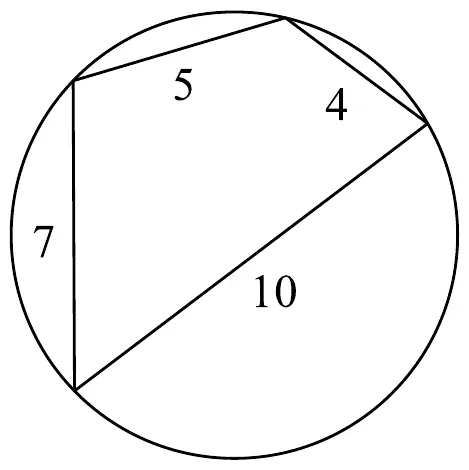
20. A cyclic quadrilateral has all four vertices on the circumference of a circle. Brahmagupta (598–670AD) gave the following formula for the area, \(A\), of a cyclic quadrilateral whose edges have lengths \(a\),\(b\),\(c\),\(d\): \(A = \sqrt{(s - a)(s - b)(s - c)(s - d)}\), where \(s\) is half of the perimeter of the quadrilateral. What is the area of the cyclic quadrilateral with sides of length 4 cm, 5 cm, 7 cm and 10 cm?
The length of \(s\), half the perimeter of the cyclic quadrilateral, is \(\tfrac{1}{2}(4 + 5 + 7 + 10)\) cm = 13 cm. So the required area, in cm2, is \(\sqrt{(13 - 4)(13 - 5)(13 - 7)(13 - 10)} = \sqrt{9 \times 8 \times 6 \times 3} = \sqrt{9 \times 144} = 3 \times 12 = 36\).
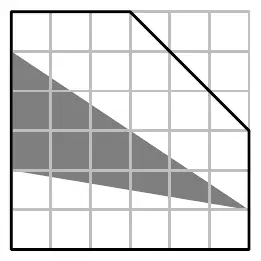
21. The diagram shows a pentagon drawn on a square grid. All vertices of the pentagon and triangle are grid points. What fraction of the area of the pentagon is shaded?
The area of the shaded triangle is \(\tfrac{1}{2} \times 3 \times 6 = 9\). The area of the square grid is 6 × 6 = 36, and the area of the triangle which is not part of the area of the pentagon is \(\tfrac{1}{2} \times 3 \times 3 = \tfrac{9}{2}\). So the area of the pentagon is \(36 - \tfrac{9}{2} = \tfrac{63}{2}\). Hence the required fraction is \(9 \div \tfrac{63}{2} = 9 \times \tfrac{2}{63} = \tfrac{2}{7}\).
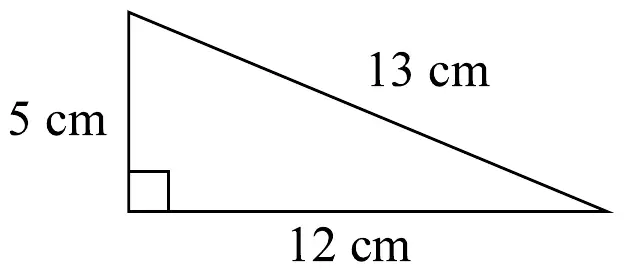
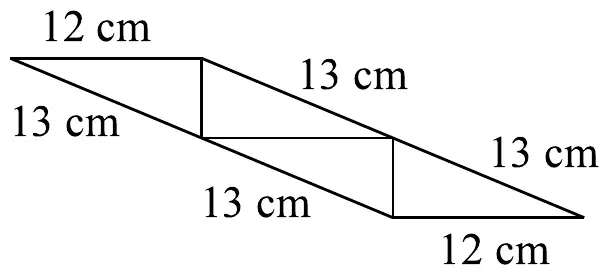
22. Four copies of the triangle shown are joined together, without gaps or overlaps, to make a parallelogram. What is the largest possible perimeter of the parallelogram?
In order to join the four triangles together it is required to join together at least three pairs of edges, which consequently are not part of the perimeter of the resulting parallelogram. The four triangles have a total of 12 edges, so the maximum number of edges which can be part of the perimeter of the parallelogram is 12 − 3 × 2 = 6. For the perimeter to be as large as possible, all four 13 cm edges should be included together with two of the 12 cm edges, if this is possible. The diagram shows how it may be accomplished. So the largest possible perimeter is (4 × 13 + 2 × 12) cm = 76 cm.
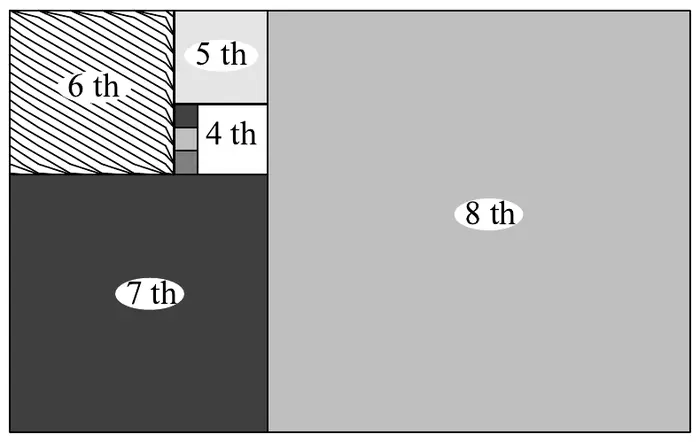
23. The diagram shows the first few squares of a ‘spiral’ sequence of squares. All but the first three squares have been numbered. After the first six squares, the sequence is continued by placing the next square alongside three existing squares – the largest existing square and two others. The three smallest squares have sides of length 1. What is the side length of the 12th square?
Note first that the fourth square has side length 3, the fifth square has side length 4 and the sixth square has side length 7. As described in the question, the seventh square is placed alongside the sixth square, the fourth square and one of the first three unit squares. However, it may be seen that the side length of the seventh square is equal to the sum of the side lengths of the fifth and sixth squares, which is 4 + 7 = 11. Similarly, the eighth square is placed along the fourth, fifth and seventh squares, but its side length is the sum of the side lengths of the sixth and seventh squares, which is 7 + 11 = 18. The spiral sequence continues in the same way and therefore the side length of any subsequent square may be calculated by adding together the side lengths of the two previous squares in the sequence. So from the fourth square onwards the side lengths of the squares are 3, 4, 7, 11, 18, 29, 47, 76, 123, …. Hence the side length of the twelfth square is 123. (All of the positive integers in the sequence from the side length of the fourth square onwards are members of the sequence of Lucas numbers − a Fibonacci sequence with first term 2 and second term 1.)
24. Part of a wall is to be decorated with a row of four square tiles. Three different colours of tiles are available and there are at least two tiles of each colour available. Tiles of all three colours must be used. In how many ways can the row of four tiles be chosen?
First note that as there are four tiles to be placed and all three colours must be used, every arrangement of tiles consists of two of one colour and one each of the other two colours. Let the colours be R, G and B and consider the arrangements in which there are two tiles of colour R. These two tiles may be placed in six different ways: RR**, R*R*, R**R, *RR*, *R*R and **RR. For each of these arrangements of R tiles, there are two possible ways of placing the remaining G tile and B tile − the G tile may go in the first remaining space or the second remaining space and then there remains only one space for the B tile. So the number of arrangements in which there are two R tiles is 2 × 6 = 12. By the same reasoning, we see that there are 12 different arrangements in which there are two G tiles and 12 different arrangements in which there are two B tiles. So the total number of different arrangements is 3 × 12 = 36.
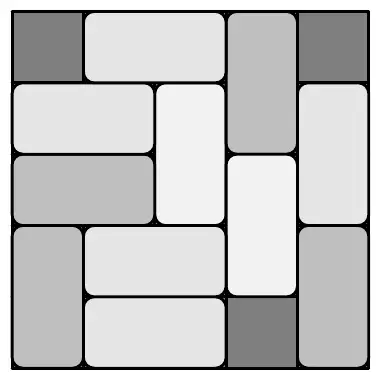
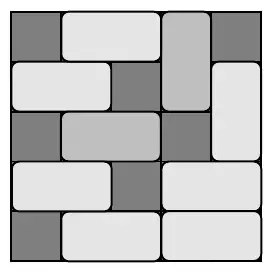
25. Beatrix places dominoes on a 5 × 5 board, either horizontally or vertically, so that each domino covers two small squares. She stops when she cannot place another domino, as in the example shown in the diagram. When Beatrix stops, what is the largest possible number of squares that may still be uncovered?
First note that there are 25 squares on the board. As each domino occupies two squares, the number of squares left uncovered must be odd. The diagram on the right shows that it is possible for Beatrix to place the dominoes so that there are seven uncovered spaces when it is not possible for her to place any more dominoes. Of the options given, it is not possible to obtain eight uncovered spaces as the number of them must be odd and it has been shown that seven uncovered spaces is possible so the correct answer is seven. (For a proof that it is not possible to obtain more than seven uncovered spaces, please see the extended solutions on the UKMT website.)
We'd like to use Google Analytics cookies to count visits and see which pages help most. They're optional, and the site works exactly the same either way. Privacy policy