The whole Junior Mathematical Challenge 2017 paper, one question at a time in order (25 questions). Press Mark as done after each one: your marks add up below.
2. Nadiya is baking a cake. The recipe says that her cake should be baked in the oven for 1 hour and 35 minutes. She puts the cake in the oven at 11:40 am. At what time should she take the cake out of the oven?
Nadiya puts her cake into the oven at 11:40 am. So 20 minutes later, it will be 12:00. Then, there will still be 1 hour and 15 minutes before the cake is due to be taken out of the oven. So she should take her cake out at 1:15 pm.
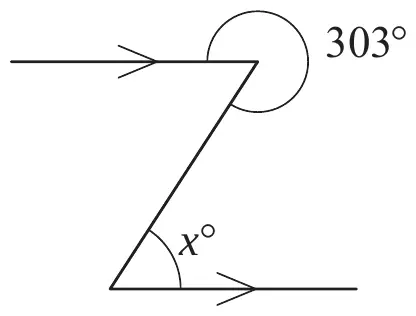
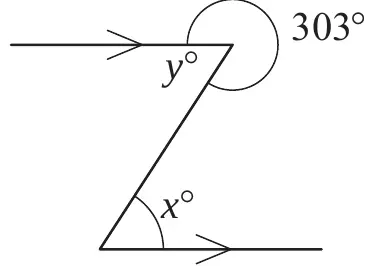
The angles which meet at a point sum to 360°, so \(y = 360 - 303 = 57\). As the marked lines are parallel, the angles marked \(x°\) and \(y°\) are equal (alternate angles). So \(x = y = 57\).
6. In a magic square, the numbers in each row, each column and the two main diagonals have the same total. This magic square uses the integers 2 to 10. Which of the following are the missing cells?
Let the total of each row, column and both diagonals be \(T\). Note that 2 + 3 + 4 + 5 + 6 + 7 + 8 + 9 + 10 = 54. Therefore \(3T = 54\), that is \(T = 18\). It is clear that option D is the only option which makes each row, each column and both diagonals sum to 18.
The values of the options are: A \(\tfrac{22}{15} = 1\tfrac{7}{15}\); B \(\tfrac{8}{15}\); C \(\tfrac{11}{4} = 2\tfrac{3}{4}\); D \(\tfrac{5}{6}\); E \(\tfrac{15}{8} = 1\tfrac{7}{8}\). In ascending order these are: \(\tfrac{8}{15}\);\(\tfrac{5}{6}\);\(1\tfrac{7}{15}\);\(1\tfrac{7}{8}\);\(2\tfrac{3}{4}\).
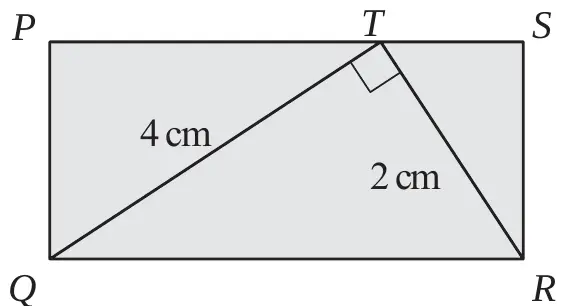
8. The diagram shows a rectangle \(PQRS\) and \(T\) is a point on \(PS\) such that \(QT\) is perpendicular to \(RT\). The length of \(QT\) is 4 cm. The length of \(RT\) is 2 cm.
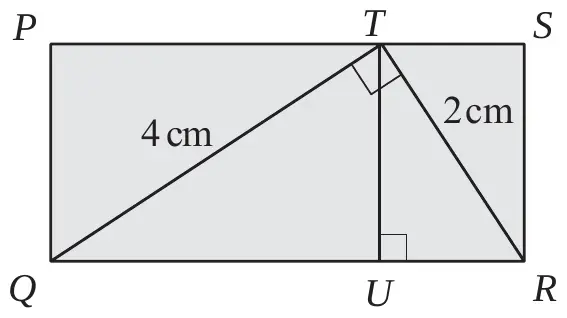
In the diagram, \(U\) is the foot of the perpendicular from \(T\) to \(QR\). The area of rectangle \(PQRS = QR \times TU\). The area of triangle \(QTR\) is \(\tfrac{1}{2} \times QR \times TU\). So the area of rectangle \(PQRS\) is equal to 2 × area of triangle \(QTR = 2 \times \left(\tfrac{1}{2} \times 2 \times 4\right)\) cm2 = 8 cm2.
9. In William Shakespeare's play As You Like It, Rosalind speaks to Orlando about “He that will divide a minute into a thousand parts”. Which of the following is equal to the number of seconds in one thousandth of one minute?
Note that 45 = 5 × 9. As 5 and 9 are coprime, a positive integer is a multiple of 45 if and only if it is a multiple of both 5 and 9. The units digit of all five options is 5, so they are all multiples of 5. An integer is a multiple of 9 if and only if the sum of its digits is also a multiple of 9. The sums of the digits of the five options is 18, 18, 18, 18 and 8. So 305 is the only one of the options which is not a multiple of 9 and hence is not a multiple of 45.
11. Seven squares are drawn on the sides of a heptagon so that they are outside the heptagon, as shown in the diagram. What is the sum of the seven marked angles?
In the diagram, each of the seven vertices of the heptagon has four angles meeting at it. This makes 28 angles in total. These comprise the seven marked angles, fourteen right angles and the seven interior angles of the heptagon. The sum of the angles meeting at a point is 360° and the sum of the interior angles of the heptagon is (7 − 2) × 180° = 5 × 180°. Therefore, (the sum of the seven marked angles) + 14 × 90° + 5 × 180° = 7 × 360°. So the sum of the seven marked angles is (28 − 14 − 10) × 90° = 4 × 90° = 360°.
12. Last year, at the school where Gill teaches Mathematics, 315 out of the 600 pupils were girls. This year, the number of pupils in the school has increased to 640. The proportion of girls is the same as it was last year. How many girls are there at the school this year?
Last year, the fraction of girls at the school was \(\tfrac{315}{600} = \tfrac{63}{120} = \tfrac{21}{40}\). This year, there are 40 more pupils at the school, but the proportion of girls has remained the same. So there are 21 more girls at the school this year, making a total of 315 + 21 = 336.
13. Consider the following three statements. (i) Doubling a positive number always makes it larger. (ii) Squaring a positive number always makes it larger. (iii) Taking the positive square root of a positive number always makes it smaller. Which statements are true?
Statement (i) is true since \(2x > x\) for all \(x > 0\). Statement (ii) is not true. For example, \(\left(\tfrac{1}{2}\right)^2 = \tfrac{1}{4}\), which is not larger than \(\tfrac{1}{2}\). Statement (iii) is also not true. For example, \(\sqrt{\tfrac{1}{9}} = \tfrac{1}{3}\), which is not smaller than \(\tfrac{1}{9}\).
14. Mathias is given a grid of twelve small squares. He is asked to shade grey exactly four of the small squares so that his grid has two lines of reflection symmetry. How many different grids could he produce?
If any corner square is shaded, then they all must be, and this gives one possible grid. Similarly if any one of \(b\),\(c\),\(j\), \(k\) is shaded then so too are the others. That leaves only all four squares in the middle row, which provides the third and final possible grid.
16. In New Threeland there are three types of coins: the 2p; the 5p; and one other. The smallest number of coins needed to make 13p is three. The smallest number of coins needed to make 19p is three. What is the value of the third type of coin?
Since neither 13 nor 19 is a multiple of 3, one couldn't possibly use three copies of a single coin in either case. If two of the extra coins are used, that would be even, so the third coin would need to be the 5p. That would imply the extra coin would have to be a 4p or a 7p to get 13p or 19p respectively. So two of the extra coin are not used. If only one of the extra coin is used, then it would come in addition to 2p + 2p or 2p + 5p or 5p + 5p. To get 13p, you would need 9p or 6p or 3p respectively; and to get 19p you would need 15p or 12p or 9p respectively. Hence 9p is the only possible extra coin which makes both 13p and 19p possible.
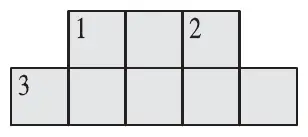
The first five positive powers of 11 are \(11^1 = 11\);\(11^2 = 121\);\(11^3 = 1331\);\(11^4 = 14641\);\(11^5 = 161051\). So 3 across is 14641, since this is the only five-digit power of 11. Therefore the solution to 2 down is a two-digit square with units digit 4 and so is \(8^2 = 64\), as the only other two-digit squares are 16, 25, 36, 49, 81. Hence 1 across is a three-digit cube with units digit 6 and so is \(6^3 = 216\), as the only other three-digit cubes are \(5^3 = 125\),\(7^3 = 343\),\(8^3 = 512\),\(9^3 = 729\). So the sum of the digits in the completed crossnumber is 2 + 1 + 6 + 1 + 4 + 6 + 4 + 1 = 25.
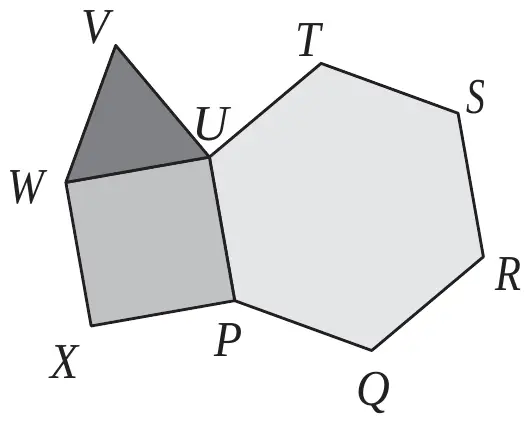
Note that the interior angles of an equilateral triangle, a square and and a regular hexagon are 60°, 90° and 120° respectively. The angles at a point sum to 360°, so \(\angle TUV = 360° - (60° + 90° + 120°) = 90°\) As \(WU\) is common to both equilateral triangle \(UVW\) and square \(PUWX\), the lengths of the sides of \(UVW\) and \(PUWX\) are equal. Similarly, \(UP\) is common to both square \(PUWX\) and regular hexagon \(PQRSTU\), so the lengths of the sides of \(PUWX\) and \(PQRSTU\) are also equal. So \(UV = UP = UT\) and hence triangle \(UTV\) is a right-angled isosceles triangle with \(\angle TVU = \angle VTU\). Therefore \(\angle TVU = (180° - 90°) \div 2 = 45°\).
Since the range is 20 there must be more than one integer in the list. Could we manage with just two integers? If so one would need to be 10 greater than the median of 17 and the other 10 less than 17. This is indeed possible with the list 7, 27. So two is the smallest possible number of integers.
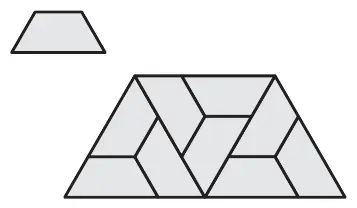
21. The small trapezium on the right has three equal sides and angles of 60° and 120°. Nine copies of this trapezium can be placed together to make a larger version of it, as shown. The larger trapezium has perimeter 18 cm. What is the perimeter of the smaller trapezium?
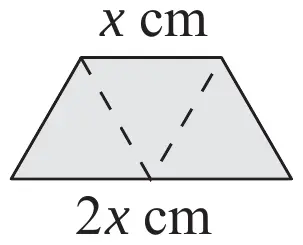
The diagram shows that the small trapezium may be divided into three congruent equilateral triangles. Let the length of each side of the triangles be \(x\) cm. Then the base of the small trapezium is \(2x\) cm. The perimeter of the larger trapezium is made up of five equal line segments each of length \((2x + x)\) cm. So \(15x = 18\). The perimeter of the smaller trapezium is \((x + x + x + 2x)\) cm = \(5x\) cm = \(5 \times \tfrac{18}{15}\) cm = 6 cm. {It is left as an exercise for the reader to prove that the small trapezium may be divided into three congruent equilateral triangles.}
22. In the window of Bradley's Bicycle Bazaar there are some unicycles, some bicycles and some tricycles. Laura sees that there are seven saddles in total, thirteen wheels in total and more bicycles than tricycles. How many unicycles are in the window?
Let the number of unicycles, bicycles and tricycles be \(u\), \(b\) and \(t\) respectively. Then \(u + b + t = 7\)… (1); \(u + 2b + 3t = 13\)… (2); also \(b > t\). (2) − (1): \(b + 2t = 6\)… (3). As \(b\) and \(t\) are both positive integers, the only values of \(b\) and \(t\) which satisfy equation (3) are \(b = 2\), \(t = 2\) and \(b = 4\),\(t = 1\). However, \(b > t\) so the only solution is \(b = 4\),\(t = 1\). Substituting in (1): \(u + 4 + 1 = 7\). So \(u = 2\).
23. The positive integers from 1 to 150 inclusive are placed in a 10 by 15 grid so that each cell contains exactly one integer. Then the multiples of 3 are given a red mark, the multiples of 5 are given a blue mark, and the multiples of 7 are given a green mark. How many cells have more than 1 mark?
As 3 and 5 are coprime, the squares that have more than one mark are multiples of both 3 and 5, (multiples of 15); or multiples of both 3 and 7, (multiples of 21); or multiples of 5 and 7, (multiples of 35); or multiples of 3, 5 and 7, (multiples of 105). However, the latter will be included in all of the first three categories. Between 1 and 150 inclusive, there are ten multiples of 15, seven multiples of 21 and four multiples of 35, making a total of 21 multiples. However, there is one multiple of 3, 5 and 7 between 1 and 150, namely 105. So 105 has been counted three times in those 21 multiples, but corresponds to exactly one marked square. Therefore the total number of marked squares is 21 − 2 = 19.
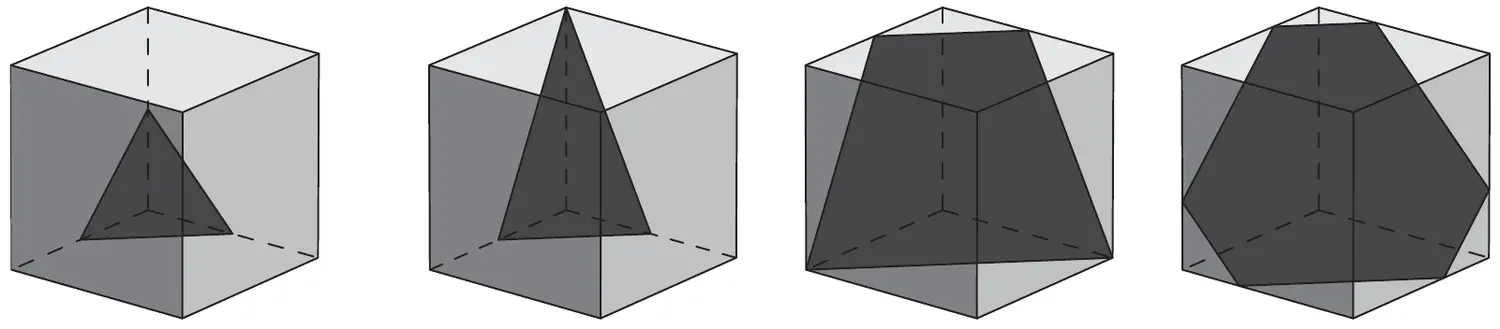
24. A large solid cube is cut into two pieces by a single plane cut. How many of the following four shapes could be the shape of the cross-section formed by the cut?
25. The distance between Exeter and London is 175 miles. Sam left Exeter at 10:00 on Tuesday for London. Morgan left London for Exeter at 13:00 the same day. They travelled on the same road. Up to the time when they met, Sam's average speed was 25 miles per hour, and Morgan's average speed was 35 miles an hour. At what time did Sam and Morgan meet?
Sam left Exeter three hours before Morgan left London, and travelled 3 × 25 miles = 75 miles in the three hours to 13:00. So at 13:00, the distance between Sam and Morgan was (175 − 75) miles = 100 miles. Let the time in hours between 13:00 and the time at which Sam and Morgan met be \(t\). Then \(25t + 35t = 100\). So \(t = \tfrac{100}{60}\) hours = 100 minutes = 1 hour 40 minutes. So Sam and Morgan met at 14:40.
We'd like to use Google Analytics cookies to count visits and see which pages help most. They're optional, and the site works exactly the same either way. Privacy policy