The whole Junior Mathematical Challenge 2018 paper, one question at a time in order (25 questions). Press Mark as done after each one: your marks add up below.
2. A train carriage has 80 seats. On my journey I noticed that all the seats in my carriage were taken and 7 people were standing. At Banbury, 9 people left the carriage, 28 people entered it and all seats were taken. How many people now had no seat?
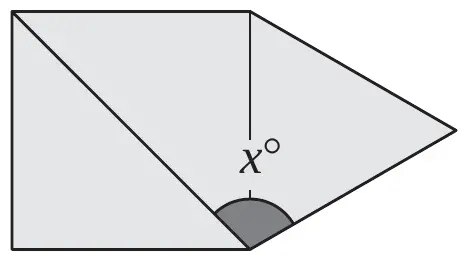
The diagonal of the square is the bisector of a right angle and the interior angle of an equilateral triangle is 60°. Therefore \(x = 90 \div 2 + 60 = 45 + 60 = 105\).
4. The perimeter of the regular decagon \(P\) is 8 times the perimeter of the regular octagon \(Q\). Each edge of the regular octagon \(Q\) is 10 cm long. How long is each edge of the regular decagon \(P\)?
The perimeter of the regular octagon \(Q\) is 8 × 10 cm = 80 cm. So the perimeter of the regular decagon \(P\) is 8 × 80 cm = 640 cm. Therefore the length of each edge of \(P\) is (640 ÷ 10) cm = 64 cm.
The required time is the difference between 06:15 and 08:48. This is a time difference of 2 hours and 33 minutes. So the length of the journey in minutes is 2 × 60 + 33 = 120 + 33 = 153.
6. The diagram shows a partially completed magic square, in which all rows, all columns and both main diagonals have the same total. What is the value of \(x + y\)?
Let the number in the top right corner of the completed magic square be represented by \(z\) and let the total of each row, column and main diagonal be \(T\). So, considering the right-hand column of the square, \(T = x + y + z\). Also, considering the diagonal from bottom left to top right, \(T = 6 + 7 + z\). So \(x + y + z = 6 + 7 + z\). Hence \(x + y = 6 + 7 = 13\).
Note that 20 + 18 = 38 and 20 × 18 = 360. So we need to know the number of integers which are greater than 38 and also less than 360, that is the number of integers from 39 to 359 inclusive. This number is 359 − 39 + 1 = 320 + 1 = 321.
8. Gill scored a goal half way through the second quarter of a ‘teachers versus pupils’ netball match. At that point, what fraction of the whole match remained to be played?
When Gill scored the goal, half of the second quarter of the match remained to be played, plus the third and fourth quarters. So the fraction of the match remaining to be played is equal to \(\dfrac{1}{2} \times \dfrac{1}{4} + \dfrac{1}{4} + \dfrac{1}{4} = \dfrac{1}{8} + \dfrac{1}{2} = \dfrac{5}{8}\).
9. The approximate cost of restoring the Flying Scotsman was £4 million. This was about 500 times the cost of building the steam engine in 1923. Roughly what did the engine cost to build?
10. Adding four of the five fractions \(\dfrac{1}{2}, \dfrac{1}{3}, \dfrac{1}{6}, \dfrac{1}{9}\) and \(\dfrac{1}{18}\) gives a total of 1. Which of the fractions is not used?
The sum of the five given fractions is \(\dfrac{1}{2} + \dfrac{1}{3} + \dfrac{1}{6} + \dfrac{1}{9} + \dfrac{1}{18} = \dfrac{9 + 6 + 3 + 2 + 1}{18}\) \(= \dfrac{21}{18} = \dfrac{7}{6} = 1\dfrac{1}{6}\). So the fraction which is not used is \(\dfrac{1}{6}\).
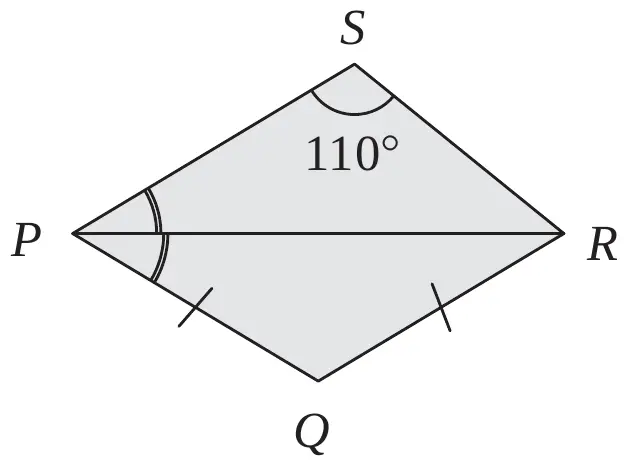
12. The diagram shows a quadrilateral \(PQRS\) in which \(PQ\) and \(QR\) have the same length. Also \(PR\) bisects \(\angle SPQ\), the ratio of \(\angle SPR\) to \(\angle PRS\) is 2 : 3 and \(\angle PSR = 110°\). How large is angle \(PQR\)?
The sum of the interior angles of a triangle equals 180°. So, as \(\angle PSR = 110°\),\(\angle SPR + \angle PRS = 70°\). Therefore \(\angle SPR = \tfrac{2}{5} \times 70° = 28°\). Now \(PR\) bisects \(\angle SPQ\), so \(\angle QPR = \angle SPR = 28°\). In triangle \(PQR\), we know that \(PQ = QR\) so \(\angle QRP = \angle QPR = 28°\). Therefore \(\angle PQR = 180° - 2 \times 28° = 124°\).
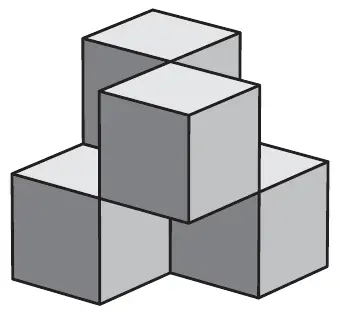
Each of the cubes has six faces all of which are exposed. Therefore the four cubes have a total of 24 faces. Each face measures 3 cm by 3 cm and so has an an area of 9 cm2. Therefore the surface area of the shape is (24 × 9) cm2 = 216 cm2.
14. Billy has three times as many llamas as lambs. Milly has twice as many lambs as llamas. They have 17 animals in total. How many of the animals are llamas?
Let Billy have \(b\) lambs and \(3b\) llamas. Let Milly have \(m\) llamas and \(2m\) lambs. Therefore, as they have 17 animals in total, \(4b + 3m = 17\). The only positive integer solution of this equation is \(b = 2\),\(m = 3\). So the number of llamas is \(3b + m = 3 \times 2 + 3 = 6 + 3 = 9\).
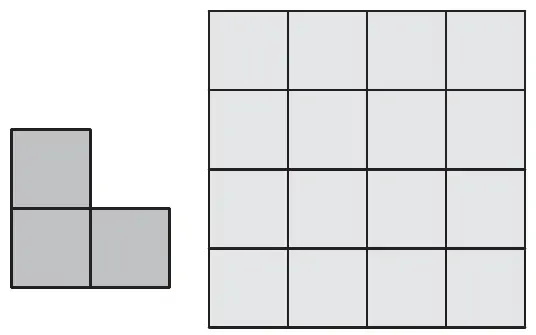
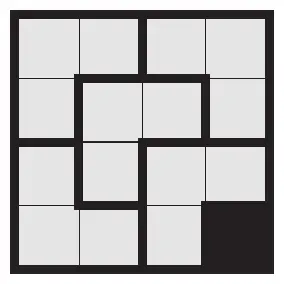
15. Beatrix places copies of the L-shape shown on a 4 × 4 board so that each L-shape covers exactly three cells of the board. She is allowed to turn around or turn over an L-shape. What is the largest number of L-shapes she can place on the board without overlaps?
The diagram shows that it is possible to place five L-shapes on the 4 × 4 board and, as there is now only one unfilled square, the maximum number of L-shapes which may be placed on the board is five.
The prime factorisation of 15 is 3 × 5. Therefore for ‘\(p\)869\(q\)’ to be a multiple of 15, the sum of the digits, \(p + 8 + 6 + 9 + q\), is a multiple of 3 and \(q = 0\) or \(q = 5\). When \(q = 0\), the sum of the digits is \(23 + p\), which is a multiple of 3 when \(p = 1\), 4 or 7. When \(q = 5\), the sum of the digits is \(28 + p\), which is a multiple of 3 when \(p = 2\), 5 or 8. So the possible pairs \((p, q)\) are (1, 0), (4, 0), (7, 0), (2, 5), (5, 5) (8, 5). There are six in all.
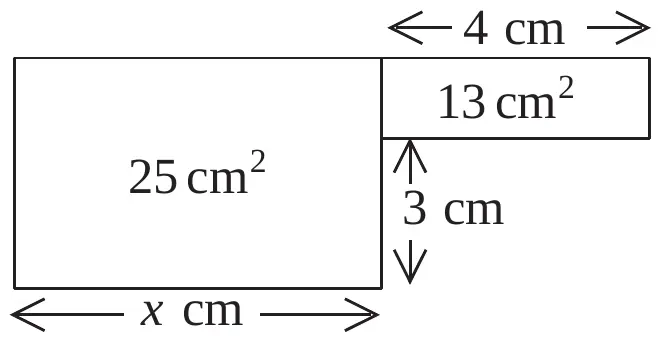
The height of the smaller rectangle is (13 ÷ 4) cm = \(\dfrac{13}{4}\) cm. Therefore the height of the larger rectangle is \(\left(3 + \dfrac{13}{4}\right)\) cm = \(\dfrac{25}{4}\) cm. So, considering the area of the larger rectangle, \(x \times \dfrac{25}{4} = 25\). Therefore \(x = 25 \div \dfrac{25}{4} = 25 \times \dfrac{4}{25} = 4\).
18. Between them, the two five-digit integers \(M\) and \(N\) contain all ten digits from 0 to 9. What is the least possible difference between \(M\) and \(N\)?
The first digits of the two numbers will need to be as close as possible to each other. Since they cannot be equal, they will have to differ by 1; say they are \(n\) and \(n + 1\). The difference between the two numbers will then be minimised by making the four digits after \(n + 1\) as small as possible and the four digits after \(n\) as large as possible. The smallest four-digit number available is 0123 and the largest is 9876. So we need to make \(n = 4\) and then the required diference is 50123 − 49876 = 247.
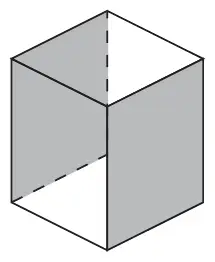
All five options contain four squares. When folded, these four squares form the unshaded faces in the diagram shown. So we need to work out in which of the options the two pairs of isosceles right angles fold together to make the two shaded faces. This happens only in option C.
20. A drawer contains ten identical yellow socks, eight identical blue socks and four identical pink socks. Amrita picks socks from the drawer without looking. What is the smallest number of socks she must pick to be sure that she has at least two pairs of matching socks?
Two matching pairs of socks could be obtained by choosing four socks, but this is not certain. For instance, two of one colour, one of a second colour and one of a third colour could be drawn. Combinations of five chosen socks would give two matching pairs unless three socks of one colour, one of a second colour and one of a third colour were chosen. When this is the case, drawing a sixth sock would guarantee that there would be two matching pairs as there would now be either four socks of one colour plus two other socks or three socks of one colour, two of a second colour plus one of a third colour.
There are already twelve vowels in the box. So the correct answer corresponds to the number which equals \(12 + n\), where \(n\) is the number of vowels in the spelling of the number. The only one of the options for which this is true is ‘fifteen’, which has three vowels and \(15 = 12 + 3\).
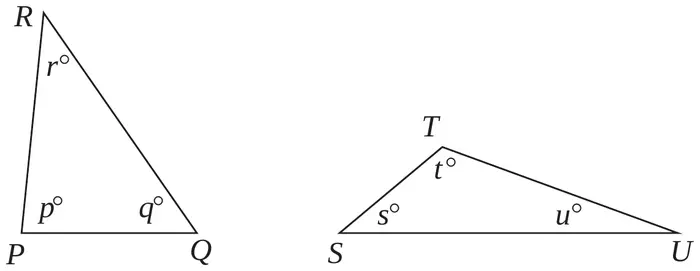
22. In the triangles \(PQR\) and \(STU\),\(\angle RPQ = 2 \times \angle UST\), \(\angle PRQ = 2 \times \angle SUT\) and \(\angle RQP = \dfrac{1}{5} \times \angle UTS\). How large is \(\angle UTS\)?
In the diagram, the sizes in degrees of the angles in triangles \(PQR\) and \(SUT\) are denoted by \(p°, q°, r°, s°, t°, u°\). Therefore \(p = 2s\);\(r = 2u\);\(q = \tfrac{1}{5}t\). Also, as the sum of the interior angles in a triangle is 180°, \(p + q + r = 180\)… (1) and \(s + u + t = 180\)… (2). Substituting for \(p\),\(q\), \(r\) in (1) gives \(2s + \tfrac{1}{5}t + 2u = 180\)… (3). Equation (2) × 2 gives \(2s + 2t + 2u = 360\)… (4). Subtracting (3) from (4) gives, \(2t - \tfrac{1}{5}t = 180\). So \(\dfrac{9t}{5} = 180\), that is \(t = 100\).
23. Ali wants to fill the empty squares so that the number in each square after the fourth from the left is the sum of the numbers in the four squares to its left. What number should Ali write in the final square?
The number in each square after the fourth from the left is the sum of the numbers in the four squares to its left. Therefore, \(s = q + 1 + r + 8\)… (1) and \(8 = 0 + q + 1 + r\)… (2). From (2), \(q + r = 7\). So, from (1), \(s = 7 + 1 + 8 = 16\). So the number which Ali will write in the final square is 16. {It is left an exercise for the reader to calculate the numbers in the other three blank squares.}
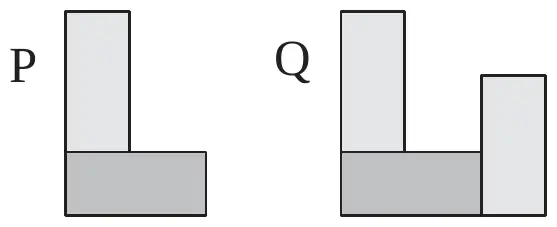
24. The shapes P and Q are formed from two and three identical rectangles, respectively. Their perimeters are 58 cm and 85 cm respectively. What is the perimeter of one of the rectangles?
Let the perimeter of one of the rectangles be \(p\) cm and let the length of one of its shorter sides be \(x\) cm. Before the rectangles in figure \(P\) are joined together, their total perimeter is \(2p\) cm. However, when they are joined together, a length equal to the lengths of two of the shorter sides is ‘lost’ at the join. So the perimeter of shape \(P\), in cm, equals \(2p - 2x\). So \(2p - 2x = 58\)… (1). Similarly, shape \(Q\) consists of three of the rectangles, but there are two joins. So a length equal to the lengths of four of the shorter sides is ‘lost’ at the joins. Therefore, the perimeter of shape \(Q\), in cm, equals \(3p - 4x\). So \(3p - 4x = 85\)… (2). Multiplying equation (1) by 2 and then subtracting equation (2) gives \(4p - 4x - (3p - 4x) = 2 \times 58 - 85\). So \(p = 31\). Therefore the perimeter of one of the rectangles is 31 cm.
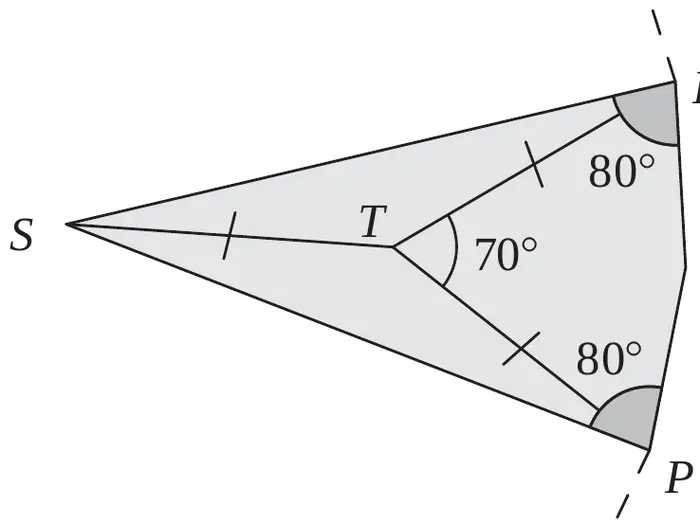
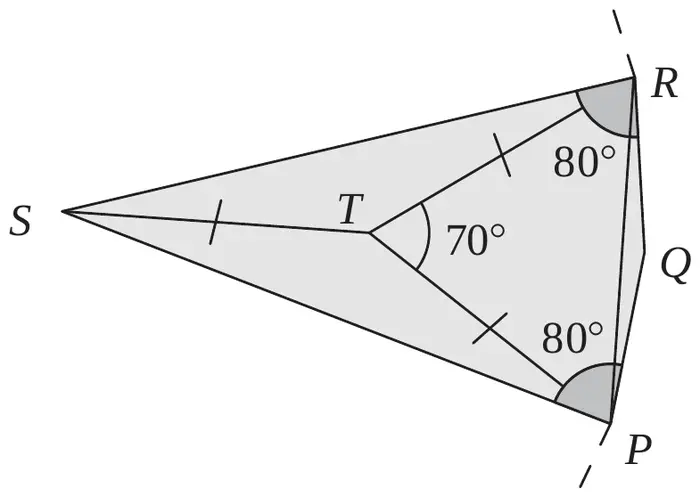
25. In the diagram \(PQ\) and \(QR\) are sides of a regular \(n\)-sided polygon, \(\angle SPQ = \angle SRQ = 80°\), \(\angle PTR = 70°\) and \(PT = ST = RT\). What is the value of \(n\)?
As \(PQ\) and \(QR\) are both sides of a regular polygon, they are equal in length. So \(\angle PRQ = \angle RPQ\) and hence in triangle \(PRS\),\(\angle PRS = \angle RPS\). Therefore triangle \(PRS\) is isosceles with \(RS = PS\). Hence triangles \(RST\) and \(PST\) are congruent (SSS). So \(\angle PTS = \angle RTS = \tfrac{1}{2} \times (360° - 70°) = 145°\). Therefore \(\angle TRS = \angle RST = \tfrac{1}{2} \times (180° - 145°) = 17\tfrac{1}{2}°\). So \(\angle RSP = 35°\). The sum of the angles in the quadrilateral \(SPQR\) is 360° and so \(\angle PQR = 360° - 80° - 80° - 35° = 165°\). Therefore the exterior angle of the regular polygon is \(180° - 165° = 15°\). So \(n = \dfrac{360}{15} = 24\).
We'd like to use Google Analytics cookies to count visits and see which pages help most. They're optional, and the site works exactly the same either way. Privacy policy