
JMC 2018 Q25
25. In the diagram \(PQ\) and \(QR\) are sides of a regular \(n\)-sided polygon, \(\angle SPQ = \angle SRQ = 80°\),
\(\angle PTR = 70°\) and \(PT = ST = RT\).
What is the value of \(n\)?
- A 15
- B 18
- C 20
- D 24
- E 30
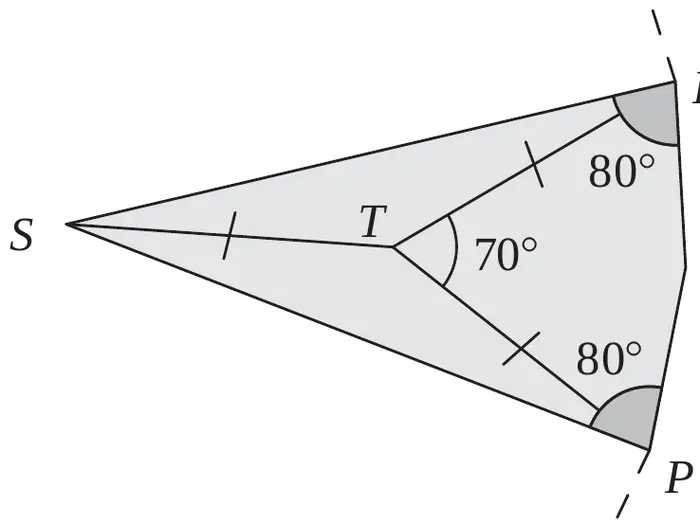
Junior Mathematical Challenge 2018, Question 25. © UK Mathematics Trust. Original paper on ukmt.org.uk
Answer: D 24
As \(PQ\) and \(QR\) are both sides of a regular polygon, they are equal in length. So \(\angle PRQ = \angle RPQ\) and hence in triangle \(PRS\), \(\angle PRS = \angle RPS\). Therefore triangle \(PRS\) is isosceles with \(RS = PS\).
Hence triangles \(RST\) and \(PST\) are congruent (SSS). So \(\angle PTS = \angle RTS = \tfrac{1}{2} \times (360° - 70°) = 145°\). Therefore \(\angle TRS = \angle RST = \tfrac{1}{2} \times (180° - 145°) = 17\tfrac{1}{2}°\).
So \(\angle RSP = 35°\). The sum of the angles in the quadrilateral \(SPQR\) is 360° and so \(\angle PQR = 360° - 80° - 80° - 35° = 165°\). Therefore the exterior angle of the regular polygon is \(180° - 165° = 15°\). So \(n = \dfrac{360}{15} = 24\).
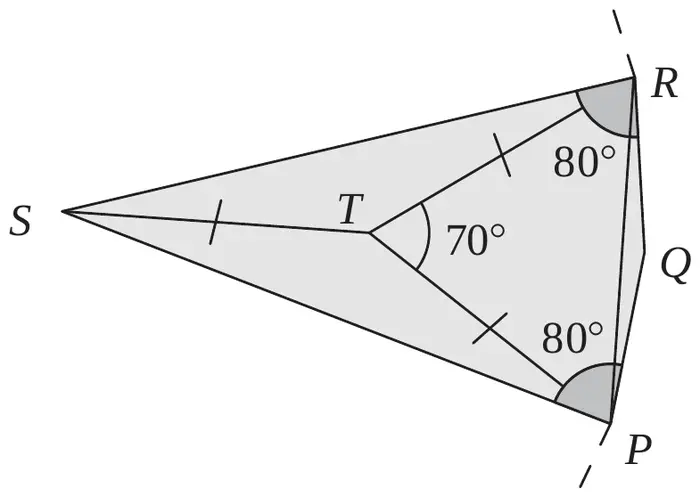
Solution © UK Mathematics Trust, from the JMC 2018 solutions. Longer versions with investigations: Solutions and investigations (PDF).